By Jonathan Photius – The NEO-Historicism Research Project
I. Introduction
Among the many symbolic figures of the Apocalypse, few have generated as much exegetical discussion as the Woman clothed with the sun in Revelation 12:1–17. From the earliest centuries of Christianity, interpreters have recognized that the vision occupies a pivotal place within the structure of the Johannine Apocalypse, linking the Incarnation of Christ with the continuing conflict between the Kingdom of God and the powers of evil until the consummation of history. Yet despite broad agreement concerning the chapter’s theological importance, Orthodox commentators have never spoken with a single voice regarding the precise identity of the Woman herself. Throughout the history of interpretation she has been identified, among other things, as faithful Israel, the Most Holy Theotokos, the Church, or as a figure embracing more than one of these realities simultaneously.¹
Modern scholarship has frequently approached these interpretations as competing hypotheses, often attempting to determine which alone best reflects the intention of the sacred author. Such an approach, however, risks imposing upon the Orthodox exegetical tradition a degree of exclusivity that it has rarely claimed for itself. Byzantine commentators, while differing in emphasis, generally recognized that the symbolic language of the Apocalypse possesses a depth that permits multiple complementary levels of meaning, provided that these remain rooted in the apostolic faith and the Church’s living tradition.² Rather than treating the various interpretations as mutually exclusive alternatives, many Orthodox writers understood them as illuminating different aspects of the same theological mystery.
This breadth of interpretation becomes especially apparent when one surveys the history of Orthodox exegesis from the early Fathers through the Byzantine and post-Byzantine periods. Hippolytus of Rome, Methodius of Olympus, Epiphanius of Salamis, Oecumenius, Andrew of Caesarea, and Arethas each approached the Woman from distinct theological perspectives, emphasizing ecclesiological, Marian, or covenantal dimensions of the vision. Later Orthodox commentators continued to develop these themes, often applying the imagery of Revelation 12 to the historical experience of the Church without abandoning its Christological and ecclesiological foundations. Modern Greek Orthodox scholarship has likewise preserved this diversity through the works of Panagiotis Bratsiotis, Nikolaos Matsoukas, Savvas Agourides, Ioannis Giannakopoulos, Monk Antipas of Patmos, Georgios Kounnousopis, and others, each contributing valuable insights into one of the Apocalypse’s most profound symbols.³
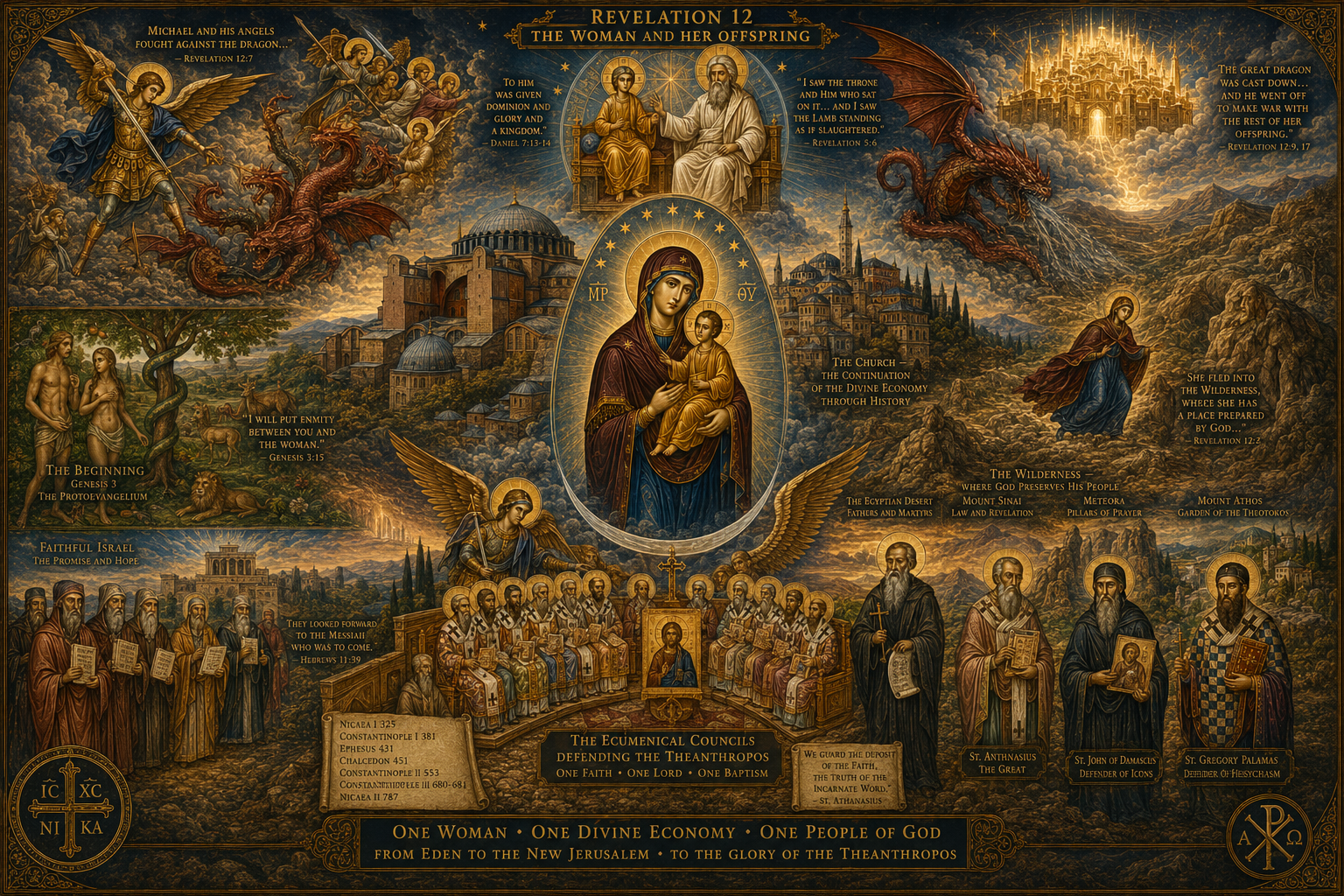
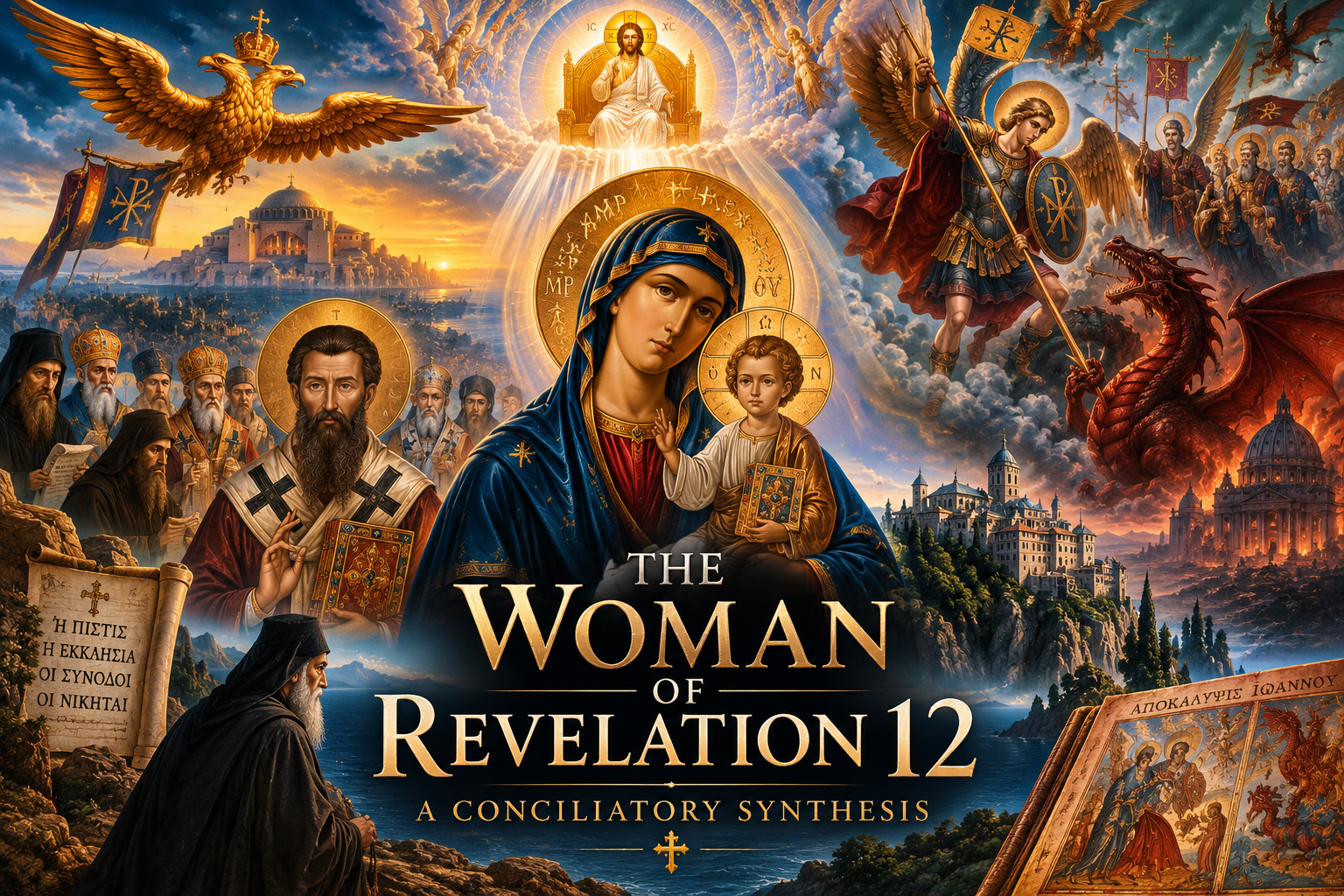
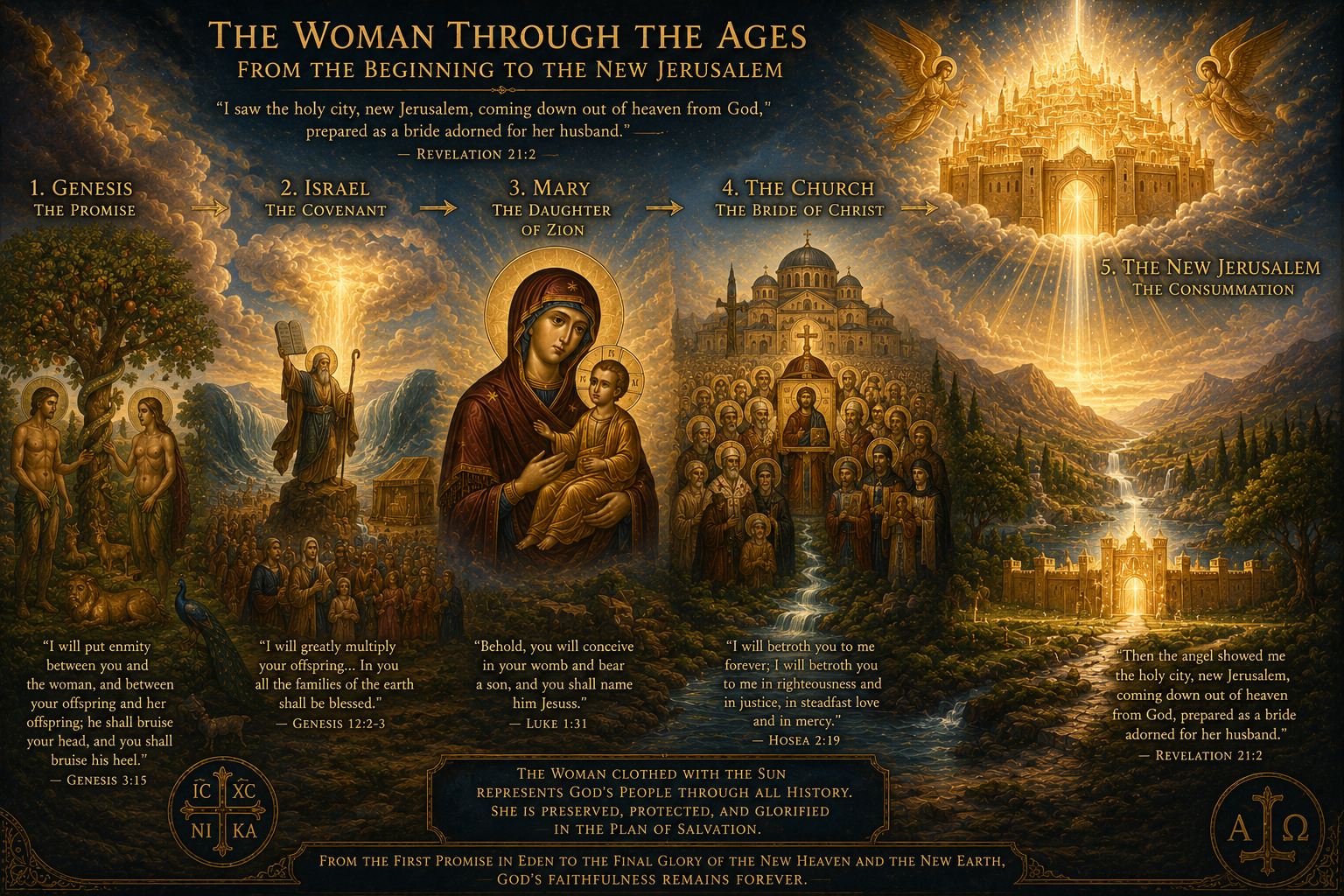
The purpose of the present study is not to advocate a fifth interpretation of the Woman, nor to argue that one patristic tradition should replace the others. Rather, it proposes that the four principal patristic interpretations are best understood as complementary manifestations of a single reality unfolding throughout the Divine Economy. The Apocalypse consistently employs persons, institutions, and events from earlier revelation not merely as historical reminiscences but as theological prototypes that progressively unfold within the life of God’s covenant people. The Woman of Revelation 12 therefore represents a single ecclesiological mystery revealed successively throughout salvation history: prefigured in Eve, anticipated in faithful Israel, personally fulfilled in the Theotokos, historically manifested in the Church, and ultimately consummated in the Bride of Christ, the New Jerusalem.
Such a synthesis also provides a hermeneutical framework for understanding why later Orthodox commentators frequently discerned historical manifestations of Revelation 12 within the continuing life of the Church. Without denying the historical reality of the Incarnation or the original context of the Johannine vision, they recognized that the Apocalypse portrays the unfolding drama of the Divine Economy from creation to the eschaton. Consequently, the imagery of the Woman, the Male Child, the Dragon, the war in heaven, and the wilderness may be understood not only in relation to the first advent of Christ but also as recurring theological patterns manifested throughout the history of the Church. The following study seeks to demonstrate that this conciliatory approach neither diminishes the diversity of the patristic witness nor compromises the integrity of the biblical text, but instead reflects the profoundly typological and ecclesial character of Orthodox exegesis itself.
II. The History of Interpretation
The interpretation of the Woman clothed with the sun has occupied a central place in Orthodox exegesis from the earliest centuries of the Church. Unlike many symbolic figures in the Apocalypse whose meaning remained comparatively stable within the patristic tradition, the Woman of Revelation 12 elicited a remarkable diversity of interpretation. This diversity, however, should not be mistaken for doctrinal disagreement. Rather, it reflects the richness of Johannine symbolism and the willingness of the Fathers to contemplate a single inspired image from multiple theological perspectives. Their concern was not to reduce the vision to a single historical referent but to uncover the fullness of its meaning within the economy of salvation.
One of the most comprehensive modern surveys of this tradition was produced by Stergios N. Sakkos, Emeritus Professor of the Aristotle University of Thessaloniki, in his study The Woman of Revelation 12:1 According to the Interpretation of the First Eight Centuries, presented before the Synod of Orthodox Biblical Theologians at Nicosia in 1991.¹ Sakkos demonstrated that the first eight centuries of Christian interpretation did not produce one universally accepted explanation of the Woman, but rather four principal interpretive traditions. These identified her respectively as the Church, faithful Israel embracing both the Old and New Covenants, the Most Holy Theotokos, and finally as both the Theotokos and the Church simultaneously. Far from representing contradictory schools of thought, these traditions frequently overlap and often complement one another.
The earliest Fathers naturally approached the vision through the theological controversies and pastoral concerns of their own age. Thus, Hippolytus of Rome and Methodius of Olympus emphasized the ecclesiological character of the Woman, seeing in her the persecuted yet victorious Church bringing forth Christ to the nations while enduring the assaults of the Dragon.² Their interpretation arose within an era when the Church herself experienced repeated persecution under the Roman Empire, making the imagery of childbirth, wilderness, and preservation especially meaningful.
Other Fathers, however, approached the passage through the broader history of Divine Revelation. Influenced by the prophetic imagery of Isaiah, Hosea, Ezekiel, and the Song of Songs, they understood the Woman as the covenant community of God extending continuously from the Old Testament into the New. In this interpretation, faithful Israel labors in expectation of the Messiah, and the Church becomes the continuation and fulfillment of that same covenant people rather than a replacement for it.³ Such an interpretation naturally emphasized the continuity of Divine Economy, viewing Revelation not merely as the conclusion of biblical history but as its theological culmination.
A third stream of patristic interpretation focused upon the historical birth of the Messiah. Since the Male Child is explicitly identified as the One “who is to shepherd all nations with a rod of iron” (Rev. 12:5), many Fathers naturally recognized in the Woman the Virgin Mary, the Theotokos, through whom the eternal Word assumed human nature. Epiphanius of Salamis, Oecumenius, and Arethas all gave varying expression to this Marian interpretation, although each did so within the broader Christological framework of the Incarnation rather than as an isolated devotion to the Virgin herself.⁴
Perhaps the most characteristically Orthodox development emerged when Byzantine theologians refused to regard these interpretations as mutually exclusive. Rather than asking whether the Woman was the Church or the Theotokos, they increasingly recognized that she could signify both simultaneously. Mary became understood as the personal embodiment of faithful Israel and at the same time the first and perfect image of the Church. What was accomplished historically and personally in the Mother of God continued mystically and sacramentally in the life of the ecclesial Body. This synthetic approach appears with increasing clarity in Byzantine exegesis and remains influential among modern Orthodox commentators.⁵
The post-Byzantine period witnessed further development without abandoning these patristic foundations. Commentators such as John Lindeos, Anastasios Gordios, Patriarch Anthimos of Jerusalem, Apostolos Makrakis, and Monk Antipas of Patmos continued to identify the Woman primarily with the Church, yet they also began applying the imagery of Revelation 12 to successive periods within ecclesiastical history. Their interpretations increasingly viewed the Apocalypse as revealing not only the historical events surrounding the Incarnation but also the ongoing experience of the Orthodox Church through persecution, doctrinal controversy, and divine preservation.⁶
Modern Greek Orthodox scholarship has largely preserved this same breadth of interpretation. Panagiotis Bratsiotis, Nikolaos Matsoukas, Savvas Agourides, Ioannis Giannakopoulos, and Georgios Kounnousopis each examine the patristic tradition carefully before advancing their own conclusions, generally acknowledging that the Woman possesses a symbolic richness that cannot be exhausted by a single historical identification. Although these scholars differ in emphasis, they collectively demonstrate that contemporary Orthodox interpretation continues to stand firmly within the broader patristic tradition while remaining open to fresh theological reflection.⁷
The diversity preserved within this long history of interpretation presents both a challenge and an opportunity. If each of the four principal patristic interpretations possesses substantial theological legitimacy, then the central question is no longer which interpretation should be accepted to the exclusion of the others. Rather, the question becomes whether the Apocalypse itself provides a theological framework capable of integrating them into a coherent vision of Divine Economy. It is precisely this possibility that the remainder of the present study seeks to explore.
III. Revelation as Progressive Typology: The Biblical Foundations of the Woman
If the preceding survey demonstrates that Orthodox tradition has preserved several legitimate interpretations of the Woman of Revelation 12, the next question necessarily concerns the hermeneutical principles governing these interpretations. Are the various patristic traditions merely independent theological reflections upon the same passage, or does the Apocalypse itself encourage a reading in which a single symbol unfolds progressively throughout the history of salvation? The answer to this question depends not primarily upon later commentators but upon the literary and theological structure of the Johannine Apocalypse itself.
One of the defining characteristics of the Book of Revelation is its remarkable ability to gather together the principal images of earlier revelation and to present them within a new prophetic horizon. The Apocalypse rarely invents entirely new symbols. Instead, it assumes that its readers are already immersed in the language of the Law, the Prophets, the Psalms, and the Gospel, and then reintroduces those images as part of a larger theological synthesis. The result is not a mere repetition of biblical history but its unveiling. Earlier persons, institutions, and events become prophetic types whose fullest significance is disclosed only in the light of Christ and the continuing life of His Church.
This literary method may be observed throughout the Apocalypse. Babylon no longer refers simply to the Mesopotamian empire defeated centuries before the birth of Christ. Rather, Babylon becomes the abiding symbol of every organized political, cultural, and religious power that exalts itself against the Kingdom of God. Likewise, the Exodus is not merely recalled as Israel’s historical deliverance from Egypt but becomes the paradigm for the Church’s pilgrimage through the wilderness toward the heavenly inheritance. The Temple, destroyed in Jerusalem, reappears as the heavenly sanctuary and finally as the New Jerusalem itself, where “the Lord God Almighty and the Lamb are its temple” (Rev. 21:22). The Apocalypse therefore employs history typologically; earlier realities remain historically true while simultaneously pointing beyond themselves toward progressively greater manifestations within the Divine Economy.¹¹
The Woman of Revelation 12 belongs within this same theological pattern. Her identity cannot be adequately explained if the interpreter seeks to confine the symbol to a single historical individual or institution. The narrative itself resists such reduction. The Woman gives birth to the Messiah, clearly recalling the historical Incarnation. Yet she also flees into the wilderness for an extended period, nourishes the faithful, and remains the object of satanic hostility long after the Child has ascended to the throne of God. Finally, the Dragon turns his warfare against “the rest of her offspring, who keep the commandments of God and hold the testimony of Jesus Christ” (Rev. 12:17). Such language naturally extends beyond the earthly life of the Virgin Mary while remaining inseparable from the historical reality of the Incarnation that occurred through her.
The Old Testament itself prepares the reader for such a comprehensive understanding of the Woman. The first promise of redemption appears immediately after the Fall, when God declares to the Serpent: “I will put enmity between you and the woman, and between your seed and her Seed” (Gen. 3:15). Already within this primordial prophecy, the conflict extends beyond the lives of the original participants. The Woman, her Seed, and the Serpent become enduring theological realities whose conflict shapes the entire history of redemption. The prophets later develop this imagery by portraying Israel as the spouse of the Lord, frequently describing her travail, restoration, and future glory in maternal language.² Thus, long before the Apocalypse was written, Scripture had already established a covenantal image of the people of God as a woman through whom the purposes of Divine Economy would be accomplished.
The New Testament deepens rather than abandons this symbolism. St. Paul describes “the Jerusalem above” as “our mother” (Gal. 4:26), while simultaneously presenting the Church as the Bride of Christ (Eph. 5:25–32). The Evangelists likewise portray the Virgin Mary as the faithful daughter of Zion in whom the hopes of Israel find their historical fulfillment. The Woman of Revelation therefore stands at the convergence of these biblical themes. She is neither exclusively Israel nor exclusively Mary nor exclusively the Church, because each represents a successive historical manifestation of the one covenant community through which God accomplishes His saving purpose.
This continuity becomes even more striking when Revelation 12 is read alongside Daniel 7. The Male Child is immediately described as the One “who is to shepherd all nations with a rod of iron” (Rev. 12:5), language drawn directly from the royal Messianic Psalm 2. Yet the narrative does not linger upon His earthly ministry. Instead, the Child is “caught up unto God and to His throne.” This movement recalls the vision of Daniel, in which “one like the Son of Man” approaches the Ancient of Days to receive dominion, glory, and an everlasting kingdom (Dan. 7:13–14). The Apocalypse thus compresses the Incarnation, Resurrection, Ascension, and heavenly enthronement of Christ into a single theological image. The Woman gives birth not merely to the infant of Bethlehem but to the enthroned Messiah who now reigns over the nations.³
Recognizing this literary pattern provides an important hermeneutical key for the interpretation of Revelation 12. John’s concern is not simply to recount past events but to reveal the abiding structure of Divine Economy. The symbols of the Apocalypse therefore possess both historical specificity and theological expansiveness. They arise from concrete events within salvation history while continuing to illuminate the ongoing life of the Church until the consummation of all things. The Woman is consequently best understood not as a symbol requiring a single referent but as a living biblical figure whose identity unfolds progressively throughout the history of God’s covenant people.
It is precisely this principle of progressive typology that allows the four principal patristic interpretations to coexist without contradiction. Each identifies a genuine historical manifestation of the Woman, yet none exhausts the richness of the Johannine vision. The Apocalypse itself invites the reader to contemplate the continuity of Divine Economy from Eden to the New Jerusalem. The Woman first appears in promise, then in expectation, then in historical fulfillment, and finally in the continuing life of the Church. The diversity of patristic interpretation therefore reflects not confusion but fidelity to the inexhaustible depth of the inspired text.
IV. The Progressive Ecclesial Manifestation of the Woman
The preceding discussion has argued that the Woman of Revelation 12 should not be confined to a single historical referent but understood as the progressive manifestation of God’s covenant people throughout the Divine Economy. If this hermeneutical principle is accepted, an important implication follows. The visions of Revelation 12 need not terminate with the historical events surrounding the Incarnation and Ascension of Christ but may continue to unfold within the subsequent life of the Church. Indeed, this is precisely the direction taken by a number of Byzantine and post-Byzantine Orthodox commentators, who regarded the Apocalypse not merely as a retrospective account of the first advent of Christ but as a prophetic unveiling of the Church’s continuing history under the guidance of the Holy Spirit.¹⁴
Such an approach should not be confused with arbitrary allegorization. Rather, it arises from the conviction that the Incarnation inaugurated an historical reality that continues to manifest itself within the ecclesial body of Christ. Just as the Church is the continuing Body of the Incarnate Lord, so too the conflict between the Woman and the Dragon extends beyond Bethlehem and Golgotha into the successive generations of Christian history. The Apocalypse itself suggests this continuity when it portrays the Dragon, after failing to destroy the Male Child, turning his wrath against “the rest of her offspring, who keep the commandments of God and hold the testimony of Jesus Christ” (Rev. 12:17). The narrative therefore moves naturally from the historical Christ to the historical Church.
Several later interpreters have proposed that this transition may be observed even in the imagery surrounding the birth of the Male Child. While the historical birth of Christ from the Virgin Mary remains the indispensable foundation of the vision, some Historicist commentators have understood the Woman’s travail as extending into the Church’s struggle to preserve and confess the mystery of the Incarnation. Within the older Western Historicist tradition, the approximately 280 years—or forty prophetic weeks of years—between the Resurrection and Ascension of Christ in A.D. 33 and the Constantinian settlement of A.D. 313 were compared to the period of human gestation.¹⁵ Within an Orthodox ecclesial reading, this chronology acquires an additional Christological significance: the termination of imperial persecution prepared the historical setting in which the Church, twelve years later at Nicaea, gave universal conciliar expression to the identity of the Male Child. The Constantinian settlement therefore marks the deliverance of the persecuted Church, while Nicaea represents the great dogmatic confession of the Theanthropos whom the Woman had already brought forth according to the flesh.
This historical reading acquires additional significance when considered alongside the imagery of Daniel 7. Revelation immediately declares that the Male Child “was caught up unto God and to His throne” (Rev. 12:5). The language recalls Daniel’s vision of “one like a Son of Man” approaching the Ancient of Days to receive dominion, glory, and an everlasting kingdom (Dan. 7:13–14). Yet the Apocalypse itself develops Daniel’s imagery in a strikingly Christological direction. When St. John first beholds the glorified Christ, he sees “one like unto the Son of Man” whose “head and his hairs were white like wool, as white as snow” (Rev. 1:13–14)—language strongly recalling Daniel’s description of the Ancient of Days, whose garment was “white as snow” and the hair of His head “like pure wool” (Dan. 7:9). Revelation therefore preserves the personal distinction found in Daniel’s vision while simultaneously clothing the Son of Man with imagery expressive of the eternal divine glory of the Ancient of Days. The Son does not become the Father, nor are the divine Persons confused; rather, the Apocalypse reveals that the Son of Man possesses the divine majesty, eternity, and sovereign authority belonging to God. The Child born of the Woman and caught up to the throne is therefore no merely earthly ruler, but the incarnate and enthroned Theanthropos, the God-Man. In this sense, the confession of Nicaea becomes not a second fulfillment but an ecclesial manifestation of the same Christological mystery revealed in Daniel and consummated in Revelation.¹⁶
At the center of this interpretation, therefore, stands the question that would dominate the great doctrinal struggles of the early Church: Who is this Male Child? Revelation presents Him according to His humanity as the Child born of the Woman and, in the imagery of Daniel 7, as the Son of Man who receives everlasting dominion and heavenly kingship. Yet the Church confesses that this Son of Man is none other than the eternal Son and Word of God who has truly assumed human nature. The distinction of divine Persons must therefore remain intact: the Son does not become the Father, nor does the Son of Man become personally identical with the Ancient of Days. Rather, the mystery revealed through the Incarnation is that the human Child born of the Woman is the eternal divine Logos, “God from God, Light from Light, true God from true God,” who as the incarnate Son receives and manifests the everlasting Kingdom in His humanity. The Nicene confession thus provides the dogmatic key by which the Church recognizes the identity of the Child: the humanity born of the Woman and the divine Son enthroned in glory do not constitute two subjects or two Christs, but the one Person of the Incarnate Word. Read in this light, the subsequent history of the Ecumenical Councils may be understood as the Church’s continuing defense of the answer to the question posed symbolically by the Apocalypse. Nicaea confessed the Child as truly God; Ephesus defended the unity of His divine Person and consequently confessed Mary as Theotokos; Chalcedon proclaimed Him perfect in divinity and perfect in humanity, one and the same Christ in two natures; Constantinople III defended the integrity of His divine and human wills; and Nicaea II affirmed the final visible consequence of the Incarnation—that the Word who truly became flesh may truly be depicted according to His humanity. In this sense, the confession of Nicaea and the subsequent conciliar definitions constitute not a second fulfillment of the vision, but the Church’s historical and ecclesial manifestation of the same Christological mystery revealed in Daniel and consummated in Revelation.¹⁷ The conciliar struggle is therefore fundamentally a struggle over the identity of the Male Child, the Theanthropos whom the Woman brings forth and whom the Dragon seeks unsuccessfully to overcome.
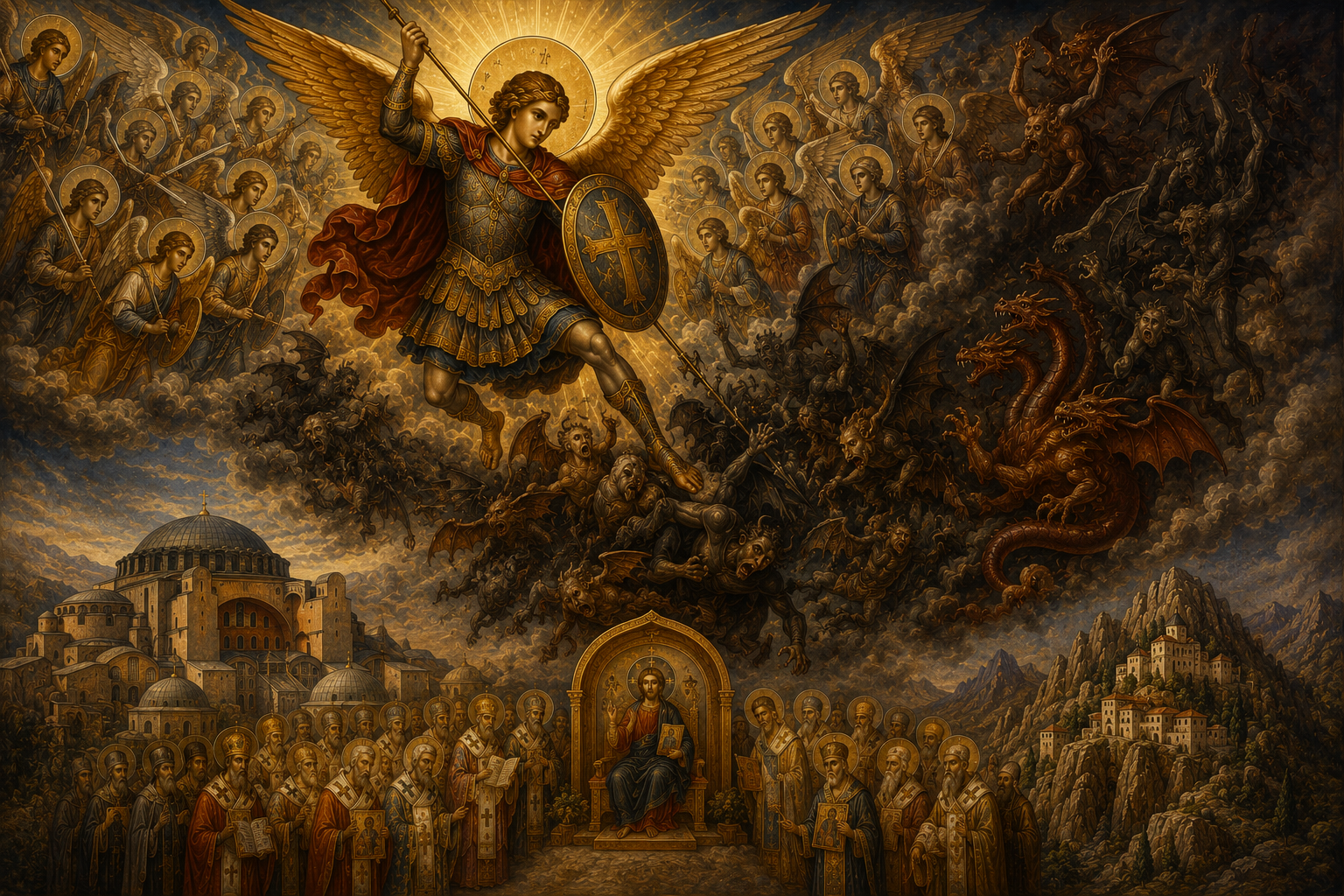
The subsequent vision of the war in heaven likewise received fresh historical application within the Byzantine tradition. While the early Fathers frequently understood Michael’s victory in relation to the primordial fall of Satan or the triumph achieved through the Cross, later Orthodox commentators increasingly recognized that the conflict between truth and falsehood continued within the doctrinal life of the Church. John Lindeos interpreted the heavenly conflict as taking place over the “heavenly and evangelical dogmas of the Orthodox faith,” while Theodoret of Ioannina described Michael and his angels as representing the pious defenders of Orthodoxy against the Dragon and those who follow him.¹⁸ These interpretations preserve Michael as the heavenly Archangel while simultaneously recognizing that his victory becomes historically visible through the bishops, monks, confessors, theologians, and Christian emperors who faithfully defended the apostolic confession.
Within this perspective, the Ecumenical Councils assume a profoundly apocalyptic significance. The successive Christological controversies of the fourth through eighth centuries may be viewed as historical manifestations of the Dragon’s continuing assault upon the identity of the Male Child. Arianism challenged His eternal divinity; Nestorianism divided His Person; Monophysitism obscured the integrity of His humanity; Monothelitism weakened the reality of His human will; and Iconoclasm attacked the visible implications of the Incarnation itself. The victory of the Orthodox confession at Nicaea, Constantinople, Ephesus, Chalcedon, and the subsequent councils therefore represents, within this interpretive tradition, the continuing triumph of Michael and his angels over the Dragon’s repeated attempts to corrupt the mystery of the God-Man.¹⁹
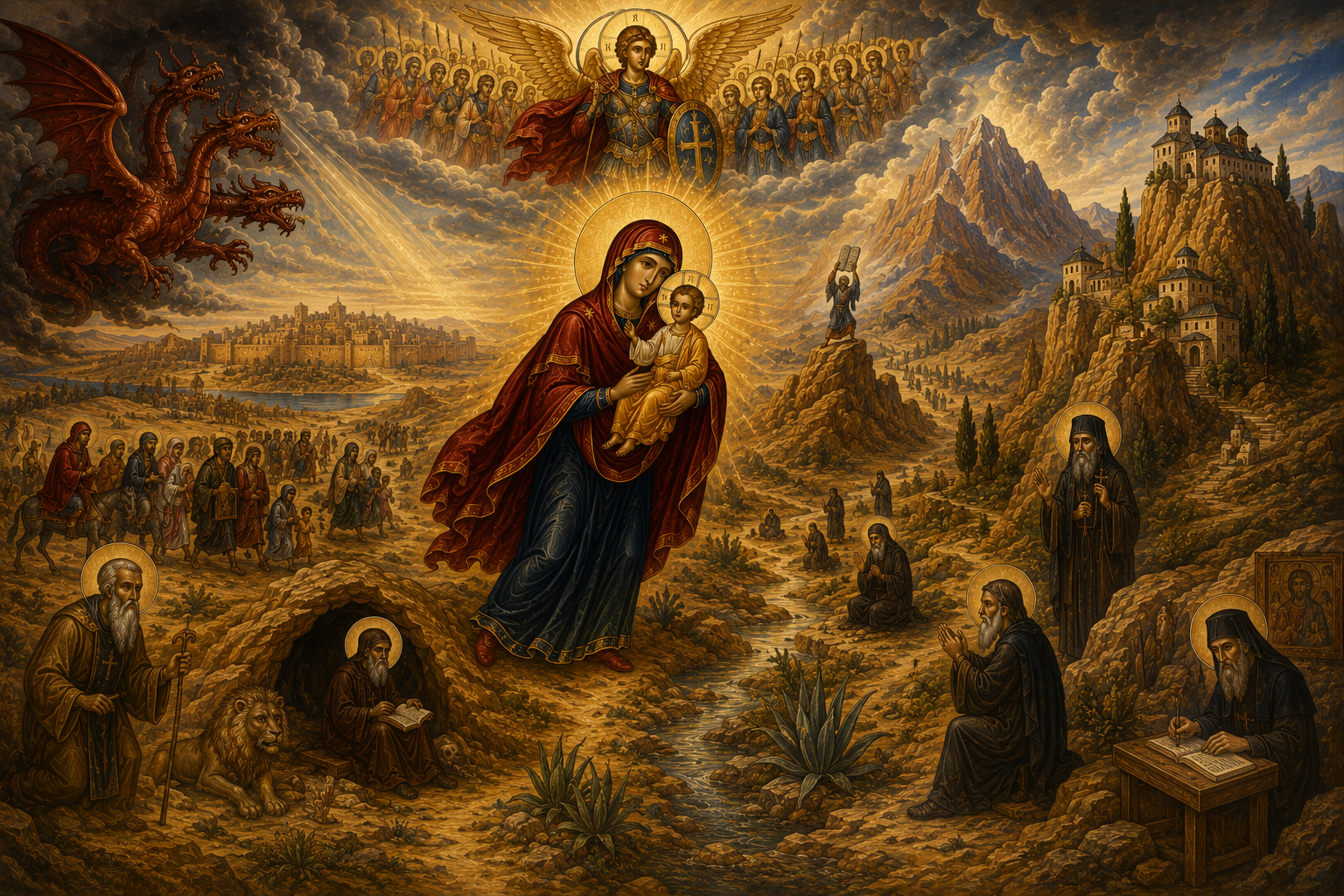
This historical unfolding of Revelation 12 does not end with the conciliar age. The Woman’s flight into the wilderness likewise acquired concrete expression within the developing life of Eastern monasticism. The wilderness had long functioned as one of Scripture’s great theological symbols. Israel encountered God in the wilderness following the Exodus. Elijah found refuge there while fleeing Jezebel. Our Lord Himself entered the wilderness immediately following His baptism. Beginning in the fourth century, however, the deserts of Egypt, Palestine, Sinai, and later Mount Athos became places where the Church herself sought refuge, preserving the apostolic life amid doctrinal confusion and worldly compromise. Some Orthodox Historicist interpreters consequently regarded the rise of monasticism—particularly under the influence of St. Athanasius the Great and the Egyptian Desert Fathers—as an historical realization of the Woman’s divinely prepared refuge.²⁰ The wilderness thus becomes not merely a geographical location but an enduring ecclesial reality in which the Church is nourished by God during periods of prolonged spiritual conflict.
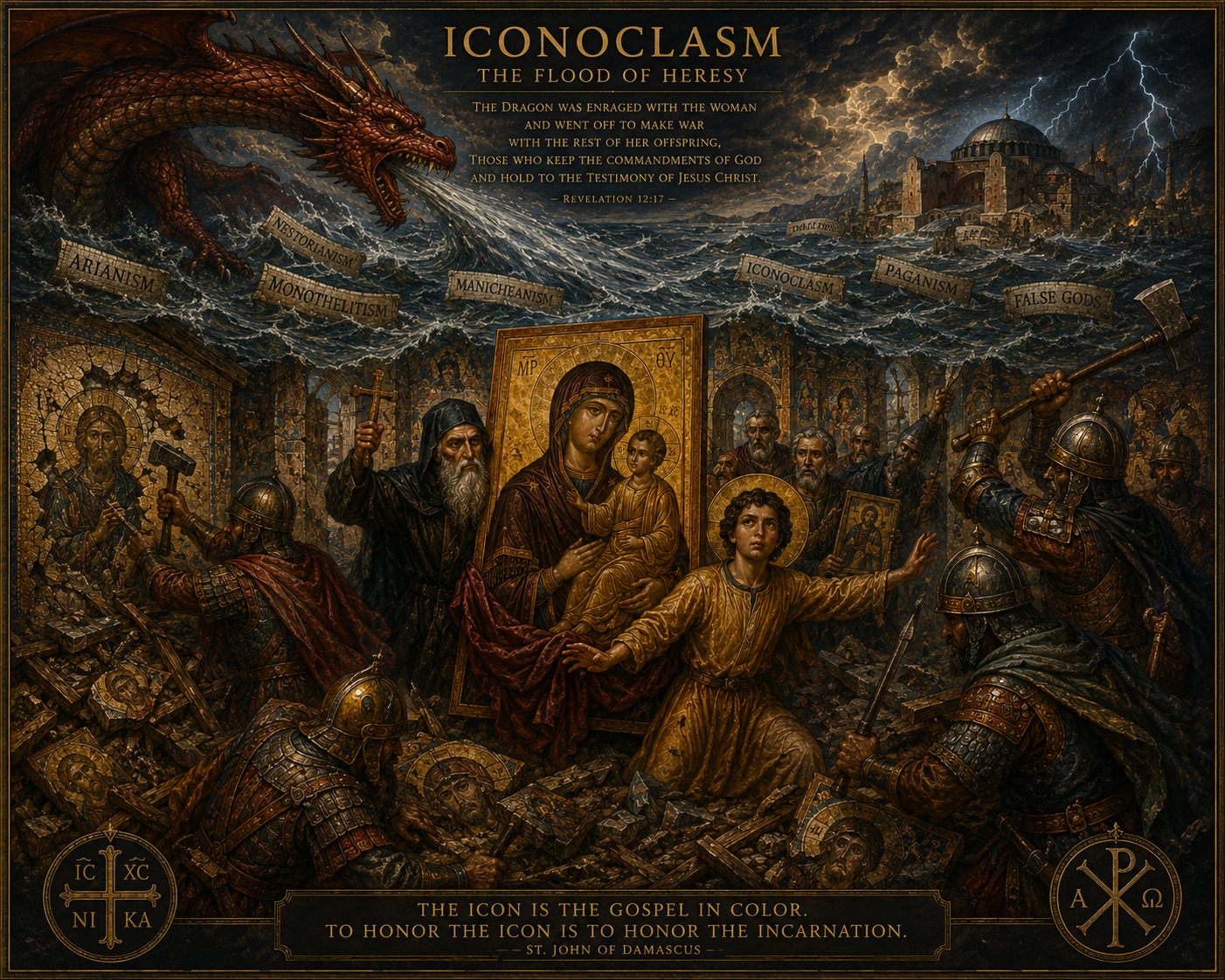
Later Orthodox history provides further examples of this continuing apocalyptic pattern. During the iconoclastic controversy, the Dragon’s flood may be understood as a torrent of false doctrine directed against the visible confession of the Incarnation. If, as the Seventh Ecumenical Council affirmed, the Son truly became man, then His human form may truly be depicted. The defense of the holy icons therefore represented far more than an artistic controversy; it became a defense of the Incarnation itself. In a similar manner, the Hesychast Councils of the fourteenth century, culminating in the triumph of St. Gregory Palamas, defended the Orthodox doctrine of participation in the uncreated energies of God. Although separated by centuries, these struggles exhibit a common theological structure. In each case the Church defended the mystery of the Incarnate Word against successive attempts to diminish or distort its meaning.²¹
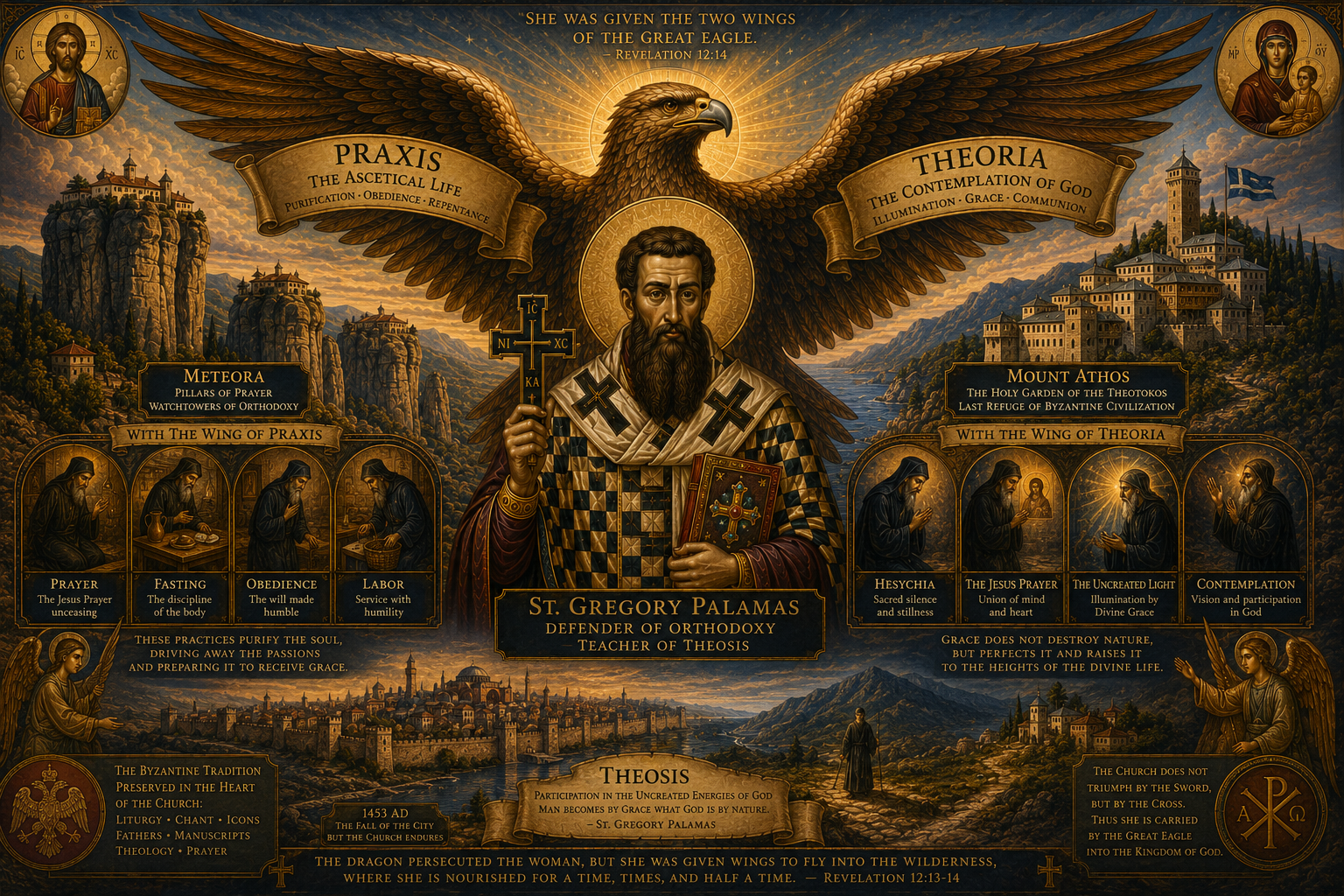
Such interpretations should not be understood as exhausting the meaning of Revelation 12, nor should they be regarded as replacing its historical or eschatological dimensions. Rather, they illustrate the manner in which later Orthodox commentators perceived the Apocalypse as a living book, continually illuminating the historical pilgrimage of the Church. The Woman remains the same covenant community throughout, while the Dragon repeatedly adapts his methods to the circumstances of each age. The battlefield shifts from persecution to heresy, from doctrinal controversy to iconoclasm, from philosophical rationalism to attacks upon the experience of deification itself. Yet the fundamental conflict remains unchanged because its object remains the same: the preservation of the mystery of Christ within His Body, the Church.
V. The Woman as the Covenant Community: Toward an Orthodox Conciliatory Synthesis
The preceding discussion suggests that the diversity of patristic interpretation does not arise from uncertainty concerning the text itself but from the extraordinary richness of the symbol employed by St. John. If Revelation consistently portrays earlier biblical realities as finding progressively fuller expression within the unfolding Divine Economy, then the Woman of chapter twelve should likewise be understood as a symbol whose historical manifestations develop without sacrificing their essential unity. The question is therefore no longer whether the Woman is Israel, the Theotokos, or the Church, but how each of these realities participates in the one covenantal mystery revealed by the Apocalypse.
Such an approach is not foreign to Orthodox theology. The Fathers frequently recognized that a single biblical image may simultaneously possess historical, ecclesiological, sacramental, and eschatological dimensions without these being regarded as contradictory. The Temple, for example, may signify the historical sanctuary in Jerusalem, the Body of Christ, the Church, the individual believer, and finally the heavenly sanctuary, each interpretation arising from the others through the progressive unfolding of Divine Economy rather than through mutual exclusion. Likewise, Jerusalem may denote the historical city, the covenant people, the Church, and the heavenly Jerusalem described at the conclusion of the Apocalypse. The symbolic world of Scripture is therefore organic rather than static. Images mature as salvation history itself advances.²²
The Woman of Revelation 12 appears to function according to precisely this theological pattern. Her earliest manifestation is found in Eve, the first woman through whom the promise of redemption entered history. The Protoevangelium established not merely an isolated prophecy concerning the coming Messiah but an enduring conflict between the Serpent and the Woman that would continue throughout the whole history of redemption (Gen. 3:15). Already within Genesis, therefore, the Woman transcends her own historical person. She becomes the mother of all those who belong to the promise, while the enmity between her seed and the seed of the Serpent establishes the fundamental structure of sacred history.
This covenantal identity develops further in faithful Israel. Throughout the prophetic literature, Israel is repeatedly portrayed as the spouse of the Lord, enduring labor pains while awaiting the birth of the Messianic age. Isaiah speaks of Zion travailing before bringing forth her children (Isa. 66:7–9); Micah associates Bethlehem with the woman in labor whose child will shepherd Israel (Mic. 5:2–4); Hosea portrays the restoration of the covenant relationship in marital language (Hos. 2). These prophetic images prepare the theological world within which Revelation 12 becomes intelligible. The Woman is no longer merely Eve but the covenant community through whom the promises given in Eden gradually move toward their historical fulfillment.²³
The historical center of this development is found in the person of the Most Holy Theotokos. In her, faithful Israel reaches its personal fulfillment. She is the Daughter of Zion in whom the expectation of the prophets culminates and through whom the eternal Word truly assumes human nature. The Marian interpretation of Revelation 12 therefore cannot be dismissed as a later devotional development. It arises naturally from the historical reality that only one woman literally gave birth to the Messiah described by St. John. Yet even here the Apocalypse refuses to allow the symbol to terminate with the Nativity alone. The Woman continues to appear after the Child has ascended to the throne of God, fleeing into the wilderness and becoming the mother of those who “keep the commandments of God and hold the testimony of Jesus Christ.” The text itself therefore extends beyond the historical life of the Virgin Mary while never ceasing to include her.²⁴
The Church consequently appears not as a replacement for Israel or the Theotokos but as their continuation within history. The Church is the covenant community renewed in Christ, nourished by the Holy Spirit, and united sacramentally to the Incarnate Lord. The same Woman who first appeared in promise, then in expectation, and finally in the historical birth of the Messiah now continues her pilgrimage through the centuries, preserving the apostolic faith while enduring the hostility of the Dragon. It is for this reason that many Byzantine commentators found no contradiction in identifying the Woman simultaneously with the Theotokos and the Church. Mary is the first and perfect realization of what the Church herself is called to become. She stands at the meeting point of the Old and New Covenants, embodying within her own person the faithful remnant of Israel while becoming the living image of the redeemed humanity brought to perfection in Christ.²⁵
This progression also explains why later Orthodox commentators frequently interpreted the subsequent scenes of Revelation 12 within the continuing history of the Church. The wilderness becomes more than the geographical refuge of the Holy Family in Egypt; it also signifies the Church’s historical preservation through the ascetic life. The war in heaven becomes more than the primordial fall of Satan; it also reveals the Church’s continuing struggle to preserve the truth of the Incarnation against successive waves of heresy. Likewise, the Dragon’s hostility toward “the rest of her offspring” naturally extends to every generation of faithful Christians who bear witness to Christ. These later applications do not create new meanings foreign to the text. Rather, they represent the historical maturation of a symbol whose theological horizon was never confined to a single moment within sacred history.
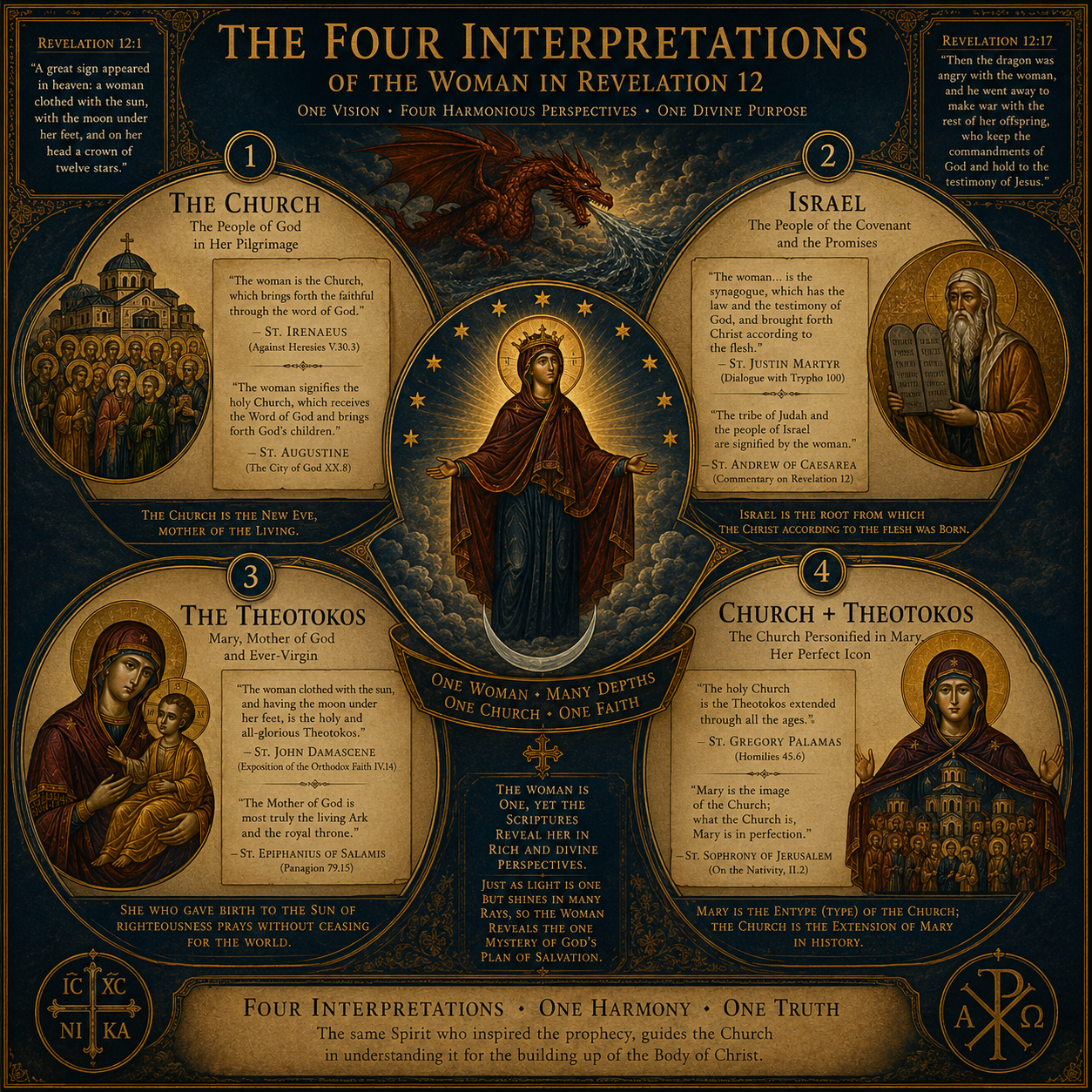
The history of Orthodox interpretation therefore suggests that the four principal patristic traditions should not be arranged as competing alternatives but as concentric circles surrounding a common center. The Woman is Eve because the history of redemption begins with the Protoevangelium. She is faithful Israel because the covenant promises mature within the chosen people. She is the Theotokos because the Word truly becomes flesh through her obedience. She is the Church because the Incarnate Lord continues His life within His Body throughout history. Finally, she is the Bride of the Lamb because the Divine Economy reaches its consummation only in the New Jerusalem descending from heaven. The symbol grows precisely because the history of salvation itself grows. Each interpretation therefore preserves a genuine dimension of the biblical witness without exhausting its theological depth.
Within such a framework, the diversity of Orthodox exegesis appears not as evidence of interpretive uncertainty but as testimony to the inexhaustible richness of the Apocalypse itself. The Woman of Revelation 12 need not be reduced to a single historical figure because she embodies the entire covenantal history of God’s people. She is at once historical and eschatological, personal and corporate, Marian and ecclesial, beginning in Eden and reaching her consummation only when “the tabernacle of God is with men” (Rev. 21:3). The conciliatory synthesis proposed in this study therefore seeks not to replace the classical patristic interpretations but to demonstrate the profound theological unity that has always existed beneath their apparent diversity.
VI. Theological and Hermeneutical Implications
The conciliatory synthesis proposed in this study has implications extending beyond the interpretation of a single symbol within the Apocalypse. It illustrates a fundamental characteristic of Orthodox biblical hermeneutics: the unity of Scripture is disclosed through the progressive unfolding of the Divine Economy. Earlier persons, institutions, and events retain their historical integrity while simultaneously acquiring fuller significance in Christ and within His Body, the Church. Typology, in this sense, is neither a denial of history nor an unrestricted allegorical method. It is grounded in the conviction that the same divine purpose revealed imperfectly through earlier biblical realities reaches its center in the Incarnation and its continuing historical manifestation within the life of the Church.
This principle is particularly evident in the Apocalypse, whose symbolic vocabulary is overwhelmingly drawn from earlier Scripture. The Serpent of Genesis reappears as the Dragon; the Exodus and wilderness become paradigms of the pilgrimage and preservation of God’s people; Babylon becomes the great anti-city opposed to God; the Temple is transformed into the heavenly sanctuary; and Jerusalem reaches its eschatological fulfillment in the Holy City descending from heaven. St. John does not merely repeat these earlier images but receives and transfigures them within a Christological and eschatological horizon.²⁶ Revelation therefore presents biblical history as a unified theological drama whose symbols can retain their earlier meanings while acquiring fuller manifestations as the Divine Economy advances toward its consummation.
The principal hermeneutical implication of this approach is therefore not simply that Revelation 12 possesses multiple possible meanings, but that its meanings are ordered Christologically and ecclesially. Typology does not permit unlimited allegorical invention. Historical applications remain accountable to the biblical pattern from which they arise and to the dogmatic confession of the Church. The Incarnation is consequently not one interpretation among several but the controlling center of the vision. The Woman’s subsequent history can possess ecclesial significance because the Church is united to the Christ to whom she bears witness; the wilderness can acquire later historical manifestations because it already belongs to the biblical pattern of divine preservation; and the Dragon’s warfare can reappear within doctrinal history because its fundamental object remains opposition to the Word made flesh.
This distinction is especially important for an Orthodox historical interpretation of the Apocalypse. Historical fulfillment need not be conceived as a sequence of arbitrary correspondences in which every symbol is assigned exclusively to a single date, ruler, institution, or event. Rather, ecclesial history may manifest recurring theological structures already revealed within Scripture. Persecution, heresy, conciliar confession, ascetic withdrawal, Iconoclasm, and the defense of deification can therefore participate in the imagery of Revelation 12 insofar as they reproduce within history the underlying conflict between the Dragon and the mystery of the Incarnate Word within His Church. The historical application remains subordinate to the Christological reality rather than replacing it.
This provides a theological basis for understanding the remarkable continuity between the early Fathers and later Orthodox commentators. Although separated by centuries and responding to very different historical circumstances, they approached Revelation as a book addressed to and lived within the Church. Later interpreters could therefore discern in the Ecumenical Councils, the rise of monasticism, the Iconoclastic controversy, or the Hesychast struggle further ecclesial manifestations of patterns already present in the inspired vision. Such applications did not require the Incarnation, Ascension, or earliest Christian referents of Revelation 12 to be displaced. On the contrary, those realities remained foundational. The historical manifestation presupposes the Christological archetype. Ecclesiastical history becomes intelligible within the Apocalypse precisely because the history of the Church remains the continuing history of the Body that confesses the Incarnate Word.
This approach also provides an important safeguard for the historical method itself. The legitimacy of an ecclesial application cannot rest merely upon chronological resemblance or an ingenious correspondence between a symbol and a later event. The stronger question is whether the proposed historical manifestation participates in the theological structure established by Scripture. Does it concern the preservation of the apostolic confession? Does it reproduce the conflict between truth and falsehood centered upon Christ? Does it belong organically to the pilgrimage, suffering, preservation, or witness of the covenant community? Does it remain consistent with the dogmatic boundaries established by the Church? These criteria distinguish an Orthodox ecclesial Historicism from an uncontrolled historicization of the Apocalypse.
The resulting hermeneutic is therefore simultaneously biblical, Christological, ecclesial, historical, and eschatological. Revelation draws its symbolic language from the biblical past, centers that language upon the Incarnate and victorious Christ, manifests its theological patterns within the historical pilgrimage of His Church, and directs the whole drama toward the final consummation of the Kingdom. These dimensions need not compete with one another because they belong to the same Divine Economy. The question posed to the interpreter is consequently not only, “Which historical person or event does this symbol represent?” but also, “What theological reality does this symbol reveal, and how does that reality manifest itself throughout the economy of salvation?”
Seen from this perspective, the symbolic richness of the Woman becomes an especially important test case for Orthodox apocalyptic hermeneutics. Modern Orthodox reflection upon Revelation has continued to recognize the relationship between the historical, ecclesiological, and theological dimensions of Johannine symbolism.²⁷ The four principal interpretations surveyed in this study can coexist because each approaches the Woman from within this larger theological horizon. Their compatibility does not depend upon making every interpretation identical, but upon recognizing that each participates in a mystery whose center lies beyond any one historical manifestation.
The conciliatory synthesis proposed here should therefore not be understood as a fifth interpretation added alongside the four traditions surveyed by Sakkos. Rather, it is a proposal concerning the theological relationship among them. The persistence of multiple interpretations throughout patristic, Byzantine, and modern Orthodox exegesis suggests that the Woman’s symbolic richness has historically resisted reduction to a single exhaustive referent.²⁸ The Woman remains one because the Divine Economy is one; the plurality of legitimate manifestations is possible because the saving work of God unfolds historically toward its eschatological consummation. The purpose of synthesis is therefore not to dissolve the distinctions among the four traditions, but to explain how their different insights can remain simultaneously true within the typological and ecclesial structure of the Apocalypse.
VII. Conclusion
The history of Orthodox interpretation of Revelation 12 presents an unusual but theologically significant phenomenon. The patristic and Byzantine tradition preserved several apparently different identifications of the Woman—Church, faithful Israel, Theotokos, and Theotokos together with the Church—without producing a single interpretation that displaced all the others. The present study has argued that this plurality need not be regarded as an unresolved exegetical problem. Rather, the four traditions may be understood as complementary perspectives upon a single covenantal mystery whose unity derives from the Divine Economy and whose center is the Incarnate Christ.
The decisive Christological question within the vision is therefore not only who the Woman is, but who the Male Child is. Revelation presents the Child born of the Woman as the royal Messiah destined to shepherd the nations, while the Danielic and Johannine imagery of heavenly enthronement reveals Him as the Son of Man possessing divine glory and everlasting dominion. The subsequent history of the Church’s Christological confession may consequently be read as an ecclesial defense of the mystery already revealed in the Apocalypse: the Male Child is the Theanthropos, the eternal Word truly made man. The great conciliar struggles over His divinity, humanity, Person, wills, and the visible consequences of His Incarnation thus provide the theological center around which the later Orthodox historical interpretation of Revelation 12 coheres.
This perspective helps explain why post-Byzantine Orthodox commentators could discern manifestations of the chapter within the Ecumenical Councils, monasticism, Iconoclasm, Hesychasm, and other decisive moments of ecclesiastical history. Such applications deserve renewed study, not because every historical identification must necessarily be accepted, but because they preserve an important Orthodox conviction concerning the nature of the Apocalypse: the prophecy illuminates the historical pilgrimage of the Church because that history remains inseparable from the mystery of Christ. Historical interpretation, when governed by Scripture and the Church’s Christological confession, therefore need not compete with patristic exegesis; it may develop organically from its typological and ecclesial foundations.
The Woman of Revelation 12 thus provides a particularly powerful example of how Orthodox apocalyptic interpretation may hold together biblical typology, Christology, ecclesiology, sacred history, and eschatological expectation. The diversity of interpretations preserved within the tradition need not be resolved by declaring one referent correct and the others mistaken. Their deeper coherence is found in the unity of the saving work of God. The biblical past supplies the types, Christ reveals their center, the Church bears their testimony within history, and the eschaton reveals their consummation. From the first promise of victory over the Serpent to the final triumph of the Bride and the Lamb, the Apocalypse reveals one Divine Economy and one continuous conflict surrounding the identity, testimony, and Kingdom of Jesus Christ.
© 2026 by Jonathan Photius
Footnotes
1. For representative early and Byzantine interpretations of the Woman of Revelation 12, see Hippolytus of Rome, De Christo et Antichristo (PG 10); Methodius of Olympus, Symposium (PG 18); Epiphanius of Salamis, Panarion (PG 42); Oecumenius, Commentary on the Apocalypse; Andrew of Caesarea, Commentary on the Apocalypse (PG 106); and Arethas of Caesarea, Commentary on the Apocalypse (PG 106). These sources illustrate the diversity of ecclesiological, Marian, and covenantal readings that developed within the early Orthodox exegetical tradition.
2. On the symbolic and multivalent character of Orthodox interpretation of the Apocalypse, see Panagiotis Bratsiotis, Ἡ Ἀποκάλυψις τοῦ Ἀποστόλου Ἰωάννου (Athens, 1950); Nikolaos Matsoukas, Ἡ Ἀποκάλυψη τοῦ Ἰωάννη (Thessaloniki, 2002); and Savvas Agourides, Ἡ Ἀποκάλυψη τοῦ Ἰωάννη (Thessaloniki, 2000).
3. Representative modern Greek Orthodox treatments include Panagiotis Bratsiotis, Ἡ Ἀποκάλυψις τοῦ Ἀποστόλου Ἰωάννου; Monk Antipas of Patmos, Ἡ Ἑπτάφωτος Λυχνία (Athens, 1923); Georgios Kounnousopis, “Ἡ γυναίκα τοῦ βιβλίου τῆς Ἀποκαλύψεως”; Nikolaos Matsoukas, Ἡ Ἀποκάλυψη τοῦ Ἰωάννη; Savvas Agourides, Ἡ Ἀποκάλυψη τοῦ Ἰωάννη; and Ioannis Giannakopoulos, Ἑρμηνεία τῆς Ἀποκαλύψεως. Together these works demonstrate the continuing vitality and diversity of Revelation exegesis within modern Greek Orthodox scholarship.
4. Stergios N. Sakkos, “The Woman of Revelation 12:1 According to the Interpretation of the First Eight Centuries,” in Presentations to the Synod of Orthodox Biblical Theologians (Nicosia, Cyprus, September 26–October 3, 1991), 161–180. Sakkos surveys the principal interpretations of the Woman during the first eight centuries and provides the immediate historical framework for the fourfold classification employed in the present study.
5. See Hippolytus of Rome, De Christo et Antichristo (PG 10), and Methodius of Olympus, Symposium (PG 18), for important early examples of the ecclesiological interpretation of the Woman.
6. For the Old Testament background of the Woman as the covenant people of God, see especially Isa. 54; Hos. 2; Ezek. 16; Song of Songs; and Gal. 4:21–31. Cf. Sakkos, “The Woman of Revelation 12:1,” 168–173, for the development of this covenantal interpretation within early Christian exegesis.
7. For representative witnesses to the Marian interpretation, see Epiphanius of Salamis, Panarion (PG 42); Oecumenius, Commentary on the Apocalypse; and Arethas of Caesarea, Commentary on the Apocalypse (PG 106). These interpretations connect the Woman directly with the historical birth of the Messiah while situating the Marian referent within the wider mystery of the Incarnation.
8. See Andrew of Caesarea, Commentary on the Apocalypse (PG 106); Arethas of Caesarea, Commentary on the Apocalypse (PG 106); and Sakkos, “The Woman of Revelation 12:1,” 174–179, for the convergence and overlap of Marian and ecclesiological interpretations within the Byzantine tradition.
9. For representative post-Byzantine Orthodox interpretations of Revelation as sacred and ecclesiastical history, see Anastasios Gordios, Interpretation of the Revelation (1718); Patriarch Anthimos of Jerusalem, Interpretation of the Holy Apocalypse; John Lindeos, Interpretation of the Revelation (1791); Apostolos Makrakis, Interpretation of the Book of Revelation (1881); and Monk Antipas of Patmos, The Seven-Lamped Lamp [Ἡ Ἑπτάφωτος Λυχνία] (Athens, 1923).
10. For representative modern Greek Orthodox treatments of Revelation 12 and the wider Apocalypse, see Panagiotis Bratsiotis, Ἡ Ἀποκάλυψις τοῦ Ἀποστόλου Ἰωάννου (Athens, 1950); Ioannis Giannakopoulos, Ἑρμηνεία τῆς Ἀποκαλύψεως (Thessaloniki, 1992); Savvas Agourides, Ἡ Ἀποκάλυψη τοῦ Ἰωάννη (Thessaloniki, 2000); Nikolaos Matsoukas, Ἡ Ἀποκάλυψη τοῦ Ἰωάννη (Thessaloniki, 2002); and Georgios Kounnousopis, “The Woman of the Book of Revelation.”
11. On the pervasive reuse and transformation of Old Testament imagery within the Apocalypse, see Richard Bauckham, The Theology of the Book of Revelation (Cambridge: Cambridge University Press, 1993), 17–38; cf. Panagiotis Bratsiotis, Ἡ Ἀποκάλυψις τοῦ Ἀποστόλου Ἰωάννου, Introduction. This scriptural recapitulation provides the hermeneutical basis for understanding earlier biblical persons and events as types capable of fuller Christological, ecclesial, and eschatological manifestation.
12. See especially Isa. 54:1–17; 66:7–9; Hos. 2:14–23; Ezek. 16; Mic. 4:9–10; 5:2–4. These passages establish the prophetic background for the imagery of Zion or the covenant people as Woman, Mother, Bride, and Woman in travail.
13. Ps. 2:7–9; Dan. 7:13–14; Rev. 12:5. The Male Child who is destined to shepherd the nations with a rod of iron combines the royal-Messianic imagery of Psalm 2 with the heavenly enthronement and universal dominion of Daniel’s Son of Man.
14. For examples of post-Byzantine Orthodox commentators who interpret the Apocalypse in relation to the continuing history of the Church, see Anastasios Gordios, Interpretation of the Revelation (1718); John Lindeos, Interpretation of the Revelation (1791); Apostolos Makrakis, Interpretation of the Book of Revelation (1881); and Monk Antipas of Patmos, The Seven-Lamped Lamp (Athens, 1923). Their interpretations provide important precedents for reading Johannine imagery ecclesially and historically without severing it from its biblical and Christological foundations.
15. The interpretation of the Woman’s travail as a prophetic gestation of forty year-weeks, or 280 years, has precedent within the older Western Historicist tradition. Edward Bishop Elliott, Horae Apocalypticae; or, A Commentary on the Apocalypse, Critical and Historical, 5th ed., vol. III (1862), interprets the period from the Resurrection and Ascension of Christ in A.D. 33 to the Constantinian settlement of A.D. 313 according to the year-day principle as corresponding to the forty weeks, or approximately 280 days, of human gestation. Elliott himself cites William Whiston for the explicit calculation, noting that the passage had also been cited by Bishop Thomas Newton: “As the time of gestation, from the conception to the birth, in women with child, is known to be 40 weeks, or 280 days, so from the first rise of our Saviour’s kingdom at his resurrection and ascension, A.D. 33 … A.D. 313 … was exactly 280 years.” Elliott applies this chronology to the emergence of the previously persecuted Christian Church into public and imperial recognition under Constantine. The present study develops the historical pattern in an explicitly Orthodox and Christological direction: the termination of the 280-year period in the Constantinian settlement prepared the historical setting in which the Church, at Nicaea in 325, publicly and universally confessed the identity of the Male Child as the divine-human Christ, the Theanthropos.
16. Dan. 7:9, 13–14; Ps. 2:7–9; Rev. 1:13–14; 12:5. Revelation’s description of Christ as “one like unto the Son of Man” whose head and hair are “white like wool, as white as snow” recalls both the Son of Man and Ancient-of-Days imagery of Daniel 7. The Apocalypse preserves the distinction of divine Persons while attributing to the Son of Man imagery expressive of divine eternity, glory, and sovereign authority. Compare the observations of Panagiotis Bratsiotis concerning the theological relationship between Revelation 12 and the enthronement of the Son of Man.
17. See the Nicene-Constantinopolitan Creed and the Christological definitions of the Ecumenical Councils, especially Nicaea I (325), Ephesus (431), Chalcedon (451), Constantinople III (680–681), and Nicaea II (787). Read together, these conciliar definitions progressively defend the Church’s confession of the identity of Jesus Christ: truly divine, truly human, one and the same incarnate Son and Word of God, possessing the fullness of divine and human nature and will, and truly depictable according to the humanity He assumed. Within the Orthodox Historicist reading proposed here, this conciliar confession constitutes an ecclesial manifestation—not a replacement—of the Christological mystery represented by the Male Child of Revelation 12.
18. John Lindeos, Interpretation of the Revelation (1791), interprets the heavenly conflict in relation to the “heavenly and evangelical dogmas of the Orthodox faith”; Theodoret of Ioannina, Interpretation of the Revelation (c. 1800), likewise applies Michael and his angels to the pious defenders of Orthodoxy. These interpretations provide significant post-Byzantine precedents for understanding the War in Heaven as possessing an ecclesial and doctrinal manifestation within Christian history.
19. See “The War in Heaven: The Ecumenical Councils,” together with the historical interpretations preserved in Lindeos, Theodoret of Ioannina, Makrakis, and Antipas. Within this interpretive tradition, the great Christological and iconological controversies may be read as successive historical manifestations of warfare concerning the identity of the Incarnate Word: His divinity, Person, humanity, wills, and the visible consequences of His Incarnation.
20. Athanasius of Alexandria, Life of Antony. Compare later Orthodox Historicist applications connecting the Woman’s flight into the wilderness with the rise and expansion of Christian monasticism in Egypt, Palestine, Sinai, and subsequently the Byzantine monastic world. Such interpretations understand the wilderness not merely geographically but ecclesiologically, as a divinely prepared place of preservation, purification, and spiritual nourishment.
21. See the Seventh Ecumenical Council (Nicaea II, 787) concerning the theological relationship between the Incarnation and the veneration of holy icons; and the Hesychast Councils of Constantinople (1341–1351) associated with St. Gregory Palamas concerning the reality of participation in the uncreated energies of God. See also “Two Wings of the Great Eagle: St. Gregory Palamas.” Within the historical reading developed here, Iconoclasm and the Hesychast controversy represent later conflicts over the implications of the Incarnation and humanity’s participation in divine life.
22. On the multivalent and typological character of Orthodox biblical interpretation, see Andrew of Caesarea, Commentary on the Apocalypse (PG 106), and Panagiotis Bratsiotis, Ἡ Ἀποκάλυψις τοῦ Ἀποστόλου Ἰωάννου, Introduction. Biblical types retain their historical reality while acquiring fuller Christological, ecclesiological, and eschatological significance within the unfolding Divine Economy.
23. Gen. 3:15; Isa. 66:7–9; Mic. 5:2–4; Hos. 2:14–23. These passages trace the biblical development of the Woman motif from the Protoevangelium through the prophetic portrayal of Zion and the covenant people awaiting Messianic fulfillment.
24. Rev. 12:5–17; see also Oecumenius, Commentary on the Apocalypse, and Arethas of Caesarea, Commentary on the Apocalypse. The continuation of the Woman’s activity after the enthronement of the Male Child, culminating in the Dragon’s warfare against “the rest of her offspring,” provides an important textual basis for the ecclesiological extension of the symbol beyond the historical Nativity.
25. Compare Patriarch Anthimos of Jerusalem, Interpretation of the Holy Apocalypse; Panagiotis Bratsiotis, Ἡ Ἀποκάλυψις τοῦ Ἀποστόλου Ἰωάννου; and Georgios Kounnousopis, “The Woman of the Book of Revelation.” These works may be read alongside the broader Orthodox tradition in which Marian, covenantal, and ecclesiological dimensions of apocalyptic imagery coexist without necessarily being reduced to mutually exclusive alternatives.
26. See Andrew of Caesarea, Commentary on the Apocalypse (PG 106); Richard Bauckham, The Theology of the Book of Revelation, 17–38. The Apocalypse repeatedly receives earlier biblical images—Eden, Exodus, Babylon, Jerusalem, Temple, wilderness, and the Serpent—and re-presents them within a Christological and eschatological horizon.
27. Compare Panagiotis Bratsiotis, Ἡ Ἀποκάλυψις τοῦ Ἀποστόλου Ἰωάννου; Nikolaos Matsoukas, Ἡ Ἀποκάλυψη τοῦ Ἰωάννη; and Georgios Kounnousopis, “The Woman of the Book of Revelation,” for modern Orthodox reflection upon the relationship between the historical, ecclesiological, and theological dimensions of Johannine symbolism.
28. Stergios N. Sakkos, “The Woman of Revelation 12:1 According to the Interpretation of the First Eight Centuries,” in Presentations to the Synod of Orthodox Biblical Theologians (Nicosia, 1991); Panagiotis Bratsiotis, Ἡ Ἀποκάλυψις τοῦ Ἀποστόλου Ἰωάννου; and Georgios Kounnousopis, “The Woman of the Book of Revelation.” The persistence of multiple interpretations from the patristic through the modern Orthodox tradition suggests that the Woman’s symbolic richness has historically resisted reduction to a single exhaustive referent.