
Recovering the Byzantine and Post-Byzantine Tradition of Prophetic Interpretation
“But thou, O Daniel, shut up the words, and seal the book, until the time of the consummation, until many shall have been taught and knowledge shall have been multiplied.“ – Daniel 12:4 (Theodotion-Greek)
Neo-Historicism (also referred to as Eastern Orthodox Historicism, Greek Orthodox Historicism, or Ecclesial Historicism) is a Nicene, Ecclesial, and Orthodox interpretation of biblical prophecy that understands the visions of Daniel and the Apocalypse as unfolding progressively throughout the history of the Church from the apostolic age until the Second Coming of Christ. Rooted in the theology, worship, councils, and lived experience of the Orthodox Church, it views prophecy not merely as a prediction of future events, but as a divine revelation of Christ’s work in and through His Church across the centuries. Drawing upon the Byzantine and Post-Byzantine exegetical tradition, Neo-Historicism interprets Revelation through the historical experience of the Nicene Church, whose doctrinal witness, struggles, victories, and perseverance form the principal arena in which prophetic truth is progressively disclosed.
The term “Neo” does not imply doctrinal innovation. Rather, it denotes a modern recovery, synthesis, and continuation of an interpretive tradition whose roots extend deep into the Byzantine exegetical heritage and which reached its fullest expression during the Post-Byzantine Exegetical Movement. While Neo-Historicism is grounded in a Nicene Ecclesial Orthodox understanding of prophecy, it seeks to recover a largely forgotten stream of Orthodox interpretation preserved in Greek, Slavic, and Eastern Christian commentaries, manuscripts, sermons, and apocalyptic literature.
Nicene Ecclesial Orthodox Historicism
Although Neo-Historicism began as a recovery of the Byzantine and Post-Byzantine tradition of interpreting biblical prophecy, it has come to represent more than a historical method. It reflects a distinct theological vision rooted in the Nicene faith and the ecclesial life of the Orthodox Church.
For this reason, Neo-Historicism may also be understood as Nicene Ecclesial Orthodox Historicism.
Nicene
The Apocalypse is fundamentally Christological. The Book of Revelation begins not with the Beast or the Antichrist, but with the glorified Christ, the Son of Man, standing among His Churches and enthroned before the Ancient of Days. The confession of the God-Man—the Theanthropos—stands at the center of prophetic history. Within this framework, the Council of Nicaea occupies a uniquely important place in the history of the Church, for the Nicene Creed became the definitive confession of Christ’s divine sonship and consubstantiality with the Father. Just as Revelation centers upon the enthroned Christ and His victory over the Dragon, so the Nicene faith stands as one of the principal lenses through which the Apocalypse is interpreted. For Neo-Historicism, the history of prophecy is inseparable from the history of the Church’s witness to Christ.
Ecclesial
Revelation unfolds primarily through the history of the Church. Councils, bishops, heresies, schisms, persecutions, missionary expansion, and doctrinal victories form the principal arena in which prophecy is manifested and understood. The history of the Church is not merely background to the Apocalypse; it is one of its primary subjects.
Orthodox
This interpretive tradition arises from the theological inheritance of the Eastern Orthodox Church, particularly the exegetical tradition preserved and developed in the Byzantine and Post-Byzantine world. Its reading of prophecy is inseparable from the worship, doctrine, and historical experience of the Orthodox Church.
Historicism
Prophecy unfolds progressively throughout history. The Apocalypse is neither confined exclusively to the first century nor postponed entirely to the end of time. Rather, its symbols reveal themselves through the lived experience of the Church across the centuries.
Neo-Historicism therefore seeks to read Revelation through the history of the Nicene Church, viewing the Apocalypse as a prophetic unveiling of Christ’s work in and through His Body throughout the ages.
The foundations of this tradition may be found in the Byzantine commentators Oecumenius, Andrew of Caesarea, and Arethas of Caesarea, who understood apocalyptic prophecy not merely as a prediction of distant future events, but as a revelation progressively disclosed through the historical life of the Church. Andrew of Caesarea in particular articulated the principle that prophecy becomes clearer through time and experience, establishing a hermeneutical framework that would profoundly influence later Orthodox interpreters.
Unlike both Futurism and Full Preterism, Neo-Historicism understands prophetic fulfillment as extending across the whole course of Christian history. While sharing certain methodological similarities with Western Historicism, Eastern Orthodox Historicism developed independently within the life of the Orthodox Church and interprets prophecy through the historical experience of the Christian East, the Ecumenical Councils, the struggle against heresy, the rise of Islam, the Great Schism, the fall of Constantinople, and the continuing witness of the Orthodox Church throughout the centuries. This Eastern Orthodox hermeneutic, situates apocalyptic fulfillment within the shared history of both the Eastern and Western Roman worlds, emphasizing ecclesiastical history and identifying Jerusalem and Constantinople as central prophetic arenas.
At its core, Neo-Historicism is an ecclesial interpretation of prophecy. The Apocalypse is not principally the story of political empires, but the story of Christ and His Church. The symbols of Revelation are understood primarily through the Church’s theological development, Christological controversies, conciliar definitions, missionary expansion, persecutions, apostasies, and ultimate triumph in history. Political and imperial events remain important, but chiefly insofar as they affect the life and mission of the Church.
For this reason, Neo-Historicism may also be described as Ecclesial Historicism: a historical reading of prophecy centered upon the continuous life of the One, Holy, Catholic, and Apostolic Church as she advances through history toward the consummation of all things in Christ. As a form of Ecclesial Historicism, Neo-Historicism places particular emphasis upon the historical development, defense, and preservation of Christological doctrine as reflected in the symbols of the Apocalypse. Within this framework, the visions of Revelation are understood in relation to the age of the Ecumenical Councils, the Church’s struggle against major heresies, the rise of monasticism through the witness of the Desert Fathers, and the great historical crises that culminated in the fall of the Byzantine Empire and the fragmentation of Western Christendom. These developments are interpreted within the Greek Orthodox historicist tradition as significant stages in the Church’s prophetic journey, shaped profoundly by the rise of Islam and the Papacy and their impact upon both Eastern and Western Christendom.
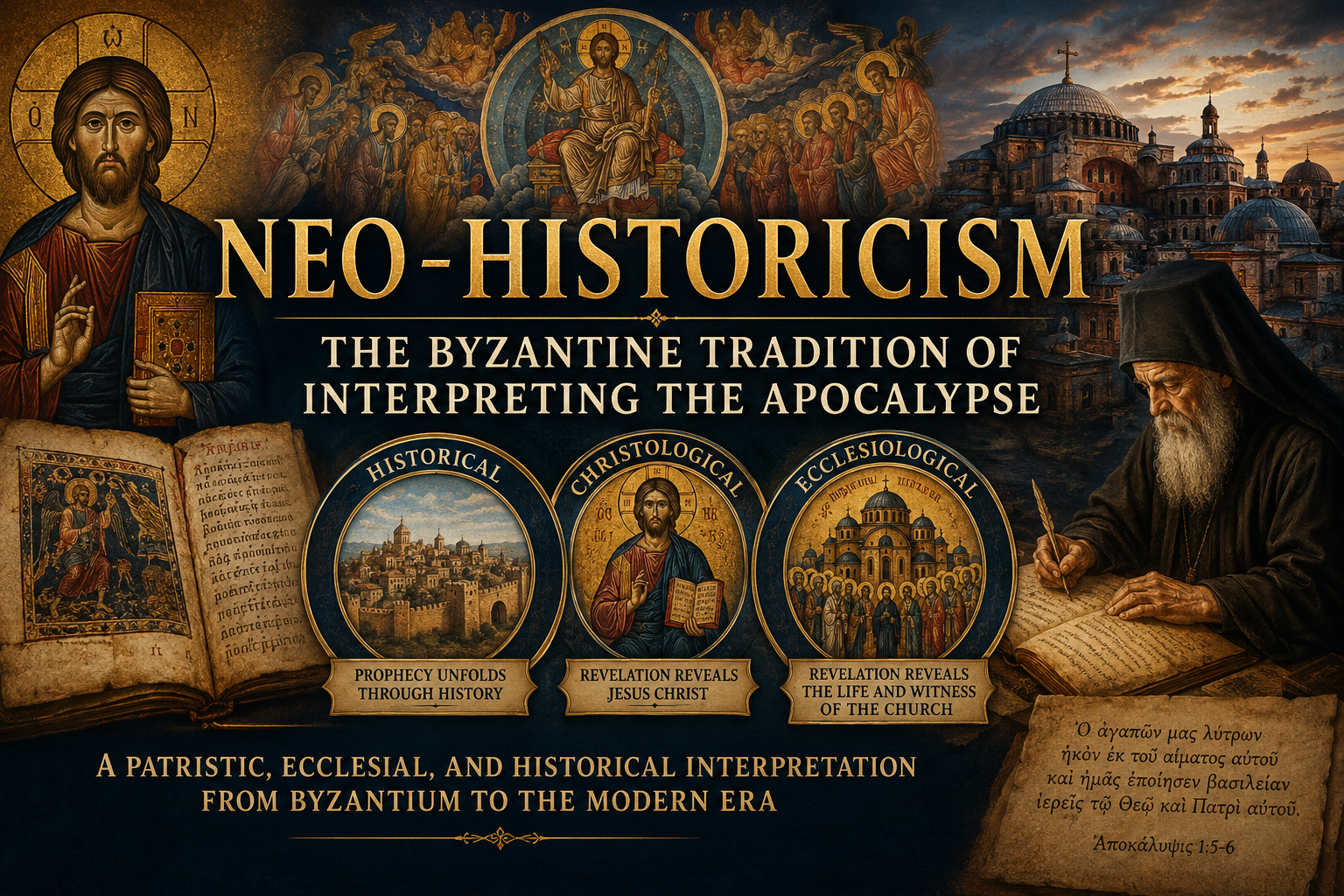
At its core, Neo-Historicism rests upon three complementary pillars: a Historical vision in which prophecy unfolds progressively through the providential course of history; a Christological vision in which the Apocalypse reveals the person and work of Jesus Christ; and an Ecclesiological vision in which the Church herself becomes the primary arena through which that revelation is manifested in the world. Together, these principles provide the distinctive framework through which Eastern Orthodox Historicism approaches the interpretation of Daniel and Revelation.
The Byzantine Apocalyptic Tradition and Byzantine Historic Postmillennialism
One of the most distinctive features of Eastern Orthodox Historicism is its close relationship with the broader Byzantine Apocalyptic Tradition. Throughout the Byzantine and Post-Byzantine periods, Orthodox theologians, monks, bishops, and commentators frequently interpreted biblical prophecy not as a prediction of an immediate end of the world, but as a revelation of God’s providential guidance of history through successive ages of trial, purification, renewal, and restoration and unity.
This historical vision differed significantly from modern forms of apocalyptic pessimism. While Byzantine writers recognized periods of persecution, apostasy, foreign domination, and ecclesiastical crisis, they often viewed these trials as temporary stages within a larger redemptive drama leading toward the vindication of the Orthodox faith. The rise of heresies, the expansion of Islam, the divisions of Christendom, and the collapse of empires were understood not as evidence of divine abandonment, but as events foreseen within the prophetic economy of God.
Many Post-Byzantine commentators consequently developed a historical expectation that may be described as Byzantine Historic Postmillennialism. Unlike modern Protestant postmillennial systems, this view did not anticipate a political utopia or a humanly constructed Christian civilization. Rather, it envisioned a future period in which the power of the great historical apostasies would diminish, the Orthodox faith would experience renewed strength, the nations would be increasingly evangelized, and Israel would ultimately be reconciled to Christ and His Church before the final consummation of history.
This expectation appears in varying forms throughout Byzantine apocalyptic literature and among later Orthodox historicist commentators. Although details differed from writer to writer, many shared a common conviction that the long historical tribulations experienced by the Church would not continue indefinitely. Instead, divine providence would ultimately bring about a period of restoration, renewal, and spiritual flourishing prior to the final rebellion of evil and the Second Coming of Christ.
Within this framework, the restoration themes found throughout Byzantine prophetic literature—including the renewal of Orthodox Christian civilization (often connected to the Megali Idea, but understood spiritually rather than nationalistically), the healing of divisions within Christendom, the liberation of Christian peoples, and the conversion of Israel—are understood primarily in spiritual and ecclesial terms rather than as expressions of political nationalism. The ultimate hope of the Byzantine apocalyptic tradition is not the restoration of an earthly utopian empire, but the vindication of the Kingdom of God within history and the final triumph of Christ and His Church.
For this reason, Eastern Orthodox Historicism is fundamentally a theology of hope. It affirms that history remains under the sovereignty of Christ, that the Church will endure every assault against her, and that the prophetic visions of Daniel and Revelation reveal not the defeat of Christianity, but its ultimate victory through the providential unfolding of God’s plan in history. This Christ-centered hope is grounded in the belief that history unfolds under divine providence and leads ultimately to the resurrection of the Body of Christ, the church, and appearance in glory of our Lord Jesus Christ.
The Post-Byzantine Exegetical Movement
Following the fall of Constantinople in 1453, the Orthodox world entered a period of profound political, cultural, and ecclesiastical crisis. The collapse of the Byzantine Empire, the expansion of Ottoman rule, the continuing divisions of Christendom, and the encounter with both Islam and the emerging confessional movements of Western Europe compelled Orthodox theologians to revisit the prophetic books of Scripture with renewed urgency.
Out of this historical context emerged what may be described as the Post-Byzantine Exegetical Movement: a continuous tradition of Orthodox commentary on Daniel and the Apocalypse extending from the sixteenth through the twentieth centuries. While deeply rooted in the earlier Byzantine heritage of Oecumenius, Andrew of Caesarea, and Arethas of Caesarea, these later interpreters increasingly applied apocalyptic prophecy to the historical realities confronting the Orthodox Church in their own age.
Unlike many earlier Byzantine commentators, who often emphasized the spiritual and theological dimensions of apocalyptic symbolism, Post-Byzantine exegetes developed increasingly historical applications of prophecy. The symbols of Daniel and Revelation were interpreted in relation to the rise of Islam, the Ottoman domination of Orthodox lands, the Great Schism, the expansion of Papal authority, the sufferings of the Christian East, and the anticipated renewal of Orthodox Christianity. This development did not represent a departure from patristic tradition, but rather an extension of the principle articulated by Andrew of Caesarea that prophecy becomes clearer through the unfolding of historical experience.
A distinguishing characteristic of the movement was its ecclesial orientation. Revelation was not interpreted primarily as a chronicle of secular political history, but as the history of the Church herself. Theological controversies, Ecumenical Councils, Christological definitions, missionary expansion, schisms, persecutions, and apostasies all became central interpretive categories. Political events were significant chiefly because of their relationship to the life, mission, and preservation of the Church.
Many commentators within this tradition also recognized two major historical challenges confronting Christian civilization: the rise of Islam and the rise of Papal supremacy. Although individual interpretations varied, these developments were frequently viewed as the principal apostasies or adversarial powers shaping the historical experience of both Eastern and Western Christendom. Consequently, Orthodox historicist interpretation often sought to understand biblical prophecy through the interaction of these two great forces and their impact upon the Church throughout history.
The movement produced a remarkable succession of exegetes, hierarchs, monks, theologians, and scholars who preserved and expanded this historical method of interpretation. Figures such as Metropolitan Zacharias Gerganos, Christophoros Angelos, Mitrofanis Kritopoulos, Paisios Ligarides, Saint Anastasios Gordios, Nektarios Terpos, Patriarch Anthimos of Jerusalem, Pantazes of Larissa, Metropolitan John Lindios of Myra, Theodoret of Ioannina, Kyrillos Lavriotis, Nikolaos Damalas, Apostolos Makrakis, and Neilos Sotiropoulos each contributed to the development of a distinctly Orthodox historicist reading of prophecy.
Taken together, these commentators represent the Eastern counterpart to the historicist movements that emerged in Western Europe. Yet their work remained uniquely Orthodox in character, rooted in the sacramental life of the Church, the authority of the Fathers, the legacy of the Ecumenical Councils, and the lived historical experience of the Christian East. Their largely forgotten writings form the principal foundation upon which modern Eastern Orthodox Historicism and Neo-Historicism seek to build and recover. A tradition that is rooted in rich Orthodox theology, sacramentality, and patristic continuity.
Key Greek Historicist Exegetes and Precursors
Although the fully developed historical interpretations of the Apocalypse emerged during the Post-Byzantine period, their foundations were laid centuries earlier within the Byzantine exegetical tradition. The following figures represent the principal stages in the development of Eastern Orthodox Historicism.
I. Byzantine Foundations
1. OECUMENIUS (Sixth Century)
The earliest surviving Greek commentator on the Apocalypse. Oecumenius established important historical principles of interpretation, including the identification of Babylon with Rome and the application of apocalyptic symbolism to the historical experience of the Christian Roman world.
2. ANDREW OF CAESAREA (Early Seventh Century)
The most influential Byzantine commentator on Revelation and the authoritative guide for nearly all subsequent Orthodox interpreters. Andrew emphasized that prophecy becomes progressively clearer through historical experience, a principle that would later serve as one of the foundations of Orthodox historicist interpretation.
3. SOPHRONIUS OF JERUSALEM (c. 637)
Among the earliest Orthodox writers to interpret the Islamic conquest through the lens of biblical prophecy. His writings concerning the fall of Jerusalem and the rise of the Saracens helped establish themes that would later become central to Orthodox historicist exegesis.
4. ARETHAS OF CAESAREA (c. 895–913)
The successor of Andrew’s tradition and one of the earliest Byzantine commentators to historicize Revelation 13 in relation to the Saracens. His interpretation formed an important bridge between Byzantine apocalyptic thought and the later Post-Byzantine historicist movement.
5. ST. NEOPHYTOS THE RECLUSE (1207)
The first known Greek commentator to develop an explicitly historical reading of the Apocalypse in response to contemporary events, particularly the catastrophe of the Fourth Crusade and the Latin occupation of Constantinople.
II. The Post-Byzantine Exegetical Movement
After the fall of Constantinople (1453), apocalyptic consciousness intensified. Under Ottoman occupation, Greek clergy and scholars produced a continuous stream of commentaries and prophetic works seeking to understand their historical trials through Scripture. This body of literature produced from the 16th to the 19th centuries forms the backbone of Eastern Orthodox Historicism.
6. ZACHARIAS GERGANOS (1621)
Among the earliest Ottoman-era Orthodox exegetes to apply apocalyptic prophecy systematically to historical developments affecting both East and West.
7. CHRISTOFOROS ANGELOS (1624)
One of the earliest Orthodox commentators to employ chronological prophetic models and historical applications concerning Islam and the future of Christendom.
8. MITROFANIS KRITOPOULOS (1627)
Scholar, patriarch, and theologian whose apocalyptic reflections integrated world history, ecclesiastical developments, and Orthodox theology.
9. PAISIOS LIGARIDES (1655)
Compiler of the Book of Prophecies (Chrismologion) and a major figure in the transmission of Byzantine prophetic and historicist traditions.
10. ST. ANASTASIOS GORDIOS (1718)
One of the most important Post-Byzantine historicist commentators. His Treatise Concerning Mohammed and Against the Latins offered an extensive historical interpretation of Daniel and Revelation focused on Islam, the Papacy, and the destiny of the Orthodox Church.
11. NEKTARIOS TERPOS (1740)
Missionary, preacher, and popularizer of Orthodox prophetic interpretation who presented historicist themes in a pastoral and accessible manner.
12. PATRIARCH ANTHIMOS OF JERUSALEM (1758)
A major ecclesiastical authority whose commentary on Revelation represents one of the highest-ranking episcopal contributions to the Orthodox historicist tradition.
13. PANTAZES OF LARISSA (1767)
Scholar and teacher associated with the intellectual revival of the eighteenth century whose apocalyptic writings contributed to the growing historical interpretation of Revelation.
14. METROPOLITAN JOHN LINDIOS OF MYRA (1791)
Developed one of the most systematic ecclesial interpretations of the Apocalypse, presenting Revelation as a continuous history of the Church from the Ecumenical Councils through the Ottoman era.
15. THEODORET OF IOANNINA, ABBOT OF ESPHIGMENOU (c. 1800)
Athonite exegete who combined Byzantine apocalyptic traditions, historicist chronology, and expectations of future Orthodox renewal into a comprehensive interpretation of Revelation.
16. KYRILLOS LAVRIOTIS OF PATRAS (1817)
A prominent representative of Athonite historicism who integrated the interpretation of Daniel and Revelation with the historical struggles of Orthodoxy and the approaching Greek War of Independence.
17. NIKOLAOS DAMALAS (1878)
Professor of theology at the University of Athens who helped introduce Orthodox historicist interpretation into modern academic discourse.
18. APOSTOLOS MAKRAKIS (1881)
Author of one of the most extensive modern Orthodox commentaries on Revelation. His interpretation synthesized patristic theology, ecclesial history, prophetic chronology, and Byzantine restoration themes into a comprehensive historicist system.
19. NEILOS SOTIROPOULOS OF SIMONOPETRA (1964, 1996)
One of the final major representatives of the Post-Byzantine historicist tradition. His works employed detailed chronological analysis of Daniel and Revelation while preserving the ecclesial and Christological orientation characteristic of Orthodox historicism.
Together these figures demonstrate the continuous development of a distinctively Eastern Orthodox historical interpretation of prophecy spanning more than fourteen centuries, from the Byzantine Empire to the modern era.
The Principles of Eastern Orthodox Historicism
Eastern Orthodox Historicism is governed by several foundational hermeneutical principles that distinguish it from both modern futurist and preterist approaches to biblical prophecy.
1. Prophecy Unfolds Progressively Through History
The Apocalypse is understood as a revelation of events extending across the entire history of the Church from the apostolic era until the Second Coming of Christ. Prophetic fulfillment is therefore neither confined primarily to the first century nor postponed exclusively to the final generation. Instead, the visions of Daniel and Revelation progressively unfold throughout history according to the providential plan of God.
2. The Church Stands at the Center of Prophetic History
Eastern Orthodox Historicism is fundamentally ecclesial in orientation. The primary subject of prophecy is not the rise and fall of secular empires but the historical life of the Church. Councils, heresies, schisms, missionary expansion, persecutions, apostasies, and spiritual renewal constitute the principal framework through which prophetic symbolism is interpreted. Political powers become significant primarily because of their relationship to the mission and preservation of the Church.
3. History Reveals the Meaning of Prophecy
Following the principle articulated by Andrew of Caesarea, prophecy becomes progressively clearer through the unfolding of historical events. Symbols that may appear obscure in one generation often become more intelligible through later developments. Historical experience therefore serves not as a replacement for Scripture, but as a witness to its fulfillment.
4. The Apocalypse is Fundamentally Christological
Eastern Orthodox Historicism understands the Apocalypse primarily as a revelation of Jesus Christ and His work within history. Centered upon the mystery of Christ as the God-Man (Theanthropos), fully divine and fully human, this approach views the prophetic narrative not merely as a chronicle of historical events, but as the history of the Church’s witness to the person and work of Christ throughout the ages. Consequently, the great Christological controversies, Ecumenical Councils, doctrinal definitions, and struggles against heresy occupy a central place within the interpretation of St. John’s Apocalypse. Revelation is therefore understood not only as the history of the Church, but as the history of the Church’s testimony to Christ amid successive challenges to the apostolic faith and the Orthodox confession of the Incarnation.
5. The Apocalypse Is Fundamentally Ecclesiological
Eastern Orthodox Historicism understands the Apocalypse as a prophetic revelation of the life and mission of the Church throughout history. The symbols of Revelation frequently describe the Church’s struggles, victories, witness, persecutions, doctrinal conflicts, missionary labors, and ultimate preservation under the providence of God. Consequently, the Church is not merely the recipient of prophecy but often its principal subject. The Woman clothed with the sun, the Two Witnesses, the Seven Churches, the heavenly temple, and other ecclesial symbols are understood as manifestations of the One, Holy, Catholic, and Apostolic Church as she advances through history toward the consummation of all things in Christ.
6. The Great Historical Apostasies Unfold Within History
Rather than expecting all major apostasies to arise only in a future generation, Eastern Orthodox Historicism recognizes the gradual emergence of great religious and ecclesiastical deviations throughout the course of Christian history. Many Orthodox commentators consequently interpreted the rise of Islam and the growth of Papal supremacy as major historical developments anticipated within biblical prophecy and profoundly affecting the life of the Church.
7. Prophecy Ultimately Reveals the Triumph of Christ and His Church
Eastern Orthodox Historicism is fundamentally a theology of hope. While acknowledging periods of persecution, decline, and apostasy, it affirms that Christ remains Lord of history and that the Church will ultimately emerge victorious. The prophetic narrative culminates not in the destruction of Christianity, but in the vindication of the Orthodox faith, the gathering of the nations, the reconciliation of Israel, the final defeat of evil, and the glorious return of Christ.
Why Eastern Orthodox Historicism Matters Today
The modern study of biblical prophecy is often dominated by approaches that either confine prophetic fulfillment almost entirely to the first century or postpone it almost entirely to the final years immediately preceding the Second Coming. In many cases, these systems leave little room for the historical experience of the Church itself and often separate prophecy from the theological, liturgical, and conciliar life of Christianity.
Eastern Orthodox Historicism offers an alternative perspective. Rather than viewing prophecy as either entirely past or almost entirely future, it understands the visions of Daniel and Revelation as unfolding progressively throughout the whole history of the Church. The Apocalypse becomes a sacred history of Christ’s continual presence and activity within His Body, revealing the triumphs, trials, councils, persecutions, apostasies, missionary labors, and spiritual victories that have shaped Christian civilization over two millennia.
Yet Eastern Orthodox Historicism is not merely ecclesial in focus. It is fundamentally Christological. The history revealed in the Apocalypse is above all the history of the Church’s witness to Jesus Christ as the God-Man (Theanthropos), fully divine and fully human. Consequently, the great Christological controversies, Ecumenical Councils, and doctrinal struggles of Christian history occupy a central place within the Neo-Historicist reading of the Book of Revelation.
This approach also restores an important dimension of Orthodox memory. The Byzantine and Post-Byzantine commentators devoted considerable attention to the interpretation of biblical prophecy, yet many of their works remain largely unknown outside specialized academic circles. The recovery of these texts reveals a rich and sophisticated tradition of historical interpretation that has often been overlooked, misunderstood, or marginalized within modern Orthodox eschatological discourse. While contemporary discussions frequently focus on future Antichrist scenarios and events expected immediately before the Second Coming, many Byzantine and Post-Byzantine commentators interpreted large portions of Daniel and Revelation through the lens of unfolding Church history and the providential development of Christian civilization. The rediscovery of these sources challenges common assumptions about the history of Orthodox eschatology and reveals a broader and more historically conscious interpretive tradition than is generally recognized today.
Eastern Orthodox Historicism furthermore provides a framework capable of integrating theology, Church history, and prophetic interpretation into a unified vision of divine providence. Rather than isolating prophecy from history, it recognizes history itself as the arena in which God’s purposes are progressively revealed. The great doctrinal controversies of the Ecumenical Councils, the rise and fall of empires, the missionary expansion of Christianity, the struggles of the Orthodox Church under persecution, and the continuing witness of the saints all become part of a larger providential narrative illuminated by Scripture.
At the same time, Eastern Orthodox Historicism rejects both apocalyptic sensationalism and historical despair. It neither encourages speculative predictions concerning the immediate end of the world nor assumes the inevitable collapse of Christianity before the return of Christ. Instead, it affirms that Christ remains Lord of history, that His Church endures through every age, and that the prophetic promises of Scripture ultimately reveal the victory of truth over error, faith over apostasy, and the Kingdom of God over every power that opposes it.
The purpose of Neo-Historicism is therefore not merely to recover a forgotten method of interpretation, but to recover a forgotten vision of history itself—a vision rooted in the Fathers, nourished by the life of the Church, refined through centuries of historical experience, and centered upon the abiding lordship of Jesus Christ.
By recovering the Byzantine Fathers, the Post-Byzantine Exegetical Movement, and the ecclesial interpretation of prophecy preserved within the Orthodox tradition, Neo-Historicism seeks not only to illuminate the meaning of Daniel and Revelation, but also to recover a distinctly Orthodox understanding of sacred history itself. In this vision, prophecy, theology, and history converge in a single testimony to the providential reign of Jesus Christ over His Church and the world.
“(…) in a time of times and a half of a time, when the dispersion hath been consummated, all these things shall become known.” – Daniel 12:8 (Theodotion-Greek)
© 2026 by Jonathan Photius
About the Neo-Historism Research Project
This project seeks to recover and present the Orthodox historicist interpretation of biblical prophecy by grounding apocalyptic symbolism in the Church’s theological tradition, conciliar history, and lived historical experience. It affirms historicist eschatology as an organic expression of Eastern Orthodox thought, distinct from modern futurist and preterist models, and rooted in the continuous life of the Church from the apostolic era to the present.

