
By Jonathan Photius – The NEO-Historicism Research Project
Introduction
“And there was war in heaven: Michael and his angels fought against the dragon; and the dragon fought and his angels” (Rev. 12:7).
Few passages in the Apocalypse have generated more discussion than the War in Heaven of Revelation 12. Throughout Christian history interpreters have commonly understood the vision either as a primordial conflict among the angels before the creation of the world or as a future battle immediately preceding the end of the age. Yet the Orthodox exegetical tradition suggests a richer and more ecclesiastical reading of the passage.
The key to understanding the vision lies in the identity of the Woman. Long before the development of modern prophetic systems, St. Methodius of Olympus identified the Woman clothed with the Sun as the Church herself. This interpretation was later preserved and transmitted by St. Andrew of Caesarea in the first complete Greek commentary on the Apocalypse. If the Woman represents the Church, then the events surrounding her are naturally connected with the life, struggles, victories, and preservation of the Church throughout history rather than being confined exclusively to either primordial time or the distant future.1
The Orthodox commentators examined in this study—Apostolos Makrakis, John Lindios of Myra, and Theodoret of Ioannina—approach Revelation 12 from different angles, yet together they reveal a remarkably coherent picture. Makrakis emphasizes the dogmatic confession of Christ, Lindios identifies the battlefield as the sphere of Orthodox doctrine, and Theodoret interprets the participants in the conflict through visible historical actors. When these insights are considered together, the War in Heaven emerges as a prophetic image of the Church’s struggle to preserve the true confession of the Incarnate Word against the assaults of heresy and false teaching.
The Birth of the Man-Child
Before the War in Heaven begins, the Woman gives birth to a Man-Child destined to rule the nations with a rod of iron (Rev. 12:5). The interpretation of this Child is central to understanding the remainder of the chapter.
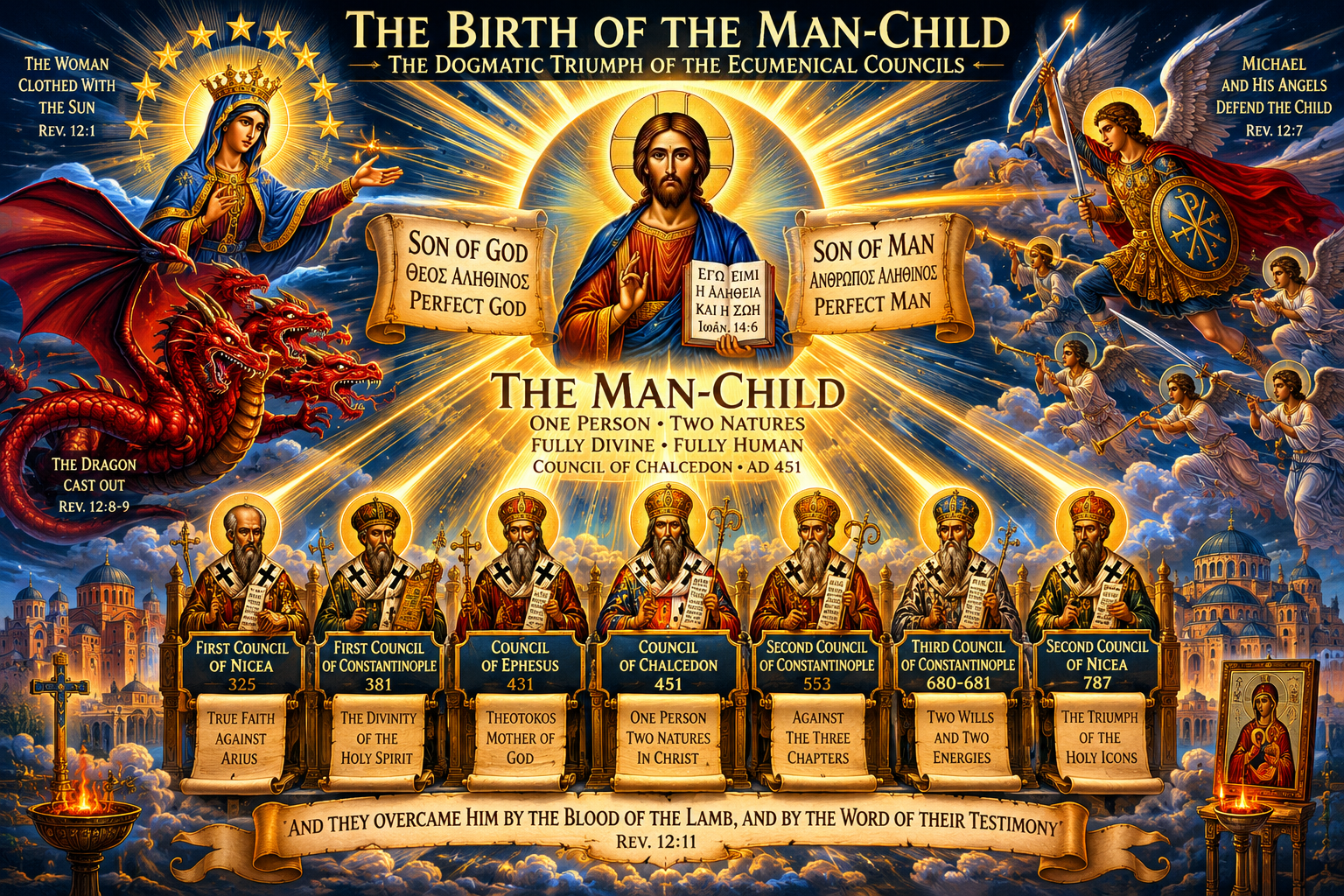
Apostolos Makrakis proposed one of the most remarkable interpretations in the Orthodox tradition when he identified the Man-Child with the Christ dogmatized by the Ecumenical Councils.2 According to Makrakis, the Church labored through centuries of persecution and doctrinal controversy until she gave birth to the full confession of Jesus Christ as perfect God and perfect Man. He places particular emphasis upon the Fourth Ecumenical Council at Chalcedon (451) and the Sixth Ecumenical Council at Constantinople (680–681), which clarified and defended the Church’s teaching concerning the two natures and two wills of Christ.
While Makrakis focuses upon Chalcedon and its later clarification, the broader historical process may be understood as beginning much earlier. The First Ecumenical Council at Nicaea in 325 marked the first great public dogmatic proclamation of Christ’s consubstantial divinity against the Arian denial. Subsequent councils refined and defended this confession against successive heresies. The birth of the Child may therefore be viewed not as a single moment but as a conciliar process through which the Church progressively articulated the mystery of the God-Man.
Such an interpretation illuminates the remainder of the chapter. If the Child represents the Church’s dogmatic confession of Christ, then every major Christological heresy becomes an attempt to devour that Child. Arius sought to diminish the Son’s divinity. Nestorius divided the unity of Christ’s person. Monophysitism obscured His humanity. Monothelitism denied the integrity of His human will. The struggle described in Revelation 12 therefore concerns the preservation of the Church’s confession of Christ Himself.
What Is Heaven?
The meaning of the War in Heaven depends largely upon the meaning of “heaven.” If heaven is understood only as the invisible realm of angels, then the vision remains detached from the historical experience of the Church. Yet John Lindios offers a different perspective.
Commenting upon Revelation 12, Lindios explains that the conflict occurred for the sake of the “heavenly and Evangelical dogmas of the Right Faith.” 3 Heaven, in this context, signifies more than the abode of the angels. It represents the doctrinal sphere of the Church itself—the realm of Orthodox confession, dogmatic truth, and apostolic teaching.
This interpretation is not without precedent. Throughout Scripture, heavenly imagery frequently symbolizes spiritual realities manifested upon earth. The Church herself is often described as a heavenly commonwealth, and her bishops, teachers, and saints are represented under celestial symbols. Lindios extends this principle to Revelation 12 by identifying the battlefield with the sphere in which Orthodox doctrine is defended and preserved.
Under this interpretation the War in Heaven becomes a struggle over the truth concerning Christ. The Dragon seeks to corrupt the faith, while Michael defends it. The conflict therefore unfolds not merely among invisible powers but also within the visible history of the Church.
Michael and His Angels
Who are Michael and his angels?
Before attempting to identify Michael’s angels, it is important to observe that the Apocalypse itself provides a precedent for interpreting angelic figures as historical leaders within the Church. In Revelation 1:20, Christ declares that “the seven stars are the angels of the seven churches.” While some commentators understood these angels as heavenly guardians, the dominant patristic tradition frequently interpreted them as the bishops or ecclesiastical leaders of the seven churches. The stars therefore represent visible ministers through whom Christ governs and instructs His Church. This principle establishes an important interpretive foundation for the remainder of the Apocalypse. Angelic imagery may refer not only to invisible heavenly beings but also to human agents who participate in the work of God within history.
Lindios preserves the traditional understanding of Michael as the Archangel and protector of God’s people. Yet elsewhere in his commentary he demonstrates how heavenly realities become manifest through historical actors. Interpreting Revelation 10, he explains that divine power acted through the Archangel and was placed into the heart of Constantine the Great, enabling the triumph of Christianity throughout the Roman Empire. 4
The same principle may illuminate the War in Heaven. Michael remains the heavenly commander, but his victory becomes visible through earthly instruments. Theodoret of Ioannina provides an important clue when he writes that Michael and his angels signify “the pious,” while the Dragon and his angels signify the impious and those who resemble him. 5 Elsewhere he explains that prophetic language often uses angelic imagery to indicate visible helpers who act according to the likeness of heavenly powers.
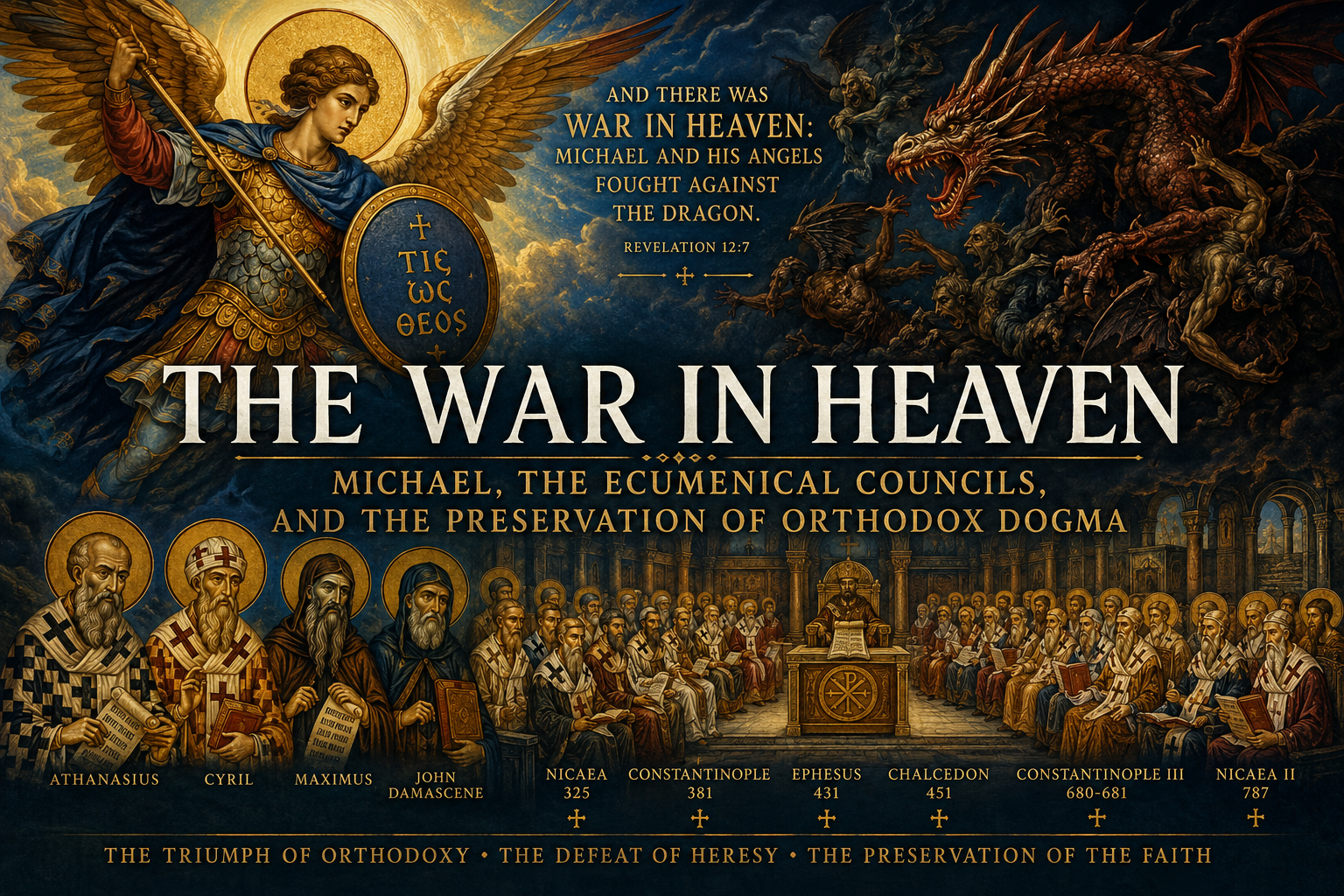
Viewed from this perspective, the great defenders of Orthodoxy appear as historical manifestations of Michael’s army. Athanasius of Alexandria standing against Arius, Cyril of Alexandria opposing Nestorius, Maximus the Confessor resisting Monothelitism, and John of Damascus defending the holy icons all become participants in the same heavenly struggle. They do not replace Michael, nor are they merely symbolic figures. Rather, they are the visible instruments through whom Michael’s victory is revealed within the life of the Church.
A further dimension emerges from Byzantine apocalyptic literature itself. In several Greek Apocalypses of Daniel, the figure of Michael becomes closely associated with the Christian Roman Emperor. This association derives naturally from Daniel 12, where Michael appears as the great prince standing on behalf of God’s people. Within Byzantine political theology, the emperor functioned as the earthly protector of the Christian commonwealth and defender of the Church. Thus Michael could serve both as the heavenly archetype and as a symbolic representation of Orthodox imperial authority. The very meaning of the name Michael—”Who is like unto God?”—made him an especially fitting symbol of rulers called to defend divine truth against earthly pride and rebellion.
This tradition sheds additional light upon the War in Heaven. The victory of Michael was manifested not only through bishops and theologians but also through emperors who convened councils, enforced conciliar decisions, and defended Orthodox doctrine against heresy. Constantine at Nicaea, Theodosius at Constantinople, Marcian at Chalcedon, Constantine IV at the Sixth Ecumenical Council, and Irene at Nicaea II all appear as historical instruments through whom Michael’s victory became visible within the life of the Church.
The War in Heaven therefore possesses both a heavenly and historical dimension. The conflict originates among spiritual realities, yet its effects become visible through bishops, confessors, monks, emperors, and councils who contend for the truth of the Gospel. Through this lens, the Ecumenical Councils themselves may be viewed as the earthly manifestation of Michael’s war against the Dragon, where emperors convened, bishops deliberated, confessors testified, and Orthodox dogma triumphed over heresy.
The Dragon and His Angels
Just as Michael’s victory is manifested through historical defenders of Orthodoxy, so the activity of the Dragon appears through historical agents.
The Dragon remains Satan, the ancient serpent and enemy of mankind. Yet both Lindios and Theodoret interpret his activity through visible forces that oppose the truth. The Dragon’s angels are those who advance false doctrine, corrupt the faith, and seek to overthrow the confession of Christ.
Throughout the first centuries of Christian history this assault took the form of successive doctrinal crises. Arius denied the full divinity of the Son. Nestorius divided the one Christ into separate subjects. Monophysitism confused His natures. Monothelitism denied the completeness of His humanity. Later, the Iconoclast controversy challenged the implications of the Incarnation itself by rejecting the legitimacy of sacred images.
The Dragon’s army therefore appears not merely as a host of invisible spirits but as a succession of historical movements and teachers seeking to corrupt the Church’s confession. The battlefield is theological, and the object of attack remains the same: the truth concerning the God-Man Christ.
The Ecumenical Councils as the Historical War
When viewed through this ecclesiastical lens, the Ecumenical Councils emerge as the visible battlefields of Revelation 12.
The controversies that shook the Church between the fourth and eighth centuries were not secondary disputes concerning discipline or custom. They concerned the identity of Christ and therefore the salvation of mankind itself. Each council represented another stage in the Church’s struggle to preserve the truth against error.
At Nicaea the Church defended the full divinity of the Son against Arianism. At Constantinople she completed the Nicene confession and safeguarded the doctrine of the Holy Trinity. At Ephesus she defended the unity of Christ’s person against Nestorian division. At Chalcedon she proclaimed the two natures of the one Christ. At Constantinople III she defended His two wills and activities. Finally, at Nicaea II she defended the reality of the Incarnation against Iconoclasm.
Each council expelled another manifestation of the Dragon from the doctrinal heaven of the Church. The language of Revelation becomes strikingly appropriate: “Neither was their place found any more in heaven” (Rev. 12:8). Heresy was cast out from the sphere of Orthodox doctrine, and the Church emerged with an ever clearer confession of the God-Man.
The victory described by St. John therefore finds a compelling historical counterpart in the triumph of Orthodox dogma through the Ecumenical Councils. What appears in heaven as the defeat of the Dragon becomes visible on earth through the condemnation of heresy and the preservation of apostolic truth.
Conclusion
The Orthodox interpretation of the War in Heaven does not deny the existence of a genuine conflict among spiritual powers. Rather, it recognizes that heavenly realities frequently manifest themselves through historical events. What St. John beheld in heaven became visible within the life of the Church.
The Woman is the Church. The Child is the dogmatized Christ. The Dragon is Satan working through heresy and deception. Michael is the heavenly defender of Orthodox truth. His angels appear through the Fathers, confessors, bishops, monks, emperors, and councils who preserved the faith once delivered to the saints.
Understood in this way, Revelation 12 presents more than a description of a distant celestial battle. It offers a prophetic portrait of one of the greatest dramas in Christian history: the preservation of the confession of the Incarnate Word against every attempt to corrupt it. The Ecumenical Councils become the visible battlefields of this conflict, and the triumph of Orthodoxy becomes the earthly manifestation of Michael’s victory in heaven.
© 2026 by Jonathan Photius
Notes
- St. Methodius of Olympus, Symposium, Discourse VIII; St. Andrew of Caesarea, Commentary on the Apocalypse, Rev. 12.
- Apostolos Makrakis, The Interpretation of the Apocalypse (Chicago: Orthodox Christian Educational Society, 1948), commentary on Rev. 12:5.
- John Lindios, Interpretation of the Apocalypse, commentary on Revelation 12:7–8, translated from the original Greek manuscript by the author.
- John Lindios, Interpretation of the Apocalypse, commentary on Revelation 12:7–8, translated from the original Greek manuscript by the author.
- Theodoret of Ioannina, Interpretation of the Apocalypse, commentary on Revelation 12:7–11, translated from the original Greek manuscript by the author.
- Greek texts consulted alongside Asterios Argyriou, Les Exégèses Grecques de l’Apocalypse à l’époque Turque (1453–1821) (Thessaloniki, 1982).

