
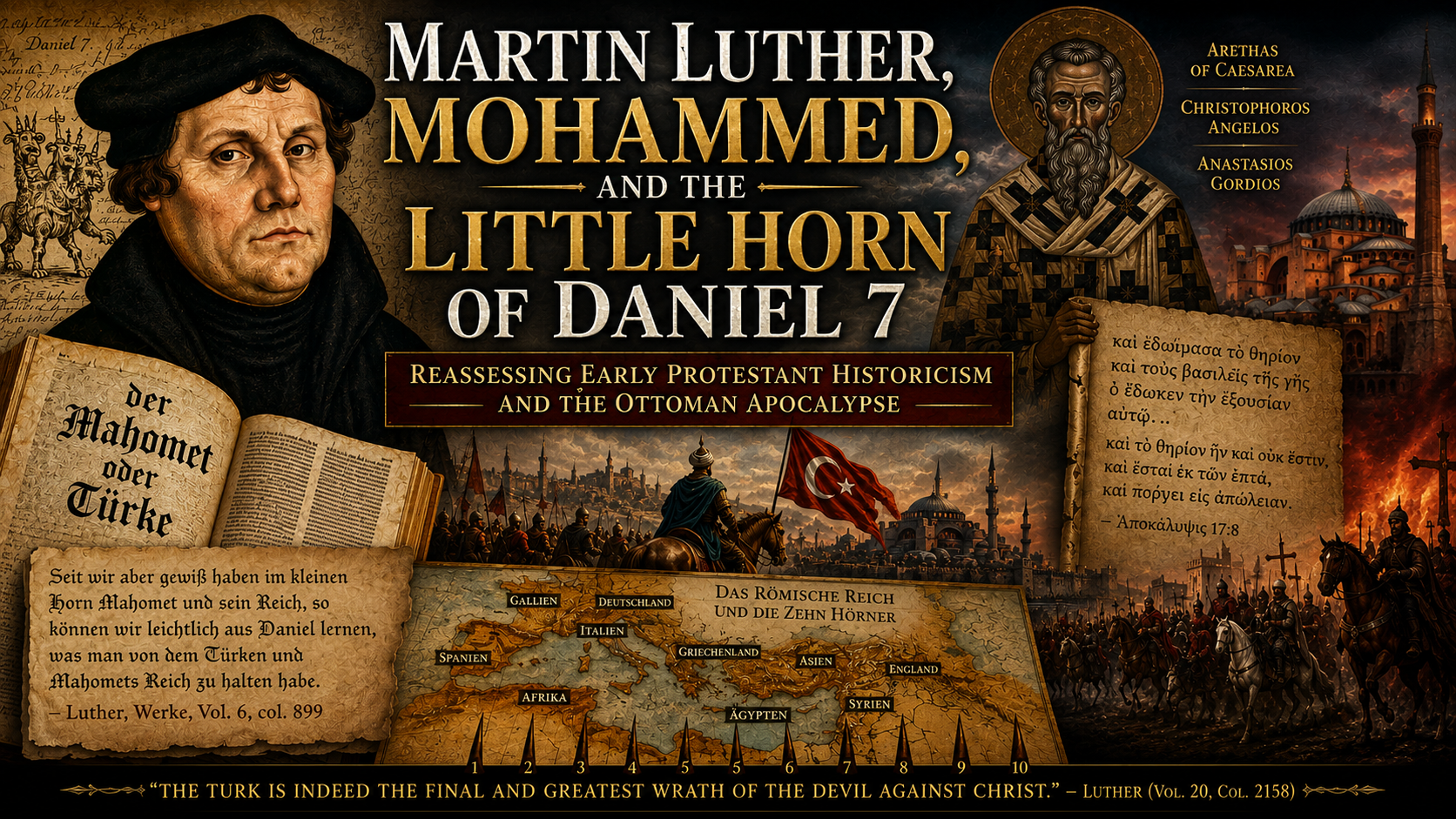
By: Jonathan Photius – The nEO-Historicist Research Project
I. Introduction
Reconsidering the Ottoman Dimension of Early Protestant Historicism
The dominant narrative of early Protestant historicism has long centered almost exclusively upon the identification of the Papacy as Antichrist. From the Magdeburg Centuriators to later Protestant polemicists, the Reformation is frequently portrayed as producing a primarily anti-papal prophetic framework in which the Roman Papacy occupied the chief apocalyptic role within Daniel and Revelation. Yet a closer examination of Martin Luther’s own prophetic writings reveals a far broader and more historically dynamic vision. Alongside his famous anti-papal interpretations, Luther repeatedly integrated Mohammed, the Ottoman Turks, and Islamic imperial expansion into the prophetic structure of Daniel’s Fourth Beast and the Little Horn arising within the divided continuation of the Roman imperial order described in Daniel 7. Far from treating the Ottoman threat merely as a political or military danger, Luther interpreted the rise of the Turks as part of the unfolding drama of sacred history itself. In doing so, he developed an Ottoman-apocalyptic dimension of early Protestant historicism that has often been overlooked within later historiography.
Even more remarkably, Luther’s prophetic worldview developed in striking structural parallel with post-Byzantine Orthodox historicism. Both Protestant and Orthodox interpreters increasingly sought to interpret Ottoman expansion through a continuous-historical reading of prophecy tied to Roman continuity, imperial succession, persecution of the saints, and the unfolding structure of sacred history. This convergence suggests that the Ottoman conquest of the Christian Roman world fundamentally reshaped apocalyptic interpretation across both East and West.
II. The Ottoman Crisis and the Transformation of Apocalyptic Consciousness
The fall of Constantinople in 1453 profoundly transformed Christian eschatological consciousness throughout Europe and the eastern Mediterranean. The collapse of the ancient Christian Roman capital under Ottoman conquest was not perceived merely as a geopolitical catastrophe, but as a theological and civilizational crisis. Former Byzantine territories continued falling under Islamic dominion while Ottoman armies advanced steadily into Southeastern Europe and eventually toward Vienna itself. Under such conditions, both Protestant and Orthodox interpreters increasingly sought to situate Islam and Ottoman expansion within the prophetic architecture of Daniel and Revelation.
For Byzantine and post-Byzantine Christians especially, Ottoman conquest represented the collapse of the Christian Roman oikoumene itself. Ancient patriarchates, monastic centers, and apostolic sees came under Islamic rule. Consequently, Ottoman dominion was interpreted not merely politically, but providentially and apocalyptically. Similar concerns emerged in the West as Protestant interpreters increasingly integrated the Turks into their prophetic worldview alongside papal corruption and ecclesiastical decline.
III. Luther’s Continuous-Historical Reading of Daniel
The Four Kingdoms
Luther’s interpretation of Daniel follows the classic continuous-historical succession of world empires: Babylon, Persia, Greece, and Rome. In his exposition of Daniel 7, Luther writes:
“The first beast, the kingdom of Assyria and Babylon, is the lion with the golden eagle’s wings… The second beast, the bear, is the kingdom of Persia and Media… The third beast, the leopard with four wings and four heads, is the kingdom of great Alexander in Greece… The fourth beast, with iron teeth, is the truly dreadful and final kingdom, namely the Roman Empire.”¹
This historical framework is essential for understanding Luther’s Ottoman historicism. Daniel’s prophecies are not treated merely symbolically or futuristically, but as progressively unfolding sacred history extending from the ancient world into Luther’s own age.
Divided Rome and the Ten Horns
Particularly important within Luther’s interpretation is his understanding of the ten horns as the divided continuation of the Roman Empire after the collapse of ancient imperial unity. Commenting upon the iron legs and divided toes of Daniel’s image, Luther writes:
“Thus the Roman Empire is divided, so that Spain, France, England, and many other parts have arisen from it. Yet it has nevertheless grown forth and been, as it were, transplanted from the Greeks to the Germans; so that the iron toes still remain, for it still possesses its cities, offices, laws, and customs as it had in former times.”²
Luther therefore viewed the post-Roman kingdoms of Europe not as entirely new civilizations detached from Rome, but as continuing manifestations of the Roman imperial structure itself. The divided kingdoms retained continuity with the Fourth Beast through inherited political institutions, territories, and imperial succession. He further insists:
“It must remain until the Last Day, however weak it may become. For Daniel does not say otherwise, and experience up to this day proves it.”³
Within this framework Luther explicitly identifies the ten kingdoms arising from divided Rome as:
“Syria, Egypt, Asia, Greece, Africa, Spain, Gaul, Italy, Germany, and England.”⁴
This list is extraordinarily important because it reveals that Luther’s prophetic geography extended beyond Western Europe alone. Former Byzantine and eastern Mediterranean territories remained part of the Roman prophetic structure. Consequently, when Luther later identifies Mohammed and the Turks with the Little Horn, he does so within a specifically Roman-historical framework.
IV. “Mahomet oder Türke”: Luther’s Little Horn Interpretation
The most significant aspect of Luther’s Ottoman historicism appears in his explicit identification of Mohammed and the Turks with Daniel’s Little Horn. Commenting directly upon Daniel 7, Luther writes:
“A little horn shall also come forth from among them and shall pluck out three of the foremost horns of the ten. This is Mohammed or the Turk, who today has Asia, Egypt, and Greece in his claws.”⁵
Elsewhere Luther states even more directly:
“Since we have for certain in the little horn, Mohammed and his empire, we can easily learn from Daniel what should be thought about the Turk and Mohammed’s kingdom.”⁶
These statements are historically remarkable because Luther is not merely employing anti-Islamic rhetoric. Rather, he is integrating Ottoman dominion directly into the prophetic structure of Daniel itself. The Little Horn becomes a historical and imperial reality manifesting through Islamic conquest and Ottoman expansion.
Luther and the Later Protestant Historicist Tradition
Later Protestant historicists would increasingly standardize the interpretation of the Little Horn of Daniel 7 as the Papacy, while often relocating Islam and Mohammedanism primarily to Daniel 8. Yet Luther’s own writings reveal a more fluid and historically immediate interpretive framework in which Mohammed and the Ottoman Turks could themselves function as the Little Horn arising within the divided Roman order. Although Luther appears in some earlier writings to have identified the Papacy with the Little Horn of Daniel 7, his later expositions increasingly applied the symbol directly to Mohammed and the Ottoman Empire. This development may perhaps be explained by the growing Ottoman threat to Christendom and possibly even by increased Protestant engagement with Greek Christians and the post-Constantinopolitan Byzantine world.
V. The Ottoman Empire Within the Fourth Beast
Perhaps the most striking aspect of Luther’s interpretation is his explanation for why the Ottoman Empire belongs within Daniel’s Fourth Beast. Luther explicitly argues that the Turkish Empire inherited territories formerly belonging to the Roman-Christian world and therefore prophetically belonged within the Roman imperial structure itself:
“The Turk and Mohammed’s kingdom also belong to the Roman Empire, even though they oppose God.”⁷
He explains further that the Ottoman Empire possessed:
“Greece, Egypt, Asia, Africa… and the Turkish or Mohammedan kingdom, which the Turk now possesses.”⁸
This represents a remarkably sophisticated form of sacred-historical geopolitics. Luther’s logic depends upon territorial succession, imperial continuity, and the inheritance of former Roman-Christian lands. Because the Ottoman Empire conquered and inherited territories formerly belonging to the Christian Roman world, Luther concluded that it prophetically belonged within Daniel’s Fourth Beast.
This interpretive mechanism is absolutely essential to Luther’s system. The Turks are not external invaders detached from the Roman prophetic structure. Rather, Ottoman dominion becomes part of the continuing history of the divided Roman world itself.
VI. The Three Horns and Ottoman Expansion
Luther also interprets the uprooting of “three horns” before the Little Horn as corresponding to Ottoman conquest over major eastern regions formerly belonging to the Roman world. Discussing Daniel 7, he states:
“Three kingdoms were removed before him…”⁹
Luther specifically connects these conquered regions to territories such as Egypt, Greece, and Asia that had come under Ottoman domination. Ottoman expansion itself thus became evidence of prophetic fulfillment within Daniel’s horn structure.
This aspect of Luther’s interpretation is especially important because it demonstrates how deeply historical and geopolitical his prophetic method actually was. Ottoman conquest was not merely contemporary history; it was sacred history unfolding before the eyes of Christendom.
VII. The Turk as Divine Scourge and Final Persecutor
Luther consistently interpreted Ottoman power as both satanic persecution and divine chastisement. In one of his most powerful apocalyptic statements, he writes:
“Therefore hold firmly and be certain that the Turk is indeed the final and greatest wrath of the devil against Christ… moreover he is also the greatest punishment of God upon earth against the impenitent and godless despisers and persecutors of Christ and His Word.”¹⁰
The Turks thus become simultaneously:
- agents of satanic opposition,
- instruments of divine judgment,
- and signs of the approaching end.
Luther continues:
“For Daniel says that after the Turks there shall soon follow the Judgment and hell.”¹¹
This language moves far beyond ordinary anti-Ottoman polemic. Ottoman expansion is explicitly situated within the final stage of sacred history preceding the Last Judgment itself.
VIII. Eyes and Mouth: Outward Tyranny and Inward False Doctrine
Particularly fascinating is Luther’s symbolic interpretation of the Little Horn’s “eyes” and “mouth.” He explains that the “eyes” signify worldly wisdom, political power, and outward government, while the “mouth” signifies false doctrine and blasphemy against Christ.¹² Luther then applies this symbolism directly to Islam and Mohammed:
“All this happens outwardly through persecution and inwardly through false teaching.”¹³
This distinction is extraordinarily important. Luther here develops a dual structure of opposition to Christianity:
- outward persecution through imperial domination,
- inward corruption through false doctrine and blasphemy.
Such formulations begin approaching composite antichrist structures that later appeared in more developed forms within both Protestant and Orthodox historicism.
IX. The Pope and the Turk: Composite Antichrist Structures
In several Table Talk traditions and later reports, Luther appears at times to synthesize papal corruption and Ottoman persecution into one broader antichristian structure. One famous report attributed to Luther states:
“The body of the Antichrist is as well the pope as the Turk… The spirit of the Antichrist is the pope, his flesh is the Turk.”¹⁴
Whether every wording of these later reports can be verified precisely in surviving editions, the broader conceptual structure clearly aligns with Luther’s authenticated prophetic writings. Papal corruption and Ottoman persecution were not always treated as mutually exclusive prophetic categories. Rather, Luther sometimes understood them as complementary manifestations of a larger antichristian reality.
X. Protohistoricist Trajectories in Byzantine and Post-Byzantine Orthodoxy
Arethas of Caesarea
Long before the rise of mature Protestant historicism, Byzantine apocalyptic interpretation had already begun integrating Islam into prophetic reflection. Certain manuscript traditions associated with Arethas of Caesarea linked Saracen powers with imagery from Revelation 13, creating protohistoricist trajectories later developed more fully after the Ottoman conquest of Constantinople.¹⁵ While Arethas himself was not a full historicist in the later Protestant sense, these traditions became increasingly important within post-Byzantine apocalyptic interpretation.
Christophoros Angelos
These developments intensified significantly after 1453. The Greek Orthodox writer Christophoros Angelos, publishing in England in 1624, interpreted Ottoman dominion through apocalyptic chronology and sacred history. Significantly, Angelos predates Joseph Mede’s Clavis Apocalyptica by approximately three years.¹⁶ Angelos interpretaion includes 1260-year calculations measured from Mohammed’s rise, which appears to be the first applicatoin of the 1260-day/42-month times statements applied to Islamic domination. Like Luther, Angelos integrated Islam into a continuous-historical prophetic structure tied to Roman continuity and the unfolding drama of sacred history.
Anastasios Gordios
The parallels become even more striking in the writings of Anastasios Gordios. Gordios explicitly states that he had studied earlier commentators such as Arethas while contemplating the prophetic passages concerning the Beast and the kingdoms of Daniel and Revelation.¹⁷ In Gordios, Islam and the Papacy become twin persecuting powers within sacred history itself. Ottoman dominion is interpreted simultaneously as divine chastisement, apocalyptic oppression, and part of the providential unfolding of the final age. These themes strongly parallel Luther’s own dual emphasis upon outward persecution and inward false doctrine.
XI. Parallel Structures Between Protestant and Orthodox Historicism
The similarities between Luther’s Ottoman historicism and post-Byzantine Orthodox apocalypticism are striking. Both traditions:
- interpreted prophecy continuously through history,
- understood the Roman world as prophetically enduring,
- integrated Ottoman conquest into sacred history,
- viewed Islam as both persecuting and doctrinally hostile,
- and interpreted the Ottoman Empire as part of the final historical drama before judgment.
Importantly, these parallels do not necessarily require direct literary dependence. Rather, both Protestant and Orthodox interpreters were responding to the same immense historical crisis: the collapse of the Christian Roman East under Islamic conquest and the continuing Ottoman threat to Christendom. In both East and West alike, prophecy increasingly became a framework for interpreting the unfolding catastrophe of history itself.
XII. Conclusion
Reassessing the Origins of Historicism
The evidence demonstrates that early Protestant historicism was originally broader, more fluid, and more Ottoman-apocalyptic than later simplified narratives often acknowledge. Luther’s prophetic worldview integrated Mohammed, the Turks, divided Rome, imperial succession, persecution of the saints, and final judgment into one continuous-historical interpretation of Daniel’s Fourth Beast.
Moreover, Luther’s Ottoman historicism developed in remarkable structural parallel with post-Byzantine Orthodox apocalyptic interpretation. In both traditions, Islamic expansion became part of sacred history itself. The Ottoman conquest of the Christian Roman world forced both East and West alike to rethink prophecy historically. In Luther, Angelos, and Gordios alike, the Apocalypse became not merely a vision of the distant future, but the unfolding drama of sacred history itself.
© 2026 by Jonathan Photius
Footnotes
- Martin Luther, Dr. Martin Luthers Sämmtliche Schriften, ed. Johann Georg Walch, vol. 6 (St. Louis: Concordia Publishing House), cols. 902–903.
- Ibid., col. 899.
- Ibid.
- Ibid., col. 903.
- Ibid.
- Ibid., cols. 898–900.
- Martin Luther, Dr. Martin Luthers Sämmtliche Schriften, ed. Johann Georg Walch, vol. 20 (Halle, 1747), cols. 2162–2163.
- Ibid.
- Ibid., cols. 2160–2161.
- Ibid., col. 2158.
- Ibid.
- Ibid., cols. 2162–2163.
- Ibid.
- Le Roy Edwin Froom, The Prophetic Faith of Our Fathers, vol. 2 (Washington, D.C.: Review and Herald, 1948), 269–272.
- A. A. Agryriou, Les Exégèses grecques de l’Apocalypse à l’époque turque (1453–1821) (Thessaloniki: Patriarchal Institute for Patristic Studies, 1982).
- Christophoros Angelos, Apocalypse Interpretation (London, 1624); Joseph Mede, Clavis Apocalyptica (Cambridge, 1627).
- Anastasios Gordios, Treatise Concerning Mohammed and Against the Latins, manuscript traditions discussed in Agryriou, Les Exégèses grecques de l’Apocalypse.

