
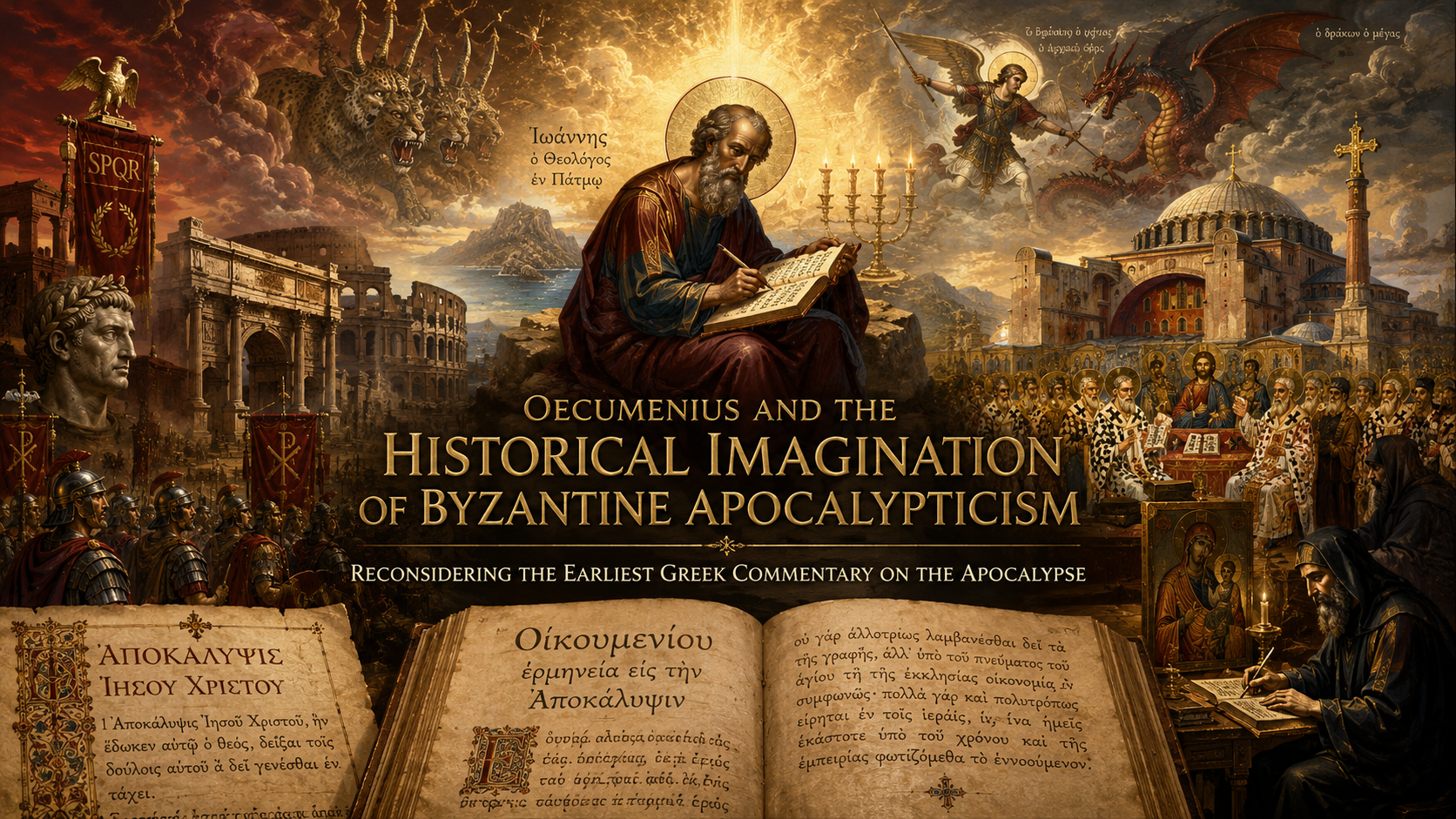
Reconsidering the Earliest Greek Commentary on the Apocalypse
By Jonathan Photius – The NEO-Historicism Research Project
Abstract
The commentary on the Apocalypse attributed to Oecumenius has often been characterized in modern scholarship as predominantly allegorical, anti-chiliastic, and derivative of earlier patristic traditions. Yet a close reading of the full commentary reveals a more historically conscious and ecclesially grounded exegetical method than is commonly recognized. This article argues that Oecumenius represents an important transitional stage in Byzantine apocalyptic interpretation in which symbolic exegesis, ecclesiastical history, imperial theology, and historical consciousness coexist within a unified sacramental worldview. Far from reducing Revelation to abstract spirituality, Oecumenius repeatedly interprets the Apocalypse through the concrete realities of Roman imperial order, persecution, doctrinal conflict, and the historical life of the Church. Particular attention is given to his treatment of Rome, Danielic kingdom imagery, Revelation 12, ecclesiastical warfare, and the relationship between heavenly and historical realities. The study further argues that Oecumenius helps illuminate the developmental continuity between early Byzantine exegesis and later Orthodox historico-symbolic interpreters such as Andrew of Caesarea, Theodoret of Ioannina, John of Myra, and Apostolos Makrakis. In doing so, the article challenges the modern dichotomy between “allegorical” and “historicist” interpretation and proposes instead that Byzantine apocalypticism often operated through a symbolic-historical ecclesiology in which history itself became an arena of apocalyptic revelation.
Introduction
The history of Byzantine interpretation of the Book of Revelation has frequently been framed through overly rigid modern categories. Scholars have often divided apocalyptic interpretation into opposing camps: allegorical versus literal, spiritual versus historical, or patristic versus historicist. Within this framework, the commentary attributed to Oecumenius has typically been classified as predominantly spiritual and anti-chiliastic, lacking sustained historical engagement.¹
Yet a comprehensive reading of the commentary complicates this characterization considerably.
Although Oecumenius unquestionably rejects crude millenarian literalism, his interpretation of Revelation remains deeply embedded in the historical life of the Church and the imperial world of late antiquity. Throughout the commentary, symbolic imagery repeatedly intersects with concrete historical realities: Roman imperial rule, persecution, doctrinal controversy, ecclesiastical struggle, and the unfolding destiny of Christian civilization. The result is neither later chronological historicism in the post-Reformation sense nor mere abstract allegory, but something more distinctly Byzantine: a symbolic-historical theology of sacred history.
This article argues that Oecumenius should be understood as an important transitional figure within the Greek apocalyptic tradition. His commentary preserves early evidence of a Byzantine historical imagination that would later develop more fully in medieval and post-Byzantine Orthodox interpreters. While Oecumenius does not construct systematic prophetic chronologies, he consistently reads Revelation as unfolding within the historical existence of the Church.
Oecumenius and the Historical Horizon of Revelation
One of the most striking features of the commentary is the persistent presence of history beneath the symbolic surface of the text. Oecumenius does not approach Revelation as a detached mystical allegory. Rather, the Apocalypse is continually interpreted within the context of the Church’s struggle in time.
This becomes especially visible in his treatment of imperial imagery and the continuity between Daniel and Revelation. In one particularly significant passage, Oecumenius remarks that the prophet spoke “in his desire to hint at the rule of the Romans.”² Such a statement is revealing for several reasons.
First, it demonstrates that apocalyptic symbols are not treated as abstractions detached from historical referents. The Roman Empire remains a living theological category within the commentary. Second, it places Oecumenius squarely within the older Christian interpretive tradition that identified Daniel’s fourth kingdom with Rome.³ Third, it suggests that imperial history itself forms part of the interpretive horizon of Revelation.
This historical consciousness is crucial. Oecumenius repeatedly assumes that apocalyptic realities manifest themselves within the structures of historical existence. Rome is not merely a past empire; it functions as a theological reality intertwined with divine providence and eschatological order.
Such an approach anticipates later Byzantine apocalyptic traditions concerning the destiny of the Roman Empire and the notion of Christian imperial continuity. While Oecumenius himself does not develop later medieval “Last Roman Emperor” traditions in explicit form, the conceptual foundations are already visible: empire, ecclesiastical order, and sacred history remain deeply interconnected.
Revelation 12 and the Historical Life of the Church
Perhaps nowhere is Oecumenius’s historical imagination more evident than in his interpretation of Revelation 12. Modern interpreters frequently reduce the chapter either to the incarnation and ascension of Christ or to exclusively future eschatological events. Oecumenius, however, reads the vision in a manner that extends beyond a single isolated moment of sacred history.
Oecumenius primarily identifies the woman with the Theotokos, since she gives birth to the Messiah who is destined to rule the nations. Much of the chapter is therefore interpreted through the historical events surrounding Christ’s birth, the flight into Egypt, the Passion, and the Resurrection. Yet the vision does not remain confined to the historical life of Mary alone. As the narrative unfolds, the dragon turns his warfare toward “the rest of her offspring,” whom Oecumenius explicitly identifies as “the faithful,” the sons and brothers of the Lord.⁴ The conflict therefore expands from the historical Nativity into the continuing persecution of believers throughout history.
This observation is particularly significant because it reveals a mode of interpretation distinct from both strict futurism and flattened realized eschatology. The cosmic conflict of Revelation is not exhausted in a single past event, nor postponed entirely to a final tribulation. Rather, apocalyptic realities continue to reverberate throughout the historical life of the faithful community. The dragon’s war unfolds through tyrants, rulers, persecutions, temptations, and martyrdoms directed against those who “keep the commandments of God and bear testimony to Jesus.”
Such an approach resonates strongly with later Byzantine understandings of doctrinal conflict as spiritual warfare. Theological controversies were not viewed merely as intellectual disputes but as manifestations of a deeper cosmic struggle unfolding within history itself. The casting down of the dragon could therefore be understood analogically through the defeat of heresy, while ecclesiastical judgment reflected heavenly warfare.
This symbolic-historical framework helps explain why later Byzantine interpreters increasingly read Revelation through the history of councils, schisms, invasions, persecutions, and imperial crises without believing they had abandoned patristic principles of interpretation. The Apocalypse became not merely a prophecy of isolated future events, but the continuing historical drama of Christ and His Church unfolding through time.
Ecclesiology, Cosmic Warfare, and Dogmatic History
A defining characteristic of Byzantine apocalypticism is its profoundly ecclesial orientation. Oecumenius consistently interprets Revelation through the life of the Church rather than through speculative chronological systems.
Yet this ecclesial focus does not eliminate historical consciousness. On the contrary, it intensifies it.
Heavenly realities become manifest historically through:
- councils,
- martyrdom,
- persecution,
- imperial conflict,
- doctrinal controversy,
- and ecclesiastical judgment.
The heavenly liturgy mirrors the earthly Church; angelic warfare corresponds to doctrinal conflict; divine judgment appears within the movement of history itself.
This is particularly important for understanding the later Byzantine tendency to interpret ecclesiastical history apocalyptically. The development of dogma, the condemnation of heresies, and the defense of orthodoxy could all be understood as manifestations of the Apocalypse within history.
Such a framework eventually made possible later Orthodox historico-symbolic readings in which the Seven Ecumenical Councils, Islamic expansion, imperial decline, and ecclesiastical crises were interpreted through apocalyptic categories while still preserving symbolic and theological interpretation.
Beyond the False Dichotomy: Allegory versus Historicism
Oecumenius’s interpretation of Revelation 12 illustrates a broader characteristic of Byzantine apocalyptic exegesis. The modern opposition between allegorical and historical interpretation often obscures the distinctive nature of the Greek tradition, in which symbolic, theological, ecclesial, and historical meanings frequently coexist within the same vision.
His commentary is simultaneously:
- symbolic,
- ecclesial,
- theological,
- and historical.
Apocalyptic symbols are polyvalent. A single image may refer simultaneously to:
- spiritual realities,
- ecclesiastical realities,
- historical realities,
- and eschatological realities.
This interpretive flexibility is one of the defining characteristics of Byzantine apocalypticism. Symbols are not emptied of history by becoming spiritual, nor are they reduced to literal chronology by acquiring historical referents.
Instead, history itself becomes sacramental. The Church’s life in time participates in heavenly realities. Earthly events reveal transcendent truths. Revelation unfolds not merely at the end of history but within the historical pilgrimage of the people of God.
This symbolic-historical ecclesiology may ultimately provide a more accurate category for Byzantine apocalyptic interpretation than either “allegorical” or “historicist.”
Oecumenius and the Development of Orthodox Historico-Symbolic Interpretation
The significance of Oecumenius becomes even clearer when viewed alongside later Orthodox interpreters.
The commentary of Andrew of Caesarea would later stabilize and systematize Byzantine Revelation exegesis, often in a more cautious and restrained form.⁵ Yet many of the interpretive instincts already visible in Oecumenius remain present:
- the ecclesial nature of Revelation,
- the relationship between heavenly and historical realities,
- the continuity between Daniel and Revelation,
- and the openness of apocalyptic symbols to historical manifestation.
As Eugenia Scarvelis Constantinou has demonstrated, Andrew understood prophetic interpretation as something clarified progressively through time and experience.⁶ Revelation was not treated as exhausted within a single historical moment, but as a text whose meaning unfolded within the life of the Church across history.
Later post-Byzantine interpreters would develop these tendencies more explicitly. Writers such as:
- Christophoros Angelos,
- Theodoret of Ioannina,
- John of Myra,
- and Apostolos Makrakis
would increasingly interpret Revelation through unfolding historical realities including imperial collapse, Islamic expansion, ecclesiastical crisis, and prophetic chronology.
The continuity is neither absolute nor simplistic. Oecumenius himself does not construct later chronological systems. Nevertheless, his commentary preserves important interpretive instincts and symbolic-historical patterns that helped make later Orthodox historico-symbolic interpretation possible.
Conclusion
The commentary of Oecumenius deserves renewed attention within the history of Christian apocalyptic interpretation. Far from representing a merely abstract or ahistorical allegorism, the commentary reveals a deeply historical and ecclesial imagination in which Revelation unfolds through the lived experience of the Church.
Oecumenius stands at an important transitional point in Byzantine exegesis:
- rooted in patristic symbolic theology,
- shaped by Roman imperial consciousness,
- attentive to ecclesiastical history,
- and open to the manifestation of apocalyptic realities within time.
His work ultimately challenges modern interpretive binaries. Byzantine apocalypticism was neither purely allegorical nor narrowly historicist. It often operated through a symbolic-historical theology of sacred history in which heaven and earth, liturgy and empire, doctrine and cosmic warfare converged within the historical life of the Church.
In this sense, Oecumenius may be understood not as a fully developed historicist interpreter, but as one of the earliest and most important witnesses to the historical imagination of Byzantine apocalyptic thought.
© 2026 by Jonathan Photius
Notes
- Eugenia Scarvelis Constantinou, Guiding to a Blessed End: Andrew of Caesarea and His Apocalypse Commentary in the Ancient Church (Washington, D.C.: Catholic University of America Press, 2013), 25–39.
- Oecumenius, Commentary on the Apocalypse, commentary on Revelation 10.
- See Irenaeus, Against Heresies 5.26–30; Hippolytus of Rome, On Christ and Antichrist.
- Oecumenius, Commentary on the Apocalypse, commentary on Revelation 12.
- Constantinou, Guiding to a Blessed End, 40–65.
- Ibid., 203–205.

