By Jonathan Photius – The NEO-Historicism Research Project
Introduction
Among the many images found within the Apocalypse of St. John, few have exercised a greater influence upon Christian imagination than the vision of the Woman clothed with the sun fleeing into the wilderness. Throughout the centuries, interpreters have debated the identity of the Woman, the nature of the wilderness, and the significance of the mysterious “two wings of the great eagle” by which she escapes the wrath of the Dragon. While many modern readers focus upon the persecution itself, the text repeatedly directs attention to another theme that is often overlooked. The Woman is not merely hidden in the wilderness; she is nourished there. The question therefore arises: what is the nature of this nourishment, and how does God preserve His Church throughout the long centuries of trial described by the vision?
Several interpreters of the Post-Byzantine Orthodox tradition approached this question in a manner that deserves renewed attention. Metropolitan John Lindios of Myra, Theodoret of Ioannina, and Apostolos Makrakis each understood the Woman not as an abstract symbol but as the historical Orthodox Church preserving the apostolic faith amid successive waves of persecution. Although their interpretations differ in emphasis, they collectively present a vision of the Church sustained by right doctrine, Holy Scripture, ascetical discipline, and divine grace. When read alongside the theology of St. Gregory Palamas, these interpretations reveal a profound understanding of the spiritual life of the Church during her wilderness pilgrimage. The flight of the Woman becomes not merely a story of survival, but a testimony to the preservation of the revelation of Jesus Christ through prayer, worship, doctrine, and participation in the divine life.
The importance of this theme becomes increasingly evident when Revelation is viewed not simply as a catalogue of future events, but as the unfolding history of the Body of Christ. The central concern of the Apocalypse is announced in its opening words: it is “The Revelation of Jesus Christ” (Rev. 1:1). The preservation of that revelation, and of the Church entrusted with its proclamation, becomes one of the dominant themes of the entire book. In this sense, the wilderness of Revelation 12 may be understood as one of the most important chapters in the history of Orthodoxy itself.
The Woman and the Historical Church
The identification of the Woman with the Church is ancient and widespread within Christian tradition. Yet several Post-Byzantine interpreters move beyond a general ecclesiastical interpretation and identify the Woman more specifically with the historical Eastern and Apostolic Church. John Lindios explicitly states that the Woman signifies “the Holy Eastern and Apostolic Church of Christ,” a Church that continually gives birth to multitudes of saints through the grace of the Holy Spirit. Likewise, Theodoret of Ioannina understands the persecution of the Woman not primarily as the persecutions of the Roman emperors but as the later afflictions endured by the Orthodox Church after the completion of the Seven Ecumenical Councils. In his interpretation, the assaults of the Latins and the followers of Hagar constitute the historical context of the Church’s wilderness existence.
This perspective is significant because it places Revelation 12 within the continuing history of Orthodoxy rather than restricting its fulfillment to a single moment in the past or future. The Woman is not merely a symbol of the Church at one point in time. She is the Church throughout her historical pilgrimage, preserving the apostolic testimony amid changing political and religious circumstances. The wilderness therefore becomes not merely a geographical location but a condition of existence in which the Church survives without reliance upon worldly power.
Such an interpretation resonates deeply with the experience of Eastern Christianity. From the rise of Islam and the gradual loss of ancient patriarchates to the fall of Constantinople and the long centuries of Ottoman domination, the Orthodox Church frequently found herself deprived of imperial protection while continuing to preserve her faith, worship, and theological inheritance. The wilderness is thus revealed not as a place of abandonment but as a place prepared by God.
The Christological Wings of the Great Eagle
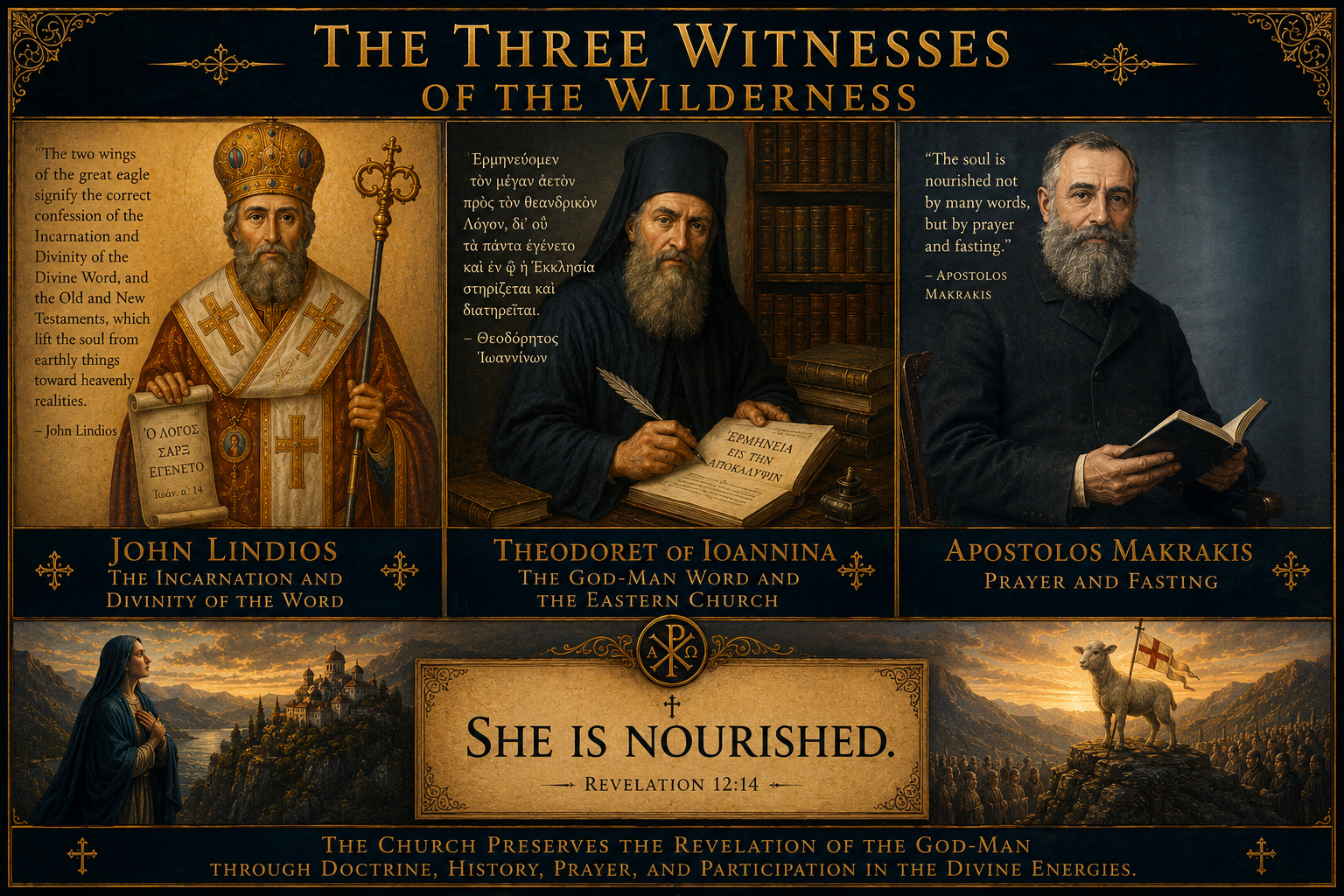
Perhaps the most remarkable contribution of John Lindios and Theodoret concerns their interpretation of the two wings of the great eagle. Rather than identifying the wings with political powers or historical alliances, both commentators interpret them in explicitly Christological terms. Lindios teaches that the wings signify the correct confession of the Incarnation and Divinity of the Divine Word. He further identifies them with the Old and New Testaments, whose revelation lifts the soul from earthly concerns toward heavenly realities. Similarly, Theodoret interprets the great eagle itself in relation to the God-Man Word, thereby grounding the entire image in the mystery of Christ.
These interpretations deserve careful consideration because they place the Incarnation at the center of the vision. The Woman escapes the Dragon not through military strength or political influence but through fidelity to the truth concerning Jesus Christ. The wings by which she ascends are the very doctrines that occupied the attention of the Ecumenical Councils: the full divinity of Christ, His true humanity, and the union of both in the one Person of the Incarnate Word. The Church survives because she preserves the revelation of the God-Man.
Viewed in this light, Revelation 12 assumes a profoundly Christological character. The flight of the Woman is inseparable from the Church’s struggle to preserve the truth expressed at Nicaea, Constantinople, Ephesus, Chalcedon, and the subsequent councils. The wilderness becomes the historical arena in which the Church safeguards the mystery proclaimed by St. John: “And the Word became flesh and dwelt among us” (John 1:14).
St. John the Theologian and the Eagle
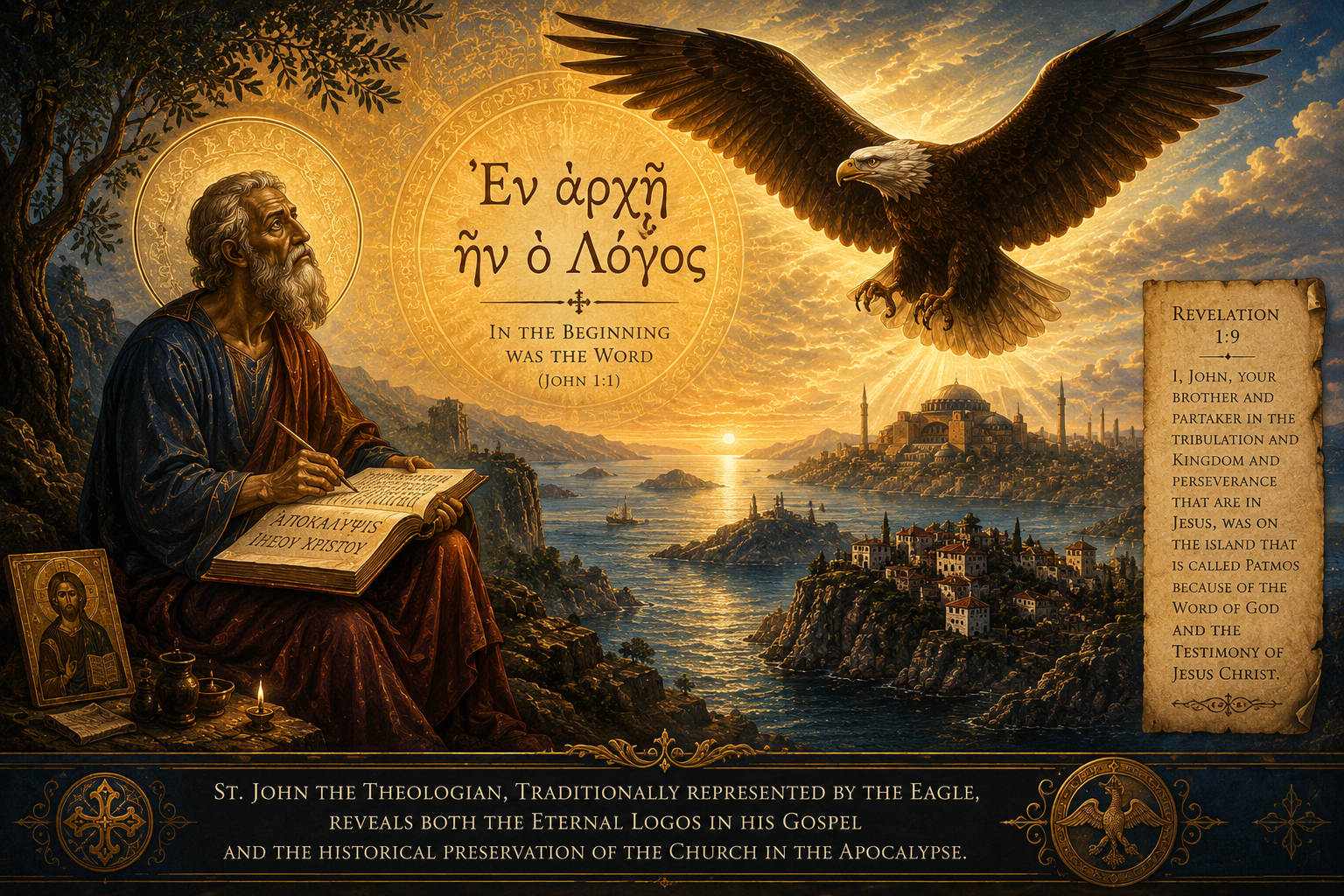
Among the four Evangelists, St. John has long been represented by the eagle, the highest-flying of the creatures associated with the heavenly tetramorph of Ezekiel and Revelation. The Fathers frequently explain that while Matthew emphasizes Christ’s humanity, Mark His royal authority, and Luke His priestly ministry, John rises above earthly events to contemplate the eternal and divine nature of the Word. Like an eagle ascending beyond the clouds and gazing directly toward the sun, John directs the reader toward the deepest mysteries of the Godhead.
This symbolism is immediately evident in the opening words of his Gospel. Whereas Matthew begins with Christ’s genealogy, Mark with the ministry of John the Baptist, and Luke with the events surrounding Christ’s birth, John ascends beyond time itself: “In the beginning was the Word, and the Word was with God, and the Word was God” (John 1:1). Before speaking of Bethlehem, Nazareth, or Galilee, John reveals the eternal existence of the Logos before all creation. He contemplates not merely what Christ did, but who Christ is.
Throughout the Gospel, John repeatedly emphasizes truths that reveal Christ’s divinity. He records the declaration that “the Word became flesh and dwelt among us” (John 1:14), uniting eternity and history in the mystery of the Incarnation. He preserves Christ’s great “I AM” sayings, echoing the divine name revealed to Moses at the burning bush. Christ proclaims, “Before Abraham was, I AM” (John 8:58), a statement so explicit that His hearers attempted to stone Him for blasphemy. John alone records Christ’s teaching, “I and My Father are one” (John 10:30), as well as the confession of Thomas after the Resurrection: “My Lord and my God” (John 20:28).
The eagle symbolism becomes even more fitting when one considers John’s unique emphasis on heavenly realities. Much of his Gospel consists of profound theological discourses concerning eternal life, the relationship between the Father and the Son, the coming of the Holy Spirit, and the union of believers with God. His vision continually ascends from visible things to invisible realities, from earthly signs to heavenly truths. The miracles themselves are presented as “signs” pointing beyond themselves to deeper spiritual mysteries.
This traditional symbolism acquires special significance when considered alongside the imagery of Revelation. The same apostle who revealed the mystery of the eternal Logos also received the vision of the Woman carried by the wings of the great eagle. Whether or not the eagle of Revelation 12 should be identified directly with John himself, the theological connection is difficult to ignore. The eagle symbolizes ascent to divine realities, contemplation of heavenly mysteries, and the preservation of the truth concerning the Incarnate Word. These themes permeate both the Gospel and Apocalypse of St. John.
Seen in this light, the interpretation of the great eagle offered by John of Myra and Theodoret becomes even more profound. The eagle is not merely an image of protection or escape. It points ultimately to Christ Himself and to the divine revelation of His Incarnation and divinity. Just as the Evangelist John soars above earthly concerns to proclaim the mystery of the Word made flesh, so the Woman is carried by the wings of those same Christological truths, preserved in the wilderness through her confession of the God-Man Word.
The connection becomes even more striking when considered in relation to the Orthodox understanding of Holy Wisdom. The great cathedral of Hagia Sophia in Constantinople was dedicated not to a saint named Sophia but to Christ Himself as the Wisdom of God. The city that served as the center of Orthodox civilization for over a millennium placed the mystery of Divine Wisdom at the heart of its identity. The repeated calls to wisdom throughout Revelation, culminating in the famous declaration “Here is wisdom” (Rev. 13:18), therefore acquire a distinctly Johannine significance. The wisdom sought by the Church is ultimately the revelation of Christ Himself.
The Wilderness and the Monastic Refuge
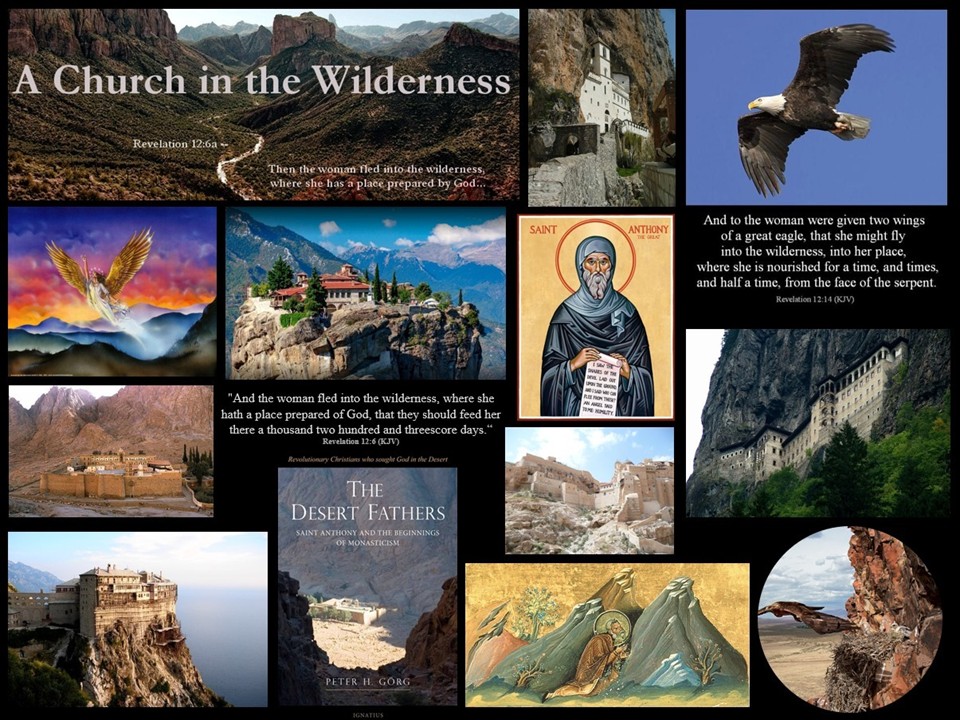
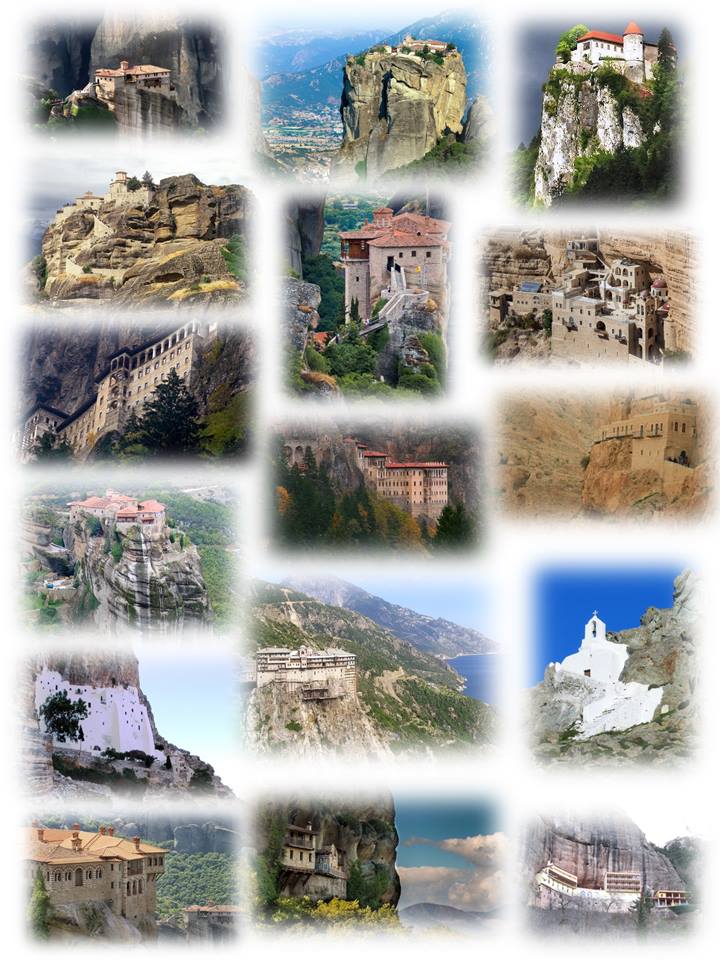
While Lindios and Theodoret emphasize the doctrinal dimension of the wilderness flight, Apostolos Makrakis develops its ascetical significance. His interpretation identifies the wilderness with the monastic refuge prepared by God for the preservation of the Church. Throughout the centuries of political upheaval, monasteries became centers of worship, learning, manuscript preservation, and spiritual formation. Places such as Mount Athos, Meteora, Sinai, and countless lesser-known monastic communities served as living testimonies to the enduring vitality of Orthodoxy.
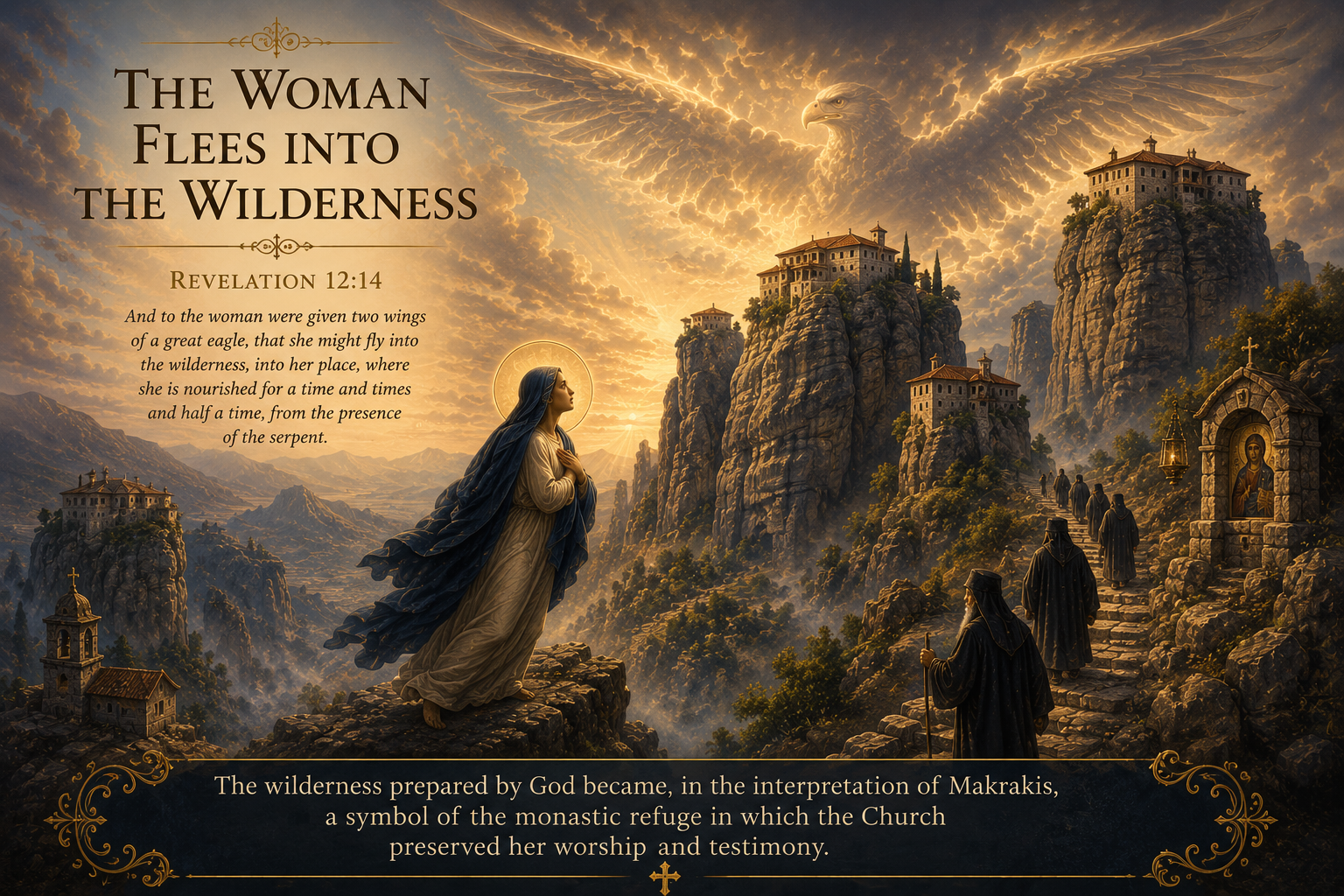
Makrakis’ most distinctive contribution is his interpretation of the two wings as prayer and fasting. These ascetical practices enable the Woman to rise above the reach of the Serpent. The Dragon can attack those attached to earthly things, but he cannot overcome those whose minds and hearts are directed toward God. Through prayer and fasting, the Church continually ascends from earthly concerns toward heavenly realities.
What is particularly noteworthy is Makrakis’ distinction between bodily and spiritual nourishment. The material resources of monasteries sustain the physical life of the Church, while prayer and fasting sustain her spiritual life. The wilderness thus becomes not merely a refuge from persecution but a place of transformation. The Church survives because she is nourished.
St. Gregory Palamas and the Nourishment of the Woman
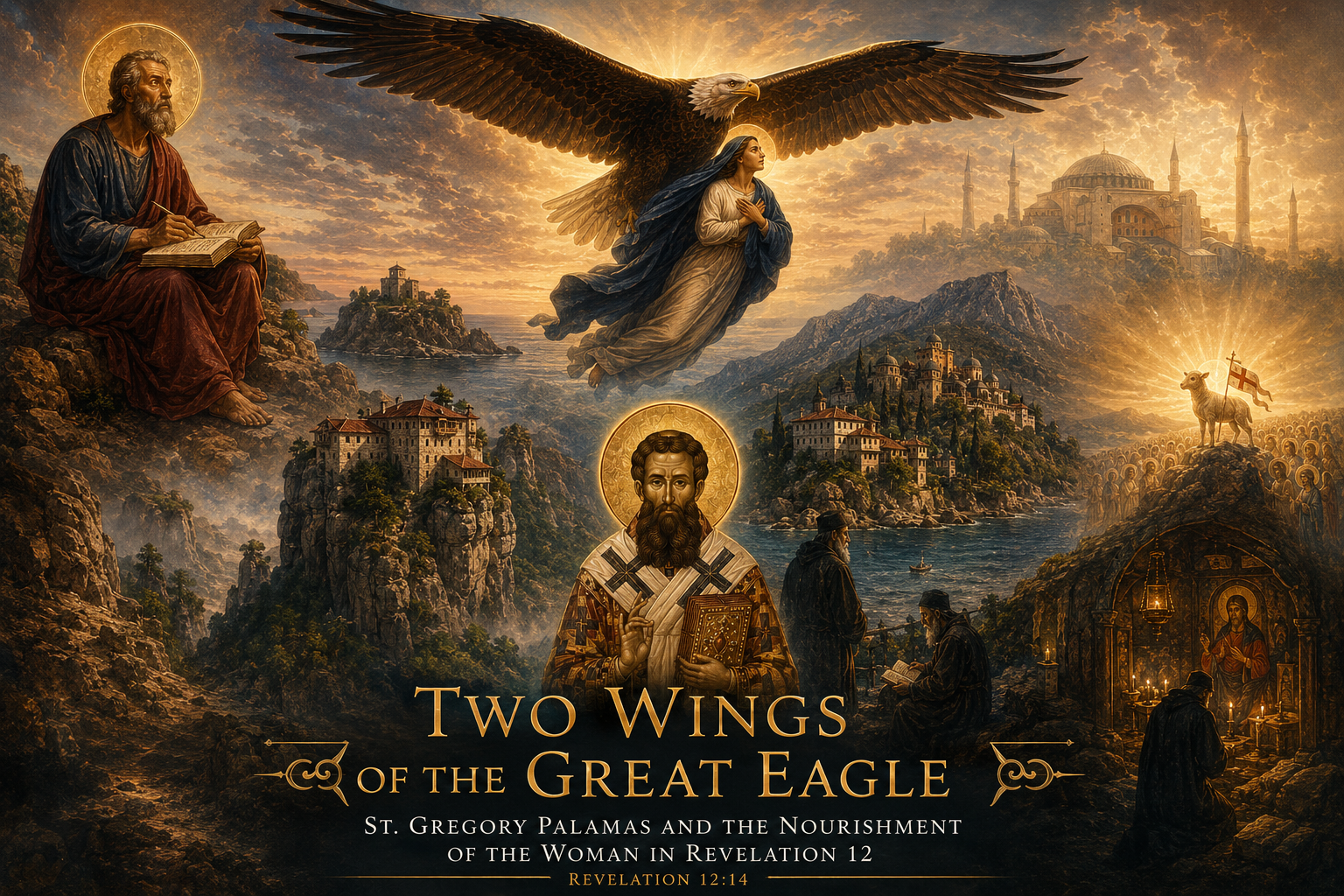
It is at this point that the theology of St. Gregory Palamas provides an indispensable contribution. While Palamas does not offer a direct interpretation of Revelation 12, his defense of Hesychasm illuminates the deeper meaning of the Woman’s nourishment. The fourteenth-century controversy surrounding the Hesychast monks was fundamentally a debate concerning the possibility of genuine communion with God. Against those who reduced spiritual knowledge to intellectual understanding, Palamas defended the Orthodox teaching that believers truly participate in the uncreated energies of God.
This distinction between divine essence and divine energies provides a theological explanation for the ascent described by Makrakis. Prayer and fasting nourish the Church because they are not merely moral disciplines. They are means of communion with the living God. Through purification, contemplation, and participation in divine grace, the believer is elevated toward the very life of God.
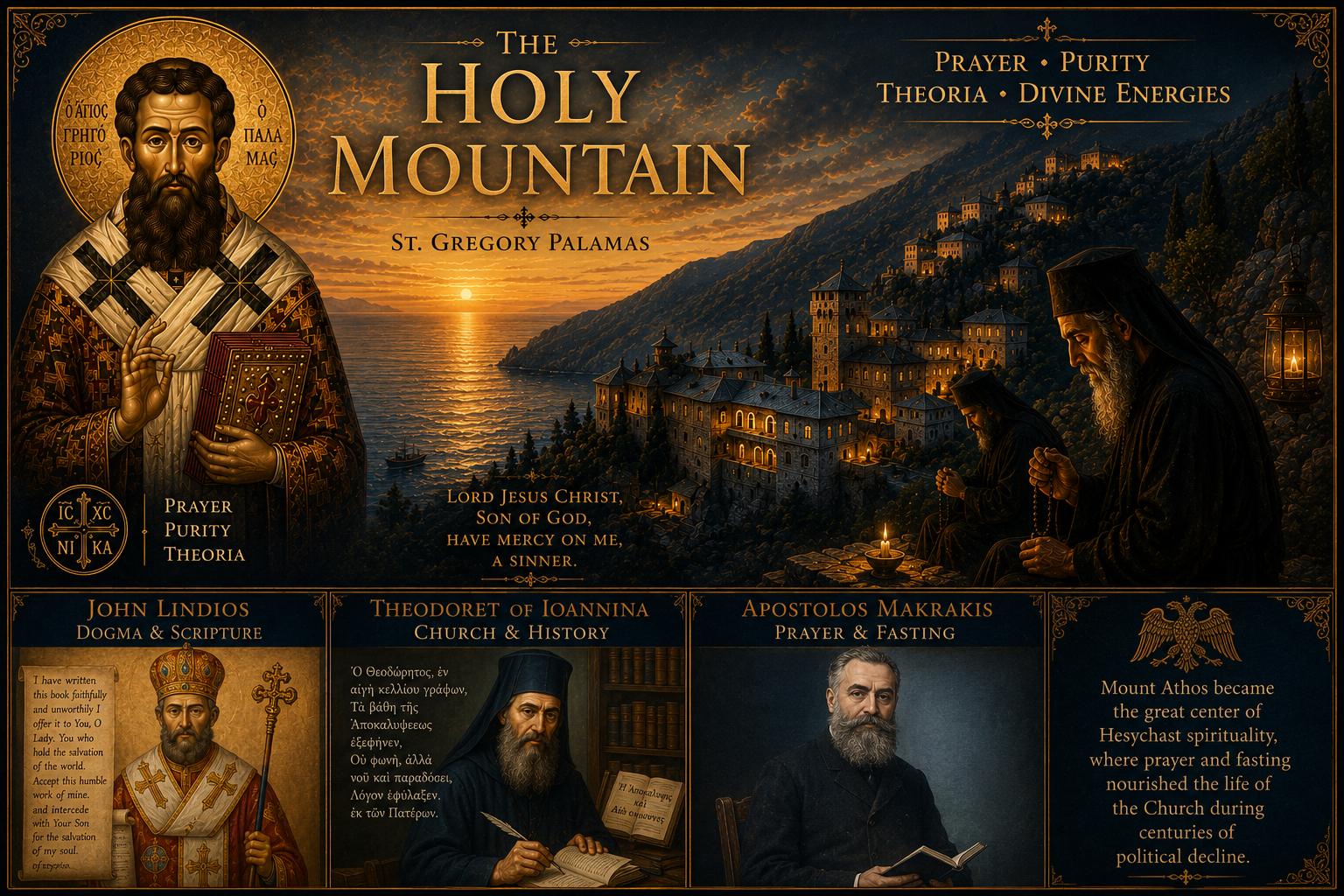
In this respect Palamas may be viewed as the theologian of the wilderness. John Lindios explains what the Church preserves. Theodoret explains the historical circumstances of that preservation. Makrakis explains the ascetical practices through which the Church survives. Palamas explains why those practices sustain the Church: they unite her to the God-Man whose life she bears within herself.
The significance of this insight cannot be overstated. The wilderness is not merely a place of hiding. It is a place of communion. The Woman survives because she continually participates in the life of the One whom she proclaims.
From the Wilderness to Mount Zion
The flight into the wilderness is not the end of the story. Revelation 12 is followed by the rise of the Beast in Revelation 13 and then by the appearance of the Lamb standing upon Mount Zion in Revelation 14. The sequence is important. The wilderness is a period of preparation. The Woman is nourished so that her testimony of the seven thunders may endure until the final vindication of the Lamb and His faithful remnant.
Viewed from this perspective, the monasteries of Orthodoxy assume an eschatological significance. They are not merely historical institutions but places in which the revelation of Jesus Christ is preserved across generations. Through prayer, fasting, worship, theological reflection, and participation in divine life, the Church safeguards the apostolic testimony until the day when the Lamb stands openly upon Mount Zion.
The wilderness therefore emerges as one of the central themes of the Apocalypse. It is the place where the Church loses worldly power yet preserves spiritual authority; where empires fall but the faith remains; where kingdoms disappear but the revelation of Jesus Christ continues to be proclaimed.
Conclusion
The interpretations of John Lindios, Theodoret of Ioannina, and Apostolos Makrakis reveal a remarkably coherent vision of Revelation 12. Although differing in emphasis, all three understand the wilderness flight as a period of divine preservation in which the Orthodox Church safeguards the revelation entrusted to her. The wings of the eagle signify fidelity to the Incarnate Word, the witness of Holy Scripture, and the ascetical life of prayer and fasting. Together these themes point toward a deeper reality that finds theological expression in the work of St. Gregory Palamas.
The Church survives because she remains united to Christ. She preserves the truth concerning the God-Man, nourishes herself through prayer and contemplation, and participates in the divine life through grace. The monasteries of the Christian East become visible signs of this reality, serving as places where the revelation of Jesus Christ is preserved during centuries of trial and upheaval. In this light, the wilderness of Revelation 12 is not merely a refuge from persecution but a sacred space in which the Church is nourished by God until the Lamb stands upon Mount Zion with His faithful remnant.
© 2026 by Jonathan Photius