
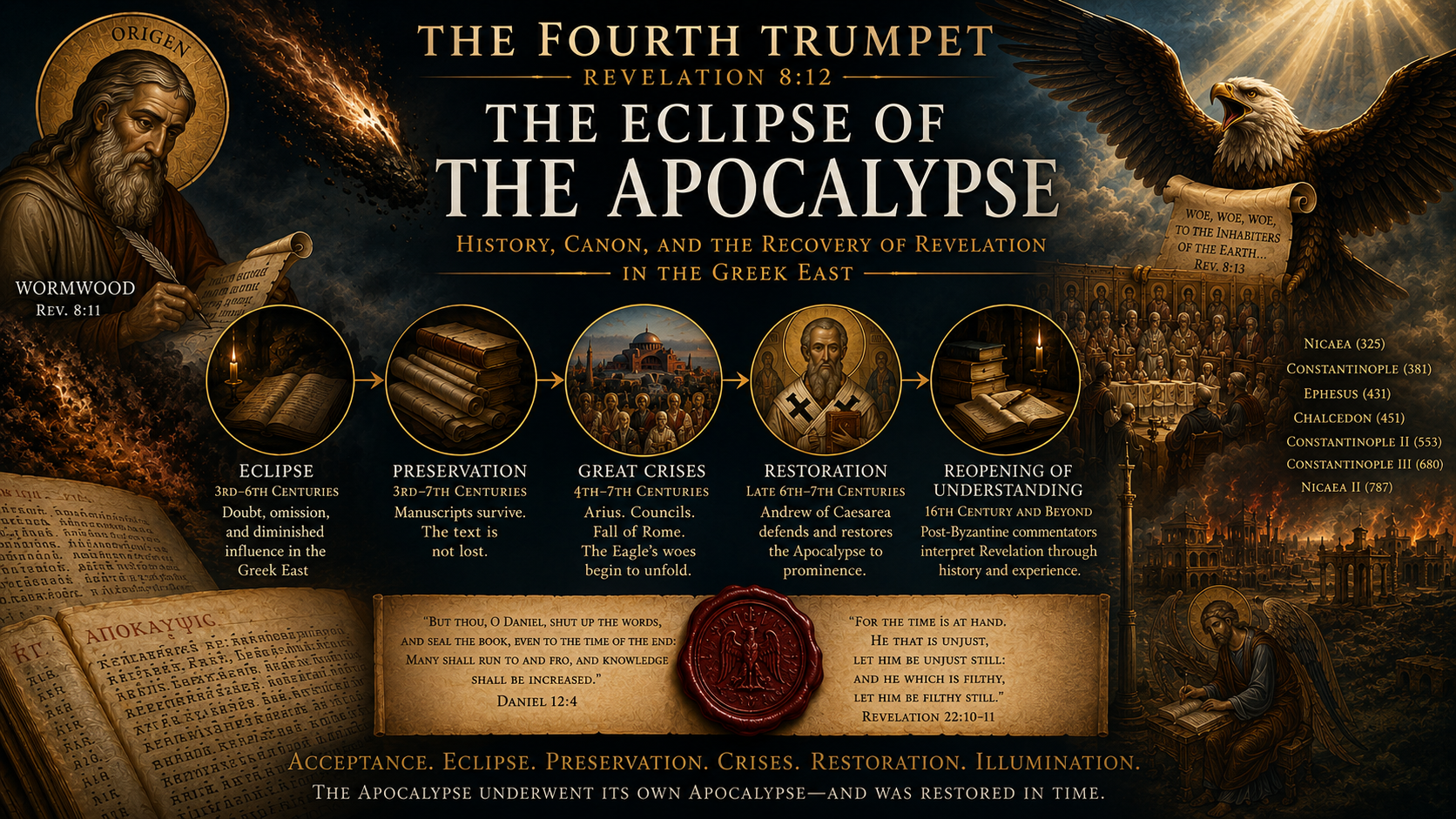
Before the Church faced the great woes, she first experienced a partial eclipse of her prophetic light of the Apocalypse in the Christian East.
By Jonathan Photius – The NEO-Historicism Research Project
Introduction
Among the trumpet judgments of Revelation 8, the Fourth Trumpet remains one of the most enigmatic. St. John writes:
“And the fourth angel sounded, and the third part of the sun was smitten, and the third part of the moon, and the third part of the stars; so as the third part of them was darkened, and the day shone not for a third part of it, and the night likewise.”¹
Throughout Christian history interpreters have proposed numerous explanations for this vision. Some have understood the heavenly luminaries as political rulers, others as ecclesiastical authorities, and still others as symbols of spiritual illumination itself. Yet one remarkable historical phenomenon has received little attention in discussions of this passage: the decline of the Apocalypse’s authority and influence throughout much of the Greek-speaking East between the fifth and ninth centuries.
Recent studies of the reception history of Revelation have demonstrated that the Apocalypse occupied a uniquely precarious position within Eastern Christianity during this period.² While never entirely rejected, Revelation experienced a substantial decline in manuscript transmission, liturgical use, artistic representation, and theological citation. Major authors ignored it. Canonical lists treated it ambiguously. Its apostolic authorship was questioned. In some regions its presence within the New Testament itself became uncertain.
This historical development invites reconsideration of the Fourth Trumpet. If the sun, moon, and stars symbolize sources of divine illumination and guidance, might their partial darkening correspond not merely to political upheaval but also to a temporary eclipse of prophetic understanding within the Church? More specifically, could the decline of the Apocalypse itself represent a historical manifestation of the darkening described by St. John?
This possibility becomes especially intriguing when viewed within the broader sequence of Revelation 8. The Fourth Trumpet does not stand alone. It follows immediately after the Third Trumpet, in which a great star named Wormwood falls from heaven and corrupts the rivers and fountains of waters.³ It is then followed by the appearance of the Eagle announcing the three great woes that will subsequently unfold.⁴ The sequence suggests a progression from corruption, to obscuration, to warning, and finally to judgment.
This study proposes that the reception history of Revelation in the Greek East may illuminate this progression. It argues that the decline of the Apocalypse corresponds remarkably well to the imagery of the Fourth Trumpet and that this eclipse occurred during the very centuries preceding the great historical crises later associated by Byzantine commentators with the Fifth and Sixth Trumpets. The recovery of the Apocalypse through Andrew of Caesarea and the later flowering of Post-Byzantine historical interpretation may then be understood as a restoration of prophetic light following a prolonged period of darkness.
I. The Third Trumpet and the Corruption of the Waters
Before considering the darkening of the heavenly luminaries, it is necessary to examine the preceding trumpet. Revelation 8:10–11 describes a great star falling from heaven:
“And the third angel sounded, and there fell a great star from heaven, burning as it were a lamp, and it fell upon the third part of the rivers, and upon the fountains of waters; and the name of the star is called Wormwood.”⁵
Among historicist interpreters, stars frequently symbolize prominent teachers or ecclesiastical figures. The image of a star falling from heaven therefore naturally suggests the decline or corruption of a previously influential spiritual authority. Within the context of Eastern Christian history, few figures fit this description more closely than Origen of Alexandria (c. 185–254).
Origen’s brilliance as a scholar and exegete earned him enormous influence throughout the Christian world. His learning was extraordinary, and many later Fathers benefited from aspects of his work. Yet his legacy proved deeply controversial. Numerous speculative doctrines associated with his name—including the preexistence of souls, universal restoration, and highly allegorical methods of interpretation—became subjects of intense dispute in subsequent centuries.⁶
Particularly significant for the present study is Origen’s attitude toward the Apocalypse. While he accepted Revelation as Scripture, his approach to biblical interpretation contributed to an intellectual climate that often preferred spiritualized and allegorical readings over historical and prophetic ones. Even more consequential was the influence of his intellectual heirs.
Among these was Dionysius of Alexandria (c. 190–264), one of the earliest major figures to challenge Johannine authorship of Revelation. Eusebius preserves Dionysius’s argument that the Apocalypse differed significantly in style and language from the Gospel of John and therefore likely originated from another author.⁷ Although Dionysius did not reject the book outright, his criticisms became enormously influential in the Greek East.
The importance of Dionysius can scarcely be overstated. Many later Eastern doubts regarding Revelation trace ultimately to the questions he raised. The chain is not simply Origen to rejection of Revelation. Rather, it is Origen to Dionysius, and Dionysius to centuries of uncertainty regarding the Apocalypse’s authority and authorship.
In this light, the symbolism of Wormwood acquires a striking historical dimension. The rivers and fountains of waters represent sources of theological nourishment and scriptural interpretation. The corruption begins not with the extinguishing of light but with the poisoning of the waters. The result is not immediate darkness but a gradual weakening of confidence in one of the Church’s most important prophetic books.
II. The Fourth Trumpet and the Eclipse of the Apocalypse
The Fourth Trumpet introduces a new image:
“And the fourth angel sounded, and the third part of the sun was smitten, and the third part of the moon, and the third part of the stars.”⁸
The symbolism of heavenly luminaries as sources of divine guidance is deeply rooted in Scripture. Joseph’s dream portrays the sun, moon, and stars as covenantal authorities.⁹ Daniel describes the righteous shining like stars forever.¹⁰ Christ Himself holds the seven stars in His right hand and walks among the lampstands of the churches.¹¹
Within this symbolic framework, the darkening of the luminaries suggests not the destruction of the Church but the obscuration of spiritual illumination. The heavenly lights continue to exist, yet their ability to shine is diminished.
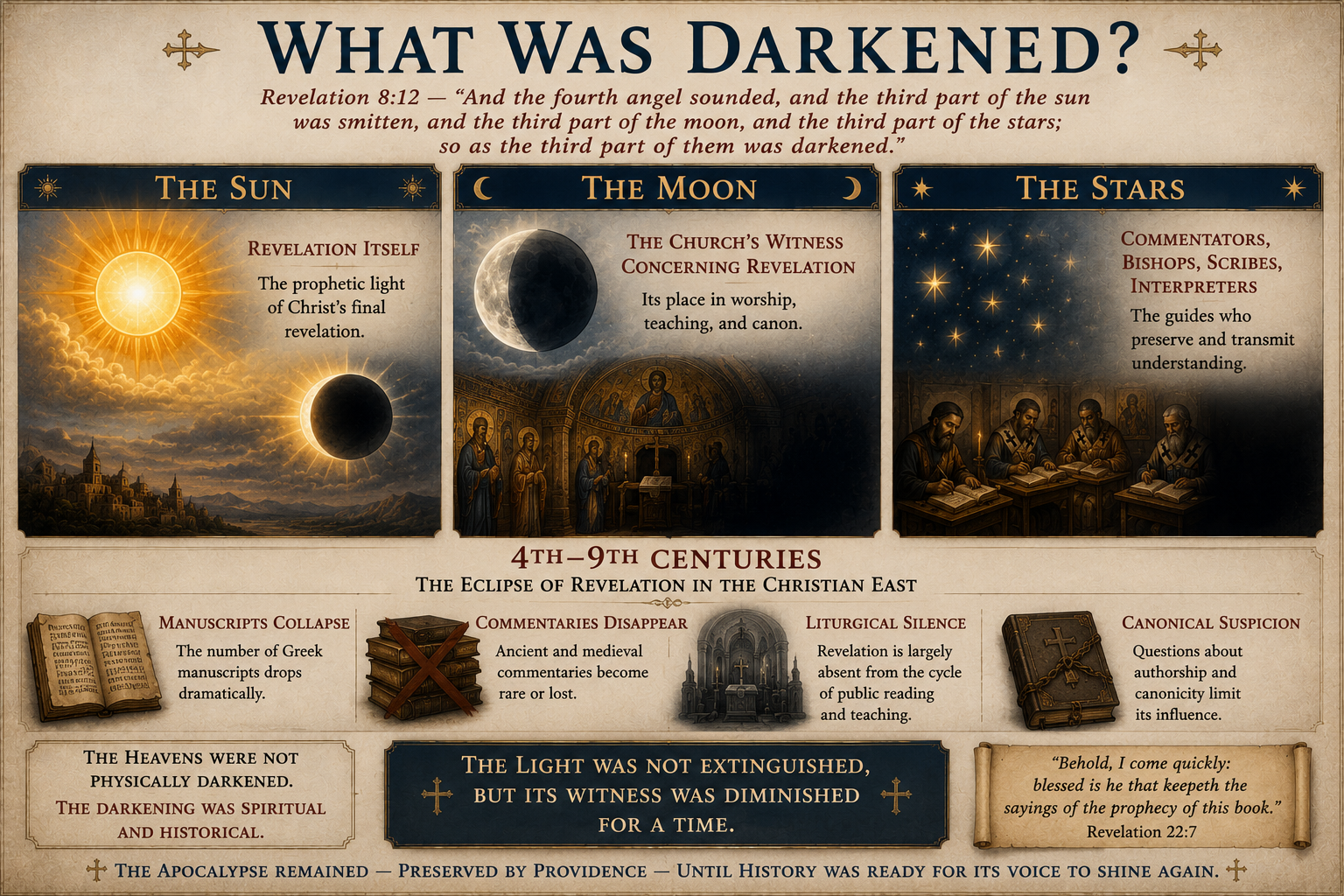
Recent research into the reception history of Revelation reveals a historical phenomenon remarkably consistent with such imagery. According to Joseph Verheyden Schmid’s comprehensive study of Revelation’s reception in the East, the Apocalypse experienced a significant decline in prestige and influence between approximately the fifth and ninth centuries.¹²
One of the earliest indicators appears in the testimony of Oecumenius (c. 550), who remarks that the “nonsense of the majority” denied that John the Evangelist wrote Revelation.¹³ The statement is extraordinary because it demonstrates that skepticism toward the Apocalypse had become widespread enough to require explicit refutation.
Other evidence points in the same direction. John of Scythopolis found it noteworthy that Pseudo-Dionysius appeared to accept the Apocalypse at all.¹⁴ Leontius of Byzantium, despite writing extensively on Christological questions, never appears to cite Revelation.¹⁵ Maximus the Confessor likewise shows little or no use of the book throughout his vast corpus.¹⁶
Canonical evidence further reveals the book’s precarious status. The Council of Trullo (692) approved various canonical traditions, some of which included Revelation and others which omitted it.¹⁷ Nicephorus of Constantinople later classified the Apocalypse among disputed writings.¹⁸ Photius, despite devoting enormous attention to theological and biblical questions, rarely discussed the book.¹⁹
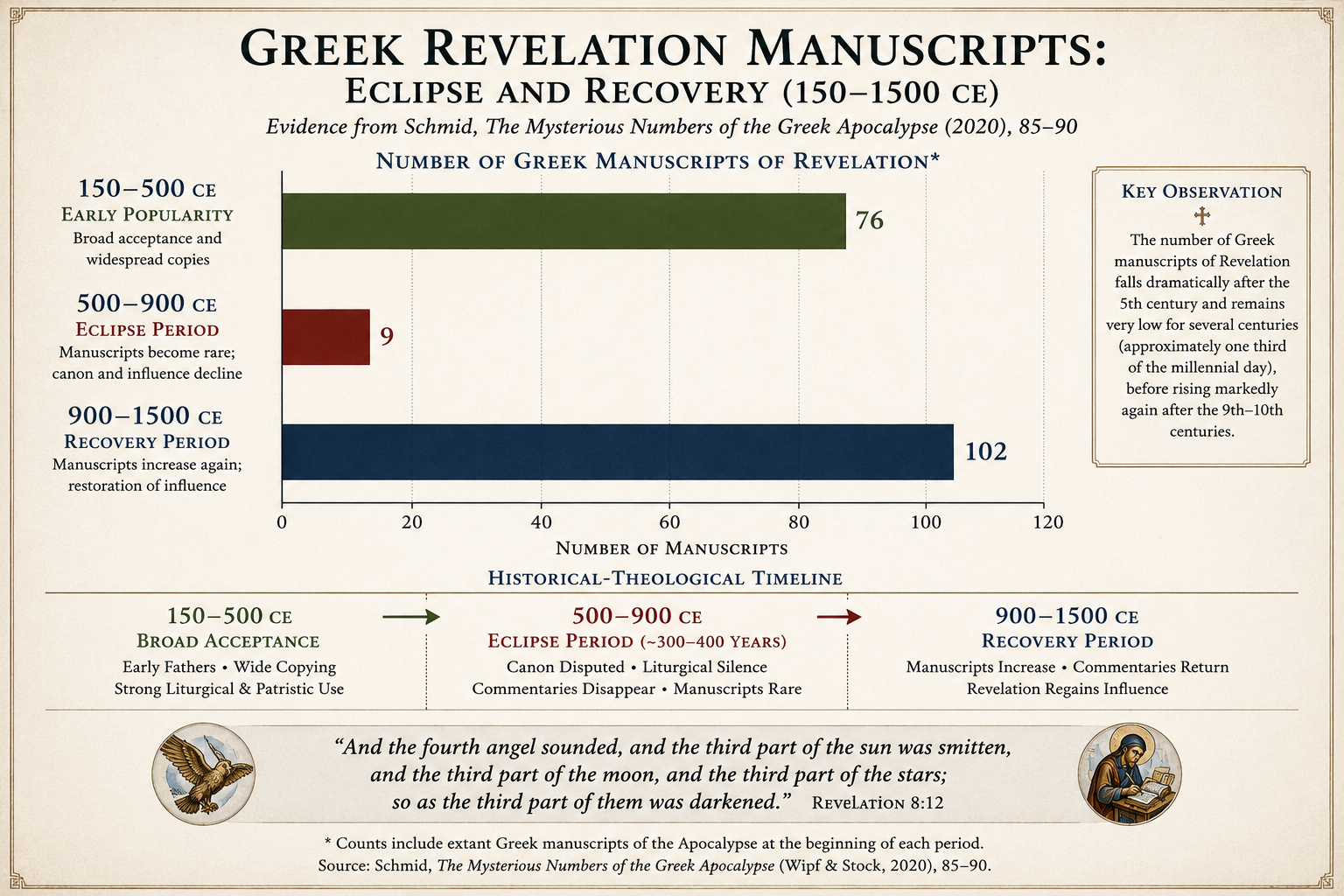
The manuscript evidence is perhaps even more striking. Of the earliest surviving Greek Revelation manuscripts, only a handful originate between the fifth and ninth centuries. By contrast, the book enjoyed much stronger manuscript support both before and after this period.²⁰ Schmid concludes that Revelation experienced a significantly sharper decline in manuscript production than the New Testament as a whole.²¹
Nor was the eclipse limited to manuscripts. Revelation disappeared almost entirely from Byzantine lectionaries and liturgical usage.²² Artistic depictions of its imagery became exceedingly rare.²³ Even texts discussing St. John’s exile on Patmos often omitted any mention of the Apocalypse itself.²⁴
Taken together, these facts suggest a genuine historical eclipse. Revelation was not extinguished, but it was partially darkened. Its authority remained, yet its influence diminished. Its light continued to shine, but only faintly.
The Principal Voices of Doubt
The eclipse of Revelation within much of the Greek East did not occur through a formal conciliar rejection of the book. Rather, it developed gradually through the influence of a number of respected theologians, bishops, and ecclesiastical traditions.
Among the most influential figures was Dionysius of Alexandria (c. 190–264). Although he accepted the Apocalypse as an ancient Christian writing, he questioned its Johannine authorship and argued that its language differed substantially from the Gospel and Epistles of John.²⁵ His criticisms would exercise considerable influence upon subsequent generations.
Eusebius of Caesarea (c. 260–339) likewise contributed to the uncertainty. While acknowledging the book’s widespread use, he classified Revelation among writings whose status remained disputed.²⁶ His immense authority as a church historian ensured that later readers remained aware of the controversy.
Several influential canonical traditions omitted Revelation entirely. The Council of Laodicea (fourth century), in its traditional form, excluded Revelation from its list of canonical books.²⁷ Gregory Nazianzen’s famous poetic canon likewise omitted the Apocalypse.²⁸ Amphilochius of Iconium reported that many accepted Revelation while others rejected it.²⁹ These witnesses reveal that uncertainty persisted among respected ecclesiastical leaders during the very period in which the New Testament canon was still being consolidated.
The Syrian tradition proved especially hesitant. The Peshitta omitted Revelation, and for centuries the book occupied an uncertain position within Syriac Christianity.³⁰ Later writers such as Junilius reported that Revelation was strongly doubted among the Eastern churches.³¹ Even in the twelfth century Dionysius bar Salibi could lament that many teachers remained uncertain concerning the Apocalypse.³²
The influence of these traditions extended far beyond their own lifetimes. By the sixth century Oecumenius felt compelled to defend Revelation against what he called “the nonsense of the majority” who denied its apostolic authorship.³³ In the ninth century Nicephorus still classified it among disputed books.³⁴ Even Photius, one of Byzantium’s greatest scholars, virtually ignored the Apocalypse in his major works.³⁵
The result was not the disappearance of Revelation but its marginalization. The Apocalypse survived, yet its authority became weakened in significant portions of the Christian East. The light remained, but it no longer shone with its former brightness.
III. One Third of the Day and Night: The Duration of the Eclipse
The most unusual feature of the Fourth Trumpet is not merely the darkening of the heavenly luminaries but the duration attached to that darkening. St. John writes that the sun, moon, and stars were smitten:
“so as the third part of them was darkened, and the day shone not for a third part of it, and the night likewise.”³⁶
The language deserves careful attention. The text does not merely describe a reduction in brightness. It also emphasizes a proportional duration of darkness. A third of the day and a third of the night cease to shine. The image therefore combines both intensity and duration. The darkness is partial rather than total, yet it persists long enough to be measured.
Historically, interpreters have proposed a variety of explanations for this phrase. Some understand it as a symbolic description of diminished spiritual illumination. Others view it as an image of cosmic disorder. Still others associate it with political decline or ecclesiastical corruption. Yet the language may also invite reflection upon a temporal dimension.
Within biblical prophecy, the relationship between symbolic days and historical periods is well established. The prophet Ezekiel was commanded to bear the iniquity of Israel according to the principle of a day representing a year.³⁷ Daniel’s seventy weeks are widely understood as symbolic periods extending beyond literal days.³⁸ The Apocalypse itself repeatedly employs symbolic durations such as forty-two months, 1,260 days, and “a time, times, and half a time.”³⁹
Equally significant is the biblical association between a day and a millennium. The Psalmist declares:
“For a thousand years in thy sight are but as yesterday when it is past.”⁴⁰
The Apostle Peter repeats the same principle:
“One day is with the Lord as a thousand years, and a thousand years as one day.”⁴¹
These texts do not establish a rigid chronological formula, yet they demonstrate the scriptural precedent for associating a prophetic day with a millennium.
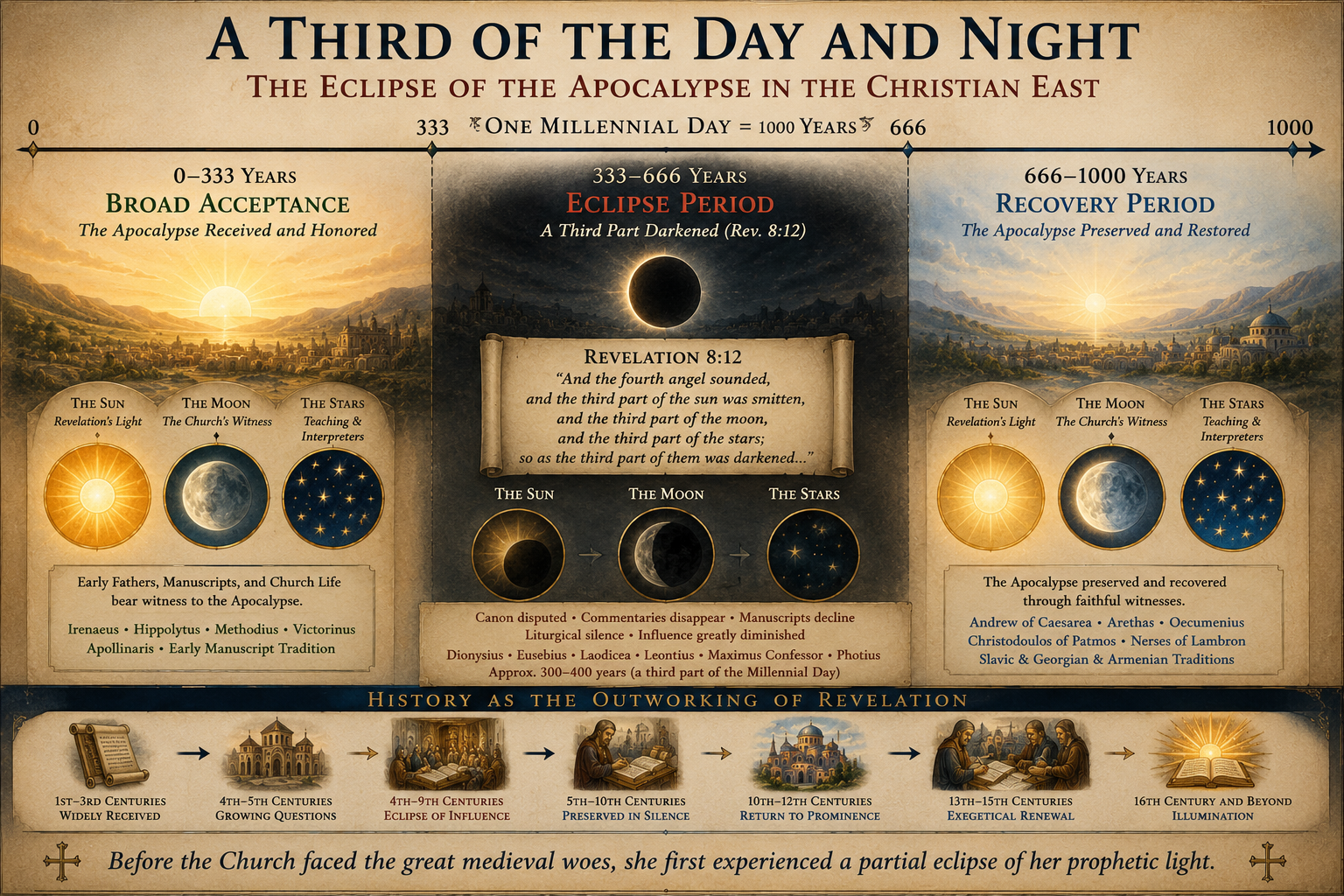
If such symbolism is relevant to Revelation 8:12, then the darkening of one-third of the day would correspond approximately to one-third of a millennium. Numerically this yields roughly 333 years.
The significance of this observation becomes apparent when compared with the reception history of Revelation in the East. As documented above, the Apocalypse experienced its most substantial eclipse between approximately the fifth and ninth centuries. During this period the book’s authority was questioned, its manuscript production declined dramatically, its liturgical use disappeared, and its influence upon theological discourse diminished.⁴²
The chronology is necessarily approximate, for historical developments rarely conform to precise numerical boundaries. Yet the broad correspondence remains noteworthy. From the gradual decline of the Apocalypse’s authority during the fifth century until its recovery through Andrew of Caesarea and the subsequent expansion of the commentary tradition spans approximately three to four centuries. The period of greatest obscuration therefore occupies roughly one-third of the first Christian millennium.
This correspondence should not be pressed beyond the evidence. Revelation does not explicitly state that a millennium is intended, nor does it provide a direct chronological key. Nevertheless, the parallel is sufficiently striking to merit consideration. The Fourth Trumpet describes neither complete darkness nor permanent extinction. Rather, it depicts a measured and temporary obscuration affecting a third of the heavenly lights and a third of the day and night.
The historical evidence reveals a remarkably similar pattern. Revelation was never wholly rejected. It survived in Egypt, remained known in portions of Syria and Armenia, and continued to be preserved through scattered manuscripts and ecclesiastical traditions. The light remained, but its influence was diminished. The darkness was partial rather than absolute.
This distinction is crucial. The Fourth Trumpet does not portray the destruction of the sun, moon, and stars. The luminaries remain in place. Their light is merely reduced. Likewise, the Apocalypse remained within the Church. It was copied, read, and defended by a faithful minority. Yet throughout much of the Greek East its prophetic witness shone with diminished brightness.
The historical pattern therefore corresponds remarkably well to the imagery of an eclipse. During roughly one-third of the first Christian millennium, the Church’s principal prophetic book experienced a measurable decline in authority and influence. The Apocalypse was not extinguished. It was obscured.
Such an interpretation also provides a natural transition to the appearance of the Eagle in Revelation 8:13. The warning comes not during complete darkness but during a period of diminished illumination. Before the great woes unfold, the Church first experiences a weakening of her prophetic vision. The Eagle’s cry therefore serves as both warning and preparation for the judgments that follow.
IV. The Eagle’s Warning and the Coming Woes
Immediately following the darkening of the heavenly lights, St. John records a dramatic interruption in the trumpet sequence:
“And I beheld, and heard an eagle flying in the midst of heaven, saying with a loud voice, Woe, woe, woe, to the inhabitants of the earth by reason of the other voices of the trumpet of the three angels, which are yet to sound!”⁴³
The appearance of the Eagle is unique. Unlike the preceding trumpets, the Eagle introduces no judgment of its own. Instead, it serves as a herald, announcing the severity of what is about to follow. The Eagle stands between the Fourth Trumpet and the final three woes, functioning as a transitional figure between the period of darkening and the period of intensified judgment.
This placement is highly significant. The warning does not precede the darkening of the sun, moon, and stars. Nor does it appear after the woes have already begun. Rather, it appears precisely at the moment when the heavenly lights have been partially obscured and before the Church enters the next phase of her historical struggles.
Within the framework proposed in this study, the sequence assumes a remarkable coherence. First comes the corruption of the waters through the influence represented by Wormwood. Then comes the eclipse of prophetic illumination through the diminished reception of the Apocalypse. Only afterward does the Eagle announce the coming woes.
The warning therefore follows a loss of vision.
Historically, the pattern appears strikingly similar. The centuries during which Revelation experienced its greatest eclipse were also the centuries immediately preceding some of the most significant doctrinal and civilizational crises in Christian history. The Church entered an age of profound controversy precisely when one of her principal prophetic witnesses had become increasingly neglected throughout much of the East.
Apostolos Makrakis interpreted the Fifth Trumpet as referring to Arius and the Arian controversy.⁴⁴ Whether one accepts this identification in its entirety or not, the historical significance of the fourth-century Christological crisis cannot be denied. The controversy shook the Christian world, divided bishops and emperors, and compelled the Church to articulate with greater precision the relationship between the Father and the Son.
From the perspective of the present study, it is noteworthy that Revelation itself contains some of the richest Christological imagery in the New Testament. The Apocalypse repeatedly emphasizes the divine glory of Christ, His heavenly kingship, His worship alongside the Father, His eternal attributes, and His role as the ruler of history.⁴⁵ If the Apocalypse was increasingly neglected during this period, then a significant source of Christological testimony had likewise become less influential within portions of the Church.
This observation should not be overstated. Arius did not arise because Christians stopped reading Revelation. Nevertheless, the coincidence remains striking. The Church’s most severe Christological crisis emerged during the very period in which the Apocalypse’s authority and influence were diminished.
Makrakis further identified the Sixth Trumpet with the collapse of Roman power and the invasions that transformed the ancient world.⁴⁶ The disintegration of imperial unity, the migrations of nations, and the fall of the Western Roman Empire marked the beginning of a new historical epoch. The political order that had governed the Mediterranean world for centuries was profoundly altered.
Once again the sequence deserves attention. The eclipse precedes the woes.
Before the Church faced the doctrinal turmoil associated with Arius, before the Roman world fractured under the pressures of invasion and migration, there occurred a measurable decline in the reception of the Apocalypse. The Eagle’s warning therefore acquires an unexpected historical resonance. The Church’s prophetic vision was partially darkened before she entered the age of great trial.
The imagery of the Eagle itself may also be significant. Throughout Christian tradition the Eagle has long been associated with St. John the Theologian. The Fourth Gospel’s lofty contemplation of the eternal Word earned John the symbolic designation of the Eagle among the Evangelists.⁴⁷ His theology ascends to heavenly realities just as the eagle soars above the earth.
Viewed from this perspective, the Eagle of Revelation 8:13 acquires a poignant symbolism. The very apostle whose prophetic book had become increasingly neglected now appears as the herald warning of approaching judgment. The Apocalypse had been partially eclipsed, yet its author still cries out from the midst of heaven:
“Woe, woe, woe.”
Such a reading cannot be demonstrated with certainty. Nevertheless, it accords remarkably well with the broader historical pattern documented in the preceding sections. The prophetic witness remains present, but its voice is less widely heard. The Eagle continues to speak, yet many no longer attend to the message.
The warning is therefore not merely about future judgments. It is also about the consequences of diminished prophetic vision. Before the Church encountered the great woes of history, she first experienced a partial eclipse of the book that warned of their coming.
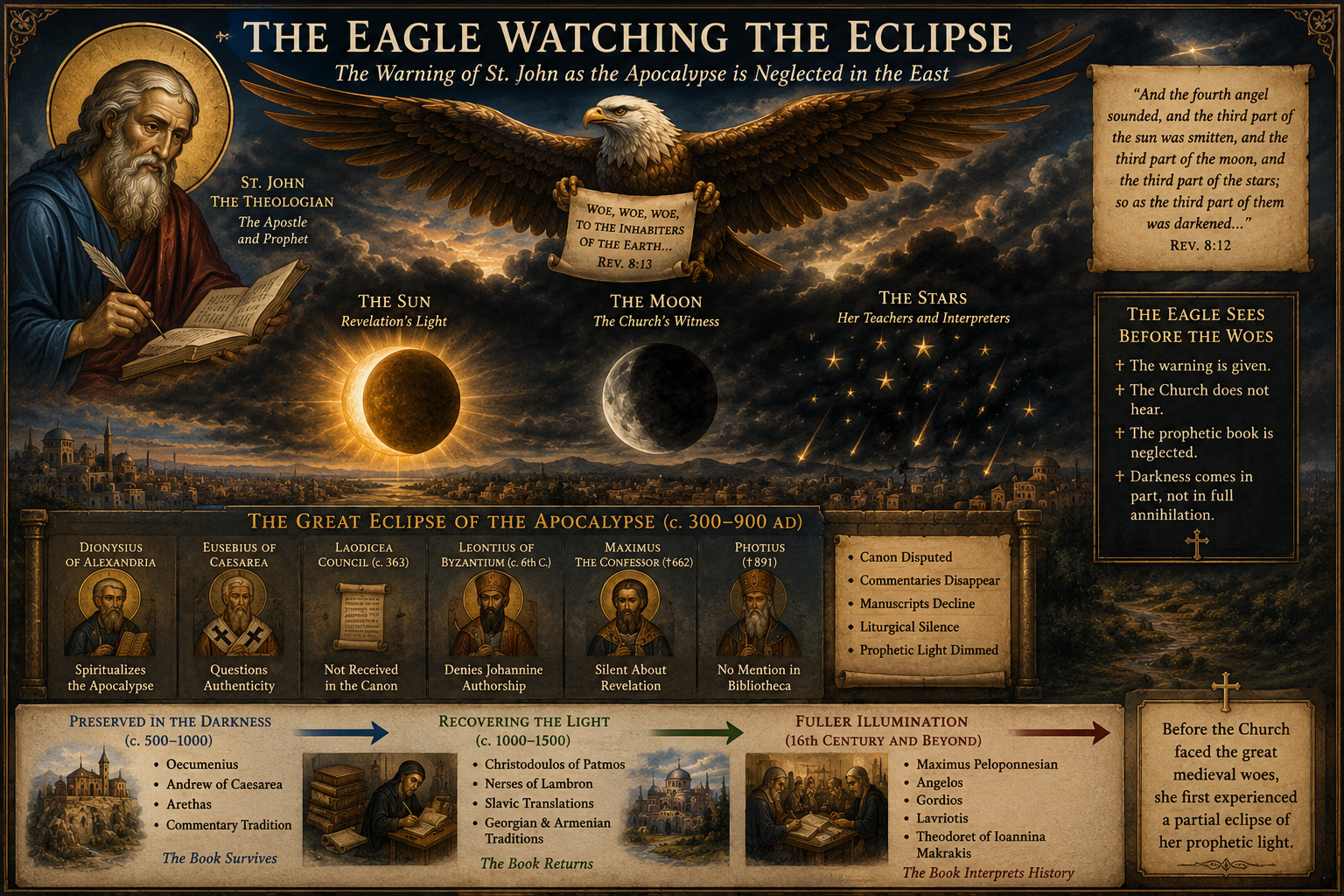
This observation becomes even more significant when considered alongside the later recovery of the Apocalypse. If the Fourth Trumpet corresponds to an eclipse of Revelation’s influence, and the Eagle announces the coming woes, then the restoration of Revelation through Andrew of Caesarea and the subsequent commentary tradition may be understood as a recovery of prophetic sight after a prolonged period of obscuration. The Church did not merely preserve the Apocalypse. She gradually rediscovered its voice.
The next stage of the story therefore concerns not the eclipse itself but the restoration of light. Through Andrew, Arethas, and their successors, the Apocalypse began once again to illuminate the historical experience of the Church. What had been obscured gradually became visible. The Eagle’s warning would eventually be heard anew.
The traditional association of the Eagle with St. John the Theologian invites a striking historical reflection. During the centuries in which the Apocalypse occupied an increasingly marginal position within much of the Greek East, the symbolic creature most closely associated with its author appears in Revelation 8:13 as the herald of warning. The Eagle’s cry follows immediately after the darkening of the heavenly lights and precedes the coming woes. Historically, this sequence corresponds to the period in which the authority and influence of Revelation itself became obscured within many ecclesiastical centers. The Apocalypse was neither lost nor condemned, yet it increasingly occupied a disputed and peripheral position during the very centuries when the New Testament canon was still being consolidated. If the Eagle recalls St. John himself, the symbolism becomes particularly poignant: the author of the Apocalypse appears as the messenger warning the Church of approaching dangers even as his prophetic testimony is gradually neglected. The warning remains in heaven, but it is only partially heard.
V. The First Woe and the Christological Crisis
Following the Eagle’s warning, the Apocalypse introduces the first of the three great woes:
“And the fifth angel sounded, and I saw a star fall from heaven unto the earth: and to him was given the key of the bottomless pit.”⁴⁸
The ensuing vision describes smoke ascending from the abyss and darkening the air, followed by the emergence of destructive locusts that afflict mankind.⁴⁹ Throughout the history of interpretation, these symbols have received numerous explanations. Among Greek commentators, however, Apostolos Makrakis identified the Fifth Trumpet with Arius and the Arian controversy that engulfed the Church during the fourth century.⁵⁰
Whether or not one accepts Makrakis’ interpretation in every detail, the historical significance of the Arian crisis is undeniable. The controversy represented one of the most severe doctrinal challenges faced by the early Church. At stake was nothing less than the identity of Jesus Christ. Was the Son fully divine and co-eternal with the Father, or was He the highest of created beings? The answer would shape the theological future of Christianity.
The timing of this controversy is particularly noteworthy when viewed alongside the reception history of Revelation. As demonstrated above, the centuries following Dionysius of Alexandria witnessed a gradual weakening of the Apocalypse’s authority throughout much of the Greek East. Questions concerning Johannine authorship persisted. Canonical uncertainty remained unresolved in many regions. The book was increasingly neglected in theological discourse, liturgical practice, and manuscript transmission.⁵¹
At precisely the same time, the Church entered the greatest Christological controversy of her early history.
This coincidence deserves attention because the Apocalypse contains some of the strongest Christological affirmations in the New Testament. From its opening chapter, Revelation presents Christ in terms that transcend ordinary prophetic categories. He is described as:
“the Alpha and Omega, the beginning and the ending.”⁵²
He identifies Himself as:
“the First and the Last.”⁵³
He possesses the keys of death and Hades.⁵⁴ He receives worship alongside the Father.⁵⁵ He sits upon the heavenly throne.⁵⁶ He bears titles and attributes associated with God Himself.⁵⁷
The Christology of Revelation is therefore not peripheral. It is among the most exalted Christological witnesses in all of Scripture.
This observation does not imply that greater use of Revelation would necessarily have prevented the rise of Arianism. Historical causation is rarely so simple. The origins of the controversy were complex, involving theological, philosophical, ecclesiastical, and political factors. Yet the historical irony remains striking. During the very period in which the Church struggled to articulate the full divinity of Christ, one of her richest Christological books was experiencing diminished authority throughout significant portions of the Christian East.
The relationship becomes even more suggestive when viewed through the symbolism of the Fourth Trumpet. The darkening of the sun naturally evokes questions of Christological illumination. If the sun represents Christ, as many commentators have maintained, then a partial darkening of the sun may signify a diminished apprehension of Christ’s glory within the visible Church.⁵⁸ The subsequent emergence of a Christological crisis immediately after the Eagle’s warning would then follow a remarkably coherent sequence.
Within the framework proposed by this study, the progression appears as follows:
First, Wormwood falls upon the waters, introducing confusion into the streams of interpretation. Second, the heavenly lights are partially darkened through the eclipse of the Apocalypse’s authority and influence. Third, the Eagle warns of approaching woes. Finally, the Church enters the great Christological struggle associated with Arius and the Arian controversy.
The sequence is not one of direct causation but of historical correspondence. The Church’s prophetic vision becomes partially obscured before she enters one of the most significant doctrinal battles of her history.
Indeed, from a retrospective perspective, the Arian controversy may be viewed as the first great test of the Church after the eclipse began. The challenge was not merely intellectual but theological and spiritual. The Church was compelled to confess with greater precision what had always been true concerning the eternal Word. The Council of Nicaea (325) and the subsequent struggles of Athanasius and the Nicene defenders represent not merely ecclesiastical victories but clarifications of the Church’s understanding of Christ Himself.⁵⁹
In this respect, the First Woe occupies a pivotal place in the historical narrative. It demonstrates that the consequences of diminished prophetic illumination were not merely theoretical. The Church soon found herself confronting profound questions regarding the identity of the very One revealed throughout the Apocalypse.
The significance of this observation becomes even clearer when the First Woe is viewed alongside the Second. If the Fifth Trumpet corresponds to the great Christological crisis, the Sixth Trumpet will introduce a crisis of an entirely different order: the transformation and eventual collapse of the Roman world itself. The doctrinal struggle is followed by a civilizational one. The Eagle’s warning therefore proves fully justified. The woes that follow the eclipse are neither minor nor isolated. They are among the most consequential events in Christian history.
VI. The Second Woe and the Collapse of the Roman World
The Sixth Trumpet introduces a vision of judgment on an even greater scale. St. John writes:
“Loose the four angels which are bound in the great river Euphrates.”⁶⁰
The angels are released and an immense army emerges, bringing devastation upon a third part of mankind.⁶¹ Throughout Christian history interpreters have proposed a wide variety of explanations for this passage. Among Greek commentators, Apostolos Makrakis identified the Sixth Trumpet with the invasions and upheavals that contributed to the collapse of Roman power in the West and the transformation of the ancient world.⁶²
The significance of this interpretation lies not merely in the identification itself but in its place within the larger sequence of events. The First Woe concerns a crisis within the Church. The Second Woe concerns a crisis within civilization.
The Roman Empire had long provided the political framework within which Christianity expanded. The apostolic mission unfolded within Roman roads, Roman cities, and Roman institutions. The Ecumenical Councils convened under Roman emperors. Even after the conversion of Constantine, the Empire continued to serve as the principal political structure of Christian civilization.
Yet by the fourth and fifth centuries this order faced increasing pressure. Gothic migrations, Hunnic invasions, Vandal incursions, and numerous other movements of peoples transformed the political landscape of the Mediterranean world.⁶³ The sack of Rome in 410 shocked contemporaries throughout the Empire. The deposition of Romulus Augustulus in 476 traditionally marks the end of the Western Roman Empire. Though the Eastern Roman Empire endured, the unity of the ancient world had been irrevocably altered.
From the perspective of the present study, the importance of these developments lies in their position within the sequence established by Revelation 8 and 9. The collapse of Roman power follows both the eclipse of the Apocalypse and the Eagle’s warning. The pattern is striking:
First, the waters are corrupted.
Second, the heavenly lights are darkened.
Third, the Eagle announces coming woes.
Fourth, the Church enters the Christological crisis associated with Arius.
Fifth, the Roman world itself undergoes profound transformation.
Whether or not one accepts every aspect of Makrakis’ interpretation, the historical progression remains noteworthy. The centuries following the eclipse of Revelation proved among the most tumultuous in Christian history.
The connection becomes even more intriguing when viewed through the lens of prophetic understanding. The Apocalypse is uniquely concerned with the relationship between the Church and the kingdoms of the world. Its visions repeatedly address empires, rulers, persecutions, judgments, and the ultimate sovereignty of Christ over history.⁶⁴ Yet during the centuries in which the Roman world entered its greatest crisis, the book itself occupied an increasingly uncertain position within much of the Greek East.
Once again, caution is necessary. The fall of Rome did not occur because Christians neglected Revelation. Historical events arise from complex political, military, economic, and cultural causes. The point is not causation but correspondence. The Church’s prophetic witness concerning the rise and fall of kingdoms became partially obscured during the very period in which one of the greatest political transformations of Christian history unfolded.
The irony is particularly striking when viewed from the perspective of later Byzantine commentators. Writers such as Anastasios Gordios, John of Lindios, Christophoros Angelos, Theodoret of Ioannina, and Apostolos Makrakis increasingly interpreted Revelation through the lens of historical events.⁶⁵ For them, the Apocalypse was not merely a book about the distant future but a prophetic revelation of the Church’s historical experience. Yet the development of such historical interpretation occurred only after centuries of neglect and uncertainty.
In this respect, the Sixth Trumpet serves as a bridge between two worlds. It marks the end of the ancient Roman order and the beginning of the medieval era. It also stands at the threshold of the events that would increasingly shape the later Byzantine understanding of Revelation: the rise of Islam, the contraction of Christian territory, and the prolonged struggle for the preservation of the Church.
The collapse of Roman power therefore represents more than a political event. It marks the beginning of a new historical environment in which Christians would be compelled to reexamine the Apocalypse itself. The very crises that followed would eventually encourage renewed interest in the prophetic book that had been partially eclipsed during the preceding centuries.
This observation leads naturally to the next stage of the story. The Eagle’s warning was not exhausted by the doctrinal controversies of the fourth century or the political upheavals of the fifth. Additional challenges remained. As the ancient world gave way to the medieval, the Christian East would soon confront a new force that would permanently reshape its history. The eclipse of Revelation had not yet fully passed, and the consequences of diminished prophetic vision continued to unfold.
VII. Islam, Egypt, and the Continuing Eclipse
The transformation of the Roman world did not mark the end of the historical developments associated with the Eagle’s warning. During the seventh century, a new force emerged that would permanently reshape the Christian East. Within a remarkably short period, territories that had long been centers of Christian life—including Syria, Palestine, Egypt, and much of North Africa—came under Islamic rule.⁶⁶
The rise of Islam is especially significant for the present study because it coincided with the very period in which Revelation continued to occupy an uncertain position throughout much of Eastern Christianity. Yet the evidence suggests that some Christians were already turning to the Apocalypse in an attempt to understand these unprecedented events.
One of the most intriguing examples appears in the chronicle of John of Nikiu (c. 690 CE). According to Schmid, John appears to draw upon Revelation 13:18 in identifying Muhammad with the number of the Beast.⁶⁷ If this interpretation is correct, it would represent one of the earliest known applications of the Apocalypse to the rise of Islam and would predate by centuries the better-known medieval Western identifications of Muhammad with apocalyptic figures.
The significance of this testimony extends beyond the question of 666 itself. It demonstrates that some Christians living close to the events were already reading the Apocalypse historically. The book was not merely being preserved as a relic of the apostolic age. It was being employed as a lens through which contemporary history could be understood.
Even more striking is the geographical context. Throughout the reception history surveyed by Schmid, Egypt repeatedly appears as a place where Revelation survived despite broader patterns of neglect. Egyptian Christianity preserved important manuscript traditions. Syriac translations associated with Revelation often pass through Egyptian monastic centers. The anonymous Syriac commentary on Revelation is connected with the Monastery of the Syrians in the Nitrian Desert.⁶⁸ Thomas of Harkel completed his Syriac translation while residing in Egypt.⁶⁹
This pattern is difficult to ignore. The same region that preserved some of the strongest traditions of Christian monasticism also appears repeatedly as a refuge for the Apocalypse itself.
Such observations invite comparison with the imagery of Revelation 12. Byzantine commentators frequently associated the wilderness with places of refuge and preservation. Monastic communities in Egypt, Sinai, and later Mount Athos became centers where Christian tradition was protected during times of turmoil.⁷⁰ It is therefore noteworthy that Egypt likewise served as a refuge for the transmission and interpretation of Revelation during centuries when the book’s authority was diminished elsewhere.
The historical irony is profound. While much of the Christian East continued to debate the Apocalypse’s status, the very events that later generations would identify with apocalyptic symbols were already unfolding. The rise of Islam transformed the political and religious landscape of the Mediterranean world. Yet some of the earliest attempts to interpret those events through Revelation appear to have emerged from the regions most directly affected by them.
This development also anticipates the later Byzantine and Post-Byzantine tradition. Centuries after John of Nikiu, commentators such as Christophoros Angelos, Zacharias Gerganos, Anastasios Gordios, John of Lindeos, and Apostolos Makrakis would increasingly interpret Revelation through the lens of historical experience.⁷¹ In this respect, John of Nikiu may represent an early precursor to a much larger movement that would eventually flourish after the Apocalypse’s recovery.
The rise of Islam therefore occupies a unique place within the history of Revelation’s reception. It occurred during the continuing eclipse of the Apocalypse, yet it also contributed to the gradual rediscovery of the book’s historical significance. The very crises confronting Eastern Christianity would eventually encourage renewed attention to the prophetic text that had long been neglected.
The darkness had not yet passed. Yet signs of renewed illumination were already beginning to appear.
VIII. The Recovery of the Apocalypse: Oecumenius, Andrew, and Arethas
If the centuries between the fifth and ninth centuries may be described as an eclipse of the Apocalypse, they were nevertheless not centuries of complete darkness. Throughout the period, a small number of commentators, manuscripts, and ecclesiastical traditions preserved the book’s authority and transmitted its text to future generations. Among these figures, three stand out as particularly significant: Oecumenius, Andrew of Caesarea, and Arethas of Caesarea.
The earliest of these was Oecumenius, whose commentary on Revelation is generally regarded as the oldest surviving Greek commentary on the Apocalypse. Writing during the sixth century, Oecumenius demonstrates that the book had not disappeared from Byzantine intellectual life. More importantly, he reveals the extent of the challenge facing those who sought to defend it. In a famous passage he complains about what he calls the “nonsense of the majority” who denied that John the Evangelist authored Revelation.⁷²
The statement is revealing. Oecumenius was not arguing against a fringe position. He was responding to a widespread skepticism that had become deeply embedded within portions of the Greek East. His commentary therefore represents not merely an act of interpretation but also an act of preservation.
Yet it was Andrew of Caesarea who became the decisive figure in the history of Revelation’s reception. Writing around the beginning of the seventh century, Andrew composed the commentary that would shape Orthodox interpretation of the Apocalypse for centuries to come.⁷³ His work quickly became the standard Greek exposition of Revelation and eventually served as the foundation for later Georgian, Slavonic, Armenian, and other Eastern traditions.⁷⁴
The importance of Andrew extends beyond the content of his commentary. He wrote at precisely the moment when Revelation’s authority remained uncertain in many quarters. As Schmid observes, Andrew still felt compelled to defend the book’s divine inspiration and apostolic character.⁷⁵ The Apocalypse had survived, but its place within the life of the Church could not yet be taken for granted.
Andrew’s contribution was therefore twofold. First, he preserved the Apocalypse itself. Second, he preserved a framework for understanding it. Unlike many earlier writers, Andrew approached Revelation as a prophetic book intended for the edification of the Church throughout history. His famous observation that certain mysteries would become clearer through “time and experience” would later prove foundational for the development of historical interpretation within the Orthodox tradition.⁷⁶
The significance of Andrew’s work becomes apparent when examining the manuscript evidence. Schmid notes that the transmission of Revelation and the transmission of commentaries upon Revelation became closely intertwined.⁷⁷ In many cases the commentary tradition functioned as the primary vehicle through which the Apocalypse survived. This phenomenon is particularly visible in the Georgian and Slavonic worlds, where the earliest surviving manuscripts of Revelation are frequently commentary manuscripts derived from Andrew’s tradition.⁷⁸
The process continued through Arethas of Caesarea in the tenth century. Arethas preserved, expanded, and transmitted Andrew’s work, ensuring its continued influence throughout the Byzantine world.⁷⁹ Through Andrew and Arethas, the Apocalypse gradually regained a secure position within Eastern Christianity.
The historical importance of this recovery can scarcely be overstated. If the Fourth Trumpet corresponds to a partial eclipse of prophetic illumination, then Andrew and Arethas represent the beginning of a restoration of that light. The sun, moon, and stars had not been extinguished. Their brightness had been diminished. Through the commentary tradition, however, the obscuration gradually gave way to renewed illumination.
The recovery was not immediate. Doubts concerning Revelation persisted in some regions for centuries. Yet the trajectory had changed. Manuscript production increased. Commentary traditions multiplied. Revelation spread into additional languages and cultures. The Apocalypse was no longer merely surviving. It was once again shaping the theological imagination of the Christian East.
In this respect, Andrew occupies a unique place within the history of Revelation. He was more than a commentator. He was a restorer of the Apocalypse. Through his work the prophetic voice of St. John regained a hearing within the Church, and the long eclipse began to recede.
The story, however, does not end with recovery. The restoration of the Apocalypse’s authority would eventually lead to something even more significant: the reopening of its historical meaning. The same principle articulated by Andrew—that prophetic understanding increases through time and experience—would become the foundation for a remarkable movement of interpretation that flourished in the centuries following the fall of Constantinople.
IX. The Reopening of Understanding: Maximus the Peloponnesian and the Post-Byzantine Exegetical Movement
The restoration of the Apocalypse through Oecumenius, Andrew of Caesarea, and Arethas marked a decisive turning point in the history of Revelation’s reception. Yet the recovery of the book’s authority did not immediately produce a corresponding recovery of its historical interpretation. The Apocalypse had been preserved, but much of its meaning remained unexplored.
For several centuries following Andrew, the commentary tradition focused primarily upon preserving the text, defending its authority, and transmitting the inherited patristic interpretation. This work was indispensable. Without it, the Apocalypse might have remained marginal within significant portions of Eastern Christianity. Yet preservation alone was not the final stage of the story.
The next stage would emerge only after the Christian East had passed through centuries of historical experience.
Andrew himself had already anticipated this development. Commenting upon the number of the Beast, he famously observed that the precise identification would become clearer through “time and experience.”⁸⁰ The statement reflects a broader hermeneutical principle that appears repeatedly within Byzantine apocalyptic thought. Prophecy is not always understood immediately. Rather, historical events gradually illuminate meanings that previously remained obscure.
This principle echoes the words of Daniel:
“But thou, O Daniel, shut up the words, and seal the book, even to the time of the end: many shall run to and fro, and knowledge shall be increased.”⁸¹
The connection between Daniel and Revelation is particularly significant. Both books present visions whose full significance unfolds progressively through history. The passage of time becomes not merely a chronological reality but an interpretive aid. History itself becomes a teacher.
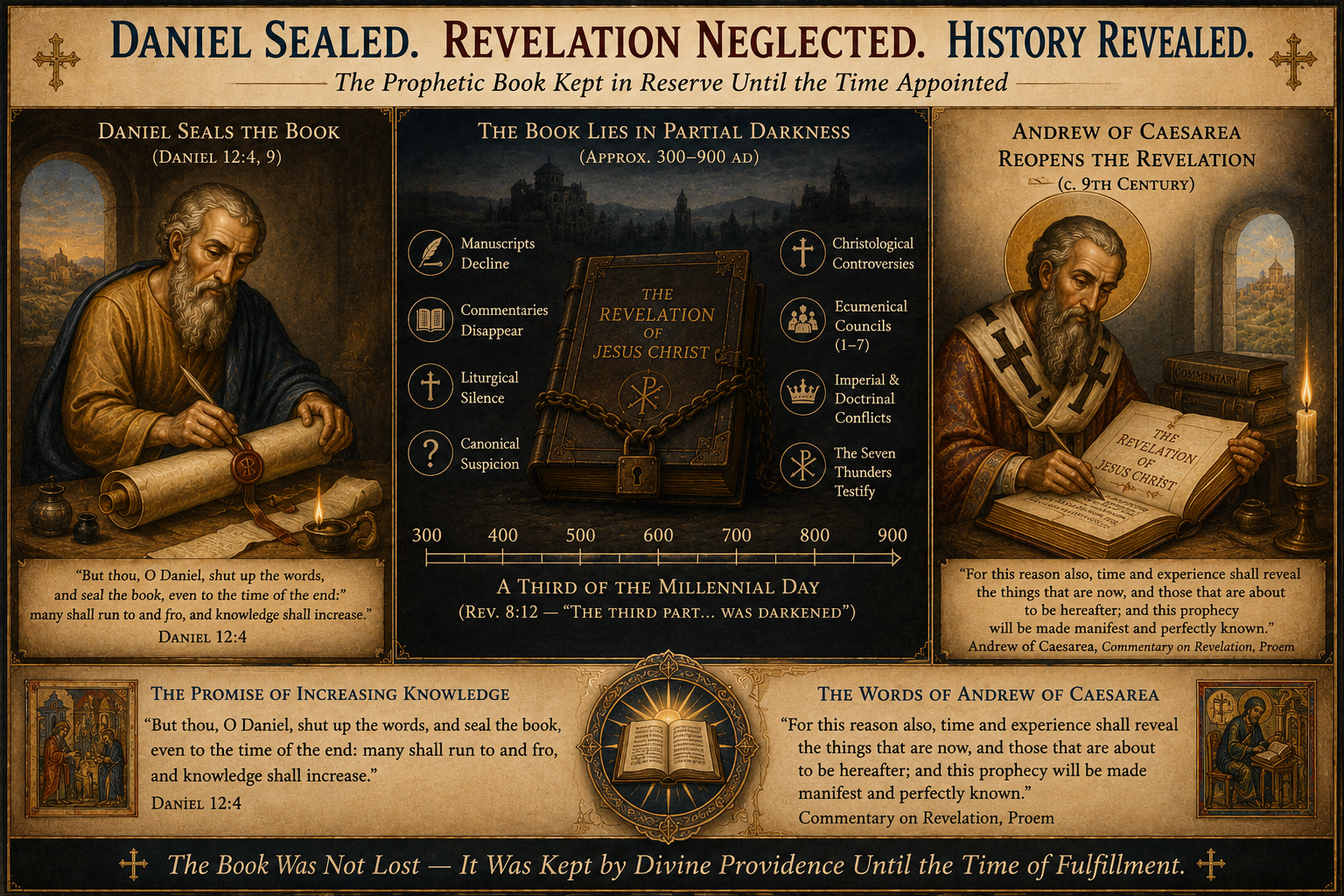
The centuries following the fall of Constantinople provided precisely such a historical education. The Christian East had now experienced events that earlier generations could scarcely have imagined. The rise of Islam, the Arab conquests, the Ottoman expansion, the fall of Christian kingdoms, the loss of Constantinople, and the prolonged experience of life under foreign domination transformed the historical consciousness of Orthodox Christians. These events naturally encouraged renewed attention to the Apocalypse.
Within this context there emerged a remarkable revival of Revelation interpretation that may properly be described as the Post-Byzantine Exegetical Movement. Beginning with Maximus the Peloponnesian in the sixteenth century and continuing through a succession of commentators, Orthodox interpreters increasingly approached Revelation as a prophetic account of the Church’s historical experience.⁸²
Maximus occupies a pivotal place in this development. Writing only decades after the fall of Constantinople, he stands at the threshold of a new era. The Apocalypse was no longer merely a disputed book requiring defense. Nor was it simply a spiritual text detached from historical events. It had become a lens through which Christians sought to understand the dramatic transformations of their own age.
The movement expanded in subsequent centuries through figures such as Christophoros Angelos, Zacharias Gerganos, Paisios Ligarides, Anastasios Gordios, Kyrillos Lavriotis, John of Lindeos, and Theodoret of Ioannina.⁸³ Although differing in details, these commentators shared a common conviction: the Apocalypse speaks meaningfully to the unfolding history of the Church.
The significance of this development cannot be overstated. Earlier centuries had debated whether Revelation should be accepted. The Post-Byzantine commentators assumed its authority and asked a different question:
How has Revelation been fulfilled within the history through which the Church has already passed?
The shift was profound.
The rise of Islam was interpreted through the imagery of the Beast and the locusts. Ottoman domination was examined in light of apocalyptic symbols. Ecclesiastical conflicts, imperial transformations, and historical crises were increasingly viewed through the lens of prophetic history. Revelation ceased to be merely a book about the distant future and became a guide to understanding the Christian past and present.
Perhaps no figure better represents the culmination of this movement than Apostolos Makrakis. His commentary exhibits a comprehensive historical reading of the Apocalypse, identifying the Fifth Trumpet with Arius, the Sixth Trumpet with the collapse of Roman power, and numerous subsequent visions with major events in Church history.⁸⁴ Whatever one’s assessment of particular identifications, Makrakis demonstrates the maturity of a tradition that had spent centuries reflecting upon Revelation through the lens of lived historical experience.
The trajectory from Andrew to Makrakis reveals a remarkable continuity. Andrew had argued that time and experience would clarify prophetic mysteries. The Post-Byzantine commentators increasingly believed that this clarification had begun to occur. History itself had supplied interpretive context unavailable to earlier generations.
This development suggests an intriguing conclusion regarding the Fourth Trumpet. If the eclipse of the Apocalypse involved a temporary obscuration of prophetic light, then the Post-Byzantine revival may be understood as a corresponding restoration of that light. The Apocalypse was not merely recovered as a canonical book. It was recovered as a historical revelation.
The irony is profound. During the centuries in which Revelation experienced its greatest eclipse, many of the historical events later identified within its visions were already unfolding. Only after those events had occurred did the Church begin to recognize their possible prophetic significance.
In this respect, the history of Revelation’s interpretation mirrors the very principle articulated by both Daniel and Andrew. The book was sealed, preserved, reopened, and increasingly understood through the passage of time. Knowledge increased. Experience accumulated. The prophetic witness gradually emerged from eclipse.
The Apocalypse had not merely survived history.
It had become intelligible through history.
The Seven Thunders and the Providential Veiling of Understanding
The historical eclipse of the Apocalypse followed by the Post-Byzantine recovery of historical interpretation also raises a broader theological question concerning the relationship between revelation and concealment within the Apocalypse itself. Although Revelation is presented as an unsealed book, St. John records one notable exception:
“And when the seven thunders had uttered their voices, I was about to write: and I heard a voice from heaven saying unto me, Seal up those things which the seven thunders uttered, and write them not.”⁸⁵
This command introduces an important tension within the book. On the one hand, Revelation concludes with the instruction:
“Seal not the sayings of the prophecy of this book.”⁸⁶
On the other hand, a portion of its contents remains intentionally concealed. The Apocalypse is therefore both revealed and partially hidden. Some mysteries are disclosed immediately, while others appear reserved for a future time.
This pattern recalls the experience of the prophet Daniel, who was commanded:
“Shut up the words, and seal the book, even to the time of the end.”⁸⁷
The relationship between Daniel and Revelation has often been understood as one of sealing and unsealing. Daniel’s visions were closed until a future age, whereas John’s Apocalypse was presented as an open book for the Church. Yet the command concerning the Seven Thunders suggests that even within the unsealed Apocalypse certain dimensions of understanding remain providentially withheld.
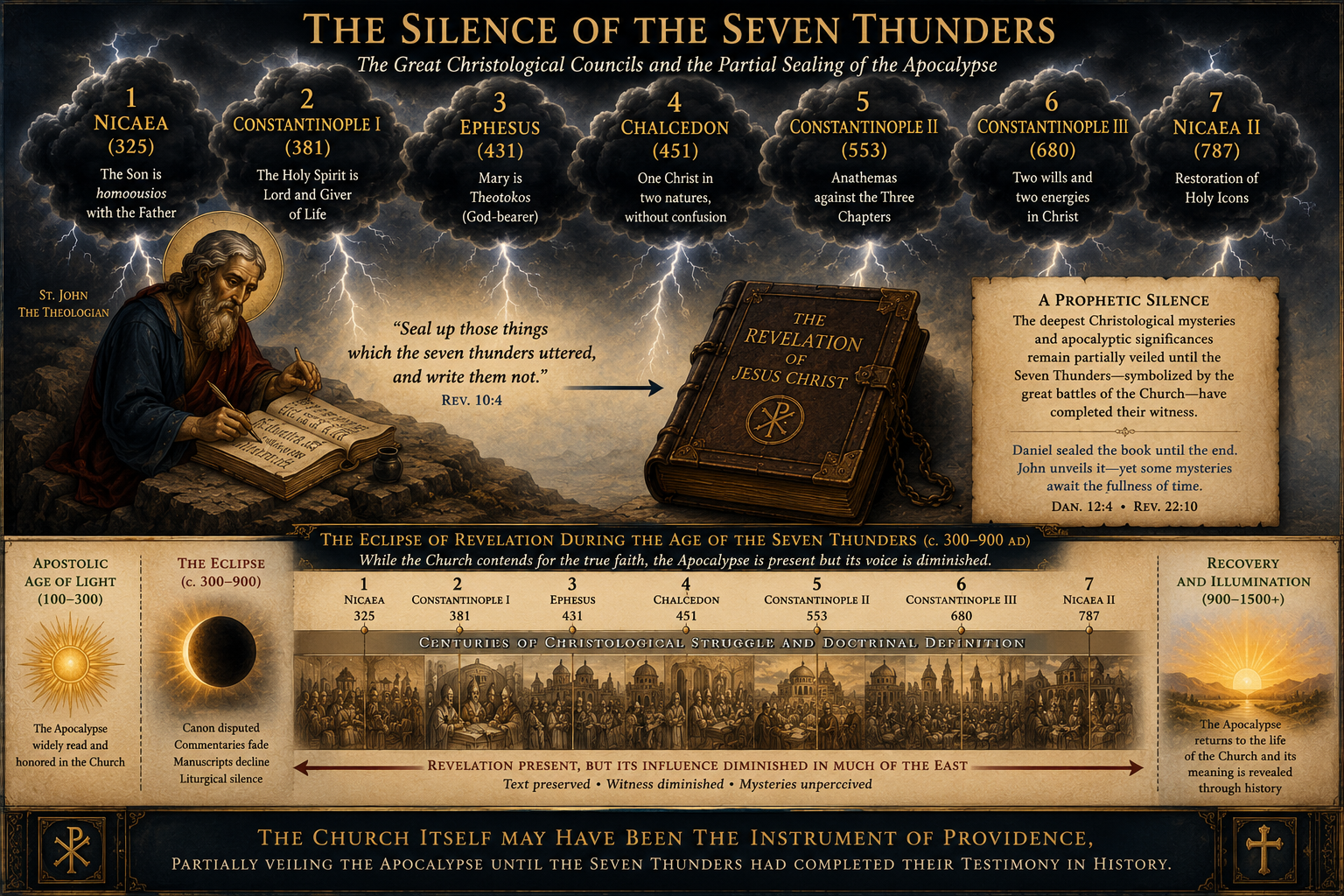
Viewed from this perspective, the historical eclipse of Revelation acquires an additional theological dimension. The Church did not formally reseal the Apocalypse, nor did she consciously suppress its testimony. Nevertheless, during the very centuries in which the great Christological controversies and Ecumenical Councils unfolded, the Apocalypse occupied a diminished position within much of the Christian East. Its text survived, but its influence was reduced. Its witness remained, but its voice was heard less clearly.
One may therefore ask whether this eclipse served, at least in part, a providential purpose. The deepest Christological implications of the Apocalypse may not have been intended to be fully appreciated before the Church had passed through the struggles of Nicaea, Constantinople, Ephesus, Chalcedon, and the subsequent doctrinal conflicts that shaped Orthodox theology. Only after centuries of historical experience did commentators increasingly perceive dimensions of the prophecy that earlier generations could scarcely have recognized.
Such reflections necessarily remain speculative. Yet they accord remarkably well with the principle articulated by Andrew of Caesarea that prophetic understanding unfolds through “time and experience.” The Apocalypse was not hidden because it lacked meaning, but because some aspects of its meaning awaited the historical circumstances necessary for their recognition.
In this light, the eclipse of Revelation may be understood not merely as a loss but also as a preparation. The book remained preserved within the Church until the appointed time when its testimony could once again be heard with greater clarity. What Daniel sealed, John unveiled; yet even within the unveiling, certain mysteries awaited the gradual illumination supplied by history itself.
X. Conclusion
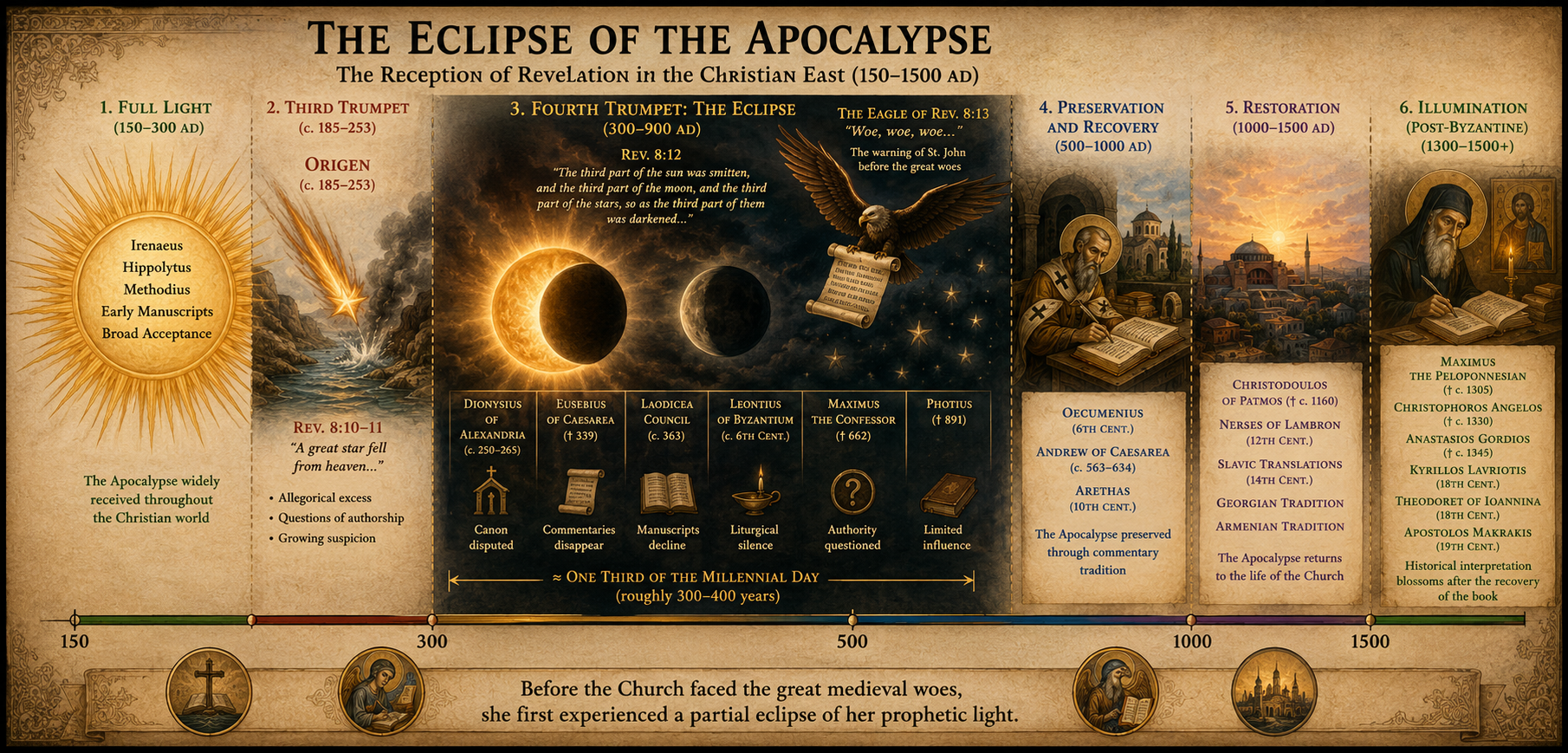
The history of Revelation within the Christian East presents one of the most remarkable episodes in the reception of any New Testament book. Unlike the Gospels, Acts, or the Pauline Epistles, the Apocalypse experienced a prolonged period in which its authority, influence, and visibility were substantially diminished throughout significant portions of the Church. Its apostolic authorship was questioned. Its place within the canon remained uncertain in some regions. Its manuscript transmission declined. Its liturgical use largely disappeared. Its imagery became increasingly absent from Byzantine artistic and theological life.
Yet the Apocalypse was never entirely lost.
The evidence surveyed in this study suggests a pattern strikingly consistent with the imagery of the Fourth Trumpet. The heavenly lights are not extinguished; they are partially darkened. The sun, moon, and stars remain, but their illumination is diminished. Likewise, Revelation continued to exist within the Church, yet its prophetic witness shone with reduced brightness throughout much of the Greek East for several centuries.
When viewed within the broader sequence of Revelation 8 and 9, the correspondence becomes even more compelling. The eclipse follows the falling of Wormwood and precedes the Eagle’s warning. Historically, the influence of Origen and the controversies surrounding his intellectual legacy were followed by the gradual marginalization of the Apocalypse. The Eagle then announces the coming woes, and the centuries that follow witness some of the most significant crises in Christian history: the Arian controversy, the transformation of the Roman world, the rise of Islam, and the profound upheavals that reshaped both Church and Empire.
The argument advanced here is not one of simplistic causation. Arius did not arise because Christians neglected Revelation, nor did Rome fall because the Apocalypse was omitted from canonical lists. History is more complex than such explanations permit. Yet the sequence remains noteworthy. Before the Church encountered the great trials associated by later commentators with the trumpet judgments, she first experienced a measurable weakening of her prophetic vision.
The traditional association of the Eagle with St. John the Theologian lends the narrative an additional layer of significance. During the very centuries in which the Apocalypse occupied a marginal and disputed position within much of the East, the symbolic creature associated with its author appears in Revelation as the herald of warning. Whether this correspondence is intentional or providential, it remains striking. The prophetic voice continued to cry out from the midst of heaven, even when many no longer listened attentively to its testimony.
Yet the eclipse was temporary.
Through Oecumenius, Andrew of Caesarea, Arethas, and the commentary tradition that followed, the Apocalypse gradually regained its place within the life of the Church. Manuscripts multiplied. Commentaries spread. Translations appeared throughout the Orthodox world. The light that had been obscured was preserved and eventually restored.
The recovery of Revelation’s authority, however, was only the beginning. In the centuries following the fall of Constantinople, Orthodox commentators increasingly returned to the Apocalypse as a guide to understanding the Church’s historical experience. Maximus the Peloponnesian, Christophoros Angelos, Zacharias Gerganos, Anastasios Gordios, John of Lindeos, Theodoret of Ioannina, Kyrillos Lavriotis, Apostolos Makrakis, and others began reading Revelation not merely as a prophecy of the distant future but as a revelation of the Church’s journey through history.
In this respect, the reception history of Revelation appears to mirror the very principle articulated by both Daniel and Andrew of Caesarea. Prophetic understanding unfolds through time and experience. The book is preserved, reopened, and gradually understood as history itself becomes a teacher. What earlier generations could only glimpse dimly later generations perceive with greater clarity.
The Fourth Trumpet may therefore describe more than political decline, ecclesiastical turmoil, or cosmic symbolism. It may also portray a temporary eclipse of the Church’s prophetic witness. During approximately one-third of the first Christian millennium, the Apocalypse itself occupied a diminished place within much of the Christian East. The light remained, but it shone less brightly. The warning remained, but it was less widely heard.
And yet the light was never extinguished.
The Apocalypse survived its eclipse. Through the preservation of a faithful remnant of manuscripts, commentators, and interpreters, the prophetic testimony of St. John endured until the time came for its renewed illumination. The history of Revelation in the East thus stands as a powerful reminder that divine revelation may be obscured for a season without being lost. The sun, moon, and stars may be darkened, but they continue to shine beyond the shadow.
In the end, the Book of Revelation underwent its own apocalypse—not in the sense of destruction, but in the deeper sense of unveiling. Its history reveals a pattern of reception, eclipse, preservation, recovery, and renewed understanding. The prophetic book that warned the Church about history ultimately became intelligible through history. As knowledge increased and time became a teacher, the Apocalypse emerged once more from eclipse to illuminate the path of the Church.
© 2026 by Jonathan Photius
Footnotes
- Rev. 8:12 (KJV).
- Joseph Verheyden Schmid, The Reception of Revelation in the East, Appendix in The Reception of the Book of Revelation (Cambridge: Cambridge University Press, 2023), 182–204.
- Rev. 8:10–11.
- Rev. 8:13.
- Rev. 8:10–11.
- See Elizabeth Clark, The Origenist Controversy (Princeton: Princeton University Press, 1992).
- Eusebius, Ecclesiastical History 7.25.
- Rev. 8:12.
- Gen. 37:9.
- Dan. 12:3.
- Rev. 1:16, 20.
- Schmid, “Reception of Revelation in the East,” 182–204.
- Oecumenius, Commentary on the Apocalypse 12.20.4.
- Schmid, “Reception of Revelation in the East,” 182–183.
- Ibid., 184.
- Ibid.
- Ibid., 184.
- Ibid., 185.
- Ibid.
- Ibid., 186–187.
- Ibid., 186.
- Ibid., 189.
- Ibid., 188–189.
- Ibid., 189.
- Dionysius of Alexandria, as preserved in Eusebius of Caesarea, Ecclesiastical History 7.25.
- Eusebius of Caesarea, Ecclesiastical History 3.25.
- Canon 60 of the Council of Laodicea (if authentic), in Nicene and Post-Nicene Fathers, Second Series, vol. 14.
- Gregory Nazianzen, Carmina Dogmatica 1.12.
- Amphilochius of Iconium, Iambi ad Seleucum, lines 289–319.
- Bruce M. Metzger, The Canon of the New Testament: Its Origin, Development, and Significance (Oxford: Clarendon Press, 1987), 219–27.
- Junilius Africanus, Instituta Regularia 1.4–7; discussed in Schmidt, Reception of Revelation 500–1500 CE, 197.
- Dionysius bar Salibi, Commentary on Revelation 3.3–4; Schmidt, Reception of Revelation 500–1500 CE, 200–201.
- Oecumenius, Commentary on the Apocalypse, Prologue 1.1.4.
- Nicephorus I of Constantinople, Chronographia Brevis (Stichometry of Nicephorus); Schmidt, Reception of Revelation 500–1500 CE, 185.
- Schmidt, Reception of Revelation 500–1500 CE, 185. Schmidt notes that Photius never quotes Revelation in his two principal works, despite their extensive treatment of biblical questions.
- Rev. 8:12.
- Ezek. 4:6.
- Dan. 9:24–27.
- Rev. 11:2–3; 12:6, 14; 13:5.
- Ps. 90:4.
- 2 Pet. 3:8.
- Schmid, “Reception of Revelation in the East,” 182–204.
- Rev. 8:13.
- Apostolos Makrakis, Interpretation of the Book of Revelation (Athens, 1882), comments on Rev. 9:1–12.
- Rev. 1:8, 17–18; 5:6–14; 19:11–16; 22:13.
- Makrakis, Interpretation of the Book of Revelation, comments on Rev. 9:13–21.
- See, for example, entity[“people”,“Irenaeus of Lyons”,“Early Church Father”], Against Heresies 3.11.8; also later Byzantine tetramorph traditions identifying John with the Eagle.
- Rev. 9:1.
- Rev. 9:2–11.
- Apostolos Makrakis, Interpretation of the Book of Revelation (Athens, 1882), comments on Rev. 9:1–12.
- Schmid, “Reception of Revelation in the East,” 182–220.
- Rev. 1:8.
- Rev. 1:17.
- Rev. 1:18.
- Rev. 5:8–14.
- Rev. 3:21; 22:1.
- Rev. 22:13.
- Compare Gen. 37:9; Ps. 84:11; Mal. 4:2.
- See Athanasius, Orations Against the Arians; also the Creed of Nicaea (325).
- Rev. 9:14.
- Rev. 9:15–19.
- Apostolos Makrakis, Interpretation of the Book of Revelation (Athens, 1882), comments on Rev. 9:13–21.
- Peter Heather, The Fall of the Roman Empire (Oxford: Oxford University Press, 2005), 187–453.
- Rev. 11:15; 13:1–8; 17:1–18; 18:1–24; 19:11–21.
- See John of Lindeos, Commentary on the Apocalypse; Theodoret of Ioannina, Interpretation of the Apocalypse; Apostolos Makrakis, Interpretation of the Book of Revelation.
- Hugh Kennedy, The Great Arab Conquests (Philadelphia: Da Capo Press, 2007), 83–312.
- Schmid, “Reception of Revelation in the East,” 208–209.
- Ibid., 198.
- Ibid., 214.
- See John of Lindeos, Commentary on the Apocalypse; Apostolos Makrakis, Interpretation of the Book of Revelation, comments on Rev. 12.
- Christophoros Angelos, On the End of the World; Zacharias Gerganos, Interpretation of Revelation; John of Lindeos, Commentary on the Apocalypse; Apostolos Makrakis, Interpretation of the Book of Revelation.
- Oecumenius, Commentary on the Apocalypse 12.20.4.
- Andrew of Caesarea, Commentary on the Apocalypse, Prologue.
- Schmid, “Reception of Revelation in the East,” 213–220.
- Ibid., 220.
- Andrew of Caesarea, Commentary on the Apocalypse on Rev. 13:18.
- Schmid, “Reception of Revelation in the East,” 220.
- Ibid.
- Arethas of Caesarea, Commentary on the Apocalypse, Prologue.
- Andrew of Caesarea, Commentary on the Apocalypse on Rev. 13:18.
- Dan. 12:4.
- Maximus the Peloponnesian, Interpretation of the Apocalypse (16th century).
- Christophoros Angelos, On the End of the World; Zacharias Gerganos, Interpretation of Revelation; Paisios Ligarides, Apocalyptic Writings; Anastasios Gordios, Commentary on the Apocalypse; John of Lindeos, Commentary on the Apocalypse; Theodoret of Ioannina, Interpretation of the Apocalypse.
- Apostolos Makrakis, Interpretation of the Book of Revelation.
- Rev. 10:4.
- Rev 22:10.
- Dan 12:4.
- Schmidt, Reception of Revelation 500–1500 CE, 186–187. Schmidt observes that only three known Greek Revelation manuscripts date between 500 and 900 CE, compared with thirteen between 150 and 500 CE, suggesting a marked decline in the transmission of the Apocalypse during precisely the period under discussion.
Selected Bibliography
Andrew of Caesarea. Commentary on the Apocalypse. Greek text and translations.
Athanasius. Orations Against the Arians.
Clark, Elizabeth A. The Origenist Controversy: The Cultural Construction of an Early Christian Debate. Princeton: Princeton University Press, 1992.
Eusebius of Caesarea. Ecclesiastical History.
Heather, Peter. The Fall of the Roman Empire. Oxford: Oxford University Press, 2005.
Makrakis, Apostolos. Interpretation of the Book of Revelation. Athens, 1882.
Oecumenius. Commentary on the Apocalypse.
Schmid, Joseph Verheyden. “The Reception of Revelation in the East.” In The Reception of the Book of Revelation, 176–221. Cambridge: Cambridge University Press, 2023.
Theodoret of Ioannina. Interpretation of the Apocalypse.
John of Lindeos. Commentary on the Apocalypse.

