
By Jonathan Photius – The NEO-Historicism Research Project
Introduction
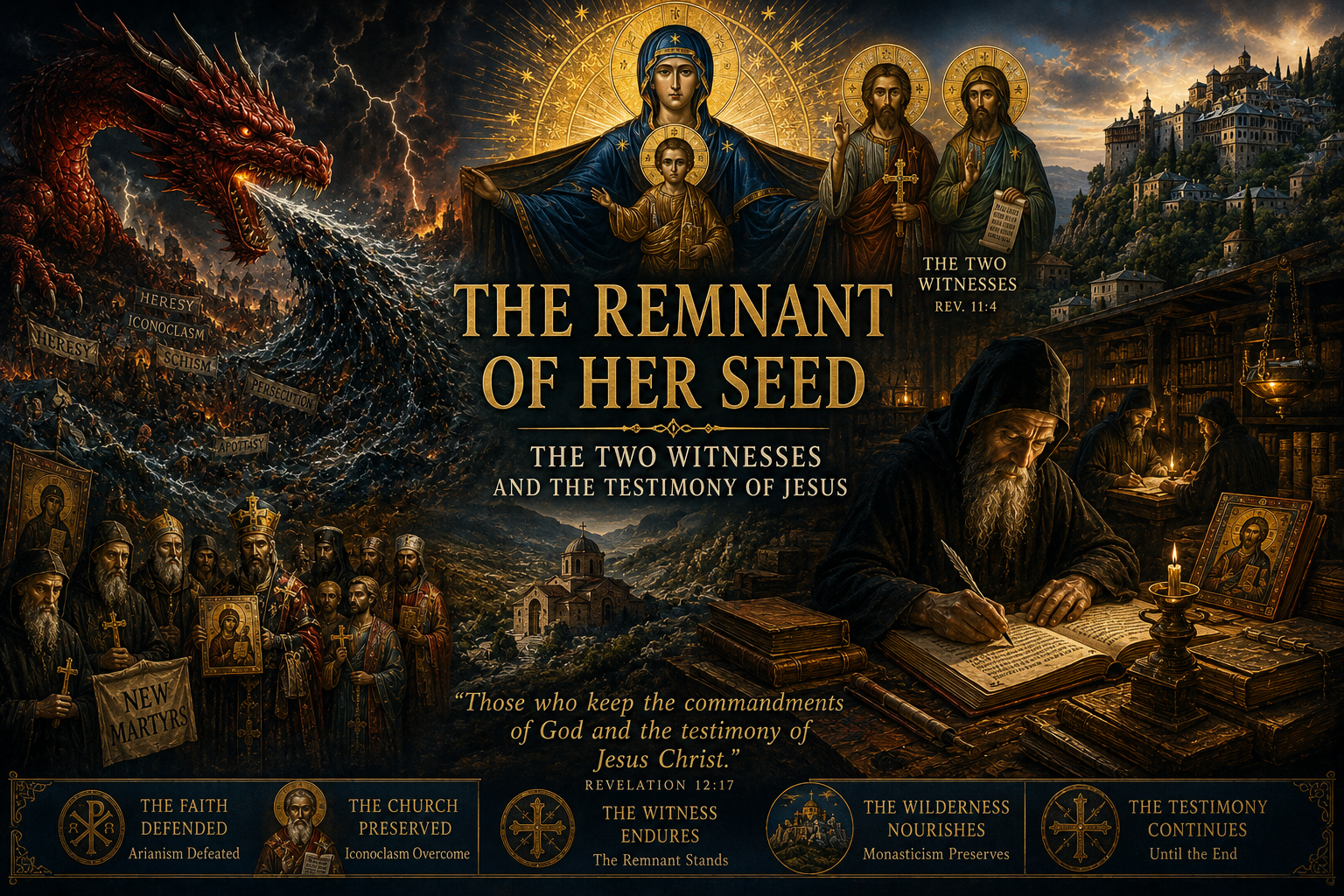
The final scene of Revelation 12 is among the most profound in the entire Apocalypse. After failing to destroy the Man-Child and after seeing the Woman preserved in the wilderness, the Dragon turns his attention toward a new target. St. John writes:
“And the dragon was wroth with the woman, and went to make war with the remnant of her seed, which keep the commandments of God, and have the testimony of Jesus Christ” (Rev. 12:17).
This verse forms the climax of the chapter. The Dragon first attempted to destroy the Child. Failing in that effort, he sought to overwhelm the Woman with a flood. When that assault likewise failed, he turned his fury against her offspring. The focus of the vision narrows from Christ, to the Church, and finally to the faithful believers who preserve the life of the Church throughout history.
Apostolos Makrakis offers a particularly illuminating interpretation of this passage. He identifies the remnant of the Woman’s seed who have the testimony of Jesus with the Two Witnesses described earlier in Revelation 11 who gave their prophetic testimony in the Great City with holy fire proceeding from their mouth. This connection provides a key for understanding the final war of Revelation 12. The remnant are not merely survivors of persecution. They are the witnessing body of faithful Christians who preserve the seven-thundered testimony of the nature of Jesus Christ throughout the centuries.
The Third and Final War
Makrakis interprets Revelation 12 as describing three successive wars waged by Satan against the divine plan of salvation. The first war is directed against Christ Himself. This conflict concerns the truth of the Incarnation and the identity of the God-Man. Through heresies, false doctrines, and spiritual deception, Satan seeks to destroy the Child whom the Woman has brought forth.
The second war is directed against the Church. Having failed to overthrow the truth concerning Christ, Satan attacks the institution that preserves and proclaims that truth. The flood proceeding from the Dragon’s mouth represents the attempt to portray the Church as idolatrous and therefore unworthy of trust. Through the Iconoclast controversy and similar assaults upon the Church’s authority, the Dragon seeks to undermine the credibility of the Bride of Christ.
The third war is directed against the faithful themselves. Unable to destroy either the truth or the Church, Satan attacks those who continue to confess the truth and live within the life of the Church. This final conflict is therefore intensely personal. It concerns not merely doctrine or institutions but living Christians who keep the commandments of God and bear witness to Christ before the world.
The Remnant and the Two Witnesses
One of the most remarkable aspects of Makrakis’ interpretation is his identification of the remnant with the Two Witnesses of Revelation 11. Speaking of the Woman, he writes that she “gave birth to the two witnesses standing before the God of the earth as two olive trees and two candlesticks.” This statement reveals a profound connection between the visions.
The Two Witnesses are often interpreted as two future individuals who will appear shortly before the end of the world. Makrakis instead understands them within the broader history of the Church. They represent the enduring witness of faithful Christianity. Just as the Woman gives birth to the Man-Child, she also gives birth to generations of witnesses who preserve and proclaim the truth.
The remnant therefore consists of those who continue this witness throughout history. They are the confessors who defend the faith during times of doctrinal crisis, the martyrs who suffer for Christ, the monks who preserve sacred tradition, the bishops who guard apostolic teaching, and the faithful laity who remain steadfast in the midst of persecution and temptation.
Later Orthodox commentators reinforce this interpretation from complementary perspectives. Theodoret of Ioannina explains that the Dragon could not harm the Woman in the place prepared for her by God and therefore turned his fury against “the other pious ones who are of her seed.” He emphasizes that both the Woman and her offspring belong to the same heavenly seed and are united in the keeping of God’s commandments and the testimony of Jesus Christ. John Lindios applies the passage more concretely to the historical experience of Orthodoxy, identifying the remnant with “us, the Orthodox of the Church of Christ” who endured centuries of captivity and persecution without abandoning the faith. Together these commentators reveal the remnant not as a separate community but as the continuing life of the Church herself, preserving Christ’s testimony throughout history.
What Is the Testimony of Jesus?
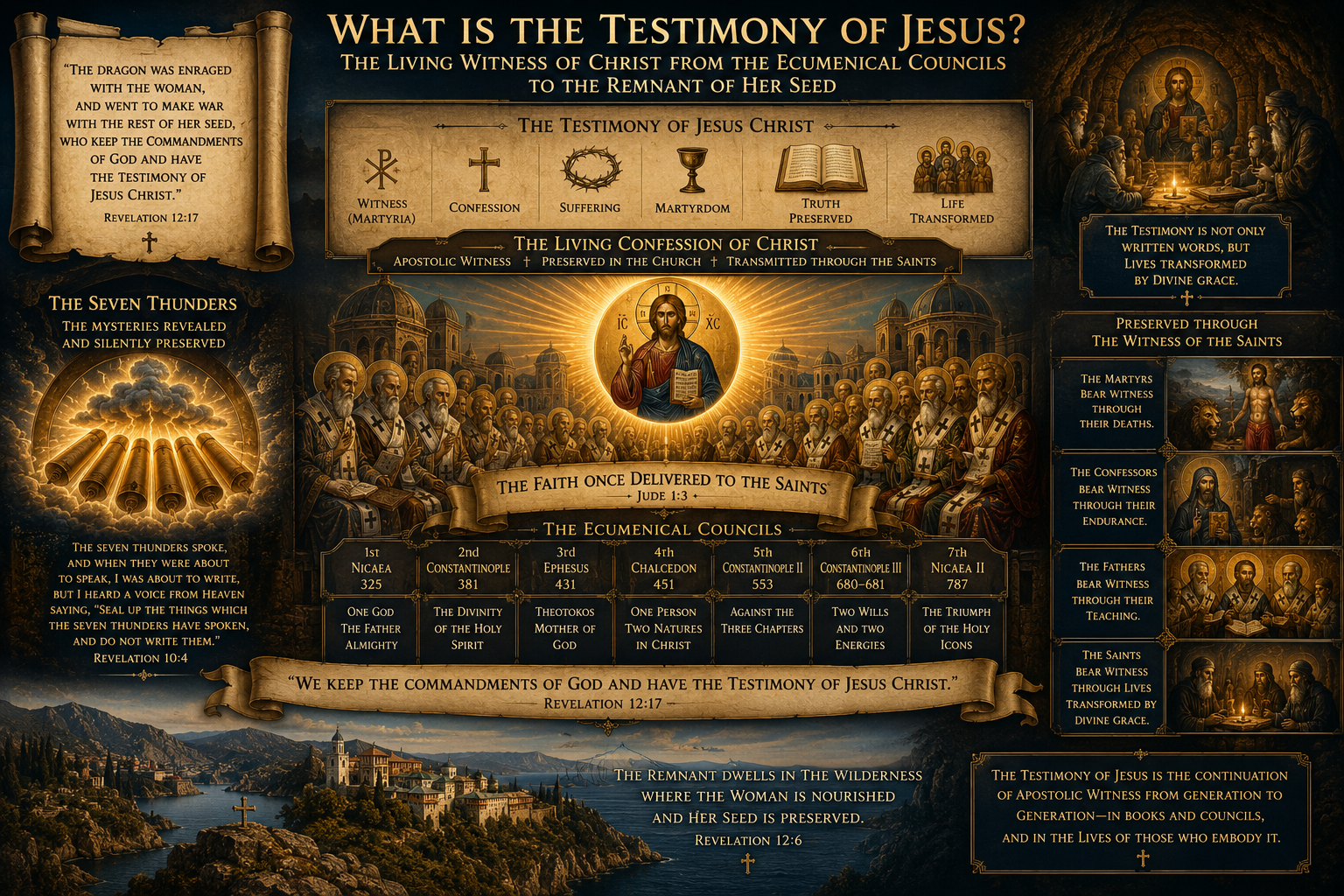
The defining characteristic of the remnant is that they possess “the testimony of Jesus Christ.” This phrase carries a deeper meaning than mere intellectual belief. The Greek word martyria signifies witness, confession, and ultimately martyrdom.
Throughout Christian history the testimony of Jesus has been preserved not merely through written documents but through the lives of believers. The martyrs bore witness through their deaths. The confessors bore witness through their endurance. The Fathers bore witness through their teaching. The saints bore witness through lives transformed by divine grace.
The testimony of Jesus is therefore the living confession of Christ. It is the continuation of apostolic witness from generation to generation. It is the faith once delivered to the saints, preserved not only in books and the seven ecumenical councils but in the lives of those who embody it.
The Wilderness and the Preservation of the Faith
The rise of monasticism provides a striking historical illustration of this principle. Shortly after Christianity emerged from persecution and entered the life of the Roman Empire, countless men and women withdrew into the deserts of Egypt, Palestine, Sinai, and Syria. At first glance this movement appears unrelated to the vision of Revelation 12. Yet the symbolism is difficult to ignore.
The Woman flees into the wilderness where she is nourished by God. Likewise, the Church found nourishment in the wilderness through the ascetic life. The deserts became places of spiritual renewal, theological reflection, and preservation of tradition. While cities rose and fell, empires expanded and collapsed, and theological controversies shook the Christian world, the monasteries remained centers of prayer, fasting, and fidelity.
The wilderness was not a place of abandonment. It became a place of preservation.
Indeed, the wilderness may also be understood as a place of preparation. Long before the great doctrinal and political crises that would shake the Christian world, the ascetic tradition had already taken root in Egypt, Sinai, Palestine, Cappadocia, and later Mount Athos. Through prayer, fasting, manuscript preservation, and theological reflection, the monasteries safeguarded the Church’s spiritual inheritance. In this sense, the Church was prepared beforehand for the Dragon’s assaults. The flood of heresy, persecution, and false teaching would come, but the means of preservation had already been established by divine providence.
The Remnant Through History
The history of Orthodoxy may be viewed as the history of this remnant. During the Arian crisis, Athanasius stood nearly alone in defending the Nicene faith. During the Nestorian controversy, Cyril of Alexandria preserved the confession of the Incarnate Word. During the Monothelite crisis, Maximus the Confessor endured exile and mutilation rather than compromise the truth.
The same pattern appears during Iconoclasm. John of Damascus and Theodore the Studite defended the veneration of holy icons against powerful political opposition. Later, Mark of Ephesus resisted ecclesiastical compromise during the Council of Florence. Under Ottoman rule, countless New Martyrs preserved the testimony of Jesus through suffering and death.
These figures differ in circumstance and vocation, yet they share a common identity. Each belongs to the remnant of the Woman’s seed. Each continues the witness entrusted to the Church.
Mount Athos and the Living Witness of Orthodoxy
Perhaps no place better symbolizes the remnant than Mount Athos. For more than a millennium the Holy Mountain has served as a center of prayer, asceticism, manuscript preservation, iconography, and theological continuity. Generations of monks have copied texts, preserved liturgical traditions, defended Orthodox doctrine, and transmitted the spiritual inheritance of the Fathers.
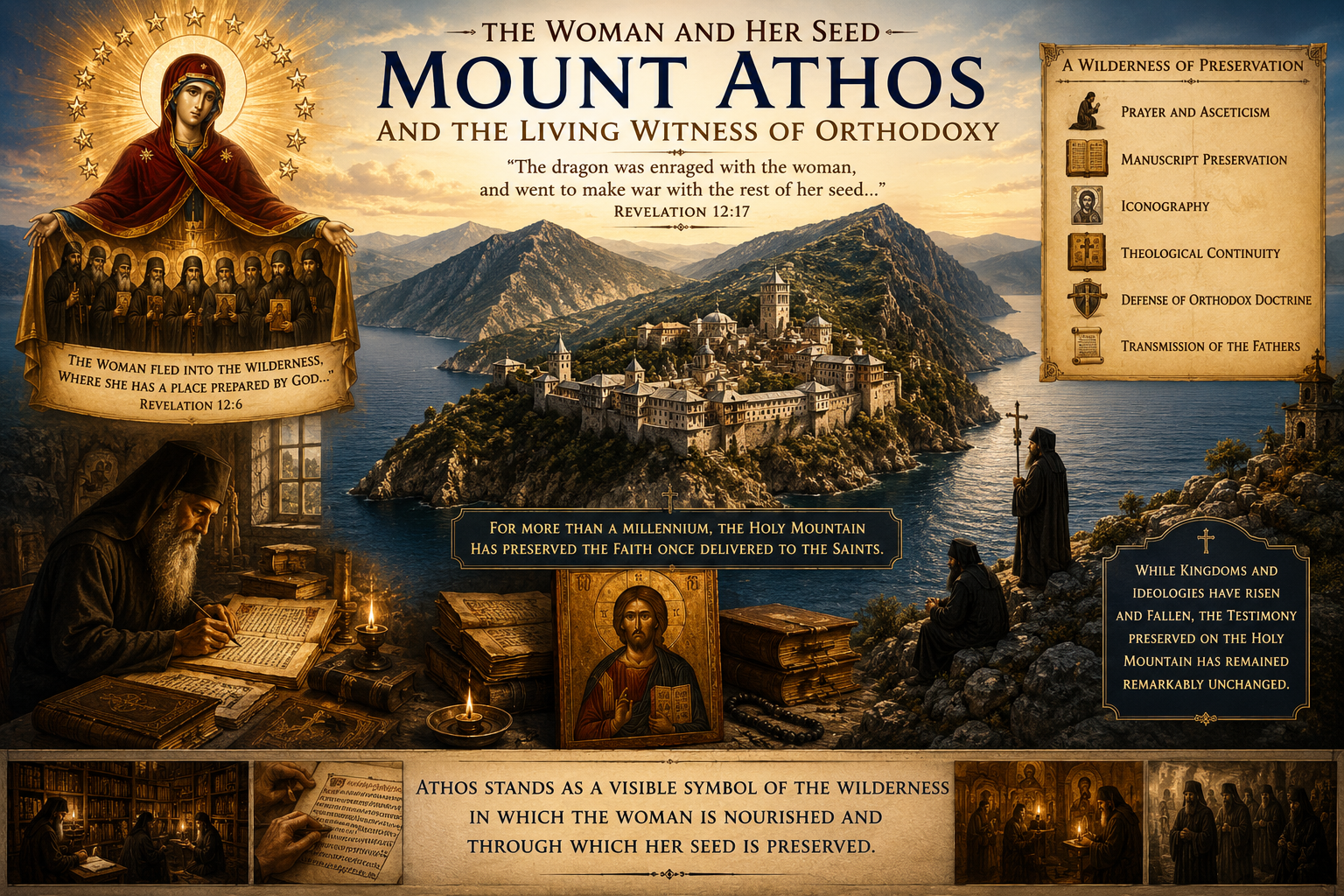
The significance of Athos extends beyond monasticism itself. It represents the enduring continuity of Orthodox Christianity. While kingdoms and ideologies have risen and fallen, the testimony preserved on the Holy Mountain has remained remarkably unchanged.
In this sense Athos stands as a visible symbol of the wilderness in which the Woman is nourished and through which her seed is preserved.
The Living Continuation of the Woman
The remnant are not separate from the Woman. They are her children. The life of the Church continues through them just as the life of a family continues through successive generations.
This relationship helps explain the structure of Revelation 12. The chapter begins with the Woman and ends with her offspring. The Church gives birth to Christological truth, preserves that truth through history, and then transmits it to faithful believers who continue her witness in every generation.
The Woman survives because her seed survives. The Church endures because faithful Christians continue to keep the commandments of God and hold the testimony of Jesus Christ.
A broader theological pattern may also be discerned in the surrounding visions of Revelation. Earlier chapters describe the Seven Thunders, the Two Witnesses, and the appearance of the Ark of God’s Testament in heaven. While the Apocalypse does not explicitly connect these images, they may be viewed as successive aspects of the Church’s mission. The Seven Thunders symbolize the great dogmatic witness of the Church, preserved historically in the Seven Ecumenical Councils. The Ark signifies the preservation of this apostolic and conciliar deposit within the life of the Church. The remnant of the Woman’s seed then become those who continue to hold, defend, and transmit that testimony throughout history. From this perspective, the remnant are not merely survivors of persecution but custodians of the Church’s inheritance.
The historical experience of Orthodoxy offers striking parallels to this pattern. The wilderness that nourished the Woman gave rise to the great monastic centers of the Christian East, especially Mount Athos. From that wilderness emerged works such as The Rudder of St. Nicodemus the Hagiorite, which gathered and preserved the canonical and conciliar tradition of the Church. Just as the Ark safeguarded the covenant entrusted to Israel, so the Church safeguards the apostolic deposit entrusted to the saints. The remnant bear witness to that inheritance and hand it down from generation to generation.
Conclusion
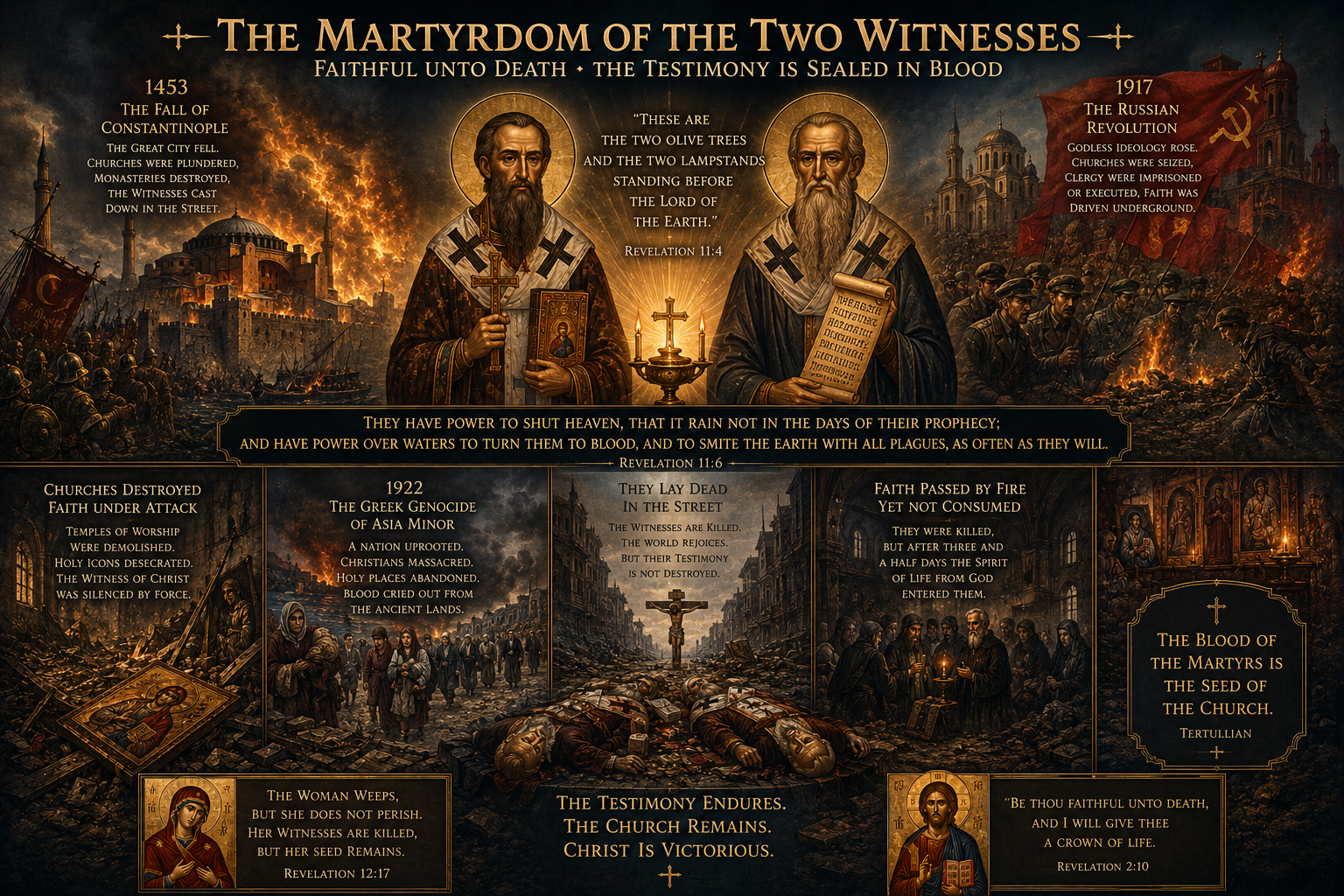
Revelation 12 concludes not with defeat but with preservation. The Dragon continues to wage war, yet he never succeeds in destroying the purposes of God. The Child survives. The Woman survives. The remnant survives.
Through martyrs, confessors, monks, bishops, fathers, and faithful laity, the testimony of Jesus has continued throughout the centuries. These witnesses form the living continuation of the Woman clothed with the Sun. They are the Two Witnesses of history, preserving the apostolic faith amid every assault of the Dragon.
The final object of the Dragon’s wrath is therefore not merely a doctrine or an institution but a people—a faithful remnant who keep the commandments of God and hold fast the testimony of Jesus Christ until the end of the age.
© 2026 by Jonathan Photius
 NEO-Historicism - End Times Eschatology From An Eastern Orthodox Christian Historicist Perspective