
By Jonathan Photius – The NEO-Historicism Research Project
Introduction
The identity of the Woman clothed with the Sun in Revelation 12 has long been debated among Christian interpreters. Some have understood the Woman primarily as the Virgin Mary, while others have identified her with Israel or the people of God more generally. Yet among the earliest surviving interpreters of the Apocalypse, one Father stands out for the depth and breadth of his ecclesial interpretation: St. Methodius of Olympus (c. AD 250–311).
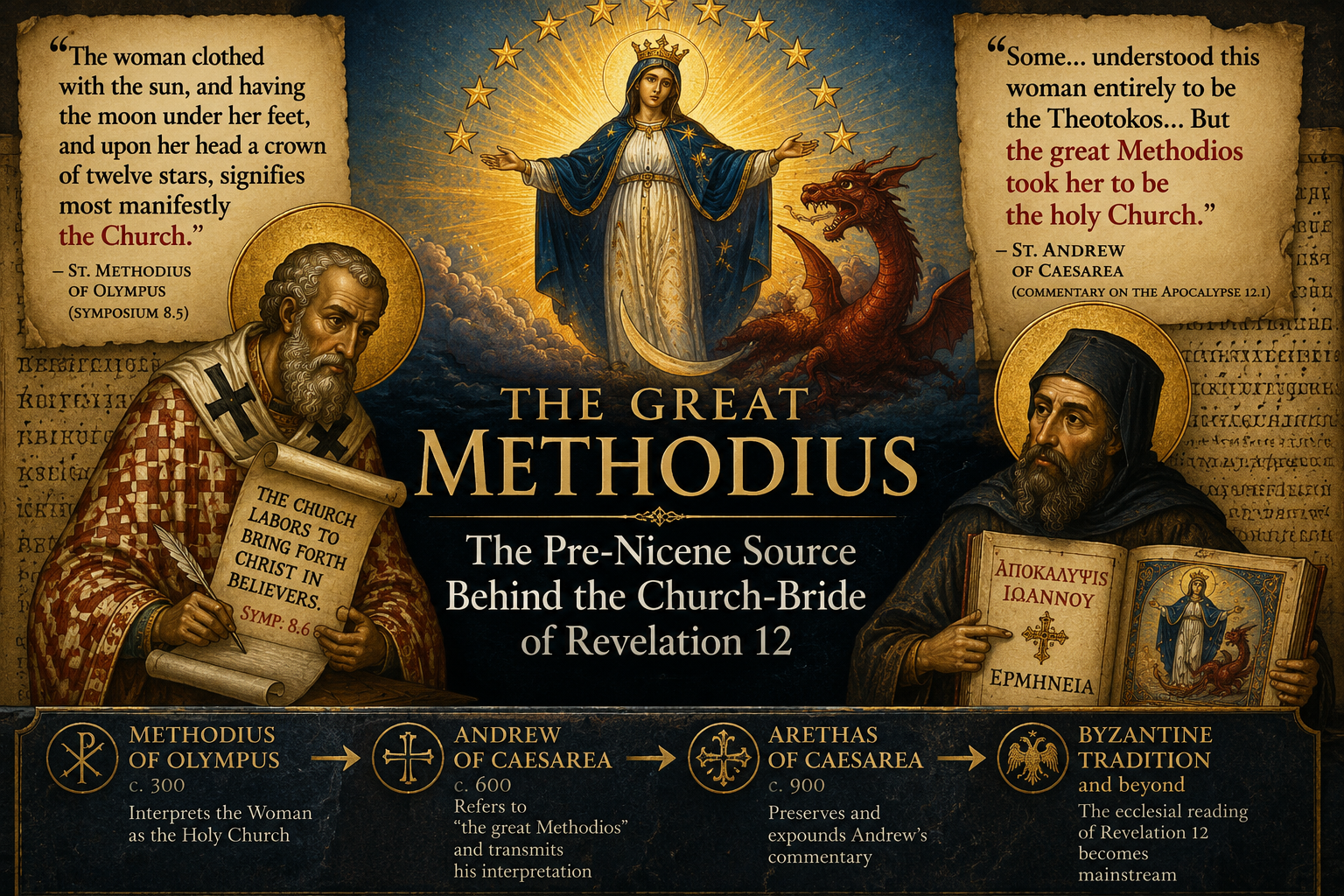
Writing before the Council of Nicaea and during the final age of Roman persecution, Methodius developed one of the earliest extant interpretations of Revelation 12 as a vision of the Church. More significantly, his interpretation was later preserved and transmitted by St. Andrew of Caesarea, the most influential Byzantine commentator on the Apocalypse. When introducing the ecclesial interpretation of the Woman, Andrew explicitly appeals to “the great Methodius” (ὁ μέγας Μεθόδιος), thereby providing direct evidence of the transmission of this tradition from the pre-Nicene Church into Byzantine exegesis.
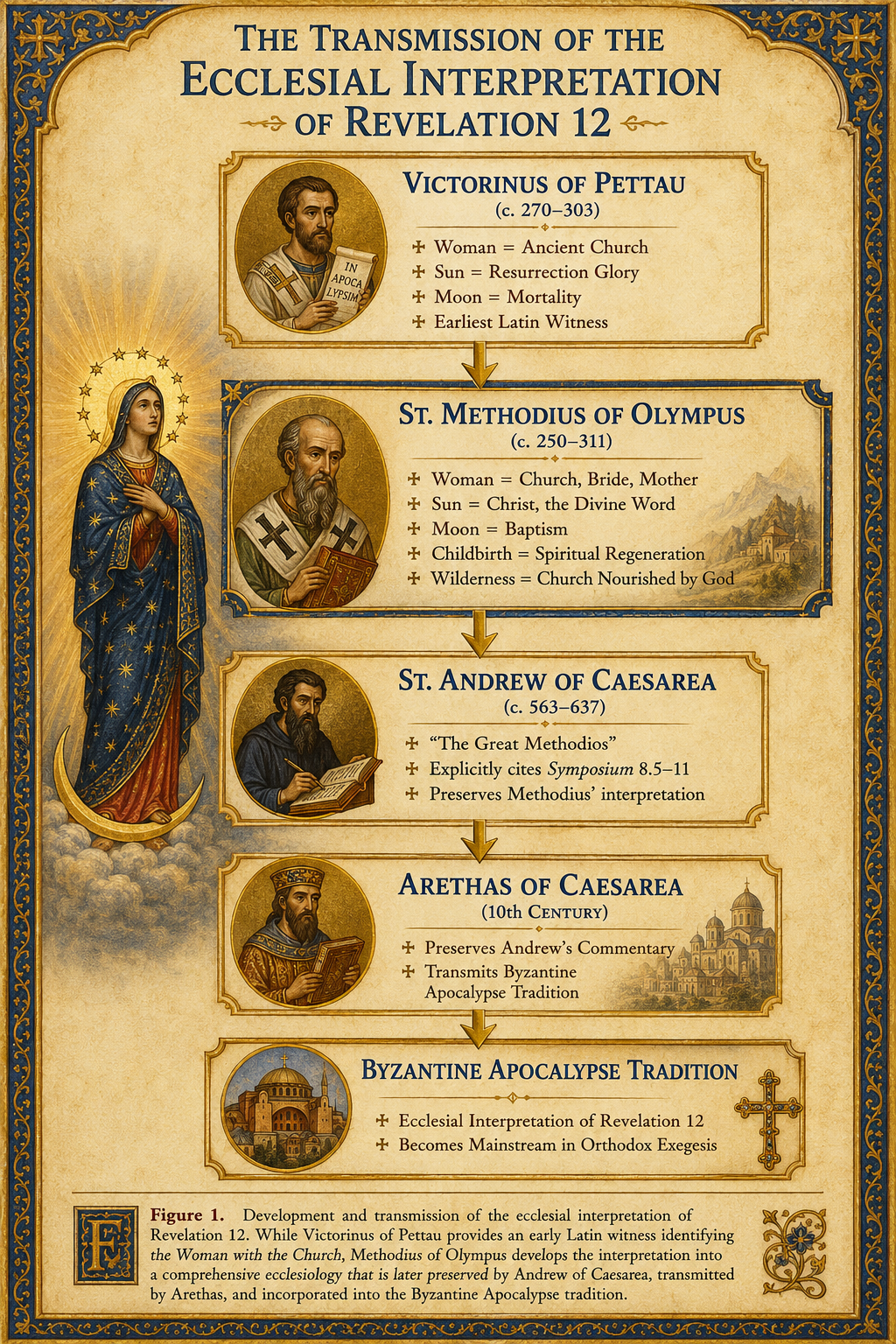
Although Victorinus of Pettau appears to provide an earlier surviving ecclesial interpretation of Revelation 12, Methodius significantly expands the symbolism. Whereas Victorinus identifies the Woman primarily as the covenant Church awaiting the fulfillment of the promise in Christ, Methodius presents her as the Church-Bride and Mother of believers, continually bringing forth spiritual children through baptism and shaping them according to the likeness of Christ. It is this richer ecclesial interpretation—not that of Victorinus—which Andrew of Caesarea repeatedly cites when commenting upon Revelation 12.
The significance of Methodius therefore extends beyond his own writings. Through Andrew, his interpretation became one of the foundational streams of Orthodox commentary on Revelation 12.
St. Methodius of Olympus and the Ante-Nicene Church
St. Methodius lived during a transitional period in Christian history. A bishop and martyr of the late third and early fourth centuries, he wrote at a time when the Church still endured persecution and before the theological formulations of the Ecumenical Councils had been fully articulated.
Among his surviving works, the Symposium, or Banquet of the Ten Virgins, is particularly important. Modeled loosely upon Plato’s Symposium, the work presents a series of theological discourses concerning Christian virtue, virginity, and the spiritual life. Embedded within these discussions is one of the earliest surviving extended interpretations of Revelation 12.
Unlike later commentators who often focused on a single symbol, Methodius provides a comprehensive interpretation of the Woman, her crown, the moon beneath her feet, her labor pains, and her conflict with the Dragon.
The Woman as the Church, Bride, and Mother
Methodius begins with a direct identification:
“The woman clothed with the sun, and having the moon under her feet, and upon her head a crown of twelve stars, signifies most manifestly the Church.”¹
This statement alone establishes Methodius as one of the earliest surviving Fathers to interpret the Woman ecclesiologically. Yet his interpretation extends far beyond a simple identification.
According to Methodius, the Woman represents the Church under various biblical images. She is Jerusalem, the Bride, Mount Zion, the Temple, and the Tabernacle of God. These titles reveal the Church as the dwelling place of God and the covenant community through whom salvation is manifested in the world.
Most significantly, Methodius repeatedly describes her as a Mother:
“It is the church whose children by baptism will swiftly come running to her from all sides after the resurrection.”²
The Woman of Revelation 12 is therefore not merely an institution or collective body. She is the spiritual Mother of believers, continually gathering and nurturing her children through the grace of Christ.
Clothed with the Sun
Methodius interprets the Woman’s radiant garment Christologically:
“The Church, clothed with the Word of the Father, whose brightness is above the sun…”³
The Sun signifies Christ Himself, the eternal Word and Light of the world. The Church is clothed in His glory and participates in His divine illumination.
This interpretation would later reappear in Andrew of Caesarea’s commentary, where the Woman is likewise described as clothed with the “Sun of Righteousness.”
For Methodius, the Church’s splendor derives entirely from her union with Christ.
The Crown of Twelve Stars
The twelve stars are interpreted as the apostolic foundation of the Church.
Methodius explains that the Church is:
“crowned with the doctrine of the twelve Apostles.”⁴
The crown therefore signifies apostolic teaching and authority. The Woman’s glory is inseparable from the faith once delivered to the saints and preserved through the apostolic tradition.
The Moon Beneath Her Feet
One of Methodius’ most original interpretations concerns the moon beneath the Woman’s feet.
Rather than viewing the moon merely as a symbol of changeability or earthly existence, Methodius associates it with baptism and spiritual rebirth.
He writes that the Church stands upon:
“the faith and our adoption—signified here by the moon.”⁵
The moon therefore represents the laver of regeneration through which believers enter the Church. Because baptism brings illumination and new birth, the moon becomes a fitting symbol of the sacramental life that sustains the Church’s children.
Andrew later preserves this very interpretation, explicitly noting that Methodius understood the moon to signify baptism.
Labor Pains and Spiritual Childbirth
Perhaps the most remarkable aspect of Methodius’ interpretation concerns the Woman’s labor pains.
Drawing upon Galatians 4:19, Methodius understands the birth imagery spiritually rather than merely historically.
He writes:
“The church… constantly conceiving those who take refuge in the Word, and shaping them according to the likeness and form of Christ.”⁶
The Church takes natural men and women and gives birth to them as spiritual children.
Methodius further explains:
“laboring and bringing forth natural people as spiritual people.”⁷
This interpretation transforms Revelation 12 into a vision of the Church’s ongoing mission. The Woman’s travail is not confined to Bethlehem. It continues wherever the Church forms Christ within the faithful through baptism, instruction, and sanctification.
Andrew directly echoes this theme when he explains that the Church suffers labor pains for those being reborn “until Christ has been formed in them.”
The Dragon and the Warfare Against the Church
Methodius identifies the Dragon without hesitation:
“The great fiery dragon… is the devil.”⁸
The Dragon’s assault is directed against the Church and her children.
Yet he fails in his attempt to devour the Child because those reborn in Christ are carried upward toward heavenly realities. The struggle of Revelation 12 is therefore understood as the perpetual conflict between the Church and the powers of evil.
The Wilderness as the Church’s Place of Nourishment
Methodius also interprets the wilderness ecclesiologically.
Andrew preserves his explanation:
“The desert, into which the Church came to be nourished, is destitute of evils and barren of decay.”⁹
The wilderness is not merely a geographical refuge but a spiritual place of preservation and divine nourishment.
Here Methodius moves beyond a historical reading of Revelation 12 and presents the vision as an ongoing reality in the life of the Church.
The Church is persecuted, yet protected.
Driven into the wilderness, yet nourished by God.
Opposed by the Dragon, yet preserved through divine grace.
St. Andrew of Caesarea and “The Great Methodius”
The influence of Methodius is nowhere more evident than in the commentary of St. Andrew of Caesarea.
Commenting on Revelation 12:1, Andrew writes:
“Some, on the one hand, had understood this woman entirely to be the Theotokos… But the great Methodios took her to be the holy Church.”¹⁰
This statement is extraordinary.
Andrew not only cites Methodius by name; he introduces him honorifically as “the great Methodius.” Moreover, throughout his discussion of Revelation 12 he repeatedly returns to Methodius’ interpretations of the Woman, the moon, the labor pains, the Dragon, and the wilderness.
Far from being an incidental source, Methodius appears as one of Andrew’s principal authorities in this chapter.
The line of transmission is therefore clear:
Conclusion
The evidence demonstrates that St. Methodius of Olympus provided one of the earliest surviving and most comprehensive ecclesial interpretations of Revelation 12.
For Methodius, the Woman is the Church: the Bride, the Mother, the New Jerusalem, and the dwelling place of God. Clothed with Christ, crowned with apostolic doctrine, standing upon the baptismal moon, and continually laboring to form Christ within her children, she embodies the life and mission of the Church throughout history.
The significance of this interpretation is confirmed by St. Andrew of Caesarea, who repeatedly appeals to “the great Methodius” as an authority for understanding Revelation 12. Through Andrew’s commentary, Methodius’ ecclesial vision entered the mainstream Byzantine tradition and continued to shape Orthodox interpretation for centuries.
Long before the medieval commentators and centuries before the rise of later historical approaches to Revelation, the great Methodius saw in the Woman clothed with the Sun a vision of the Church herself—suffering, nurturing, preserving, and triumphing through Christ.
© 2026 by Jonathan Photius
Notes
- Methodius of Olympus, Symposium 8.5.
- Methodius, Symposium 8.5–6.
- Methodius, Symposium 8.5.
- Methodius, Symposium 8.5.
- Methodius, Symposium 8.6.
- Methodius, Symposium 8.6.
- Methodius, Symposium 8.6.
- Methodius, Symposium 8.10.
- Methodius, Symposium 8.11, cited by Andrew of Caesarea, Commentary on the Apocalypse 12.3.
- Andrew of Caesarea, Commentary on the Apocalypse 12.1, trans. Eugenia Scarvelis Constantinou (Washington, DC: Catholic University of America Press, 2011), 136.
Chart 1: The Development of the Ecclesial Interpretation of Revelation 12
| Father | Date | Woman | Distinctive Contribution |
|---|---|---|---|
| Victorinus of Pettau | c. 270–303 | Church | Earliest surviving Latin witness |
| Methodius of Olympus | c. 250–311 | Church-Bride-Mother | Most developed Ante-Nicene ecclesial interpretation |
| Andrew of Caesarea | c. 563–637 | Church (following Methodius) |
Chart 2: Victorinus vs. Methodius – Ante-Nicene Interpretations of Revelation 12
| Symbol | Victorinus | Methodius |
|---|---|---|
| Woman | Ancient Church | Church, Bride, Mother |
| Sun | Resurrection Glory | Christ, the Divine Word |
| Moon | Mortality | Baptism |
| Twelve Stars | Patriarchs / Apostles | Apostolic Doctrine |
| Childbirth | Awaiting Messiah | Spiritual Regeneration |
| Dragon | Devil | Devil |
| Wilderness | Protection from Antichrist | Nourishment of the Church |
 NEO-Historicism - End Times Eschatology From An Eastern Orthodox Christian Historicist Perspective