
By Jonathan Photius – The nEO-Historicism Research Project
Empire, Ecclesiology, and the Historical Apocalypse
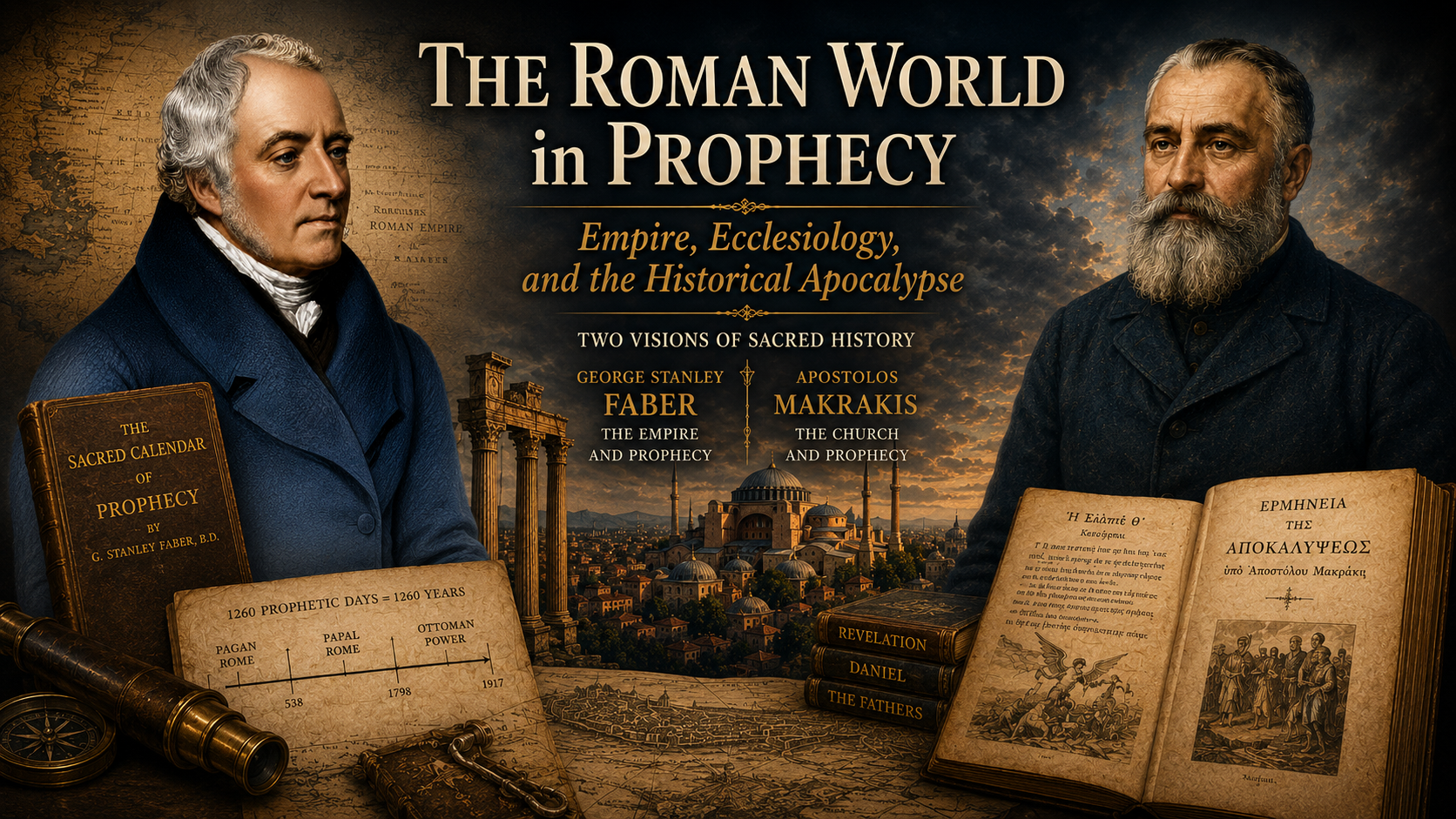
Modern scholarship often treats historicism as an exclusively Protestant phenomenon associated primarily with post-Reformation anti-papal polemics, prophetic chronology, and the interpretation of political events through the lens of biblical prophecy. Yet a closer examination of Byzantine and post-Byzantine Orthodox exegesis reveals striking structural parallels between Eastern and Western historical approaches to the Apocalypse. Both traditions understood Revelation as unfolding through the history of the Roman world, interpreted empire and ecclesiastical conflict as prophetically significant, and viewed sacred history itself as the arena in which apocalyptic meaning becomes progressively manifest through time.
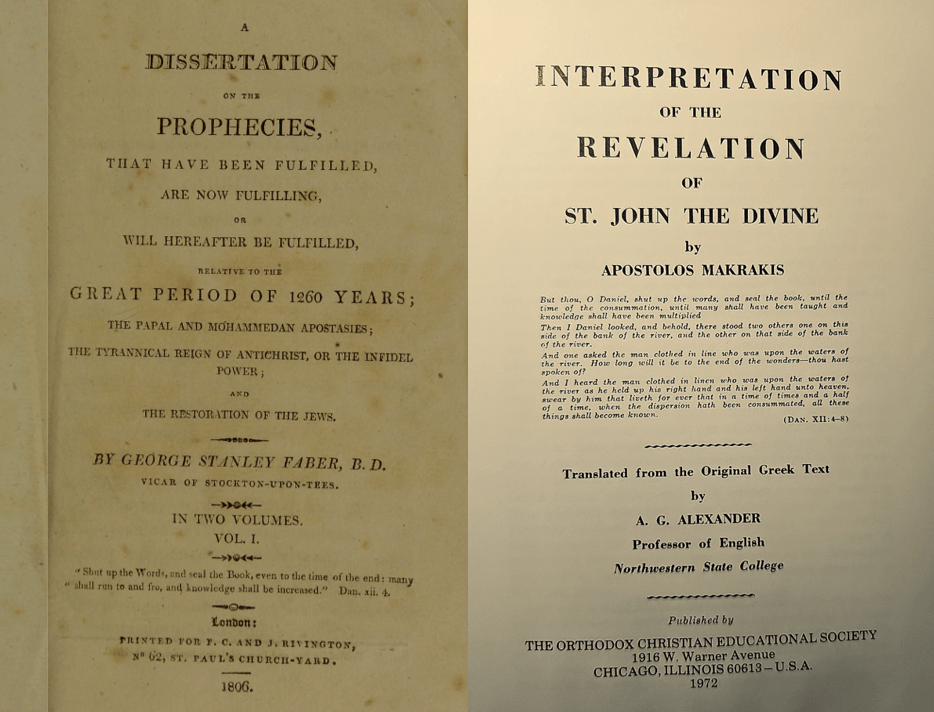
The differences, however, are equally illuminating. Where Protestant historicists such as George Stanley Faber emphasized geopolitical chronology, imperial transformation, and the rise and fall of external powers such as Islam and the Papacy, other post-byzantine era Greek Orthodox authors like Apostolos Makrakis re-centered the Apocalypse upon the doctrinal, sacramental, and ecclesial struggles within the life of the Church itself. Both interpreted Revelation historically; yet one historical vision was primarily imperial, while the other was profoundly ecclesiological.
At the heart of both systems lies a shared assumption often overlooked by modern interpreters: the Apocalypse unfolds upon the stage of the Roman world.
The Roman World as Sacred Geography
For both Faber and Makrakis, the Roman Empire was not merely a political backdrop to biblical prophecy. It functioned as sacred geography — a providentially ordered historical arena within which the drama of Revelation unfolded. This assumption derives ultimately from the prophetic structure of Daniel itself, where successive world empires form the chronological and territorial framework of sacred history.
Faber repeatedly insists that the Apocalypse unfolds across the duration of the Roman order, synchronizing the visions of Daniel and Revelation into one continuous historical structure. The Roman Empire becomes the geographical platform upon which the seals, trumpets, vials, apostasies, persecutions, and judgments successively emerge. History itself becomes a theological architecture governed by sacred chronology.
Makrakis likewise interprets Revelation through a profoundly Roman framework, though in a distinctly Byzantine manner. For him, the “earth” of Revelation frequently signifies the ordered Roman-Christian world — the civilized and ecclesiastical realm shaped by the inheritance of Christian Rome — while the “sea” represents the external barbarian regions beyond the imperial and ecclesial frontier: the migrations of barbarian tribes, the deserts of Arabia, and the chaotic outer nations lying beyond the stable boundaries of Roman civilization.
This distinction between “earth” and “sea” reflects an ancient Byzantine consciousness in which the Roman Empire functioned not merely as a state, but as a providential civilizational order intimately connected to the life of the Church. The Apocalypse therefore unfolds not in abstraction, but within the concrete historical and spiritual geography of the Roman oikoumene.
Faber and the Geopolitical Apocalypse
Faber’s historicism is fundamentally geopolitical in orientation. His prophetic system seeks to synchronize Daniel, Revelation, the rise of the Papacy, the emergence of Islam, the Ottoman Empire, the French Revolution, and the great prophetic periods into a single chronological architecture governed by the “Sacred Calendar of Prophecy.”
Central to this structure is the famous historicist equation:
1260 prophetic days=1260 years
The 1260 years become the great era of ecclesiastical domination, apostasy, and persecution extending across the divided Roman world. Faber interprets both the Papacy and Islam as parallel manifestations of long-duration prophetic opposition within the Western and Eastern spheres of the former Roman Empire.
Most striking is his “homogeneity principle.” Because Daniel presents two analogous “little horns,” Faber argues that both must represent analogous powers. If the Western horn symbolizes an ecclesiastical dominion — the Papacy — then the Eastern horn must likewise symbolize a spiritual and political power arising in the East. Thus Islam becomes the Eastern counterpart to Papal Rome: a rival ecclesiastical empire emerging from the post-Roman world.
This framework leads Faber to interpret Revelation 9 historically through the rise of Islam and the Saracen invasions. The abyss, smoke, locusts, and Euphratean horsemen become symbols of Mohammedan expansion, Ottoman power, and the successive military torments inflicted upon the Roman world from the East. Revelation becomes a map of civilizational upheaval and imperial transformation.
Makrakis and the Ecclesial Apocalypse
Makrakis shares many of the historical instincts of the historicist tradition, yet radically reorients its theological center. Whereas Faber reads Revelation primarily through empire, chronology, and geopolitical conflict, Makrakis interprets the Apocalypse through the doctrinal and spiritual life of the Church.
This becomes especially evident in his interpretation of the trumpets.
Unlike most Protestant historicists, Makrakis does not identify the locusts of Revelation 9 primarily with Islam or the Saracens. Instead, he internalizes the symbolism ecclesiologically. The smoke darkening the air becomes doctrinal corruption and theological confusion; the locusts become heretical teachers and spiritual destroyers within the Christianized Roman world itself.
Most notably, Makrakis associates the trumpet judgments with the great Christological and theological crises of the early Church, particularly the rise of Origenism and Arianism. The true battlefield of Revelation is therefore not merely military invasion, but spiritual corruption within the body of Christ. Heresy, not external conquest, becomes the primary torment of the Christian world.
This approach reflects a deeply Byzantine theological instinct. In the Orthodox consciousness, doctrinal corruption threatens not merely political order but salvation itself. Empires may destroy bodies, but heresy destroys souls. Consequently, the great controversies of the Ecumenical Councils — Arianism, Nestorianism, Monothelitism, and Iconoclasm — become cosmic historical events within the unfolding drama of the Apocalypse.
Makrakis’s interpretation also reflects a broader Byzantine suspicion regarding the theological legacy of Origen. Byzantine writers frequently associated Origen’s speculative theology with the later emergence of Christological error. Figures such as Epiphanius of Salamis regarded Origen as exerting a dangerous influence upon subsequent theological deviations, particularly those connected to Arianism. Within later Byzantine and post-Byzantine historical interpretation, Origen could therefore appear as a kind of intellectual progenitor of doctrinal corruption — at times even described as the “father of Christological heresies.”
This historical consciousness profoundly shaped Makrakis’s reading of Revelation. The smoke rising from the abyss was not merely political deception, but theological darkness obscuring the vision of Christ Himself. The trumpet judgments represented the progressive corruption of doctrine within the Christian Roman world, culminating in the great ecclesiastical crises that convulsed the empire during the centuries preceding the triumph of Orthodoxy.
Makrakis therefore transforms historical interpretation from a primarily geopolitical system into an ecclesial-historical theology of sacred conflict.
Revelation 9: Islam or Arius?
The contrast between Faber and Makrakis becomes especially illuminating in their respective interpretations of Revelation 9.
For Faber, the trumpet vision represents external invasion:
- the smoke is Mohammedan delusion,
- the locusts are Saracen armies,
- the torment is military conquest,
- and the Euphratean imagery corresponds to Ottoman expansion.
For Makrakis, the same imagery signifies internal corruption:
- the smoke is doctrinal darkness,
- the locusts are heretical teachers,
- the torment is spiritual deception,
- and the trumpet judgments describe the theological crises that afflicted the Christian Roman world from within.
Yet despite these differences, both systems share the same underlying architecture:
- Revelation unfolds historically,
- prophecy develops progressively through time,
- the Roman world forms the prophetic stage,
- and sacred history itself reveals apocalyptic meaning.
The difference lies not in whether Revelation is historical, but in what kind of history stands at the center of interpretation.
Empire and Ecclesiology
The contrast between Faber and Makrakis ultimately reveals two distinct forms of historical-apocalyptic interpretation.
Faber’s system is:
- imperial,
- chronological,
- geopolitical,
- and externally historical.
Makrakis’s system is:
- ecclesial,
- sacramental,
- doctrinal,
- and spiritually historical.
Faber sees the Apocalypse primarily through the movement of kingdoms, invasions, and prophetic periods. Makrakis sees it through the suffering, purification, and doctrinal struggles of the Church. One approach is centered upon empire; the other upon ecclesiology.
Yet both share a profound conviction largely foreign to modern biblical interpretation: prophecy unfolds within history itself.
Toward a Recovery of Historical-Ecclesial Interpretation
The comparison between Faber and Makrakis suggests that historical readings of prophecy were never confined solely to Protestant polemics. Rather, Eastern and Western interpreters developed parallel historical approaches to the Apocalypse shaped by different theological priorities and civilizational experiences.
The Protestant tradition emphasized chronology, geopolitics, and the rise and fall of empires. The Byzantine and post-Byzantine Orthodox tradition preserved a more ecclesial and sacramental understanding of sacred history, interpreting the Apocalypse through doctrine, worship, sanctity, and the inner life of the Church.
Together, they reveal not one historicism, but two parallel visions of sacred history — one geopolitical, the other ecclesial — demonstrating that historical approaches to prophecy were not confined to Protestant interpretation, but also emerged organically within the wider Byzantine and Orthodox exegetical tradition.
© 2026 by Jonathan Photius

