
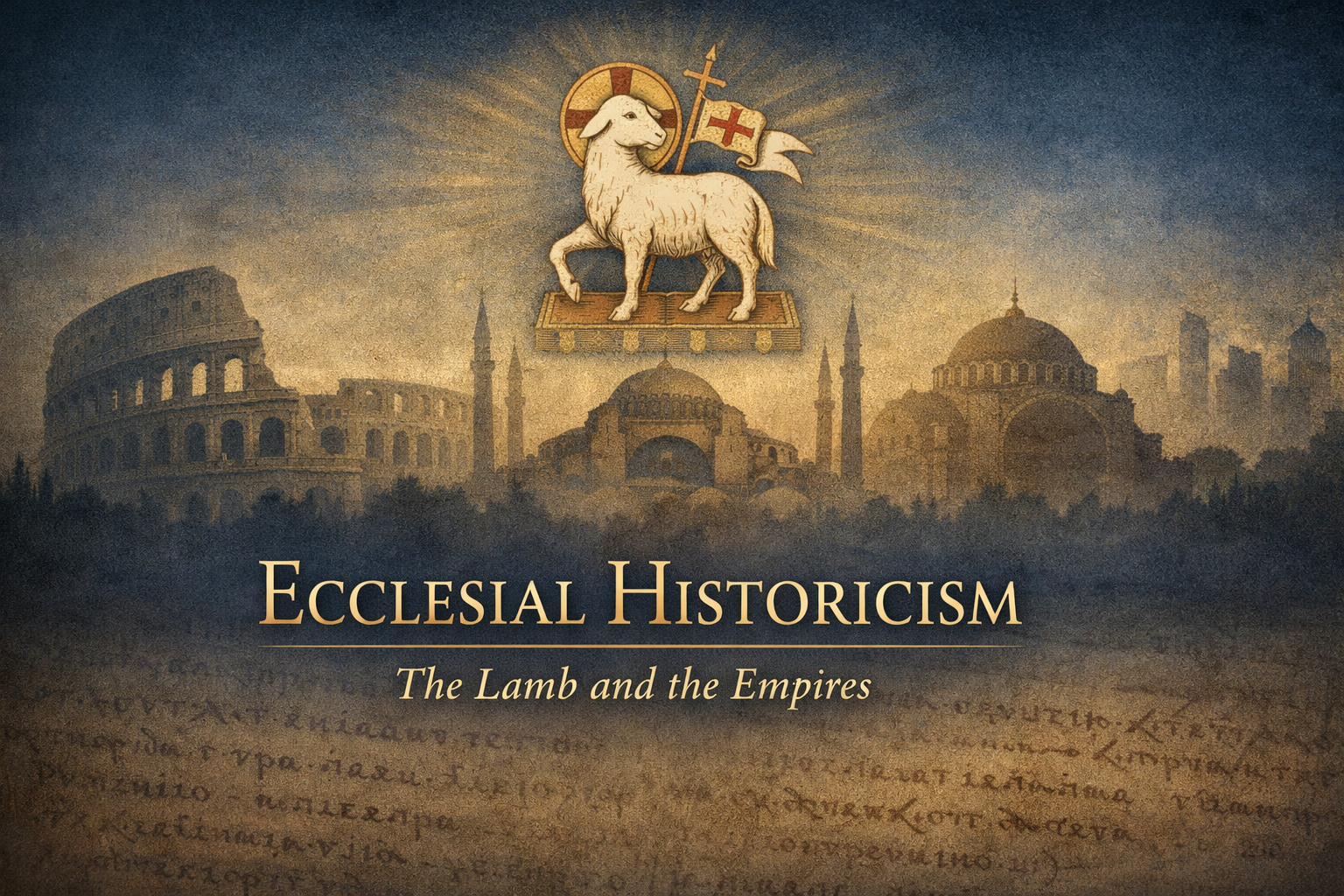
Beyond Headline Panic Toward a Christ-Centered Theology of History
By Jonathan Photius – The NEO-Historicism Research Project
Author’s Preface
In recent months, renewed geopolitical instability has reignited widespread apocalyptic speculation within Orthodox circles, often expressed in the language of imminent “end times” or a looming “final countdown.” This essay is offered not to dismiss vigilance, but to recover the deeper Orthodox tradition of reading Daniel and Revelation through the long experience of the Church. Historical memory does not weaken eschatology; it stabilizes it.
Download this article as a printable PDF
I. Introduction
Periods of geopolitical instability inevitably produce renewed apocalyptic certainty. Wars intensify. Economies tremble. New technologies emerge. Social media accelerates every development into an existential headline.
Within days, Revelation is once again treated as a live decoding manual.
This pattern is not new. Each generation facing upheaval has felt the tremor of finality. Roman persecutions appeared terminal. Imperial heresies seemed to threaten the very structure of the faith. Islamic conquests reshaped entire civilizations. Ottoman domination endured for centuries. The twentieth century witnessed world wars and militant atheism.
In every age, believers could reasonably ask: Is this the end?
Yet the Orthodox Church has not historically read the Apocalypse as a sequence suspended for two thousand years, awaiting modern headlines. Nor has she reduced Daniel’s visions to a final, isolated episode detached from the centuries that followed.
A different interpretive stream has long existed within Orthodox tradition — one that reads Daniel and Revelation through the continuous life of the Church. In this view, prophecy unfolds within history. Empires rise and fall. Anti-Christ powers manifest in recurring forms. The struggle between the Lamb and the beasts is not confined to a single climactic moment, but spans the ages.
This approach may be called ecclesial historicism.
It does not deny a final crisis. It does not dismiss vigilance. It does not domesticate apocalyptic warning. Rather, it insists that prophecy must be read within the long memory of the Church — conciliar, sacramental, and historical.
When Revelation is severed from that memory, it becomes vulnerable to what might be called headline eschatology: a reactive habit of attaching each geopolitical tremor to an immediate countdown.
But when Daniel and Revelation are read through the enduring life of Orthodoxy, a different picture emerges. The beasts are not hypothetical abstractions awaiting technological fulfillment. They are patterns of godless power already witnessed. The “little horn” was not silent for millennia. The spirit of antichrist has operated across centuries.
And through every empire, persecution, and upheaval, the Lamb has remained enthroned.
Recovering this long view is not merely an academic exercise. It is a necessary act of historical and theological stability. For without it, each generation risks mistaking immediacy for ultimacy — and anxiety for discernment.
What follows is an outline of this ecclesial-historical reading, tracing its roots in Orthodox interpretation and its implications for how we read prophecy today.
To see how this long view emerges, we must begin where the Church herself begins — not with modern crises, but with the prophetic architecture laid down in Daniel.
II. Daniel and the Architecture of Empire
The Book of Daniel provides the structural foundation for any serious Orthodox reading of Revelation. Before the Apocalypse unveils the conflict between the Lamb and the beasts, Daniel establishes the architecture through which empires rise, consolidate power, persecute the saints, and ultimately fall beneath divine judgment.
Daniel’s visions are not episodic flashes disconnected from history. They trace a sequence.
The statue of chapter 2 descends from gold to clay.
The beasts of chapter 7 emerge one after another from the turbulent sea of nations.
The ram and the goat of chapter 8 collide within identifiable historical movements.
Empire follows empire.
This progression is neither abstract nor suspended. It unfolds within time.
The “little horn” does not appear in a vacuum. It emerges from within the fourth kingdom. It grows gradually. It speaks arrogantly. It wages war against the saints. It alters times and laws. Its power is real, extended, and historically situated.
Daniel does not present a single apocalyptic explosion at the end of time. He presents a long drama of imperial succession and spiritual conflict.
The saints are not removed from history — they endure within it.
This is crucial.
If Daniel’s framework is sequential and historical, then Revelation — which echoes Daniel’s imagery repeatedly — should not be detached from that architecture. The beasts of the Apocalypse do not float free from the prophetic structure already given. They arise within the same continuum of empire, persecution, and divine sovereignty.
In this sense, Daniel establishes a theology of history.
Empire is permitted.
Empire overreaches.
Empire persecutes.
Empire is judged.
The Ancient of Days remains seated. The Son of Man receives the kingdom. The dominion of arrogant powers is temporary.
This pattern has recurred across centuries. It is not confined to a final generation alone.
When the Church reads Daniel through the lived experience of Rome, imperial controversies, conciliar struggles, and subsequent dominations, the prophetic architecture becomes visible. The text is not speculative futurism; it is divine commentary on the structure of history itself.
The “little horn” is not merely a future curiosity awaiting technological expression. It is the manifestation of concentrated, blasphemous authority arising within the stream of empire — a pattern already witnessed and repeatedly encountered.
Daniel therefore stabilizes eschatology.
It teaches the Church to recognize recurring forms of anti-Christ power without assuming that every emergence of such power is the final one.
It guards against two errors:
- collapsing prophecy entirely into the past, and
- collapsing all fulfillment into a single future moment.
Instead, it offers a long horizon.
The kingdom of God advances not by evading history, but by outlasting empire.
And this horizon becomes indispensable when we turn to the Apocalypse — for Revelation does not replace Daniel’s architecture. It intensifies it.
If Daniel establishes the structural sequence of empire and judgment, Revelation does not discard that structure. It deepens it — revealing the spiritual dimension of the same historical drama.
III. Revelation in the Life of the Church
If Daniel establishes the architecture of empire, Revelation reveals the spiritual depth of that architecture.
The Apocalypse does not abandon Daniel’s sequential horizon; it amplifies it. The beasts reappear. The blasphemous power persists. The saints suffer. The throne of God remains unmoved.
But Revelation is not addressed to political analysts. It is addressed to the Church.
From its opening chapters, the book situates itself within the concrete life of ecclesial communities — seven churches facing pressure, compromise, persecution, and internal weakness. The imagery that follows unfolds within that pastoral setting.
This is not incidental.
The Apocalypse is given to the Church, and its meaning unfolds in the Church.
One of the most important witnesses to this ecclesial reading is Saint Andrew of Caesarea, whose commentary became the foundational interpretive guide to Revelation within the Byzantine tradition.
Andrew does not treat the Apocalypse as a sealed future code reserved for a distant generation. He repeatedly applies its imagery to realities already known in the life of the Church — persecutions under pagan Rome, the endurance of martyrs, the spiritual corruption of power, the recurring hostility of empire toward the faithful.
He reads Revelation historically, yet not reductively.
The beasts represent real forces.
The conflict is genuine.
The judgments are serious.
But the scope is expansive.
Andrew frequently recognizes layers of meaning — some fulfilled in earlier persecutions, others manifesting in ongoing struggles, and still others reserved for a final intensification. This elasticity does not produce confusion; it reflects the cyclical and cumulative character of apocalyptic prophecy.
In this way, Revelation becomes a theological commentary on the lived history of the Church.
The dragon persecutes not once, but repeatedly.
The beast arises not merely at the terminus of history, but wherever concentrated rebellion against God consolidates itself in power.
Babylon is not confined to a single city; it is the archetype of corrupt dominion.
The Lamb stands at the center.
This ecclesial framing guards against two distortions.
First, it prevents the Apocalypse from being reduced to ancient history alone, as though its warnings were exhausted in the first century.
Second, it prevents the text from being detached from the centuries between the apostles and the present, as though the Church wandered through a prophetic silence awaiting modern geopolitical triggers.
The Apocalypse has accompanied the Church through imperial Rome, doctrinal crisis, foreign conquest, and civilizational upheaval.
It has never ceased to interpret the times.
When read within this long continuity, Revelation does not generate panic. It generates perseverance.
The saints conquer “by the blood of the Lamb and by the word of their testimony.” That conquest unfolds across centuries.
The beast’s authority is always described as limited.
The throne of God is never described as threatened.
This is not headline eschatology.
It is ecclesial historicism.
The Church does not read Revelation from outside history, anxiously scanning for its first appearance. She reads it from within history, recognizing that the drama has been unfolding all along.
And through every age of beastly power, the same proclamation endures:
The Lamb reigns.
When Daniel and Revelation are read together within the Church’s experience, the continuity of their symbolism becomes unmistakable. The little horn and the beast do not inhabit separate worlds. They speak the same language of concentrated rebellion.
IV. The Little Horn and the Beast: Continuity of Symbol
Daniel and Revelation are not separate prophetic worlds.
They speak in a shared symbolic grammar.
The “little horn” of Daniel 7 arises from within the fourth kingdom. It grows gradually. It speaks great and blasphemous words. It persecutes the saints. It attempts to alter sacred order — “times and law.” Its authority endures for a defined period, yet it is ultimately judged when the Ancient of Days convenes His court.
Centuries later, Revelation presents a beast rising from the sea. It bears blasphemous names. It wages war against the saints. It receives authority for a limited duration. It demands allegiance. It stands in defiance of God and persecutes the faithful.
The parallels are not accidental.
The beast of Revelation is not a novel symbol detached from Daniel’s architecture. It is the intensification and expansion of the same pattern.
In both visions, imperial power becomes theological rebellion. Political authority evolves into sacrilegious self-exaltation. Dominion seeks worship.
This continuity is essential for understanding prophecy within history.
If the little horn emerged within the stream of empire — not outside it — then the beast must also be read within that stream. The imagery describes concentrated forms of anti-Christ authority arising from historical realities.
This does not eliminate the possibility of a final and climactic manifestation. Scripture allows for intensification. Patterns often culminate.
But culmination presupposes continuity.
The prophetic symbols are not suspended for millennia, awaiting technological fulfillment. They are alive within the unfolding drama of Christian history.
Throughout the centuries, the Church has confronted powers that:
• Blasphemed divine authority
• Claimed universal jurisdiction
• Altered sacred order
• Persecuted dissent
• Demanded ideological conformity
Such manifestations were not peripheral to prophecy. They were instances of it.
The spirit of antichrist, as the Apostle John writes, is already in the world. That spirit does not operate only at the end; it recurs wherever rebellion consolidates itself into system and structure.
The genius of Daniel’s vision is that it embeds rebellion within imperial succession. The genius of Revelation is that it reveals the spiritual dimension of that rebellion.
Together they teach the Church to recognize pattern before panic.
The little horn and the beast are not random future anomalies. They are symbols of recurring historical concentration — moments when empire and blasphemy converge.
This recognition produces vigilance without hysteria.
For if the Church has already endured such manifestations, then she need not assume that every reappearance is the first, nor that every crisis is the final.
The prophetic drama unfolds across centuries.
The Lamb confronts the beast in every age.
And in every age, the beast’s authority is measured — while the Lamb’s dominion is everlasting.
The question, then, is not whether such patterns exist, but where they have appeared. To answer that, we must turn from symbol to history — from vision to lived ecclesial struggle.
V. Councils, Conquests, and the Testing of the Church
If Daniel reveals the architecture of empire and Revelation unveils its spiritual dimension, history supplies the field upon which these realities unfold.
Prophecy does not hover above the Church. It is tested within her life.
The centuries following the apostolic era were not prophetically silent. They were marked by confrontation — not only with external persecution, but with internal distortion.
Imperial Rome persecuted the saints openly. The blood of martyrs testified that beastly power does not tolerate rival allegiance.
Yet when persecution ceased, the struggle did not. It changed form.
The fourth and fifth centuries witnessed imperial involvement in doctrinal controversy. Arianism rose not merely as a theological error but as a movement intertwined with political authority. Emperors convened councils, influenced bishops, and attempted to stabilize the empire through doctrinal uniformity.
The Church responded conciliarity.
The Ecumenical Councils were not abstract theological exercises. They were moments when the integrity of the faith stood under imperial pressure. Creeds were forged in contexts where political power and doctrinal deviation intersected.
This is not accidental.
When empire seeks theological control, the pattern of Daniel and Revelation becomes visible.
Blasphemous speech.
Alteration of sacred order.
Persecution of dissenting confession.
The Church endured not only pagan emperors but baptized ones who attempted to subordinate dogma to imperial policy.
Later centuries introduced new trials.
The Islamic conquests reshaped vast Christian territories. Churches fell under foreign dominion. The faithful navigated survival within systems not their own.
The Ottoman period intensified this experience for the Orthodox world. The Church persisted under prolonged political subjugation. Structures of authority were constrained. Faithfulness required endurance rather than dominance.
The prophetic imagery of oppression, endurance, and limited authority was no abstraction.
In more recent centuries, militant atheism sought not merely political control but the eradication of religious life altogether. Entire populations endured systematic attempts to extinguish the Church’s public presence.
Each era felt existential.
Each could reasonably be described in apocalyptic terms.
Yet the Church remained.
The Lamb’s throne was not shaken by imperial decree, foreign conquest, or ideological revolution.
This long history reveals something crucial:
The beastly pattern is not confined to a singular, future eruption. It manifests wherever concentrated power opposes divine sovereignty and pressures the faithful to compromise.
The Church’s response has not been hysteria. It has been confession, conciliarity, martyrdom, endurance, and sacramental continuity.
The Councils themselves stand as witnesses that prophecy unfolds within ecclesial struggle. They demonstrate that Christ governs history not by removing His Church from conflict, but by preserving her through it.
To read Revelation apart from this history is to detach symbol from substance.
To read it within this history is to see prophecy as divine commentary on the Church’s pilgrimage through empire, error, and endurance.
The Lamb has never abdicated.
And the Church has never been prophetically unaccompanied.
If the Church has already endured repeated manifestations of beastly power, why does the present moment feel uniquely final? The answer lies not only in theology, but in the conditions of modern consciousness.
VI. Why Modern Futurism Feels Urgent
If the Church has long read Daniel and Revelation within the unfolding of history, why does modern apocalyptic speculation feel so immediate?
Part of the answer lies not in theology alone, but in environment.
Never before has humanity lived within a media ecosystem that compresses global events into instantaneous, emotionally amplified cycles. Wars are livestreamed. Economic tremors are analyzed in real time. Technological developments are framed in existential terms within hours of announcement.
The psychological effect is powerful.
Immediacy begins to feel like ultimacy.
When events move quickly, the imagination moves even faster. Symbols long familiar in Scripture — beasts, marks, tribulation, deception — seem to align effortlessly with contemporary developments. The acceleration of technology and the integration of global systems create a sense of convergence that feels unprecedented.
It is understandable that many believers experience this convergence as apocalyptic proximity.
Yet historical perspective tempers urgency.
Every generation has experienced its own convergence:
The fall of Jerusalem.
The collapse of Rome.
The rise of Islam.
The Black Death.
The Ottoman conquest of Constantinople.
The French Revolution.
The mechanized slaughter of the World Wars.
The totalitarian regimes of the twentieth century.
In each case, Christians perceived an intensification of evil unlike anything before.
In each case, the Church endured.
Modern futurism also reflects a particular theological inheritance. In the post-Reformation West, apocalyptic interpretation increasingly shifted toward highly detailed futurist schemas — systems that concentrated fulfillment almost entirely in a final generation. These frameworks, later popularized through revival movements, study Bibles, and mass media, shaped much of contemporary Christian expectation.
Within that atmosphere, Revelation becomes primarily predictive rather than interpretive — a map of what will happen rather than a theological unveiling of what has been happening.
Orthodox tradition, however, preserved a different instinct. It retained historical continuity. It remembered empire. It remembered councils. It remembered persecution and survival. It resisted isolating prophecy from the lived memory of the Church.
When historical memory weakens, immediacy intensifies.
Without awareness of how prophecy has already accompanied the Church through centuries of upheaval, each new crisis feels singular and definitive.
Ecclesial historicism restores proportion.
It does not deny the possibility of a final intensification. Scripture itself speaks of culmination.
But it refuses to treat acceleration as proof of exclusivity.
The presence of digital systems does not automatically define the “mark.”
Global conflict does not automatically signal the last battle.
Technological integration does not automatically mean prophetic novelty.
Patterns repeat before they culminate.
The Church has confronted concentrated evil before — and survived it.
Modern urgency, then, is not entirely misplaced. It reflects genuine instability. It reflects moral confusion. It reflects spiritual struggle.
But urgency must be disciplined by memory.
Without memory, vigilance becomes volatility.
With memory, vigilance becomes endurance.
And endurance is the recurring victory of the saints.
Historical memory tempers urgency. But memory alone is not the final anchor. Prophecy ultimately directs our gaze higher — beyond empire, beyond anxiety, beyond acceleration — to the One seated upon the throne.
VII. The Lamb at the Center: A Christological Conclusion
At the heart of Daniel stands the Ancient of Days.
At the heart of Revelation stands the Lamb.
The prophetic drama does not culminate in the beast. It culminates in worship.
Daniel’s vision does not end with the little horn’s arrogance, but with the Son of Man receiving dominion that shall not pass away. The court sits. Judgment is rendered. Empire dissolves before eternity.
Revelation does not end with the dragon’s fury, nor with the mark, nor with tribulation. It ends with the marriage supper of the Lamb. It ends with the holy city descending. It ends with the throne of God and of the Lamb at the center of renewed creation.
This ordering is not incidental.
When the Church reads prophecy primarily through the lens of the Antichrist, fear easily becomes central. When she reads prophecy through the Lamb, perseverance becomes central.
The Apocalypse is, above all, a liturgical unveiling.
Heaven worships.
The martyrs cry out.
The elders bow.
The Lamb stands as though slain — yet alive.
The beasts are permitted for a time.
The Lamb reigns forever.
This Christological center stabilizes eschatology.
It reminds the Church that prophecy is not given to generate panic, but to sustain faithfulness. It is not designed to produce speculation, but endurance. It is not a mechanism for decoding every geopolitical tremor, but a revelation of the One who governs history through suffering love.
The Lamb does not conquer by spectacle.
He conquers by sacrifice.
The saints do not triumph by predicting timelines.
They triumph “by the blood of the Lamb and by the word of their testimony.”
The long view of ecclesial historicism therefore serves a deeply Christological purpose. It guards against making the beast more vivid than the Lamb. It restores proportion between temporary rebellion and eternal dominion. It anchors vigilance in worship.
Yes, a final intensification may come.
Yes, evil may yet concentrate in unprecedented ways.
But even then, the pattern will not be new.
Empire will overreach.
Blasphemy will speak.
The saints will endure.
The Lamb will reign.
And the kingdom given to the Son of Man will never be taken from Him.
In every century — whether under Rome, under conquest, under ideological pressure, or under digital acceleration — the Church proclaims the same confession:
Christ is King.
The Lamb was slain.
The Lamb lives.
And His dominion has no end.
© 2026 by Jonathan Photius
 NEO-Historicism - End Times Eschatology From An Eastern Orthodox Christian Historicist Perspective
1 Comment