
By Jonathan Photius – The NEO-Historicism Research Project
Abstract
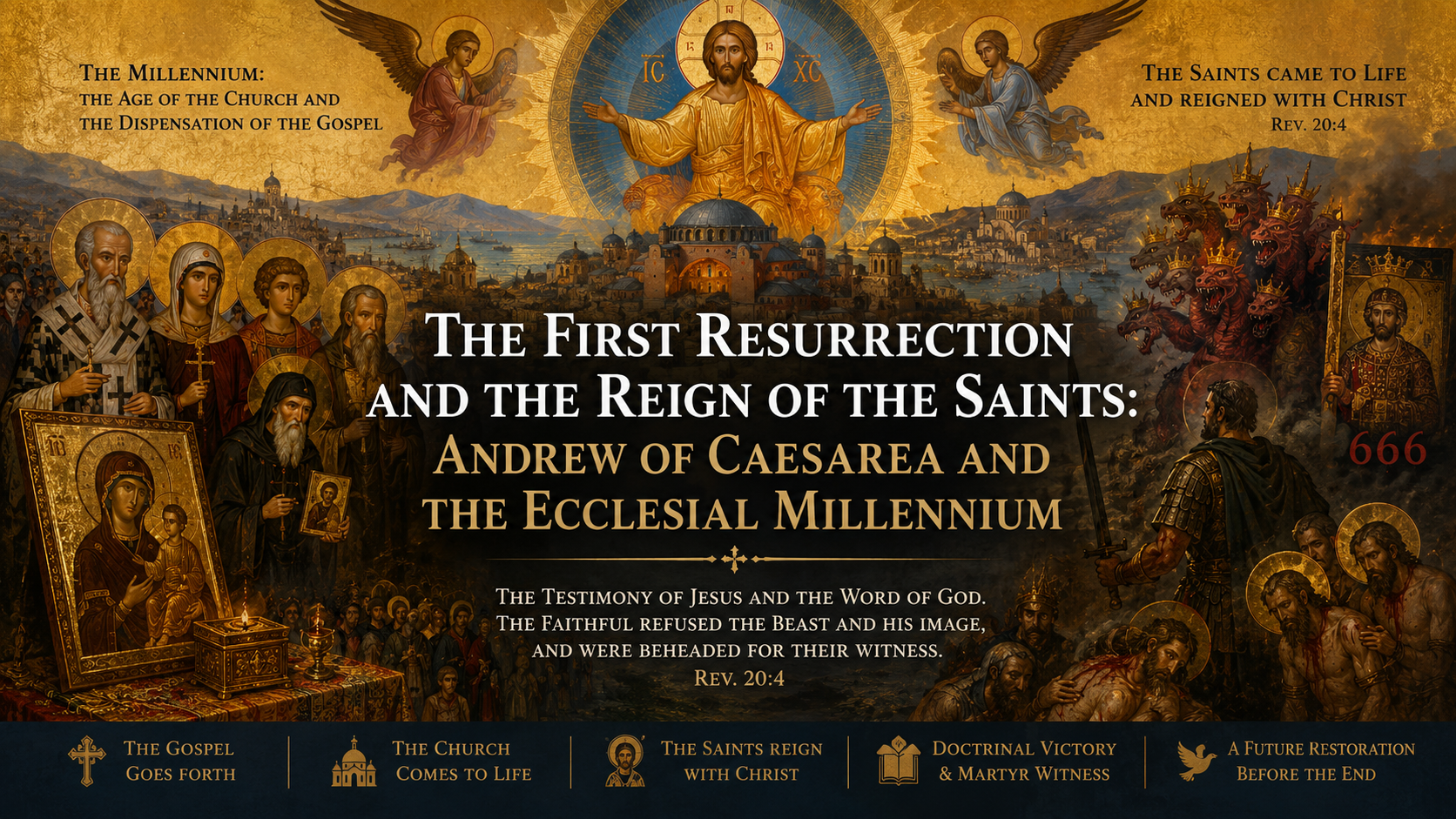
The interpretation of Revelation 20 has long stood at the center of Christian eschatological debate. Modern scholarship frequently reduces the Byzantine tradition to a generalized form of “amillennialism,” assuming that Greek patristic exegesis transformed the millennium into a largely ahistorical symbol. Yet the Apocalypse commentary of Andrew of Caesarea reveals a far more dynamic and ecclesial vision of sacred history. While Andrew explicitly rejects literal chiliasm and denies a future earthly kingdom of sensuous delight, he nevertheless preserves the historical and dramatic texture of the Apocalypse. The “thousand years” become neither a crude political utopia nor a merely abstract symbol, but the providential age of the Church inaugurated by the Incarnation and extending through the dissemination of the Gospel among the nations until the appearance of Antichrist.
This study argues that Andrew’s interpretation of Revelation 20 is best understood as an ecclesial millennium: the progressive historical manifestation of the resurrected life of the Theanthropos within His Body, the Church. The “first resurrection” signifies not merely future bodily resurrection nor merely inward spiritual rebirth, but the historical vindication and manifestation of resurrectional life through the saints, martyr-confessors, liturgical life, doctrinal victory, and the triumph of Orthodox confession in history. Revelation 20 thus describes the gradual maturation and glorification of the Church through the Gospel prior to the final anti-Theanthropic rebellion of Antichrist.
This article further proposes that Andrew’s theology leaves open the conceptual architecture for a distinctly Byzantine form of ecclesial historicism and historic postmillennialism. The Apocalypse is revealed not simply as a prophecy of the end, but as Paschal history: the Passion, Resurrection, and reign of Christ unfolding through time in His Body.
Introduction
Revelation 20 remains one of the most difficult and contested chapters in Christian eschatology. The vision of the “thousand years,” the binding of Satan, the reign of the saints, and the “first resurrection” has generated centuries of disagreement concerning the relationship between the Kingdom of Christ and the unfolding of history. While Byzantine theology largely rejected literal chiliasm, the interpretation of Revelation 20 within the Greek patristic tradition cannot be reduced simply to abstract or ahistorical “amillennialism.”
The Apocalypse itself complicates overly realized interpretations of the millennium. Although Satan is restrained in Revelation 20 for the dissemination of the Gospel, the Dragon of Revelation 12 continues to persecute the Woman and wage war against those “who keep the commandments of God and hold the testimony of Jesus Christ” (Rev. 12:17). Likewise, the saints who “come to life” in Revelation 20 are specifically identified as those who held the testimony of Jesus, refused the worship of the Beast and its image, and endured persecution for their witness. Such imagery appears to describe not merely a completed past event, but an ongoing historical struggle involving witness, conflict, martyrdom, and vindication.
These tensions become especially significant in the Apocalypse commentary of Andrew of Caesarea, the most influential Greek interpreter of Revelation in the Byzantine tradition. Andrew explicitly rejects a future earthly millennium of material delights and interprets the “thousand years” as the era extending from the Incarnation of Christ until the appearance of Antichrist. Yet Andrew also preserves the historical and dramatic character of the Apocalypse. Satan is restrained, but not inactive. The saints already reign with Christ, yet the conflict between the Church and the powers opposing the testimony of Jesus continues throughout history.
This article argues that Andrew’s interpretation of Revelation 20 is best understood not as a purely abstract amillennialism, but as an ecclesial and historical theology of the Kingdom centered on the manifestation of the risen life of Christ within His Church. The millennium becomes the age of Gospel dissemination, martyr-confessor witness, doctrinal struggle, and the progressive manifestation of resurrectional life within history itself.
Within such a framework, the Apocalypse may be read not merely as a prophecy of the distant end, but as the unfolding history of the Church’s witness in the world: a continuing struggle between the testimony of Jesus and the forces opposing the Incarnate Logos throughout the course of sacred history.
The Millennium as the Historical Age of the Church
Andrew explicitly defines the millennium as the period appointed by God for the dissemination of the Gospel throughout the world. Rejecting literal chronology, he explains that the “thousand years” symbolize fullness, completion, and the providential extent of sacred history rather than a mathematically fixed duration.
The millennium therefore begins not after history, but with the Incarnation itself. The coming of the Logos into the world inaugurates the restraint of Satan and the historical expansion of divine life among the nations. The devil remains active, but his dominion has been fundamentally broken through the Cross, Resurrection, Ascension, and Pentecost. History is extended so that the Gospel may spread and the nations may be incorporated into the Body of Christ.
This interpretation radically transforms the meaning of the millennium. The thousand years are neither an earthly political utopia nor merely a timeless symbol, but the historical age of the Church itself—the gradual dissemination and manifestation of resurrectional life in history.
Andrew’s interpretation therefore contains a profoundly dynamic conception of sacred history. The Church does not merely survive history; it progressively manifests the reign of the risen Christ within history. The millennium is missionary, sacramental, and ecclesial. It is the age in which the resurrected humanity of Christ extends itself throughout the world through the Gospel and the saints.
The First Resurrection and Resurrectional Participation
One of the central difficulties of Revelation 20 concerns the meaning of the “first resurrection.” The Apocalypse describes those who “came to life” and reigned with Christ, particularly those who had been beheaded for the testimony of Jesus and for the Word of God.
Andrew interprets this resurrection ecclesially and sacramentally. Those reigning with Christ are those who have been “buried and raised with Christ” through baptism and sanctification. The “dead” are those remaining spiritually dead in sins. This interpretation reflects broader Johannine and Pauline theology in which resurrectional language frequently refers to present participation in divine life.
The same verbal family used in Revelation 20 appears elsewhere in the New Testament in contexts of restoration and spiritual rebirth. In the parable of the Prodigal Son, the father declares: “This my son was dead and is alive again” (Luke 15:24). The language refers not to bodily resurrection, but to restoration from alienation and death through repentance. Likewise, the Gospel of John repeatedly speaks of believers already possessing eternal life and having “passed from death unto life.”
Yet Revelation 20 cannot be reduced to generalized symbolism. The Apocalypse specifically emphasizes martyrs, witnesses, confessors, and those who refuse the worship of the Beast. The “coming to life” therefore acquires an ecclesial-historical dimension. The saints participate in the resurrectional life of Christ not merely inwardly, but visibly and historically through sanctity, martyrdom, confession, miracles, liturgical memory, and ecclesial vindication.
The first resurrection thus signifies the manifestation of resurrected humanity in history through the Church.
The Testimony of Jesus and the Theanthropos
The Apocalypse repeatedly identifies the faithful by “the testimony of Jesus” and “the Word of God.” These two phrases are also repeated in Revelation 20:4. These expressions are not merely generic descriptions of Christian belief, but apocalyptic identifiers associated with fidelity to the Incarnate Logos in the face of anti-Christian powers.
Within Byzantine theology, this testimony becomes profoundly Christological. The saints bear witness to the Theanthropos—the God-Man Jesus Christ. The great struggles of Church history therefore become manifestations of apocalyptic conflict concerning the identity of Christ Himself.
This is especially visible in the era of the Ecumenical Councils. Arianism, Nestorianism, Monophysitism, and Iconoclasm were not perceived merely as theological disagreements, but as assaults upon the Incarnation and the salvific union of divinity and humanity in Christ. The confessors and martyrs who defended Orthodoxy therefore became apocalyptic witnesses holding fast to “the testimony of Jesus.”
Within this framework, the “War in Heaven” of Revelation 12 may be understood not merely as a primordial celestial event, but as the historical and ecclesial struggle surrounding the confession of the Incarnate Logos in history. The Dragon is cast down through the victory of Christ, yet he is not inactive. Unlike the restrained Satan of Revelation 20, the Dragon of Revelation 12 actively persecutes the Woman, wars against her seed, and pursues “those who keep the commandments of God and hold the testimony of Jesus Christ” (Rev. 12:17). The Apocalypse therefore portrays not the absolute cessation of satanic activity after the Cross, but its continued historical operation against the Church within divinely imposed limits.
The age of the Ecumenical Councils may thus be viewed as a historical manifestation of this heavenly war. Bishops, confessors, monks, martyrs, and saints become participants in the apocalyptic struggle over the identity of Christ and the preservation of the apostolic faith. The “testimony of Jesus” becomes the dogmatic witness of the Church concerning the Theanthropos.
This context also illuminates the imagery of the Two Witnesses in Revelation 11. Their prophetic testimony unfolds amid persecution, martyrdom, humiliation, and apparent defeat before vindication and resurrection. Such imagery resonates deeply with the historical experience of the Church throughout the centuries of doctrinal conflict and persecution. The witnesses of the Apocalypse therefore may be understood not only as isolated prophetic figures, but as representing the enduring martyric and confessional witness of the Church throughout history.
In this context, the saints reigning with Christ may be understood as the historical manifestation of resurrectional fidelity to the Theanthropos through the life of the Church. The Apocalypse unfolds through councils, martyrdoms, confessions, exiles, liturgical triumphs, missionary expansion, and the vindication of Orthodoxy in time. The “War in Heaven” thus becomes ecclesial and dogmatic history: the continuing struggle between the Dragon and the Body of Christ as the Church bears the testimony of Jesus throughout the ages.
The Veneration of the Saints and the Vindication of Resurrectional Humanity
Andrew remarks that the saints already reign with Christ now, being venerated by pious rulers and manifesting divine power against demonic forces and bodily ailments. This statement becomes extraordinarily significant in the context of Byzantine theology and the iconoclastic controversies.
The reign of the saints is not political domination, but the manifestation of glorified humanity through the life of the Church. The saints are alive in Christ and visibly participate in His reign through:
- relics,
- miracles,
- icons,
- liturgy,
- intercession,
- and ecclesial veneration.
Revelation 20 therefore acquires profound iconological significance. The saints “come to life” historically through their vindication within the worshiping life of the Church.
This became especially clear after the triumph of Orthodoxy over Iconoclasm. The iconodule position fundamentally defended the reality of the Incarnation and the transfiguration of matter through the Theanthropos. Icons proclaimed that sanctified humanity truly participates in divine glory. The veneration of saints was therefore itself a testimony that the saints reign with Christ and that resurrectional life has already entered history.
The “coming to life” of the saints may thus also signify the ecclesial manifestation and vindication of glorified humanity in the Church.
This perspective is strikingly illustrated in the lives of many “beheaded” Orthodox martyrs and confessors across history. Ephraim of Nea Makri endured torture and martyrdom under Ottoman persecution, later becoming glorified and venerated throughout the Orthodox world centuries later. Likewise Raphael of Lesbos, Nicholas of Lesbos, and Irene of Lesbos—martyrs hidden in history and later revealed through miracles and ecclesial remembrance—demonstrate how the saints “come to life” within the consciousness and liturgical life of the Church, centuries after their martyrdom. Their vindication becomes an historical manifestation of resurrectional glory.
The First Resurrection and Victory Over the Second Death
Revelation 20:6 declares:
“Blessed and holy are those who share in the first resurrection. The second death has no power over them, but they will be priests of God and of Christ and will reign with him for a thousand years.”
Within Andrew’s ecclesial interpretation of the millennium, this passage acquires profound ascetical and historical significance. The “first resurrection” is not merely a distant future event, but participation in the resurrectional life of Christ within the historical life of the Church. Those who share in this resurrection already overcome the dominion of spiritual death and begin to reign with Christ through sanctification, martyrdom, confession, and ascetic participation in divine life.
This perspective may also illuminate the difficult imagery of Revelation 9:6:
“During those days people will seek death but will not find it; they will long to die, but death will elude them.”
Within the Byzantine ascetical tradition, the saints voluntarily embrace a different kind of death: death to the world, death to the passions, and death to the dominion of sin. Monasticism in particular becomes a historical manifestation of this apocalyptic principle. The monk seeks not annihilation, but crucifixion with Christ. Through ascetic struggle, voluntary self-denial, and participation in the life of the Church, the saints “die before death” in order to live unto God.
In this sense, Revelation 9:6 and Revelation 20:6 stand in paradoxical relationship:
- the worldly seek escape from suffering but remain captive to corruption,
- while the saints voluntarily die to the world and thereby conquer death itself.
This theology resonates deeply with the Apostle Paul’s proclamation:
“O death, where is thy sting? O grave, where is thy victory?” (1 Cor. 15:55).
Those participating in the first resurrection already experience the overthrow of death through union with Christ. The “second death” has no power over them because they have already passed from death into life through sanctification and participation in the resurrected Body of Christ.
Within the historical life of the Church, monasticism therefore becomes one of the clearest manifestations of the ecclesial millennium. The monk is a living witness of the resurrection within history:
- dying before death,
- conquering the passions,
- and manifesting the life of the age to come within the present world.
The reign of the saints is therefore not earthly domination, but victory over death, corruption, demonic powers, and the passions through participation in the risen life of the Theanthropos. The millennium is thus revealed not merely as chronology, but as the historical manifestation of resurrectional humanity within the Church prior to the final rebellion of Antichrist.
The Ecclesial Millennium and Byzantine Historic Postmillennialism
Andrew’s theology preserves a profound tension characteristic of Orthodox eschatology. The Kingdom is already present, yet not fully consummated. Satan is restrained, yet still active. The saints reign now, yet the final rebellion remains future. The Church manifests resurrectional life in history, yet still awaits the final unveiling of glory.
This dynamic tension suggests something beyond conventional “amillennialism.” The millennium becomes the progressive historical maturation and glorification of the Church through the dissemination of the Gospel and the manifestation of the saints. Orthodoxy spreads, sanctifies nations, vindicates the testimony of Jesus, and manifests the life of the risen Christ throughout history prior to the final anti-Theanthropic rebellion.
Such a conception may be described as a distinctly Byzantine form of ecclesial historic postmillennialism—not a secular optimism or political triumphalism, but the gradual manifestation of resurrectional life through the Church in history.
The Church itself becomes Paschal history:
- the Passion of Christ extended through persecution,
- the Resurrection manifested through the saints,
- and the reign of Christ revealed sacramentally and historically through His Body.
In this framework, Revelation is neither merely symbolic nor merely predictive. It is the unfolding history of the Theanthropos in the world.
Conclusion
Andrew of Caesarea’s interpretation of Revelation 20 reveals a far richer eschatological theology than modern categories often permit. The millennium is not a future earthly utopia, nor merely a timeless abstraction, but the providential age of the Church inaugurated by the Incarnation and extending through the dissemination of the Gospel among the nations. The “first resurrection” signifies participation in the resurrectional life of Christ through baptism, sanctification, martyrdom, confession, liturgical life, icons, and ecclesial communion. The saints reign because Christ reigns in them.
Yet Revelation 20 itself suggests that this resurrectional reign unfolds progressively within history and moves toward a future historical culmination. The Apocalypse specifically identifies those who “came to life” as those who:
- held the hypostatic union ‘testimony’ of Jesus and the Word of God,
- refused the worship of the Beast and its image,
- and endured persecution and martyrdom for their witness.
Such descriptions cannot be exhausted merely by reference to the apostolic age or the initial triumph of Christianity after the Cross. The earliest generations of Christians had not yet encountered the full historical manifestations of the Beast, the Image, and the anti-Christian systems depicted in the Apocalypse. Revelation 20 therefore appears to anticipate an ongoing and future historical struggle in which the Church progressively manifests resurrectional victory through doctrinal confession, martyrdom, sanctity, and ecclesial vindication.
In this light, the “first resurrection” may be understood not merely as an invisible spiritual reality already completed, but as the historical manifestation and vindication of the resurrected Body of Christ through the life of the Orthodox Church. The saints “come to life” through the triumph of the testimony of Jesus in history: through councils, confessors, martyrs, liturgical vindication, iconographic manifestation, missionary expansion, and the restoration of Orthodoxy among the nations.
The Byzantine apocalyptic tradition frequently preserves expectation of a future restoration and glorification of Orthodoxy prior to the final rebellion of Antichrist. Within such a framework, the millennium may be understood as the gradual maturation and perfection of the Church through the Gospel until the Body of Christ manifests a fuller historical realization of resurrectional life before the final satanic revolt. The reign of the saints is therefore not static, but progressive and historical—an unfolding Paschal victory in time.
The iconodule triumph after the Seventh Ecumenical Council offers a particularly powerful image of this resurrectional vindication. The saints, once rejected and obscured through iconoclastic persecution, “came to life” again in the liturgical and visible consciousness of the Church through icons, relics, veneration, and restored confession of the Theanthropos. In the same way, Revelation 20 may point toward a future universal restoration and vindication of Orthodox confession throughout the world prior to the final loosing of Satan.
Andrew’s theology therefore stands not merely as Byzantine amillennialism, but as the foundation for a distinctly Orthodox ecclesial historicism and historic postmillennialism centered upon the Theanthropos and the historical manifestation of resurrected humanity within the Church. The Apocalypse becomes the history of Pascha unfolding through time: the Passion, Resurrection, glorification, and future vindication of the Body of Christ in the world before the final consummation of all things.
© 2026 by Jonathan Photius
Further Reading and Bibliography
Primary Sources
- Andrew of Caesarea. Commentary on the Apocalypse. Translated by Eugenia Scarvelis Constantinou. Washington, D.C.: Catholic University of America Press, 2011.
- Andrew of Caesarea. Commentarius in Apocalypsin. In Patrologia Graeca, Vol. 106, edited by J.-P. Migne. Paris: Migne, 1863.
- Oikoumenios. Commentary on the Apocalypse. In Greek Commentaries on Revelation. Ancient Christian Texts Series. Downers Grove, IL: InterVarsity Press, 2011.
- Arethas of Caesarea. Commentary on the Apocalypse. In Patrologia Graeca, Vol. 106.
Major Scholarly Studies on Andrew of Caesarea
- Eugenia Scarvelis Constantinou. Guiding to a Blessed End: Andrew of Caesarea and His Apocalypse Commentary in the Ancient Church. Washington, D.C.: Catholic University of America Press, 2013.
- Eugenia Scarvelis Constantinou. Andrew of Caesarea and the Apocalypse in the Ancient Church of the East. PhD diss., Université Laval, 2008. Dissertation PDF
- Garrick V. Allen. The Book of Revelation and Early Jewish Textual Culture. Cambridge: Cambridge University Press, 2017.
- Garrick V. Allen. “The Machinery of the Andrew of Caesarea Tradition.” In The Book of Revelation and Early Jewish Textual Culture. Oxford University Press.
- Manlio Simonetti. Biblical Interpretation in the Early Church: An Historical Introduction to Patristic Exegesis. Edinburgh: T&T Clark, 1994.
- Adele Monaci Castagno. “I Commenti de Ecumenio e di Andrea di Cesarea: Due letture divergenti dell’Apocalisse.” Memorie della Academia delle scienze di Torino V, Fascicolo IV (1981).
Orthodox and Byzantine Eschatology
- Averky Taushev. The Apocalypse in the Teachings of Ancient Christianity and the Orthodox Church. Jordanville, NY: Holy Trinity Monastery.
- Seraphim Rose. The Apocalypse of St. John. Platina, CA: Saint Herman of Alaska Brotherhood.
- Tadros Yacoub Malaty. The Book of Revelation. Alexandria: St. George Coptic Orthodox Church.
- Methodius of Olympus. The Banquet of the Ten Virgins (Symposium), especially Book VIII on Revelation 12.
- Hippolytus of Rome. On Christ and Antichrist.
- Ephraim the Syrian. Sermons on the Last Times, Antichrist, and the End of the World.
Byzantine and Orthodox Historicist Tradition
- Christophoros Angelos. On the End of the World (1624).
- Anastasios Gordios. On Mohammed and Against the Latins.
- Theodoret of Ioannina. Commentary on the Apocalypse.
- John of Myra. Commentary on the Apocalypse.
- Apostolos Makrakis. Interpretation of the Book of Revelation.
- Asterios Argyriou. Les Exégèses Grecques de l’Apocalypse à l’époque turque (1453–1821). Thessaloniki, 1982.
Related Orthodox Themes: Icons, Saints, and Resurrectional Humanity
- John of Damascus. On the Divine Images.
- Theodore the Studite. On the Holy Icons.
- Maximus the Confessor. Ambigua and Mystagogia.
- Gregory Palamas. The Triads.
- Nicholas Cabasilas. The Life in Christ.

