
By: Jonathan Photius – The NEO-Historicist Research Project
Introduction
One of the most influential eschatological syntheses in modern evangelical theology is the combination of Partial Preterism, Idealism, and Postmillennialism. This approach seeks to preserve the historical context of Revelation while also maintaining its relevance for subsequent generations of Christians. Preterism grounds the Apocalypse in the first-century struggle between the Church and the Roman world. Idealism extends the symbolism beyond the first century, allowing the Beast, Babylon, and the Dragon to represent recurring realities throughout history. Postmillennialism then supplies an optimistic vision of the Kingdom’s progressive triumph as the nations are gradually discipled through the preaching of the Gospel.
This synthesis possesses several undeniable strengths. It avoids the speculative excesses of modern futurism, recognizes the historical circumstances of the seven churches of Asia, and preserves the enduring relevance of Revelation for the life of the Church. Yet despite these strengths, the system faces a significant exegetical difficulty. At the center of the problem stands the Dragon.
If Satan was bound at Christ’s first advent, as most Augustinian Amillennialists and Preterist-Idealist Postmillennialists maintain, how should we understand Revelation 12? Why does the Dragon appear throughout the prophetic period as an active and dangerous adversary who wages war against the Church? More importantly, how can this portrait be reconciled with Revelation 20, where Satan is imprisoned, sealed, and prevented from deceiving the nations?
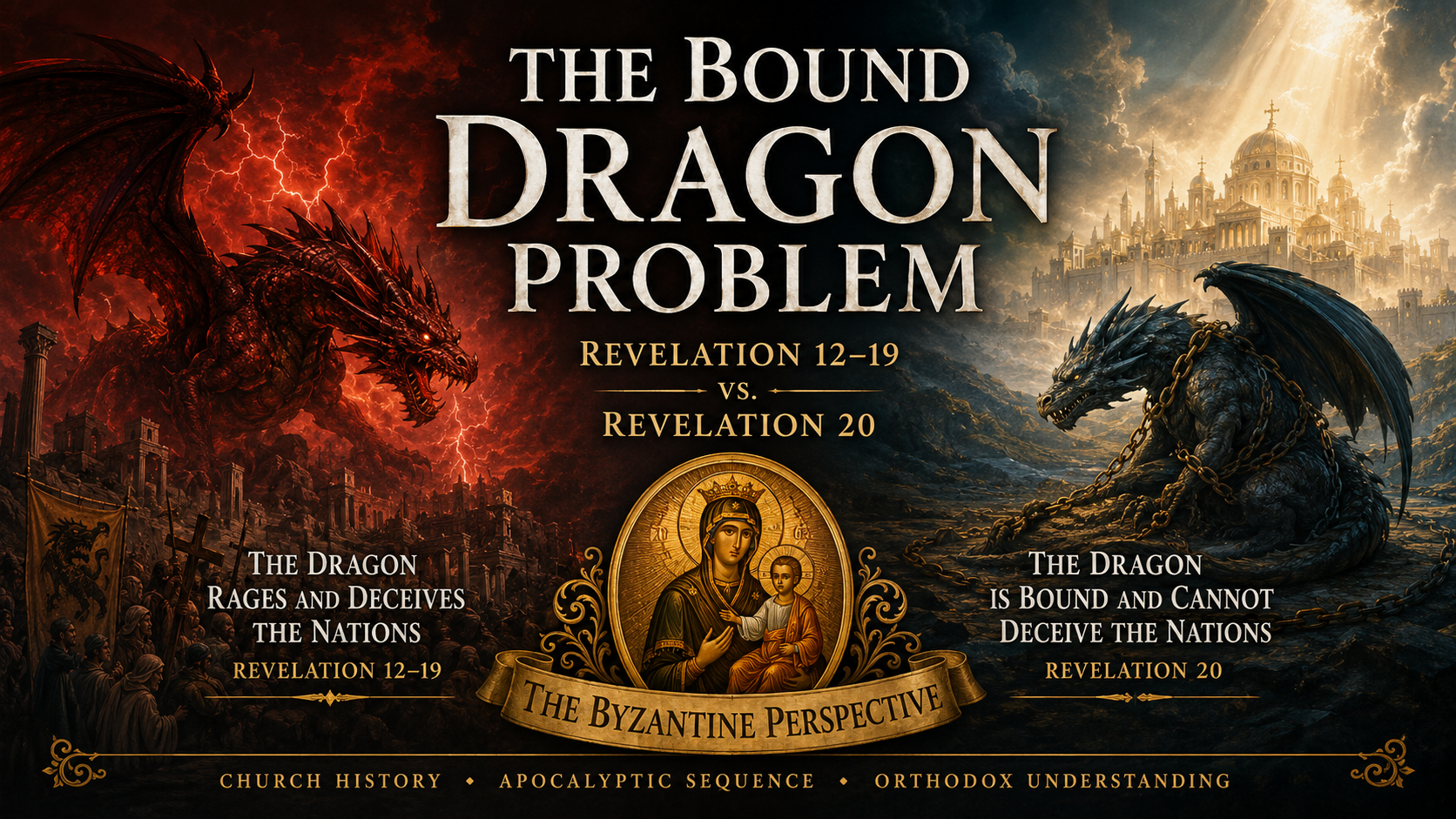
This tension may be called the Bound Dragon Problem. Far from being a minor detail, it strikes at the heart of how one understands the relationship between the 1260 days of Revelation 12–13 and the thousand years of Revelation 20. While modern systems often collapse these passages into the same general era, the Byzantine apocalyptic tradition preserved a different sequence—one in which the Dragon’s persecution belongs to the age of tribulation, while his binding belongs to a subsequent age of restoration and victory.
What Preterist-Idealism Gets Right
Before examining the problem, it is important to acknowledge the genuine insights offered by the Preterist-Idealist approach.
Revelation was written to real churches facing real trials within the Roman Empire. The Beast, Babylon, and the Dragon were not abstract symbols floating above history but realities confronting the first Christians. Likewise, the symbols of Revelation possess an enduring significance that transcends any single historical manifestation. Tyrannical governments, false religions, persecuting powers, and worldly civilizations opposed to God continue to arise throughout history.
In this respect, the Idealist impulse is correct. Babylon is not exhausted by one city, nor the Beast by one ruler. The Apocalypse reveals recurring spiritual patterns that manifest themselves repeatedly throughout the ages.
Yet acknowledging recurring patterns does not require abandoning historical fulfillment. The question is whether Revelation merely establishes timeless archetypes, or whether it also reveals a progressive historical drama unfolding within the life of the Church.
The Dragon of Revelation 12
The twelfth chapter of Revelation presents one of the most dramatic scenes in the entire Apocalypse. After the heavenly war, the Dragon is cast down from heaven to the earth.
Yet his expulsion does not result in restraint. Instead, the Dragon descends in fury:
“Therefore rejoice, ye heavens, and ye that dwell in them. Woe to the inhabiters of the earth and of the sea! For the devil is come down unto you, having great wrath, because he knoweth that he hath but a short time” (Rev. 12:12).
The Dragon then persecutes the Woman who gave birth to the man-child. When the Woman is protected in the wilderness, he turns his wrath against the remnant of her seed:
“And the dragon was wroth with the woman, and went to make war with the remnant of her seed, which keep the commandments of God, and have the testimony of Jesus Christ” (Rev. 12:17).
This persecution is explicitly connected to the prophetic period of “a time, and times, and half a time” (Rev. 12:14).
The picture is unmistakable. The Dragon is active, deceptive, enraged, and engaged in a sustained campaign against the Church throughout the prophetic period.
The question naturally arises: Is this what a bound Satan looks like?
The Historical Drama of Revelation 12
One of the weaknesses of modern Preterist-Idealist interpretation is that it often reduces Revelation 12 to a timeless symbol of spiritual conflict. While the chapter certainly possesses enduring spiritual significance, the Orthodox Historicist tradition saw in it a remarkable outline of actual ecclesiastical history.
The Dragon’s tail drawing down a third of the stars from heaven was frequently understood as the corruption of large portions of the visible Church through false doctrine and heresy. The early centuries witnessed repeated doctrinal crises in which bishops, clergy, and entire regions were drawn into theological error. From the Gnostic and Montanism movements of the second century, to the great Christological controversies of the fourth and fifth centuries, the Dragon’s assault was directed not merely against individual believers but against the doctrinal integrity of the Church itself.
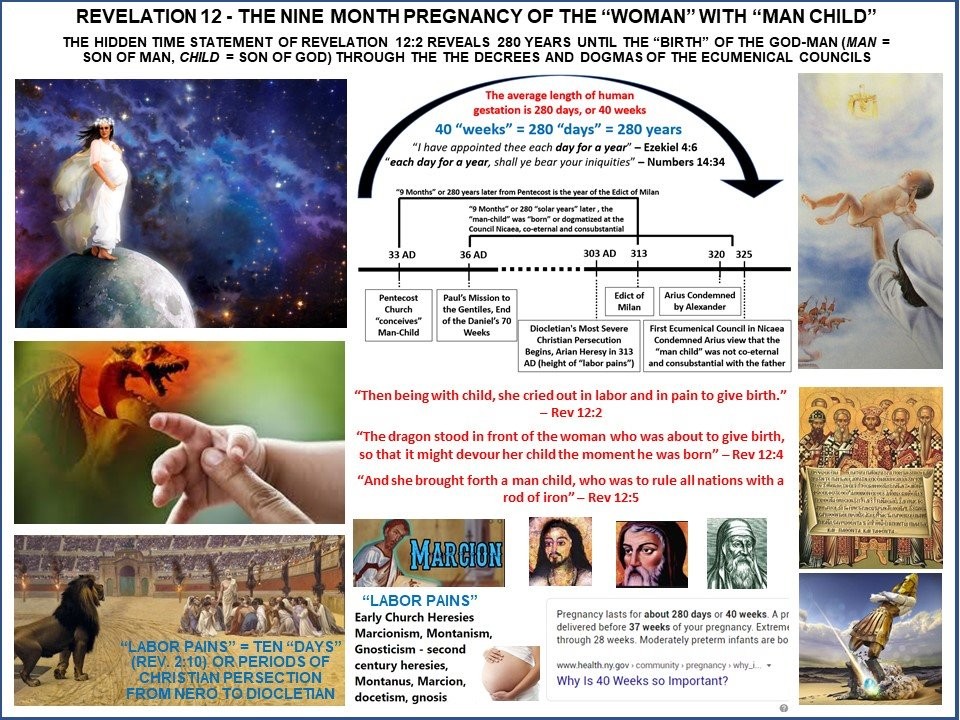
The birth of the Man-Child was likewise understood in an ecclesial rather than merely individual sense. While Christ Himself remains the ultimate referent, the Man-Child also symbolizes the dogmatic proclamation of the God-Man or Theanthropos by the Ecumenical Councils as fully human and divine. Significantly, the First Ecumenical Council at Nicaea occurred approximately 280-years after Pentecost, corresponding symbolically to the nine months of gestation of a human fetus preceding birth. In this reading, the Church’s doctrinal consciousness of the Incarnate Word reaches maturity through the conciliar definition of the faith.
The subsequent war in heaven represents the great age of doctrinal and conciliar conflict. Arians, Nestorians, Monophysites, Monothelites, and Iconoclasts were successively cast from the ecclesiastical heavens through the judgments of the councils. Heaven in this context signifies the visible ecclesiastical sphere, and the war describes the struggle to preserve apostolic doctrine within the Church.
Yet the Dragon’s defeat in heaven does not end the conflict.
Having failed to corrupt the Church doctrinally, he turns his fury against the Woman herself.
The result is the great flood.
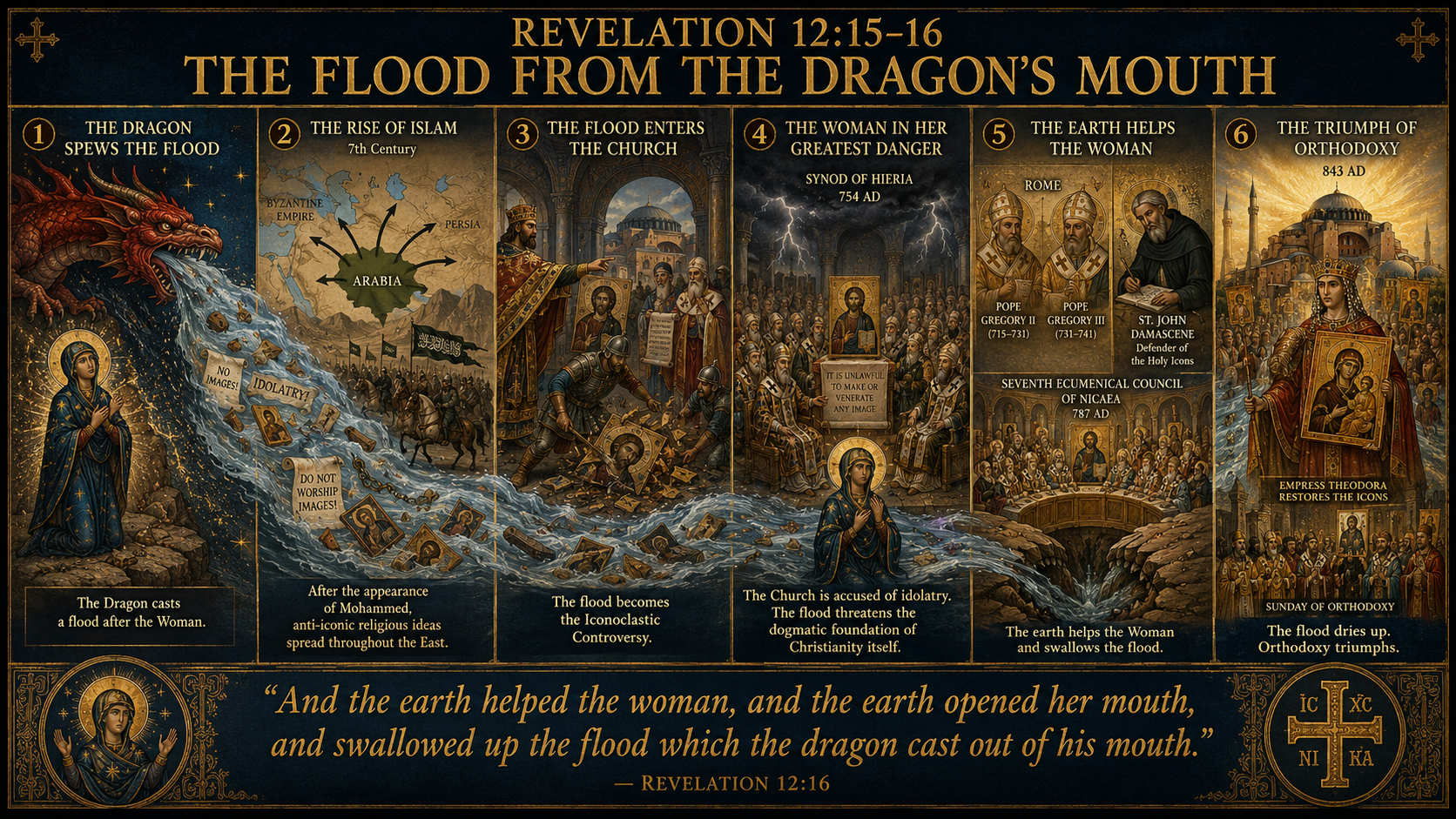
Historically, Orthodox Historicists saw this flood manifested in the successive waves of persecution and external assault that engulfed Christendom. The rise of Islam, the Arab conquests, the fall of ancient patriarchates, Iconoclasm, and later invasions all formed part of the Dragon’s attempt to sweep away the Church from the earth.
The Woman’s flight into the wilderness was therefore understood not as a mere abstraction but as a historical reality. During periods of persecution and civilizational collapse, the monasteries, deserts, mountains, and remote strongholds of the Christian world became places of refuge where the faith was preserved. The wilderness was not the absence of the Church but the hidden preservation of the Church.
Under this reading, Revelation 12 is not simply describing a timeless struggle. It is unveiling the actual historical pilgrimage of the Church through the age of tribulation.
The Contrast of Revelation 20
When the reader reaches Revelation 20, the description changes dramatically.
An angel descends from heaven holding the key of the abyss and a great chain. The Dragon is seized, bound, cast into the abyss, shut up, and sealed.
The stated purpose is clear:
“That he should deceive the nations no more, till the thousand years should be fulfilled” (Rev. 20:3).
The contrast between Revelation 12 and Revelation 20 is striking.
In Revelation 12:
- The Dragon persecutes the saints.
- The Dragon wages war.
- The Dragon deceives.
- The Dragon empowers beastly opposition.
In Revelation 20:
- The Dragon is imprisoned.
- The Dragon is sealed.
- The Dragon is restrained.
- The Dragon can no longer deceive the nations.
The two portraits appear fundamentally different.
If Revelation 12 is describing the age of heresies, councils, Islam, Iconoclasm, schisms, persecutions, and the Church’s wilderness experience, then the Dragon cannot already be in the condition described in Revelation 20.
Augustine’s Solution
The traditional Augustinian solution has been to limit the scope of Satan’s binding.
According to this interpretation, Satan remains active in many respects but is bound in one particular sense: he can no longer prevent the spread of the Gospel among the nations.
This explanation has exercised enormous influence throughout Western theology and continues to shape both modern Amillennialism and many forms of Postmillennialism.
Yet the text itself presents a difficulty. Revelation 12 does not merely portray Satan as a nuisance operating within narrow restrictions. It depicts him as a powerful adversary actively waging war against the saints throughout the prophetic period. The intensity of this warfare seems difficult to reconcile with the language of imprisonment, sealing, and restraint found in Revelation 20.
The Problem of Revelation 12–19
At first glance, the debate may appear to concern only two chapters. Revelation 12 portrays an active Dragon, while Revelation 20 portrays a bound Dragon. Yet the difficulty facing the Preterist-Idealist paradigm extends far beyond a single chapter.
The problem is not merely that Revelation 12 depicts an unbound Dragon. The problem is that Revelation 12–19 depicts an entire age of conflict, judgment, and beastly domination that must be traversed before Revelation 20 ever introduces the binding of Satan.
Under the Orthodox Historicist reading, Revelation 12 unveils the historical pilgrimage of the Church. The Dragon first corrupts a third of the stars through early heresies. The birth of the Man-Child corresponds to the Church’s mature confession of Christ as true God and true Man at Nicaea. The war in heaven reflects the age of the Ecumenical Councils, where successive heresies were cast down from the doctrinal heavens of the Church. The Dragon then unleashes a flood against the Woman through persecutions, invasions, Iconoclasm, schisms, and the rise of Islam, driving the Church into her wilderness refuge.
Yet the narrative does not end there.
Following Revelation 12 come:
- the rise of the beasts,
- the 1260 days,
- the harvest,
- the winepress of God’s wrath,
- the seven vials,
- the fall of Babylon,
- the gathering at Armageddon,
- and the destruction of the beastly powers.
These events form a continuous historical drama extending well beyond the initial conflict of Revelation 12.
If the millennium began at the First Advent, then all of these judgments must somehow be collapsed into the present Church Age. Yet the sequence of the Apocalypse suggests something different. The beastly powers are judged before the Dragon is bound. The winepress precedes the binding. Armageddon precedes the binding. The destruction of Babylon precedes the binding.
The narrative repeatedly moves toward a climactic historical intervention before Revelation 20 is ever reached.
The sequence is significant. The Dragon’s binding is not presented as the beginning of the age described in Revelation 12–19 but as the consequence of its completion. Revelation consistently moves from dragonic persecution to beastly domination, from divine judgments to the overthrow of Babylon, before finally arriving at the restraint of Satan in Revelation 20.
The Forgotten Byzantine Alternative
A different approach emerged within the Byzantine apocalyptic tradition.
Rather than identifying the thousand years with the entire Church Age, many Post-Byzantine interpreters understood the prophetic period of Revelation 12–13 as a prolonged era of conflict preceding the binding of Satan.
In this framework, the Church passes through centuries of struggle against heresies, apostasies, persecutions, invasions, and beastly powers. The Dragon remains active throughout this period, precisely as Revelation 12 depicts him.
Only after the completion of the prophetic period does the binding occur.
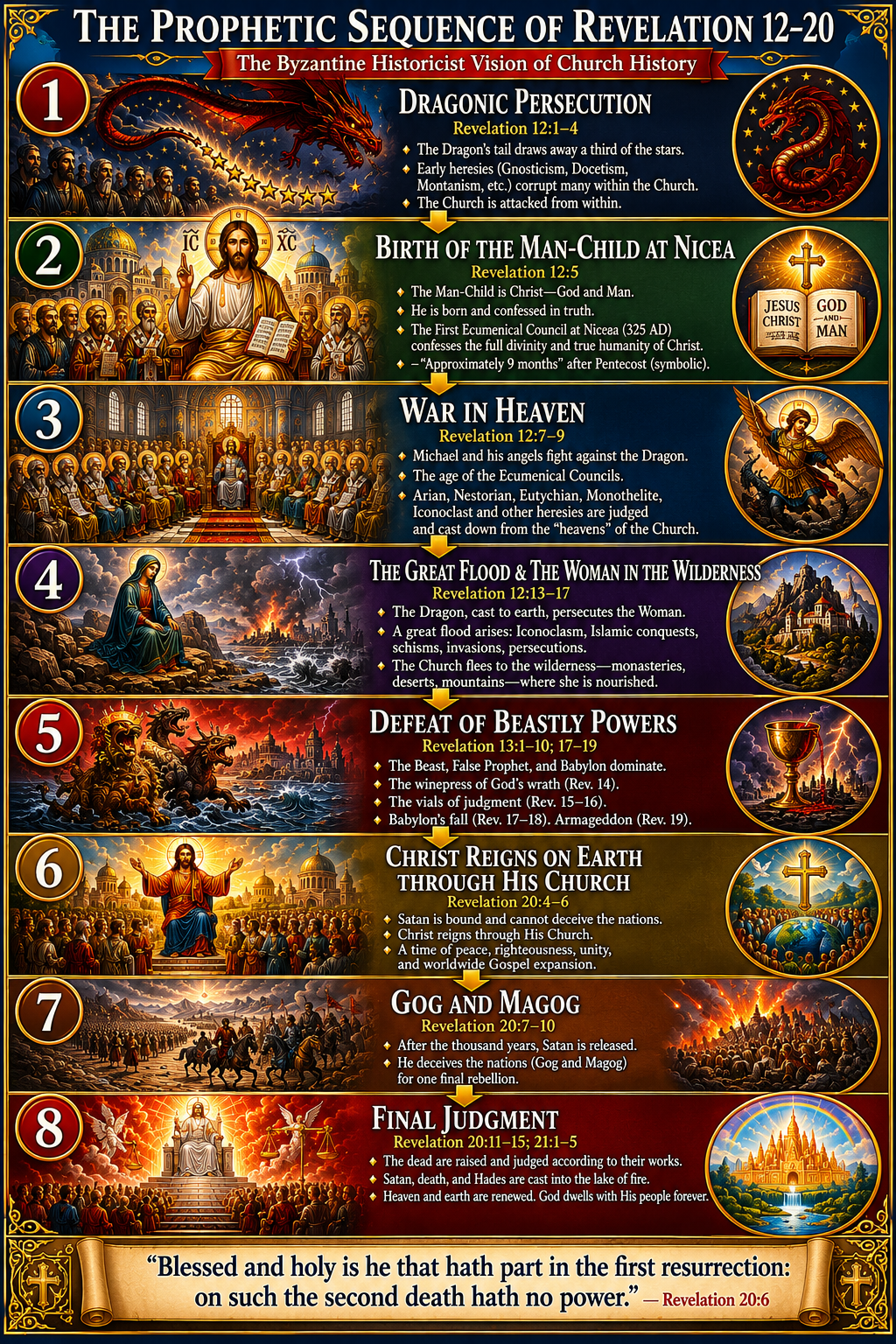
The sequence becomes:
Dragonic Persecution → Birth of God Man (Man Child) → War in Heaven → 1260 Years in Wilderness → Defeat of Beastly Powers → Binding of Satan → Church Reigns → Gog and Magog → Final Judgment →
Such a structure preserves the plain contrast between Revelation 12 and Revelation 20 while also accounting for the historical character of the Church’s long struggle through the centuries.
A Witness from Orthodox Apocalyptic Tradition
Interestingly, this sequence appears not only in the biblical text but also in later Orthodox apocalyptic literature.
One striking example occurs in the Vision of Agathangelos. Following the destruction of the enemies of the Church and the restoration of divine order, the text describes the binding of the Dragon:
“The impious school of the Devil, which has the appearance of sanctity before the eyes of men, behold, it will be completely destroyed and disappear; then a most bright Constitution of the Divine Providence will shine in the world and illumine it…”
The vision then continues:
“And lo and behold, a great multitude of a heavenly army carried away the Great Dragon and they tied him with formidable chains and cast him off in the Tartarus of the burning furnace of fire, while the Angels were singing upon the earth, in the ether, and upon the waters as follows:
Holy God, Holy Mighty, Holy Immortal, have Mercy on us.”
Whether one accepts the prophetic character of such literature is beside the point. What matters is the sequence. The overthrow of evil powers precedes the binding of the Dragon, and the binding introduces a period of divine restoration and ecclesial renewal.
This is remarkably close to the pattern suggested by Revelation itself.
Conclusion: The Bound Dragon Problem
The central question remains.
If Revelation 12 and Revelation 20 describe the same period, why does one depict a raging Dragon deceiving and persecuting the saints while the other depicts a Dragon imprisoned and unable to deceive the nations?
Yet the difficulty extends even further. The problem is not merely that Revelation 12 portrays an unbound Dragon. The problem is that Revelation 12–19 presents an entire prophetic drama of dragonic warfare, beastly domination, divine judgment, Babylon’s fall, and Armageddon before Revelation 20 ever introduces the binding of Satan.
The modern Preterist-Idealist Postmillennial synthesis offers an answer, but not without tension. The Byzantine apocalyptic tradition offers another: the Dragon of Revelation 12 is not yet the bound Dragon of Revelation 20.
Under this reading, the Church presently lives within the age of conflict symbolized by the Woman’s sojourn in the wilderness. The Dragon continues to wage war against the saints through deception, persecution, heresy, and beastly powers. The age of the councils, the struggle against false doctrine, the Church’s wilderness refuge, and the successive judgments depicted throughout Revelation 12–19 belong to this ongoing historical drama.
Yet this period is neither endless nor ultimate. At its appointed conclusion, the beastly powers are overthrown, the Dragon is restrained, the nations are delivered from his deception, and a new phase in the triumph of Christ’s Kingdom begins. The millennium of Revelation 20 is therefore not the same age as the Dragon’s persecution of Revelation 12, but the divinely appointed resolution of that conflict.
Such a vision is neither futurism nor Augustinian amillennialism. Nor is it simply another form of modern postmillennialism. Rather, it represents a forgotten Orthodox alternative—one preserved within the Byzantine apocalyptic tradition and increasingly relevant to contemporary discussions of prophecy, Church history, and the unfolding revelation of God’s providential purposes in time.
© 2026 by Jonathan Photius
 NEO-Historicism - End Times Eschatology From An Eastern Orthodox Christian Historicist Perspective