
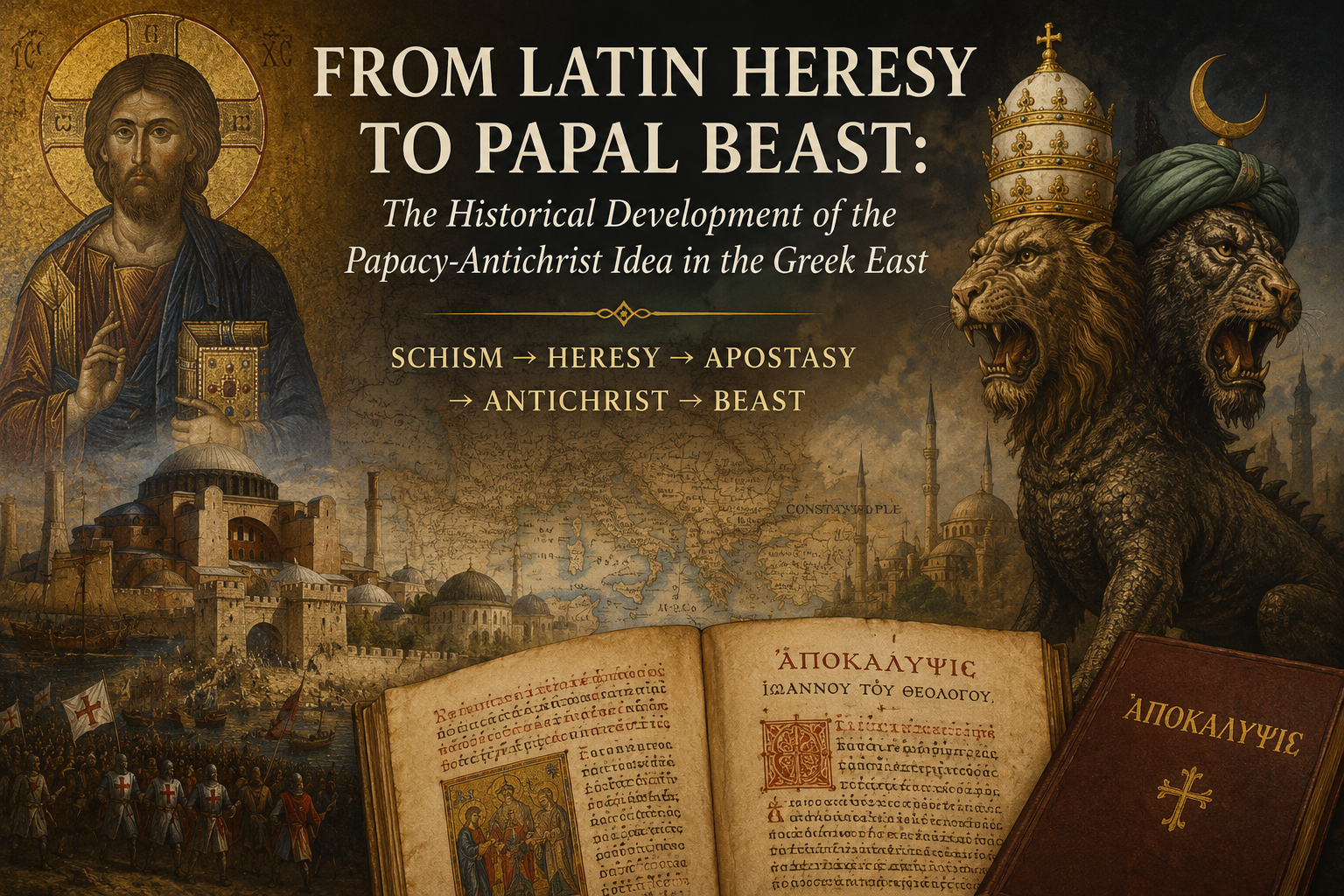
By Jonathan Photius – The NEO-Historicism Research Project
Introduction
Among modern scholars of Orthodox eschatology, it is frequently assumed that the identification of the Papacy with the Antichrist or with the second beast of Revelation 13 entered the Greek East through contact with Protestant historicist literature during the Ottoman period. The appearance of explicitly anti-papal interpretations in the works of post-Byzantine commentators such as Anastasios Gordios, Kyrillos Lavriotis, John of Lindos, and later Apostolos Makrakis would seem, at first glance, to support such a conclusion. Protestant historicist literature was indeed disseminated throughout the eastern Mediterranean after the sixteenth century and undoubtedly interacted with Orthodox apocalyptic thought. Yet the precise nature and extent of this influence remain difficult to determine.
Such an explanation, while partially true, is historically incomplete. It accounts for the appearance of a developed Papacy–Antichrist identification but does not adequately explain why such ideas found fertile soil among Orthodox writers in the first place. Ideas do not flourish in a vacuum. The remarkable reception of anti-papal apocalyptic interpretations within segments of the Orthodox world presupposes a much older set of theological, historical, and cultural developments.
The question was not merely theological. Following the fall of Constantinople, Orthodox Christians found themselves confronted by competing interpretations of history itself. Muslim authors frequently regarded Ottoman victories as proof of the truth of Islam and the divine mission of Muhammad. Roman Catholic polemicists often interpreted the decline of Byzantium as divine judgment upon a church that had rejected papal authority and resisted ecclesiastical union. Later Protestant writers would likewise portray the sufferings of the Greeks as evidence of superstition, idolatry, corruption, or ecclesiastical decline. Against all three claims, Orthodox commentators developed a distinctive theology of history. Political success did not establish religious truth, nor did political defeat invalidate the Church. Rather, the rise of hostile powers was interpreted through the biblical categories of chastisement, repentance, providence, and eventual restoration. It was within this broader framework of sacred history that increasingly apocalyptic interpretations of Rome began to emerge.¹
The evidence preserved in Byzantine chronicles, anti-Latin polemical literature, ecclesiastical correspondence, apocalyptic texts, and post-Byzantine commentaries suggests that the roots of the Papacy–Antichrist idea reach much deeper into the Byzantine past than is often acknowledged. Long before the Protestant Reformation, Byzantine authors had already come to regard Latin Christianity as the chief theological rival of Orthodoxy. Through the cumulative effects of the Photian controversy, the Filioque dispute, the Crusades, the Latin occupation of Constantinople, the Council of Florence, and the experience of Latin missionary activity under Ottoman rule, Rome gradually ceased to be viewed merely as a separated church. Increasingly it came to be portrayed as the culmination of heresy, the principal adversary of Orthodoxy, and the religious embodiment of apostasy itself.²
This transformation did not occur suddenly. Rather, it was the product of centuries of historical memory and theological reflection. By the late Byzantine and early Ottoman periods, anti-Latin polemic had already developed many of the conceptual elements that would later characterize explicitly apocalyptic interpretations. The Papacy was increasingly associated with innovation, pride, false doctrine, persecution, and spiritual deception. In some circles, Latinism came to be described as the sum and culmination of all previous heresies.³ Such ideas did not yet amount to a fully developed Papacy–Antichrist doctrine, but they supplied many of its essential foundations.
As Asterios Argyriou observed in his study of post-Byzantine eschatology, the notion that Latin Christianity represented the final and greatest heresy could gradually and almost imperceptibly lead to the idea of a Papacy–Antichrist.⁴ Significantly, Argyriou does not present this development as a simple borrowing from Protestantism. Rather, Protestant eschatological and polemical literature encountered an Orthodox world already shaped by centuries of anti-Latin theology and historical memory. To use Argyriou’s own imagery, the soil had long been cultivated before the seed arrived. Protestant historicism did not create the underlying trajectory. Instead, it interacted with a theological tradition already moving in that direction and provided additional prophetic language through which existing Byzantine convictions could be expressed.
The history of the Papacy–Antichrist idea in the Greek East is therefore not primarily a story of borrowing but of convergence. Byzantine and Protestant writers often arrived at similar anti-papal conclusions, yet they did so through very different historical experiences. The former emerged from centuries of conflict over papal authority, the Filioque, the Crusades, the Latin occupation of Constantinople, and the failed unions of Lyons and Florence. The latter emerged from the theological controversies of the Reformation and the critique of late medieval Catholicism. When these traditions encountered one another during the Ottoman period, they frequently reinforced one another, but neither can be wholly reduced to the other.
This article argues that the Ottoman-era identification of the Papacy with the second beast of Revelation 13 should be understood as the culmination of a long Byzantine historical process rather than as a simple borrowing from Protestant sources. Through the Photian controversy, the Crusades, the Latin occupation of Constantinople, the failure of ecclesiastical reunion, and the experience of Ottoman-era missionary rivalry, Rome was progressively reinterpreted as schismatic, heretical, apostate, and ultimately antichristian. By tracing the evolution of Byzantine attitudes toward Rome from the Photian controversy through the Ottoman period, this study seeks to demonstrate how Latin heresy gradually became transformed into the Papal Beast of Greek historicist interpretation.
I. Rome and the Byzantine Commonwealth: Before the Schism
The later identification of the Papacy with the Antichrist or with the second beast of Revelation 13 must not be projected backward into the first millennium. Such interpretations were the product of a long historical development and would have been largely unintelligible to most Christians of the early Byzantine period. Before the gradual estrangement of East and West, the Church of Rome occupied a respected position within the Christian oikoumene, and despite periodic disagreements, the bishops of Rome and Constantinople generally regarded themselves as members of the same ecclesiastical commonwealth.
The Roman Empire provided the political framework within which this unity was maintained. Even after the transfer of imperial authority to Constantinople, the empire continued to understand itself as a single Christian civilization. The inhabitants of the East called themselves Romans (Ῥωμαῖοι), and the emperor in Constantinople remained the Roman emperor. The bishop of Rome, although increasingly separated from the imperial center by geography and language, continued to occupy a position of exceptional honor within the pentarchic structure of the Church. Ecumenical councils routinely included papal representatives, and appeals to Rome were not uncommon in major ecclesiastical disputes. While disagreements concerning jurisdiction, authority, and ecclesiastical prerogatives periodically emerged, neither side yet viewed the other as representing an eschatological enemy.
Indeed, Byzantine apocalyptic literature of the early centuries reveals little hostility toward Rome itself. The principal threats envisioned by Christian writers were pagan persecutors, heretics, Persians, and later Arabs. When commentators reflected upon the prophecies of Daniel and Revelation, they generally understood the Roman Empire not as an adversary of the Church but as the providential order within which Christianity had triumphed. The Christian empire was frequently regarded as the restraining force described by the Apostle Paul, delaying the appearance of the final Antichrist and preserving order within the world. Such an outlook left little room for identifying the bishop of Rome as an eschatological adversary.
Perhaps the clearest indication of this earlier outlook is found in Byzantine eschatology itself. Although the Apocalypse continued to be interpreted throughout the Christian East, Rome was not generally identified with Antichrist, Babylon, or the Beast. The principal eschatological adversaries of Byzantine writers were typically pagan persecutors, heretics, Persians, Arabs, or a future personal Antichrist. Whatever tensions existed between Constantinople and Rome, they had not yet assumed an explicitly apocalyptic character. The transformation of Rome into an eschatological adversary would require centuries of additional theological conflict and historical experience.
The gradual deterioration of relations between East and West arose not primarily from apocalyptic speculation but from a complex combination of political, cultural, linguistic, and theological developments. As Asterios Argyriou notes, the emergence of Latin as the dominant theological language in the West and Greek as the dominant theological language in the East increasingly produced two distinct Christian worlds.⁵ The collapse of imperial authority in the western provinces accelerated this divergence. Whereas the East remained centered upon the Roman Empire and the civilization of Constantinople, the West developed under the influence of the emerging Frankish kingdoms and the growing authority of the Papacy.
Several developments during the seventh through ninth centuries proved especially significant. In 589 the Third Council of Toledo approved the insertion of the Filioque into the Creed in Visigothic Spain. In 607 Emperor Phocas formally recognized the Church of Rome as the head of all the churches.⁶ Although neither event immediately produced a schism, both contributed to the emergence of competing conceptions of ecclesiastical authority. At approximately the same moment that Islam was appearing in the East, the foundations were being laid for the eventual separation of the two Christian worlds.
The Photian controversy of the ninth century marked a decisive turning point. The conflict between Patriarch Photius and Pope Nicholas I exposed profound disagreements concerning papal jurisdiction, missionary activity among the Bulgarians, and the Filioque. Yet even at this stage the controversy remained fundamentally ecclesiological rather than apocalyptic. Photius criticized what he regarded as Latin innovations and resisted Roman claims of supremacy, but he did not identify the Papacy with the Antichrist. Rome was viewed as erring, not yet as the embodiment of eschatological opposition to the Church.
This distinction is essential. The Byzantine perception of Rome evolved gradually through successive historical crises. The Photian controversy established the category of Latin innovation. The schism of 1054 transformed innovation into formal separation. The Crusades converted theological disagreement into collective historical memory. The Latin occupation of Constantinople and the failed unions of Lyons and Florence transformed that memory into a narrative of betrayal. Only after centuries of accumulated experience would these developments begin to assume an explicitly apocalyptic character.
Consequently, the roots of the Papacy–Antichrist idea are not to be sought in the first millennium but in the progressive reinterpretation of history by later Byzantine and post-Byzantine writers. The early Byzantine world still conceived of Rome as part of the Christian commonwealth. The emergence of anti-papal eschatology would require not only doctrinal disputes but also the accumulation of historical memories that fundamentally reshaped Byzantine perceptions of the Latin West after the ninth century. The story of the Papal Beast begins not with the Apocalypse itself but with the gradual transformation of Rome’s place within the historical consciousness of Orthodox Christianity.
II. From Schism to Heresy: The Transformation of Rome in Byzantine Consciousness (863–1204)
The transformation of Rome within Byzantine consciousness did not occur suddenly. Between the ninth and thirteenth centuries, a series of political, theological, and cultural conflicts gradually altered the manner in which Orthodox Christians perceived the Latin West. During this period Rome ceased to be viewed merely as a distant patriarchate possessing ancient prestige and increasingly came to be regarded as the principal source of ecclesiastical innovation and doctrinal deviation. Although the fully developed identification of the Papacy with apocalyptic enemies would emerge much later, the foundations of that development were laid during these centuries.
The Photian controversy represents the first major stage of this transformation. The conflict was not simply a personal dispute between Patriarch Photius of Constantinople and Pope Nicholas I. Rather, it exposed deeper disagreements concerning ecclesiastical authority and the boundaries of legitimate doctrinal development. The controversy over the evangelization of Bulgaria brought Greek and Latin missionaries into direct competition and revealed the growing distance between the two Christian traditions. For Byzantine observers, the issue was not merely jurisdictional. It increasingly appeared that the Latin Church had begun to introduce teachings and practices unknown to the common tradition of the Fathers.⁷
The Filioque became the most visible symbol of this divergence. From the Byzantine perspective, the unilateral alteration of the Nicene-Constantinopolitan Creed represented more than a theological mistake. It constituted an innovation introduced without the consent of the universal Church. Photius therefore treated the Filioque not simply as an isolated doctrinal error but as evidence of a broader tendency within the Latin Church to depart from the inherited faith.⁸ Although his criticisms remained directed toward specific teachings and practices rather than toward the institution of the Papacy itself, an important conceptual shift had occurred. Rome was increasingly being judged according to the standard of Orthodoxy rather than occupying its traditional position as a leading see within the Christian commonwealth.
The political developments of the period reinforced these theological tensions. The coronation of Charlemagne as Emperor of the Romans in 800 represented, from the Byzantine perspective, a challenge not merely to imperial authority but to the unity of Christian civilization itself. Constantinople continued to regard itself as the legitimate continuation of the Roman Empire. The emergence of a rival western empire fostered the perception that the Latin world was developing independently of the Roman and ecclesiastical order preserved in the East.⁹ The gradual fusion of papal authority with Frankish political ambitions would become a recurring theme in later Byzantine interpretations of history.
Asterios Argyriou argues that the ninth century witnessed the emergence of an increasingly negative perception of Latin Christianity within Byzantine thought. The Church of Rome began to be associated not merely with isolated errors but with a broader pattern of innovation.¹⁰ This development is reflected in the rhetoric of the period. The language employed by Photius and his supporters remained measured compared with later polemical literature, yet it established categories that would prove enormously influential. The Latins were no longer simply distant Christians who happened to differ on certain matters. They were becoming representatives of a rival ecclesiastical vision.
The events surrounding the schism of 1054 accelerated this process. Although modern historians often caution against treating 1054 as a single definitive break, Byzantine memory would later regard it as a symbolic watershed.¹¹ The mutual excommunications exchanged between Cardinal Humbert and Patriarch Michael Cerularius transformed longstanding disputes into a visible rupture. Significantly, both sides increasingly began to enumerate the errors of the other. Cardinal Humbert accused the Greeks of a multitude of heresies, while Byzantine writers responded with growing catalogues of Latin innovations.¹² These lists would expand dramatically in subsequent centuries and eventually become a distinctive feature of anti-Latin literature.
The development of these catalogues reveals an important shift in Byzantine thinking. Earlier controversies had focused upon particular doctrinal questions. By the eleventh century, however, Byzantine authors increasingly portrayed Latin Christianity as a system of accumulated innovations. The problem was no longer one or two errors but a pattern of deviation. Argyriou notes that the number of alleged Latin heresies steadily increased in later centuries, eventually reaching more than one hundred in some anti-Latin compilations.¹³ Such catalogues reflected a growing conviction that Latinism represented not merely a mistaken doctrine but a fundamentally corrupted religious tradition.
The significance of these catalogues extended beyond polemics. They represented an attempt to reinterpret the entire Latin tradition through the category of heresy. As successive generations expanded the lists of Latin innovations, Rome increasingly ceased to be viewed as a church possessing particular errors and instead came to be viewed as a religious system characterized by error itself. The cumulative effect of these catalogues was to transform isolated controversies into a comprehensive narrative of doctrinal corruption. By the late Byzantine period, this process would lead some authors to portray Latinism not merely as a heresy but as the sum and recapitulation of previous heresies, a development of enormous significance for the later emergence of Papacy–Antichrist interpretations.
At this stage, however, Rome had not yet become an explicitly apocalyptic adversary. The language of heresy predominated over the language of Antichrist. Byzantine writers viewed the Latins as innovators, schismatics, and increasingly as heretics, but they had not yet identified the Papacy with the eschatological enemy foretold in Scripture. The significance of the period from 863 to 1204 therefore lies not in the emergence of anti-papal apocalypticism but in the creation of the intellectual and theological categories that would later make such interpretations possible. Although these developments remained ecclesiological rather than apocalyptic, they established concepts that later generations would extend into the realm of prophecy. Once Rome came to be viewed as the source and culmination of heresy, the transition from theological adversary to eschatological adversary became increasingly conceivable.
By the beginning of the thirteenth century, the essential framework had been established. Rome was no longer perceived as a sister church temporarily separated from Constantinople. It had become the principal theological rival of Orthodoxy. The Photian controversy had introduced the language of innovation. The Filioque controversy had transformed innovation into doctrinal corruption. The schism had institutionalized separation. Yet one crucial element remained absent: collective historical trauma. The language of innovation and heresy had been established, but it had not yet been fused with the powerful memories that would reshape Byzantine historical consciousness. The theological categories were now in place. What remained was the historical experience that would transform those categories into a narrative of betrayal. That experience would arrive with devastating force during the era of the Crusades and especially with the Latin conquest of Constantinople in 1204. Only then would theological disagreement become collective memory, and only then would anti-Latin polemic begin its gradual transformation into an explicitly apocalyptic vision of history.
III. From Heresy to Apostasy: The Crusades, the Fall of Constantinople, and the Memory of Betrayal (1204–1453)
If the controversies of the ninth through eleventh centuries transformed Rome from a sister church into a theological rival, the events of the Crusading era transformed that rival into something far more dangerous within the Byzantine imagination. The period between the Fourth Crusade and the fall of Constantinople witnessed the emergence of a collective historical memory that would profoundly shape Orthodox attitudes toward the Latin West for centuries to come. During this period, anti-Latin polemic ceased to be merely a matter of theological disagreement and increasingly became a narrative of betrayal, oppression, and apostasy.
The Crusades were originally proclaimed in the West as holy wars undertaken for the liberation of Christian lands and the defense of Christendom against its enemies. Yet from the perspective of many Byzantines, the practical consequences of the Crusading movement appeared very different. What had begun as a military alliance between East and West gradually evolved into a relationship marked by suspicion, rivalry, and ultimately violence. The establishment of Latin principalities throughout the eastern Mediterranean and the growing interference of western powers in Byzantine affairs fostered the perception that the Latins were pursuing their own political and ecclesiastical ambitions under the guise of religious zeal.¹⁴
The decisive turning point came in 1204. The capture and sack of Constantinople by the Fourth Crusade represented one of the greatest traumas in Byzantine history. Unlike earlier invasions by Persians, Arabs, or Turks, the conquerors were fellow Christians. Churches were looted, monasteries plundered, relics carried away, and the capital of Eastern Christendom subjected to humiliation at the hands of those who professed the same faith. For many Byzantines, this event fundamentally altered the meaning of the schism. Theological disputes that had once appeared abstract were now interpreted through the lens of lived historical experience. The Latins were no longer merely innovators or schismatics. They had become destroyers of the Christian empire itself.¹⁵
The significance of 1204 cannot be overstated. More than any previous controversy, the events of the Fourth Crusade transformed anti-Latin sentiment from the concern of theologians and ecclesiastical leaders into a defining element of Byzantine collective memory. The conquest of Constantinople gave concrete historical form to fears that had previously been expressed largely in doctrinal language. After 1204, Rome could no longer be evaluated solely through theological categories. It was now judged through the memory of conquest, occupation, and humiliation. As Asterios Argyriou observes, the Crusades transformed what had previously been a dispute among emperors, bishops, and theologians into a matter affecting the consciousness of entire populations.¹⁶ The memory of the Latin conquest became deeply embedded within popular tradition and was preserved by monks, preachers, chroniclers, and later commentators. The distinction between theological disagreement and historical grievance gradually disappeared. To oppose Latinism increasingly became synonymous with defending Orthodoxy itself.
This transformation is visible in the rhetoric of the period. Byzantine authors increasingly described the Latins using language that extended beyond the traditional categories of schism and heresy. A striking example appears in the writings associated with Patriarch Photius and later Byzantine polemicists, where Constantinople is portrayed through imagery drawn from the New Jerusalem of Revelation while western intruders are depicted through the language of thunder, earthquake, hail, and savage beasts.¹⁷ Such imagery did not yet identify the Papacy with the Beast of Revelation, but it reveals the gradual penetration of apocalyptic categories into Byzantine perceptions of the Latin West.
The memory of the Crusades also contributed to a remarkable reinterpretation of contemporary history. In western Europe, the Crusades had frequently been presented as a struggle against the enemies of Christ and even against Antichrist himself. In the Byzantine East, however, the same events increasingly appeared as evidence that the Latins had become enemies of Orthodoxy. The contradiction was profound. Those who claimed to be defenders of Christendom had sacked the greatest Christian city in the world. Those who proclaimed the liberation of Christians had established foreign domination over Orthodox populations. As a result, many Byzantines began to view Latin claims to religious leadership with deep suspicion.
The decades following the Latin conquest witnessed the further expansion of anti-Latin literature. Catalogues of Latin heresies multiplied. The number of alleged western errors steadily increased. What had begun as objections to specific doctrines gradually evolved into a comprehensive critique of Latin Christianity as a whole. Argyriou notes that by the later Byzantine and Ottoman periods some authors described Latinism as the sum of all previous heresies.¹⁸ This development is of enormous importance for understanding the later emergence of Papacy–Antichrist interpretations.
The consequence of this development was profound. A church accused of particular errors might still be regarded as misguided. A church viewed as the repository of all previous errors increasingly appeared as something more dangerous. The language of heresy gradually began to merge with the language of apostasy. Rome was no longer criticized merely for departing from aspects of the tradition. It was increasingly portrayed as having abandoned the tradition itself. A religious system regarded as containing every previous error could easily be viewed as the culmination of apostasy. The transition from schism to heresy that had begun in the ninth century was now evolving into a far more radical interpretation of the Latin West.
The failed attempts at ecclesiastical reunion further intensified these sentiments. The Councils of Lyons (1274) and Florence (1439) were undertaken largely in response to political necessity and the growing Ottoman threat. Yet both unions were rejected by large segments of the Orthodox population. The opposition was especially intense after Florence. While emperors and bishops negotiated theological compromises, many monks, clergy, and laypeople regarded such agreements as betrayals of the Orthodox faith.¹⁹ Those who supported union were increasingly portrayed as collaborators willing to sacrifice doctrinal truth for political advantage.
For many Orthodox Christians, Florence represented a different kind of danger than the Crusades. The Latin conquest had threatened the empire from without. Florence appeared to threaten Orthodoxy from within. If 1204 symbolized coercion, Florence symbolized seduction. The union was rejected not merely because it was politically unpopular but because it was perceived as a compromise of truth itself. Consequently, anti-Latin sentiment increasingly acquired a spiritual and ecclesiological dimension that extended beyond memories of military conquest. Rome was no longer viewed simply as a foreign power. It was increasingly perceived as a force capable of corrupting the faith from within the Church itself. This perception would later prove highly significant in the development of apocalyptic interpretations that emphasized deception as much as persecution.
It was within this context that the famous saying attributed to Loukas Notaras acquired its enduring significance: “Better the Turkish turban than the Latin mitre.”²⁰ Whatever its precise historical origins, the phrase captured a sentiment that had become widespread among many Byzantines. The statement did not imply approval of Islam or preference for Muslim rule. Rather, it reflected the conviction that political subjugation was preferable to ecclesiastical submission. The Turks might conquer bodies, but union with Rome threatened souls. Such a perspective reveals how deeply anti-Latin consciousness had penetrated Byzantine religious thought by the eve of the Ottoman conquest.
By the fifteenth century, therefore, the transformation was largely complete. Rome was no longer merely a schismatic church. It had become, in the minds of many Orthodox Christians, the embodiment of betrayal, innovation, and apostasy. Theological disputes, political rivalries, crusading violence, and failed unions had fused into a single historical narrative. The categories established in the age of Photius had been reshaped by centuries of collective memory. Yet one final step remained. The language of apostasy had not yet fully become the language of Antichrist. That transition would occur under the radically altered circumstances of Ottoman rule, when Greek Christians confronted not only the memory of Latin domination but also the competing historical claims of Islam, Rome, and eventually Protestantism. It was in that environment that the idea of the Papacy as an explicitly apocalyptic power would finally emerge.
IV. From Apostasy to Antichrist: Ottoman Rule, Protestant Historicism, and the Papalization of the Beast
The transition from viewing Rome as a heresy or apostasy to identifying the Papacy with Antichrist and the Beast of Revelation did not occur immediately after the fall of Constantinople. The process unfolded gradually during the centuries of Ottoman domination and emerged from the convergence of several distinct currents: Byzantine anti-Latin polemic, Orthodox interpretations of historical suffering, renewed engagement with apocalyptic literature, and later interaction with Protestant historicist exegesis. The resulting synthesis produced one of the most distinctive features of post-Byzantine prophetic interpretation—the identification of the Papacy with the second beast of Revelation 13.
The Ottoman conquest radically altered the intellectual and spiritual environment of the Orthodox East. Byzantine political structures had collapsed. The empire that many earlier Christians had regarded as the earthly guardian of Orthodoxy no longer existed. The Church found itself living under Islamic rule while simultaneously facing persistent pressure from Roman Catholic missionary efforts. In this new context, historical events demanded explanation. Why had God permitted the fall of Constantinople? Why did the faithful suffer under Muslim domination? Why had the promises of Christian civilization seemingly collapsed? These questions encouraged renewed reflection upon biblical prophecy and particularly upon the Book of Revelation.
As Asterios Argyriou has demonstrated, post-Byzantine Orthodox literature increasingly interpreted history through an eschatological lens.²¹ The disasters experienced by the Orthodox world were not understood as proof of the truth of Islam nor as evidence of the correctness of Rome. Rather, they were interpreted as divine chastisements permitted for the correction and purification of God’s people. This perspective appears repeatedly in consolation literature, anti-Islamic polemics, martyrologies, and prophetic texts. Ottoman domination was therefore incorporated into a providential narrative rather than accepted as a verdict against Orthodoxy itself.
At the same time, the memory of Latin aggression remained vivid. The Crusades, the Latin occupation of Constantinople, the failed unions of Lyons and Florence, and the continuing activity of Roman Catholic missionaries ensured that anti-Latin sentiment remained a powerful force within Orthodox society. The Papacy was already viewed by many writers as the culmination of ecclesiastical innovation and the embodiment of western religious error. The theological foundations of a future Papacy–Antichrist interpretation therefore existed long before sustained contact with Protestant historicism.
Indeed, the movement from apostasy to Antichrist was already latent within Byzantine anti-Latin thought itself. As later Byzantine writers increasingly portrayed Latinism as the sum and recapitulation of all previous heresies, the transition to explicitly antichristian categories became increasingly conceivable. A church viewed as the repository of every major doctrinal error could readily be interpreted as the culmination of ecclesiastical corruption and opposition to the true faith. The logic did not originate with Protestant exegesis. It emerged organically from the internal development of Byzantine anti-Latin polemic.
This point is crucial. Argyriou explicitly argues that the conception of the Papacy as Antichrist was influenced by Protestant eschatological literature.²² Yet he immediately qualifies that observation by noting that Protestant ideas fell upon soil that had long been cultivated. The Orthodox East had already developed a comprehensive critique of Latin Christianity. Lists of Latin heresies had multiplied for centuries. Anti-Latin treatises portrayed Rome as the source of innovation and corruption. Popular memory associated the Papacy with betrayal and oppression. The essential components of an anti-papal eschatology already existed before the arrival of Protestant literature.
The distinction between influence and origin is therefore essential. Protestant authors did not persuade Orthodox writers that Rome was in error. Orthodox polemicists had been arguing that point for centuries. Nor did Protestants introduce the notion that the Papacy represented apostasy. Argyriou himself traces the emergence of such language to the Byzantine Middle Ages.²³ Protestant historicism provided one possible interpretive framework through which existing Byzantine convictions could be expressed, but the theological assumptions underlying anti-papal apocalypticism had already been established long before the Reformation. The relationship between Protestant and Orthodox anti-papal traditions should therefore be understood not simply as one of borrowing but as one of convergence.
The intellectual relationship between Byzantine and Protestant anti-papal traditions was almost certainly more complex than a simple model of western influence upon the East. The migration of Greek scholars and manuscripts into western Europe following the fall of Constantinople contributed significantly to Renaissance and Reformation-era engagement with Greek patristic sources. Although the precise extent of Byzantine influence upon Protestant anti-papal thought remains difficult to determine, the circulation of ideas occurred in multiple directions rather than along a single path. By the sixteenth and seventeenth centuries, Orthodox and Protestant writers often arrived at similar anti-papal conclusions, but they did so through different historical experiences and intellectual trajectories.
This development is visible throughout the post-Byzantine commentary tradition. Anastasios Gordios repeatedly presents Latinism as the culmination of previous heresies and treats western ecclesiastical claims as manifestations of spiritual deception.²⁴ Kyrillos Lavriotis similarly incorporates anti-Latin themes into his interpretation of sacred history, while Theodoret of Ioannina frequently reads contemporary events through the lens of providential conflict between Orthodoxy and its adversaries. John of Lindos, writing within the context of Ottoman domination and western intervention, likewise situates the struggles of the Orthodox Church within a broader prophetic narrative. These commentators did not merely repeat Protestant polemics. Rather, they integrated anti-Latin themes into distinctly Orthodox historical narratives shaped by the fall of Constantinople, Ottoman domination, ecclesiastical survival, and the preservation of the true faith. Although they differ in detail, they share a common tendency to interpret Rome and Islam not as isolated historical phenomena but as actors within the unfolding drama of Revelation.
Particularly significant is the emergence of a dual-adversary framework. Earlier Byzantine literature had often portrayed Islam as a precursor of Antichrist or as a manifestation of eschatological evil. During the Ottoman period, however, a growing number of commentators came to apply similar categories to the Papacy. The result was a prophetic structure in which the two principal external rivals of Orthodoxy—the Islamic East and the Latin West—were integrated into a single apocalyptic vision. If Islam represented one of the great persecuting powers foretold in prophecy, then Rome naturally appeared as the other. Argyriou summarizes this logic with remarkable clarity when he observes that Byzantine and post-Byzantine writers could reason as follows: if Muhammad was the Antichrist, why should the Pope not be? If Islam was one of the two beasts of Revelation 13, why should the Papacy not be the other?²⁵
This reasoning did not arise merely from theological speculation. It reflected centuries of accumulated historical experience. The Orthodox world found itself squeezed between two powerful civilizations, each claiming religious legitimacy. Islamic authors interpreted Ottoman victories as proof of the truth of Islam. Roman Catholic writers frequently interpreted Byzantine decline as evidence that God had judged the Greeks for rejecting papal authority. Against both claims, Orthodox commentators increasingly advanced a third interpretation of history. The sufferings of the Church did not prove the truth of Islam or the correctness of Rome. They revealed the temporary triumph of anti-Christian powers permitted by God for the chastisement of His people and the fulfillment of prophecy.
Within this framework, the identification of the Papacy with the second beast of Revelation 13 became both historically intelligible and theologically persuasive. The second beast appeared lamb-like yet spoke as a dragon. It exercised religious influence rather than military domination. It performed signs, demanded submission, and directed worship toward another power. For many Greek commentators, such imagery appeared remarkably compatible with the historical role they believed the Papacy had assumed. Whether or not one accepts their conclusions, the logic underlying the interpretation is clear. The Beast was not identified with Rome merely because Protestants had done so. It was identified with Rome because centuries of Byzantine history had prepared Orthodox readers to recognize the Papacy as the culmination of a long process of innovation, apostasy, and opposition to the Church.
By the seventeenth and eighteenth centuries, the transformation was complete. The progression from schism to heresy, from heresy to apostasy, and from apostasy to Antichrist had produced a distinctly Orthodox form of historicist interpretation. Protestant historicism frequently paralleled and at times reinforced this development, but the underlying trajectory was rooted in centuries of Byzantine theological reflection and historical experience. The Papal Beast of the Ottoman-era commentators was therefore not the product of a foreign doctrine imposed upon Orthodoxy. It was the culmination of a process that stretched from Photius and the Filioque controversy through the Crusades, Florence, and the long struggle for Orthodox survival under Ottoman rule.
V. The Two Beasts of Revelation 13 and Orthodox Historicism
The identification of Islam and the Papacy with the two beasts of Revelation 13 should not be understood merely as an exercise in polemical exegesis. To interpret the Ottoman Empire as the first beast and the Papacy as the second was not simply to denounce two historical rivals. Rather, it reflected a broader Orthodox attempt to understand the meaning of sacred history itself. The post-Byzantine commentators who adopted such interpretations were not primarily concerned with proving the superiority of Orthodoxy through prophecy. They were attempting to explain how the Orthodox Church could remain the true Church while simultaneously enduring political collapse, foreign domination, and centuries of suffering.²⁶
The distinctive feature of post-Byzantine Greek exegesis was not merely the identification of particular prophetic symbols but the conviction that the prophecies of Daniel and Revelation unfolded progressively throughout the history of the Church. Earlier commentators such as Andrew of Caesarea had already emphasized that prophetic understanding becomes clearer through time and experience. Ottoman-era interpreters increasingly applied this principle to the entire course of Christian history, reading contemporary events as successive stages within the unfolding drama of the Apocalypse. Revelation was therefore approached not simply as a prediction of the distant future but as a providential map of sacred history.²⁹
This conviction lies at the heart of Byzantine and post-Byzantine eschatology. From the earliest Christian centuries, Orthodox writers had understood suffering, persecution, exile, and captivity as recurring features of sacred history. Israel had experienced bondage in Egypt and exile in Babylon. The early Church had endured persecution under pagan Rome. The saints had frequently suffered at the hands of powers that appeared invincible. Consequently, the subjugation of Orthodox Christians under Ottoman rule did not necessarily imply the falsity of their faith. On the contrary, it could be interpreted as part of the same providential pattern visible throughout biblical history.
The Book of Revelation provided a particularly powerful framework for such reflection. The Apocalypse does not present the Church as a community enjoying uninterrupted earthly triumph. Rather, it depicts the saints enduring persecution, exile, deception, and oppression before final vindication. The Woman flees into the wilderness. The holy city is trampled underfoot. The witnesses are slain. The saints suffer beneath the power of the Beast. Yet throughout these tribulations the Church remains the people of God. The fundamental lesson of the Apocalypse is therefore not that historical success proves divine favor, but that divine truth may persist even when outward circumstances appear disastrous.
This interpretive framework produced what may properly be called an Orthodox form of historicism. Like western historicist interpreters, Ottoman-era Greek commentators increasingly read the prophecies of Daniel and Revelation as unfolding throughout the history of the Church. Yet their historical narrative was shaped by distinctively Orthodox experiences and concerns. Their primary questions were not those of the Reformation but those of Byzantium: the preservation of the Church under foreign domination, the meaning of Ottoman captivity, the challenge of Latin claims to ecclesiastical supremacy, and the hope of eventual restoration. Prophecy was therefore interpreted not merely as a prediction of future events but as a theological explanation of the entire historical experience of Orthodox Christianity.
Although later Protestant historicists would develop their own chronological systems, the underlying Byzantine principle was considerably older. Andrew of Caesarea had already argued that prophecy becomes clearer through the passage of time and the accumulation of historical experience. Post-Byzantine commentators extended this principle by reading the successive fortunes of the Orthodox Church through the imagery of Revelation itself. History became a teacher of prophecy, while prophecy supplied the theological meaning of history.²⁹
Within this framework, the emergence of a dual-beast scheme becomes more intelligible. The first beast represented the military and political power that oppressed the Orthodox world from without. The second beast represented the religious power that sought to deceive, corrupt, or dominate it from within. Different commentators identified these figures in different ways, but among many Ottoman-era interpreters the pattern increasingly converged upon Islam and the Papacy. Islam embodied the external force that had conquered Orthodox lands and reduced Christian populations to subordinate status. The Papacy represented the rival religious authority that claimed universal jurisdiction over the Church and sought to draw Orthodox Christians into submission to Rome. Together they formed the two great historical adversaries confronting Orthodoxy in the post-Byzantine world.
Equally important was the image of the Woman in the wilderness. Many Greek commentators interpreted the history of Orthodoxy itself through this symbol. The Church appeared outwardly defeated, deprived of political power, and scattered among hostile nations, yet she remained preserved by God. Monastic communities, faithful clergy, confessors, and ordinary believers became living manifestations of the wilderness motif. The Woman’s preservation provided the theological counterpart to the rise of the beasts. If the beasts represented temporary powers permitted to oppress the Church, the Woman represented the enduring continuity of Orthodoxy throughout centuries of trial.²⁸
What is particularly noteworthy is that these identifications were embedded within a larger theology of divine providence. Neither beast operated independently of God. Both were permitted for a time. Both functioned as instruments through which God chastened His people and tested their faithfulness. Such an interpretation appears repeatedly in post-Byzantine consolation literature, prophetic writings, and Apocalypse commentaries. The sufferings of the Church were not evidence that God had abandoned His people. Rather, they were understood as temporary trials permitted within the divine economy of salvation.²⁷
This perspective also explains why many Orthodox commentators remained fundamentally hopeful despite their often severe assessments of contemporary events. Their writings are not characterized merely by denunciation but by expectation. The same prophetic texts that described oppression also foretold deliverance. The same Apocalypse that spoke of beasts and persecution also promised the preservation of the Woman, the victory of the Lamb, and the ultimate defeat of every anti-Christian power. Consequently, Ottoman-era historicism frequently combined sharp criticism of contemporary enemies with confidence in eventual restoration.
The significance of this interpretive framework extends beyond the identification of individual prophetic symbols. It represents a distinctive Orthodox philosophy of history in which providence governs the rise and fall of empires, the chastisement of the faithful, and the eventual vindication of the Church. Historical events acquire meaning not through political success but through their place within the divine economy revealed in Scripture.
Seen in this light, the dual-beast interpretation was not simply an anti-Islamic or anti-papal polemic. It formed part of a broader Orthodox effort to understand the continuity of the Church within history itself. The commentators were not merely identifying enemies. They were constructing a theology of sacred history capable of explaining how the Orthodox Church could remain the people of God while enduring centuries of apparent defeat. The two beasts therefore functioned not only as symbols of external adversaries but also as theological markers within the unfolding drama of providence.
The result was a uniquely Orthodox form of historicism. History was neither random nor self-validating. Political success did not determine truth, nor did suffering prove falsehood. Instead, history revealed the gradual unfolding of divine providence, the testing of the faithful, and the ultimate triumph of Christ over every earthly power. Within that framework, both the Ottoman Empire and the Papacy could be interpreted as temporary manifestations of the apocalyptic opposition described by St. John, while the Orthodox Church remained identified with the Woman preserved in the wilderness and the remnant who keep the commandments of God and hold the testimony of Jesus.²⁹
VI. The Orthodox Response to Competing Interpretations of History: Rome, Islam, and the Protestants
The emergence of post-Byzantine apocalyptic interpretation cannot be understood apart from the competing historical narratives that confronted Orthodox Christians after the fall of Constantinople. The question was not merely how to interpret Revelation. The deeper question was how to interpret history itself. Why had the Christian empire fallen? Why did the Orthodox Church remain under foreign domination? Why had God permitted the faithful to suffer while rival religious communities appeared to prosper? Throughout the Ottoman period, Orthodox Christians encountered answers to these questions from Muslims, Roman Catholics, and later Protestants. The development of Greek historicist interpretation was, in part, a response to all three.
From the Islamic perspective, the success of the Ottoman Empire appeared to provide obvious evidence of divine favor. The conquest of Constantinople in 1453, the expansion of Muslim rule across formerly Christian lands, and the political subordination of Orthodox populations could all be interpreted as signs that Islam had superseded Christianity. If God grants victory to whom He wills, then Ottoman success seemed to validate the claims of Muhammad and his religion. Such arguments formed part of the broader intellectual environment in which Orthodox Christians lived and against which many later commentators reacted.³⁰
Roman Catholic writers often advanced a different but equally powerful interpretation. According to this view, the sufferings of the Greeks were the consequence of schism. Byzantium had rejected the authority of the Roman See, resisted ecclesiastical reunion, and refused the remedies repeatedly offered by the Papacy. The fall of Constantinople and the subsequent decline of the Orthodox East were therefore understood as divine judgments upon a church that had separated itself from the center of Christian unity. In this interpretation, history itself testified to the correctness of Rome. The military weakness of the Orthodox world and the political strength of western Christendom appeared to furnish empirical confirmation of papal claims.
The Protestant critique introduced a third explanation. While rejecting papal authority, many Protestant writers nevertheless regarded the Orthodox East as deeply compromised by superstition, ritualism, and what they perceived as idolatrous practices associated with the veneration of icons, relics, and saints. The prolonged subjugation of Orthodox Christians under Ottoman rule was therefore interpreted as evidence of divine displeasure. According to this perspective, the Greeks had preserved neither the purity of the Gospel nor the simplicity of apostolic Christianity and consequently remained under judgment. In different ways, both Catholics and Protestants appealed to history itself as evidence against Orthodoxy.
Orthodox commentators rejected all three explanations. Their response was not to deny the reality of historical catastrophe but to challenge the assumptions upon which these interpretations rested. They denied that political success constitutes proof of religious truth and equally denied that political defeat demonstrates theological error. Such assumptions, they argued, were contradicted by the testimony of Scripture itself.
The biblical narrative repeatedly presents the people of God enduring periods of apparent defeat. Israel suffered slavery in Egypt and exile in Babylon. The prophets were persecuted by their own nation. The early Christians endured centuries of oppression beneath pagan Rome. The saints frequently appeared weak while their enemies appeared triumphant. Yet none of these reversals invalidated the covenant of God. On the contrary, suffering often became the very means through which divine purposes were accomplished.³¹
This understanding of history appears consistently throughout the Orthodox tradition. St. Gregory Palamas defended the Orthodox faith while large portions of the Byzantine world remained under foreign domination. Gennadios Scholarios interpreted the Ottoman conquest not as proof of Islamic truth but as a providential chastisement permitted by God. Later Orthodox writers repeatedly emphasized repentance, perseverance, and divine providence rather than political triumph as the true measure of spiritual health. The survival of the Church, rather than the success of empires, became the primary lens through which history was interpreted.
The post-Byzantine commentators inherited and expanded this perspective. Ottoman domination was understood not as proof of the truth of Islam but as a temporary chastisement permitted for the correction of God’s people. Roman Catholic claims were rejected not because Rome lacked power but because power itself could not determine theological truth. Protestant accusations of corruption were answered by appealing to the continuity of Orthodox doctrine, worship, sacramental life, and apostolic tradition rather than to political circumstances. The proper measure of the Church was faithfulness, not success.
This providential framework also explains the remarkable optimism often found within post-Byzantine apocalyptic literature. Despite centuries of captivity, many commentators continued to anticipate divine intervention, restoration, and renewal. Historical reversals were viewed as temporary rather than permanent. The same God who had delivered Israel from Egypt, preserved the faithful during the Babylonian captivity, and sustained the Church through Roman persecution remained active in history. Consequently, periods of oppression could be interpreted as stages within a larger providential drama rather than as evidence of abandonment.
Apostolos Makrakis would later express this principle with particular clarity. The victories of hostile powers did not prove their truth. Rather, they revealed the temporary ascendancy of forces permitted by God for the testing of the faithful. The Church might be chastened, oppressed, or humbled, but she remained the Body of Christ and the guardian of apostolic truth. Similar themes appear throughout the post-Byzantine commentary tradition, where persecution is repeatedly interpreted as a sign of fidelity rather than divine rejection.³²
Seen in this light, the post-Byzantine interpretation of Revelation functioned as more than a prophetic system. It became an Orthodox answer to competing philosophies of history. Islam interpreted conquest as validation. Rome interpreted schism as punishment. Protestants interpreted captivity as evidence of corruption and idolatry. The Greek commentators answered that history proved none of these claims. The victories of anti-Christian powers were temporary chastisements permitted by God, while the preservation of the Church testified to the enduring truth of Orthodoxy.
The significance of this perspective extends beyond the Ottoman period. It reveals a distinctive Orthodox theology of history in which providence governs even the darkest moments of human affairs. The Church is not defined by political dominance, military success, or cultural prestige. She is defined by fidelity to Christ amid trial. In that sense, the post-Byzantine commentators were doing far more than interpreting Revelation. They were defending the continuity of Orthodox Christianity against rival claims and constructing a theological explanation for centuries of suffering, captivity, and hope.
VII. Conclusion: From Latin Heresy to Papal Beast
This study has argued that the identification of the Papacy with the Antichrist or the second beast of Revelation 13 did not emerge suddenly in the Ottoman period, nor can it be adequately explained as a simple borrowing from Protestant historicism. Rather, it developed through a long process of theological reflection, historical experience, and collective memory within the Byzantine and post-Byzantine world. The Papal Beast of the later Greek commentators was not an isolated innovation. It was the culmination of a trajectory that had been unfolding for centuries.
Asterios Argyriou’s work proves particularly important in this regard. His analysis demonstrates that the foundations of anti-papal apocalypticism were already present within Byzantine anti-Latin thought itself. Protestant historicism undoubtedly interacted with Orthodox interpreters and, in certain cases, reinforced existing tendencies. Yet the evidence does not support the view that Protestantism created the Papacy–Antichrist idea in the Greek East. The relationship is better understood as one of convergence. Byzantine and Protestant writers often arrived at similar conclusions regarding the Papacy, but they did so through different historical experiences and intellectual traditions. The former emerged from centuries of conflict over ecclesiastical authority, doctrinal innovation, crusading violence, and failed reunion. The latter emerged from the theological controversies of the Reformation and the critique of late medieval Catholicism.³³
More significantly, the Ottoman-era commentators were engaged in something larger than the identification of prophetic symbols. They were constructing an Orthodox interpretation of history itself. Muslims interpreted conquest as evidence of divine favor. Roman Catholics interpreted Byzantine decline as proof of the necessity of papal authority. Protestants frequently interpreted Greek captivity as evidence of superstition and corruption. Against all three claims, Orthodox writers advanced a fundamentally different reading of history. Political success did not establish religious truth, nor did political defeat invalidate the Church. The rise of hostile powers was understood as a temporary chastisement permitted by God for the testing, purification, and preservation of His people.
Within this framework, the identification of Islam and the Papacy with the two beasts of Revelation became historically intelligible. The beasts were not merely enemies. They were theological explanations for the apparent triumph of powers hostile to Orthodoxy. Their victories were temporary. Their authority was limited. Their role was providential rather than ultimate. The true subject of history remained not the beasts but the Church herself, preserved by God amid persecution and captivity, like the Woman nourished in the wilderness throughout the trials described in the Apocalypse.
The significance of this conclusion extends beyond the history of a particular interpretation. It illustrates the intimate relationship between historical experience and prophetic exegesis within the Orthodox tradition. As Andrew of Caesarea observed, prophecy becomes clearer through time and experience. The text of Revelation remained unchanged, but the experiences of the Church supplied new insight into its symbols and warnings. The post-Byzantine commentators therefore read the Apocalypse not merely as a prediction of future events but as a theological account of the historical experience of Orthodoxy.
The history of the Papacy–Antichrist idea in the Greek East is therefore not primarily a story of borrowing but of convergence, memory, and interpretation. It reveals how centuries of conflict with the Latin West gradually reshaped Byzantine perceptions of Rome and how those perceptions were ultimately incorporated into a broader Orthodox theology of sacred history. The Papal Beast of the Ottoman-era commentators was not the beginning of the story. It was its final stage: the apocalyptic expression of a historical consciousness forged through schism, crusade, captivity, and the enduring conviction that the Church remains faithful even when the powers of this world appear to prevail.
© 2026 by Jonathan Photius
Notes
- Asterios Argyriou, Les Exégèses Grecques de l’Apocalypse à l’Époque Turque (1453–1821) (Thessaloniki, 1982), 13–24.
- Ibid., 25–31.
- Ibid., 29–31.
- Ibid., 31.
- Asterios Argyriou, Les Exégèses Grecques de l’Apocalypse à l’Époque Turque (1453–1821) (Thessaloniki, 1982), 25–27.
- Ibid., 26; George Ostrogorsky, History of the Byzantine State, trans. Joan Hussey (Oxford: Basil Blackwell, 1968), 98–116.
- Francis Dvornik, The Photian Schism: History and Legend (Cambridge: Cambridge University Press, 1948), 89–134.
- Photius, Mystagogy of the Holy Spirit, trans. Joseph P. Farrell (Brookline, MA: Holy Cross Orthodox Press, 1987), 47–72.
- John Meyendorff, Byzantium and the Rise of Russia (Cambridge: Cambridge University Press, 1981), 9–18; George Ostrogorsky, History of the Byzantine State, trans. Joan Hussey (Oxford: Basil Blackwell, 1968), 164–176.
- Asterios Argyriou, Les Exégèses Grecques de l’Apocalypse à l’Époque Turque (1453–1821) (Thessaloniki, 1982), 26–30.
- Steven Runciman, The Eastern Schism (Oxford: Clarendon Press, 1955), 1–23.
- Argyriou, Les Exégèses Grecques, 30.
- Ibid., 30–31.
- Steven Runciman, A History of the Crusades, 3 vols. (Cambridge: Cambridge University Press, 1951–1954); Paul Lemerle, “Byzance et la Croisade,” Congrès International des Études Historiques III (1955): 595–620.
- George Ostrogorsky, History of the Byzantine State, trans. Joan Hussey (Oxford: Basil Blackwell, 1968), 441–474.
- Asterios Argyriou, Les Exégèses Grecques de l’Apocalypse à l’Époque Turque (1453–1821) (Thessaloniki, 1982), 27–28.
- Ibid., 28–29; J. N. Karmiris, Τὰ Δογματικὰ καὶ Συμβολικὰ Μνημεῖα τῆς Ὀρθοδόξου Καθολικῆς Ἐκκλησίας, vol. I (Athens, 1952), 321–343.
- Argyriou, Les Exégèses Grecques, 29–31.
- R. Janin, “Les tentatives d’union des Églises après 1204,” Échos d’Orient 32 (1933): 5–20, 195–202; Joseph Gill, The Council of Florence (Cambridge: Cambridge University Press, 1959).
- Argyriou, Les Exégèses Grecques, 28; Ducas, Historia Turco-Byzantina, ed. Immanuel Bekker (Bonn, 1834), 264.
- Asterios Argyriou, Les Exégèses Grecques de l’Apocalypse à l’Époque Turque (1453–1821) (Thessaloniki, 1982), 23–25, 32.
- Ibid., 30–31.
- Ibid., 29–31.
- Anastasios Gordios, Exegesis on the Apocalypse (manuscript tradition discussed in Argyriou, Les Exégèses Grecques, passim).
- Argyriou, Les Exégèses Grecques, 31.
- Asterios Argyriou, Les Exégèses Grecques de l’Apocalypse à l’Époque Turque (1453–1821) (Thessaloniki, 1982), 23–31.
- Ibid., 24–25. Argyriou identifies divine chastisement, repentance, and providential interpretation of Ottoman domination as recurring themes in post-Byzantine consolation literature and anti-Islamic writings.
- On the preservation of the Church in the wilderness motif and the interpretation of sacred history among later Greek commentators, see the discussions of John of Lindos, Kyrillos Lavriotis, and Apostolos Makrakis in Argyriou, Les Exégèses Grecques, passim.
- For the broader Byzantine principle that historical experience assists in the interpretation of prophecy, compare Andrew of Caesarea, Commentary on the Apocalypse, Prologue.
- Asterios Argyriou, Les Exégèses Grecques de l’Apocalypse à l’Époque Turque (1453–1821) (Thessaloniki, 1982), 13–24.
- Ibid., 23–25. Argyriou repeatedly notes the providential interpretation of suffering and captivity within post-Byzantine Orthodox literature.
- On Makrakis’s interpretation of divine chastisement, persecution, and providential history, see Apostolos Makrakis, Interpretation of the Book of Revelation (Athens, 1882), passim; see also Argyriou, Les Exégèses Grecques, passim.
- Asterios Argyriou, Les Exégèses Grecques de l’Apocalypse à l’Époque Turque (1453–1821) (Thessaloniki, 1982), 29–31.

