
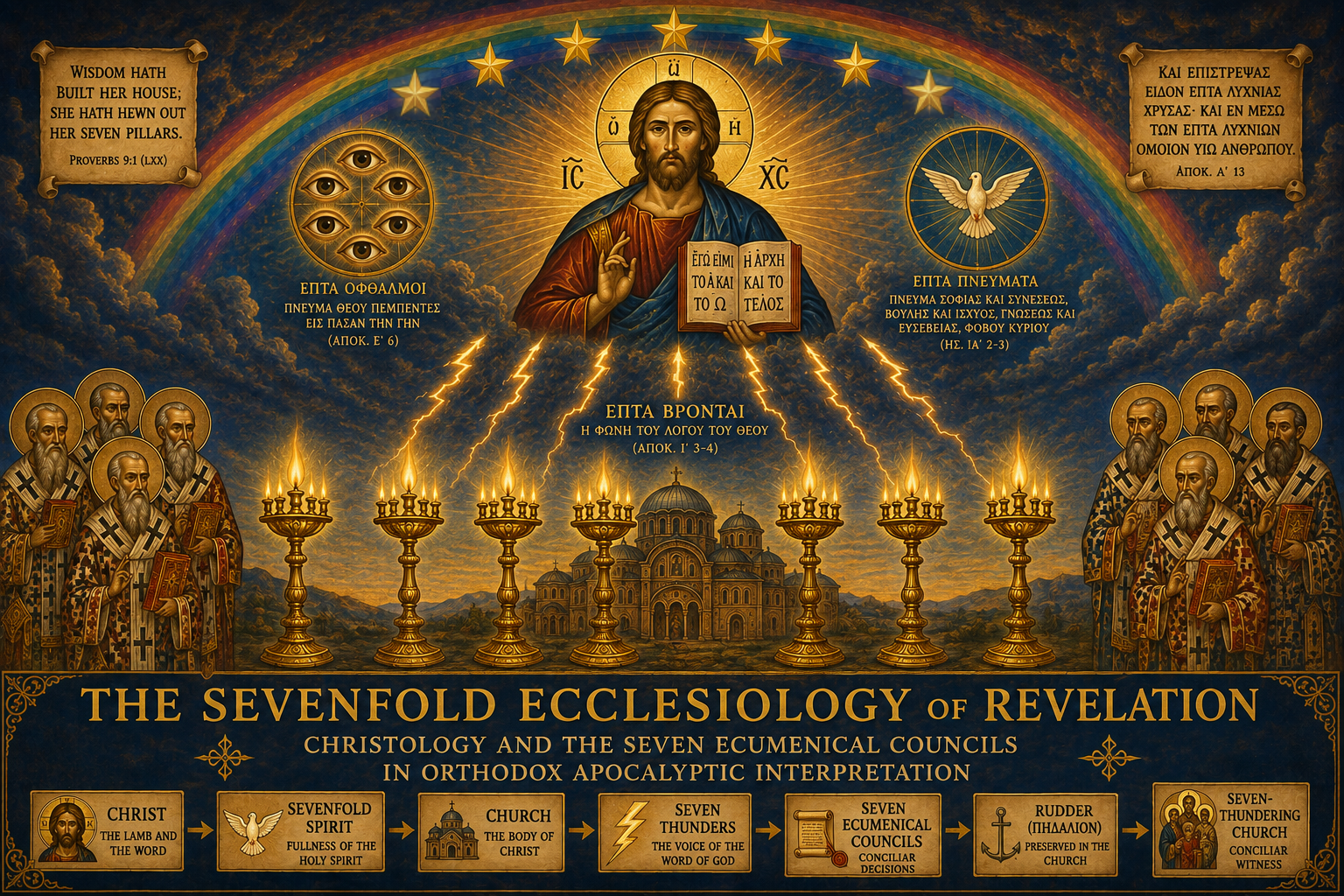
By Jonathan Photius – The NEO-Historicism Research Project
Introduction
“Wisdom hath built her house; she hath hewn out her seven pillars.”
— Proverbs 9:1 (LXX)
Few books of Holy Scripture are as saturated with symbolic sevens as the Apocalypse of St. John. Seven Churches, seven lampstands, seven stars, seven Spirits before the throne, seven seals, seven trumpets, seven thunders, seven horns, seven eyes, seven bowls, and other recurring septenary images weave themselves throughout the prophetic vision. Modern interpreters often examine these symbols independently or understand the number seven principally as an expression of completeness or perfection. While such observations are not without value, they leave another question largely unexplored: might some of Revelation’s recurring sevens participate in a common Christological and ecclesiological pattern?
A remarkable stream within Orthodox interpretation of the Apocalypse suggests precisely such a possibility.
Patriarch Anthimos of Jerusalem (1856), John Lindios (1791), and the twentieth-century monk Antipas of Patmos approach Revelation from different historical contexts, yet each develops aspects of its sevenfold imagery in relation to Christ and His Church. Anthimos interprets the Seven Spirits of God through Isaiah’s prophecy of the sevenfold gifts resting upon the Messiah (Isa. 11:2–3). Lindios goes considerably further, associating numerous sevenfold symbols—including the Seven Churches, Seven Lampstands, Seven Stars, Seven Eyes, Seven Horns, and Seven Thunders—with the Seven Ecumenical Councils and their preservation of the Orthodox faith. Antipas likewise interprets the Seven Spirits through Isaiah while developing additional connections through the Seven Lamps, the sevenfold radiance of the rainbow surrounding the mighty Angel, and the “thundering decrees” of the local and Ecumenical Councils. In modern Orthodox exegesis, Fr. Daniel Sysoev provides a further witness by likewise associating the Seven Thunders of Revelation 10 with the Seven Ecumenical Councils.
These interpretations do not constitute a uniform exegetical system, nor do these commentators interpret every apocalyptic seven identically. The significance lies instead in their convergence. Read together, they suggest a theological movement extending from Christ, to the sevenfold Spirit, to the Church, and finally to the Church’s conciliar witness in history.
The Christological starting point is essential. Before the Lamb opens a single seal, Revelation first reveals the Lamb. The Apocalypse presents Jesus Christ as the Lion of Judah and the Lamb who was slain, the eternal Word who became flesh, true God and true Man. The prophetic history that follows therefore cannot be separated from the identity of the One who opens and governs it. Christology precedes chronology.
The purpose of this study is to recover this neglected strand of Orthodox interpretation and examine whether its recurring associations disclose what may appropriately be called a sevenfold ecclesiology of Revelation. The argument is not that every seven in the Apocalypse signifies the Seven Ecumenical Councils, nor that the commentators considered here taught an identical symbolic scheme. Rather, their interpretations reveal a recurring relationship between Revelation’s sevenfold imagery, the fullness of the Holy Spirit in Christ, and the historical preservation of the apostolic confession through the conciliar life of the Church.
Seen from this perspective, Proverbs’ image of Divine Wisdom building a house upon seven pillars becomes an especially fitting point of departure. The question before us is whether the Apocalypse itself presents a corresponding vision: the fullness of Christ manifested in His Church and preserved throughout history through a sevenfold conciliar witness.
I. The Seven Spirits Rest Upon Christ
The Christological foundation of Revelation’s sevenfold symbolism is especially evident in Patriarch Anthimos of Jerusalem’s commentary on Revelation 5. Interpreting the Lamb standing “as though it had been slain” (Rev. 5:6), Anthimos insists upon the unity of Christ’s divine Person and the reality of His two natures. The Lion of Judah signifies Christ’s divine and royal power, while the Lamb reveals His voluntary sacrifice according to the flesh. The Apocalypse thus presents the one Lord Jesus Christ as perfect God and perfect Man.
Anthimos reinforces this distinction in his explanation of the sealed book. Christ opens the book because He is “the pre-eternal God” who “afterward became man for the salvation of the world.” When the Lamb receives the book from the One seated upon the throne (Rev. 5:7), Anthimos explains that according to His divinity the Son already possesses everything belonging to the Father and the Holy Spirit; according to His humanity, however, He is said to receive the book and all authority. The language of “receiving” therefore pertains to the incarnate economy, not to any deficiency in the eternal Logos.
This Christological framework governs Anthimos’ interpretation of the Seven Eyes and Seven Spirits in Revelation 5:6. Rather than treating the number seven merely as a symbol of completeness, he explicitly grounds the imagery in Isaiah’s prophecy concerning the Messiah:
Καὶ ἀναπαύσεται ἐπ’ αὐτὸν πνεῦμα τοῦ Θεοῦ, πνεῦμα σοφίας καὶ συνέσεως, πνεῦμα βουλῆς καὶ ἰσχύος, πνεῦμα γνώσεως καὶ εὐσεβείας· πνεῦμα φόβου Θεοῦ πληρώσει αὐτόν.
(Isaiah 11:2–3, Septuagint)“And the Spirit of God shall rest upon Him: the Spirit of wisdom and understanding, the Spirit of counsel and might, the Spirit of knowledge and godliness; and the Spirit of the fear of God shall fill Him.”
Commenting directly on Revelation 5:6, Anthimos writes:
“The seven eyes are the seven gifts of the Holy Spirit dwelling in His humanity, which Isaiah foretold, saying: ‘The Spirit of wisdom and understanding, the Spirit of knowledge, counsel, might, godliness, and the fear of God shall rest upon Him.'”
The significance of Anthimos’ interpretation lies precisely in where he locates the sevenfold gifts: in the humanity of the Incarnate Word. The Seven Eyes of the Lamb are therefore Christological before they become ecclesiological. Revelation identifies the slain and risen Lamb as the Messiah upon whom Isaiah’s promised Spirit rests in fullness.
This establishes the theological starting point for the sevenfold ecclesiology developed in the sections that follow. The Church does not originate the gifts represented by Revelation’s sevenfold imagery; she receives them through union with Christ. The Seven Spirits belong first to the Head before their operations become manifest in the Body.
II. From Christ to the Church: The Sevenfold Spirit Becomes Ecclesial
If the Seven Spirits rest first upon Christ, the Apocalypse does not leave this sevenfold fullness isolated in the Head. The same Holy Spirit who rests upon the Incarnate Word gives life to His Body, the Church. The movement from Christology to ecclesiology is therefore not a change of subject but the unfolding of the same mystery: what belongs to Christ by nature and in fullness is communicated by grace to those united to Him.
This movement is already implicit in Isaiah 11. The Spirit of wisdom, understanding, counsel, might, knowledge, godliness, and the fear of God rests upon the Messiah. In the New Testament, the same Spirit is poured out upon the Apostles at Pentecost, constituting the Church as the Spirit-bearing Body of Christ and empowering her witness throughout history. Revelation’s sevenfold imagery can therefore be read within this Christological and ecclesial movement: the Spirit rests upon Christ and works through His Church.
The Apocalypse itself reinforces this relationship. The Seven Spirits appear before the throne (Rev. 1:4; 4:5), as the Seven Lamps of fire burning before God (Rev. 4:5), and as the Seven Eyes of the slain Lamb “sent forth into all the earth” (Rev. 5:6). The imagery moves outward: from the throne, through the Lamb, and into the world. The sevenfold Spirit is not static but missionary, illuminating and empowering the Church’s testimony to Christ among the nations.
This is especially important for understanding the ecclesial significance of Revelation’s later sevenfold symbols. The Church does not possess a light, wisdom, or authority independent of Christ. She bears what she has received. Just as a lampstand does not generate the flame it carries, the Church does not create the truth she proclaims. Her vocation is to receive, preserve, embody, and transmit the apostolic confession entrusted to her.
The movement may therefore be summarized simply:
Christ → Sevenfold Spirit → Church
This provides the theological bridge to the historical and conciliar dimension examined in the sections that follow. If the sevenfold fullness belongs first to Christ and is communicated to His Body through the Holy Spirit, the next question is how that Spirit-guided witness becomes manifest within the Church’s history.
III. The Sevenfold Gifts Manifest in the Seven Ecumenical Councils
The movement from Christ to His Church raises a further question. If the sevenfold Spirit foretold by Isaiah rests upon Christ and works through His Body, might the Seven Ecumenical Councils be understood as historical manifestations of these same Spirit-given operations?
Neither Anthimos nor Antipas explicitly assigns each of Isaiah’s seven gifts to a particular Ecumenical Council. Nor does Lindios provide such a one-to-one correspondence. The following proposal should therefore be understood as a theological synthesis, not as an interpretation explicitly taught by any one of these commentators. Nevertheless, when Anthimos’ Christological reading of Isaiah 11 is placed alongside Lindios’ repeated identification of Revelation’s sevenfold symbols with the Councils and Antipas’ conciliar imagery, an illuminating correspondence emerges.
| Isaiah 11 | Ecumenical Council | Theological Correspondence |
| Wisdom | Nicaea I (325) | Confessed the eternal divinity of the Son against Arianism and established the Christological foundation upon which the subsequent Councils would build. |
| Understanding | Constantinople I (381) | Clarified the Church’s confession of the Holy Trinity and the divinity of the Holy Spirit. |
| Counsel | Ephesus (431) | Defended the unity of Christ’s Person and the title Theotokos, safeguarding the mystery of the Incarnation. |
| Might | Chalcedon (451) | Confessed Christ as one Person in two natures, without confusion, change, division, or separation. |
| Knowledge | Constantinople II (553) | Refined the Church’s Christological language against interpretations that threatened the unity of the Incarnate Word. |
| Godliness | Constantinople III (680–681) | Defended Christ’s two natural wills and energies, preserving the fullness of both His divinity and humanity. |
| Fear of God | Nicaea II (787) | Restored the holy icons and grounded their veneration in reverence for the reality of the Incarnation. |
The correspondence should not be pressed as though each gift belonged exclusively to one Council. Every Ecumenical Council manifests wisdom, understanding, counsel, might, knowledge, godliness, and the fear of God. The value of the comparison is instead typological and theological: the sevenfold operations attributed by Isaiah to the Spirit resting upon the Messiah find a striking historical reflection in the Church’s sevenfold conciliar defense of the mystery of Christ.
This is particularly evident in the Christological character of the Councils themselves. From Nicaea’s confession that the Son is consubstantial with the Father to Nicaea II’s defense of the depictability of the Word made flesh, the conciliar tradition repeatedly returns to the same fundamental question: Who is Jesus Christ? The Seven Councils may therefore be viewed as seven historical witnesses to the one apostolic confession of the Incarnate Word.
The proposed correspondence can thus be summarized:
Christ → Sevenfold Spirit → Church → Seven Ecumenical Councils
This synthesis prepares us to examine the strongest primary-source evidence for such a conciliar reading of Revelation: John Lindios, who explicitly and repeatedly associates the Apocalypse’s recurring sevenfold symbols with the Seven Ecumenical Councils.
IV. John Lindios and the Sevenfold Ecclesiology of the Apocalypse
Among the Orthodox commentators considered in this study, John Lindios (1791) provides the most extensive explicit association between Revelation’s recurring sevenfold symbolism and the Seven Ecumenical Councils. His importance lies not in identifying a single apocalyptic symbol with the Councils, but in returning to this interpretation repeatedly across the Apocalypse. The Seven Churches, Seven Golden Lampstands, Seven Stars, Seven Eyes, Seven Horns, and Seven Thunders become complementary expressions of the Church’s conciliar witness to Christ.
The Seven Churches
Lindios first identifies the Seven Churches of Asia with the Seven Ecumenical Councils themselves. Explaining Revelation 1, he writes:
“These, then, are the Seven Holy Ecumenical Councils, which were prophetically intimated by the blessed Evangelist through the Seven Churches of Asia.”
(Lindios, Commentary on Revelation, p. 83.)
Elsewhere he expands the symbolism:
“Through these holy Churches—that is, through the Holy Ecumenical Councils—the heavenly doctrines were distributed like rays of the spiritual Sun, Christ, unto the four corners of the inhabited world.”
(Lindios, p. 80.)
This interpretation transforms the Seven Churches from merely local congregations into prophetic images of the Church’s universal doctrinal witness. The Councils become the historical means by which the light of Christ is carried to the ends of the earth.
The Seven Golden Lampstands
Lindios immediately extends this symbolism to the Seven Golden Lampstands:
“Those whom he previously mentioned through the Seven Churches, he called the Seven Holy Ecumenical Councils, whom he also previously likened to the Seven Golden Lampstands.”
(Lindios, pp. 107–108.)
The imagery is particularly significant. Lampstands do not generate light; they bear it. Christ alone is the true Light and the “Sun of Righteousness.” The Seven Ecumenical Councils therefore function as the golden lampstands that preserve and manifest the light of apostolic doctrine. Their role is not to introduce new revelation, but faithfully to hold forth the light received from Christ Himself.
The Seven Stars
The same ecclesial symbolism continues with the Seven Stars held in Christ’s right hand. Lindios explains:
“He named them stars because of the light-bearing, heavenly, and unerring character of the teaching of the Holy Spirit within them.”
(Lindios, pp. 107–108.)
The stars signify the Seven Ecumenical Councils because their doctrine reflects the light of heaven itself. Their position in Christ’s right hand signifies that the Orthodox confession proclaimed through the Councils remains secure under His divine protection. Their authority is not derived from imperial power or ecclesiastical prestige, but from their participation in the truth of the Incarnate Word.
The Seven Eyes
Lindios’ interpretation reaches remarkable theological depth in his exposition of Revelation 5:6:
“The Seven Eyes of the Lamb are these same Ecumenical teachings of the holy Fathers, through which the Catholic Church of Christ beholds the divine beauties of the sacred dogmas of the Evangelical and Apostolic grace.”
(Lindios, Commentary on Revelation 5:6.)
This is one of the most profound images in his commentary. The Seven Eyes signify the Church’s spiritual vision. Through the doctrinal teaching of the holy Fathers assembled in Council, the Church beholds the beauty of evangelical truth and remains safeguarded from deception. The conciliar tradition thus becomes the Church’s means of seeing rightly.
The Seven Horns
Immediately following his interpretation of the Seven Eyes, Lindios identifies the Seven Horns with the authoritative witness of the Councils:
“The Seven Horns of the Lamb signify the acts against the heretics by the Seven Ecumenical Councils, the common and particular teachings produced on behalf of the right faith, which shall then serve for the condemnation of every heretical false belief and godlessness.”
(Lindios, Commentary on Revelation 5:6.)
Throughout Holy Scripture the horn symbolizes strength, authority, and victory. Lindios therefore understands the Seven Horns as the victorious power of Christ exercised through the Ecumenical Councils. They represent the Church’s decisive defense of the apostolic faith against successive waves of heresy.
The Seven Thunders: The Councils Unfolding in Church History
Lindios’ conciliar interpretation reaches its fullest historical expression in Revelation 10. The Seven Thunders are not merely another symbolic correspondence with the Seven Ecumenical Councils. They represent doctrinal events that John was permitted to hear prophetically but forbidden to record because their meaning would become manifest only “in due time” within the historical life of the Church.
Lindios situates the vision within the transformation of the Roman world under Constantine the Great. The mighty Archangel cries from heaven, while Constantine, empowered from above, triumphs through the Cross and inaugurates the Christian imperial order in which the great doctrinal controversies and Ecumenical Councils will subsequently arise. Commenting on the loud voice of Revelation 10:3, Lindios writes:
“By the ‘loud voice’ with which the Archangel cried, we must understand a certain active operation possessing an inherent power, which the power from on high, through the Archangel, placed within the heart of that God-like emperor, so that, as though through a strong and loud voice, there might be heard throughout the whole world both the brilliant and glorious trophies of that universal victory through the Cross and the sacred doctrines of piety, just as the course of time subsequently demonstrated, according to the prophetic prediction of the blessed attendant: ‘And when he cried,’ it says, ‘the seven thunders uttered their own voices.’”
(Lindios, p. 392.)
The expression “just as the course of time subsequently demonstrated” is crucial. Lindios reads the Apocalypse retrospectively through the unfolding history of Christianity. The prophecy is given beforehand, but its correspondence becomes visible through subsequent events.
On the following page he identifies the Seven Thunders explicitly:
“Then, in due time, they began to utter their own voices of evangelical grace, and the God-delivered doctrines—the Seven Thunders of the Seven Ecumenical and local sacred Councils—were proclaimed with a thunderous voice throughout the whole inhabited world, as they were assembled in various places and cities according to imperial decree.”
(Lindios, p. 393.)
The historical character of the interpretation should not be overlooked. Lindios does not imagine the Seven Thunders as sounding all at once in the apostolic age. “Then, in due time, they began” to speak. Their voices emerge within history as the Church confronts successive doctrinal crises and gathers in council to confess the apostolic faith. The Seven Thunders are thus the God-delivered doctrines proclaimed through the Seven Ecumenical Councils and the associated local synods.
Lindios then turns to the command of Revelation 10:4: “Seal up the things which the seven thunders uttered, and do not write them.” His explanation makes the historical character of his exegesis even more explicit:
“Behold here also both the profound wisdom of the All-Holy Spirit and the most compassionate dispensation of God. For those things which, after the passage of so many years, were destined in due time to come to pass in the Church of Christ, these the Holy Spirit revealed in minute detail to the blessed John. And what were these things? The impious and godless doctrines put forth by the heretics, and the pious refutations made by the Seven Ecumenical and the other local holy Councils, together with the God-delivered teachings of the Holy Gospel.”
(Lindios, pp. 393–394.)
This is one of Lindios’ clearest statements of an ecclesial-historical interpretation of prophecy. Revelation anticipates events that would occur “after the passage of so many years” and “in due time … in the Church of Christ.” Those events are not primarily wars, dynasties, or political revolutions, but doctrinal conflicts within Christian history: heresies arise, and the Church answers them through the Seven Ecumenical Councils and other holy synods.
This also explains why John was commanded to seal the voices of the Seven Thunders. Lindios continues:
“Since it was not profitable for the Christians of that time to know all these things, lest they should be thrown into confusion and despair by the multitude of heresies that were to arise and by the difficulties involved in the sacred refutations, for this reason the blessed John was commanded by the heavenly voice to seal these things and not to write them.”
(Lindios, Commentary on Revelation p. 394.)
The Seven Thunders are therefore not sealed because their meaning must remain permanently unknowable. Their contents are withheld from the Christians of John’s own age because they concern controversies belonging to later centuries of Church history. To reveal beforehand the multitude of future heresies and the struggles required to refute them would, according to Lindios, have risked confusion and despair among the early Christians.
Most strikingly, Lindios explains how the meaning of the sealed prophecy would eventually become known:
“It was sufficient that the events themselves, coming to pass in due time, should demonstrate their exact truth to the pious Christians then living: that they should drive away the wicked and dark opinions of the heretics as harmful, while embracing and preserving the light-bearing and saving refutations of the Holy Fathers and the sacred canons as saving to the soul.”
(Lindios, p. 394.)
Here Lindios articulates an important principle of historical interpretation: the unfolding of the events themselves discloses the meaning and accuracy of the prophecy. John hears the Seven Thunders prophetically; their contents are sealed from his contemporaries; centuries pass; heresies arise; Councils assemble; the Fathers formulate their “light-bearing and saving refutations”; and Christians living amid those events are able to recognize what the Apocalypse had foretold.
The Seven Thunders therefore bring Lindios’ sevenfold ecclesiology to a remarkable culmination. The Seven Churches prophetically intimate the Seven Ecumenical Councils; the Seven Lampstands signify their illumination; the Seven Stars their Spirit-guided teachers; the Seven Eyes their doctrinal vision; and the Seven Horns their power against heresy. With the Seven Thunders, however, the symbolism becomes explicitly historical: the Councils themselves sound successively through the centuries as the Church confronts heresy and confesses the truth of Christ.
For Lindios, then, Revelation does not merely predict the external events surrounding Christianity. It prophetically unveils the doctrinal history of the Church. The rise of heresy, the gathering of the Councils, the refutations of the Fathers, and the preservation of the sacred canons all belong within the prophetic horizon of the Apocalypse. The Seven Thunders are the conciliar voice of that history—heard beforehand by John, sealed from his contemporaries, and disclosed “in due time” through the life of the Church.
A Unified Sevenfold Ecclesiology
When Lindios’ commentary is considered as a whole, a remarkable theological pattern emerges. The recurring “sevens” of Revelation are not isolated symbols but interconnected expressions of the Church’s conciliar life.
| Symbol | Lindios’ Interpretation |
| Seven Churches | Prophetic figures of the Seven Ecumenical Councils |
| Seven Golden Lampstands | The Councils bearing the light of Christ to the world |
| Seven Stars | The heavenly and Spirit-guided teaching of the Councils, held in Christ’s right hand |
| Seven Eyes | The doctrinal vision of the holy Fathers through which the Church beholds divine truth |
| Seven Horns | The victorious authority of the Councils over heresy |
| Seven Thunders | The universal proclamation of Orthodox doctrine through the Councils |
Taken together, these interpretations demonstrate that Lindios’ association of Revelation’s sevenfold imagery with the Seven Ecumenical Councils is neither incidental nor confined to a single passage. The pattern recurs across widely separated portions of the Apocalypse. Churches, Lampstands, Stars, Eyes, Horns, and Thunders each disclose a different aspect of the Church’s conciliar witness: its universality, illumination, heavenly teaching, doctrinal perception, authority over heresy, and proclamation of the apostolic faith.
Lindios therefore provides the strongest explicit primary-source foundation for speaking of a sevenfold ecclesiology of Revelation rooted in Christ and manifested through the conciliar life of the Orthodox Church. His comprehensive interpretation also provides an important point of comparison with Monk Antipas of Patmos, whose later commentary develops the conciliar imagery of the Apocalypse in a distinctive direction.
V. Monk Antipas and the Living Voice of the Sevenfold Church
If John Lindios provides the most extensive explicit association between Revelation’s recurring sevens and the Seven Ecumenical Councils, Monk Antipas of Patmos develops the conciliar theme through a different but complementary series of images. Writing in the twentieth century, Antipas connects Revelation’s sevenfold symbolism with divine illumination, dogmatic proclamation, the radiant imagery of the rainbow, and the continuing conciliar witness of the Orthodox Church.
Commenting on Revelation 4:5, Antipas interprets the Seven Lamps burning before the throne through the same Isaianic sevenfold Spirit encountered earlier in Anthimos:
“The seven lamps burning before the throne symbolize the seven Spirits of God: the Spirit of wisdom, understanding, counsel, might, knowledge, piety, and the fear of God.”
Antipas then explains the lightnings, voices, and thunders proceeding from the throne:
“The lightnings represent the illuminations of divine knowledge that God grants to the saints. The voices signify the teachings that proceed from those divine inspirations. The thunders represent the dogmatic principles and authoritative doctrinal declarations, which are made known to us through the thunderous decrees of the local and Ecumenical Councils.”
The progression is significant: divine illumination → ecclesial teaching → dogmatic proclamation. Heavenly thunder thus acquires an ecclesial expression in the authoritative doctrinal declarations of the Councils. Antipas is not merely associating thunder with power or judgment; he specifically hears in it the dogmatic voice of the conciliar Church.
The Seven-Colored Rainbow and the Sevenfold Confirmation of the Church
Antipas extends this sevenfold imagery in his exposition of the heavenly rainbow. On page 61 he explicitly draws attention to its seven colors:
“the rainbow, bearing seven colors, symbolizing the number of the angelic orders, corresponding in number to the Seven Spirits of God sent forth into all the earth.”
(Antipas, p. 61.)
Antipas does not explicitly identify the seven colors themselves with the Seven Ecumenical Councils, and that distinction must be maintained. His significance lies instead in recognizing yet another sevenfold manifestation of divine radiance and relating it numerically to the Seven Spirits of God. The imagery is especially suggestive when considered alongside his later treatment of the Seven Thunders: sevenfold light of Christ the Sun of Righteousness and sevenfold voice become complementary features of his apocalyptic theology.
Immediately afterward, as Antipas begins his exposition of the seals, the sevenfold pattern becomes explicitly historical and ecclesial. He identifies the White Horse with:
“the Catholic Apostolic Church, already prepared and fully ordered through the confirmation of her doctrines and commandments by the Seventh Ecumenical Council.”
(Antipas, p. 62.)
Antipas describes this doctrinal ordering with the striking expression “this sevenfold confirmation” (τῆς ἑπταδικῆς ταύτης ἐπικυρώσεως). The completion of the Seven Ecumenical Councils therefore marks, within his historical interpretation of Revelation, a decisive confirmation of the Church’s doctrinal order.
Christ and the Seven Thunders
Antipas’ conciliar interpretation reaches its clearest expression in Revelation 10. The Christological setting is crucial. Commenting on the mighty Angel descending from heaven, clothed with a cloud, crowned with the rainbow, His face shining like the sun and His feet like pillars of fire, Antipas identifies Him explicitly as:
“the incarnate Christ Himself.”
(Antipas, p. 107.)
The Seven Thunders that follow therefore appear within an explicitly Christological vision. The mighty Angel is the Incarnate Word; He cries with the voice of a lion; and the Seven Thunders answer His voice.
Antipas makes the meaning explicit on page 111:
“The thunders signify the decisions of the Seven Ecumenical Councils, which followed the voice of the Word of God, in order to demonstrate to us their authority and their incapacity for alteration or modification.”
(Antipas, p. 111.)
The phrase “which followed the voice of the Word of God” is especially important. The Seven Councils do not possess an independent revelation or authority detached from Christ. Their thunder follows His voice. Conciliar authority is therefore fundamentally Christological: the Councils speak authoritatively because they preserve and confess the truth revealed in the Word of God.
Antipas then interprets John’s command to seal what the Seven Thunders had spoken:
“John was commanded not to write what the Seven Thunders spoke, but simply to seal it, in order to teach us spiritually that these are precisely those commandments contained in the Rudder (Πηδάλιον) of the Church, so that their repetition was unnecessary.”
(Antipas, p. 111.)
The sealing of the Seven Thunders therefore does not signify the disappearance of their testimony. Antipas understands their words as already received and preserved within the canonical life of the Church. His explicit reference to the Πηδάλιον (Rudder) makes the interpretation concrete: the decisions symbolized by the Seven Thunders are embodied in the Church’s received conciliar and canonical tradition.
The connection is consequently stronger than a numerical correspondence between seven thunders and seven councils. Antipas establishes a theological sequence:
The Word of God speaks → the Seven Thunders answer → the Seven Thunders signify the Seven Ecumenical Councils → their decisions are sealed against alteration → their commandments are preserved in the Rudder of the Church.
The Church’s conciliar voice is thus presented as an historical echo of the voice of Christ.
The “Seven-Thundering Orthodox Church”
Antipas finally gathers this imagery into an extraordinary ecclesiological expression. Near the conclusion of Revelation 10, addressing his Orthodox readers, he calls them:
τέκνα γνήσια τῆς ἑπταβρόντου ὀρθοδόξου ἐκκλησίας
“true children of the Seven-Thundering Orthodox Church.”
(Antipas, pp. 114–115.)
The expression ἑπτάβροντος—literally “seven-thundering” or “sevenfold-thundering”—is particularly significant. Antipas no longer merely identifies the Seven Thunders with the Seven Ecumenical Councils; he incorporates the symbolism into his description of the Orthodox Church herself. She is the Seven-Thundering Church because the conciliar confession represented by the Seven Thunders continues to resound within her doctrinal and canonical life.
The context makes the expression still more remarkable. Antipas exhorts the “true children” of this Seven-Thundering Orthodox Church to become instruments for fulfilling the command of Revelation 10:11:
“You must prophesy again.”
He specifically connects this renewed prophetic witness with translating and disseminating the interpretation of the Apocalypse, writing that it should be translated into other languages and “above all into English.” As the sentence continues onto page 115, Antipas understands this work as part of the Church’s responsibility to preserve and proclaim the Orthodox faith amid pressures toward ecclesiastical union.
The Seven-Thundering Church is therefore not merely a Church that received the Seven Councils in the past. She remains a witnessing Church. The conciliar confession received from the Fathers is to be preserved and proclaimed within history.
Taken together, these passages reveal the distinctiveness of Antipas’ sevenfold ecclesiology. The Seven Spirits are represented by the burning Lamps; divine illumination gives rise to teaching; teaching culminates in the thunderous dogmatic decrees of the Councils; the rainbow displays a sevenfold radiance corresponding numerically to the Seven Spirits; the Church reaches a decisive doctrinal ordering through the “sevenfold confirmation” of the Seventh Ecumenical Council; the incarnate Christ speaks; the Seven Thunders follow the voice of the Word of God; those Thunders explicitly signify the decisions of the Seven Ecumenical Councils; their commandments are preserved in the Rudder; and the Orthodox Church herself is called “Seven-Thundering.”
Antipas therefore does more than associate individual occurrences of the number seven with the Councils. He presents a theological movement from divine illumination to ecclesial confession, centered upon Christ and historically embodied in the conciliar life of the Church. The voice originates in the Word of God; the Thunders answer that voice; and the Church preserves and continues their testimony.
A Contemporary Orthodox Witness
The identification of the Seven Thunders with the Seven Ecumenical Councils is not confined to Antipas or to the eighteenth-century commentary of John Lindios. It also appears in modern Orthodox interpretation. Fr. Daniel Sysoev, commenting on Revelation 10, likewise identifies the Seven Thunders with the Seven Ecumenical Councils.
Sysoev does not develop the extensive network of sevenfold symbols found in Lindios, nor the broader symbolic sequence developed by Antipas. His importance here is more limited but nevertheless noteworthy. The recurrence of the Seven Thunders–Seven Councils identification in a commentator separated from Lindios by more than two centuries demonstrates that this interpretation was not confined to one author or a single period of Orthodox exegesis.
Sysoev therefore provides a useful contemporary corroboration of a reading already developed much more extensively by Lindios and Antipas: the thunderous voices of Revelation may be heard ecclesially as the dogmatic witness of the Seven Ecumenical Councils.
VI. The Sevenfold Ecclesiology of Revelation: A Theological Synthesis
The preceding interpretations reveal a theological pattern that becomes visible only when these Orthodox commentators are read together. Anthimos establishes the Christological foundation of the sevenfold imagery in the Spirit resting upon the Incarnate Word. Lindios gives that imagery an explicitly conciliar expression across numerous symbols of the Apocalypse. Antipas develops the relationship between divine illumination, ecclesial teaching, and conciliar proclamation, while the later witness of Daniel Sysoev confirms the persistence of the Seven Thunders–Seven Councils interpretation within modern Orthodox exegesis.
Considered together, these witnesses suggest that Revelation’s recurring sevens can be understood as interconnected expressions of the relationship between Christ, the Holy Spirit, and the Church.
The movement begins with Christ. The Seven Spirits rest upon the Lamb in fulfillment of Isaiah’s prophecy concerning the Messiah. The sevenfold imagery therefore has a Christological center before it acquires an ecclesiological expression. The Church does not originate this fullness; she receives and manifests what belongs first to her Head.
This movement becomes historical in the Church’s conciliar witness. The Ecumenical Councils do not replace Christ’s presence or add a new revelation to the apostolic deposit. Rather, they preserve, articulate, and defend the confession entrusted to the Church. In Lindios especially, the recurring sevens of the Apocalypse become different expressions of this one conciliar reality:
- The Seven Spirits reveal the fullness of Christ.
- The Seven Lamps illuminate His Church.
- The Seven Churches manifest His historical Body.
- The Seven Stars signify heavenly and Spirit-guided teaching.
- The Seven Eyes behold the beauty of apostolic doctrine.
- The Seven Horns defend the Orthodox confession.
- The Seven Thunders proclaim that confession to the world.
The Seven Ecumenical Councils may therefore be understood as a historical manifestation of this sevenfold witness—not because every apocalyptic seven must signify the Councils, nor because every commentator makes the same identification, but because the conciliar life of the Church repeatedly appears within this Orthodox exegetical tradition as the historical preservation of the truth revealed in Christ.
This synthesis also clarifies why the Councils belong fundamentally to Christology. Their central controversies concerned the identity of Jesus Christ and the consequences of the Incarnation: His relation to the Father, the divinity of the Holy Spirit, the unity of His Person, His divine and human natures, His natural wills and energies, and ultimately the depictability of the Word made flesh. From Nicaea I to Nicaea II, the Councils preserved the Church’s confession of the Theanthropos—true God and true Man.
The Apocalypse can therefore be read not merely as a history of events, but as a history of confession. Its historical drama unfolds around the identity of Christ and the testimony borne to Him by His Church. Before the seals disclose the conflicts of history, the Lamb stands at the center of the throne. The history He opens is inseparable from the testimony to who He is.
Proverbs 9:1 provides a fitting theological image for this synthesis:
“Wisdom has built her house; she has hewn out her seven pillars.”
The present study does not claim that Proverbs 9:1 constitutes an explicit prophecy of the Seven Ecumenical Councils. Yet within the theological pattern traced above, its imagery acquires a striking resonance. Christ is the Wisdom of God; the Church is His house; and the Seven Councils stand historically as pillars defending the apostolic confession upon which that house remains established.
The resulting movement may therefore be expressed simply:
Christ → Sevenfold Spirit → Church → Conciliar Witness
The sevenfold ecclesiology of Revelation is ultimately Christological. Its center is not the number seven, nor even the Councils considered in themselves, but Jesus Christ confessed by His Church. The recurring sevens become significant insofar as they bear witness to the fullness of His Spirit, the life of His Body, and the preservation of His truth throughout history.
Conclusion
The evidence examined in this study reveals a neglected trajectory within Orthodox interpretation of the Apocalypse. Patriarch Anthimos of Jerusalem, John Lindios, Monk Antipas of Patmos, and, more recently, Fr. Daniel Sysoev do not present an identical exegetical system. Yet their commentaries preserve a striking convergence between Revelation’s sevenfold imagery, the fullness of the Holy Spirit, the Church, and the Seven Ecumenical Councils.
The significance of this convergence is not primarily numerical. The Seven Ecumenical Councils matter because they preserved the Church’s confession of Jesus Christ. From the consubstantial Son confessed at Nicaea to the depictability of the Incarnate Word defended at Nicaea II, the conciliar history of the Church is fundamentally the history of her testimony to the God-Man (i.e. the “man-child” of Rev. 12). The Councils therefore belong within the Christological world of the Apocalypse: the world of the Lion and the Lamb, the Word of God and the Testimony of Jesus, the Son of Man and the One who rules the nations.
This study has not argued that every seven in Revelation signifies the Seven Ecumenical Councils, nor that the commentators examined here assign identical meanings to every symbol. Anthimos’ Seven Eyes are the seven gifts of the Spirit resting upon Christ’s humanity; Lindios gives numerous sevenfold symbols an explicitly conciliar interpretation; Antipas develops the imagery through the Seven Lamps, the seven-colored rainbow, and the thunderous dogmatic voice of the Church; and Sysoev provides a later witness to the identification of the Seven Thunders with the Seven Councils. Their differences should be preserved rather than artificially harmonized. Yet precisely within those differences, a coherent theological trajectory emerges.
That trajectory may appropriately be called a sevenfold ecclesiology of Revelation. It begins not with the Councils but with Christ. The sevenfold Spirit rests upon the Messiah; the same Spirit gives life to His Body; and within history the Church bears, defines, and defends the apostolic testimony entrusted to her. The Seven Ecumenical Councils stand as the great historical monuments of that conciliar witness.
This perspective also suggests a different way of approaching the historical interpretation of the Apocalypse. Church history is not merely a sequence of external events to be matched with prophetic symbols. At its deepest level, it is the history of confession: the struggle to preserve and proclaim the identity of Jesus Christ against every distortion of the apostolic faith. Christology therefore does not merely accompany the interpretation of prophetic history. Christology governs it.
The words of Proverbs with which this study began thus acquire a fitting resonance:
“Wisdom hath built her house; she hath hewn out her seven pillars.”
— Proverbs 9:1 (LXX)
The Apocalypse reveals that house not as an abstraction, but as the living Church of the Incarnate Word—illumined by the Holy Spirit, established in the apostolic faith, and bearing through history the testimony of Jesus Christ. Its sevenfold imagery directs us ultimately beyond the symbols themselves to the One from whom their meaning proceeds.
Before the Lamb opens history, Revelation first reveals the Lamb.
© 2026 by Jonathan Photius
Bibliography
Anthimos of Jerusalem, Patriarch. Ἑρμηνεία εἰς τὴν Ἱερὰν Ἀποκάλυψιν τοῦ Ἁγίου Ἐνδόξου καὶ Πανευφήμου Ἀποστόλου καὶ Εὐαγγελιστοῦ Ἰωάννου τοῦ Θεολόγου [Interpretation of the Holy Apocalypse of the Holy, Glorious, and All-Renowned Apostle and Evangelist John the Theologian]. Published by order of Patriarch Kyrillos of Jerusalem. Jerusalem: Printing House of the Holy Sepulchre, under the direction of I. Lazaridis, 1856.
Antipas of Patmos, Monk. Ἡ Ἑπτάφωτος Λυχνία, ἤτοι Ἑρμηνεία τῆς Ἱερᾶς Ἀποκαλύψεως Ἰωάννου τοῦ Θεολόγου [The Seven-Lighted Lamp, or, An Interpretation of the Holy Apocalypse of John the Theologian]. Edited and published by G. K. Zervos. Athens: Printing House of I. B. Vartsos, 1923.
Lindios, John, Archbishop of Myra in Lycia. Ἡ Θεία καὶ Ἱερὰ Ἀποκάλυψις Ἰωάννου τοῦ Θεολόγου [The Divine and Holy Apocalypse of John the Theologian]. Monastery of Iviron, Mount Athos, 1791.
Sysoev, Daniel, Priest. Explanation of the Apocalypse. New Jersey: Daniel Sysoev Inc., 2017
Appendix A
Sevenfold Symbols in the Orthodox Commentators
| Symbol | Anthimos | Lindios | Antipas | Sysoev |
| Seven Spirits | Isaiah 11 | Fullness of the Spirit | Isaiah 11 | — |
| Seven Lamps | — | Councils (Lampstands) | Sevenfold Spirit | — |
| Seven Churches | — | Seven Councils | Historical Church | — |
| Seven Stars | — | Seven Councils | — | — |
| Seven Eyes | Isaiah 11 | Conciliar teachings | — | — |
| Seven Horns | Omnipotence | Conciliar authority | — | — |
| Seven Thunders | — | Conciliar proclamation / Seven Ecumenical Councils | Decisions of the Seven Ecumenical Councils; preserved in the Rudder | Seven Councils |
| Rainbow | — | — | Seven colors associated with the Seven Spirits | — |

