
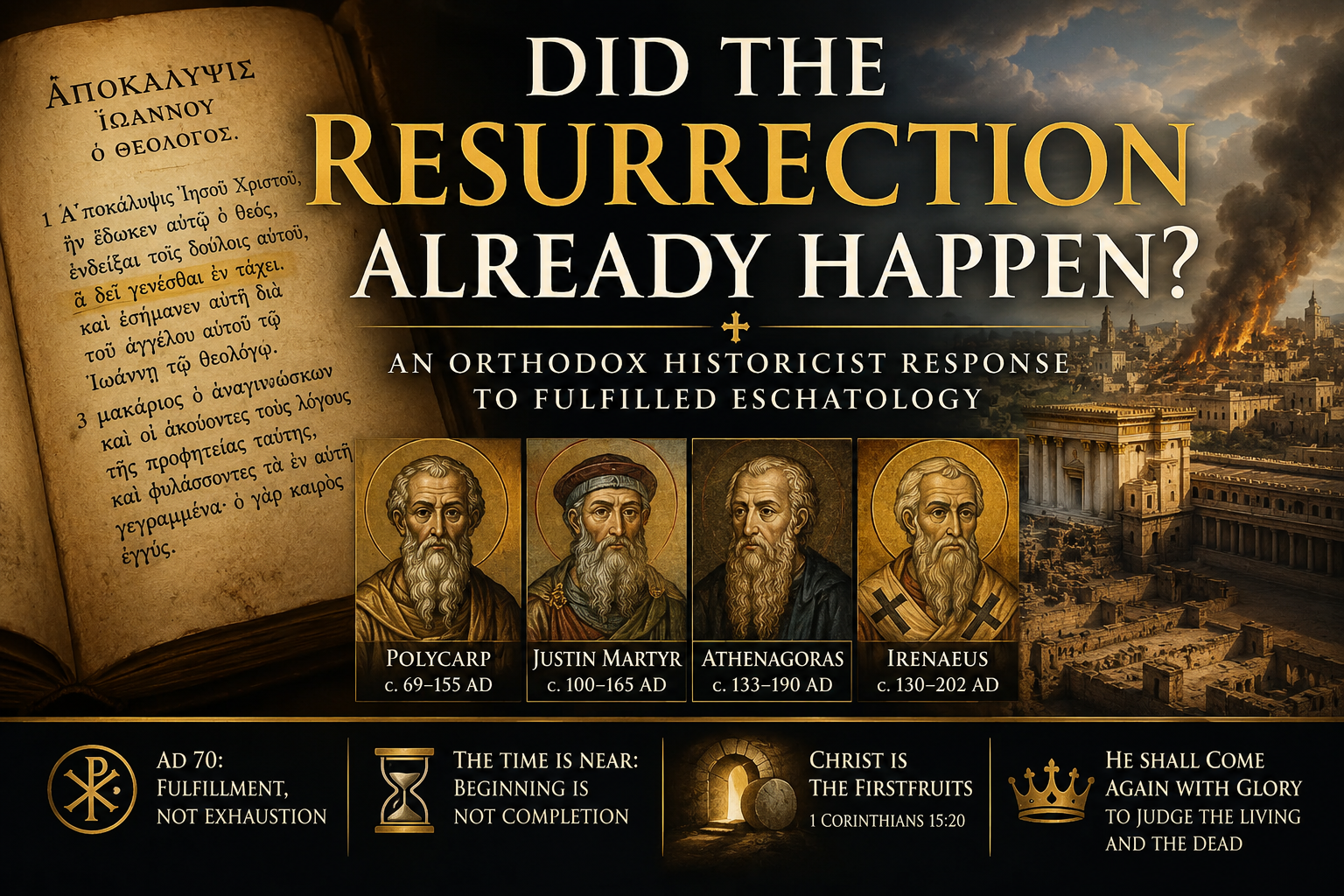
The Vincentian Canon, AD 70, “The Time Is Near,” and the Bodily Resurrection of the Dead
I. A Challenge Worth Answering
A recent challenge to Eastern Orthodox eschatology raises an important question: What was the universal eschatological expectation of the apostolic communities? Mark Mountjoy, writing from what he describes as a fulfilled or Atavist eschatological perspective, appeals to the famous principle associated with St. Vincent of Lérins: quod ubique, quod semper, quod ab omnibus—what has been believed everywhere, always, and by all. Mountjoy argues that the apostles universally expected the fulfillment of New Testament prophecy within their own generation, whereas the Orthodox Church continues to confess a future physical return of Christ, a future general resurrection, and a future Last Judgment. According to his argument, the traditional Christian expectation represents a later development produced by the Church’s attempt to account for events that apparently failed to occur when the apostles expected them.¹
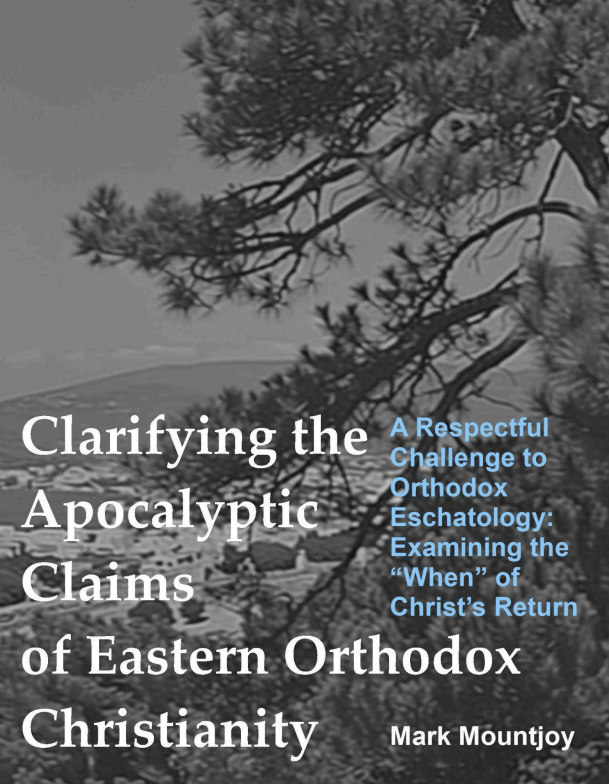
The question deserves a serious answer. Indeed, an Orthodox Christian should have no objection to applying the Vincentian principle to eschatology. But that standard must be applied consistently. It is not enough to establish that the New Testament contains genuine language of imminence. We must also determine what the apostles expected imminently, and then ask how the Christians immediately following them understood that expectation.
I have no difficulty granting that the apostles expected real prophetic fulfillment within their own generation. Nor is there any need for an Orthodox Historicist to minimize the destruction of Jerusalem in AD 70. Christ really foretold the destruction of the Temple, and the Jewish-Roman War unquestionably represents a major prophetic judgment in sacred history. The crucial question is whether imminent fulfillment necessarily means total fulfillment.
That distinction is fundamental. If the Orthodox belief in a future physical return of Christ, future resurrection of the dead, and future Last Judgment is supposedly a post-apostolic corruption, then where is the early catholic evidence that these events had already occurred? Where do we find Christians after AD 70—or even after Mountjoy’s broader terminus encompassing the Bar Kokhba revolt—proclaiming that Christ had already returned, the dead had already been raised, and the Last Judgment was now behind them?
If fulfilled eschatology represents quod ubique, quod semper, quod ab omnibus, we should expect precisely this belief throughout the earliest post-apostolic Church.
Instead, the surviving evidence presents a Church still awaiting resurrection, judgment, and the coming of Christ.
The issue, therefore, is not whether AD 70 fulfilled prophecy, but whether AD 70 exhausted prophecy. Those are very different claims.
II. Applying the Vincentian Canon to Full Preterism
Mountjoy’s appeal to the Vincentian Canon is initially powerful because the New Testament certainly does contain repeated expressions of imminence. James says that the Judge stands at the door. Peter announces that the end of all things is at hand. John begins Revelation by saying that the things revealed “must shortly take place” and that “the time is near.” Christ Himself declares in the Olivet Discourse that “this generation” will not pass until the things of which He speaks occur. Mountjoy gathers these statements and argues that they constitute a universal apostolic expectation of fulfillment within the late Second Jewish Commonwealth.²
But a significant logical step occurs when this observation is converted into the conclusion that the future bodily Parousia, general resurrection, and Last Judgment were therefore themselves completed within that same historical horizon.
That conclusion cannot simply be assumed. It must be demonstrated.
If catholic consensus is going to function as the criterion, we cannot stop with a concordance of the words “near,” “shortly,” and “this generation.” We must ask how the ancient Church actually understood the apostolic proclamation. Did Christians immediately following the apostles believe that the resurrection of the dead was now a completed event of recent history? Did they regard Christ’s glorious return as something that had already occurred? Did they teach that final judgment had taken place in the destruction of Jerusalem or in the subsequent Jewish revolts?
The testimony of the second century is extraordinarily important precisely because these Christians lived on the other side of the events that fulfilled eschatology identifies as the consummation.
Polycarp of Smyrna, standing near the apostolic generation, says that Christ “comes as the Judge of the living and the dead” and adds that the God who raised Christ “will raise us up also.”³ Whatever else may be debated about Polycarp’s eschatology, he plainly does not speak as though the resurrection of Christians and the judgment of the living and the dead were completed events belonging to the recent destruction of Jerusalem.
Justin Martyr is even more significant for Mountjoy’s particular chronology because Justin wrote after the Bar Kokhba revolt. Mountjoy’s expanded framework does not terminate the prophetic drama merely in AD 70; it continues through the later Jewish revolts and regards Bar Kokhba as the final Gog-and-Magog convulsion of the late Second Jewish Commonwealth.⁴ If this reconstruction is correct, Justin lived immediately after the completion of the very sequence in question.
Yet Justin does not describe himself as living after the general resurrection and final judgment. Quite the opposite. In his Dialogue with Trypho, while explicitly discussing the Apocalypse of John, Justin says that after the millennial period would come “the eternal resurrection and judgment of all men.”⁵ Whatever one thinks of Justin’s millennial interpretation, the chronological point is unmistakable: a Christian writing after Bar Kokhba and explicitly invoking John’s Revelation still regarded the general resurrection and judgment as future.
Athenagoras of Athens makes the nature of this expected resurrection equally unmistakable. His entire treatise On the Resurrection of the Dead argues that God will restore human beings whose bodies have died and dissolved. He insists that there must be “a resurrection of the bodies which are dead, or even entirely dissolved,” because the same human beings must be restored as the union of body and soul.⁶ This is not simply a metaphor for covenantal transition. It is an argument for the restoration of dead human bodies.
Irenaeus of Lyons is perhaps the most important witness of all because he does not present this expectation merely as his personal speculation. Writing around AD 180, he describes the faith that the Church, though dispersed throughout the whole world, had “received from the apostles and their disciples.” Included within that received faith are Christ’s manifestation from heaven, the raising again of “all flesh of the whole human race,” and universal judgment.⁷
That is remarkably close to a Vincentian argument centuries before St. Vincent of Lérins formulated his famous maxim. Irenaeus is explicitly appealing to antiquity, apostolic reception, geographic universality, and ecclesial consensus.
Elsewhere he is equally explicit concerning the bodily character of resurrection. The dead whom Christ raised, he says, rose in their “identical bodies,” and he uses those miracles to establish what will occur “at the end,” when the dead are raised at the last trumpet.⁸
The historical problem for fulfilled eschatology therefore becomes formidable. If the Parousia, resurrection, and judgment had been completed by AD 70—or even by Mountjoy’s broader terminus around the Bar Kokhba revolt—why are Christians living immediately afterward still awaiting precisely these realities? More importantly, why does Irenaeus describe this future expectation not as a recent theological innovation but as the faith received from the apostles by the Church throughout the world?
Mountjoy’s argument consequently develops a peculiar structure. Its premise is that Orthodox Christians must submit their eschatology to ancient catholic continuity. Its conclusion requires Orthodox Christians to accept an eschatology for which the ancient catholic Church provides no comparable consensus.
The Vincentian challenge therefore cuts both ways.
If Full Preterism represents the universal apostolic understanding, where is the Full-Preterist Church immediately after the apostles?
III. Christology Before Chronology: What Is the Resurrection?
There is an even more fundamental difficulty. The question cannot ultimately be decided merely by determining the chronological force of expressions such as “near” and “shortly,” because before asking when resurrection occurs, Christianity must first ask what resurrection is.
Here the Apostle Paul gives us a Christological rather than merely chronological answer:
“But now Christ is risen from the dead, and has become the firstfruits of those who have fallen asleep.”
— 1 Corinthians 15:20
The image of the firstfruits is decisive. The firstfruit reveals the nature of the harvest that follows it.
Christ’s Resurrection was not simply a covenantal transition. His corpse did not remain in Joseph’s tomb while His status before God changed. The crucified Christ truly rose. The tomb was empty. The risen Christ could be seen and touched. He ate with His disciples. The same Jesus who was crucified was raised in a glorified body.
Paul calls this bodily risen Christ the Firstfruits of those who have fallen asleep.
If the Firstfruit is bodily resurrection, why should the harvest represented by that Firstfruit be a fundamentally different kind of resurrection?
Paul continues:
“For this corruptible must put on incorruption, and this mortal must put on immortality.”
— 1 Corinthians 15:53
Likewise, 1 Thessalonians 4 does not merely describe the transition from one covenantal administration to another. Paul says that “the dead in Christ will rise first.”
This produces a remarkably simple question for fulfilled eschatology:
What happened to the dead in Christ in AD 70—or AD 136?
If their bodies were raised, where is the historical or ecclesial testimony to such an extraordinary occurrence?
If their bodies were not raised, in what sense was Paul’s resurrection fulfilled?
Appealing to Paul’s use of the first-person plural—“we who are alive and remain”—cannot solve this problem. Even if one grants the strongest possible temporal force to Paul’s identification with his living audience, the same passage tells us what must occur: the dead in Christ rise. An interpretation that treats Paul’s pronoun with uncompromising literalism while transforming the resurrection itself into a non-bodily covenantal event risks allowing chronology to determine ontology.
The proper order should be the reverse.
Christology precedes chronology.
We should not first determine from the word “near” that the resurrection must have occurred in the first century and then redefine resurrection until it fits that timetable. Christ Himself tells us what resurrection is because Christ Himself is the Firstfruits.
The Ascension reinforces the same point. In Acts 1, the disciples watch the risen Jesus ascend, and they are told that “this same Jesus” will come in the manner in which they saw Him go into heaven. Biblical language certainly permits divine “comings” in historical judgment. Jerusalem’s destruction may legitimately be described within that prophetic idiom. But a providential coming in judgment should not simply be equated without argument with the promised return of this same risen Jesus.
The Resurrection and Parousia therefore remain fundamentally Christological events before they become entries on an eschatological timetable.
IV. “The Time Is Near”: Beginning Is Not Completion
Mountjoy devotes considerable attention to the Greek temporal vocabulary of the New Testament. He emphasizes ἐγγύς (engys, near), ἐν τάχει (en tachei, shortly or speedily), ταχύ (tachy, quickly), and μέλλω (mellō, about to), arguing that the Orthodox tradition cannot simply make language of temporal proximity refer to events thousands of years away.⁹
An Orthodox Historicist has no need to do so.
We can happily say:
Yes, Revelation began to be fulfilled shortly.
What does not follow is:
Therefore Revelation finished being fulfilled shortly.
Revelation 1:1 announces “things which must shortly take place.” It does not say, “Everything contained within this prophecy will be completed within forty years.” A historical sequence may begin shortly after a prophecy is given and nevertheless extend far beyond its opening events.
Indeed, the Apocalypse itself contains temporal expanses and successive developments: forty-two months, 1,260 days, “a time, times, and half a time,” successive kingdoms, repeated cycles of judgment, and the millennium. Whatever interpretation one ultimately gives these periods, Revelation itself does not present prophetic history as a single undifferentiated event.
The literary movement of the book is also instructive. Before John gives us the seals, trumpets, beasts, Babylon, and later judgments, Revelation 1–5 first reveals Christ, the Seven Churches, the heavenly throne, and finally the Lamb who alone possesses the authority to open the sealed scroll.
Before the Lamb opens history, Revelation first reveals the Lamb.
The chronology of the Apocalypse proceeds from its Christology. The history contained in the scroll begins to unfold because the slain and risen Lamb opens it.
“The time is near” therefore tells us something genuinely important about when the prophetic drama begins. It does not magically tell us that every eschatological event contained within the drama terminates in AD 70—or even with Bar Kokhba.
Here Historicism offers an alternative to the familiar Preterist-Futurist binary. Extreme Futurism can push the Apocalypse so far beyond John’s original readers that the repeated declarations of imminence become difficult to explain. Full Preterism rightly recognizes that problem, but then risks moving to the opposite extreme by compressing the entire or nearly entire prophetic drama into the opening generations of Christian history.
Historicism offers another possibility:
The prophecy really did begin shortly because the history it describes had already begun.
V. AD 70: Fulfillment Without Exhaustion
The destruction of Jerusalem should not be minimized merely because Full Preterists emphasize it. Christ truly foretold the Temple’s destruction. The Jewish-Roman War was a catastrophic judgment, and Josephus provides an extraordinary historical witness to the siege, famine, destruction of the sanctuary, and ominous signs associated with that period.
Mountjoy places considerable weight upon this correspondence, describing Josephus as external historical confirmation of the New Testament’s prophetic announcements.¹⁰ On this point there is considerably more room for agreement than disagreement.
An Orthodox Christian can say: Amen. AD 70 mattered.
The logical leap occurs when the proposition “AD 70 fulfilled prophecy” becomes “AD 70 fulfilled eschatology.”
Josephus records Jerusalem destroyed.
He does not record the general resurrection of the Christian dead.
He does not record the transformation of the living described by Paul.
He does not record the destruction of death itself.
He does not record the resurrection of “all flesh of the whole human race” described by Irenaeus as part of the faith received throughout the ancient Church.
Nor does Josephus describe the return of the bodily risen Jesus in the manner associated with His Ascension.
Consequently, the historical correspondence between Josephus and Christ’s prophecy can establish a major first-century fulfillment without establishing the exhaustion of the entire Christian eschatological hope.
This distinction allows us to take Matthew 24 seriously without forcing every eschatological statement in the New Testament into one event. Jerusalem’s judgment may possess a genuine first-century fulfillment while the Resurrection, universal judgment, and consummation remain ahead.
AD 70 was an eschatological fulfillment. It was not necessarily the exhaustion of eschatology.
VI. From Jerusalem to Bar Kokhba: How Much Does “Remez” Prove?
Mountjoy’s Atavist framework extends considerably beyond an ordinary AD-70 Preterist reading. He argues that Revelation employs what he describes as the rabbinic technique of Remez, embedding contemporary historical identifications within layers of Old Testament allusion. Revelation 11’s “great city” is identified with Jerusalem; 666 is linked to the 666 talents of Solomon; and Gog and Magog are identified with the rebellious covenant people culminating in the Bar Kokhba revolt.¹¹
Revelation is unquestionably saturated with the Old Testament. There is therefore nothing inherently unreasonable about searching its symbolism for scriptural intertexts. Revelation 11:8 strongly connects its “great city” with the place “where also their Lord was crucified.” The appearance of 666 talents in Solomon’s history is likewise a suggestive numerical parallel worthy of investigation.
But these observations do not automatically produce Mountjoy’s complete historical reconstruction.
Recognizing the number 666 in Solomon’s history does not by itself prove that the Beast represents apostate covenant Israel. Revelation itself describes 666 as “the number of a man.” Likewise, establishing Jerusalem as the referent of the “great city” in Revelation 11 does not establish that Babylon in Revelation 17–18, the Beast, the millennium, Gog and Magog, the resurrection, and New Jerusalem all belong to one continuous first- and second-century Jewish sequence.
Most importantly, nothing about Old Testament intertextuality by itself proves:
Revelation 20:8–9 = the Bar Kokhba revolt of AD 132–136.
Mountjoy calls his Gog-and-Magog identification “unmistakable” and interprets the multitude “as the sand of the sea” through promises concerning Israel, finally placing its fulfillment in the Bar Kokhba catastrophe.¹² But this is an interpretive argument, not simply a lexical observation.
And here the Vincentian challenge returns with considerable force:
Where is the patristic witness identifying Gog and Magog of Revelation 20 with Bar Kokhba?
If the ancient universal Church is going to be invoked as the standard against Orthodox eschatology, a highly specific interpretation of Revelation 20 that apparently lacks corresponding ancient catholic consensus cannot simply be treated as the lost apostolic meaning of the text.
There is also another possibility. Old Testament imagery may possess continuing prophetic usefulness precisely because biblical patterns recur through sacred history.
Egypt can recur.
Babylon can recur.
Jezebel can recur.
Gog and Magog can recur.
Typology does not necessarily become exhausted at the first post-biblical historical correspondence we identify. Historicism is particularly comfortable with this because it views Revelation as sacred history unfolding through recurring biblical forms.
VII. Augustine Cannot Explain a Belief Older Than Augustine
Mountjoy assigns extraordinary importance to Augustine’s interpretation of Revelation 20. He argues that Augustine effectively pulled the millennium backward to Pentecost and made it coextensive with the Church age. According to Mountjoy, this simultaneously deprived Revelation 1–19 of their original sequential historical function. The Apocalypse’s supposed late-Second-Jewish-Commonwealth referents became obscured, producing what Mountjoy memorably calls the shattering of the Apocalypse’s “mirror.”¹³
Whatever judgment one makes concerning Augustine’s interpretation of the millennium, there is a fundamental chronological problem with making Augustine responsible for Christianity’s expectation of a future resurrection, Parousia, and judgment:
Augustine is far too late.
Augustine was born in AD 354.
The Council of Nicaea had already confessed in AD 325 that Christ “shall come again with glory to judge the living and the dead.”
Augustine had not yet been born.
The Creed associated with the Council of Constantinople in AD 381 confesses that Christ “shall come again with glory to judge the living and the dead, whose kingdom shall have no end,” and concludes: “I look for the resurrection of the dead and the life of the age to come.”
But even Nicaea is far too late to explain the evidence.
Polycarp already expected Christ as Judge and the resurrection of believers.
Justin, writing after Bar Kokhba, still expected the general resurrection and judgment and explicitly connected this expectation with John’s Apocalypse.
Athenagoras defended the restoration of the actual dead body.
Irenaeus, around AD 180, described Christ’s future manifestation, resurrection of all flesh, and judgment as the faith the worldwide Church had received from the apostles.
If these Christians already believed in a future resurrection, future coming of Christ, and future judgment, Augustine cannot be the theologian who created the problem that Mountjoy seeks to explain.
The historical mistake is to confuse two very different questions:
How should Revelation 20’s millennium be interpreted?
and
Did ancient Christians believe in a future resurrection and Parousia?
Augustine became enormously influential concerning the first question.
He cannot plausibly be made responsible for the second.
This is especially important from an Eastern Orthodox perspective. Greek-speaking Christians did not require a fourth- or fifth-century Latin theologian to teach them to expect the resurrection of the dead. The expectation was already embedded deeply in pre-Augustinian Christianity.
Augustine may be debated.
He cannot be used as a time machine.
VIII. Montanus Does Not Supply the Missing Consensus
Mountjoy also attempts a partial rehabilitation of Montanus. His argument is striking: because Montanus expected the New Jerusalem to descend near Pepuza and Tymion, and because New Jerusalem appears in Revelation 21, Mountjoy reasons that Montanus must have regarded the judgment sequence of Revelation 6–20 as already completed.¹⁴
But notice the nature of the argument.
Mountjoy does not cite Montanus saying:
“Revelation 6–20 has already been fulfilled.”
Rather, that theology is reconstructed from where Mountjoy believes Montanus had positioned himself within Revelation’s narrative sequence.
That inference may be interesting, but it cannot bear the weight assigned to it without stronger historical evidence. Expecting an event associated with Revelation 21 does not necessarily prove that Montanus possessed Mountjoy’s interpretation of every chapter preceding it.
More importantly, even if Montanus could be shown to have believed something resembling this reconstruction, a controversial prophetic movement cannot establish quod ubique, quod semper, quod ab omnibus.
The Vincentian question remains:
Where is the catholic testimony?
Where is the widespread post-apostolic proclamation that the Parousia, resurrection, and judgment were completed events?
The second-century evidence we actually possess continues to point in the opposite direction.
IX. The Creed and the Boundaries of Orthodox Eschatology
The Nicene-Constantinopolitan Creed does not identify the seals, trumpets, beasts, prophetic days, Babylon, or Gog and Magog. It does not require one detailed chronological system of Revelation. That is precisely why a variety of eschatological interpretations have existed within Christian history.
But the Creed does establish certain boundaries more fundamental than disputes over individual prophetic symbols.
Christ will come again in glory.
He will judge the living and the dead.
Christians await the resurrection of the dead.
They await the life of the age to come.
Within those boundaries an Orthodox Historicist may recognize enormous amounts of fulfillment throughout Church history. A partial Preterist may place substantial emphasis on Jerusalem’s destruction. Other Orthodox interpreters may stress recapitulation, typology, or events still future.
Full Preterism becomes something different when the resurrection, Parousia, and Last Judgment themselves are transferred entirely into ancient history.
At that point the debate is no longer merely:
Which historical event corresponds to this trumpet?
The deeper question becomes:
What does Christianity mean when it confesses the resurrection of the dead?
And once again the answer begins not with chronology but with Christ:
Christ is the Firstfruits.
X. An Orthodox Historicist Alternative
The Full-Preterist challenge nevertheless exposes a legitimate difficulty in extreme Futurism. If Revelation repeatedly tells its original readers that its prophetic drama is “near” and must happen “shortly,” an interpretation that postpones essentially the whole book for thousands of years risks weakening the force of John’s own language.
Historicism need not do this.
The time really was near.
The Seven Churches already existed. The Church was already suffering. The Lamb had already conquered. Christ already possessed the authority to open the scroll. The conflict between the Church and the powers of this world was already underway.
The prophetic drama therefore did not need to wait two thousand years before beginning.
But neither did the history opened by the Lamb need to terminate within forty years—or even within the century ending with Bar Kokhba.
This is where an Orthodox or Nicene Ecclesial Historicism can preserve important insights emphasized by both sides without accepting either extreme. Preterism is right to insist upon genuine first-century fulfillment. Futurism is right to preserve the future bodily resurrection, glorious Parousia, and Last Judgment.
Historicism explains how both observations can be true:
Prophecy begins in the apostolic world, unfolds through the history of the Church, and moves toward a consummation that remains ahead of us.
The Apocalypse, on this reading, is neither merely a cryptogram of the final decades of the Second Jewish Commonwealth nor principally a collection of predictions awaiting a generation thousands of years removed from John. It is the Apocalypse of Jesus Christ and the sacred history governed by the Lamb who opens the scroll.
The history is therefore ecclesial as well as political. The Church passes through persecution, heresy, councils, schisms, kingdoms, religious conflicts, missionary expansion, judgment, and renewal. Biblical types reappear because sacred history continues to unfold under the sovereignty of the Lamb.
This is why Christology precedes chronology.
Before asking where an event fits on the prophetic timeline, we first ask what the Apocalypse reveals about Christ, His Church, and His victory.
XI. The Story Did Not End in AD 70
The challenge began with the Vincentian Canon, and it is appropriate to end there.
If Christians are asked to accept an eschatology in which Christ’s promised Parousia, the resurrection of the dead, and the Last Judgment were completed during the first two centuries, then the historical burden of proof is considerable.
Where was this believed everywhere?
Where was it maintained always?
Where was it confessed by all?
More concretely, what did the Christians living immediately after the proposed fulfillment actually believe?
The evidence does not show a Church celebrating the recently completed resurrection of the dead. It shows a Church awaiting resurrection.
It does not show Christians proclaiming that Christ’s promised coming was now permanently behind them. It shows Christians awaiting His manifestation.
It does not show the catholic Church remembering the Last Judgment as an event of the Jewish-Roman wars. It shows Christians expecting judgment.
And remarkably, Irenaeus tells us that this expectation belonged to the faith received from the apostles and preserved by the Church throughout the world.
None of this requires us to minimize AD 70.
Jerusalem’s destruction fulfilled prophecy.
Nor must we weaken the New Testament’s language of imminence.
“Near” may remain near.
“Shortly” may remain shortly.
“This generation” may genuinely concern the generation Christ addressed.
The mistake is assuming that because the prophetic drama began within that generation, the whole drama must have ended there.
And the Resurrection provides the decisive Christological test. Christ did not rise merely covenantally. He rose bodily. Paul calls the risen Christ the Firstfruits of those who have fallen asleep.
The harvest cannot simply be detached from the nature of its Firstfruit because an eschatological timetable requires it.
The Church therefore continues to confess:
“I look for the resurrection of the dead and the life of the age to come.”
AD 70 was an eschatological fulfillment. It was not the exhaustion of eschatology.
The time really was near.
The prophecy really did begin.
History really did unfold.
But the dead still await resurrection.
The mistake of Full Preterism is not that it finds fulfillment too early.
It is that it ends the story too soon.
Footnotes
¹ Mark Mountjoy, Clarifying the Apocalyptic Claims of Eastern Orthodox Christianity: A Respectful Challenge to Orthodox Eschatology—Examining the “When” of Christ’s Return (True Christian Press, 2025–2026), 1–4, especially 2–3. Mountjoy argues that the apostolic communities universally expected imminent fulfillment and explicitly characterizes the Orthodox expectation of “a future physical return, a future general resurrection, [and] a future last judgment” as a later development.
² Mountjoy, Clarifying the Apocalyptic Claims, 1–4. Mountjoy appeals particularly to 1 Thessalonians 4, James 5:9, 1 Peter 4:7, Revelation 1:1, 3, and Matthew 24:34 as evidence of a universal apostolic expectation of imminent fulfillment.
³ Polycarp of Smyrna, Letter to the Philippians 2. Polycarp says that Christ comes as Judge of the living and the dead and that the One who raised Christ will also raise believers.
⁴ Mountjoy, Clarifying the Apocalyptic Claims, 18–20, 35–36. Mountjoy extends the completed covenantal drama through the Kitos Wars and Bar Kokhba revolt and elsewhere identifies Revelation 20’s Gog and Magog with the final Jewish revolt.
⁵ Justin Martyr, Dialogue with Trypho 81. Justin explicitly refers to John, “one of the apostles of Christ,” and John’s Revelation before describing the general resurrection and judgment as subsequent events.
⁶ Athenagoras of Athens, On the Resurrection of the Dead 3, 18, 25. Athenagoras repeatedly argues for the restoration of bodies that have died, dissolved, and even been dispersed into their constituent elements.
⁷ Irenaeus of Lyons, Against Heresies 1.10.1–2. Irenaeus describes the Church dispersed throughout the world as having received from the apostles and their disciples a common faith including Christ’s manifestation from heaven, the resurrection of humanity, universal judgment, immortality, and everlasting glory.
⁸ Irenaeus, Against Heresies 5.13.1. He appeals to those bodily raised by Christ as anticipations of the future resurrection and connects the final resurrection with the last trumpet and John 5:28–29.
⁹ Mountjoy, Clarifying the Apocalyptic Claims, 5–8. His principal temporal terms include ἐγγύς, ἐν τάχει, μέλλω, ταχύ, εὐθέως, and ἡ γενεὰ αὕτη.
¹⁰ Mountjoy, Clarifying the Apocalyptic Claims, 9–11. He appeals to Josephus’s descriptions of the Jewish War and destruction of Jerusalem as independent historical confirmation of New Testament prophecy and also invokes Roman historical testimony.
¹¹ Mountjoy, Clarifying the Apocalyptic Claims, 33–36. Mountjoy describes Revelation’s scriptural-allusive method as Remez and applies it to 666, the Great City, and Gog and Magog.
¹² Ibid., 35–36. Mountjoy interprets the “sand of the sea” language through Genesis 32:12, Isaiah 10:22, and Romans 9:27 and identifies Revelation 20’s Gog-and-Magog multitude with apostate covenant Israel culminating in the Bar Kokhba revolt.
¹³ Ibid., 24–30, especially 26–29. Mountjoy argues that Augustine relocated Revelation 20’s millennium to the beginning of the Church age, thereby subsuming Revelation 1–19 into an ongoing spiritual framework and obscuring their supposed late-Second-Jewish-Commonwealth historical referents.
¹⁴ Ibid., 18–23. Mountjoy reasons from Montanus’s expectation of the New Jerusalem near Pepuza and Tymion that Montanus implicitly regarded Revelation 6–20 as already fulfilled. Mountjoy describes Montanus’s error as concerning the scale and geographical placement of New Jerusalem rather than the direction of his eschatological chronology.

