
By Jonathan Photius – The NEO-Historicism Research Project
Introduction
Among the most mysterious and perprlexing passages in the Apocalypse is the angel’s explanation of the seven heads of the scarlet beast:
“The seven heads are seven mountains, on which the woman sitteth. And there are seven kings: five are fallen, and one is, and the other is not yet come” (Rev. 17:9–10).
Throughout Christian history, commentators have struggled to identify these seven mountains and seven kings. Many interpreted them as individual Roman emperors. Others understood them as successive forms of Roman government or as symbolic representations of worldly power. Yet within the Byzantine tradition there emerged another approach—one that interpreted the heads not as individual rulers but as successive world kingdoms standing in the tradition of Daniel’s prophetic empires.
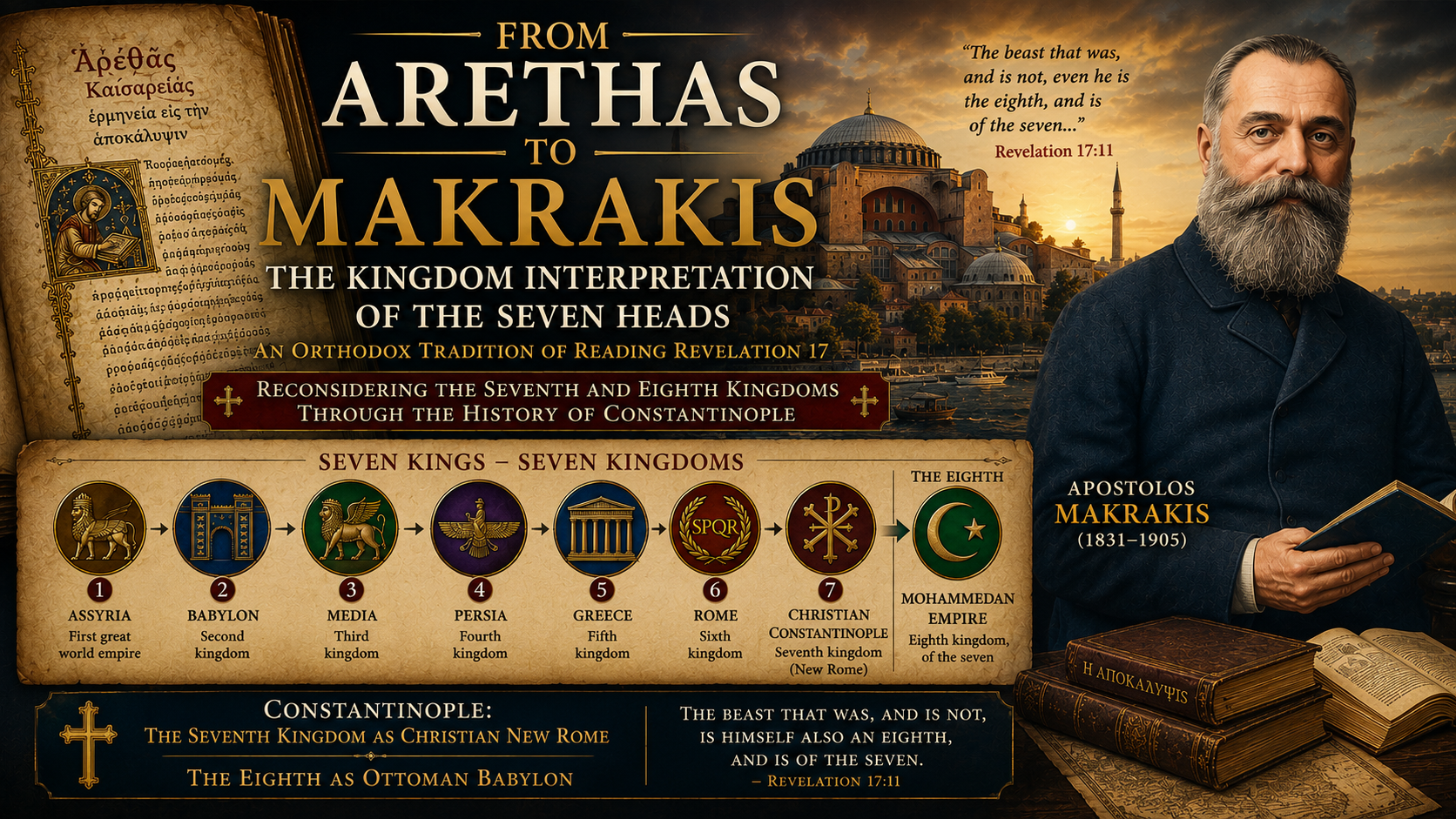
The significance of this kingdom interpretation has largely gone unnoticed in modern studies of Revelation. Long before the rise of Protestant historicism, Byzantine commentators were already reading Revelation 17 through the lens of sacred history. The most important witness to this approach is Arethas of Caesarea, whose commentary appears to preserve the earliest known extant attempt to identify the seven heads as a succession of Danielic world empires extending from the ancient Near East to Constantinople. Centuries later, Apostolos Makrakis revived and expanded this same framework, developing a historical system that culminated not in the Papacy but in the Mohammedan Empire.
Taken together, Arethas and Makrakis reveal a distinctively Orthodox trajectory of apocalyptic interpretation rooted in Daniel, shaped by the historical experience of Byzantium, and centered upon the destiny of New Rome. Their writings suggest that the seven mountains of Revelation 17 may be understood not merely as the seven hills of Rome but as successive imperial powers that dominated the people of God throughout sacred history. In this respect, they offer an alternative to both the emperor-centered interpretations of antiquity and the papal-centered historicism that later emerged in the West.¹
This article argues that Arethas of Caesarea may represent the earliest known commentator to interpret the seven mountains of Revelation 17 as successive Danielic kingdoms, while Makrakis developed that kingdom tradition into one of the most sophisticated historical interpretations of the Apocalypse produced within modern Orthodoxy. Together, their commentaries open a largely unexplored chapter in the history of Orthodox apocalyptic exegesis and invite renewed consideration of the relationship between Daniel’s kingdoms, Revelation’s mountains, and the historical destiny of Constantinople.
II. Daniel and the Historical Kingdoms
The kingdom interpretation of Revelation 17 begins not in the Apocalypse but in the Book of Daniel. Daniel’s visions present history as a succession of world empires culminating in the establishment of God’s everlasting kingdom. The image of Daniel 2 and the four beasts of Daniel 7 supplied Christian interpreters with a framework for understanding world history as a divinely ordered sequence of kingdoms.²
By the patristic era, this Danielic vision had become the standard Christian philosophy of history. Egypt, Assyria, Babylon, Persia, Greece, and Rome were not merely political entities; they were stages in the unfolding drama of divine providence. The question naturally arose whether the seven kings of Revelation 17 should likewise be understood as historical kingdoms rather than individual rulers.
Within the Byzantine tradition, Arethas appears to have answered that question in the affirmative.
III. Arethas and the Seven Kingdoms of Sacred History
In his commentary on Revelation 17, Arethas departs from the common modern-era Preterist practice of identifying the heads with individual Roman emperors. Instead, he interprets them through the succession of world kingdoms familiar from Danielic prophecy. The seven heads represent successive historical empires extending from the ancient Near East to the Christian Roman Empire centered in Constantinople.³
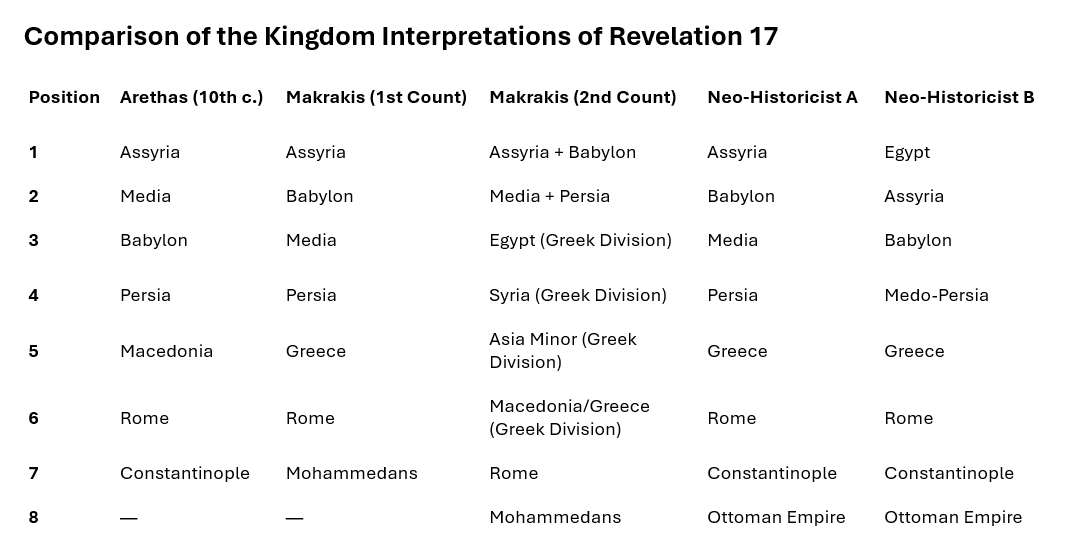
According to Arethas, the kingdoms may be summarized as follows:
| Position | Kingdom |
|---|---|
| 1 | Assyria |
| 2 | Media |
| 3 | Babylon |
| 4 | Persia |
| 5 | Macedonia (Greece) |
| 6 | Rome |
| 7 | Constantinople |
The principle uniting these kingdoms is not merely territorial size or political power. Rather, each kingdom exercised dominion over the Land of Israel and the people of God during a significant period of sacred history. Assyria conquered the Northern Kingdom, Babylon destroyed Jerusalem and carried Judah into exile, Persia ruled the restored Jewish community, Macedonia and its successors dominated Judea during the Hellenistic age, Rome governed the Holy Land during the earthly ministry of Christ and destroyed Jerusalem in A.D. 70, while Constantinople governed Palestine and the Christian holy places for centuries. The sequence therefore traces not merely world history but the history of those empires that stood in direct relationship to the covenant land and the unfolding drama of redemption history.
This interpretation is remarkable for several reasons.
First, it transforms Revelation 17 from a puzzle about Roman imperial succession into a prophecy of sacred history. The heads are not merely rulers but entire historical orders.
Second, it extends the prophetic sequence beyond pagan Rome. Unlike many earlier commentators who terminated the series with the Roman Empire, Arethas continues the sequence into the Byzantine age itself.
Third, the seventh kingdom is identified with Constantinople, the New Rome. The prophetic drama therefore does not end in the ancient world but continues into the Christian empire that inherited Rome’s political and historical legacy.⁴
This may represent one of the earliest extant Byzantine attempts to solve Revelation 17 through a succession of historical kingdoms rather than emperors. In doing so, Arethas laid the foundation for later Orthodox historical interpretations of the Apocalypse.
The significance of Arethas’ interpretation lies not merely in his enumeration of kingdoms but in his apparent integration of Daniel’s imperial schema into Revelation 17. The seven mountains are no longer understood primarily as the seven hills of Rome but as successive world powers standing in the tradition of Daniel’s kingdoms. In this respect, Arethas may represent one of the earliest extant commentators to read the mountains of Revelation 17 as historical empires extending from the ancient Near East to Constantinople itself.
Significantly, the identification of the seven heads with seven mountains finds an important biblical precedent in Jeremiah’s prophecy against Babylon:
“Behold, I am against thee, O destroying mountain” (Jer. 51:25).
Although Babylon was not literally a mountain, the prophet employs mountain imagery to describe an imperial power that dominated the nations and oppressed the people of God. This Old Testament usage provides a natural bridge between Daniel’s succession of kingdoms and Revelation’s seven mountains. Read in this light, the mountains of Revelation 17 may be understood not merely as geographical hills but as successive world empires standing in the tradition of prophetic Babylon.⁵
Notably, Arethas does not appear to develop a detailed explanation of the enigmatic eighth kingdom of Revelation 17:11. His primary contribution lies elsewhere: he establishes the kingdom framework itself, thereby opening a path that later Orthodox interpreters would continue to explore.
IV. Constantinople as New Rome
The identification of Constantinople as the seventh kingdom reflects a distinctly Byzantine worldview.
For Byzantine Christians, Constantinople was not merely another capital city. It was New Rome, the continuation of Roman imperium in Christian form. The transfer of the imperial capital from Old Rome to Constantinople was understood not as the destruction of Rome but as its transformation.
In this sense, Arethas’ interpretation is profoundly historical. The prophetic sequence moves from the ancient empires of the Near East through Greece and Rome and arrives finally at Christian Constantinople. Sacred history unfolds through successive political orders, each inheriting something of its predecessor while simultaneously transforming it.
This perspective differs sharply from many later Western interpretations, which tended to locate the continuation of Rome primarily within the Papacy. For Arethas, the historical continuation of Rome was not ecclesiastical Rome but imperial Constantinople.
V. Makrakis and the Problem of the Eighth Kingdom
Nearly a millennium after Arethas, Apostolos Makrakis revisited the problem of the seven heads and seven kings. Like Arethas, he rejected the common identification of the heads with individual Roman emperors and instead interpreted them as successive historical kingdoms. Yet Makrakis went further. He attempted to explain one of the most difficult statements in the Apocalypse:
“And the beast that was, and is not, even he is the eighth, and is of the seven” (Rev. 17:11).
According to Makrakis, the key to understanding this riddle lies in recognizing that the kingdoms may be counted according to two different historical enumerations.⁶
Makrakis’ First Enumeration
| Position | Kingdom |
|---|---|
| 1 | Assyrians |
| 2 | Babylonians |
| 3 | Medes |
| 4 | Persians |
| 5 | Hellenes (Greeks) |
| 6 | Romans |
| 7 | Mohammedans |
Under this reckoning, the Mohammedan Empire occupies the seventh position and thus fulfills the role of the final kingdom in the sequence.⁷
Makrakis’ Second Enumeration
Makrakis then proposes a second reckoning based upon later historical developments.
The Assyrian and Babylonian kingdoms were eventually united under Nebuchadnezzar. Likewise, the Median and Persian kingdoms were united under Cyrus. By contrast, the single empire of Alexander the Great was later divided into four principal Hellenistic kingdoms.⁸
Accordingly, the kingdoms may be counted as follows:
| Position | Kingdom |
|---|---|
| 1 | Assyrians and Babylonians united |
| 2 | Medes and Persians united |
| 3 Position 3-to-6 | Egypt (Ptolemaic division) |
| 4 Alexander’s Empire Divided Into 4 | Syria (Seleucid division) |
| 5 | Asia Minor |
| 6 | Macedonia and Greece |
| 7 | Romans |
| 8 | Mohammedans |
Under this second reckoning, the Mohammedan kingdom becomes the eighth kingdom.
Makrakis therefore argues that the Mohammedan Empire is simultaneously both seventh and eighth: seventh according to the first enumeration and eighth according to the second. In this manner he explains the angel’s enigmatic declaration that the beast is “the eighth, and is of the seven.”⁹
Unlike many interpreters who resort to purely symbolic explanations, Makrakis grounds his solution in concrete historical developments. The union of formerly divided kingdoms and the division of formerly united kingdoms provide the mechanism by which the final kingdom can legitimately occupy both positions.
This represents one of the most elaborate historical interpretations of Revelation 17 produced within the modern Orthodox tradition.
VI. Reconsidering the Seventh and Eighth Kingdoms Through the History of Constantinople
The contrast between Arethas and Makrakis raises an intriguing historical question.
Are their interpretations fundamentally contradictory, or do they reflect different stages in the same historical process?
Arethas identifies a succession of kingdoms culminating in Constantinople but does not appear to offer a developed explanation of the enigmatic eighth kingdom. Centuries later, Makrakis returned to the same passage and attempted to solve the problem explicitly through his theory of dual enumerations, whereby the Mohammedan Empire could be counted as both seventh and eighth.
Yet the history of Constantinople itself suggests another possible avenue of reflection.
For Arethas, Constantinople represented the Christian continuation of Roman imperium. New Rome inherited the political legacy of the Caesars and served as the center of the Christian empire.¹⁰
After the Ottoman conquest of 1453, however, the same city became the capital of the Ottoman Empire.
The city remained.
The imperial capital remained.
The administrative structures remained.
The universal claims of empire remained.
What changed was the religious and civilizational character of the ruling power.
This historical continuity invites renewed reflection upon the angel’s statement:
“And the beast that was, and is not, even he is the eighth, and is of the seven.”
While neither Arethas nor Makrakis explicitly formulated the following synthesis, their interpretations naturally suggest two possible Neo-Historicist reconstructions.
Neo-Historicist Model A
Separate Media and Persia
| Position | Kingdom |
|---|---|
| 1 | Assyria |
| 2 | Babylon |
| 3 | Media |
| 4 | Persia |
| 5 | Greece |
| 6 | Rome |
| 7 | Constantinople / Eastern Roman Empire |
| 8 | Ottoman Empire |
Neo-Historicist Model B
Egypt and Medo-Persia
| Position | Kingdom |
|---|---|
| 1 | Egypt |
| 2 | Assyria |
| 3 | Babylon |
| 4 | Medo-Persia |
| 5 | Greece |
| 6 | Rome |
| 7 | Constantinople / Eastern Roman Empire |
| 8 | Ottoman Empire |
Both reconstructions share a common principle: every kingdom in the sequence exercised authority over the Land of Israel and the people of God. From Egypt and Assyria through Babylon, Persia, Greece, Rome, Byzantium, and the Ottoman Empire, the prophetic sequence follows the powers that successively dominated the covenant land.¹¹
Within this framework, the Ottoman Empire may be understood as “of the seven” because it inherited not only Constantinople but also Jerusalem, Palestine, and much of the former Byzantine sphere. Ottoman Constantinople succeeded Christian Constantinople while preserving the same imperial center and much of the same sacred geography.
Whether this proposal ultimately proves correct, it demonstrates that the Arethian and Makrakian traditions open interpretive possibilities largely neglected in modern discussions of Revelation 17. Rather than locating the mystery of the beast primarily in the history of the Papacy or the Holy Roman Empire, these Orthodox approaches direct attention toward the historical destiny of New Rome and the lands once governed from Constantinople.
VII. An Orthodox Alternative to Western Historicism
The resulting picture differs significantly from many Western historicist interpretations.
In the West, the continuation of Rome was frequently identified with the Papacy. The prophetic drama centered upon the transformation of imperial Rome into ecclesiastical Rome.
In the Orthodox kingdom tradition, however, the focus remains fixed upon New Rome. The central historical question becomes not the fate of the Papacy but the fate of Constantinople as a continuation of the Roman Empire and Peter’s identification with “Babylon”.
Thus the mystery of the seventh and eighth kingdoms unfolds through the history of the Christian East rather than the history of Latin Christendom.
Both traditions attempt to explain the beast that “was, and is not, and yet is.”
They simply identify different heirs of the Roman legacy.
VIII. Conclusion
The interpretation of the seven heads as successive historical kingdoms represents one of the most important yet neglected streams of Orthodox apocalyptic exegesis.
In Arethas of Caesarea, we find one of the earliest known Byzantine attempts to interpret Revelation 17 through a succession of empires extending from Assyria to Constantinople. In Apostolos Makrakis, we find a later Orthodox commentator employing the same kingdom framework while identifying the Mohammedan Empire as the final successor to Rome and attempting to solve the mystery of the eighth kingdom through a sophisticated system of dual enumerations.
Together, these interpretations reveal a distinctively Orthodox approach to sacred history—one rooted in Daniel, illuminated by Jeremiah’s vision of Babylon as a “destroying mountain,” developed within Byzantium, and shaped by the rise and fall of Constantinople.
The significance of this tradition lies not in demonstrating dependence upon later Protestant historicism. Rather, it shows that Byzantine and post-Byzantine interpreters were already reading Revelation through the lens of historical kingdoms centuries before such approaches became common in the West.
The path from Daniel to Revelation did not pass through Wittenberg alone. It also passed through Caesarea, Constantinople, and the long historical memory of the Orthodox East.
© 2026 by Jonathan Photius
Footnotes
- For representative emperor-centered interpretations, see Irenaeus, Against Heresies 5.30 and Victorinus of Pettau, Commentary on the Apocalypse 17.
- Hippolytus, Commentary on Daniel 2.12–20; Jerome, Commentary on Daniel 2.31–45; John J. Collins, Daniel (Minneapolis: Fortress Press, 1993), 166–80.
- Arethas of Caesarea, Commentary on the Apocalypse, on Revelation 17:9–11.
- Ibid. In his interpretation of the seven heads and seven kings, Arethas enumerates a succession of historical kingdoms consisting of Assyria, Media, Babylon, Persia, Macedonia, Rome, and Constantinople.
- Jeremiah 51:25. Compare the prophetic identification of Babylon as a “destroying mountain,” which provides an important biblical precedent for understanding mountains as imperial powers rather than merely geographical features.
- Apostolos Makrakis, The Apocalypse of St. John, trans. D. Cummings (Chicago: Hellenic Christian Educational Society, 1948), 412–417.
- Ibid., 412–413.
- Ibid., 414–416.
- Ibid., 416–417. Makrakis explains Revelation 17:11 through two historical enumerations of the kingdoms, allowing the Mohammedan Empire to be counted as both seventh and eighth.
- Arethas of Caesarea, Commentary on the Apocalypse, on Revelation 17:9–11.
- Compare the historical succession of powers exercising dominion over the Holy Land discussed throughout both the Arethian and Makrakian kingdom schemes. See also Asterios Argyriou, Les Exégèses grecques de l’Apocalypse à l’époque turque (1453–1821) (Thessaloniki: Patriarchal Institute for Patristic Studies, 1982), 45–112; and the historical reflections of Christophoros Angelos, John Lindeos, and Anastasios Gordios on the relationship between sacred history and the destiny of the Orthodox East.

