
By Jonathan Photius – The NEO-Historicism Research Project
Introduction
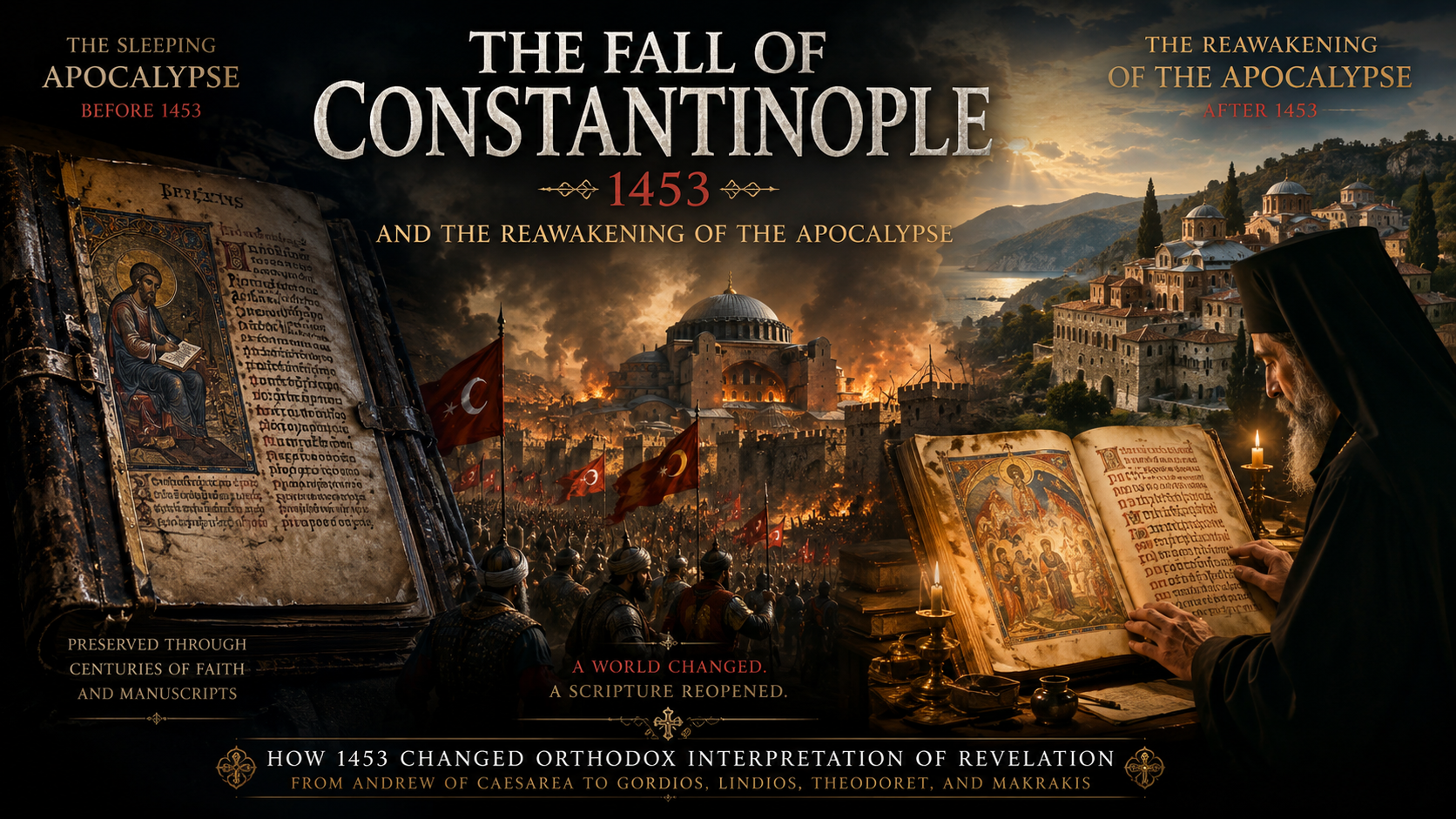
Few events in Christian history rival the fall of Constantinople in significance. On 29 May 1453, after more than eleven centuries as the capital of the Christian Roman Empire, the Queen of Cities fell to the armies of Sultan Mehmed II. The last emperor, Constantine XI Palaiologos, perished in the defense of the city, and the Byzantine Empire passed into history.¹ For Orthodox Christians throughout the eastern Mediterranean, the catastrophe was not merely political. It raised profound theological questions concerning divine providence, the future of the Church, and the meaning of history itself.
In the centuries that followed, Orthodox Christians increasingly turned to prophecy in search of answers. Ancient Byzantine apocalyptic traditions were copied, expanded, and reinterpreted. Prophecies concerning the Last Emperor, the liberation of Constantinople, and the eventual triumph of Christianity circulated widely throughout the Ottoman world.² Yet alongside this flourishing of prophetic literature occurred another development that has received comparatively little attention: a renewed engagement with the Book of Revelation.
The Apocalypse of John had experienced a complex history in the Greek East. Although accepted and cited by many early Christian writers, its reception weakened during Late Antiquity amid canonical uncertainty, declining manuscript transmission, and the near disappearance of a continuous Greek commentary tradition.³ The situation changed dramatically with the appearance of the commentary of Andrew of Caesarea in the late sixth or early seventh century. Andrew’s work not only preserved the Apocalypse within Byzantine theological culture but also established the interpretive framework through which subsequent generations would approach the book.⁴ Through the efforts of Andrew and later Arethas of Caesarea, Revelation secured a stable place within the Byzantine manuscript tradition and gradually overcame many of the doubts that had previously surrounded it.⁵
Yet preservation did not necessarily entail prominence. As modern scholarship has repeatedly observed, the Apocalypse occupied a comparatively modest place within Byzantine theological, liturgical, and exegetical life when compared with the Gospels, the Psalter, and the Pauline corpus.⁶ Although copied, read, and transmitted, Revelation remained a book whose interpretation was largely mediated through Andrew’s authoritative commentary and whose practical influence remained limited outside specialized theological circles.⁷
The Ottoman conquest therefore did not rescue Revelation from obscurity. The Apocalypse had already survived. What the conquest accomplished was to transform the book’s function within Orthodox thought. Faced with foreign domination, ecclesiastical humiliation, and the apparent collapse of the Christian Roman order, Orthodox writers increasingly sought in the visions of St. John an explanation of their historical circumstances. The Apocalypse was no longer merely a preserved text inherited from the Fathers. It became an interpretive lens through which contemporary history could be understood.⁸
This transformation is visible throughout the post-Byzantine period. Athonite marginalia, prophetic compilations, and formal commentaries increasingly identified the symbols of Revelation with the great religious and political forces confronting the Orthodox world. Ottoman rulers, Latin powers, ecclesiastical conflicts, and hopes for liberation all found expression within apocalyptic interpretation.⁹ The result was not merely a revival of interest in Revelation but the gradual emergence of a distinctly Orthodox form of historical exegesis that sought to read the history of the Church through the prophetic visions of the Apocalypse.
This article argues that the Fall of Constantinople marked the beginning of a post-Byzantine reawakening of the Apocalypse in the Greek East. Building upon the foundations laid by Andrew of Caesarea and the Byzantine manuscript tradition, Orthodox commentators of the Ottoman period developed increasingly historical interpretations of Revelation. Through the works of figures such as Anastasios Gordios, Paisius Ligarides, John Lindios, Theodoret of Ioannina, and Apostolos Makrakis, the Apocalypse became a framework for understanding the sufferings, struggles, and future hopes of Orthodox Christianity under foreign domination.¹⁰
The following study traces this development from the decline of Revelation’s reception during Late Antiquity, through its restoration and preservation within Byzantine tradition, to its renewed interpretation during the centuries of Ottoman rule. In doing so, it seeks to demonstrate that the Fall of Constantinople did not restore the Apocalypse to the Greek East; Andrew of Caesarea had already accomplished that task centuries earlier. Rather, the catastrophe of 1453 transformed the Apocalypse from a preserved book into an urgently interpreted one.
I. The Eclipse of the Apocalypse: From Early Reception to Byzantine Marginality
The Book of Revelation occupied a far more prominent position in the earliest centuries of Christianity than its later Byzantine reception might suggest. Second- and third-century writers cited the Apocalypse extensively and regarded it as an important witness to apostolic eschatology. Justin Martyr appealed to Revelation’s thousand-year reign in his Dialogue with Trypho, while Irenaeus of Lyons relied heavily upon the book in his arguments against Gnostic speculation and in his discussion of Antichrist traditions.¹¹ Hippolytus of Rome likewise employed the Apocalypse in his prophetic and anti-heretical writings, and Methodius of Olympus developed an influential ecclesiological interpretation of the Woman of Revelation 12 as the Church and Bride of Christ.¹² Far from occupying a marginal position, Revelation stood among the principal sources through which early Christians articulated their understanding of history, persecution, and the final triumph of God’s kingdom.
The situation began to change during the fourth century. The growing stability of the Christian Roman Empire, combined with emerging questions concerning the authorship and interpretation of Revelation, contributed to a gradual decline in the book’s influence within the Greek East. The most significant challenge arose from the criticisms of Dionysius of Alexandria, who questioned whether the Apocalypse had been written by the Apostle John and argued that its language and style differed substantially from the Fourth Gospel.¹³ Although Dionysius did not reject the book outright, his arguments exerted a lasting influence upon subsequent generations.
The doubts raised by Dionysius were amplified by Eusebius of Caesarea, who placed Revelation among the disputed writings while acknowledging its continued use among many Christians.¹⁴ During the same period, several influential canonical lists omitted the Apocalypse altogether. The canon associated with the Council of Laodicea excluded Revelation, while Gregory Nazianzen and Amphilochius of Iconium produced canonical catalogues that either omitted the book or reflected continuing uncertainty concerning its status.¹⁵ Although acceptance of Revelation never disappeared entirely, the cumulative effect of these developments was to weaken its position within the Greek-speaking Church.
This period of uncertainty produced consequences that extended beyond questions of canon. Modern studies of Revelation’s reception in the East have shown that the decline of the Apocalypse’s authority was accompanied by a corresponding reduction in manuscript transmission and exegetical activity.¹⁶ While other New Testament books generated extensive commentary traditions, Revelation gradually receded from the mainstream of Greek theological reflection. By the sixth century, no continuous Greek commentary on the Apocalypse had achieved widespread circulation, and the book occupied a comparatively isolated position within Byzantine intellectual life.¹⁷
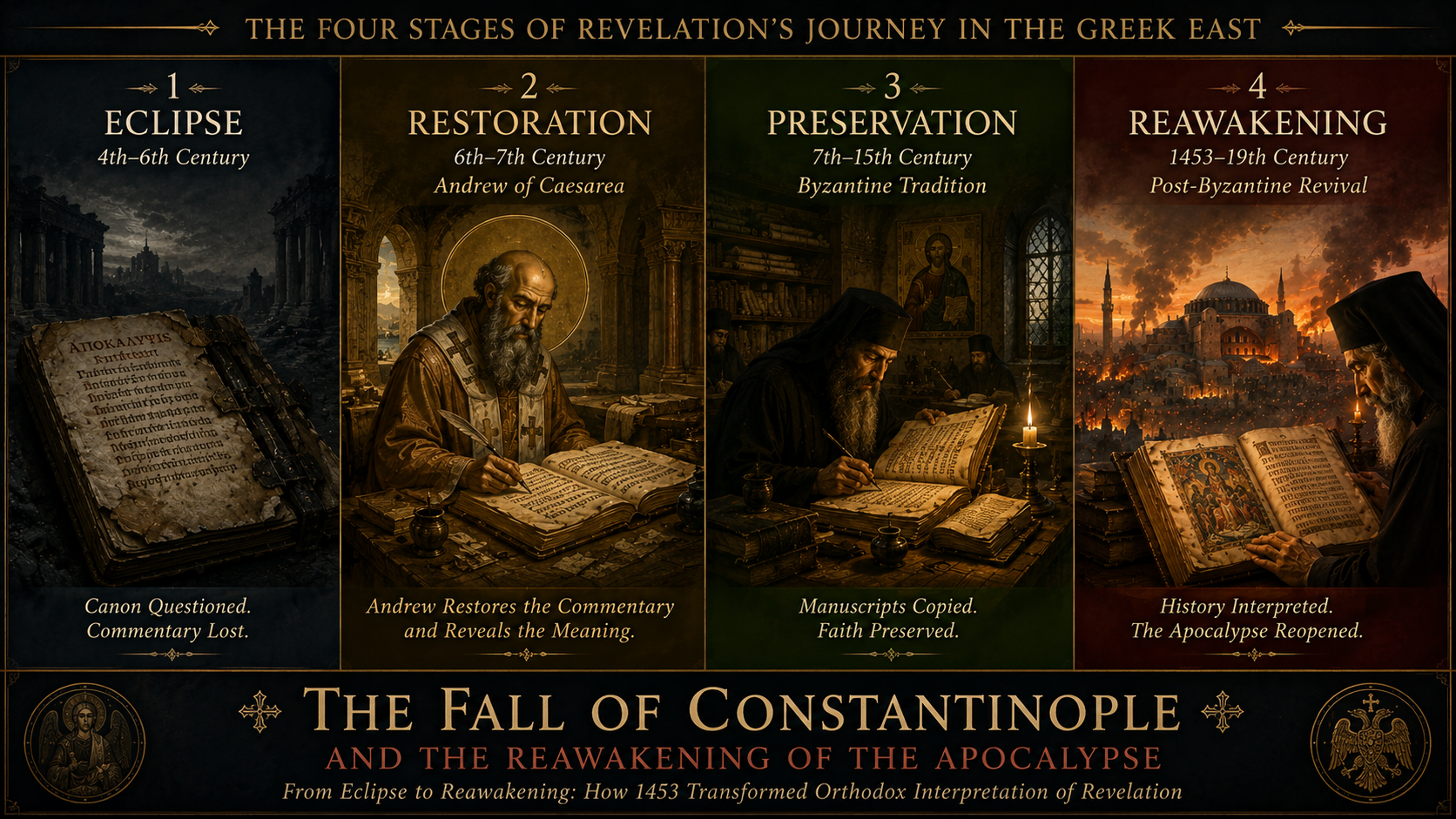
The eclipse was therefore threefold. First, canonical uncertainty weakened confidence in the book’s apostolic authority. Second, manuscript transmission declined relative to other portions of the New Testament. Third, the commentary tradition that might have preserved and expanded its interpretation largely vanished. Taken together, these developments created the conditions for what may be described as the Byzantine marginalization of the Apocalypse. The book remained part of the Church’s scriptural inheritance, but it no longer occupied the central position it had enjoyed among many early Christian writers.¹⁸
Yet the eclipse was never complete. Even during the centuries of diminished reception, Revelation continued to circulate within monastic and scholarly circles. Its authority was questioned by some, defended by others, and never wholly abandoned. This persistence would prove decisive. For when Andrew of Caesarea composed his commentary near the end of the sixth century, he was not reviving a forgotten text but restoring a neglected one. His work would provide the foundation upon which the later Byzantine and post-Byzantine reception of Revelation would ultimately be built.
II. Andrew of Caesarea and the Restoration of the Apocalypse
If the fourth through sixth centuries witnessed the eclipse of the Apocalypse in the Greek East, the late sixth and early seventh centuries witnessed the beginning of its restoration. The central figure in this recovery was Andrew of Caesarea, whose commentary on Revelation would become the single most influential interpretation of the book in Byzantine Christianity. More than any other writer, Andrew ensured that the Apocalypse remained a living part of the Orthodox theological tradition.¹⁹
Little is known concerning Andrew’s life beyond his position as Archbishop of Caesarea in Cappadocia. Yet his contribution to the history of Revelation can scarcely be overstated. Writing sometime between the late sixth and early seventh centuries, Andrew produced the first complete Greek commentary on the Apocalypse that would achieve enduring authority within the Eastern Church.²⁰ Earlier interpretations of Revelation certainly existed, but Andrew’s commentary succeeded where others had failed: it secured a permanent place within the Byzantine exegetical tradition.²¹
One reason for the commentary’s success was its consciously ecclesiastical character. Andrew did not present Revelation as an esoteric text reserved for speculative interpreters. Rather, he approached the Apocalypse as a canonical book of Scripture whose meaning should be sought within the life of the Church and in continuity with earlier Christian tradition. Drawing upon predecessors such as Methodius, Hippolytus, and Irenaeus, he sought to demonstrate that Revelation harmonized with the broader witness of the New Testament and the rule of faith preserved by the Church.²²
Equally important was Andrew’s understanding of prophetic interpretation. In the prologue to his commentary, he famously observed that the fulfillment of prophecy becomes clearer through “time and experience.”²³ This principle would prove enormously influential in subsequent Orthodox interpretation. Rather than restricting Revelation exclusively to the past or postponing its meaning entirely to the distant future, Andrew acknowledged that historical developments could illuminate prophetic symbols in ways not previously recognized. Although he remained cautious and avoided excessive speculation, he established a hermeneutical framework that allowed later generations to read Revelation in conversation with the unfolding history of the Church.
The significance of Andrew’s work extended far beyond his own lifetime. His commentary rapidly became the dominant interpretive authority on Revelation throughout the Byzantine world. Manuscripts of the Apocalypse were frequently transmitted together with Andrew’s exposition, and subsequent readers often encountered the biblical text through the lens of his commentary.²⁴ By the tenth century, Arethas of Caesarea had further reinforced Andrew’s influence through his own commentary, which preserved, expanded, and disseminated the earlier tradition.²⁵ Together, Andrew and Arethas formed the foundation upon which virtually all later Greek interpretation of Revelation would rest.
Yet Andrew’s achievement should not be misunderstood. He did not transform Revelation into one of the most frequently cited books of Byzantine theology, nor did he eliminate every trace of earlier hesitation regarding the Apocalypse. As modern scholarship has observed, Revelation continued to occupy a relatively modest place within Byzantine liturgical and theological life when compared with other portions of Scripture.²⁶ What Andrew accomplished was something more fundamental. He ensured that the Apocalypse would remain available, intelligible, and authoritative within the Orthodox tradition.
The centuries that followed therefore witnessed not the disappearance of Revelation but its preservation. Through the manuscript tradition, the commentaries of Andrew and Arethas, and the continued transmission of the biblical text itself, the Apocalypse survived the Byzantine era. The book that had once stood on the margins of Eastern Christian reception was now securely embedded within the intellectual and spiritual inheritance of the Greek Church. When new historical crises emerged centuries later, Orthodox Christians would not need to rediscover Revelation. They would inherit it through the work of Andrew of Caesarea.²⁷
III. Preservation Without Prominence: Revelation in Middle and Late Byzantium
The restoration of the Apocalypse through the work of Andrew and Arethas did not usher in a new golden age of apocalyptic exegesis. Instead, the centuries that followed were characterized by preservation rather than innovation. Revelation survived, circulated, and retained its place within the Byzantine scriptural tradition, but it rarely occupied a central role in theological discourse.²⁸
One of the most significant achievements of Andrew’s commentary was the stabilization of the Apocalypse’s reception within the Greek East. The canonical uncertainties that had troubled earlier centuries gradually receded, and the book’s place within the New Testament became increasingly secure. Manuscripts of Revelation continued to be copied, often accompanied by Andrew’s commentary, ensuring that the text remained available to successive generations of readers.²⁹ The Apocalypse was no longer a disputed book struggling for acceptance; it had become an established part of the Byzantine biblical inheritance.
Yet acceptance did not necessarily translate into prominence. Byzantine theology remained overwhelmingly centered upon the Gospels, the Psalter, the Pauline epistles, and the doctrinal controversies that shaped the Church’s life. The great theological debates of the Middle Byzantine period—Iconoclasm, Christological refinement, monastic spirituality, and liturgical development—rarely placed the Apocalypse at their center.³⁰ Unlike the Gospel of John or the writings of St. Paul, Revelation did not generate a continuous stream of new commentaries, nor did it occupy a major place within the liturgical cycle of the Church.³¹
This relative quiet should not be mistaken for neglect. Byzantine Christians continued to read Revelation, preserve its manuscripts, and transmit the commentary tradition inherited from Andrew and Arethas. The book remained present within monastic libraries and scholarly circles, and its imagery occasionally surfaced within homiletic, liturgical, and devotional literature.³² Nevertheless, the Apocalypse generally functioned as a preserved authority rather than an actively contested or frequently interpreted text.
At the same time, a parallel stream of Byzantine apocalyptic thought continued to develop outside the formal commentary tradition. From the seventh century onward, works such as the Apocalypse of Pseudo-Methodius, the Oracles of Leo, the various recensions of the Apocalypse of Daniel, and related prophetic texts sought to interpret the dramatic upheavals confronting the Byzantine world.³³ Arab conquests, military defeats, imperial crises, and eschatological expectations all contributed to the flourishing of a rich apocalyptic literature that circulated widely throughout the empire.
This development is significant because it reveals that Byzantine interest in prophecy never disappeared. Rather, it became concentrated in genres other than the formal exegesis of Revelation. While Andrew’s commentary preserved the biblical Apocalypse, Byzantine prophetic literature preserved a living expectation that history itself possessed a providential and eschatological meaning.³⁴ These two streams—the commentary tradition and the prophetic tradition—largely developed along parallel paths for centuries.
By the late Byzantine period, however, the pressures confronting the empire began to intensify. Successive territorial losses, civil conflicts, and the growing advance of Ottoman power created an atmosphere in which prophetic expectations increasingly acquired immediate relevance. The empire that had once seemed the earthly embodiment of Christian civilization now faced the possibility of extinction.³⁵ In this environment, the distance between biblical prophecy and historical experience began to narrow.
The significance of 1453 therefore lies not merely in the fall of a city but in the convergence of two long-standing traditions. The Apocalypse had been preserved through the commentary tradition of Andrew and Arethas. Byzantine prophetic expectations had been sustained through centuries of apocalyptic literature. When Constantinople fell, these traditions increasingly intersected. Orthodox Christians inherited both a canonical Apocalypse and a prophetic worldview. The catastrophe of the Ottoman conquest would bring them together in new and unexpected ways.³⁶
IV. The Fall of Constantinople and the Prophetic Crisis
On 29 May 1453, the world of Byzantine Christianity came to an end. After a siege lasting nearly two months, the armies of Sultan Mehmed II breached the walls of Constantinople and captured the capital of the Eastern Roman Empire. Emperor Constantine XI Palaiologos fell in the defense of the city, and the empire that traced its origins to Constantine the Great ceased to exist.³⁷ For many Orthodox Christians, the catastrophe appeared almost unimaginable. The city that had served for more than a thousand years as the political and spiritual center of Eastern Christendom now stood under Muslim rule.
The significance of the event extended far beyond politics. Byzantium had long understood itself as more than a state. The empire was frequently viewed as a providential instrument for the protection and advancement of Christian civilization. The fall of Constantinople therefore raised questions that were fundamentally theological. Had God abandoned the Christian Roman Empire? Were the sufferings of the Orthodox world signs of divine judgment? What did the future hold for the Church living under Ottoman domination?³⁸
Such questions were not entirely new. For centuries Byzantine Christians had interpreted military defeats, foreign invasions, and imperial crises through the lens of prophecy. The Arab conquests of the seventh century had inspired the Apocalypse of Pseudo-Methodius. Later generations produced the Oracles of Leo, the Apocalypse of Daniel traditions, and numerous prophetic texts that sought to discern God’s purposes in history.³⁹ These writings reveal that Byzantine apocalyptic expectation remained vigorous even during periods when formal commentary on Revelation remained relatively limited.
What changed after 1453 was the scale of the crisis. Earlier defeats had threatened the empire. The Ottoman conquest destroyed it. For the first time since the conversion of Constantine, Orthodox Christians found themselves living without a Christian emperor and without a Christian state capable of defending the historic centers of Eastern Christianity.⁴⁰ The collapse of the Byzantine political order transformed prophecy from a subject of occasional speculation into an urgent framework for understanding contemporary reality.
As Andreas Kraft has observed, Byzantine apocalyptic literature consistently sought to interpret present events within a providential narrative of history.⁴¹ After 1453, that impulse intensified dramatically. The fall of Constantinople became the central event around which hopes, fears, and expectations increasingly revolved. Prophecies concerning the Last Emperor, the liberation of the City, the defeat of foreign oppressors, and the future restoration of Christian rule circulated widely throughout the Orthodox world.⁴² The catastrophe itself became an apocalyptic lens through which history was interpreted.
At the same time, Ottoman rule created new conditions for the interpretation of the Apocalypse. The symbols of Revelation now seemed capable of addressing questions that earlier generations had encountered only indirectly. Orthodox Christians living under Islamic domination naturally sought to understand the place of the Ottoman Empire within sacred history. The rise of Latin influence in the East, the memory of the Fourth Crusade, and continuing ecclesiastical tensions with the West likewise encouraged historical readings of prophetic imagery.⁴³ Revelation offered a scriptural framework through which these experiences could be understood.
This development did not occur overnight. The immediate aftermath of the conquest produced a wide range of responses, including lamentation, prophetic expectation, and renewed interest in older Byzantine apocalyptic traditions. Yet over time a significant shift began to emerge. The Apocalypse increasingly ceased to function merely as a preserved biblical text accompanied by Andrew’s commentary. Instead, it became a book through which Orthodox Christians sought to interpret the history unfolding around them.⁴⁴
The importance of this shift cannot be overstated. The Ottoman conquest did not create Byzantine prophecy, nor did it create the Orthodox interpretation of Revelation. Both traditions already existed. What 1453 accomplished was their convergence. The commentary tradition preserved by Andrew and Arethas provided the scriptural foundation. The apocalyptic traditions of Byzantium supplied a historical consciousness shaped by centuries of prophetic expectation. Together they produced the conditions from which a new phase of Orthodox exegesis would emerge.⁴⁵
The generations that followed the fall of Constantinople inherited a world transformed. They also inherited a transformed relationship to the Apocalypse. The question was no longer simply what Revelation meant. The question increasingly became what Revelation meant for the Orthodox Church living under Ottoman rule. The answer to that question would shape the rise of post-Byzantine exegesis during the centuries that followed.
V. The Reawakening of the Apocalypse
The generations that followed the fall of Constantinople did not merely preserve the Apocalypse; they began to interpret it with renewed intensity. During the centuries of Ottoman rule, Revelation increasingly became a lens through which Orthodox Christians understood their historical experience. This development did not produce a single unified school of interpretation, nor did it immediately result in a succession of formal commentaries. Nevertheless, the evidence preserved in manuscripts, marginal notes, prophetic compilations, and later exegetical works reveals the emergence of a distinct post-Byzantine engagement with the Apocalypse.⁴⁶
One of the most significant features of this reawakening was the growing tendency to identify the symbols of Revelation with concrete historical realities. Earlier Byzantine commentators had generally approached the Apocalypse through ecclesiastical, moral, and theological categories. Post-Byzantine interpreters increasingly sought correspondences between prophetic imagery and the political circumstances confronting the Orthodox world. The rise of the Ottoman Empire, the continued presence of Latin powers, and the long captivity of the Orthodox Church under foreign domination all encouraged historical readings of the text.⁴⁷
Evidence of this development appears not only in formal commentaries but also in manuscript culture itself. Athonite manuscripts studied by Agyriou preserve striking examples of marginal interpretations connecting Revelation to contemporary events. One note identifies the Ottoman founder Osman through a numerical calculation associated with the number 666, while another applies the same method to the name “Lateinos,” a traditional interpretation inherited from Irenaeus.⁴⁸ Such annotations demonstrate that apocalyptic interpretation was no longer confined to scholarly treatises. Monks, scribes, and readers actively engaged the text in an effort to understand the historical forces shaping their world.
The Athonite evidence is especially significant because it reveals that the reawakening of the Apocalypse was not confined to formal commentators. Long before the appearance of the major eighteenth- and nineteenth-century interpreters, monks and scribes were already engaging Revelation as a living text capable of illuminating contemporary events. The marginal notes preserved in the manuscripts of Xenophontos and Dochiariou demonstrate that historical interpretation was circulating within the monastic culture of Mount Athos itself. The Apocalypse was being read not merely as an inherited book of Scripture but as a guide for understanding the religious and political forces shaping the destiny of Orthodox Christianity. In this respect, the Athonite manuscripts provide a valuable glimpse into the intellectual environment from which the later commentators would emerge.⁴⁹
These marginal notes are important because they reveal a significant shift in interpretive emphasis. The question was no longer merely the theological meaning of the Beast or the significance of the number 666. Increasingly, the question became whether these symbols corresponded to identifiable historical actors. Ottoman rulers, Islamic powers, Latin Christianity, and future enemies of the Church were all examined through the prism of apocalyptic symbolism.⁴⁹ Revelation had become a living text for a community seeking to interpret its present circumstances.
This renewed engagement with the Apocalypse developed alongside the flourishing of post-Byzantine prophetic literature. Expectations concerning the liberation of Constantinople, the restoration of Christian rule, and the eventual triumph of Orthodoxy circulated widely throughout the Ottoman period.⁵⁰ Although these traditions were not identical to the commentary tradition descending from Andrew of Caesarea, they increasingly interacted with one another. The symbolic language of Revelation offered scriptural support for hopes and expectations that had already become deeply rooted within Orthodox popular and monastic consciousness.
The result was the gradual emergence of a historical mode of interpretation. Rather than viewing Revelation exclusively as a description of remote future events or timeless spiritual realities, post-Byzantine readers increasingly understood the Apocalypse as speaking to the actual history of the Church. The sufferings of the Orthodox under Ottoman domination, the struggle against external enemies, and the expectation of eventual deliverance all found expression within the biblical text.⁵¹
Agyriou’s research demonstrates that this phenomenon was not limited to isolated individuals. Across the Ottoman period one encounters a growing succession of interpreters who sought to relate the visions of St. John to the historical destiny of the Orthodox Church. Some did so cautiously through marginal observations and prophetic allusions. Others would eventually produce more systematic interpretations. Taken together, these witnesses reveal the beginnings of what may properly be described as a post-Byzantine exegetical movement.⁵²
The significance of this movement lies not merely in its conclusions but in its method. The interpreters of the Ottoman era increasingly approached Revelation through the combined lenses of ecclesiastical history and contemporary experience. In this respect they stood closer to Andrew’s principle that prophecy becomes clearer through “time and experience” than is often recognized. The centuries following 1453 did not abandon the Byzantine tradition. Rather, they extended it into a new historical context.⁵³
By the seventeenth century, this reawakening would begin to produce commentators who consciously interpreted the Apocalypse through the history of Orthodoxy itself. The result was the gradual formation of an Orthodox historical exegesis that sought to explain both the sufferings and future hopes of the Church through the prophetic visions of Revelation. It is to these commentators that we now turn.
VI. The Rise of Post-Byzantine Orthodox Historical Exegesis
The reawakening of the Apocalypse after 1453 did not occur through the work of a single commentator. Rather, it unfolded gradually across several centuries as successive generations of Orthodox writers sought to understand the historical experience of their Church through the visions of St. John. From the early seventeenth century to the nineteenth, a discernible tradition of historical interpretation emerged, one that increasingly viewed Revelation as a prophetic account of Orthodox history.⁵⁴
Among the earliest representatives of this development was Zacharias Gerganos. Writing during the early seventeenth century, Gerganos belongs to the first generation of post-Byzantine Orthodox scholars who attempted to articulate the condition of the Orthodox Church in the aftermath of the Ottoman conquest. Although his engagement with Revelation was not yet as systematic as that of later commentators, his work reflects a growing tendency to interpret contemporary ecclesiastical realities through apocalyptic categories.⁵⁵
Closely associated with this early phase is Christophoros Angelos. Writing for audiences beyond the Ottoman Empire, Angelos presented the sufferings of the Orthodox Church as part of a larger providential and apocalyptic struggle. His writings reveal how Orthodox Christians increasingly understood their historical circumstances through the language of prophecy.⁵⁶ The significance of figures such as Gerganos and Angelos lies not in the construction of fully developed exegetical systems but in their demonstration that the Apocalypse had once again become relevant to the interpretation of contemporary history.
The movement matured during the seventeenth century in the writings of Paisius Ligarides (c. 1610–1678). Ligarides inherited both the Byzantine commentary tradition and the flourishing prophetic culture of the Ottoman period. His interpretation reflects an Orthodox world seeking to locate itself within sacred history. The sufferings of the Church, the domination of foreign powers, and the expectation of future deliverance increasingly became subjects of apocalyptic reflection.⁵⁷
A more explicit historical interpretation appears in the works of John Lindios and Theodoret of Ioannina. Both commentators sought to explain Revelation through the concrete experience of the Orthodox Church. Lindios interpreted the Woman of Revelation 12 as the Orthodox Church and connected the aid given to her by the earth with historical assistance received from Christian rulers and nations.⁵⁸ The visions of the Apocalypse were thus understood not merely as future events but as realities manifested throughout the historical life of the Church.
Theodoret advanced this historical perspective even further. Explaining prophetic symbols through historical developments, he famously observed that “time becomes a teacher.”⁵⁹ The phrase bears a striking resemblance to Andrew of Caesarea’s earlier conviction that prophecy becomes clearer through “time and experience.” For Theodoret, the unfolding course of history provided one of the primary means by which Revelation could be understood. Events themselves illuminated the meaning of prophecy.
The early eighteenth century witnessed the appearance of one of the most significant figures in the entire post-Byzantine tradition: Anastasios Gordios. Although not the earliest commentator of the Ottoman era, Gordios was among the first to provide a substantial and systematic interpretation of Revelation grounded in the historical experience of the Orthodox East. Drawing upon Andrew and Arethas while addressing the realities of Ottoman domination, Gordios helped transform a growing tendency into a coherent exegetical approach.⁶⁰
What distinguishes Gordios from many of his predecessors is the extent to which he consciously interpreted the Apocalypse through the condition of the Orthodox Church itself. The sufferings of the Christian population under Ottoman rule, the memory of Byzantine decline, and the continuing struggle to preserve Orthodox identity all informed his reading of the text. Revelation was no longer treated merely as a prophecy of distant events or as a repository of spiritual symbols. It became a book that spoke directly to the historical experience of the Church. In Gordios, one encounters an interpreter who sought to understand the present through the Apocalypse and the Apocalypse through the present.
His significance therefore lies not merely in the conclusions he reached but in the method he employed. Gordios stands at the intersection of two traditions that had developed separately for centuries: the Byzantine commentary tradition descending from Andrew of Caesarea and the historical-prophetic consciousness that had flourished throughout the Ottoman period. In his work, these traditions converge. The result was one of the clearest and most influential expressions of post-Byzantine Orthodox historical exegesis, providing a bridge between the earlier commentators of the seventeenth century and the more developed historical interpretations that would emerge in the nineteenth.⁶⁰
The culmination of this development may be seen in the nineteenth-century writings of Apostolos Makrakis. Building upon centuries of interpretation, Makrakis read major sections of Revelation through the history of the Church itself. Arius and the Arian controversy were associated with the Fifth Trumpet. The fall of Rome appeared within the framework of the Sixth Trumpet. The iconoclastic controversy was interpreted through the imagery of the Dragon’s flood against the Woman.⁶¹ Whatever judgment one may render concerning particular identifications, the underlying method is unmistakable. Makrakis approached Revelation as a prophetic history of the Church.
Viewed individually, these commentators differ considerably in method, emphasis, and theological outlook. Viewed collectively, however, they reveal a remarkable continuity. Across the Ottoman and post-Ottoman periods, Orthodox interpreters increasingly sought to understand Revelation through the actual history of Orthodoxy. The Apocalypse was no longer treated primarily as a distant prophecy awaiting fulfillment at the end of time. It had become a theological interpretation of history itself.⁶²
This development represents one of the most significant yet understudied consequences of the fall of Constantinople. The catastrophe of 1453 did not merely stimulate apocalyptic speculation. It encouraged generations of Orthodox Christians to reread the Apocalypse through the lens of their historical experience. Out of that experience emerged a distinctive tradition of historical interpretation that united Byzantine prophetic expectations, ecclesiastical self-understanding, and the inherited commentary tradition of Andrew of Caesarea.⁶³
VII. From Byzantine Prophecy to Orthodox Historicism
The post-Byzantine commentators discussed in the preceding section were not isolated interpreters working independently of one another. Nor were they merely repeating older Byzantine traditions. Collectively, they represent a significant development in the history of Orthodox exegesis: the gradual convergence of Byzantine prophetic expectation and the inherited commentary tradition of the Apocalypse.⁶⁴
Modern scholarship has often treated these traditions separately. Studies of Byzantine apocalyptic literature typically focus upon prophetic texts such as the Apocalypse of Pseudo-Methodius, the Oracles of Leo, and the various Daniel apocalypses. Studies of Revelation, by contrast, have generally concentrated upon the commentary tradition descending from Andrew and Arethas of Caesarea.⁶⁵ Yet the evidence of the Ottoman period suggests that these streams increasingly intersected.
The prophetic literature of Byzantium had long sought to explain history through a providential framework. Empires rose and fell according to divine purpose. Foreign invasions, military victories, and political crises possessed theological significance. The Ottoman conquest intensified this historical consciousness and gave it renewed urgency. Orthodox Christians increasingly sought not merely predictions of future deliverance but explanations for their present condition.⁶⁶
The Apocalypse provided precisely such a framework. Unlike many prophetic texts, Revelation possessed apostolic authority and canonical status. It offered a symbolic language capable of describing conflict, persecution, captivity, judgment, and ultimate victory. As post-Byzantine interpreters increasingly applied these symbols to the historical experience of the Orthodox Church, the Apocalypse became more than a book about the end of history. It became a means of interpreting history itself.⁶⁷
This transformation did not produce a rigid or uniform system. The commentators differed regarding specific identifications and historical applications. Nevertheless, they shared a common conviction that the visions of St. John possessed significance for the unfolding life of the Church. Revelation was not viewed as a sealed book whose meaning belonged exclusively to the distant future. Nor was it reduced to timeless spiritual allegory. Instead, it was increasingly understood as a prophecy whose meaning became clearer as history progressed.⁶⁸
In this respect, the post-Byzantine tradition remained deeply indebted to Andrew of Caesarea. His observation that prophecy becomes clearer through “time and experience” provided a hermeneutical principle capable of accommodating historical interpretation without abandoning ecclesiastical continuity.⁶⁹ The commentators of the Ottoman era did not reject Andrew’s approach; rather, they extended it. The passage of centuries and the experience of Ottoman domination supplied new historical contexts through which the Apocalypse could be read.
The resulting tradition may therefore be described as a form of Orthodox historicism. By this term is not meant a rigid interpretive system identical to later Protestant models, nor a comprehensive scheme shared in every detail by all commentators. Rather, it refers to the growing tendency to understand Revelation as unfolding through the historical experience of the Church. The symbols of the Apocalypse increasingly became connected with actual persons, institutions, controversies, empires, and events that shaped the destiny of Orthodox Christianity.⁷⁰
The significance of this development extends beyond the history of interpretation. It demonstrates that the Ottoman period was not merely an era of preservation or decline. It was also a period of creative exegetical activity. Faced with unprecedented political and religious challenges, Orthodox Christians returned to the Apocalypse and discovered within it a framework capable of interpreting their past, explaining their present, and sustaining hope for their future.⁷¹
The fall of Constantinople therefore marked more than the end of an empire. It initiated a new chapter in the history of Revelation’s reception. The Apocalypse that Andrew had preserved became the Apocalypse that post-Byzantine Orthodoxy increasingly interpreted through the lens of its own historical experience.
Conclusion
The history of Revelation in the Greek East cannot be reduced to a simple narrative of acceptance or rejection. The Apocalypse experienced periods of prominence and periods of marginality. During Late Antiquity, canonical uncertainty, declining manuscript transmission, and the collapse of a continuous commentary tradition contributed to a significant eclipse in the book’s reception. Yet the Apocalypse never disappeared from the life of the Church. Through the efforts of Andrew of Caesarea and later Arethas, Revelation was restored to the Byzantine tradition and preserved for future generations.⁷²
The centuries that followed were characterized less by innovation than by faithful transmission. The Apocalypse remained part of the Byzantine scriptural inheritance, even if it occupied a comparatively modest place within theological and liturgical life. At the same time, Byzantine apocalyptic literature continued to cultivate a providential understanding of history, preserving a prophetic consciousness that would outlive the empire itself.⁷³
The fall of Constantinople in 1453 transformed this historical landscape. The catastrophe did not create Orthodox interest in prophecy, nor did it restore the Apocalypse to a Church that had forgotten it. Both traditions already existed. What the Ottoman conquest accomplished was their convergence. The inherited commentary tradition of Revelation and the prophetic consciousness of Byzantium increasingly merged as Orthodox Christians sought to understand their historical experience through the visions of St. John.⁷⁴
From the early post-Byzantine writers such as Zacharias Gerganos and Christophoros Angelos, through Paisius Ligarides, John Lindios, Theodoret of Ioannina, Gordios, and finally Apostolos Makrakis, one can trace the emergence of a distinctive tradition of historical interpretation. Although differing in method and detail, these commentators increasingly viewed Revelation as a prophetic account of the Church’s journey through history. The Apocalypse became a means of explaining suffering, interpreting foreign domination, preserving ecclesiastical identity, and sustaining hope for future restoration.⁷⁵
This development deserves greater attention within both Byzantine studies and the history of biblical interpretation. Modern scholarship has often treated Byzantine prophetic literature and the commentary tradition of Revelation as separate subjects. The evidence of the post-Byzantine period suggests that they increasingly interacted with one another, producing a form of Orthodox historical exegesis that remains insufficiently explored.⁷⁶
The Fall of Constantinople therefore marked more than the end of an empire. It inaugurated a new chapter in the reception history of the Apocalypse. The book that Andrew of Caesarea had restored and Byzantium had faithfully preserved became the book that generations of Orthodox Christians would increasingly interpret through the lens of their own history. The Apocalypse was not reborn in 1453, for it had never truly died. Preserved by Andrew, transmitted by Byzantium, and reinterpreted through the trials of Ottoman rule, Revelation emerged as one of the principal lenses through which Orthodox Christians understood their place within sacred history.
© 2026 by Jonathan Photius
Notes
- Steven Runciman, The Fall of Constantinople 1453 (Cambridge: Cambridge University Press, 1965), 145–48.
- Andreas Kraft, “Byzantine Apocalyptic Literature,” in The Cambridge Companion to Apocalyptic Literature, ed. Colin McAllister (Cambridge: Cambridge University Press, 2020), 180–200.
- Thomas Schmidt, The Book of Revelation and Its Eastern Commentators: Making the New Testament in the Early Christian World (Cambridge: Cambridge University Press, 2021), 1–29; Stephen J. Shoemaker, “The Afterlife of the Apocalypse of John in Byzantium,” in The Reception of the New Testament in Byzantium, ed. Catherine Kuehn and Basil Lourié (Leiden: Brill, 2016), 37–42.
- Schmidt, The Book of Revelation and Its Eastern Commentators, 30–54.
- Shoemaker, “Afterlife of the Apocalypse,” 43–51.
- Shoemaker, “Afterlife of the Apocalypse,” 37–78.
- Schmidt, The Book of Revelation and Its Eastern Commentators, 166–175.
- Athanasios Agyriou, Les Exégèses Grecques de l’Apocalypse à l’époque turque (1453–1821) (Thessaloniki: Patriarchal Institute for Patristic Studies, 1982), Introduction, 1–54; Postface, 687–690.
- Agyriou, Les Exégèses Grecques, 223–224, 687–690.
- Agyriou, Les Exégèses Grecques, Introduction, 1–54; Postface, 687–690.
- Justin Martyr, Dialogue with Trypho 80–81; Irenaeus, Against Heresies 5.26–36.
- Methodius of Olympus, Symposium 8.5–9.5; cf. Andrew of Caesarea, Commentary on the Apocalypse, Prologue.
- Eusebius, Ecclesiastical History 7.24–25. For the influence of Dionysius upon subsequent Eastern reception, see Thomas Schmidt, The Book of Revelation and Its Eastern Commentators: Making the New Testament in the Early Christian World (Cambridge: Cambridge University Press, 2021), 1–15.
- Eusebius, Ecclesiastical History 3.25; Schmidt, The Book of Revelation and Its Eastern Commentators, 15–20.
- Council of Laodicea, Canon 60 (traditional recension); Gregory Nazianzen, Carmina Dogmatica 1.12; Amphilochius, Iambi ad Seleucum 289–319. See also Schmidt, The Book of Revelation and Its Eastern Commentators, 15–20.
- Schmidt, The Book of Revelation and Its Eastern Commentators, 1–29; Stephen J. Shoemaker, “The Afterlife of the Apocalypse of John in Byzantium,” in The Reception of the New Testament in Byzantium, ed. Catherine Kuehn and Basil Lourié (Leiden: Brill, 2016), 37–42.
- Shoemaker, “The Afterlife of the Apocalypse of John in Byzantium,” 42–46.
- Schmidt, The Book of Revelation and Its Eastern Commentators, 1–29; Shoemaker, “The Afterlife of the Apocalypse of John in Byzantium,” 37–46.
- Thomas Schmidt, The Book of Revelation and Its Eastern Commentators: Making the New Testament in the Early Christian World (Cambridge: Cambridge University Press, 2021), 30–54; Stephen J. Shoemaker, “The Afterlife of the Apocalypse of John in Byzantium,” in The Reception of the New Testament in Byzantium, ed. Catherine Kuehn and Basil Lourié (Leiden: Brill, 2016), 43–51.
- Schmidt, The Book of Revelation and Its Eastern Commentators, 30–40.
- Shoemaker, “Afterlife of the Apocalypse,” 43–46.
- Andrew of Caesarea, Commentary on the Apocalypse, Prologue; Schmidt, The Book of Revelation and Its Eastern Commentators, 40–54.
- Andrew of Caesarea, Commentary on the Apocalypse, Prologue.
- Shoemaker, “Afterlife of the Apocalypse,” 46–51.
- Ibid., 49–51.
- Shoemaker, “Afterlife of the Apocalypse,” 51–58.
- Schmidt, The Book of Revelation and Its Eastern Commentators, 166–175; Shoemaker, “Afterlife of the Apocalypse,” 58–78.
- Stephen J. Shoemaker, “The Afterlife of the Apocalypse of John in Byzantium,” in The Reception of the New Testament in Byzantium, ed. Catherine Kuehn and Basil Lourié (Leiden: Brill, 2016), 51–58.
- Ibid., 46–58.
- Ibid., 51–60.
- Ibid., 60–65.
- Ibid., 58–65.
- Andreas Kraft, “Byzantine Apocalyptic Literature,” in The Cambridge Companion to Apocalyptic Literature, ed. Colin McAllister (Cambridge: Cambridge University Press, 2020), 180–200.
- Kraft, “Byzantine Apocalyptic Literature,” 185–198.
- Ibid., 194–200.
- Athanasios Agyriou, Les Exégèses Grecques de l’Apocalypse à l’époque turque (1453–1821) (Thessaloniki: Patriarchal Institute for Patristic Studies, 1982), Introduction, 1–54; Andreas Kraft, “Byzantine Apocalyptic Literature,” 194–200.
- Steven Runciman, The Fall of Constantinople 1453 (Cambridge: Cambridge University Press, 1965), 145–48.
- Runciman, The Fall of Constantinople 1453, 169–85.
- Andreas Kraft, “Byzantine Apocalyptic Literature,” in The Cambridge Companion to Apocalyptic Literature, ed. Colin McAllister (Cambridge: Cambridge University Press, 2020), 180–194.
- Athanasios Agyriou, Les Exégèses Grecques de l’Apocalypse à l’époque turque (1453–1821) (Thessaloniki: Patriarchal Institute for Patristic Studies, 1982), Introduction, 1–20.
- Kraft, “Byzantine Apocalyptic Literature,” 181–198.
- Kraft, “Byzantine Apocalyptic Literature,” 194–200.
- Agyriou, Les Exégèses Grecques, Introduction, 20–54.
- Agyriou, Les Exégèses Grecques, Introduction, 1–54; Postface, 687–690.
- This synthesis reflects the combined evidence of Kraft, Agyriou, and the Byzantine commentary tradition discussed in the preceding sections.
- Athanasios Agyriou, Les Exégèses Grecques de l’Apocalypse à l’époque turque (1453–1821) (Thessaloniki: Patriarchal Institute for Patristic Studies, 1982), Introduction, 1–54; Postface, 687–690.
- Agyriou, Les Exégèses Grecques, Introduction, 20–54.
- Agyriou, Les Exégèses Grecques, 223–224. See also the Athonite marginalia from Xenophontos Codex 65 and Dochiariou Codex 94 discussed by Agyriou.
- Agyriou, Les Exégèses Grecques, 223–224.
- Andreas Kraft, “Byzantine Apocalyptic Literature,” in The Cambridge Companion to Apocalyptic Literature, ed. Colin McAllister (Cambridge: Cambridge University Press, 2020), 194–200.
- Agyriou, Les Exégèses Grecques, Introduction, 20–54; Postface, 687–690.
- Agyriou, Les Exégèses Grecques, Postface, 687–690.
- Andrew of Caesarea, Commentary on the Apocalypse, Prologue.
- Athanasios Agyriou, Les Exégèses Grecques de l’Apocalypse à l’époque turque (1453–1821) (Thessaloniki: Patriarchal Institute for Patristic Studies, 1982), Introduction, 1–54; Postface, 687–690.
- Agyriou, Les Exégèses Grecques, discussions of Zacharias Gerganos and the earliest post-Byzantine interpreters.
- Agyriou, Les Exégèses Grecques, discussions of Christophoros Angelos and seventeenth-century Orthodox apocalyptic thought.
- Agyriou, Les Exégèses Grecques, discussions of Paisius Ligarides.
- John Lindios, commentary on Revelation 12 (translation from the original Greek sources); cf. Agyriou, Les Exégèses Grecques.
- Theodoret of Ioannina, commentary on Revelation (translation from the original Greek sources); cf. Agyriou, Les Exégèses Grecques.
- Agyriou, Les Exégèses Grecques, discussions of Gordios and the eighteenth-century commentary tradition.
- Apostolos Makrakis, Interpretation of the Book of Revelation; cf. Agyriou, Les Exégèses Grecques, Postface, 687–690.
- Agyriou, Les Exégèses Grecques, Postface, 687–690.
- This conclusion synthesizes the evidence presented throughout Agyriou’s study and the preceding sections of this article.
- Athanasios Agyriou, Les Exégèses Grecques de l’Apocalypse à l’époque turque (1453–1821) (Thessaloniki: Patriarchal Institute for Patristic Studies, 1982), Postface, 687–690.
- Andreas Kraft, “Byzantine Apocalyptic Literature,” in The Cambridge Companion to Apocalyptic Literature, ed. Colin McAllister (Cambridge: Cambridge University Press, 2020), 180–200; Stephen J. Shoemaker, “The Afterlife of the Apocalypse of John in Byzantium,” in The Reception of the New Testament in Byzantium, ed. Catherine Kuehn and Basil Lourié (Leiden: Brill, 2016), 37–78.
- Kraft, “Byzantine Apocalyptic Literature,” 194–200.
- Agyriou, Les Exégèses Grecques, Introduction, 20–54.
- Agyriou, Les Exégèses Grecques, Postface, 687–690.
- Andrew of Caesarea, Commentary on the Apocalypse, Prologue.
- This characterization is a synthesis derived from the commentators surveyed by Agyriou and discussed throughout this article.
- Agyriou, Les Exégèses Grecques, Introduction, 1–54; Postface, 687–690.
- Thomas Schmidt, The Book of Revelation and Its Eastern Commentators: Making the New Testament in the Early Christian World (Cambridge: Cambridge University Press, 2021), 1–54; Stephen J. Shoemaker, “The Afterlife of the Apocalypse of John in Byzantium,” in The Reception of the New Testament in Byzantium, ed. Catherine Kuehn and Basil Lourié (Leiden: Brill, 2016), 37–51.
- Andreas Kraft, “Byzantine Apocalyptic Literature,” in The Cambridge Companion to Apocalyptic Literature, ed. Colin McAllister (Cambridge: Cambridge University Press, 2020), 180–200.
- Athanasios Agyriou, Les Exégèses Grecques de l’Apocalypse à l’époque turque (1453–1821) (Thessaloniki: Patriarchal Institute for Patristic Studies, 1982), Introduction, 1–54; Postface, 687–690.
- Agyriou, Les Exégèses Grecques, passim.
- This conclusion reflects the synthesis advanced throughout the present study on the basis of Schmidt, Shoemaker, Kraft, and Agyriou.

