
By Jonathan Photius – The NEO-Historicism Research Project
Abstract
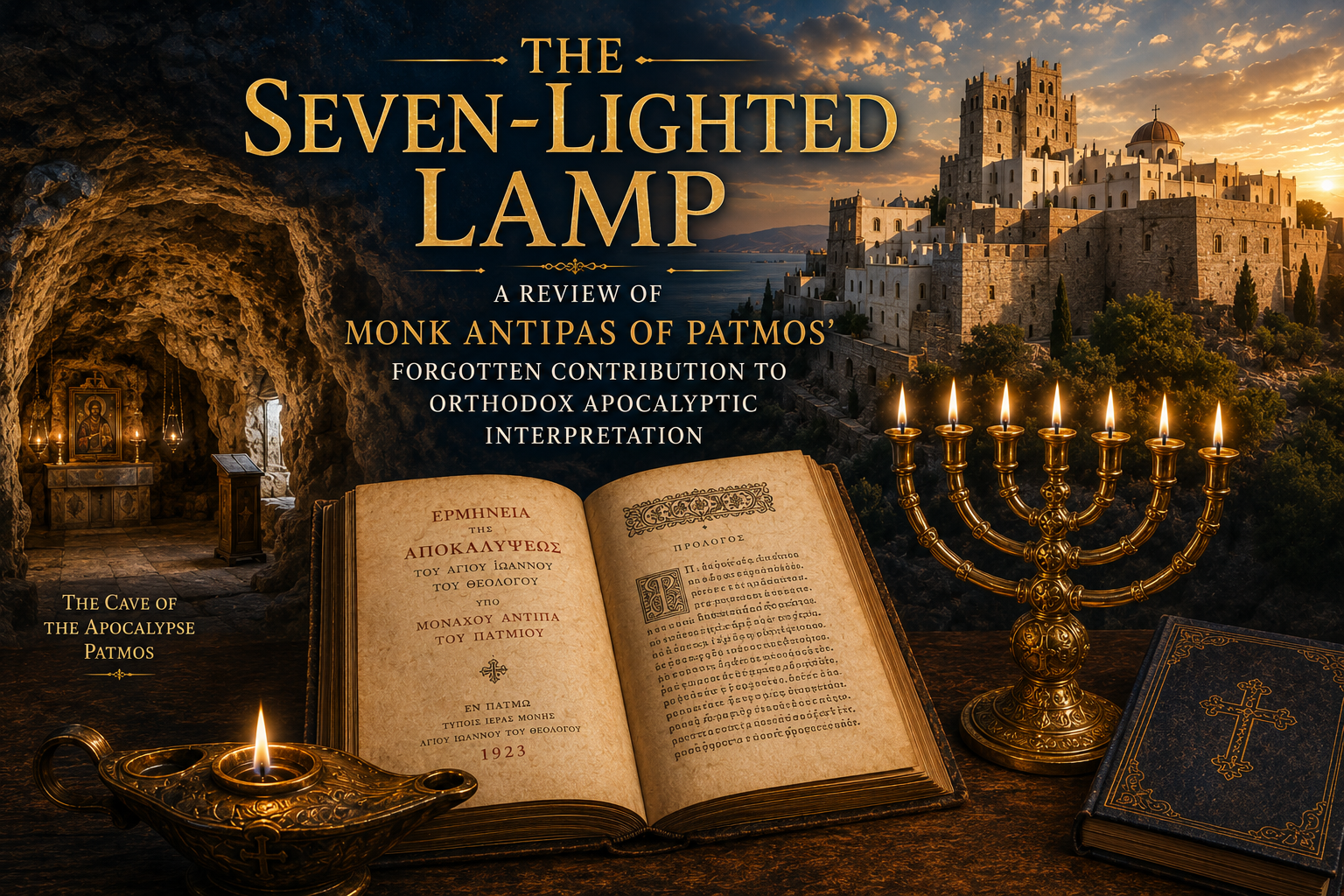
Among the numerous Orthodox commentaries on the Book of Revelation produced during the nineteenth and twentieth centuries, The Seven-Lighted Lamp, or An Interpretation of the Holy Apocalypse of John the Theologian (1923) by Monk Antipas of Patmos remains one of the least known and least studied. Published on the island traditionally associated with St. John’s reception of the Apocalypse, the work has remained inaccessible to English-speaking readers and has received virtually no attention in modern scholarship. Yet the commentary represents one of the most substantial modern Orthodox expositions of Revelation, combining patristic theology, liturgical symbolism, ecclesial history, and ascetical spirituality into a unified interpretation of the Apocalypse.
Unlike many modern studies that approach Revelation primarily through historical criticism, literary analysis, or speculative futurism, Antipas consistently interprets the book through the life of the Orthodox Church. His commentary is deeply Christological, profoundly ecclesial, and firmly rooted in the patristic tradition, while at the same time offering several original theological syntheses. Among its most distinctive contributions is the sustained identification of the Seven Thunders with the Seven Ecumenical Councils, a theme developed throughout the commentary as a theological framework for understanding the preservation of Orthodox doctrine throughout history. Rather than presenting prophecy as an isolated sequence of future events, Antipas understands the Apocalypse as the revelation of Christ’s continual guidance of His Church through worship, doctrine, persecution, confession, and ultimate victory.
The present study is based upon a (forthcoming) complete English translation of the commentary and seeks to evaluate its historical setting, theological method, principal themes, relationship to earlier Orthodox interpreters, and significance for contemporary studies of Orthodox apocalyptic interpretation. It argues that The Seven-Lighted Lamp deserves recognition as one of the most important twentieth-century Orthodox commentaries on Revelation and merits renewed attention within both Orthodox theology and the wider field of biblical studies.
Introduction
The history of Orthodox interpretation of the Book of Revelation has long been dominated by the classical commentaries of Andrew of Caesarea and Arethas of Caesarea, whose works established the principal exegetical framework through which the Apocalypse was read for centuries within the Byzantine tradition.¹ Although these foundational commentaries have rightly received considerable scholarly attention, the later development of Orthodox interpretation has remained comparatively neglected. In particular, the rich corpus of post-Byzantine and modern Greek commentaries has seldom been examined in a systematic manner, leaving significant voices virtually unknown outside the Greek-speaking world.
Among these neglected works is The Seven-Lighted Lamp, or An Interpretation of the Holy Apocalypse of John the Theologian, published on Patmos in 1923 by the monk Antipas. Written during a period of profound political and ecclesiastical upheaval following the First World War and the Asia Minor Catastrophe, the commentary represents one of the most ambitious modern Orthodox expositions of Revelation. Despite its considerable scope and theological richness, it has remained almost entirely absent from academic discussion and has never before been available in a complete English translation.
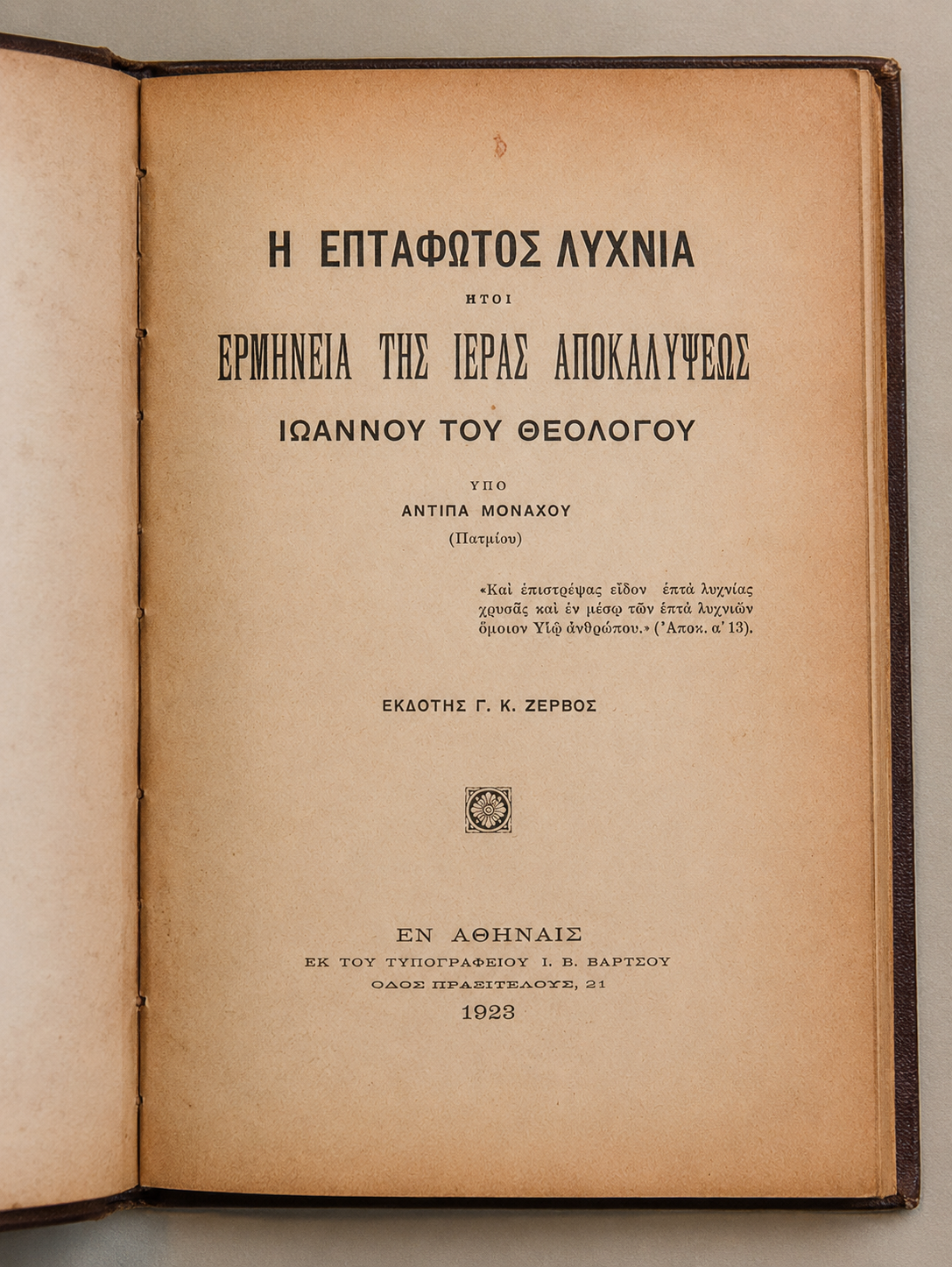
The neglect of Antipas’ commentary is significant because it preserves an important witness to the continuing development of Orthodox biblical interpretation during the modern period. Rather than approaching Revelation primarily through historical criticism or speculative eschatology, Antipas interprets the Apocalypse within the doctrinal, liturgical, and historical life of the Orthodox Church. His commentary demonstrates that Orthodox reflection upon Revelation did not conclude with the Byzantine Fathers but continued to develop through later generations while remaining firmly rooted in the Church’s patristic inheritance.
The purpose of the present study is to examine Antipas’ commentary within its historical and theological context and to assess its contribution to Orthodox interpretation of the Apocalypse. It will be argued that The Seven-Lighted Lamp represents one of the most substantial twentieth-century Orthodox commentaries on Revelation and deserves renewed attention within both Orthodox theology and the wider field of biblical studies.
Historical Background
The Seven-Lighted Lamp, or An Interpretation of the Holy Apocalypse of John the Theologian was published on the island of Patmos in 1923, a year of profound transition for both the Greek nation and the Orthodox Church. The First World War had recently concluded, the Ottoman Empire had collapsed, and the Greco-Turkish War (1919–1922) had ended in the Asia Minor Catastrophe, resulting in the displacement of hundreds of thousands of Orthodox Christians from their ancestral homes. Simultaneously, the Orthodox world was entering a period of internal uncertainty marked by ecclesiastical debates, calendar reform, and the reconfiguration of political authority throughout the eastern Mediterranean. Although Monk Antipas rarely comments directly upon contemporary events, the historical setting inevitably forms the backdrop against which his interpretation of the Apocalypse was composed.²

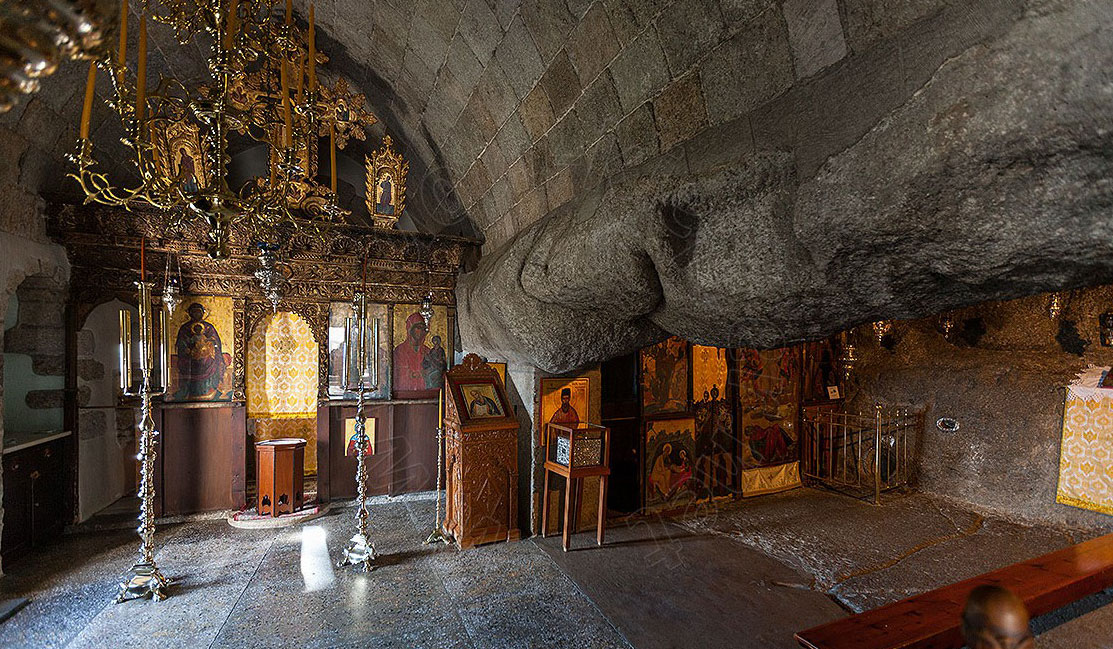
Patmos itself occupies a unique place within the Christian imagination. According to the ancient tradition of the Church, it was on this island that St. John the Theologian received the visions recorded in the Book of Revelation while exiled under the Roman emperor Domitian.³ The Cave of the Apocalypse and the Monastery of St. John the Theologian had, for centuries, made Patmos not merely a site of pilgrimage but a living center of prayer, biblical reflection, and monastic scholarship. It is therefore fitting that one of the most substantial modern Orthodox commentaries on Revelation should emerge from the very place where the sacred visions were first received.
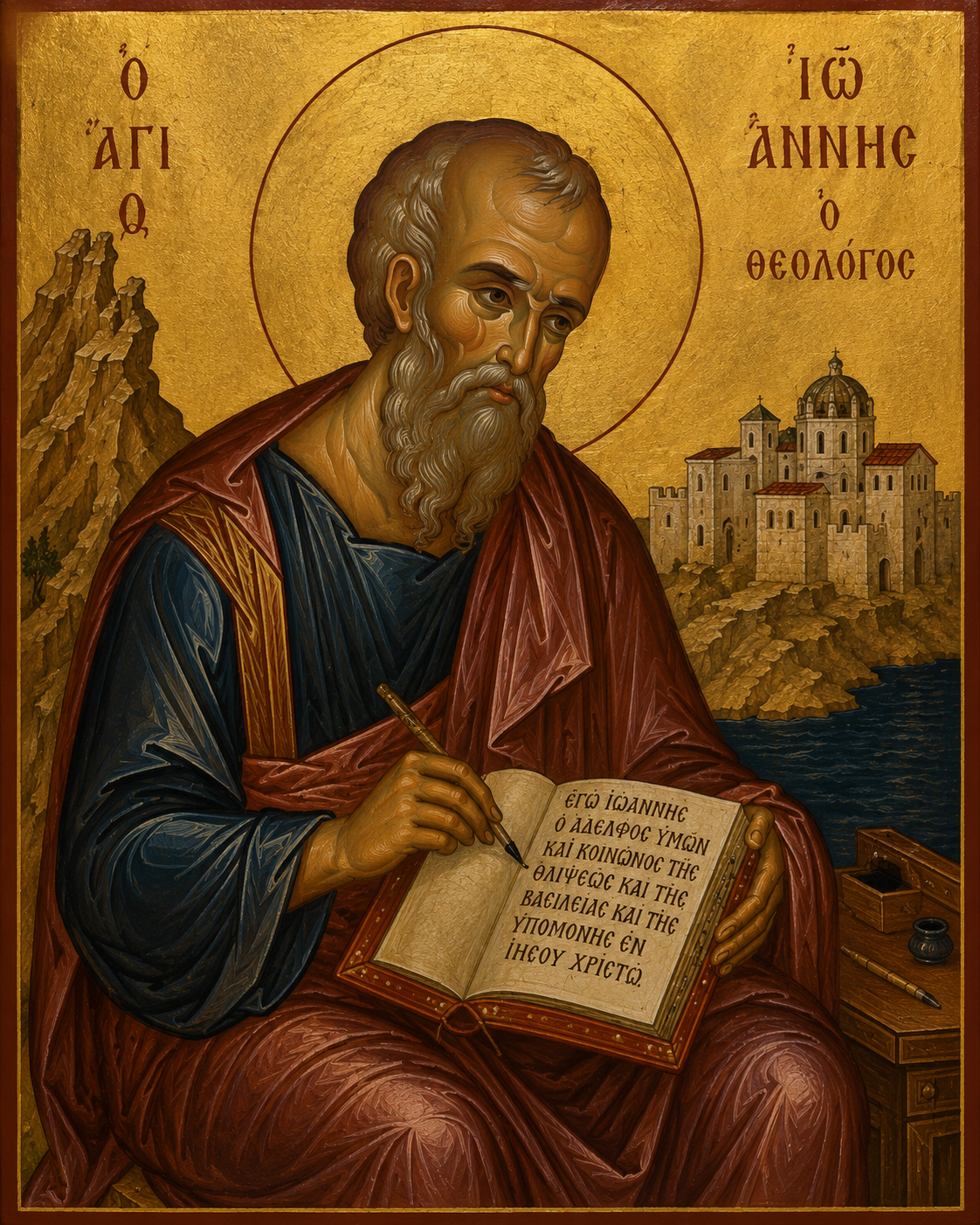
Relatively little is known concerning the life of Monk Antipas himself. Unlike many academic theologians of his generation, he did not emerge from the theological faculties of Athens or Constantinople, nor did he seek recognition through scholarly institutions. The editor of the work, Gerasimos K. Zervos, openly acknowledges that Antipas was largely self-taught, an admission that lends credibility to his assessment rather than diminishing it.⁴ Instead of emphasizing formal education, Zervos presents Antipas as a monk whose understanding of Scripture was formed through decades of prayer, ascetical discipline, liturgical participation, and continual meditation upon the Apocalypse. Whether or not one accepts every aspect of this portrayal, it reflects a thoroughly Orthodox conviction that theological knowledge is inseparable from the life of holiness and the worship of the Church.
The commentary itself confirms this characterization. Antipas displays an impressive familiarity with Holy Scripture, the language of the Divine Services, and the theological vocabulary of the Fathers. His interpretation moves effortlessly between biblical texts, hymnographic imagery, ecclesiastical history, and doctrinal reflection without treating these as separate disciplines. Revelation is approached not merely as an object of academic investigation but as the living testimony of Christ addressed to His Church in every generation.
The publication of the commentary was further strengthened by the endorsement of Gerasimos K. Zervos, one of the best-known Orthodox publishers and editors of early twentieth-century Greece. In his two-page prologue, Zervos presents Antipas’ work neither as an exercise in speculative prophecy nor as an academic theological treatise. Rather, he introduces it as the fruit of prolonged spiritual contemplation rooted in what he describes as “the unbroken spirit of patristic philosophy.”⁵ Although he acknowledges the author’s lack of formal academic training and even comments upon the density of his literary style, his overall assessment is strikingly positive. Indeed, he concludes by describing The Seven-Lighted Lamp as “a serious contribution to the science of interpreting the Apocalypse.”⁶
Perhaps the most intriguing aspect of Zervos’ introduction is his identification of the principal problem confronting interpreters of Revelation. Contrary to the common assumption that the Apocalypse is obscure because of its symbolic language, Zervos argues that the real difficulty lies in correctly relating its symbols to the events and persons of history.⁷ This observation is of considerable significance, for it reveals that both editor and author assumed the visions of Revelation to possess genuine historical referents. The challenge, in their estimation, was not whether the Apocalypse unfolds within history but how that history should be understood in continuity with the mind of the Orthodox Church. This methodological assumption provides an important key for interpreting the commentary as a whole and distinguishes it from approaches that restrict Revelation exclusively to the first century or postpone its fulfillment almost entirely to the end of the age.
The historical setting of The Seven-Lighted Lamp therefore extends beyond the political circumstances of 1923.
The Editor’s Prologue: A Methodological Manifesto
The two-page prologue written by Gerasimos K. Zervos is far more than a conventional editorial introduction. Rather than merely commending the author or summarizing the contents of the volume, Zervos provides a theological and hermeneutical framework through which the reader is invited to approach the commentary. In retrospect, after considering the work as a whole, it becomes evident that the prologue functions as a methodological manifesto, introducing many of the principles that characterize Antipas’ interpretation from beginning to end.
Zervos opens by observing that numerous interpretations of the Apocalypse had already appeared, both by ancient Fathers and by more recent Orthodox and heterodox writers. Yet, in his judgment, these works often left the ordinary reader no closer to understanding the mystery of Revelation than before. The principal difficulty, he argues, is not the symbolic nature of the visions themselves but the inability to correlate “the historical events and persons with the symbols of the Apocalypse.”⁸ This statement deserves careful attention. It assumes that the visions of Revelation possess concrete historical referents and that the task of interpretation consists in discerning those correspondences faithfully. The issue, therefore, is not whether Revelation unfolds within history but how sacred history is to be recognized through the symbolic language of the text.
Such an observation immediately distinguishes the commentary from approaches that either confine Revelation almost entirely to the circumstances of the first century or postpone its fulfillment almost exclusively to the final generation before the Second Coming. For Zervos, history is not incidental to the Apocalypse; it is the divinely appointed arena within which the prophetic visions are progressively manifested. Nevertheless, this historical perspective is never presented as an invitation to speculative chronology or arbitrary identification of contemporary events. Instead, the editor repeatedly insists that historical interpretation must remain governed by the continuous witness of the Orthodox Church.
This balance becomes especially clear when Zervos describes Antipas’ work as seeking to establish “a new method of spiritual discernment and prophecy.”⁹ Read in isolation, such language might suggest theological innovation. Yet the second page of the prologue immediately qualifies this impression by affirming that the commentary is characterized by “the unbroken spirit of patristic philosophy.”¹⁰ The apparent tension between novelty and continuity is therefore resolved. Antipas is not presented as introducing a new theology, nor as departing from the interpretive principles of the Fathers. Rather, the “new method” consists in applying the perennial wisdom of the Orthodox tradition to the continuing historical unfolding of the Apocalypse. The novelty lies not in doctrine but in synthesis.
This distinction is borne out repeatedly throughout the commentary itself. Antipas rarely proposes interpretations without grounding them in Scripture, liturgical tradition, or established Orthodox theology. Even where his symbolic identifications display considerable originality, they remain integrated into a thoroughly ecclesial and Christological framework. His work therefore exemplifies a pattern frequently encountered within Orthodox theological development: continuity of faith accompanied by fresh insight as the providential course of history reveals dimensions of Scripture not previously apparent.¹¹
Equally significant is the editor’s insistence that the commentary should not be regarded as an academic theological treatise. Zervos explicitly contrasts scholarly investigation with the spiritual perception cultivated through prayer, worship, and ascetical life. He presents Antipas not as a professional theologian but as a monk whose prolonged meditation upon the Apocalypse, undertaken within the sacred environment of Patmos, gradually opened the spiritual meaning of the text.¹² Such language reflects a deeply rooted Orthodox understanding of theology itself. Knowledge of divine mysteries is not attained solely through intellectual mastery but through purification of heart, participation in the sacramental life of the Church, and conformity to the mind of Christ.
Importantly, this emphasis does not constitute a rejection of theological learning. Zervos himself was an educated editor who readily recognized the value of careful scholarship. Indeed, he concludes by describing The Seven-Lighted Lamp as “a serious contribution to the science of interpreting the Apocalypse.”¹³ The contrast, therefore, is not between scholarship and spirituality but between a merely academic knowledge of Scripture and the experiential knowledge cultivated within the ascetical life of the Church. Theology, in the Orthodox understanding reflected by the prologue, reaches its highest fulfillment when intellectual inquiry and spiritual experience are united.
The editor’s candor concerning Antipas’ limitations further enhances the credibility of his assessment. Rather than presenting the work as flawless, Zervos frankly acknowledges that the author’s literary style is often dense, that his language could at times have been simpler, and that his lack of formal academic education resulted in certain imperfections.¹⁴ Such admissions are noteworthy precisely because they are balanced by an equally firm conviction that these deficiencies are outweighed by the commentary’s theological depth, patristic spirit, and spiritual insight. The reader is thus encouraged to approach the work not in search of literary elegance but in expectation of theological illumination.
The prologue concludes with a memorable image of the Christian life as the ascent of a difficult mountain path. Guided by the “inward light of an ascetic soul,” the reader is invited to climb toward the summit, where an expansive horizon of the glory of Christ comes into view.¹⁵ This metaphor serves as an apt summary of Antipas’ entire commentary. Revelation is not presented merely as a book to be decoded but as a spiritual ascent into the mystery of Christ’s kingdom. Historical interpretation, doctrinal reflection, liturgical worship, and ascetical transformation are all portrayed as complementary dimensions of a single journey toward the vision of divine glory.
Viewed in light of the commentary as a whole, Zervos’ introduction proves remarkably accurate. His portrayal of Antipas as a profoundly ecclesial, Christ-centered, and patristically grounded interpreter is consistently confirmed throughout the work. More importantly, the methodological principles articulated in these opening pages provide an essential lens through which the commentary should be understood. They remind the reader that the Apocalypse is neither an esoteric puzzle nor a detached historical document, but the living revelation of Jesus Christ entrusted to His Church and progressively manifested within her history.
The Structure and Literary Character of the Commentary
At first glance, The Seven-Lighted Lamp appears to follow the familiar pattern of a traditional verse-by-verse commentary on the Book of Revelation. Antipas proceeds sequentially through the twenty-two chapters of the Apocalypse, explaining individual verses and larger visionary units while frequently introducing supporting passages from both the Old and New Testaments. Yet a closer reading reveals that the work possesses a literary and theological coherence extending well beyond simple sequential exposition. The commentary is not merely an accumulation of isolated interpretations but a sustained theological meditation in which each vision contributes to an overarching understanding of Christ’s revelation to His Church.
Unlike many modern commentaries that devote extensive attention to grammatical analysis, textual criticism, or competing scholarly opinions, Antipas rarely pauses to discuss technical exegetical questions. His concern is not primarily philological but theological. The biblical text is approached as a unified revelation whose symbols illuminate one another through the broader witness of Scripture, the worship of the Church, and the accumulated wisdom of the Fathers. Individual images are therefore seldom interpreted in isolation. Instead, Antipas repeatedly returns to earlier visions, creating an intricate network of theological relationships that binds the entire Apocalypse into a coherent whole.
One of the most distinctive literary characteristics of the commentary is its extensive use of biblical cross-references. Passages from Daniel, Ezekiel, Isaiah, Zechariah, the Psalms, the Gospels, and the Pauline Epistles appear throughout the work, often without extended explanation, as though Scripture naturally interprets Scripture within the consciousness of the Church. Revelation is thus presented not as an isolated prophetic document but as the culmination of the entire biblical narrative. The Apocalypse gathers together themes already present throughout the Scriptures and reveals their fulfillment in the person and work of Jesus Christ.
Closely related to this biblical approach is Antipas’ continual reliance upon the liturgical and theological language of Orthodoxy. Although explicit citations of the Fathers are comparatively limited when measured against formal academic commentaries, the work is permeated by patristic modes of thought. Familiar expressions drawn from conciliar theology, hymnography, ecclesiastical tradition, and Orthodox spiritual vocabulary appear naturally throughout the exposition. The result is a commentary that often reads less like an academic monograph and more like an extension of the Church’s liturgical and theological consciousness.
Another noteworthy feature is the density of Antipas’ symbolic reasoning. Rarely does he restrict a biblical image to a single level of meaning. A symbol may simultaneously possess Christological, ecclesiological, sacramental, historical, and moral dimensions without these being regarded as mutually exclusive. Such an approach reflects a classical Orthodox sensitivity to the richness of biblical symbolism. Rather than reducing the imagery of Revelation to a single historical event or exclusively allegorical meaning, Antipas frequently allows several complementary levels of interpretation to coexist within the same passage. The result is a commentary that rewards slow and repeated reading but can also prove demanding for readers accustomed to more narrowly analytical forms of exegesis.
This density is acknowledged by the editor himself, who observes that the author’s language is at times complex and that his style may appear difficult to the casual reader.¹⁶ Such criticism is not without foundation. Antipas often compresses several theological ideas into a single paragraph, assuming considerable familiarity with Scripture, Orthodox doctrine, and liturgical symbolism. His prose is therefore not always immediately accessible to modern readers. Yet these stylistic challenges arise less from obscurity of thought than from the extraordinary concentration of theological material. As Zervos himself remarks, although the style may be demanding, “the meaning is always clear,” for the author expresses his ideas with remarkable precision.¹⁷
Perhaps the most remarkable literary quality of the commentary is its internal consistency. Over the course of more than five hundred pages, Antipas develops a series of recurring theological themes that reappear with increasing clarity as the exposition progresses. Symbols introduced in the opening chapters often receive fuller development many chapters later, while earlier interpretations are illuminated rather than contradicted by subsequent discussion. This cumulative method gives the commentary an architectural quality. Like the construction of a cathedral, each individual stone contributes to a larger design that only becomes fully visible upon completion of the work.
The commentary also exhibits a notable balance between historical exposition and spiritual application. Historical interpretation is never pursued for its own sake. Likewise, spiritual reflection is rarely detached from the concrete realities of ecclesiastical history. Instead, Antipas consistently views historical events as manifestations of deeper theological realities. The Apocalypse therefore becomes simultaneously the history of the Church, the revelation of Christ, the preservation of Orthodox doctrine, and the spiritual pilgrimage of every faithful believer. These dimensions are woven together with remarkable consistency throughout the commentary and constitute one of its defining literary characteristics.
For this reason, The Seven-Lighted Lamp resists easy classification. It is neither a purely historical commentary nor an exclusively mystical one. It is not simply devotional literature, nor is it an academic theological treatise in the modern sense. Rather, it belongs to a distinctively Orthodox tradition in which biblical exegesis, doctrinal theology, liturgical worship, ecclesiastical history, and ascetical spirituality form an inseparable whole. Appreciating this integrated character is essential for understanding both the strengths of Antipas’ interpretation and its enduring significance within the wider history of Orthodox biblical exegesis.
Christ at the Center of the Apocalypse
Perhaps the most pervasive characteristic of Monk Antipas’ commentary is its unwavering Christological focus. Although the Apocalypse contains visions of angels, beasts, kingdoms, judgments, martyrs, and cosmic conflict, Antipas consistently refuses to allow these secondary themes to eclipse the central subject of the book itself: the revelation of Jesus Christ. In this respect, his interpretation remains faithful to the opening words of Revelation, which identify the prophecy not simply as a revelation concerning future events but as “the Revelation of Jesus Christ” (Rev. 1:1). Throughout the commentary, every major symbol, vision, and historical development ultimately derives its meaning from the person and work of the incarnate Son of God.
This Christocentric orientation is evident from the opening chapters and continues without interruption through the final vision of the New Jerusalem. Antipas repeatedly directs the reader away from an unhealthy fascination with prophetic chronology or political speculation and toward the sovereign lordship of Christ over history. The Apocalypse is therefore not interpreted as a catalogue of catastrophes but as the progressive manifestation of Christ’s righteous government over His Church and the world. Even scenes of judgment are understood not as arbitrary displays of divine wrath but as revelations of the justice, holiness, and providence of the victorious Lamb.
This emphasis is anticipated in Gerasimos Zervos’ prologue, where the editor commends the commentary for unveiling not only the symbolic imagery of St. John but also “the supernatural mystery of the righteousness and glory of Christ.”¹⁸ Such a statement accurately summarizes the work as a whole. Antipas’ principal concern is never merely to explain symbols but to reveal how those symbols testify to Christ’s continuing activity throughout the life of the Church. Every vision ultimately becomes a theological witness to the economy of salvation.
Nowhere is this Christological emphasis more evident than in Antipas’ treatment of the recurring titles and images of Christ throughout Revelation. The Lamb who was slain yet lives, the Son of Man walking among the lampstands, the Rider upon the white horse, the Alpha and the Omega, the Bridegroom of the New Jerusalem, and the enthroned Judge are not presented as disconnected metaphors but as complementary revelations of the one incarnate Lord. Antipas continually interprets these images through the doctrinal language of the Ecumenical Councils, safeguarding the confession that Jesus Christ is both fully God and fully man, one Person in two natures without confusion, change, division, or separation.¹⁹ The Apocalypse thus becomes not merely an eschatological prophecy but a sustained confession of Orthodox Christology.
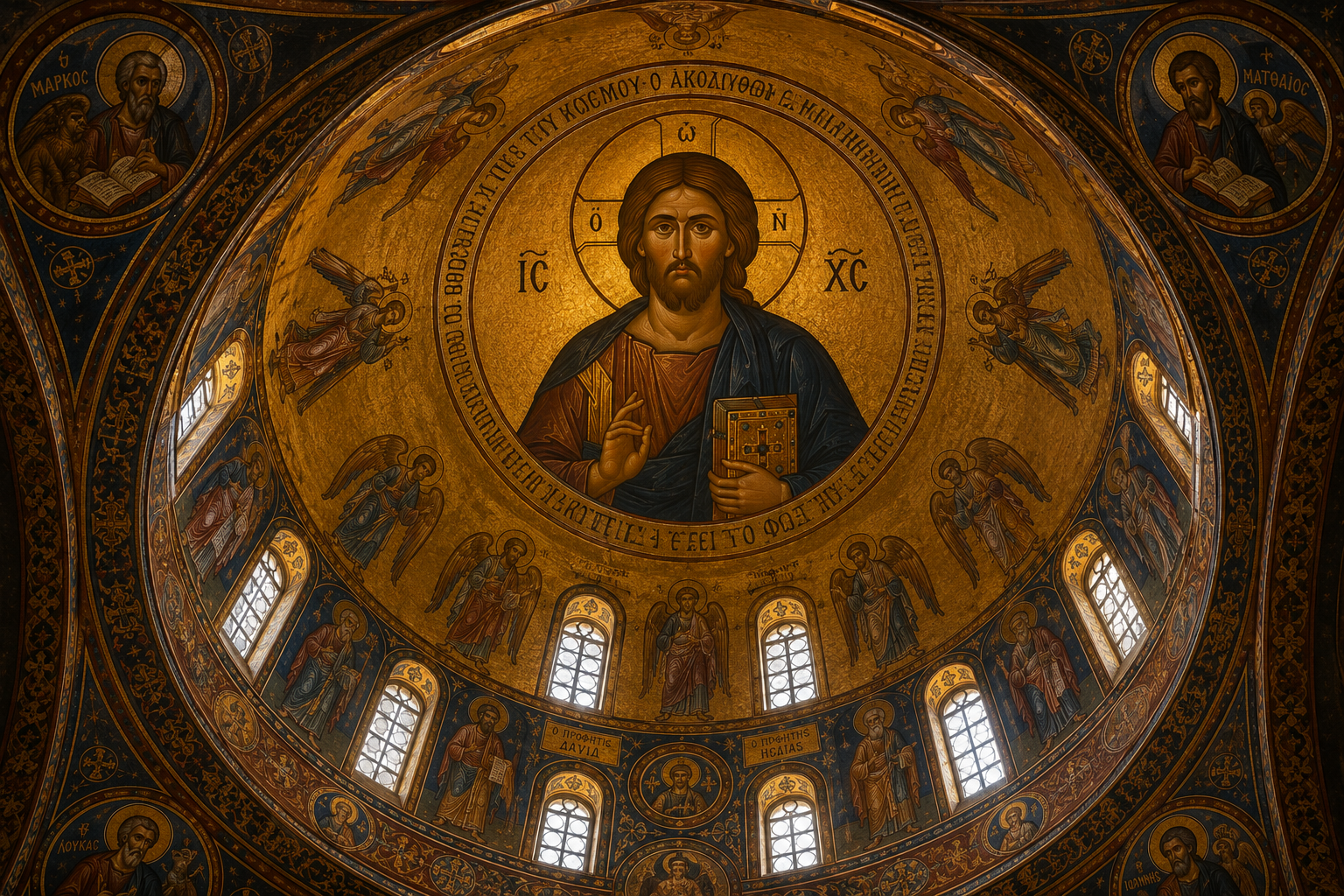
Particularly striking is Antipas’ interpretation of Revelation 12:11, where the saints overcome the dragon “by the blood of the Lamb and by the word of their testimony.” Rather than treating this passage solely as a description of martyrdom, Antipas understands the victory of the Church as inseparable from the confession of the God-Man. He explains the believers’ testimony as the confession of the one hypostasis of Christ, thereby linking the triumph of the saints directly to the Christological definitions preserved by the Ecumenical Councils.²⁰ This interpretation illustrates a characteristic feature of the commentary: doctrinal theology is never detached from biblical exegesis but is woven directly into the fabric of the Apocalypse itself.
Closely related to this Christological emphasis is Antipas’ conviction that every major movement of history unfolds under the providential government of Christ. Empires rise and fall, persecutions intensify and diminish, heresies emerge and are overcome, yet the central reality remains unchanged: Christ continues to walk among the lampstands, preserving His Church and directing history toward its appointed consummation. Human history is therefore neither autonomous nor governed by impersonal forces. It is the arena within which the risen Lord accomplishes His redemptive purposes.
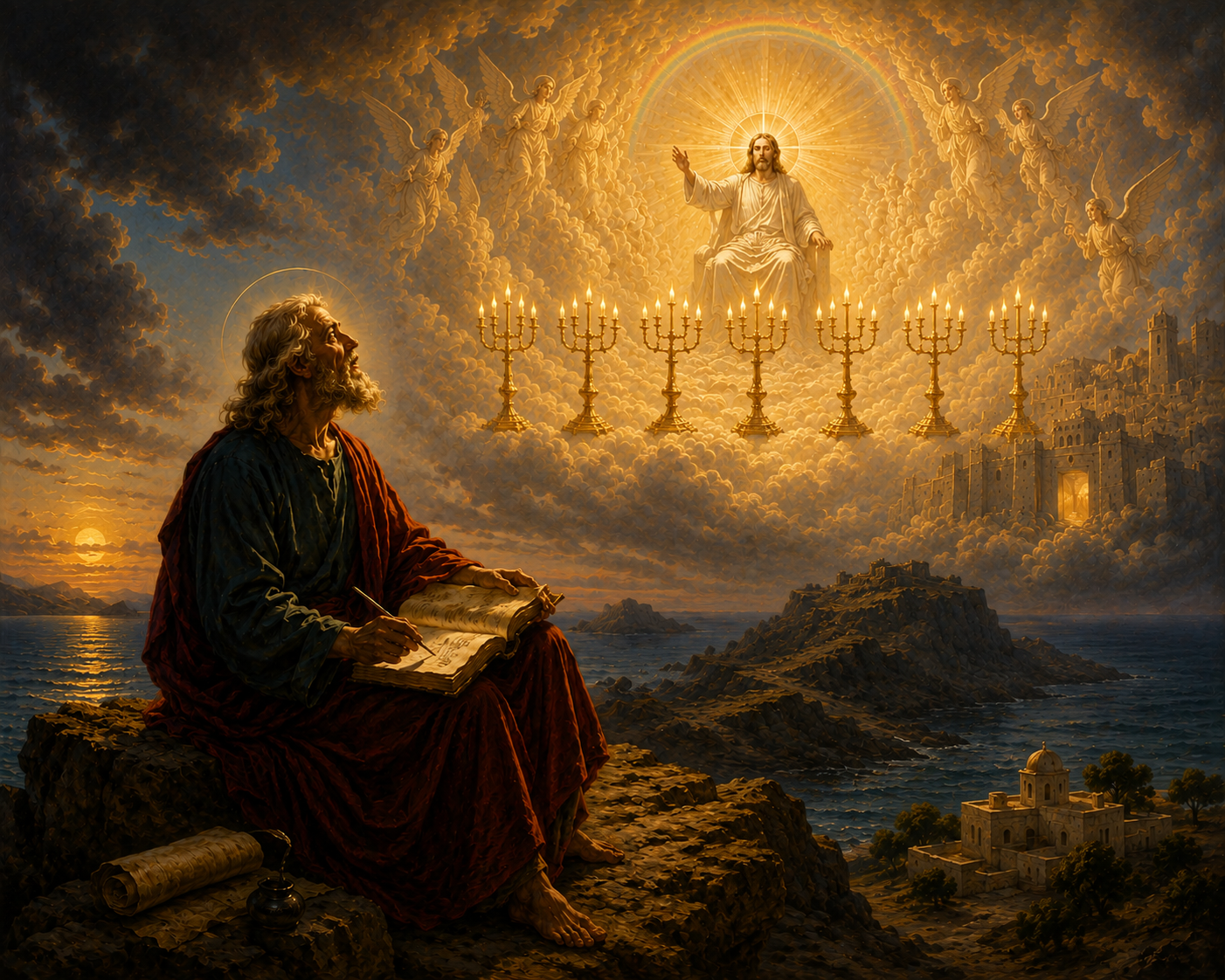
This perspective also shapes Antipas’ treatment of divine judgment. Unlike interpretations that emphasize terror or sensationalism, his exposition consistently presents judgment as the manifestation of Christ’s righteousness. The seals, trumpets, bowls, and final assize reveal not merely the punishment of evil but the vindication of divine justice and the ultimate triumph of truth. Throughout the commentary, judgment serves redemption by purifying the faithful, exposing falsehood, and bringing history to its fulfillment in the Kingdom of God.
The Christological unity of the commentary reaches its climax in the closing chapters of Revelation. The New Jerusalem is not presented simply as a future heavenly city but as the consummation of Christ’s saving work in His Bride. Likewise, the river of the water of life flowing from the throne of God and of the Lamb, cited by Zervos at the conclusion of his prologue, becomes an image of the inexhaustible life communicated by the risen Christ to His people.²¹ The Apocalypse ends where it began—with the glory of Christ illuminating His creation and dwelling eternally among those whom He has redeemed.
The significance of this sustained Christocentric emphasis cannot be overstated. Modern discussions of Revelation often become preoccupied with questions of chronology, political symbolism, or competing eschatological systems. Antipas, by contrast, repeatedly recalls the reader to the theological center of the Apocalypse. History possesses meaning because Christ governs it. The Church endures because Christ preserves her. The martyrs overcome because Christ has conquered death. The Kingdom comes because Christ reigns. Every symbol, every judgment, every promise, and every vision ultimately finds its coherence in Him.
For this reason, the commentary should not primarily be classified as a work of historical interpretation, mystical theology, or ecclesiastical symbolism, although it undoubtedly contains all three. At its deepest level, The Seven-Lighted Lamp is a sustained meditation upon the person and work of Jesus Christ as revealed in the final book of Holy Scripture. It is this profoundly Christological vision that provides the foundation upon which the remainder of Antipas’ interpretation is constructed.
The Church as the Hermeneutical Key to the Apocalypse
If Christ constitutes the theological center of Antipas’ interpretation of the Apocalypse, the Orthodox Church constitutes its living historical and sacramental context. One of the defining characteristics of The Seven-Lighted Lamp is the consistency with which Revelation is interpreted through the life of the Church. Rather than treating the Apocalypse primarily as a chronicle of political empires or military conflicts, Antipas understands its visions as revealing Christ’s continual preservation, purification, and ultimate glorification of His Body throughout history. The Church is not merely one subject within Revelation; she is the divinely appointed sphere in which the revelation of Jesus Christ is received, confessed, defended, and ultimately consummated.
This ecclesiological perspective distinguishes Antipas from many modern approaches to the Apocalypse. While historical-critical scholarship often concentrates upon the first-century churches of Asia Minor and popular eschatological literature frequently emphasizes future geopolitical events, Antipas consistently interprets Revelation through the historical experience of the Church. Historical events possess theological significance only insofar as they illuminate Christ’s providential care for His people.
Throughout the commentary, the principal symbols of Revelation converge upon ecclesial realities. The Woman clothed with the sun, the Ark of the Covenant, the Temple, the Lampstand, the Bride, the Holy City, and the Two Witnesses are all interpreted within the life of the Church. Rather than dispersing these symbols into unrelated historical or allegorical meanings, Antipas integrates them into a unified ecclesiological vision extending across the entire Apocalypse. Symbols introduced early in the book receive fuller theological development as the commentary progresses, revealing an intentional coherence that culminates in the New Jerusalem as the perfected communion of God and His people.
This ecclesial framework also governs Antipas’ understanding of doctrine. Dogma is never treated as an abstract theological system imposed upon Scripture but as the Church’s faithful confession of the revelation entrusted to her by Christ. The Ecumenical Councils, the witness of the saints, and the continuity of Orthodox worship all testify to the preservation of apostolic truth throughout history. Revelation therefore becomes not only the history of persecution but also the history of the Church’s doctrinal fidelity.
Likewise, worship occupies a central place in Antipas’ interpretation. The heavenly liturgy of the Apocalypse is continually reflected in the worship of the earthly Church, so that Revelation is read not merely as a prophecy of future events but as a living book proclaimed within the Church’s liturgical life. This liturgical perspective reinforces the fundamental unity between heaven and earth that characterizes the entire commentary.
At the same time, Antipas never separates doctrine, worship, history, and spiritual life into independent categories. They function together as complementary dimensions of a single divine economy unfolding through the life of the Church under the guidance of the Holy Spirit. This synthetic approach distinguishes his commentary from many modern studies that examine these subjects in isolation.
This ecclesial vision also shapes Antipas’ understanding of the faithful remnant. The Church’s identity is defined not by political power but by her confession of Christ, preservation of apostolic doctrine, and patient endurance amid suffering. Even in periods of persecution or apparent defeat, she remains the Bride of the Lamb, sustained by divine grace until the consummation of all things. The Apocalypse thus becomes the continuing testimony of Christ’s faithfulness to His Church throughout history.
Viewed as a whole, Antipas’ recurring emphasis upon doctrinal continuity, liturgical worship, ecclesiastical history, and spiritual perseverance arises from a single hermeneutical conviction: Revelation is the book of the Church because it is the revelation of Jesus Christ to His Church.
Within this broader ecclesiological framework, Antipas develops what is arguably his most original theological contribution: the sustained interpretation of the Seven Thunders as figures of the Seven Ecumenical Councils. Far from being an isolated symbolic proposal, this identification follows naturally from his conviction that the doctrinal life of the Church constitutes one of the principal means by which Christ preserves and manifests His truth throughout history. It is to this distinctive contribution that the present study now turns.
The Seven Thunders and the Seven Ecumenical Councils
Among the many theological insights contained within The Seven-Lighted Lamp, none is more original or more consistently developed than Monk Antipas’ interpretation of the Seven Thunders (Rev. 10:3–4) as figures of the Seven Ecumenical Councils. While earlier Orthodox commentators occasionally associated various sevens of the Apocalypse with aspects of the Church’s doctrinal life, Antipas elevates this theme into one of the governing principles of the entire commentary. The result is a comprehensive ecclesiological synthesis in which the doctrinal definitions of the Ecumenical Councils become indispensable for understanding both the symbolism and the historical fulfillment of the Apocalypse.
The vision of the Seven Thunders has long presented a challenge to interpreters. After the mighty angel cries aloud, “the seven thunders uttered their voices,” yet St. John is immediately commanded to seal what they have spoken and not to write it down (Rev. 10:3–4). Patristic commentators generally approached the passage with considerable restraint, acknowledging the mystery of the sealed voices while refraining from definitive identification.²² Antipas, however, proposes that the silence surrounding the Seven Thunders is itself profoundly significant. Their message is not lost but preserved within the doctrinal consciousness of the Orthodox Church.
According to Antipas, the Seven Thunders signify the Seven Ecumenical Councils through which the Holy Spirit definitively articulated the apostolic faith against successive waves of heresy. This interpretation transforms an otherwise enigmatic passage into a powerful theological affirmation of doctrinal continuity. The councils do not merely belong to ecclesiastical history; they represent the authoritative voice of Christ speaking through His Church. Their decrees, once proclaimed, remain permanently sealed—not in the sense of being hidden, but in the sense of being complete, inviolable, and incapable of alteration.
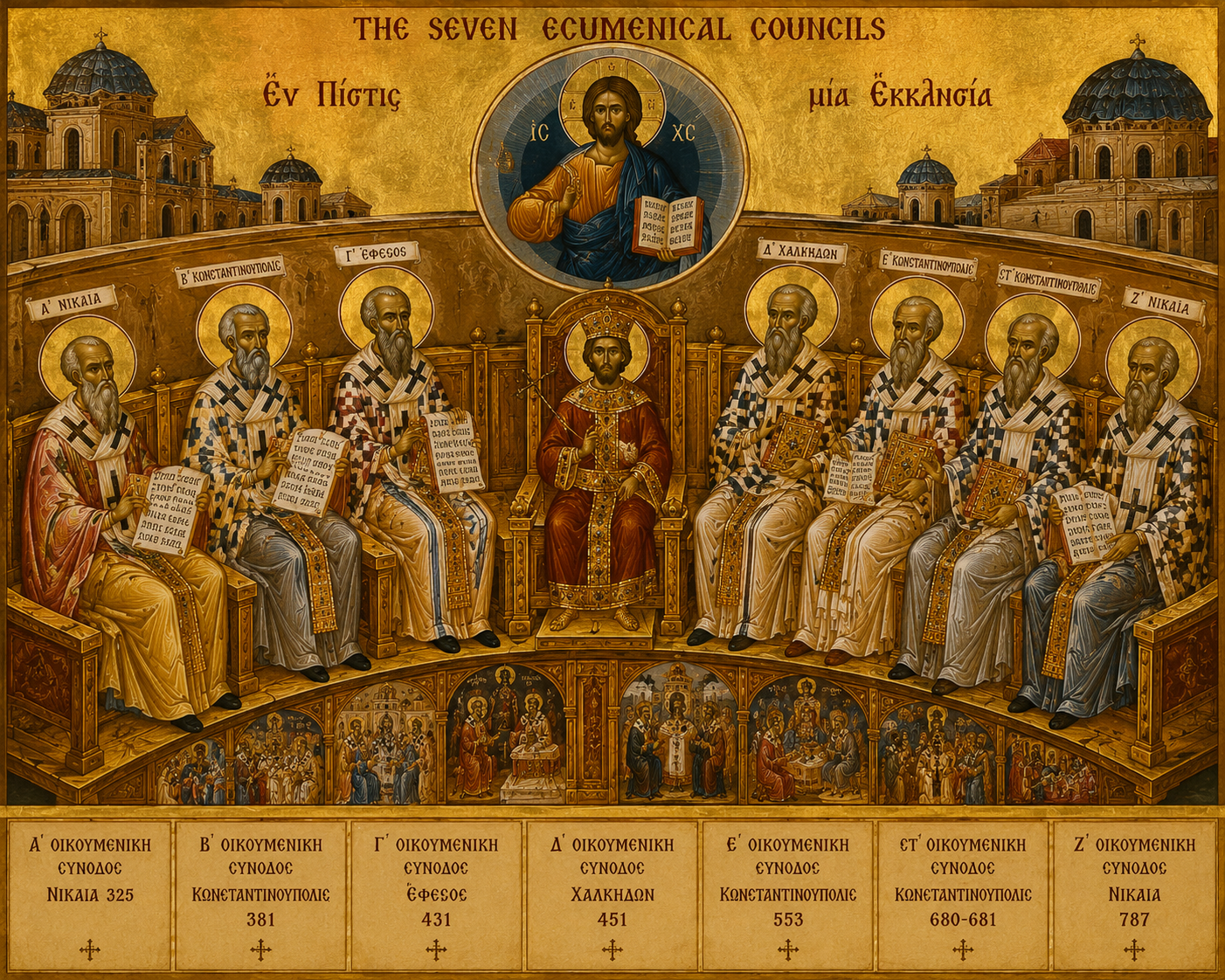
This understanding illuminates one of the recurring themes of the commentary: the inseparable relationship between revelation and doctrine. For Antipas, divine revelation did not cease with the apostolic age, nor does the Church continue to receive new public revelation. Rather, the Ecumenical Councils preserve and faithfully articulate the once-for-all revelation entrusted to the saints. The sealing of the Seven Thunders therefore signifies the definitive character of Orthodox dogma. Their voice continues to resound throughout the Church, not by the addition of new doctrines but through the faithful preservation and proclamation of the apostolic faith.
The theological implications of this interpretation extend far beyond Revelation 10. Throughout the commentary, Antipas gradually connects the Seven Thunders with other prominent septenary symbols appearing in the Apocalypse. The Seven Spirits before the throne, the Seven Eyes of the Lamb, the Seven Lampstands, and other recurring sevens are interpreted within the same doctrinal and ecclesial framework. Rather than functioning as isolated symbolic units, these images collectively testify to the fullness of divine wisdom manifested within the historical life of the Church. The symbolism of seven consistently points toward completeness—not merely numerical completeness, but the perfection of God’s providential work through His Church.
This integrative approach reaches one of its most distinctive expressions in Antipas’ broader theology of the Church’s doctrinal life. The Ecumenical Councils are not viewed simply as historical assemblies convened to resolve theological controversies. They become enduring manifestations of the Holy Spirit’s guidance of the Church throughout history. Their definitions preserve the confession of the God-Man, safeguard the integrity of apostolic faith, and provide the doctrinal foundation upon which the Church continues to interpret Scripture. Consequently, the Apocalypse itself cannot be understood apart from the theological vision embodied in the councils.
The significance of this insight becomes particularly apparent when considered alongside Antipas’ interpretation of Revelation 12. The victory of the faithful over the dragon is repeatedly associated with the confession of Christ’s true person and saving work. The triumph of the saints is therefore doctrinal as well as moral. Heresy represents not merely intellectual error but an assault upon the revelation of Christ entrusted to the Church. Conversely, the preservation of Orthodox doctrine constitutes an essential dimension of the Church’s victory throughout history. In this respect, the Seven Thunders become symbols not only of doctrinal definition but of the Church’s faithful witness amid continual spiritual conflict.
Antipas’ interpretation also exhibits a profoundly liturgical dimension. The councils are never treated as relics of a distant past. Their dogmatic formulations continue to shape the worship, hymnography, sacramental life, and daily confession of the Orthodox Church. Doctrine lives within doxology. The sealed voices of the Seven Thunders continue to echo wherever the Nicene-Constantinopolitan Creed is confessed, the Divine Liturgy is celebrated, and the faithful proclaim the apostolic faith handed down through the Fathers. Revelation thus becomes inseparable from the living worship of the Church.
One of the most compelling aspects of Antipas’ exposition is its remarkable theological coherence. The interpretation of the Seven Thunders is not introduced as an isolated symbolic speculation but emerges naturally from themes already established throughout the commentary. If Christ governs history through His Church, if the Church preserves His revelation through her doctrine, and if Revelation itself is fundamentally ecclesial, then it follows that one of the central symbolic sevens of the Apocalypse should find its fulfillment within the Church’s definitive doctrinal witness. What initially appears to be an innovative proposal gradually reveals itself as the logical culmination of Antipas’ entire hermeneutical method.
This interpretation likewise provides an important contribution to the history of Orthodox biblical exegesis. While Protestant historicist commentators frequently identified prophetic symbols with political kingdoms, emperors, reform movements, or chronological epochs, Antipas directs the reader toward the doctrinal life of the Church itself. History remains important, but ecclesiastical history takes precedence over secular history. The decisive events of sacred history are not measured solely by imperial victories or political revolutions but by the Church’s faithful confession of Christ through the Ecumenical Councils. In this respect, Antipas offers a distinctively Orthodox form of historical interpretation in which prophecy is fulfilled above all within the life of the Church.
Whether one ultimately accepts every aspect of Antipas’ symbolic identification is, in some respects, secondary to recognizing its theological significance. His interpretation of the Seven Thunders demonstrates an extraordinary effort to read Revelation through the integrated life of Orthodox doctrine, worship, history, and spirituality. It exemplifies his conviction that the Apocalypse is not merely a book about the future but a revelation continually illuminating the Church’s pilgrimage through history.
In the judgment of the present reviewer, this sustained identification of the Seven Thunders with the Seven Ecumenical Councils constitutes Monk Antipas’ most original contribution to modern Orthodox interpretation of the Apocalypse. It transforms one of Revelation’s most enigmatic visions into a profound meditation upon the permanence of Orthodox doctrine and the abiding guidance of the Holy Spirit within the Church. Even apart from the commentary’s many other strengths, this theological synthesis alone deserves careful attention from future students of Orthodox biblical interpretation.
Revelation as Sacred History
Throughout The Seven-Lighted Lamp, Monk Antipas consistently understands the visions of the Apocalypse as unfolding within the course of human history. Yet history, for Antipas, is not merely the record of political events or the backdrop against which prophecy is fulfilled. It is sacred history because it is governed by the providence of Jesus Christ, who guides His Church through persecution, doctrinal conflict, worship, and ultimate victory. The Apocalypse therefore reveals not only future events but Christ’s continual activity within the life of His Church.
This understanding is anticipated in Gerasimos Zervos’ introductory observation that the principal challenge of interpreting Revelation lies in correlating “historical events and persons with the symbols of the Apocalypse.”²³ Antipas accepts this premise throughout the commentary. Yet his purpose is not simply to identify prophetic symbols with historical incidents or construct a chronological scheme. Historical events derive their significance from their place within the unfolding economy of salvation.
Accordingly, the movement of Revelation possesses a clear theological direction. History advances toward the consummation of Christ’s Kingdom, and each age reveals another stage in His providential governance of the Church. The persecutions of the faithful, the rise of heresies, the Ecumenical Councils, and the preservation of Orthodox doctrine are all understood as manifestations of Christ’s continuing work within history. The Apocalypse is therefore interpreted not merely as a prophecy of future events but as the history of the Church under the lordship of Christ.
A defining characteristic of Antipas’ historical method is the subordination of political history to ecclesiastical history. Empires, kingdoms, and rulers certainly appear within Revelation, but they possess theological significance only insofar as they affect the life and witness of the Church. Consequently, Antipas devotes greater attention to doctrinal developments, the Ecumenical Councils, the struggle against heresy, and the preservation of apostolic tradition than to political chronology alone. The decisive events of history are those in which the Church faithfully confesses Christ.
This perspective distinguishes Antipas from several major approaches to Revelation. Unlike preterist interpretations, he does not confine the Apocalypse to the first-century Roman world. Unlike many futurist systems, he does not postpone its fulfillment almost entirely to the period immediately preceding the Second Coming. And although he shares with Protestant historicists the conviction that Revelation unfolds progressively throughout history, his focus remains fundamentally ecclesial rather than political. Sacred history is not primarily the history of nations but the history of the Body of Christ living within them.
Another notable feature of Antipas’ historical vision is its confidence in divine providence. The Apocalypse certainly contains persecution, apostasy, judgment, and conflict, yet these never become the governing theme of the commentary. Christ remains sovereign throughout every age, preserving His Church despite the rise of heresy, hostile powers, and suffering. This confidence also explains Antipas’ freedom from sensationalism. Historical interpretation serves a pastoral purpose, encouraging perseverance and hope rather than speculation about political events or future catastrophes.
Viewed as a whole, Antipas presents Revelation as the sacred history of Christ’s continuing work within His Church. Time itself becomes meaningful because it is the arena in which divine providence is manifested and the Kingdom advances toward its final consummation. By integrating prophecy with ecclesiastical history, doctrine, and worship, The Seven-Lighted Lamp offers a thoroughly Orthodox vision of history in which the unfolding life of the Church remains the primary context for understanding the Apocalypse.
Liturgy and the Apocalypse
One of the most distinctive qualities of The Seven-Lighted Lamp is the ease with which Monk Antipas moves between the text of Revelation and the liturgical life of the Orthodox Church. Modern biblical scholarship often treats the Apocalypse primarily as a literary composition, an historical document, or an apocalyptic text situated within the religious world of Second Temple Judaism and the early Roman Empire. Antipas does not deny these dimensions, yet his interpretive horizon is considerably broader. For him, Revelation is above all a liturgical book because it reveals the heavenly worship into which the earthly Church continually enters through her sacramental and ecclesiastical life.
This perspective is deeply rooted in the Orthodox tradition. From the earliest centuries, the Divine Liturgy has been understood as a participation in the worship of heaven rather than merely a remembrance of past events. The hymns of the angels, the praise of the elders, the incense rising before the throne of God, the altar, the Lamb, the white-robed martyrs, and the heavenly temple all find living expression within Orthodox worship. Antipas assumes this liturgical continuity throughout his commentary. The Apocalypse is therefore not simply read in the Church; it is continually experienced within the worship of the Church.
Consequently, liturgical imagery occupies a central place in Antipas’ exposition. The heavenly sanctuary described by St. John is never regarded as entirely removed from earthly worship. Instead, the liturgical life of the Church becomes a visible participation in the heavenly realities disclosed by Revelation. The altar signifies both the heavenly throne and the sacramental life of the Church. The incense offered before God reflects the prayers of the saints continually ascending in the Divine Liturgy. The hymns of victory sung before the throne become inseparable from the Church’s own doxology. Heaven and earth are united through worship because both are gathered around the same glorified Christ.
This liturgical perspective also explains Antipas’ remarkable sensitivity to ecclesiastical symbolism. Throughout the commentary, biblical images are illuminated not only by other passages of Scripture but also by the language of Orthodox hymnography, festal celebrations, and sacramental theology. The Apocalypse is interpreted within the living memory of the Church rather than through historical reconstruction alone. Symbolism therefore acquires its fullest meaning when contemplated within the rhythm of Orthodox worship.
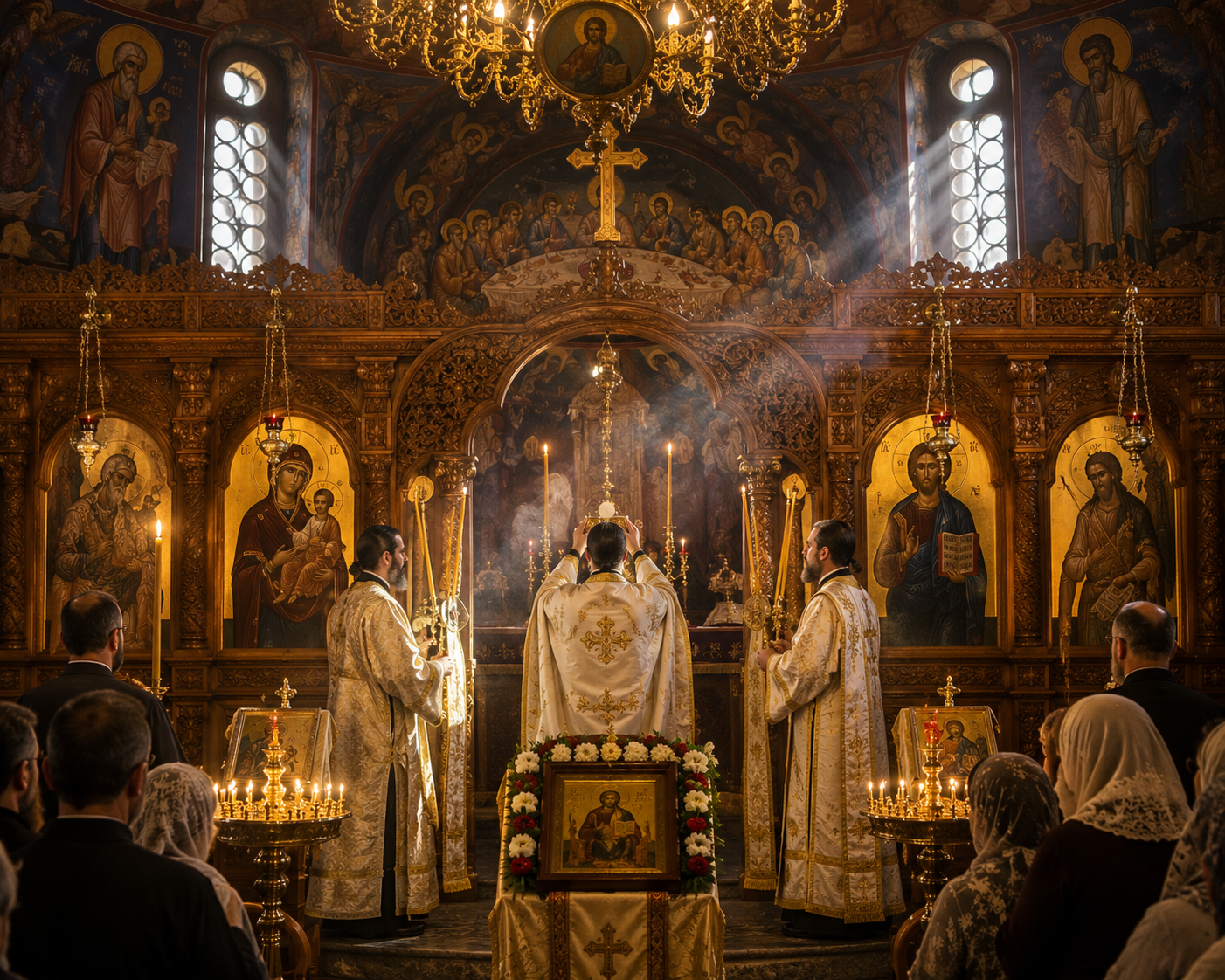
The relationship between doctrine and liturgy likewise occupies an important place within Antipas’ theological vision. The Ecumenical Councils are not treated merely as historical assemblies that settled theological disputes. Their dogmatic definitions continue to live within the liturgical confession of the Church. Every celebration of the Divine Liturgy, every recitation of the Nicene-Constantinopolitan Creed, every festal hymn proclaiming the mystery of the Incarnation, and every confession of Christ as true God and true man bears witness to the doctrinal victories preserved by the councils. Theology is not confined to written texts but is continually sung, prayed, and celebrated by the worshipping community.
This union of doctrine and worship becomes especially apparent in Antipas’ interpretation of the Apocalypse’s recurring images of light. Throughout the commentary, divine illumination is never understood merely as intellectual enlightenment. Light signifies the manifestation of divine truth within the Church through Christ, the Holy Spirit, the apostolic faith, and the worship of the faithful. The Church herself becomes the bearer of this heavenly light, reflecting the glory of Christ into the world through her liturgy, her saints, and her confession.
Closely related to this theme is Antipas’ frequent movement between biblical vision and ecclesiastical experience. The Apocalypse does not remain confined to the visionary experiences of St. John on Patmos. Rather, its symbols continually reappear within the lived experience of the Orthodox Church. The faithful hear the praises of heaven echoed in the Divine Services. They encounter the Lamb in the Eucharistic assembly. They join the company of angels and saints through prayer. They confess the faith preserved by the Fathers. In this way, Revelation becomes a present ecclesial reality rather than merely a record of future events.
This liturgical consciousness also serves an important hermeneutical function. Antipas repeatedly interprets difficult passages of Revelation through the Church’s worship rather than through speculative reconstruction. Liturgical tradition becomes a guide to biblical interpretation because both arise from the same apostolic faith. The worship of the Church preserves not only doctrine but also the spiritual imagination necessary for understanding the symbolic language of the Apocalypse. The faithful learn to read Revelation by participating in the life of the Church that continually proclaims it.
Perhaps nowhere is this more evident than in Antipas’ understanding of the relationship between heaven and earth. Modern readers often imagine the Apocalypse as describing a distant heavenly world disconnected from present ecclesiastical life. Antipas rejects such separation. The worship of heaven and the worship of the Church are not parallel realities but one continuous act of praise centered upon the Lamb who was slain and now reigns forever. The Divine Liturgy therefore becomes, in a profound sense, an anticipation of the eternal worship described in the closing chapters of Revelation.
This liturgical orientation further reinforces one of the central arguments of the present study. Antipas’ interpretation cannot be reduced to historical exegesis alone. His concern is never merely to identify prophetic symbols with historical events. History itself is interpreted through the Church’s worship because worship manifests the enduring presence of Christ within His people. Prophecy, doctrine, liturgy, and history therefore form an indivisible theological unity.
The enduring significance of this perspective should not be underestimated. In an age when biblical interpretation is frequently detached from the liturgical life of the Church, Antipas offers a compelling reminder that the Apocalypse was given to a worshipping community and continues to be understood most fully within that same worshipping community. Revelation is not only a prophetic book; it is also the Church’s book of praise. Every vision ultimately directs the faithful toward the heavenly liturgy in which Christ Himself is eternally glorified.
This liturgical dimension prepares the way for another essential feature of Antipas’ theology. If Revelation is interpreted within the worship of the Church, it is likewise interpreted through the spiritual transformation of those who participate in that worship. The Apocalypse is not merely to be understood intellectually or celebrated liturgically; it is to be lived through repentance, humility, perseverance, and holiness. It is to this ascetical dimension of the commentary that attention must now be directed.
Ascetical Theology and the Interpretation of Revelation
One of the most distinctive features of The Seven-Lighted Lamp is that it never treats the interpretation of Revelation as a merely intellectual exercise. Throughout the commentary, biblical understanding is inseparable from spiritual transformation. The Apocalypse is not presented as a book to be mastered through technical scholarship alone, but as a divine revelation whose deepest meaning is progressively disclosed through prayer, repentance, humility, and participation in the sacramental life of the Church. In this respect, Antipas stands firmly within the classical Orthodox conviction that theology is not simply learned but lived.
This principle is announced at the very beginning of the work. In his prologue, Gerasimos K. Zervos repeatedly emphasizes that Antipas’ commentary should not be read as a conventional academic treatise. Rather, he presents it as the fruit of prolonged ascetical labor, continual meditation upon the Apocalypse, and faithful participation in the spiritual life of the Church.²⁴ Whatever rhetorical enthusiasm characterizes the editor’s language, the commentary itself consistently confirms this perspective. Theological insight is portrayed not as the reward of intellectual brilliance but as the fruit of spiritual purification.
This ascetical orientation governs Antipas’ reading of Revelation throughout the commentary. The Apocalypse is not primarily a source of speculative curiosity concerning future events but a call to repentance, perseverance, vigilance, and deeper communion with Christ. Prophecy therefore possesses an unmistakably pastoral purpose: it summons believers to spiritual transformation rather than mere intellectual understanding.
Humility likewise occupies a central place in Antipas’ hermeneutic. Pride obscures spiritual vision, whereas humility prepares the soul to receive divine illumination. Zervos repeatedly urges readers to approach the commentary without self-confidence or contentiousness, seeking instead “guidance from the inward light of an ascetic soul.”²⁶ Such language does not discourage careful theological inquiry; rather, it reflects the traditional Orthodox conviction that scholarship and holiness are complementary rather than opposing pursuits.
The prominence of the martyrs throughout Revelation further illustrates this ascetical perspective. Victory over the powers of evil is never attributed to worldly strength or political success but to faithful witness, patient endurance, and sacrificial love. Likewise, Antipas interprets the Apocalypse’s spiritual warfare not merely as a succession of historical conflicts but as the continual struggle for holiness within the life of every believer. Historical events remain important, yet they derive their deepest significance from the Church’s faithful confession of Christ.
This perspective also explains the commentary’s remarkable freedom from sensationalism. Rather than cultivating fear or fascination with catastrophic events, Antipas consistently interprets even Revelation’s most terrifying visions within the larger framework of divine providence and Christ’s final victory. Judgment serves repentance, tribulation refines faith, and prophecy ultimately strengthens hope. Throughout the commentary, the Lamb remains sovereign over every trial.
The ascetical character of The Seven-Lighted Lamp also shapes its literary tone. Antipas writes less as a detached academic than as a spiritual guide accompanying the reader through the Apocalypse. His exposition frequently becomes pastoral exhortation, inviting the faithful not merely to understand Revelation but to live according to its message. Scripture is continually directed toward the transformation of the reader rather than the satisfaction of intellectual curiosity.
This orientation finds one of its most memorable expressions in the concluding image of Zervos’ prologue. The reader is invited to ascend a difficult mountain path under the guidance of an ascetic soul until reaching a summit from which the glory of Christ is revealed in its fullness.²⁷ The metaphor aptly summarizes Antipas’ entire hermeneutic. Revelation is not conquered through intellectual effort alone but gradually unveiled through spiritual growth and faithful participation in the life of the Church.
The enduring significance of this ascetical approach extends beyond Antipas’ own commentary. At a time when biblical interpretation is often separated from the spiritual formation of the interpreter, The Seven-Lighted Lamp offers a distinctly Orthodox reminder that exegesis and discipleship belong together. Scholarship remains valuable, yet its fullest purpose is realized only when united with prayer, worship, repentance, and holiness. In this respect, Antipas’ commentary contributes not only to the interpretation of Revelation but also to the broader Orthodox understanding of theology itself.
Having considered the Christological, ecclesiological, historical, liturgical, and ascetical dimensions of Antipas’ method, it now becomes possible to situate The Seven-Lighted Lamp within the broader history of Orthodox interpretation of the Apocalypse and to assess both its continuity with earlier tradition and its distinctive contribution to modern Orthodox exegesis.
Antipas Within the Orthodox Exegetical Tradition
No commentary on the Apocalypse should be evaluated in isolation from the broader tradition of Orthodox biblical interpretation. The Book of Revelation has occupied a distinctive place within the life of the Eastern Church, where its symbolic richness, profound Christology, and liturgical character have invited generations of theologians to contemplate its mysteries with both reverence and restraint. Monk Antipas consciously stands within this tradition. His commentary neither rejects the Fathers nor seeks to replace them. Rather, it represents a mature continuation of Orthodox exegesis, drawing upon earlier foundations while addressing the historical and theological questions of his own age.
The primary foundation of Antipas’ work remains the classical Byzantine tradition represented above all by Andrew of Caesarea. Andrew established the enduring Orthodox principle that Revelation must be interpreted according to the rule of faith preserved by the Church and that the fulfillment of prophecy becomes progressively clearer through “time and experience.”²⁸ Antipas inherits these principles without modification. Like Andrew, he approaches Revelation as the revelation of Jesus Christ to His Church, reads Scripture through Scripture, and remains firmly committed to Nicene and Chalcedonian orthodoxy. His originality lies not in departing from Andrew but in extending this method into a later historical context.
A similar continuity may be observed with Arethas of Caesarea. Arethas likewise emphasized the ecclesial character of the Apocalypse and interpreted its symbolism within the life of the Church. Antipas develops this trajectory further by integrating doctrinal history, liturgical theology, and the Ecumenical Councils into a more comprehensive theological synthesis. His interpretation of the Seven Thunders as the Seven Ecumenical Councils illustrates this development while remaining consistent with the broader patristic conviction that Revelation is fundamentally a book of the Church.
The relationship between Antipas and the later Greek commentators is particularly significant because it reveals the continuing vitality of Orthodox apocalyptic interpretation after the Byzantine period. Rather than treating Revelation as a closed field of patristic exegesis, these writers sought to interpret the Apocalypse in light of the Church’s unfolding historical experience while remaining faithful to the doctrinal inheritance of the Fathers.
John Lindios represents one important development within this later tradition. His commentary repeatedly associates the Apocalypse’s recurring septenary symbolism—the Seven Spirits, Seven Eyes, Seven Thunders, and related images—with the Seven Ecumenical Councils. In doing so, Lindios places the doctrinal life of the Church at the center of Revelation’s symbolic structure, emphasizing that the preservation of Orthodox confession constitutes one of the principal themes of sacred history. Antipas clearly shares this ecclesial concern but develops it more extensively, making the Seven Ecumenical Councils one of the governing principles of his entire interpretation rather than a recurring symbolic observation.
Apostolos Makrakis illustrates another trajectory within modern Greek interpretation. While equally committed to the Christological and ecclesial character of Revelation, Makrakis gives greater attention to the historical unfolding of prophecy through the life of the Church, particularly in relation to the rise of Islam, the doctrinal struggles of Christianity, and the providential course of ecclesiastical history. His commentary demonstrates how sacred history extends beyond the apostolic age into the successive centuries of the Church’s witness. Antipas shares this historical consciousness but consistently subordinates political developments to the Church’s doctrinal, liturgical, and sacramental life. History remains important because it reveals Christ’s continuing governance of His Church.
Theodoret of Ioannina provides yet another perspective shaped by the historical experience of Orthodoxy under Ottoman rule. Writing within the context of prolonged foreign domination, he interprets the Apocalypse through the sufferings, hopes, and historical memory of the Orthodox people. His exposition reflects the conviction that Revelation continues to illuminate the lived experience of the Church across successive generations. Antipas likewise understands prophecy as unfolding throughout history, yet his primary emphasis falls less upon political deliverance than upon the Church’s enduring preservation through worship, doctrine, and spiritual perseverance.
Viewed together, these later commentators reveal a remarkable continuity within post-Byzantine Orthodox interpretation of Revelation. All understand the Apocalypse as extending beyond the first century and unfolding within the historical life of the Church. Yet each emphasizes a different aspect of that unfolding. Lindios highlights the doctrinal significance of the Ecumenical Councils, Makrakis develops the historical dimension of sacred history, and Theodoret interprets prophecy through the lived experience of Orthodox Christianity under Ottoman domination. Antipas does not simply repeat these earlier emphases. Rather, he brings them together into a more comprehensive theological synthesis in which Christology, ecclesiology, sacred history, liturgical worship, doctrinal continuity, and ascetical spirituality function as complementary dimensions of a single hermeneutical vision.
The originality of Antipas’ contribution should therefore be understood with precision. He introduces no new dogmas and never claims to supersede the Fathers. Rather, his originality lies in theological synthesis. Throughout The Seven-Lighted Lamp, themes that often appear separately in earlier commentators are woven into a coherent interpretation of the Apocalypse centered upon the continuing life of the Orthodox Church. Christology, ecclesiology, sacred history, liturgy, doctrine, and ascetical theology are integrated into a unified vision that remains thoroughly Orthodox while exhibiting considerable theological creativity.
For this reason, Antipas deserves recognition as one of the most significant modern representatives of the Orthodox exegetical tradition. His commentary stands organically within the line of Andrew and Arethas while also reflecting the continued development of Orthodox apocalyptic interpretation in the post-Byzantine period. Far from standing at the margins of Orthodox biblical interpretation, The Seven-Lighted Lamp demonstrates that the tradition remained intellectually and spiritually vibrant well into the twentieth century.
Strengths of the Commentary
The principal strength of The Seven-Lighted Lamp lies in the remarkable coherence of its theological vision. Rather than approaching Revelation through a single interpretive lens, Antipas consistently integrates Christology, ecclesiology, sacred history, liturgical theology, ascetical spirituality, and biblical symbolism into a unified exposition centered upon the revelation of Jesus Christ within the life of His Church. The commentary neither fragments these themes nor allows one to eclipse the others. Instead, they function together as complementary dimensions of a distinctively Orthodox interpretation of the Apocalypse.
Equally impressive is the commentary’s profoundly ecclesial character. Throughout the work, Revelation is interpreted within the worship, doctrine, and historical experience of the Orthodox Church rather than in abstraction from it. Scripture, Holy Tradition, the Ecumenical Councils, and the liturgical life of the Church are presented not as competing authorities but as mutually illuminating witnesses to the same apostolic faith. This integrated approach gives the commentary a theological consistency that distinguishes it from many modern treatments of Revelation.
Among Antipas’ most original contributions is his sustained interpretation of the Seven Thunders as symbols of the Seven Ecumenical Councils. Whether or not one ultimately accepts every aspect of this proposal, it represents a creative and internally coherent attempt to understand the Apocalypse through the doctrinal life of the Church. More broadly, it illustrates Antipas’ conviction that Orthodox doctrine is not external to Scripture but one of the principal means by which the Church has faithfully preserved and confessed its meaning throughout history.
Another notable strength is the commentary’s extensive use of Scripture to interpret Scripture. Revelation is read as the culmination of the entire biblical canon, with continual reference to the prophets, the Gospels, and the apostolic writings. This biblical interconnectedness reflects a thoroughly patristic instinct and reinforces the unity of divine revelation across both Testaments.
The commentary also succeeds in maintaining an admirable balance between historical interpretation and spiritual application. Antipas neither reduces the Apocalypse to a catalogue of historical events nor transforms it into an abstract mystical allegory. Instead, history serves the larger theological purpose of revealing Christ’s providential guidance of His Church. The result is an interpretation that remains historical without becoming narrowly political and spiritual without abandoning historical reality.
Finally, The Seven-Lighted Lamp possesses a pastoral and ascetical depth that distinguishes it from many modern commentaries. The Apocalypse is presented not merely as a text to be analyzed but as a revelation to be lived through repentance, prayer, perseverance, and participation in the sacramental life of the Church. Combined with the work’s internal consistency and theological synthesis, this spiritual orientation gives the commentary an enduring vitality that extends beyond its particular historical interpretations.
Taken together, these strengths establish The Seven-Lighted Lamp as considerably more than a devotional meditation or historical curiosity. It is a serious work of Orthodox biblical theology whose integrated vision, theological originality, and ecclesial perspective merit careful consideration within the continuing history of Orthodox interpretation of the Apocalypse.
Limitations and Critical Observations
No commentary on the Apocalypse, however insightful, is without limitations. The Seven-Lighted Lamp is no exception. While the work possesses remarkable theological depth and internal coherence, certain aspects of its method and presentation invite critical reflection. These observations, however, should be understood not as fundamental objections to the commentary’s theological vision but as considerations that naturally arise from the genre in which Antipas was writing and from the interpretive tradition to which he consciously belonged.
The first limitation concerns the commentary’s relative lack of engagement with alternative interpretations. Antipas rarely pauses to survey competing exegetical positions or to defend his conclusions through extended argumentation. Unlike many modern academic commentaries, he does not systematically compare patristic opinions, interact with contemporary scholarship, or evaluate differing historical hypotheses. His exposition generally proceeds with confidence, assuming rather than demonstrating the validity of his interpretive framework. Readers accustomed to critical apparatuses, extensive bibliographies, and sustained dialogue with opposing viewpoints may therefore find portions of the work less analytically developed than contemporary scholarly studies.
Closely related to this observation is the commentary’s limited use of philological analysis. Antipas seldom devotes extended attention to questions of Greek grammar, textual criticism, manuscript variation, or the linguistic nuances of the biblical text. His primary interest lies in theological meaning rather than technical linguistic investigation. This emphasis reflects the traditional priorities of Orthodox spiritual exegesis, yet readers seeking detailed engagement with the original language will necessarily need to supplement his commentary with more specialized lexical and textual resources.
A further consideration concerns the nature of symbolic interpretation itself. Certain identifications proposed by Antipas inevitably remain open to discussion. As with virtually every historical interpretation of Revelation, some symbolic correspondences rest upon theological judgment rather than demonstrable historical certainty. Even readers broadly sympathetic to his ecclesial approach may occasionally question particular identifications or suggest alternative applications. Such differences should not be regarded as failures of the commentary but as reminders of the inherent complexity of apocalyptic literature, whose symbolism has invited diverse yet often complementary interpretations throughout the history of the Church.
Modern readers should also recognize that Antipas writes from within a distinctly Orthodox theological horizon. His commentary presupposes familiarity with the liturgical life of the Church, the authority of the Ecumenical Councils, the witness of the Fathers, and the continuity of Holy Tradition. These foundational assumptions are not argued from first principles but are accepted as the natural context for interpreting Scripture. Readers approaching Revelation from markedly different ecclesial traditions may therefore find certain aspects of his argument less immediately persuasive, not because of deficiencies in reasoning, but because of differing theological presuppositions regarding the nature of the Church and the authority of tradition.
Another limitation arises from the historical circumstances of the commentary itself. Published in 1923, Antipas necessarily wrote before many of the theological conversations, archaeological discoveries, manuscript studies, and literary analyses that have shaped subsequent biblical scholarship. His work therefore should not be evaluated according to standards that developed only later in the twentieth century. Conversely, it should also not be dismissed for failing to anticipate methodologies that lay outside both his historical context and his theological purpose. The commentary belongs to a different scholarly world, one whose questions and priorities often differed significantly from those of contemporary biblical studies.
It is likewise important to distinguish between Antipas’ theological method and the specific historical identifications that occasionally accompany it. The enduring value of the commentary does not depend upon universal agreement with every proposed correspondence between prophetic symbol and historical event. Individual interpretations may reasonably be reconsidered as new historical evidence emerges or as subsequent generations reflect upon the continuing fulfillment of sacred history. What gives the work its lasting significance is not the infallibility of every historical identification but the theological framework within which those identifications are situated—a framework rooted in Christ, the Church, Holy Tradition, and the providential governance of history.
Indeed, one of the commentary’s greatest strengths also introduces a corresponding challenge. Antipas’ commitment to theological integration occasionally results in symbolic networks of considerable complexity. Biblical imagery, ecclesiastical history, liturgical theology, doctrinal development, and spiritual interpretation are woven together with remarkable consistency, yet the density of these interconnections may require careful and repeated reading. The commentary rewards sustained study but does not readily lend itself to quick consultation or isolated proof-texting. Its arguments emerge cumulatively rather than through concise thematic summaries.
From the standpoint of modern academic conventions, readers may also desire more explicit documentation of Antipas’ patristic sources. Although the influence of the Fathers is evident throughout the work, formal citations are comparatively infrequent. The commentary often reflects the living memory of Orthodox tradition rather than the documentary style expected in contemporary scholarship. Future editions would benefit from annotations identifying these patristic parallels more explicitly, thereby assisting readers in tracing the continuity between Antipas and the earlier exegetical tradition.
Yet none of these observations substantially diminish the overall achievement of The Seven-Lighted Lamp. They instead clarify the nature of the work and establish appropriate expectations for its readership. Antipas did not intend to produce a critical commentary in the modern academic sense. He sought to interpret the Apocalypse from within the spiritual, doctrinal, liturgical, and historical life of the Orthodox Church. Judged according to that objective, the commentary succeeds to a remarkable degree.
Perhaps the most appropriate critical conclusion is therefore one of perspective. Readers seeking exhaustive philological discussion, comprehensive interaction with competing scholarly theories, or purely historical reconstruction will inevitably find aspects of the commentary incomplete. Those seeking an integrated Orthodox theological interpretation of Revelation, however—one that unites Scripture, Holy Tradition, worship, doctrine, ecclesiastical history, and the spiritual life—will discover in Antipas a commentator of uncommon depth and originality. His limitations are largely those of his chosen genre; his enduring strengths arise precisely from the fidelity with which he fulfills it.
Contribution to Modern Orthodox Apocalyptic Studies
The publication of a complete English translation of The Seven-Lighted Lamp provides an opportunity to reconsider the place of Monk Antipas within the history of Orthodox biblical interpretation. For much of the twentieth century, scholarly attention devoted to Orthodox exegesis of the Apocalypse remained concentrated upon the classical commentaries of Andrew of Caesarea and Arethas of Caesarea. While their foundational importance is beyond dispute, this emphasis has often left later Orthodox interpreters comparatively neglected. Antipas deserves renewed attention, not because he replaces the earlier Fathers, but because he demonstrates the continuing vitality of Orthodox apocalyptic interpretation well into the modern period.
More broadly, the commentary challenges the assumption that meaningful Orthodox engagement with the Apocalypse effectively concluded with the Byzantine era. The Seven-Lighted Lamp illustrates how later Orthodox interpreters continued to reflect upon Revelation while remaining firmly rooted in the doctrinal, liturgical, and spiritual inheritance of the Fathers. In this respect, Antipas stands not as an isolated figure but as a representative of a living exegetical tradition that continued to develop through changing historical circumstances.
The commentary likewise contributes to several important areas of contemporary theological discussion. It models an approach in which Scripture is interpreted within the life of the Church rather than in isolation from it, integrating biblical exegesis with Holy Tradition, liturgical worship, ecclesiastical history, and doctrinal theology. In doing so, Antipas offers a distinctly Orthodox hermeneutic that resists the fragmentation characteristic of many modern approaches to biblical interpretation.
Particularly deserving of future scholarly attention is Antipas’ sustained identification of the Seven Thunders with the Seven Ecumenical Councils. Whatever judgment scholars ultimately reach concerning this interpretation, it remains one of the most original and theologically integrated proposals in modern Orthodox exegesis of Revelation. More importantly, it reflects the broader conviction that the doctrinal life of the Church is itself indispensable for understanding the Apocalypse. This proposal alone warrants careful comparison with both the Byzantine commentators and later Orthodox interpreters.
The commentary also raises questions extending beyond Orthodox scholarship alone. Antipas invites renewed reflection upon the relationship between Scripture and Tradition, the role of liturgy in biblical interpretation, the theological meaning of sacred history, and the place of ecclesial experience in the interpretation of prophecy. These remain significant questions within contemporary biblical theology and ecumenical dialogue alike.
Perhaps the commentary’s greatest contribution, however, lies not in any single historical identification or symbolic interpretation but in its integrated theological vision. Throughout the work, Christology, ecclesiology, sacred history, liturgy, doctrine, and ascetical spirituality are presented not as competing interpretive methods but as complementary dimensions of a single revelation. Such a synthesis remains uncommon even within contemporary scholarship and represents Antipas’ most enduring achievement.
For these reasons, Monk Antipas deserves recognition as one of the most significant modern Orthodox interpreters of the Book of Revelation. His commentary neither claims the final word on the Apocalypse nor seeks to supersede the Fathers. Rather, it demonstrates that the Orthodox tradition of interpreting Revelation remained vibrant long after the Byzantine period and continues to offer important theological insights for contemporary biblical studies. It is hoped that the present English translation and accompanying review will encourage renewed scholarly engagement not only with Antipas himself but also with the broader and often overlooked tradition of post-Byzantine Orthodox apocalyptic interpretation.
Conclusion
Nearly a century after its publication, The Seven-Lighted Lamp, or An Interpretation of the Holy Apocalypse of John the Theologian remains one of the most substantial yet least studied contributions to modern Orthodox interpretation of the Book of Revelation. Long overshadowed by the classical commentaries of Andrew and Arethas of Caesarea and largely inaccessible outside the Greek-speaking world, Monk Antipas’ work has received remarkably little scholarly attention. The present study has sought to demonstrate that such neglect is no longer justified.
Far from offering an isolated or idiosyncratic reading of the Apocalypse, Antipas stands firmly within the living tradition of Orthodox biblical interpretation. His commentary is deeply Christological, thoroughly ecclesial, profoundly liturgical, and unmistakably ascetical. Throughout the work, Revelation is interpreted not as a detached catalogue of future events nor as a merely historical document confined to the first century, but as the continuing revelation of Jesus Christ within the life of His Church. Scripture, Holy Tradition, worship, doctrine, sacred history, and spiritual transformation are consistently held together within a single theological vision.
Particularly noteworthy is Antipas’ sustained integration of the Ecumenical Councils into his interpretation of the Apocalypse. His identification of the Seven Thunders with the Seven Ecumenical Councils represents one of the most original and theologically suggestive proposals in modern Orthodox exegesis of Revelation. Whether future scholarship ultimately embraces or modifies this specific interpretation, it nevertheless illustrates the governing conviction that runs throughout the commentary: the doctrinal life of the Church is indispensable for understanding the prophetic witness of Scripture.
More broadly, The Seven-Lighted Lamp demonstrates that Orthodox exegesis of Revelation did not conclude with the Byzantine Fathers. Standing in continuity with Andrew and Arethas while reflecting the later contributions of figures such as John Lindios, Apostolos Makrakis, and Theodoret of Ioannina, Antipas bears witness to the continued vitality of Orthodox apocalyptic interpretation in the post-Byzantine and modern periods. His commentary is therefore important not only for its individual insights but also as evidence of a living exegetical tradition that remained intellectually and spiritually creative well into the twentieth century.
Naturally, the commentary reflects the historical context in which it was written. It does not employ the critical methodologies or extensive scholarly apparatus expected in many contemporary academic studies, and certain historical identifications remain open to discussion. Yet these considerations do little to diminish its broader theological achievement. Antipas did not seek to produce a modern critical commentary but to interpret the Apocalypse from within the doctrinal, liturgical, historical, and spiritual life of the Orthodox Church. Judged according to that purpose, The Seven-Lighted Lamp succeeds with remarkable consistency.
It is hoped that the publication of the first complete English translation, together with this critical study, will encourage renewed scholarly attention not only to Monk Antipas himself but also to the broader and often overlooked tradition of post-Byzantine Orthodox interpretation of the Apocalypse. The history of Orthodox exegesis is considerably richer and more continuous than has often been recognized, and Antipas’ commentary stands as persuasive testimony to that enduring tradition.
The Apocalypse concludes with the prayer, “Even so, come, Lord Jesus” (Rev. 22:20). That confession aptly captures the spirit of Antipas’ commentary. Beneath its historical observations, symbolic interpretations, doctrinal reflections, and liturgical insights lies a single, unwavering conviction: the risen Christ remains present with His Church throughout history, guiding her through trial, preserving her in truth, and leading her toward the glorious consummation of His eternal Kingdom. It is this profoundly Christ-centered hope that gives The Seven-Lighted Lamp its lasting theological significance and secures its place among the noteworthy achievements of modern Orthodox interpretation of the Book of Revelation.
Monk Antipas should therefore be read not merely as an isolated twentieth-century commentator, but as an important witness to the continuing post-Byzantine tradition of Orthodox interpretation of the Apocalypse… a tradition that remains insufficiently explored in modern scholarship.
© 2026 by Jonathan Photius
Footnotes
¹ See Andrew of Caesarea, Commentary on the Apocalypse, PG 106; Arethas of Caesarea, Commentary on the Apocalypse, PG 106. Both commentaries established the principal interpretive tradition of the Apocalypse within Byzantine Orthodox theology and profoundly influenced subsequent Greek exegesis.
² The commentary contains relatively few explicit references to contemporary political events, yet its publication immediately following the collapse of the Ottoman Empire inevitably forms part of its historical horizon.
³ Eusebius of Caesarea, Ecclesiastical History 3.18–20; cf. Irenaeus, Against Heresies 5.30.3.
⁴ Gerasimos K. Zervos, Prologue to The Seven-Lighted Lamp, or An Interpretation of the Holy Apocalypse of John the Theologian (Patmos, 1923), 8.
⁵ Zervos, Prologue, 8.
⁶ Zervos, Prologue, 8.
⁷ Zervos, Prologue, 7.
⁸ Gerasimos K. Zervos, Prologue to The Seven-Lighted Lamp, or An Interpretation of the Holy Apocalypse of John the Theologian (Patmos, 1923), 7.
⁹ Zervos, Prologue, 7.
¹⁰ Zervos, Prologue, 8.
¹¹ Compare Andrew of Caesarea’s observation that the fulfillment of prophecy becomes clearer through “time and experience,” Commentary on the Apocalypse, Prologue.
¹² Zervos, Prologue, 7.
¹³ Zervos, Prologue, 8.
¹⁴ Zervos, Prologue, 8.
¹⁵ Zervos, Prologue, 8.
¹⁶ Gerasimos K. Zervos, Prologue to The Seven-Lighted Lamp, or An Interpretation of the Holy Apocalypse of John the Theologian (Patmos, 1923), 8.
¹⁷ Zervos, Prologue, 8.
¹⁸ Gerasimos K. Zervos, Prologue to The Seven-Lighted Lamp, or An Interpretation of the Holy Apocalypse of John the Theologian (Patmos, 1923), 8.
¹⁹ See the doctrinal definitions of the Councils of Nicaea (325) and Chalcedon (451), which provide the Christological framework consistently reflected throughout Antipas’ commentary.
²⁰ Antipas, The Seven-Lighted Lamp, commentary on Revelation 12:11.
²¹ Rev. 22:1; Zervos, Prologue, 8.
²² See Andrew of Caesarea, Commentary on the Apocalypse, on Revelation 10:3–4; Arethas of Caesarea, Commentary on the Apocalypse, ad loc. Both acknowledge the mystery of the Seven Thunders while refraining from identifying their specific content.
²³ Gerasimos K. Zervos, Prologue to The Seven-Lighted Lamp, or An Interpretation of the Holy Apocalypse of John the Theologian (Patmos, 1923), 7.
²⁴ Gerasimos K. Zervos, Prologue to The Seven-Lighted Lamp, or An Interpretation of the Holy Apocalypse of John the Theologian (Patmos, 1923), 7–8.
²⁵ See, for example, Evagrius Ponticus, Chapters on Prayer 61 (“If you are a theologian, you will pray truly…”), and Gregory the Theologian, Theological Orations, Oration 27.
²⁶ Zervos, Prologue, 8.
²⁷ Zervos, Prologue, 8.
²⁸ Andrew of Caesarea, Commentary on the Apocalypse, Prologue, where he observes that the fulfillment of prophecy becomes more clearly discerned through the passage of time and the experience of the Church.
Selected Bibliography
Primary Sources
Andrew of Caesarea. Commentary on the Apocalypse. Patrologia Graeca 106. Edited by J.-P. Migne. Paris: Migne, 1863.
Arethas of Caesarea. Commentary on the Apocalypse. Patrologia Graeca 106. Edited by J.-P. Migne. Paris: Migne, 1863.
Antipas of Patmos. The Seven-Lighted Lamp, or An Interpretation of the Holy Apocalypse of John the Theologian. Edited by Gerasimos K. Zervos. Patmos: John the Theologian Monastery Press, 1923.
Irenaeus of Lyons. Against Heresies. In The Apostolic Fathers with Justin Martyr and Irenaeus. Edited by Alexander Roberts, James Donaldson, and A. Cleveland Coxe. Ante-Nicene Fathers, Vol. 1. Buffalo, NY: Christian Literature Publishing, 1885.
John Lindios. Interpretation of the Apocalypse of John the Theologian. Venice, 1791.
Makrakis, Apostolos. Interpretation of the Book of Revelation. Athens, 1881.
Theodoret of Ioannina. Interpretation of the Apocalypse. ca. 1800.
The Holy Bible. New King James Version. Nashville: Thomas Nelson, 1982.
Secondary Sources
Beale, G. K. The Book of Revelation: A Commentary on the Greek Text. New International Greek Testament Commentary. Grand Rapids: Eerdmans, 1999.
Bauckham, Richard. The Theology of the Book of Revelation. Cambridge: Cambridge University Press, 1993.
Daley, Brian E. The Hope of the Early Church: A Handbook of Patristic Eschatology. Cambridge: Cambridge University Press, 1991.
Florovsky, Georges. Bible, Church, Tradition: An Eastern Orthodox View. Collected Works of Georges Florovsky, Vol. 1. Belmont, MA: Nordland Publishing, 1972.
Louth, Andrew. Greek East and Latin West: The Church AD 681–1071. Crestwood, NY: St. Vladimir’s Seminary Press, 2007.
Louth, Andrew. Introducing Eastern Orthodox Theology. Downers Grove, IL: InterVarsity Press, 2013.
Meyendorff, John. Byzantine Theology: Historical Trends and Doctrinal Themes. 2nd ed. New York: Fordham University Press, 1979.
Pelikan, Jaroslav. The Christian Tradition: A History of the Development of Doctrine. Vols. 1–5. Chicago: University of Chicago Press, 1971–1989.
Schmemann, Alexander. Introduction to Liturgical Theology. Crestwood, NY: St. Vladimir’s Seminary Press, 1986.
Taft, Robert F. The Byzantine Rite: A Short History. Collegeville, MN: Liturgical Press, 1992.
Reference Editions
The Greek New Testament. 5th rev. ed. Edited by Barbara Aland et al. Stuttgart: Deutsche Bibelgesellschaft, 2014.
Septuaginta. Edited by Alfred Rahlfs and Robert Hanhart. Rev. ed. Stuttgart: Deutsche Bibelgesellschaft, 2006.
Patrologia Graeca. Edited by Jacques-Paul Migne. 161 vols. Paris, 1857–1866.

