
By Jonathan Photius – The NEO-Historicism Research Project
Introduction
Among the most enigmatic symbols in the Apocalypse is the flood that proceeds from the mouth of the Dragon after his failure to destroy the Man-Child. St. John writes:
“And the serpent cast out of his mouth water as a flood after the woman, that he might cause her to be carried away of the flood.” (Rev. 12:15)
Throughout Christian history interpreters have offered numerous explanations for this mysterious flood. Some understood it as persecution. Others associated it with invading armies, barbarian migrations, or the political upheavals that repeatedly threatened the Church. Yet among Orthodox commentators, Apostolos Makrakis proposed a strikingly different interpretation. Rather than viewing the flood as a military force, Makrakis understood it as a theological assault directed against the Church herself.
This interpretation deserves careful consideration. If Revelation 12 presents the history of the Church, then the great doctrinal crises that shaped Christianity ought to appear somewhere within the chapter. The rise of Arianism, the Ecumenical Councils, the development of monasticism, and the Iconoclast controversy were not marginal events. They were among the defining struggles of Christian history. For more than a century Iconoclasm shook the Byzantine world, divided bishops and emperors, persecuted monks and confessors, and forced the Church to articulate more clearly the implications of the Incarnation itself.
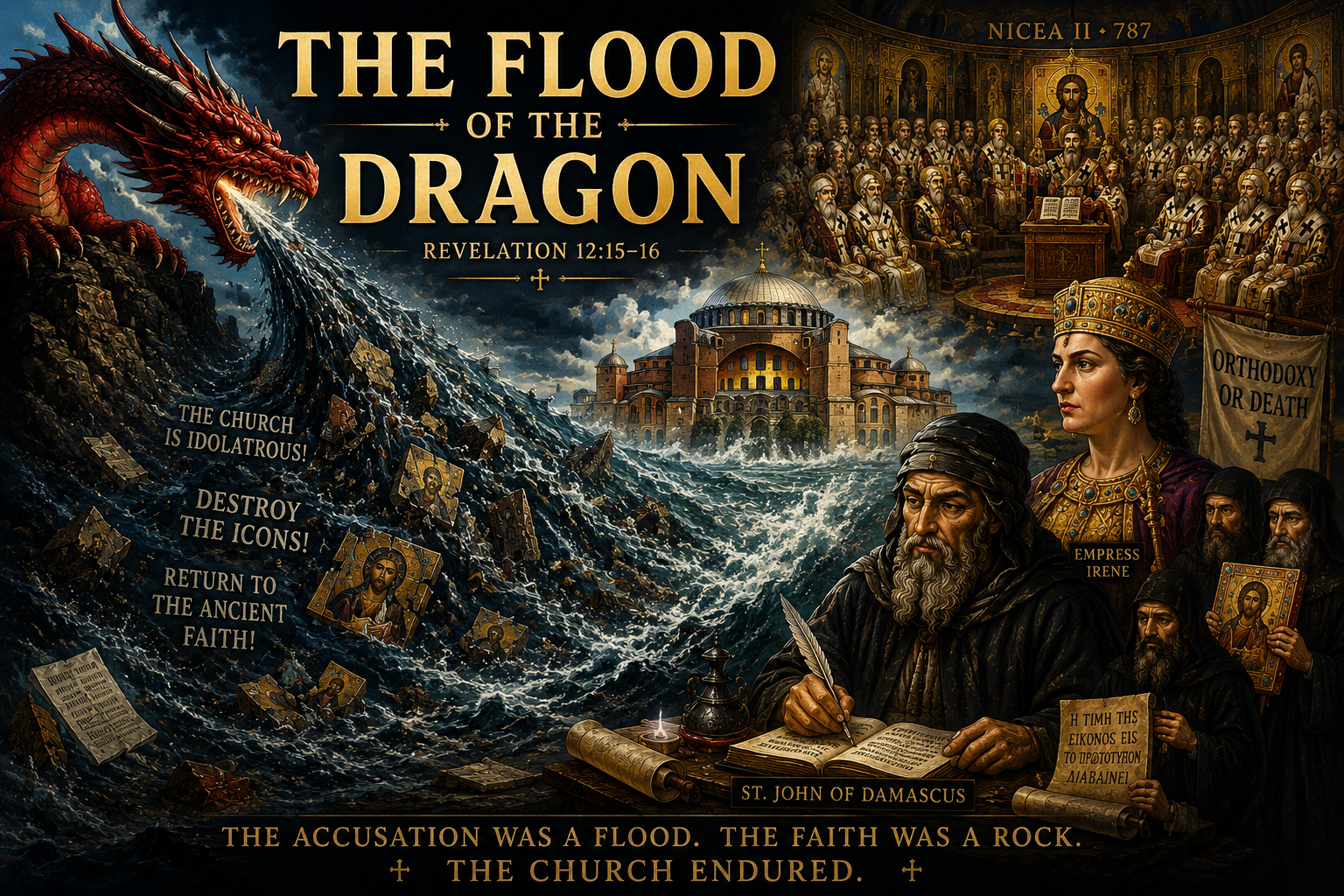
Within this historical context, Makrakis’ interpretation offers a compelling explanation. The flood is not an army. It is an accusation. It is the attempt to portray the Church as idolatrous and therefore unworthy of trust. Understood in this way, the flood becomes one of the most dangerous attacks in the entire Apocalypse, for it strikes not merely at a doctrine but at the authority of the Church that preserves doctrine.
The Child Survives
The sequence of Revelation 12 is significant. Before the flood appears, the Dragon attempts to devour the Man-Child. In the interpretation proposed by Makrakis, the Child represents the Church’s dogmatic confession of Christ, brought forth through the labor of centuries and proclaimed by the Ecumenical Councils.1
The great Christological controversies of the fourth through seventh centuries may be understood as successive attempts to destroy this Child. Arius denied the full divinity of the Son. Nestorius divided the unity of Christ’s person. Monophysitism obscured His true humanity. Monothelitism attacked the integrity of His human will. Each controversy threatened the Church’s confession of the God-Man.
Yet the Child survived. Through the witness of bishops, confessors, emperors, monks, and councils, the Church preserved the faith and handed it down to future generations. The Dragon failed to devour the Child.
This failure is crucial. If Satan could not destroy the doctrine of Christ directly, another strategy would be required. The remainder of Revelation 12 may therefore be read as the story of that new strategy.
The Attack upon the Church
The Dragon’s next assault is fundamentally different from the first. Previously the attack had been directed against the identity of Christ. Now the target becomes the Church herself.
The question is no longer, “Who is Christ?” The question becomes, “Can the Church be trusted?”
This distinction lies at the heart of Makrakis’ interpretation. The flood proceeds from the Dragon’s mouth, suggesting not merely violence but accusation. The assault is verbal, ideological, and theological. The Dragon seeks to convince the world that the Church has fallen into idolatry and has therefore forfeited her authority as the guardian of truth.
The implications of such an accusation are profound. If the Church is idolatrous, then her bishops cannot be trusted. Her saints cannot be trusted. Her councils cannot be trusted. Her tradition cannot be trusted. The issue extends far beyond the question of sacred images. The credibility of the entire conciliar tradition comes into question.
If the Church erred in worship, why should anyone trust her definitions concerning the Trinity? Why should anyone accept Nicaea, Ephesus, or Chalcedon? Why should the Fathers be regarded as reliable witnesses to the apostolic faith?
The flood therefore attacks the very institution that gave birth to the Child. Unable to destroy the doctrine itself, the Dragon seeks to undermine confidence in the Church that preserved and proclaimed it.
Why Iconoclasm Was a Christological Crisis
At first glance the Iconoclast controversy may appear unrelated to the earlier Christological disputes. Arianism, Nestorianism, and Monophysitism dealt directly with the person of Christ. Iconoclasm concerned images. Yet the defenders of Orthodoxy understood that the controversy reached much deeper than questions of artistic representation.
For St. John of Damascus and the defenders of icons, the issue was ultimately Christological. The legitimacy of depicting Christ depended upon the reality of the Incarnation. If the eternal Word truly became flesh, then He entered the visible world. If He became visible, He could be depicted. If He could be depicted, then the image became a witness to the reality of His humanity.
The icon therefore testified to the same truth proclaimed by Chalcedon. It bore witness to the God-Man.
This explains why the controversy proved so significant. Iconoclasm was not merely a dispute about devotional practice. It was another battle over the implications of the Incarnation itself. To reject the icon was, in the eyes of its defenders, to endanger the visible reality of Christ’s humanity.
The flood thus represented an indirect assault upon the Child. The Dragon could not overturn the Church’s formal dogmatic definitions, so he attacked the practical and visible expressions of those same doctrines.
The Earth Helped the Woman
St. John records that the Woman was not abandoned.
“And the earth helped the woman, and the earth opened her mouth, and swallowed up the flood which the dragon cast out of his mouth.” (Rev. 12:16)
Makrakis understood this verse as the historical defeat of Iconoclasm. The flood of accusation did not prevail because God raised up defenders of the Church at precisely the moment they were needed.
Among these defenders were Gregory II and Gregory III, who resisted iconoclastic policies despite intense political pressure. St. John of Damascus produced the most influential theological defense of sacred images while living beyond the reach of imperial persecution. Monastic communities preserved both icons and the theological tradition that supported them. Their witness proved especially important during periods when many bishops and civil authorities wavered.
The tide eventually turned through the actions of Empress Irene, who convened the Seventh Ecumenical Council at Nicaea in 787. There the Church formally condemned Iconoclasm and reaffirmed the veneration of holy icons. Although the controversy continued for several decades afterward, the final restoration came under Empress Theodora in 843, an event commemorated annually in Orthodoxy as the Triumph of Orthodoxy.
Seen from this perspective, the Earth swallowing the flood is not a single event but an entire historical process. Through saints, monks, bishops, confessors, councils, and rulers, God preserved the Church from an assault that threatened to undermine her very authority.
Nicaea II and the Swallowing of the Flood
The Seventh Ecumenical Council occupies a unique position within Christian history. The earlier councils had defined the person of Christ and defended the fundamental dogmas of the faith. Nicaea II defended the visible consequences of those dogmas.
The council distinguished carefully between the worship due to God alone and the veneration offered to sacred images. More importantly, it grounded this distinction in the mystery of the Incarnation. Honor shown to an icon passed to its prototype because the icon testified to the reality of the person depicted.
In doing so, the council answered the Dragon’s accusation. The Church was not guilty of idolatry. Rather, her veneration of icons flowed directly from her confession that the Word became flesh and dwelt among us.
The flood was therefore swallowed not by force but by theological clarity. The accusation lost its power because the Church demonstrated that icon veneration was inseparable from the doctrine of the Incarnation itself.
Conclusion
The interpretation proposed by Apostolos Makrakis possesses a remarkable historical and theological coherence. The Child represents the dogmatized Christ proclaimed by the Church. The War in Heaven represents the struggle to preserve the truth concerning His person. The Flood represents the attempt to invalidate the authority of the Church that gave birth to that confession.
This sequence reflects a profound spiritual logic. Unable to destroy the doctrine, the Dragon attacks the institution that preserves the doctrine. Unable to devour the Child, he seeks to drown the Woman.
Yet the Woman survives. Through saints, confessors, monks, councils, and faithful rulers, the flood is swallowed. The Church emerges from the Iconoclast crisis not weakened but strengthened, preserving both the holy icons and the confession of the Incarnate Word.
In this light, the Iconoclast controversy may be understood as one of the clearest historical manifestations of the Dragon’s flood. It was not merely a battle over images. It was a battle over the authority of the Church, the meaning of the Incarnation, and the preservation of Orthodox Christianity itself.
© 2026 by Jonathan Photius
Notes
- Apostolos Makrakis, The Interpretation of the Apocalypse (Chicago: Orthodox Christian Educational Society, 1948), commentary on Revelation 12:5, 15–16.
- St. John of Damascus, Three Treatises on the Divine Images.
- Acts of the Second Council of Nicaea (787), Session VII.
- Synodikon of Orthodoxy, First Sunday of Great Lent.

