
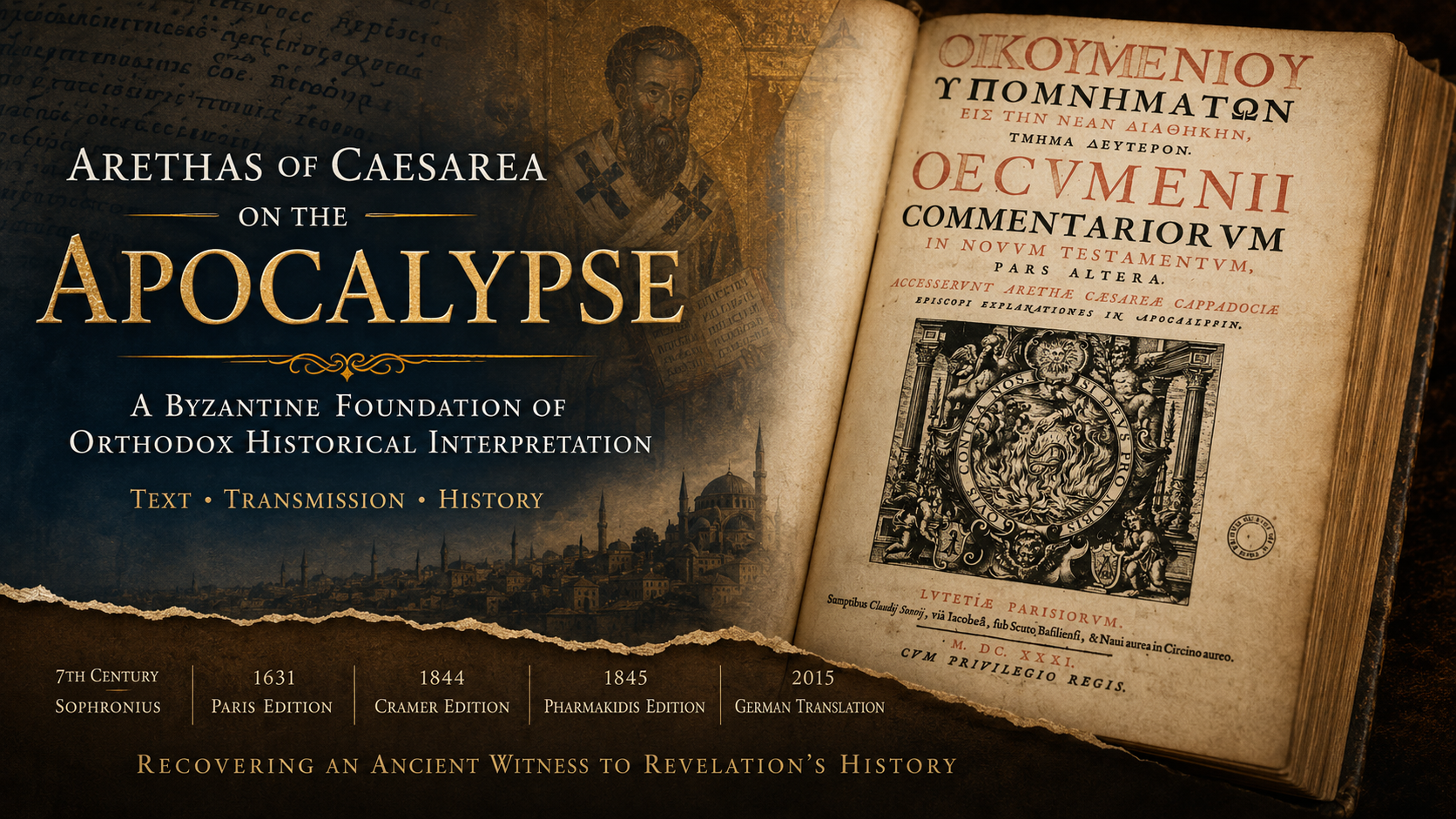
By: Jonathan Photius – The NEO-Historicist Research Project
Abstract
The history of apocalyptic interpretation within the Greek Orthodox tradition has often been portrayed as predominantly mystical, symbolic, and resistant to historical speculation. Byzantine commentators on the Apocalypse are frequently contrasted with the more explicitly historical and chronological systems associated with Joachim of Fiore, medieval Latin apocalypticism, and later Protestant historicism. Yet the surviving evidence reveals a far more historically conscious trajectory within the Byzantine tradition than is commonly acknowledged.
This study argues that a distinct form of Byzantine historical-ecclesiastical apocalyptic interpretation developed gradually from the patristic and post-patristic periods into the Ottoman era. Particular attention is given to the commentary tradition of Andrew and Arethas of Caesarea and to the emergence of Saracen and Islamic identifications within the interpretation of Revelation 13.
The longer recension of the Arethas commentary preserved in J.A. Cramer’s nineteenth-century edition explicitly associates the Babylonian kingdom of Revelation with the Saracens, thereby integrating Islamic political power into the symbolic-historical framework of the Apocalypse itself. This material, largely absent from shorter recensions, represents a crucial transitional stage between earlier Byzantine symbolic exegesis and later Orthodox historicism.
The article further examines the remarkable 1631 printed preface attached to the Arethas tradition, which openly identifies Muhammad and the continuing Saracen sect with the false prophet imagery of Revelation 13. The study situates Maximos the Peloponnesian, Zacharias Gerganos, and Christophoros Angelos within a broader seventeenth-century Orthodox apocalyptic milieu shaped profoundly by Ottoman domination and the historical experience of Islamic political supremacy.
Taken together, these developments reveal that Orthodox historicism did not emerge merely as a foreign Protestant importation, but arose organically from Byzantine ecclesiastical-historical exegesis itself. Long before Joachim of Fiore and centuries before Protestant historicism, Byzantine interpreters were already reading Revelation through the concrete realities of sacred history, imperial decline, conquest, persecution, and the enduring struggle of the Church in history.
I. Introduction
The place of the Apocalypse within Byzantine theology has long presented a paradox in the history of Christian exegesis. Although the Book of Revelation ultimately achieved canonical acceptance within the Greek Church and generated influential commentary traditions, Byzantine interpretation of the Apocalypse has frequently been characterized as cautious, symbolic, liturgical, and comparatively resistant to the forms of historical speculation that later flourished in portions of the medieval Latin West and the Protestant Reformation.
There is some truth to this characterization. Byzantine commentators generally rejected crude forms of millenarianism and approached apocalyptic chronology with considerable restraint. The Greek Fathers consistently emphasized the obscurity of prophetic mysteries and warned against excessive dogmatism concerning hidden eschatological realities. Yet such caution should not be mistaken for the absence of historical interpretation. Modern descriptions of Byzantine apocalyptic exegesis have often understated the extent to which historical consciousness permeated the Greek tradition.
Indeed, one of the defining characteristics of Byzantine apocalyptic thought is the conviction that prophecy unfolds progressively through the life of the Church in history. Revelation was not viewed merely as a cryptic vision concerning the distant end of the world, nor solely as a timeless mystical allegory detached from historical experience. Rather, Byzantine commentators increasingly interpreted the Apocalypse through the concrete realities of persecution, heresy, imperial conflict, conquest, ecclesiastical suffering, and the enduring struggle between Christ and the powers opposed to His Church.
The historical pressures shaping this development were immense. Already in the seventh century, Byzantine responses to the rise of Islam had begun employing biblical and apocalyptic categories in historically applicatory ways. Figures such as Sophronius of Jerusalem interpreted the Islamic conquest of the Holy Land through imagery associated with the “abomination of desolation” and the persecuting powers foreseen by the prophet Daniel. Such interpretations reveal that the Byzantine East had already begun developing historically responsive forms of eschatological interpretation centuries before Joachim of Fiore and long before the emergence of later Protestant historicism.
The foundations for this historical-ecclesiastical mode of interpretation appear more systematically in the commentary tradition of Andrew of Caesarea. Andrew’s famous insistence that difficult prophecies become clear through “time and experience” established a hermeneutical principle of enormous importance for later Orthodox interpretation. While Andrew himself remained cautious and deeply ecclesiastical in orientation, his method permitted increasingly concrete historical applications of apocalyptic imagery as new crises confronted the Christian world.
The significance of Arethas of Caesarea lies precisely within this development. Although Arethas largely transmits and preserves Andrew’s tradition, the manuscript tradition associated with his commentary demonstrates a greater willingness to correlate the symbols of Revelation with concrete historical empires and political realities. Particularly important are passages preserved within the longer recension of the commentary tradition that associate the Babylonian kingdom of Revelation 13 with the succession of Saracen dominion. Such material represents an important transitional stage between earlier Byzantine symbolic exegesis and the more historically explicit Orthodox apocalyptic interpretation that would emerge in the post-Byzantine period.
The 1631 preface attached to the Arethas commentary tradition is especially significant in this regard. The editor openly interprets Revelation through successive historical epochs and explicitly associates Muhammad and the continuing “Saracen sect” with the false prophet imagery of Revelation 13. Such language demonstrates that by the early seventeenth century the Byzantine Apocalypse tradition was already being read within an explicitly historical-apocalyptic framework shaped profoundly by Ottoman domination and the long historical experience of Islamic political supremacy.
The present study therefore examines the Arethas commentary tradition as a critical transitional witness in the historical development of Orthodox apocalyptic interpretation. Rather than identifying Arethas as a fully developed “historicist” in the later Protestant sense, this article argues that the Arethas tradition preserves an important stage in the gradual historical concretization of Byzantine apocalyptic exegesis. In doing so, it reveals that Orthodox historical-ecclesiastical interpretation emerged not merely through external influence, but organically from within the lived historical experience and exegetical tradition of the Byzantine Church itself.
II. Andrew of Caesarea and the Historical Horizon of Byzantine Exegesis
Any serious examination of Orthodox apocalyptic interpretation must begin with Andrew of Caesarea. His commentary on Revelation became the standard interpretation of the Apocalypse within the Greek Church and exercised enduring influence throughout Byzantine and post-Byzantine Christianity.
Andrew inherited a complex exegetical tradition. Earlier Christian interpreters such as Hippolytus of Rome, Methodius of Olympus, and Oecumenius had already explored themes concerning Antichrist, persecution, the millennium, and eschatological conflict. Yet Andrew introduced a distinctly Byzantine balance into the interpretation of Revelation.
Most importantly, Andrew rejected crude forms of materialistic chiliasm. Like Augustine of Hippo, he interpreted the millennium spiritually and ecclesiologically rather than as a literal earthly kingdom of sensual abundance. The reign of Christ was understood primarily through the life of the Church rather than through speculative earthly expectations.
Yet Andrew’s rejection of millennial literalism did not eliminate history from the Apocalypse. On the contrary, he preserved an interpretive openness that would prove decisive for later Orthodox tradition. This appears most famously in his treatment of the number 666, where he declines to identify the name dogmatically while nevertheless insisting that “time and experience” will reveal its meaning.
This principle established a uniquely Byzantine grammar of apocalyptic interpretation:
- prophecy remains symbolic,
- prophecy remains ecclesiastical,
- yet prophecy unfolds progressively through history.
Such a framework allowed Byzantine interpreters simultaneously to avoid speculative excess while still reading Revelation historically. The Apocalypse became neither a merely abstract allegory nor a rigid timetable of future events, but the unfolding drama of Christ and His Church throughout the ages.
As the Byzantine world encountered successive waves of heresy, invasion, imperial decline, and eventually Islamic conquest, Andrew’s historical principle allowed later interpreters to apply apocalyptic symbolism to new historical realities without abandoning the ecclesiastical foundations of the tradition.
Already in the seventh century, Byzantine responses to the rise of Islam had begun to employ apocalyptic and Danielic categories in historically applicatory ways. Figures such as Sophronius of Jerusalem interpreted the Islamic conquest of the Holy Land through imagery associated with the “abomination of desolation” and the persecuting powers foreseen by the prophet Daniel. Such interpretations demonstrate that the Byzantine East had already begun developing historically responsive forms of eschatological interpretation.
It is precisely within this development that the significance of Arethas emerges.
III. Arethas as the Missing Link
The importance of Arethas of Caesarea lies not primarily in radical innovation, but in the subtle expansion of the historical possibilities already latent within Andrew’s commentary tradition.
The textual history of the Arethas tradition further magnifies the importance of these developments. Although Arethas depends heavily upon Andrew and often reproduces earlier material with limited modification, the Arethas tradition nevertheless represents a decisive expansion of the historical possibilities latent within Byzantine Apocalypse exegesis. The commentary survives in multiple recensions of differing length and complexity. The longer recension represented by GA 314 and published by J.A. Cramer in the nineteenth century preserves substantial material absent from shorter printed editions. In the longer recension preserved in the manuscript tradition represented by GA 314 and published by J.A. Cramer, the commentary exhibits a greater willingness to associate the symbols of Revelation with concrete historical empires and civilizations confronting the Christian world. This development becomes especially important in relation to Revelation 13 and the interpretation of the Saracens. These materials also appear within the Greek Orthodox edition published at Athens in 1845 under the editorship of Theoklitos Pharmakidis, as well as within the remarkable Greek-Latin Paris edition of 1631.
The emergence of the Saracen conquests fundamentally altered the historical horizon within which Byzantine Christians encountered the Apocalypse. Vast formerly Christian territories fell under Islamic rule, ancient patriarchates suffered political subjugation, and the Byzantine Empire itself experienced prolonged military and civilizational pressure. Under such conditions, apocalyptic interpretation naturally acquired a more historical orientation.
Within this context, Arethas appears as a transitional figure between symbolic Byzantine exegesis and explicit Orthodox historicism. Andrew had already established the governing hermeneutical principle that prophecy becomes clearer through “time and experience.” Arethas takes the next significant step by allowing the symbols of Revelation to acquire more direct historical embodiment.
This development becomes particularly visible in the interpretation of Revelation 13.
IV. Arethas on Revelation 13 and the Saracens
The interpretation of Revelation 13 within the Arethas tradition represents one of the most important transitional moments in the history of Orthodox apocalyptic exegesis.
In earlier Byzantine interpretation, the beast imagery of Revelation generally referred either to universal persecuting powers or to earlier anti-Christian empires. Yet within the Arethas tradition, the imagery begins to acquire more concrete historical associations connected with the Saracens and the Islamic powers that had succeeded earlier eastern imperial dominions.
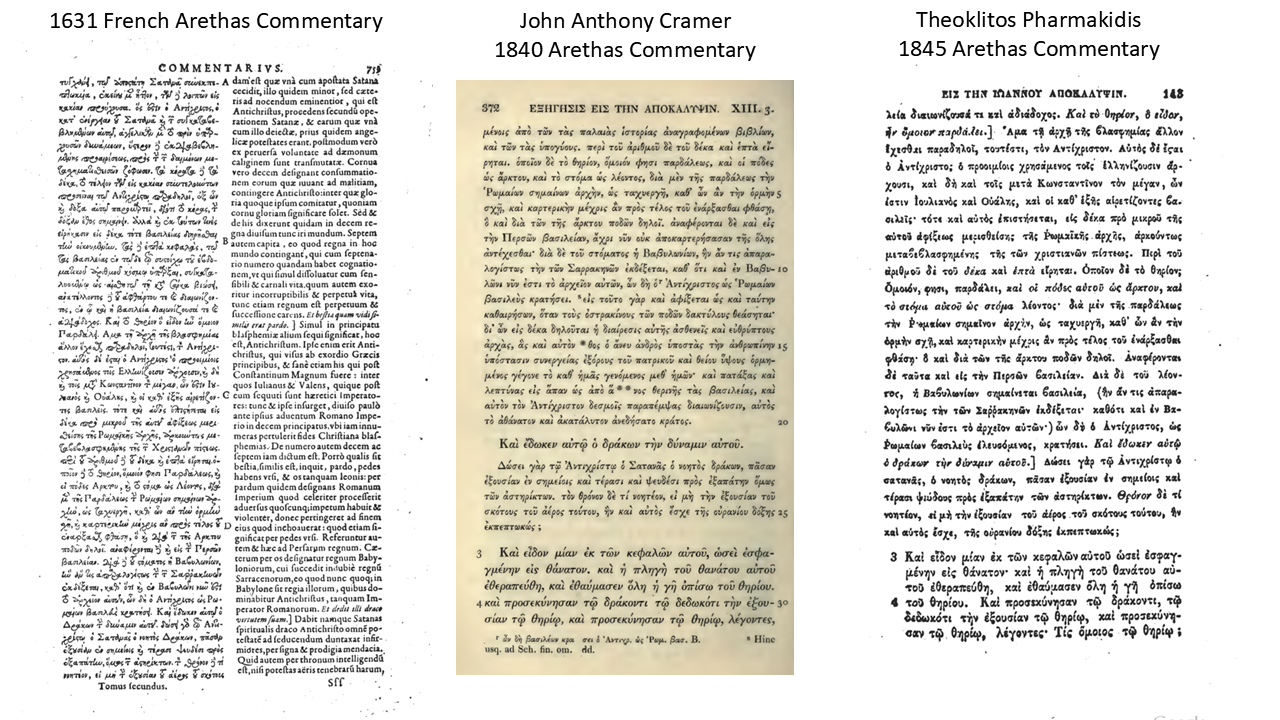
The textual history of the Arethas commentary is itself highly significant. The commentary survives in multiple recensions of differing length. The longer recension represented by GA 314 and published by J.A. Cramer preserves substantial material absent from shorter printed editions, including portions omitted in Migne’s Patrologia Graeca version. The Saracen passage associated with Revelation 13 belongs to this longer recension tradition and appears likewise in the nineteenth-century Greek Orthodox edition printed in Athens in 1845. Modern German translation work based upon Cramer’s edition has further confirmed the presence of this material.
In the longer recension preserved by Cramer, the commentary states concerning the Babylonian kingdom associated with the beast imagery:
“ἡ Βαβυλώνιος καλουμένη βασιλεία, ἣν ἄν τις ἀπαραλογίστως τὴν τῶν Σαρακηνῶν ἐκδέξεται…”
(“the so-called Babylonian kingdom, which one may reasonably understand to be succeeded by that of the Saracens…”)
The commentary continues by observing that “their rule now exists in Babylon,” thereby explicitly integrating Saracen political dominion into the symbolic-historical architecture of Revelation 13.
The importance of this development cannot be overstated.
Arethas does not yet construct the detailed chronological systems characteristic of later Orthodox historicism, nor does he explicitly identify Muhammad himself with the Antichrist or false prophet. Nevertheless, the commentary introduces a decisive interpretive transition: the beastly powers of Revelation become increasingly embodied within actual historical civilizations confronting the Church. The Saracens are no longer merely external political enemies of Byzantium, but participants within the unfolding sacred history of the Apocalypse itself.
This marks a decisive transition in Greek exegesis. Revelation 13 becomes capable of historical application to the lived realities of the Byzantine Christian experience.
Such a development would prove enormously influential for later Orthodox interpretation. Once the Saracen power entered the symbolic structure of Revelation 13, the path was opened for subsequent interpreters to develop more explicit identifications involving Islam, Muhammad, prophetic chronology, and the historical unfolding of apocalyptic prophecy.
In this sense, Arethas functions as the crucial missing link between Andrew’s historical openness and later Orthodox historicism proper.
V. The 1631 Arethas Preface and the Muhammadan Interpretation
The historical significance of the 1631 Arethas preface becomes even greater when viewed alongside the Saracen material preserved in the longer recension of the commentary itself. The preface did not create historical-apocalyptic interpretation ex nihilo; rather, it appears to intensify and systematize tendencies already present within the Byzantine commentary tradition. A tradition that lived historical realities of Ottoman domination and Islamic political supremacy.
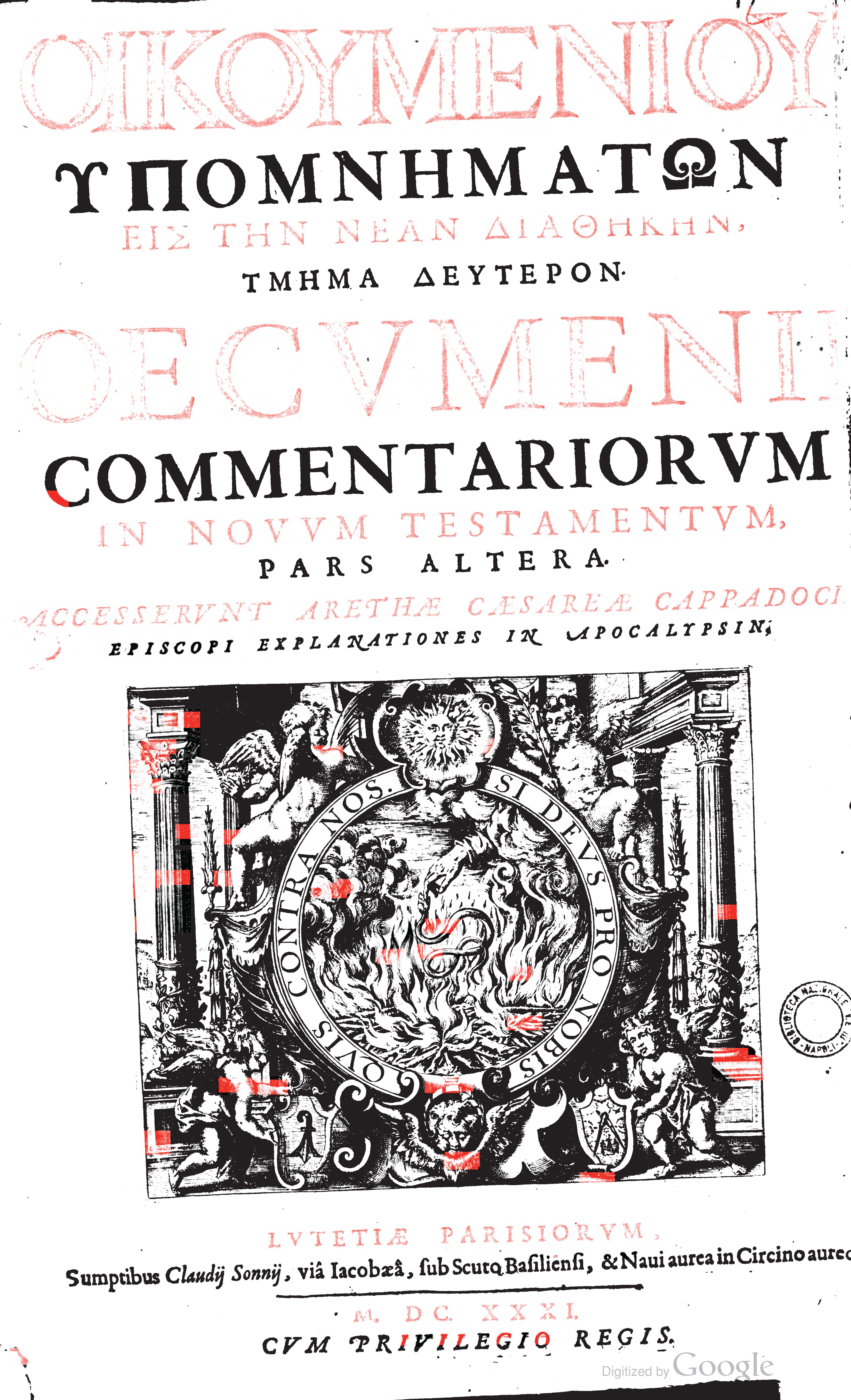
of Arethas, Bishop of Caesarea in Cappadocia.
Published at Paris.
At the expense of Claude Sonnius, on the Rue Saint-Jacques, beneath the sign of the Basel Shield and the Golden Ship in the Golden Circle.
1631 AD. With Royal Privilege.
The convergence of the 1631 Arethas edition with the contemporary activity of figures such as Zacharias Gerganos and Christophoros Angelos suggests not merely isolated instances of interpretation, but the emergence of a distinct post-Byzantine Orthodox apocalyptic milieu.
The editor of the 1631 edition explicitly structures Revelation through successive historical epochs:
- the apostolic Church and early heresies,
- the passing away of the Synagogue,
- the destruction of paganism,
- the reign of Christ in the present Church,
- and the final conflict preceding universal peace.
This framework is fundamentally historical and ecclesiastical in character. Revelation is treated as the prophetic unfolding of sacred history through successive ages of the Church.
Most remarkably, the editor to the Arethas commentary on Revelation openly identifies the false prophet imagery of Revelation 13 with Muhammad and the continuing “Saracen sect.” The preface states that although Muhammad himself died many years ago, nevertheless “his sect still lives” and continues to wage war against the people of God.
Antichrist here is not treated merely as:
- a future individual,
- nor solely as an abstract spiritual principle.
Rather, it appears as an enduring historical-religious system extending across centuries.
The editor further synchronizes:
- Daniel 7,
- Revelation 11,
- Revelation 12,
- Revelation 13,
- Ezekiel 38–39,
- and Revelation 20,
treating prophetic periods and persecutions as extended historical realities culminating in a final conflict involving Gog and Magog.
Equally important is the editor’s insistence that Revelation was written before the destruction of Jerusalem. This early dating allows the Apocalypse to be interpreted progressively through the great epochs of Christian history:
- Judaism,
- pagan Rome,
- Christian civilization,
- Islamic domination,
- and final eschatological conflict.
The 1631 preface therefore stands as one of the clearest witnesses to the continuity of historical apocalyptic interpretation within the Greek Christian world.
VI. Maximos the Peloponnesian, Zacharias Gerganos, and the Seventeenth-Century Orthodox Apocalyptic Milieu
The emergence of explicit Orthodox historicism in the seventeenth century did not occur in a vacuum. Between the Byzantine commentary tradition of Andrew and Arethas and the mature chronological systems of later Orthodox interpreters stood a series of transitional figures operating within the Ottoman world.
Among the most important was Maximos the Peloponnesian, whose vernacular transmission of the Apocalypse tradition helped preserve and disseminate the Andrew–Arethas interpretive framework within the post-Byzantine environment. Maximos appears largely dependent upon Andrew and Arethas, yet his work played an important role in carrying Byzantine apocalyptic interpretation into the Ottoman period and making it accessible to a wider Greek readership.
Within this developing environment, Zacharias Gerganos occupies an especially important transitional position. Gerganos appears deeply connected to the Maximos tradition and therefore indirectly to the earlier Byzantine framework inherited from Andrew and Arethas.
Although Gerganos does not yet present the fully developed chronological historicism visible in later interpreters, his work reflects an increasingly historical and ecclesiastical reading of Revelation shaped by Ottoman realities. The Apocalypse is no longer interpreted merely as a distant eschatological mystery, but as a living prophetic text intertwined with the suffering, endurance, and historical experience of the Orthodox Church under Islamic political domination.
What is especially striking is the chronological convergence of these developments. Around the same historical moment, the Orthodox world witnessed:
- the circulation and transmission of the Maximos tradition,
- the work of Zacharias Gerganos,
- the appearance of Christophoros Angelos’ historical-apocalyptic interpretations,
- and the 1631 printed edition of the Arethas commentary containing its explicit Muhammadan interpretation of Revelation 13.
Taken individually, each of these witnesses might be interpreted as an isolated phenomenon. Taken together, however, they suggest the emergence of a broader seventeenth-century Orthodox apocalyptic consciousness shaped profoundly by Ottoman domination and the historical experience of Islamic political rule.
This milieu forms one of the most important contexts for understanding the rise of Orthodox historicism.
VII. Christophoros Angelos and the Emergence of Explicit Orthodox Historicism
If Zacharias Gerganos represents a transitional stage in the development of Ottoman-era historical apocalyptic interpretation, Christophoros Angelos represents the first known fully explicit synthesis of Islamic historical fulfillment and prophetic chronology within the Greek Orthodox tradition.
Writing in 1624, Angelos appears to become the first Greek Orthodox interpreter explicitly to combine:
- Revelation 13,
- Muhammad,
- Islamic domination,
- and the 1260 prophetic years
into a coherent historical-apocalyptic framework.
This development marks a decisive turning point in Orthodox exegesis.
However, it must be emphasized that Orthodox developments described here should not be equated simplistically with later Protestant historicism. Byzantine historical-ecclesiastical apocalypticism remained fundamentally sacramental, ecclesial, and symbolic in orientation. Yet it nevertheless increasingly interpreted Revelation through concrete historical realities, especially those associated with imperial decline, Islamic conquest, persecution, and the historical suffering of the Church.
Earlier Byzantine interpreters had already:
- preserved historical openness,
- associated persecuting powers with apocalyptic imagery,
- and integrated Islamic domination into historical consciousness.
Arethas had already opened the way for connecting the Saracens with Revelation 13, while the seventeenth-century Orthodox milieu increasingly historicized Revelation through Ottoman experience.
Yet Angelos appears to be the first Greek Orthodox writer to synthesize these elements into a mature historicist structure involving prophetic chronology itself.
This makes Angelos one of the foundational figures of explicit Orthodox historicism.
Importantly, however, Angelos did not emerge as an isolated innovator. His work developed organically from:
- Andrew’s historical hermeneutic,
- Arethas’ historical application,
- the transmission of Maximos,
- the transitional milieu represented by Gerganos,
- and the broader post-Byzantine experience of Islamic political domination.
The historical conditions of the Orthodox world had rendered Revelation increasingly immediate and historical.
VIII. Ottoman Rule and the Maturation of Orthodox Historicism
The Ottoman conquest profoundly transformed the historical consciousness of the Orthodox world. Under centuries of Islamic political domination, apocalyptic interpretation inevitably acquired new urgency and concreteness.
The Byzantine Empire had not merely suffered military defeat; it had experienced the collapse of an entire civilizational order. Ancient Christian centers fell under Islamic rule, the political structure of Orthodox civilization fragmented, and the Church increasingly understood itself as enduring within a prolonged historical trial.
Under these conditions, Revelation ceased to function merely as an obscure prophetic text concerning distant eschatological events. It became the interpretive lens through which Orthodox Christians understood:
- conquest,
- persecution,
- imperial collapse,
- religious conflict,
- and the endurance of the Church in history.
This historical experience naturally encouraged increasingly concrete applications of apocalyptic symbolism. Islamic rule came to be interpreted not merely politically but prophetically. The beastly powers of Revelation were read through lived historical suffering.
The developments visible in the seventeenth century would continue to mature over the following centuries into increasingly systematic forms of Orthodox historicism.
John Lindios of Myra interpreted the prophetic periods of Revelation historically, especially the 1260 days and 42 months. Islamic domination was understood within the framework of apocalyptic persecution, and prophetic chronology became increasingly systematized.
This trajectory reached even greater sophistication in Theodoret of Ioannina. His commentary represents one of the most systematic historical readings in the Greek tradition, integrating:
- heresies,
- councils,
- empires,
- Islam,
- ecclesiastical decline,
- persecution,
- and prophetic chronology
into a unified ecclesiastical interpretation of Revelation.
| Stage | Development |
|---|---|
| Andrew (614 AD) | historical openness |
| Sophronius (637 AD) | Islamic conquest interpreted apocalyptically to Little Horn of Daniel |
| Arethas (913 AD) | Saracen integration into Revelation symbolism |
| later Byzantine transmission (Maximos) | preservation |
| Angelos / Gerganos / Gordios / Lindios | expansion of Islamic and Papal Beasts |
| Theodoret / Makrakis | mature Orthodox eccesial historicism |
Finally, this broader tradition reaches one of its fullest theological expressions in Apostolos Makrakis. Makrakis interpreted Revelation simultaneously as:
- historical,
- ecclesiastical,
- moral,
- theological,
- and ontological.
For Makrakis, the Apocalypse described the Passion, death, and resurrection of Christ extended throughout history in His Body, the Church. Revelation became the drama of sacred history itself.
In this sense, Makrakis did not abandon the Byzantine tradition. Rather, he brought to maturity tendencies already visible in:
- Andrew’s “time and experience,”
- Arethas’ historical applications,
- and the long post-Byzantine experience of Orthodox suffering and endurance.
IX. Conclusion
The evidence examined in this study demonstrates that historical apocalyptic interpretation possesses far deeper roots within the Greek Orthodox tradition than is often acknowledged.
The development is neither abrupt nor artificial. Rather, it unfolds gradually across centuries:
| Figure | Contribution |
|---|---|
| Andrew of Caesarea (614 AD) | Prophecy clarified through “time and experience” |
| Arethas of Caesarea (913 AD) | Saracen power associated with Revelation 13 beast imagery |
| Maximos the Peloponnesian (1610 AD) | Vernacular (Modern Greek) transmission of the Andrew–Arethas tradition |
| Christophoros Angelos (1624 AD) | First explicit Greek Orthodox synthesis of Muhammad and the 1260 years |
| Zacharias Gerganos (1631 AD) | Transitional Ottoman-era ecclesiastical-historical interpretation, Islamic Beast |
| 1631 Arethas Commentary Preface | Explicit Muhammadan interpretation of Revelation 13 |
| John of Myra & Theodoret (1791-1800) | Mature chronological Orthodox historicism |
| Apostolos Makrakis (1881 AD) | Full ecclesiastical-historical synthesis |
The evidence suggests not merely isolated interpreters scattered across centuries, but the gradual emergence of a distinct Orthodox historical-apocalyptic tradition that matured especially within the post-Byzantine and Ottoman worlds.
By the early seventeenth century, the convergence of the Arethas tradition, the transmission of Maximos, the work of Zacharias Gerganos, the Muhammadan interpretation of the 1631 preface, and the chronological syntheses of Christophoros Angelos together reveal the existence of a developing Orthodox apocalyptic milieu in which Revelation was increasingly interpreted through the historical realities of Islamic domination and ecclesiastical suffering.
Far from representing a merely foreign importation from Protestant historicism, Orthodox historical-apocalyptic interpretation emerges here as an organic development rooted deeply within Byzantine ecclesiastical-historical exegesis itself. Long before Joachim of Fiore and centuries before the Protestant Reformation, Byzantine interpreters had already begun integrating conquest, empire, persecution, and Islamic political power into the symbolic world of biblical prophecy.
The path from Sophronius to Andrew, from Andrew to Arethas, and from Arethas to the Ottoman-era interpreters reveals the gradual emergence of a distinctly Orthodox historical-ecclesiastical reading of the Apocalypse. Within this development, the Arethas tradition stands as one of the earliest surviving witnesses to the incorporation of Saracen political dominion into the prophetic-historical framework of Revelation itself.
The Apocalypse, within this Orthodox historical vision, is not merely a prophecy concerning the distant end of the world. It is the unfolding history of Christ and His Church through persecutions, heresies, empires, apostasies, conflicts, and victories until the final triumph of the Kingdom of God.
© 2026 by Jonathan Photius
Further Reading / Select Bibliography
Primary Sources
- Andrew of Caesarea. Commentary on the Apocalypse.
- Arethas of Caesarea. Commentary on the Apocalypse. 1631 edition.
- Christophoros Angelos. [1624 Apocalypse-related work/title if finalized].
- John of Myra. Commentary on the Apocalypse.
- Theodoret of Ioannina. Commentary on the Apocalypse.
- Apostolos Makrakis. Interpretation of the Book of Revelation.
Secondary Sources
- Asterios Argyriou. Les Exégèses Grecques de l’Apocalypse à l’époque turque (1453–1821).
- J. A. Kramer. Arethasstudien.
- Bernard McGinn. Visions of the End.
- Paul Alexander. The Byzantine Apocalyptic Tradition.
- Garrick V. Allen. Works on Apocalypse manuscript traditions.
- Eugenia Scarvelis Constantinou. Guiding to a Blessed End.
Appendix A
English Translation of the 1631 Preface to the Arethas Commentary on the Apocalypse (By: Federico Morello***, editor of the 1631 Arethas Commentary)
Concerning These Commentaries on the Apocalypse, the Exile of John to Patmos, and the Revelation Given to Him
Before presenting these commentaries on the Apocalypse, beloved Reader, we ask that you receive our labors with charity and understanding, and that you not hastily condemn them if, in one place or another, our translation does not fully satisfy your judgment. For to speak plainly, these latter commentaries caused us such difficulty that we often considered setting aside and erasing all our previous labors on account of them.
Whether this arose from the carelessness of scribes or printers—which we frequently discovered and quietly passed over, though at times we noted such things in the margin for the sake of honesty—or whether the weakness of our own understanding was sometimes at fault, this too we readily acknowledge. Indeed, in certain places where even we ourselves were not fully satisfied with our rendering, we marked the passage with an asterisk, leaving the judgment to you, O Reader.
Yet I remain confident that if you examine the Greek text carefully throughout this work, you will not altogether condemn our efforts, for you will see the many difficulties that confront the translator on every side—provided only that you approach our work with fairness and without prejudice. For I do not trouble myself over a Zoilus, whom not even Minerva herself could have pleased in every respect.
And even if we cannot satisfy such men, our labor will still have borne good fruit if it gives occasion to more learned scholars to produce works more complete and more refined for the common benefit of Christendom. For no one ought to disparage the labors of others unless he is both willing and able to provide something better himself.
As far as one may reasonably judge, this Arethas—or perhaps his predecessor Andrew—was a man deeply instructed not only in divine matters, but also in secular learning, highly trained in rhetoric and natural philosophy. Had we possessed additional Greek manuscripts, or the author’s own commentary as it originally appeared from his hand, the countless difficult passages in this book would not have caused us such anguish. Nevertheless, having spared no labor and accomplished what we could, we ask you to receive our efforts kindly.
Concerning this Apocalypse, Saint Jerome says that it contains as many mysteries as it does words; indeed, he teaches that multiple meanings lie hidden within every single phrase. For this reason, many interpreters have offered widely differing judgments concerning it. Some attend chiefly to the plain literal sense and outward form, while others search more deeply into its mystical meanings.
Therefore, it should not seem unreasonable if we also offer our own judgment, always submitting both ourselves and all our opinions to the sounder judgment of the Holy Roman Church.
And first, it seems to us that this John—the Apostle and Evangelist, who is also called the Theologian—was exiled to Patmos by Nero, at the very same time that he put to death the blessed Apostles Peter and Paul in Rome. Tertullian, who lived close to the times of those Apostles, affirms this in two places. Eusebius also states the same in his work The Demonstration of the Gospel, although in his Chronicle and Ecclesiastical History he places these events under Domitian, as Jerome and many others afterward followed.
Yet those earlier works, having been written in his younger years, do not carry the same authority as the later work The Demonstration of the Gospel, which appears to have been composed with greater maturity and correction.
If, then, the Apocalypse was written at Patmos before the destruction of Jerusalem, it may fittingly be divided into four parts.
From the beginning through the sixth chapter, it contains instruction to the Churches of Asia, interwoven with prophecies concerning various heresies, of which Epiphanius also speaks in his Panarion.
From the sixth chapter through the twelfth is described the passing away of the Synagogue.
From the twelfth through the nineteenth chapter is set forth the destruction of paganism, especially under the figure of Babylon and Rome, the city of seven hills, which are here called the horns of the beast upon which the harlot—that is, idolatry or paganism—sits. For in these cities paganism flourished most greatly.
From the nineteenth chapter to the end is treated the Kingdom of Christ in the present Church, together with the final victory over His enemies described in chapter twenty.
These things, however, are spoken only in a general way, for many subjects are interwoven throughout the individual sections. Nor is it possible to give a certain judgment concerning every detail, nor can every part perfectly correspond to any single interpretation. It is sufficient if one grasps generally what each chapter intends to signify.
According to this arrangement, the opinion of Johannes Annius of Viterbo does not appear altogether unreasonable. In his questions upon the Apocalypse he argues that the beast commonly interpreted as Antichrist, especially the beast in Revelation 13 which rises from the earth having two horns like a lamb yet speaking like a dragon, is the false prophet Muhammad.
For the Dragon, who is Satan, had given his power, throne, and great authority to the former beast—that is, to paganism—and from there to the Saracen sect.
And although Muhammad himself died many years ago, nevertheless his sect—that former beast—still lives, and grievously wages war against the people of God even now. And this shall continue until, according to the seventh chapter of Daniel, the kingdom is given to the people of the saints of the Most High.
That is to say: after a long intervening period of peace and security, that beast shall once again wage war against the people of God together with the great host symbolized by Gog and Magog, of whom Ezekiel speaks in chapters 38 and 39, and likewise Revelation 20. Yet they shall ultimately be overthrown by God with great destruction, just as those Scriptures declare.
After this there shall be true and perfect peace within the Church, and the pure worship of God, separated from every heresy and persecution, as Ezekiel describes in chapter 40 and following, and as Revelation 21 and 22 likewise proclaim.
[***NOTE: The precise authorship of the remarkable 1631 preface remains uncertain. Although the Greek-Latin edition depends heavily upon the earlier Latin translation of Joannes Hentenius, the prefatory material itself appears to reflect a later early seventeenth-century editorial and theological milieu shaped by Ottoman-era historical consciousness and anti-Islamic apocalyptic interpretation. Theoklitos Pharmakidis, in his 1845 Arethas edition, provided the historical background and names attributed to the 1631 edition. Joannes Hentenius translated the Latin text of Arethas in 1547, and 1631 Paris edition appears connected to Federico Morello]
© 2026 by Jonathan Photius
 NEO-Historicism - End Times Eschatology From An Eastern Orthodox Christian Historicist Perspective