
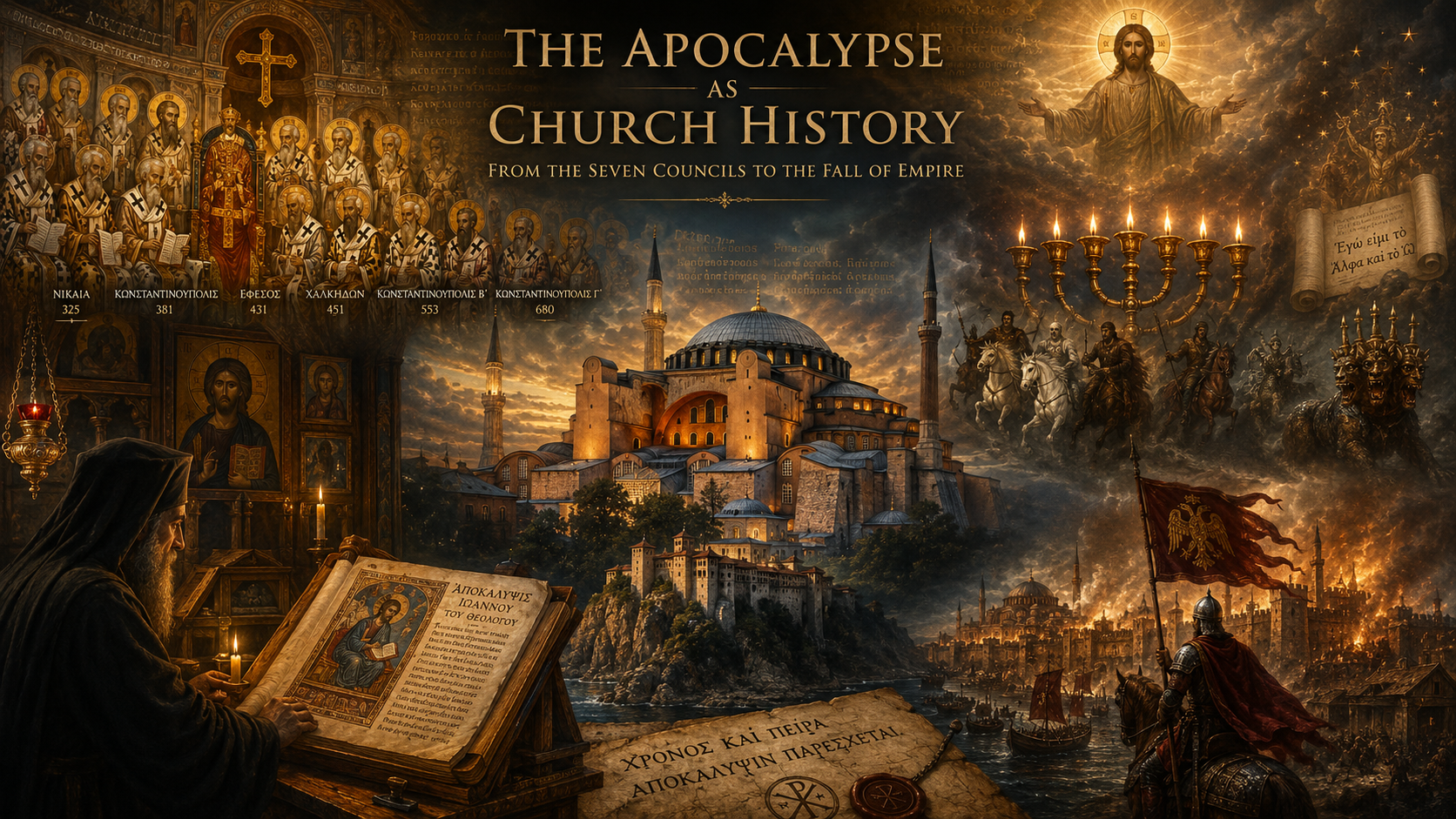
By Jonathan Photius – The NEO-Historicism Research Project
Modern discussions surrounding the Book of Revelation often assume that Christian interpretation falls into only a handful of familiar categories. On one side stand futurist systems, which interpret the Apocalypse primarily as a prophecy of events immediately preceding the end of the world. On another stand preterist approaches, which confine most of Revelation to the first-century Roman context. Still others approach the text symbolically or psychologically, treating the visions as timeless allegories detached from concrete historical fulfillment. Within contemporary Orthodoxy, meanwhile, many assume that the Eastern Church largely avoided historical interpretation altogether, preferring either mystical symbolism or cautious silence regarding the Apocalypse.
Yet the surviving Greek commentarial tradition reveals a far more sophisticated and historically conscious approach. Buried within Byzantine and post-Byzantine exegesis lies a remarkably developed vision of Revelation as the unfolding history of the Church herself—a sacred drama manifested through councils, persecutions, heresies, empires, apostasies, and the gradual revelation of divine providence across centuries. Long before the rise of modern Protestant historicism, Orthodox commentators were already interpreting the Apocalypse through the lived experience of Christian civilization.
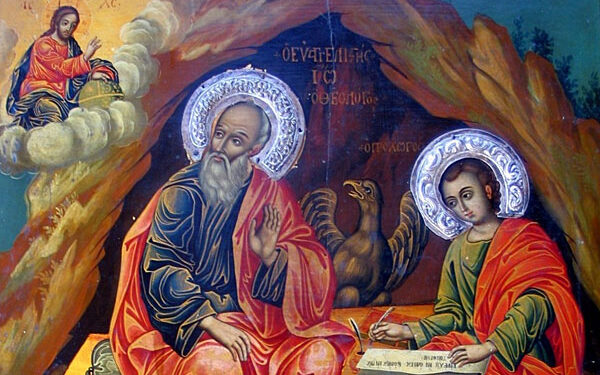
Among the most important witnesses to this neglected tradition are Metropolitan John Lindios of Myra and Theodoret of Ioannina. Though separated by time and emphasis, both men testify to a distinctly Orthodox form of historical-ecclesiastical exegesis in which Revelation becomes not merely a prophecy of the distant end, but the mystical history of the Body of Christ unfolding within time itself.
At the foundation of this entire interpretive stream stands the great Byzantine commentator Andrew of Caesarea. Andrew’s commentary would become enormously influential throughout the Greek East, not simply because of its exegetical detail, but because of a single methodological principle that later commentators would expand dramatically: the idea that “time and experience” reveal the precision of prophecy. In one of the most important hermeneutical statements in Orthodox apocalyptic tradition, Andrew remarks that the full meaning of the prophetic number and the things written concerning it would be disclosed through χρόνος καὶ πείρα—“time and experience.” With this statement, Andrew established a principle of enormous historical consequence. Prophecy was not exhausted in a single moment, nor could it always be fully understood at the time it was first received. Rather, sacred history itself gradually unveiled prophetic meaning.
“Time and experience will reveal to sober researchers the precision of the number and the other things written about it.” – St. Andrew of Caesarea
This principle would become increasingly important as the Church passed through crises that earlier generations could scarcely have imagined. The early Fathers certainly anticipated persecution, apostasy, and the appearance of Antichrist, yet many still operated within the historical horizon of the Roman Empire and the expectation of relatively imminent eschatological fulfillment. They preserved the dogmatic and typological foundations of the Apocalypse, but they had not yet witnessed the rise of Islam, the collapse of Christian unity, the centuries-long struggle of Byzantium, or the eventual fall of Constantinople. History itself had not yet unfolded sufficiently to reveal the long-duration structure of prophetic fulfillment.
One of the first major turning points in this development appears in the work of Arethas of Caesarea during the tenth century. By this point, the Islamic conquests had permanently transformed the eastern Mediterranean world. Jerusalem had fallen. Ancient patriarchates had come under Muslim rule. Christian civilization now confronted a vast rival religious empire claiming prophetic authority of its own. In this new historical context, Arethas began applying apocalyptic imagery to the Saracens and the rise of Islam itself, associated with the first beast of Revelation 13. This was no small development. Once Revelation’s symbols became attached to visible historical powers unfolding across centuries, the Apocalypse ceased to be merely an abstract future expectation. Sacred history itself had become apocalyptic terrain.
Development of Orthodox Historical-Ecclesiastical Exegesis
| Figure | Major Contribution to Orthodox Apocalyptic Interpretation |
|---|---|
| Andrew of Caesarea | Established the principle that “time and experience” progressively unveil prophetic meaning |
| Arethas of Caesarea | Applied apocalyptic imagery historically to the Saracens and Islamic expansion |
| John of Myra | Interpreted Revelation as the doctrinal and ecclesiastical history of the Church through the Ecumenical Councils |
| Theodoret of Ioannina | Developed a comprehensive theology of sacred history involving empires, apostasy, and historical fulfillment |
| Apostolos Makrakis | Philosophically synthesized Revelation as prophetic, historical, ethical, theological, ontological, and dramatic |
The importance of this shift cannot be overstated. It reveals that historical interpretation within Orthodoxy did not emerge suddenly or artificially, but organically through the Church’s lived historical experience. As Christian civilization encountered new crises, the prophetic text was reread in light of unfolding events. Andrew’s principle that “time and experience” would reveal prophecy became not merely a theological observation, but the interpretive engine of an entire tradition.
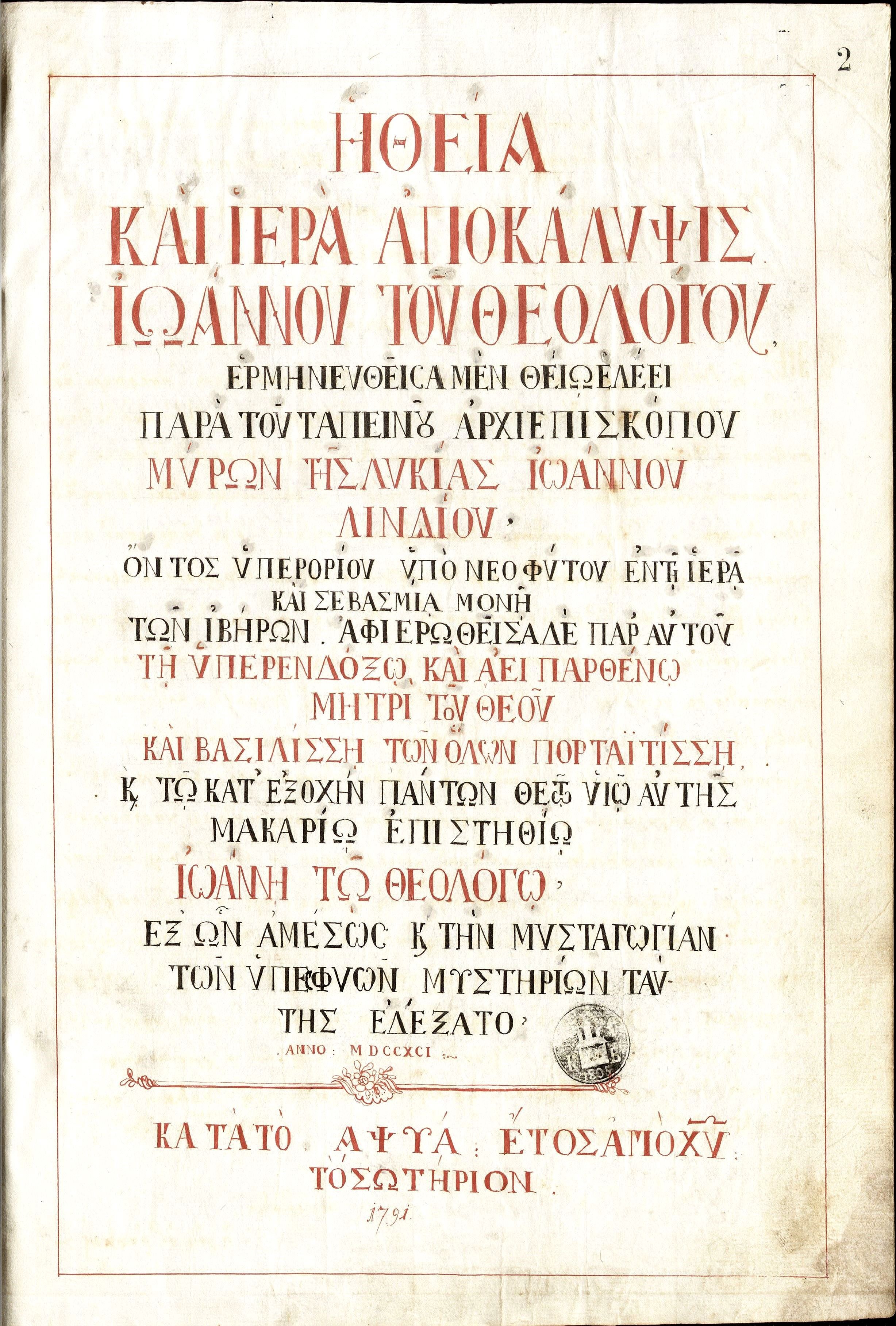
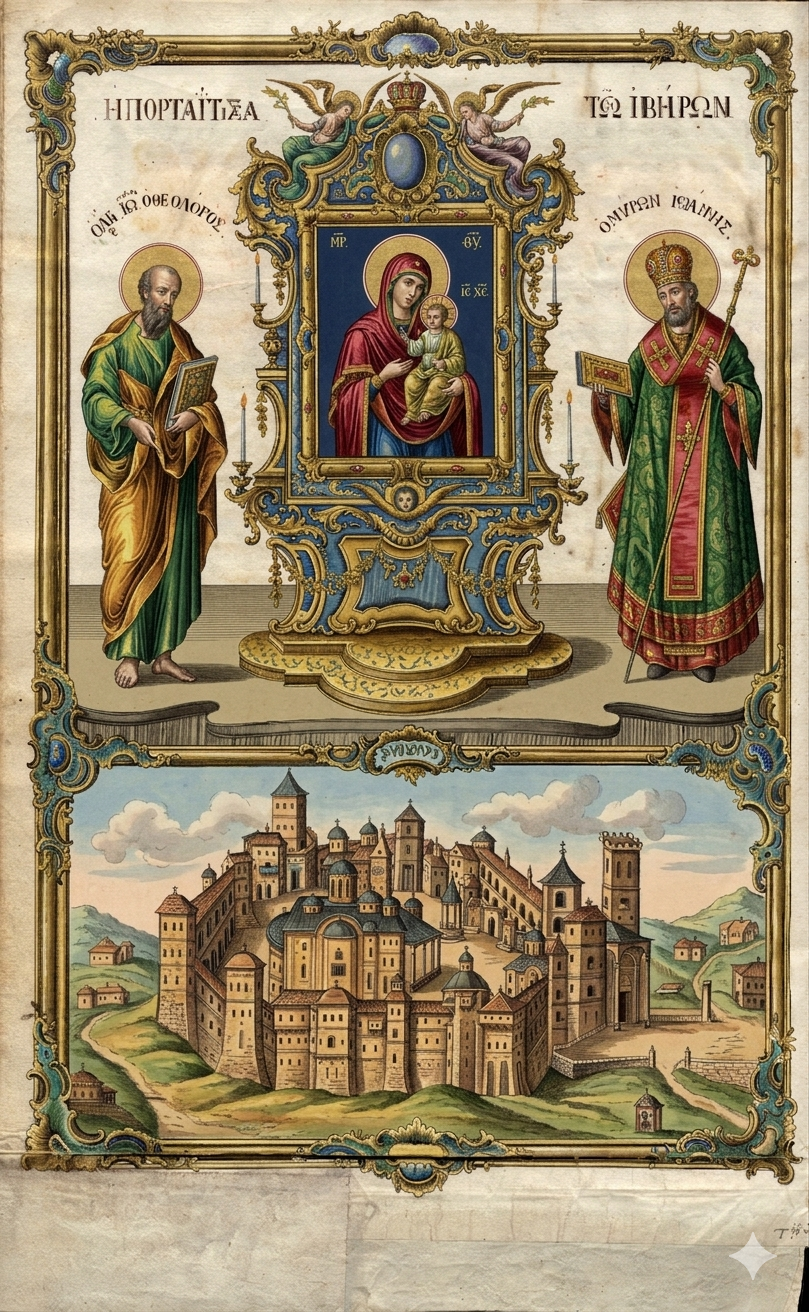
This development reaches a remarkable level of sophistication in the commentary of Metropolitan John Lindios of Myra, written during his exile at at Monastery of Iviron on Mt Athos in the year 1791. In his hands, Revelation becomes a prophetic map of the doctrinal and ecclesiastical history of the Church. Perhaps the most striking feature of his commentary is his repeated identification of the Seven Thunders, Seven Churches, Seven Lampstands, Seven Stars, and even the Trumpet Voice with the Seven Ecumenical Councils and the God-bearing Fathers who defended Orthodoxy throughout history.
1791 Athonite recension of John of Myra’s Commentary on Revelation, associated with the Monastery of Iviron on Mount Athos.
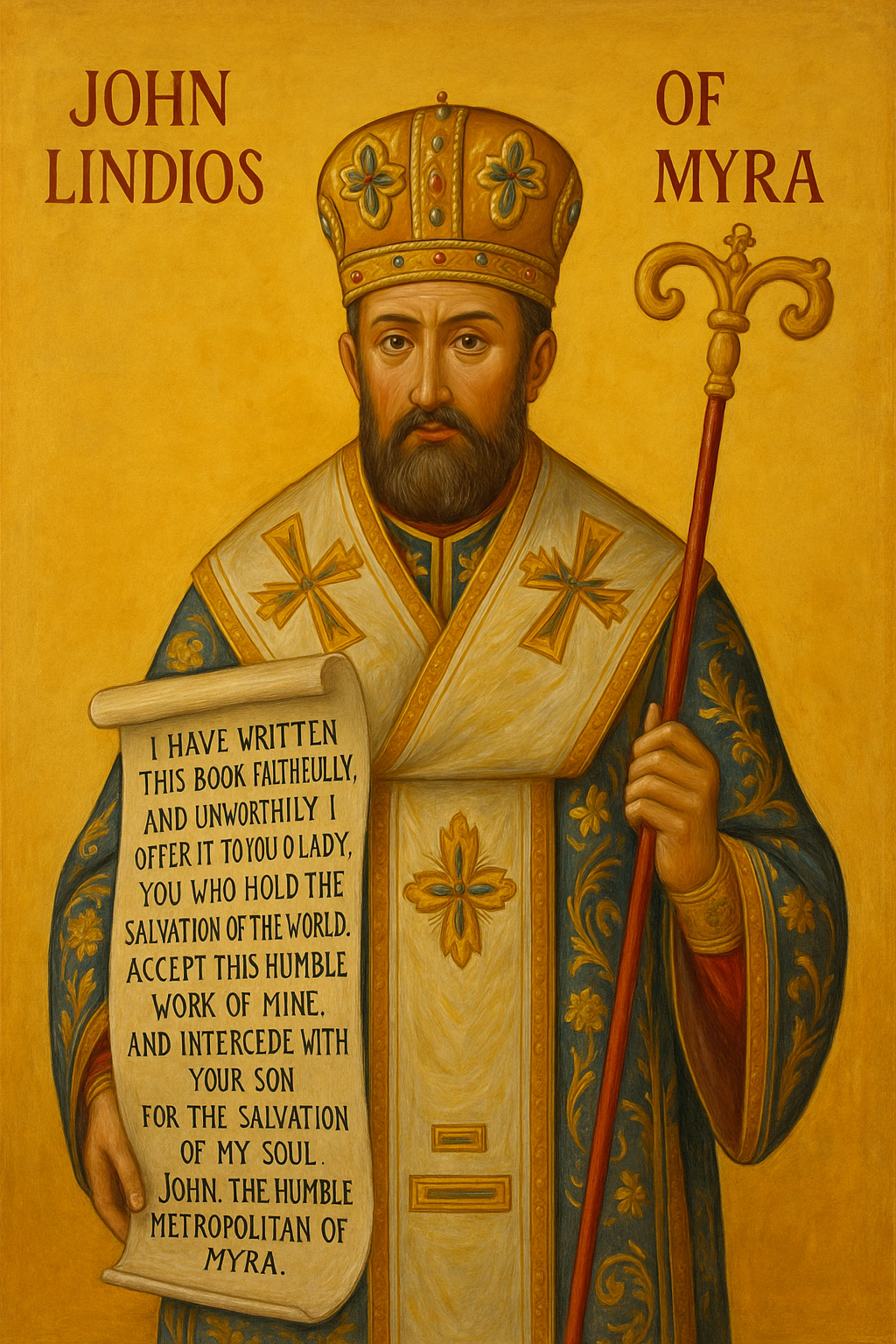
For John of Myra, the Apocalypse does not merely describe local churches in first-century Asia Minor. The Seven Churches become prophetic archetypes of the Church’s historical life through time. The Lampstands signify the holy Fathers whose virtuous lives preserve the light of dogma. The Stars held in Christ’s hand signify the bishops and councils through whom divine truth shines into the world. The Trumpet Voice and Thunders becomes the proclamation of the Ecumenical Councils resounding throughout the inhabited earth like heavenly thunder against heresy.
This is not mere allegory in the modern sense. John is not arbitrarily spiritualizing the text. Rather, he is interpreting Revelation historically through the concrete doctrinal life of the Church. Nicaea, Chalcedon, the struggle against Arianism, the defense of icons, and the preservation of Orthodox Christology all become part of the unfolding drama of the Apocalypse itself. Revelation is transformed into the prophetic history of dogma.
Revelation as Church History in Orthodox Exegesis
| Revelation Symbol | Historical-Ecclesiastical Interpretation |
|---|---|
| Seven Churches | Historical life of the Church and Ecumenical Councils |
| Lampstands | Bishops, Fathers, and guardians of Orthodox dogma |
| Trumpets | Proclamation of divine truth and conciliar theology |
| Beast | Anti-Christian political and religious systems |
| Babylon | Apostate civilization and spiritual corruption |
| Wilderness | The Church under persecution, exile, or captivity |
| Witnesses | The enduring testimony of the Church through history |
| Three Days and a Half | Paschal humiliation, burial, and eventual restoration |
| Millennium | The historical age of the Church between Christ’s comings |
| New Jerusalem | Final glorification of the Church in the Kingdom of God |
Equally significant is John’s explicit rejection of simplistic chronological literalism. He insists that St. John the Theologian was not writing history in the manner of a secular historian. A prophet, he argues, may condense vast stretches of history into a few symbolic words. Entire ages may be contained within a single image. One vision may encompass both ancient persecutions and future apostasy simultaneously. This principle explains how John moves fluidly from Nero to Constantine, from Roman persecution to Arianism, from the early martyrs to the Ecumenical Councils, all within the same symbolic framework. The Apocalypse operates on multiple historical levels at once.
This understanding allowed Byzantine interpreters to read Revelation as both historical and transhistorical simultaneously. The symbols were not exhausted by one event, but recurred throughout sacred history in different manifestations. Heresy itself became a recurring apocalyptic phenomenon. Arians, Nestorians, Iconoclasts, Latins, Protestants, and other opponents of Orthodoxy were not viewed merely as isolated theological disagreements, but as manifestations of the same spiritual warfare unfolding throughout the history of the Church.
John’s interpretation of the millennium is equally revealing. Like the mainstream Orthodox tradition following Augustine of Hippo and Andrew of Caesarea, he rejects literal earthly chiliasm. The “thousand years” are not understood as a future temporal kingdom after Christ’s return, but as the historical era of the Church extending between the First and Second Comings. Yet unlike purely symbolic amillennialism, this millennium remains concretely historical. It unfolds through persecutions, councils, heresies, empires, and the gradual struggle of the Church across time. This creates what might properly be called a Byzantine historical amillennialism: anti-chiliast, sacramental, liturgical, and yet deeply historical.
If John of Myra presents Revelation as the doctrinal and ecclesiastical history of the Church, then Theodoret of Ioannina expands this vision into a full theology of sacred civilization-history. In Theodoret’s commentary, the Apocalypse becomes the drama not only of councils and dogma, but of empires, civilizations, apostasies, and the fate of Christendom itself.
1800 Leipzig edition of Theodoret of Ioannina’s Commentary on the Apocalypse, first printed “for the benefit of lovers of truth.”
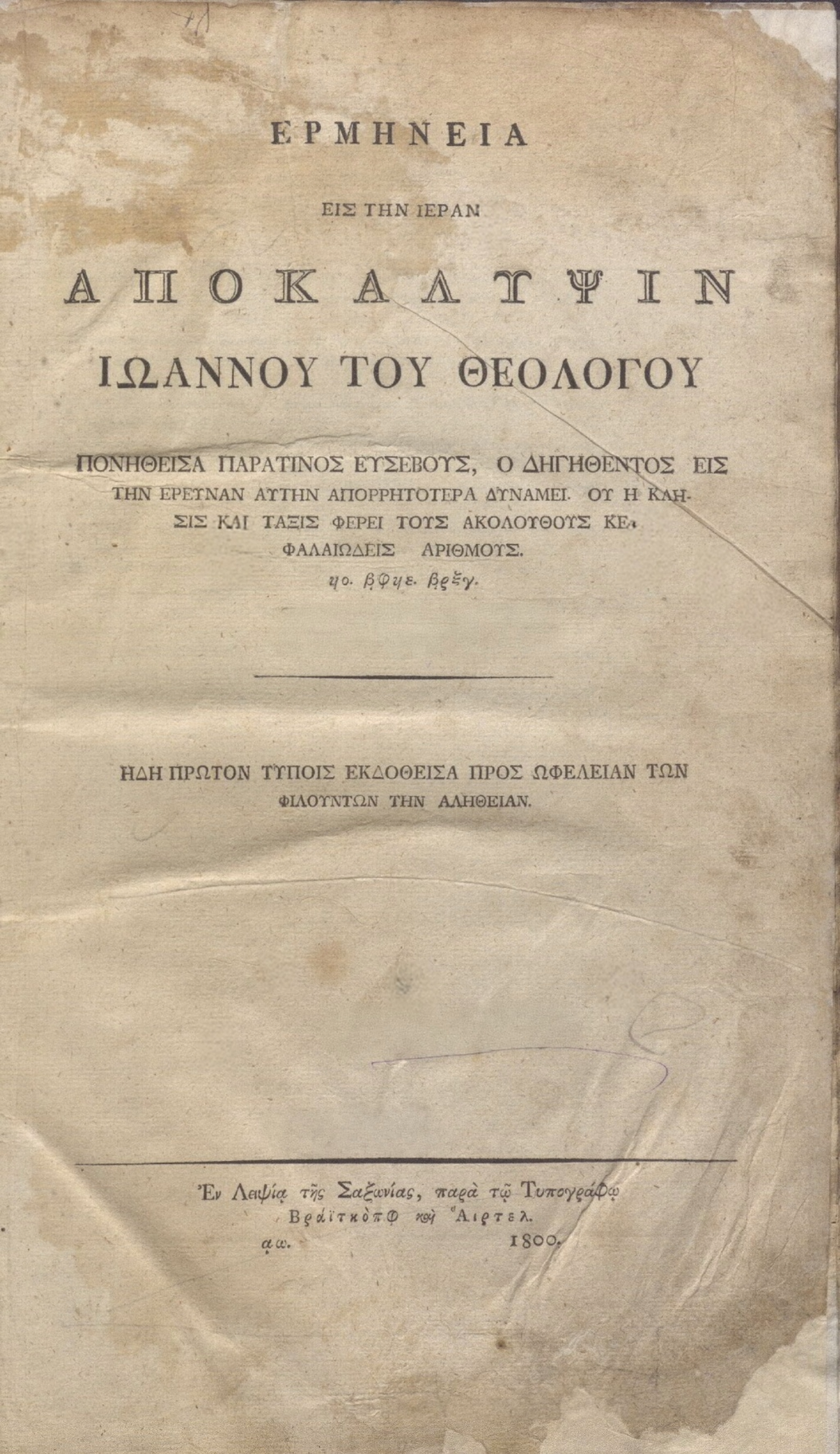
An Athonite like John of Myra, Theodoret served as Superior of both the Great Lavra and Esphigmenou monasteries in Mount Athos, Greece in the late 1700s and early 1800s. One of Theodoret’s most important contributions is his distinction between fixed dogma and developing prophetic interpretation. The doctrines of the Trinity, Christology, and the faith of the Ecumenical Councils remain unchangeable. Yet the historical manifestation of prophetic symbols becomes clearer as sacred history unfolds. Earlier Fathers preserved the apostolic foundations, but later generations, having lived through centuries of historical experience, could recognize patterns that earlier interpreters had not yet seen fully. Prophetic understanding itself develops historically—not because truth changes, but because providence gradually unveils its fulfillment.
This distinction is extraordinarily sophisticated. It allows Theodoret simultaneously to preserve absolute reverence for the Fathers while acknowledging the legitimacy of deeper historical insight. The Fathers were not “wrong”; rather, they interpreted before the full historical outcome had manifested itself. Theodoret repeatedly appeals to the concept of ἔκβασις—“outcome” or “historical result”—as a key to understanding prophecy. History itself becomes interpretive revelation.
Within this framework, Theodoret develops a sweeping interpretation of the Apocalypse as the sacred history of Christian civilization. Babylon is no longer merely ancient Rome, but any apostate civilization opposing divine truth. The Beast becomes not simply an individual tyrant, but an enduring anti-Christian system manifested through history. Papal supremacy and Islam emerge as parallel historical manifestations of anti-Christian power—one ecclesiastical and western, the other military and eastern. Both become participants in the same apocalyptic struggle against the Orthodox Church.
Here the influence of post-Byzantine historical consciousness becomes unmistakable. The fall of Constantinople was not experienced merely as a political catastrophe, but as an apocalyptic transition within sacred history itself. “Fallen, Fallen is Babylon the Great,” that once Great City. The Ottoman conquest, the fragmentation of Christendom, the rise of competing religious powers, and the suffering of the Orthodox under foreign domination all contributed to a growing sense that Revelation described not merely future events, but the entire historical drama of the Church after Pentecost.
Yet despite these historical identifications, Theodoret never descends into mere political speculation. Like John of Myra, his vision remains fundamentally ecclesiological and sacramental. Revelation is ultimately about the Body of Christ struggling through history toward final glorification. The Apocalypse becomes simultaneously theological, historical, ethical, ontological, and dramatic.
It is precisely here that the later synthesis of Apostolos Makrakis becomes especially illuminating. Makrakis famously described Revelation as “prophetic, historical, ethical, theological, ontological, and finally dramatic.” The book should be approached from all of those perspectives to begin to achieve a successful interpretation. Far from inventing an entirely novel approach, Makrakis appears to articulate philosophically what figures like John of Myra and Theodoret had already been practicing exegetically for centuries. Revelation was not merely a codebook of future events. It was the unveiling of sacred history itself.
The Apocalypse as Paschal History
Perhaps the most profound theological insight emerging from post-Byzantine Orthodox exegesis is the idea that the Apocalypse is not merely a prophecy of future events, nor simply a symbolic description of spiritual realities, but the extension of the Passion, Death, and Resurrection of Christ into history through His Body, the Church. In this vision, sacred history itself becomes paschal. The Church does not merely remember the sufferings of Christ liturgically; she relives them historically.
This perspective appears with remarkable force in the commentary of Theodoret of Ioannina. Interpreting the “three days and a half” during which the witnesses lie dead in the streets of the great city, Theodoret approaches the text not merely as a chronological puzzle, but through the lens of the saving Passion itself. The imagery of death, humiliation, exposure, burial, and eventual restoration becomes inseparable from the mystery of Christ’s own Passion and Resurrection. The Apocalypse thus unfolds according to a paschal pattern. History itself enters into the rhythm of Golgotha, the Tomb, and the Resurrection Morning.
The Paschal Structure of Sacred History
| Life of Christ | Historical Experience of the Church |
|---|---|
| Passion | Persecution and suffering |
| Crucifixion | Apparent defeat before the world |
| Burial | Historical captivity and humiliation |
| Three Days in the Tomb | Extended periods of oppression and obscurity |
| Resurrection | Restoration and renewal |
| Ascension | Final glorification of the Church |
| Kingdom of God | Eschatological fulfillment |
This interpretive framework profoundly shaped how many Greek Orthodox Christians understood the fall of Constantinople in 1453 AD and the long centuries of Ottoman domination that followed. The collapse of the Christian Roman Empire was not viewed merely as a political catastrophe or the failure of divine providence. Rather, it was increasingly interpreted as a form of burial — a descent into the tomb. The Church, like Christ Himself, appeared humiliated before the nations, stripped of earthly glory, and subjected to foreign domination. Yet burial is not annihilation. The tomb itself becomes the hidden chamber of resurrection.
Within this framework, the “three days” of apocalyptic humiliation came to symbolize periods of sacred historical suffering extending far beyond literal chronology. Just as Christ lay in the tomb before rising again in glory, so too Christian civilization could pass through historical death before eventual restoration. This interpretation transformed history into a continuation of the Paschal Mystery itself.
The later writings of Apostolos Makrakis appear to preserve and expand this same theological structure. Makrakis interpreted the long Ottoman occupation of the Greek people through a profoundly paschal lens. The “three and a half days” period of Revelation 11 became associated not merely with symbolic prophecy, but with the historical suffering and eventual liberation of the Orthodox people themselves. The centuries between the Fall of Constantinople and the Greek War of Independence could thus be read as a prolonged burial awaiting resurrection. National restoration itself became intelligible within the theological grammar of Pascha.
Yet the significance of this framework extends far beyond political history. At its deepest level, it reflects a profoundly Orthodox understanding of the Church as the continuation of Christ’s life within history. The Church is not merely an institution founded by Christ; she is His Body. Consequently, the pattern of Christ’s earthly ministry becomes the pattern of the Church’s historical existence. What occurred once in the flesh of Christ unfolds again and again within the life of His Body throughout sacred history.
The Apocalypse therefore becomes the revelation of this continuing participation in Christ:
- persecution as Passion,
- apparent defeat as Crucifixion,
- historical collapse as Burial,
- preservation in obscurity as Holy Saturday,
- and restoration as Resurrection.
This insight illuminates why post-Byzantine commentators increasingly interpreted Revelation ecclesiologically rather than merely politically. The visions of the Apocalypse describe not simply the fate of empires, but the mystical experience of the Church moving through history toward final glorification. The “witnesses” of Revelation become not isolated individuals alone, but the enduring testimony of the Church herself. Babylon becomes every civilization that exalts itself against divine truth. The Beast becomes every anti-Christian system seeking to extinguish the life of Christ within history. Yet none of these powers possess ultimate victory, because the entire structure of sacred history remains governed by the Paschal Mystery.
This perspective also helps explain why Orthodox historical exegesis differs so sharply from modern forms of apocalyptic speculation, such as futurism and preterism. In much contemporary prophecy discourse, Revelation becomes a catalogue of future catastrophes or a single 70 AD temple destruction event detached from liturgical and ecclesial life. In the post-Byzantine Orthodox vision, however, apocalypse is inseparable from Pascha. The key to understanding history is not fear, chronology, or political calculation, but the Cross and Resurrection of Christ.
In this sense, Revelation is ultimately the story of Christ continuing His Passion within history through His Body, the Church, until the final resurrection and revelation of the Kingdom of God. The Apocalypse unveils not merely the end of the world, but the mystical structure of sacred history itself — a history that passes continuously through death into resurrection.
Conclusion
The recovery of this Orthodox historical-ecclesiastical tradition has profound implications for modern discussions surrounding the Apocalypse. It challenges the widespread assumption that historical interpretation belongs primarily to Western Protestantism, while also complicating the simplistic division between “symbolic” Eastern readings and “historical” Western ones. The Byzantine and post-Byzantine commentators reveal something far more integrated: a sacramental and Christological interpretation of history itself.
For these interpreters, Revelation was not merely a catalogue of future catastrophes nor an abstract allegory detached from concrete historical experience. Councils, heresies, persecutions, empires, schisms, captivities, and restorations were all understood as manifestations of the same sacred drama unfolding through the life of the Church. The Apocalypse became the revelation of Church history transfigured through the Passion, Death, and Resurrection of Christ.
In this vision, the One Holy Catholic and Apostolic Church does not simply await the fulfillment of Revelation at the end of time. She lives it. Through suffering, humiliation, exile, endurance, and renewal, the Body of Christ participates continuously in the Paschal Mystery throughout history itself. The Book of Revelation therefore became, for these Orthodox commentators, not merely a prophecy of the world’s end, but the sacred biography of Christ’s Body moving through history toward its final resurrection and glorification in the Kingdom of God.
© 2026 by Jonathan Photius

