
By Jonathan Photius – The nEO-Historicism Research Project
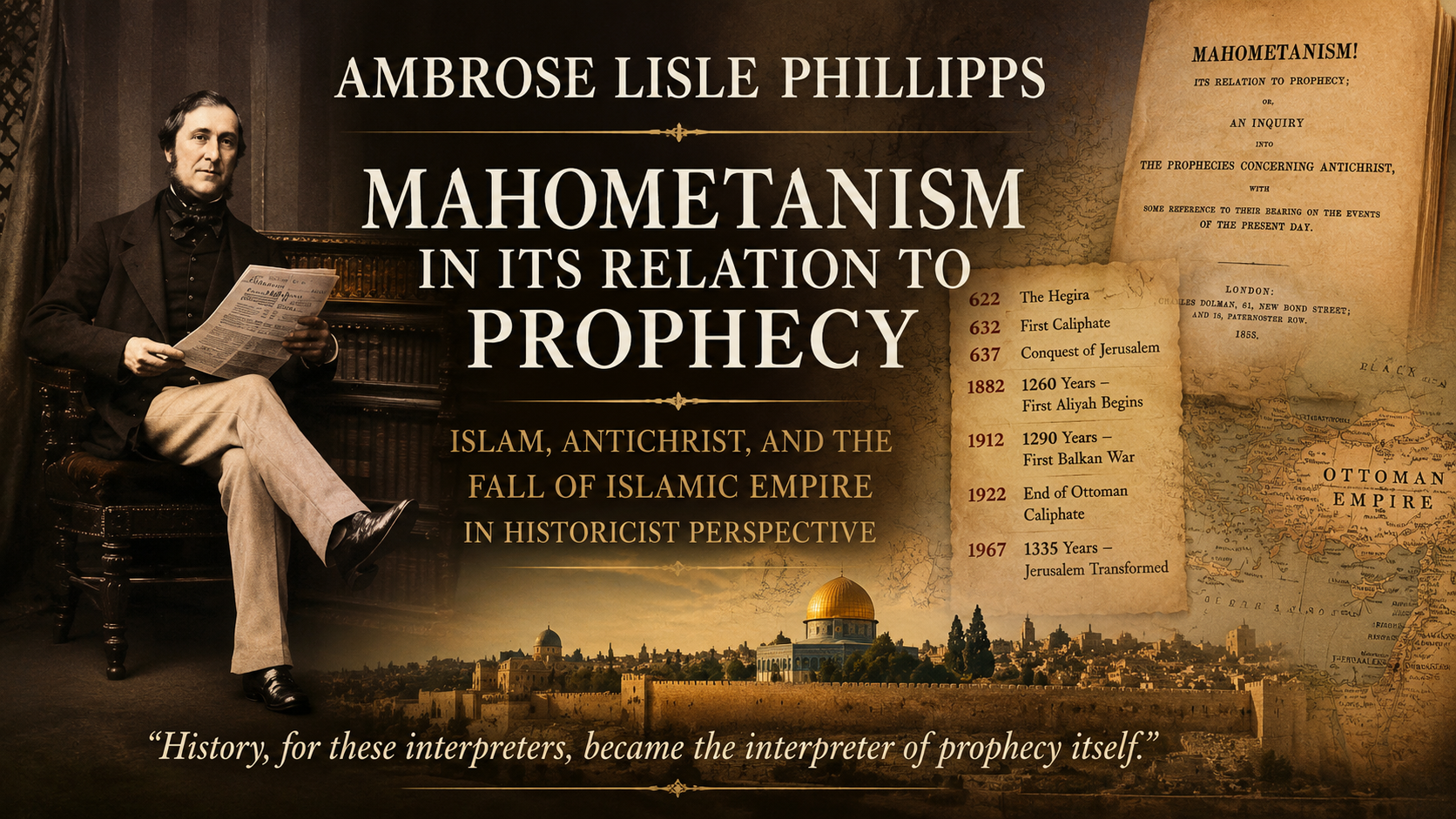
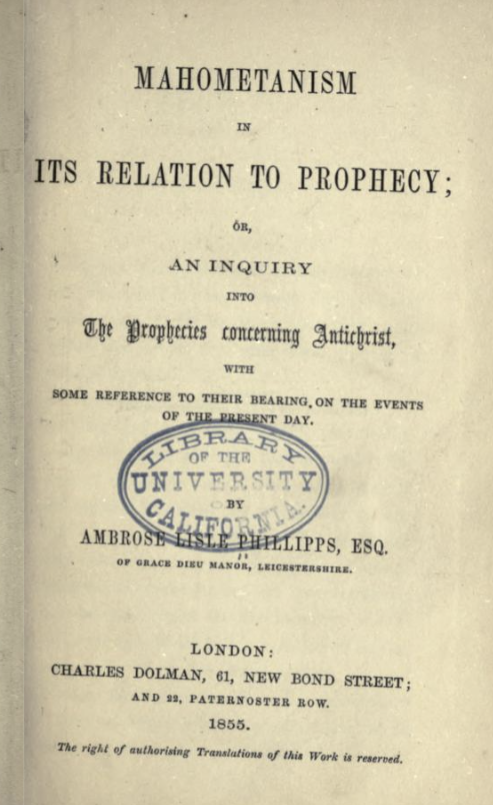
In 1855, the English Roman Catholic convert Ambrose Lisle Phillipps de Lisle published a remarkable and now largely forgotten work entitled Mahometanism in its Relation to Prophecy: Or, an Inquiry into the Prophecies Concerning Antichrist, with Some Reference to Their Bearing on the Events of the Present Day.
The book deserves renewed attention not merely as a curiosity of nineteenth-century polemics, but as an important witness to the existence of a much broader historicist-apocalyptic consciousness stretching across Protestant, Roman Catholic, and Eastern Orthodox traditions. Far from representing a uniquely Protestant approach to prophecy, Phillipps’ work demonstrates that historical interpretation of Daniel and Revelation had penetrated deeply into multiple confessional worlds during the Ottoman crisis of the nineteenth century.
What makes the work especially significant is the extraordinary symmetry between Phillipps’ prophetic system and the later Post-Byzantine Orthodox Historicist tradition represented by interpreters such as Christophoros Angelos, Anastasios Gordios, John Lindios of Myra, Apostolos Makrakis and Theodoret of Ioannina,
A Roman Catholic Historicist?
Ambrose Lisle Phillipps was not a Protestant polemicist. Born into an Anglican environment, he converted to Roman Catholicism as a teenager and became one of the major figures of the English Catholic revival. He promoted Catholic restoration in England, encouraged monastic renewal, and pursued various ecumenical efforts involving Anglicans and Eastern Christians.
Yet despite his Roman Catholic identity, Phillipps retained a profoundly historicist approach to prophecy. Throughout the book, prophecy is interpreted historically, progressively, chronologically, and through unfolding world events. Like the great historicist interpreters before him, Phillipps believed that Daniel and Revelation unfold across centuries, that empires become prophetic actors within sacred history, and that history itself progressively unveils prophetic meaning.
This alone makes the work historically important, since it complicates the simplistic modern assumption that Protestants were historicists, Catholics were futurists or preterists, and Orthodox Christians were merely symbolic interpreters. The historical reality was far more fluid, with overlapping prophetic traditions developing across confessional boundaries in response to shared historical crises.
Mohammed as Antichrist
The central thesis of Phillipps’ work is direct and uncompromising: Mohammed himself is the great Antichrist foretold in Scripture. Phillipps explicitly identifies Mohammed with:
- the Little Horn of Daniel,
- the False Prophet of Revelation,
- the Beastly anti-Christian power,
- and the “Man of Sin.”
He argues that Islam differs fundamentally from paganism because it arose after Christ and consciously opposed Christianity itself. In his words, Mahometanism was “raised up for the special purpose of warfare with Christianity.”
This language strongly parallels later Orthodox historicist interpretations which likewise viewed Islam not merely as another religion, but as a providential anti-Christian empire opposing the Church throughout history. The similarities to Apostolos Makrakis 1881 commentary are particularly striking. Makrakis likewise:
- identified Mohammed as the Little Horn,
- interpreted Islam historically through Daniel and Revelation,
- connected Ottoman decline with prophetic fulfillment,
- and viewed Islamic power as a temporary but providentially permitted anti-Christian dominion.
The Beast Empire and the Ottoman Crisis
Phillipps treats Islam not merely as a religious movement, but as a political-religious civilization empowered historically against Christianity. The Ottoman Empire becomes, in his framework, the final great embodiment of this Islamic beastly power.
Writing during the Crimean War era and the height of the “Eastern Question,” Phillipps believed the Ottoman Empire was visibly entering its prophetic decline. He repeatedly interprets Turkish weakening and Russian expansion southward as signs that the prophetic destruction of Islamic imperial power had already begun. This parallels later Orthodox historicists such as Makrakis, who interpreted the drying up of the Euphrates in Revelation 16 as the gradual collapse of Ottoman power and the retreat of Islamic dominion from Christian lands.
In both systems: history itself becomes the visible arena of prophetic fulfillment.
The 666 Calculation and Byzantine Greek Tradition
One of the most fascinating aspects of the work is Phillipps’ treatment of the number 666.
Unlike Protestant interpreters who often identified “Lateinos” (ΛΑΤΕΙΝΟΣ) with the Papacy and Latin Christianity, Phillipps rejects anti-papal applications of the number and instead redirects the entire framework toward Mohammed.
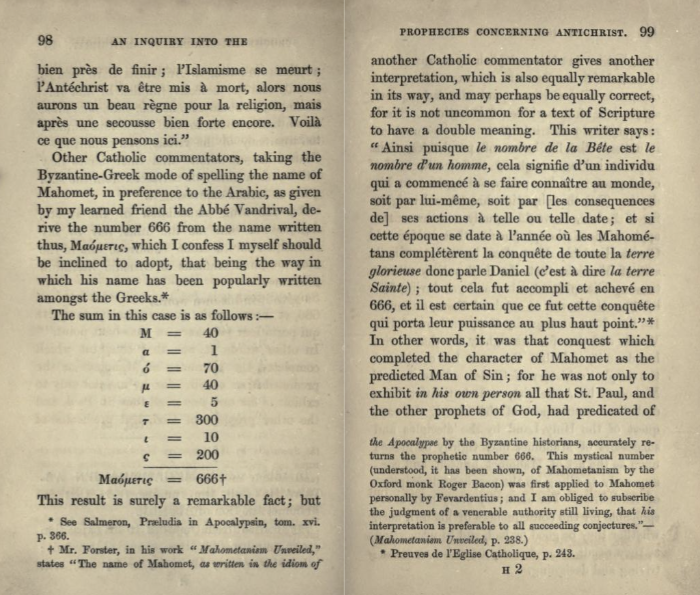
Most remarkably, he explicitly appeals to Byzantine Greek spellings of Mohammed’s name in support of his interpretation.
Phillipps references:
- Byzantine historians Cedrenus, Zonaras, and Euthymius 666 calculations on Mohammed
- Greek renderings of Mohammed’s name,
- medieval Catholic commentators,
- Roger Bacon,
- and earlier anti-Islamic prophetic traditions.
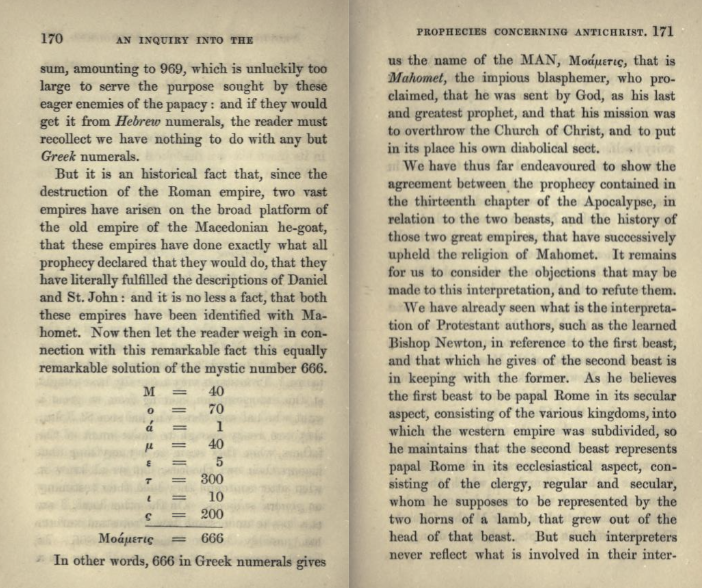
He argues that the Greek spelling of Mohammed’s name, as popularly written among Byzantine Greeks, numerically yields 666.
This is historically significant because it demonstrates direct awareness of Eastern Christian interpretive traditions within a nineteenth-century Roman Catholic prophetic framework.
The result is an extraordinary East-West convergence: Byzantine anti-Islamic apocalyptic memory entering Western historicist chronology.
The 1260, 1290, and 1335 Years
Perhaps the most astonishing feature of Phillipps’ work is his detailed chronological system.
Phillipps explicitly dates the 1260 years from: 622 AD — the Hegira of Mohammed.
From this starting point he develops multiple prophetic calculations involving:
- 1260 years,
- 1290 years,
- 1335 years,
- and prophetic versus solar year distinctions.
Using ordinary reckoning:
622 + 1260 = 1882.
From a modern perspective, this is striking because 1882 marks the beginning of the First Aliyah — the first major wave of modern Jewish immigration into Ottoman Palestine.
Phillipps also explores prophetic-year recalibrations using 360-day prophetic years, yielding alternative dates near 1865, which he expected might correspond to the destruction of the Ottoman Empire.
Although the empire did not collapse fully at that exact date, the nineteenth century did in fact witness:
- accelerating Ottoman decline,
- Russian military pressure,
- Balkan uprisings,
- territorial disintegration,
- and the irreversible weakening of Islamic imperial power.
He then extends the prophetic sequence:
- 1290 years representing the destruction of Islamic political power,
- followed by the 1335 years representing the arrival of a future “blessed period.”
These calculations become even more fascinating when viewed historically:
622 + 1290 = 1912
The First Balkan War begins, leading to catastrophic Ottoman collapse in Europe.
632 + 1290 = 1922
From the rise of the First Caliphate to the abolition of the Ottoman Sultanate — the collapse of the final great Islamic imperial caliphate.
632 + 1335 = 1967
The Six-Day War transforms the status of Jerusalem and the Holy City.
Whether one accepts these calculations prophetically or not, the historical symmetry is undeniably striking.
The 637 Jerusalem Connection
Phillipps also mentions another possible starting point: 637 AD — the conquest of Jerusalem by Caliph Omar. This is extraordinarily important because 637 occupies a central place in Byzantine and Post-Byzantine apocalyptic memory.
It was:
- the year of Jerusalem’s surrender,
- the beginning of long Islamic dominion over the Holy Land,
- and the era in which Sophronius of Jerusalem lamented the “abomination of desolation.”
This same date repeatedly appears in later Orthodox historicist systems:
- Makrakis,
- Metropolitan John of Myra,
- Cyril Lavriotis
- and various post-Byzantine interpreters.
Again we see remarkable convergence between Eastern and Western historicist chronology.
History as the Interpreter of Prophecy
Perhaps the most important theological principle underlying Phillipps’ work is his repeated insistence that prophecy becomes clearer through historical fulfillment. He writes that many things concerning prophecy remain sealed until the time of their fulfillment, at which point difficulties become progressively unraveled. This principle strongly parallels:
- Andrew of Caesarea’s emphasis on χρόνος and πείρα (“time and experience”),
- Theodoret of Ioannina’s principle that “Outcome proves prophecy,”
- and the broader Greek Orthodox Historicist understanding that history progressively unveils the Apocalypse.
This is what makes Phillipps so important. He demonstrates that nineteenth-century historicism was not merely an isolated Protestant phenomenon. Rather, a broad trans-confessional apocalyptic consciousness emerged across Christendom in response to:
- Islamic imperial expansion,
- Ottoman domination,
- the decline of Christian civilization in the East,
- and the eventual collapse of Ottoman power.
Conclusion
Ambrose Lisle Phillipps stands today as one of the most intriguing forgotten witnesses to the wider historicist tradition. His work reveals:
- a Roman Catholic interpreter employing historicist chronology,
- explicit engagement with Byzantine Greek traditions,
- Islamic identification with Antichrist prophecy,
- and chronological systems remarkably parallel to later Orthodox historicism.
The more these forgotten sources are studied together, the clearer it becomes that Eastern and Western historicist traditions were not isolated intellectual worlds. They were overlapping responses to a shared historical reality: the rise, dominion, and decline of Islamic empire across the Christian world. And for interpreters like Phillipps, Makrakis, and the Post-Byzantine historicists, history itself became the unfolding commentary upon prophecy.
© 2026 by Jonathan Photius

