
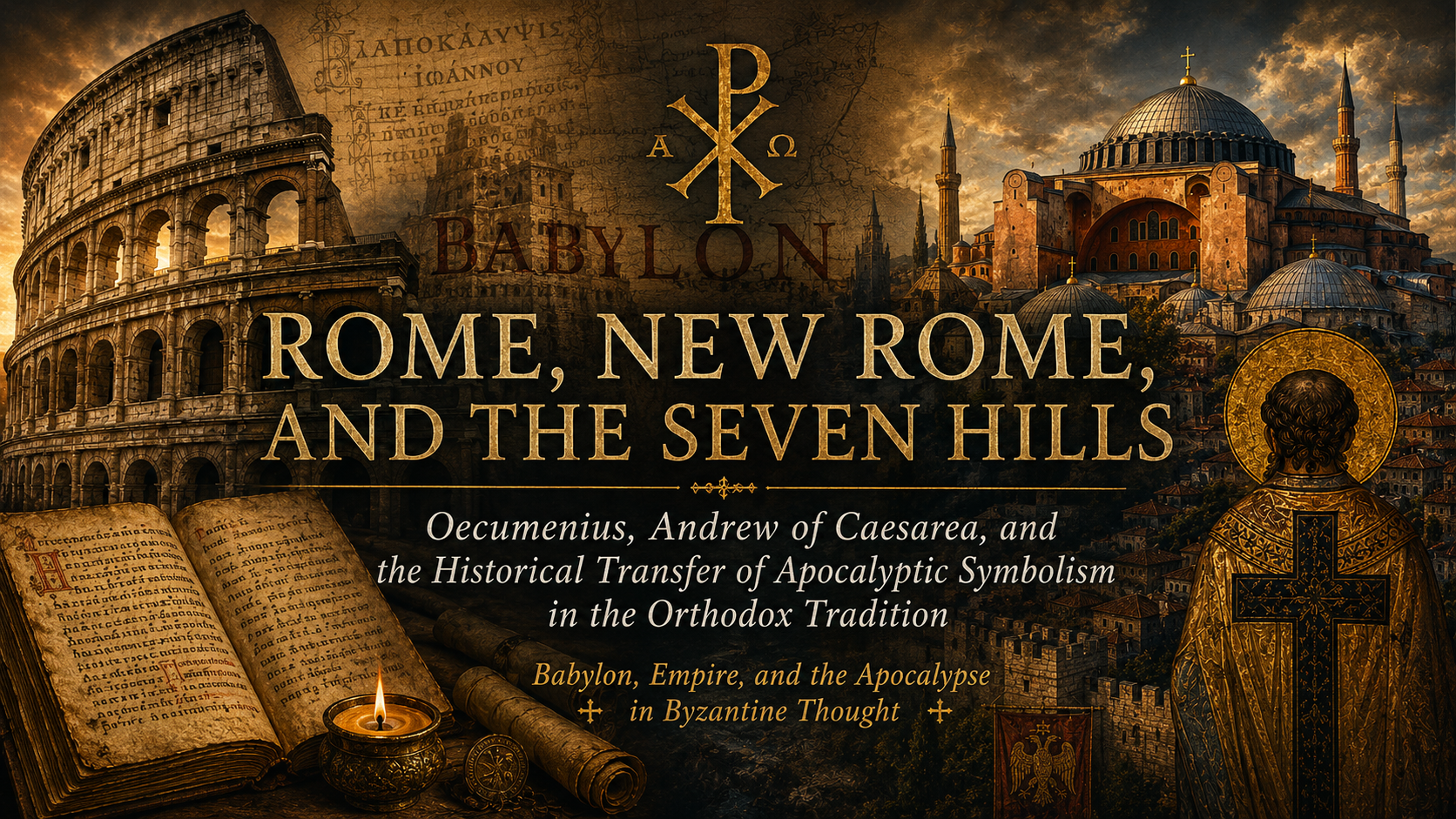
By: Jonathan Photius – The nEO-Historicist Research Project
The history of Christian interpretation of the Apocalypse reveals a persistent tension between symbolic theology and historical application. While many modern scholars sharply divide “historicist,” “futurist,” and “allegorical” approaches into mutually exclusive categories, the Byzantine exegetical tradition often operated far more organically. Apocalyptic symbols could simultaneously possess theological depth, spiritual meaning, ecclesial application, and historical embodiment.
This becomes especially clear in the interpretation of Rome and Babylon within the Orthodox tradition. From the second century onward, Christian writers increasingly identified the Beast, Babylon, and the persecuting order of Revelation with Rome. Yet this identification did not remain confined to a single historical moment. As Roman civilization evolved from Pagan Rome to Christian Rome and eventually to New Rome (Constantinople), before continuing into the post-Byzantine world and later Papal and Ottoman realities, the symbolic framework of Revelation itself became increasingly historically transferable.
The seeds of this development appear remarkably early. By the time of Oecumenius in the sixth century, Revelation’s symbols were already being connected directly to Roman imperial history. Later Byzantine and post-Byzantine interpreters would expand these historical associations into increasingly sophisticated historical-ecclesiastical interpretations of the Apocalypse. Far from being reducible to a later Protestant innovation, a distinctly Orthodox form of historical apocalyptic consciousness developed gradually within the Byzantine tradition itself.
I. Irenaeus and the Early Roman Association
The roots of this historical trajectory may already be seen in Irenaeus. In Against Heresies V.30.3, Irenaeus famously proposed ΛΑΤΕΙΝΟΣ (Lateinos) as one possible solution to the number 666.¹ Although he does not construct a fully developed historical system, the association between the Beast, Roman-Latin identity, and imperial dominion is already clearly present.
Importantly, Irenaeus remains cautious. He explicitly warns against excessive dogmatism regarding the precise identity of the Beast. Yet even this caution reveals something significant: the Apocalypse was already being interpreted in relation to concrete historical realities rather than merely abstract moral symbolism.
The Roman principle had already entered the consciousness of Christian apocalyptic interpretation.
II. Oecumenius and the Historical Grounding of Revelation
This historical tendency becomes much clearer in Oecumenius’ Commentary on the Apocalypse, one of the earliest surviving Greek commentaries on Revelation. Oecumenius explicitly identifies Babylon with Rome:
“For we considered that it was Rome which the Revelation meant.”²
Likewise, he interprets the seven heads of the Beast as the seven hills of Rome, and the kings associated with those heads as historical Roman emperors. His list includes:
- Nero,
- Domitian,
- Trajan,
- Severus,
- Decius,
- Valerian,
- and Diocletian.³
This is a strikingly historical reading for so early a Byzantine exegete. The Apocalypse is no longer merely timeless symbolism. It is directly tied to imperial persecution, Roman history and the suffering of the Church under concrete political powers. Yet Oecumenius remains profoundly theological. Rome is not merely a city or empire. It is simultaneously a persecuting civilization, a spiritual condition, and an instrument of demonic rebellion. Thus Babylon becomes more than Rome while still including Rome. This layered approach proves enormously important for later Orthodox apocalyptic interpretation.
III. The Seven Hills and the Mobility of Roman Symbolism
One of the most significant features of Oecumenius’ interpretation is his identification of the Beast’s heads with the famous seven hills of Rome:
“He says, ‘The seven heads are seven hills on which the woman is seated’: this is a very clear indication that he is speaking about Rome.”⁴
In antiquity, the “Seven-Hilled City” was universally associated with Rome. Yet history itself complicated this symbolism.
Constantinople, consciously founded as Nova Roma—New Rome—eventually inherited nearly all the symbolic characteristics formerly associated with Old Rome:
- universal empire,
- sacral kingship,
- imperial dominion,
- ecclesiastical centrality,
- and even the title of the “Seven-Hilled City.”
This parallel is extraordinary.
The Byzantines themselves never believed Rome had ended. They called themselves:
- Ῥωμαῖοι (Romans),
and their empire: - the Empire of the Romans.
Thus the symbolic geography of Rome migrated eastward together with imperial authority itself. This created an interpretive situation in which Revelation’s Roman imagery could no longer remain historically static. If Rome continued historically through Constantinople, then apocalyptic “Roman” symbolism could also continue historically.
IV. Andrew of Caesarea and “Time and Experience Reveal”
The crucial bridge between early patristic interpretation and later Orthodox historical apocalypticism appears most clearly in Andrew of Caesarea.
Andrew is often described as a moderate or cautious interpreter of Revelation, and rightly so. He rejects speculative excess and frequently prefers spiritual or ecclesial readings. Yet Andrew simultaneously introduces one of the most important hermeneutical principles in the entire Byzantine apocalyptic tradition: history itself reveals prophecy.
In his commentary on Revelation 13:18 concerning the number of the Beast, Andrew famously states:
“But as for the exact meaning of the number, time and experience will reveal it to the vigilant.”⁵
This statement is extraordinarily significant.
This principle creates the interpretive space necessary for later Orthodox historicist developments. Importantly, Andrew’s statement is not a form of modern rationalistic historicism. He does not propose a mechanical decoding of prophecy through secular chronology or purely external historical calculation. Rather, prophecy becomes intelligible through ecclesial vigilance, historical suffering, and spiritual discernment within the life of the Church itself.
The phrase “time and experience” therefore emerges as a distinctly Byzantine hermeneutical principle. History is not understood as something separate from revelation, but as participating in its gradual unveiling. The meaning of prophecy unfolds through the lived experience of the Church as she passes through persecution, doctrinal conflict, imperial transformation, and spiritual struggle across the ages.
IV.1 Andrew of Caesarea and the Continuing Mystery of Babylon
Although Andrew of Caesarea often adopts a cautious and spiritual interpretation of Revelation, his treatment of Babylon likewise preserves a remarkable openness toward historical realization. Like earlier exegetes, Andrew associates Babylon with Rome, yet he does not rigidly confine the symbol to a single first-century manifestation. For Andrew, Babylon signifies not merely one city, but the broader civilization of impiety and persecution opposed to God and His Church. In his commentary on Revelation 17 and 18, Babylon becomes the image of worldly dominion intoxicated with power, luxury, violence, and spiritual fornication.
Importantly, Andrew repeatedly avoids overly narrow identifications. Instead, he interprets apocalyptic symbols through layered theological categories that remain historically extensible. This interpretive reserve proved enormously influential. Because Andrew refrained from exhausting Babylon’s meaning in one historical moment, later Byzantine and post-Byzantine interpreters could continue applying the symbol to unfolding historical realities without believing they had abandoned patristic tradition.
Thus Babylon in the Byzantine tradition became simultaneously: historical, spiritual, ecclesial, and eschatological. The symbol retained continuity while history supplied new embodiments. In this sense, Andrew’s commentary preserves precisely the kind of dynamic symbolic realism that later Orthodox historicist interpreters would develop more explicitly. This explains why later Orthodox interpreters could increasingly reread Revelation through the lens of unfolding history without believing they had abandoned patristic tradition.
V. The Historical Expansion of the Roman Principle
Once Revelation’s symbols became historically grounded in Rome while remaining spiritually and typologically open, later reinterpretation became almost inevitable. As history advanced, the “Roman” principle migrated through successive historical embodiments:
- Pagan Rome,
- Christian Rome,
- New Rome,
- Papal Rome,
- and eventually broader imperial-civilizational realities.
This process intensified dramatically after the fall of Constantinople in 1453, Ottoman domination, and the fragmentation of the Orthodox world. The post-Byzantine era produced a far more historically conscious apocalyptic literature. Writers increasingly interpreted Revelation through ecclesiastical decline, imperial collapse, Islamic expansion, and long-duration prophetic chronology. Within this context, interpreters such as Christophoros Angelos, Anastasios Gordios, John of Myra, Theodoret of Ioannina, and Apostolos Makrakis developed increasingly sophisticated historical-ecclesiastical readings of the Apocalypse.
VI. Theodoret of Ioannina and New Rome
Theodoret of Ioannina represents one of the most mature expressions of this Orthodox historical consciousness. Writing in the late eighteenth century under Ottoman domination, Theodoret interpreted Revelation through a sweeping historical synthesis involving the Roman Empire, Constantinople, Islam, ecclesiastical struggle, and the rise of Antichrist.⁶ In his framework, the Roman principle no longer referred exclusively to ancient pagan Rome, but unfolded through successive phases of Christian and post-Christian imperial history.
The symbolism of the Seven-Hilled City could therefore evoke both Old Rome and New Rome simultaneously, reflecting not only imperial continuity but also the tragic decline and fragmentation of Christian civilization itself. Revelation became a vast sacred history of the Church’s struggle within the world, extending across empires, doctrinal conflicts, invasions, and civilizational transformations.
Importantly, this historical expansion did not emerge as an arbitrary innovation imposed upon the text. Rather, it developed organically from Byzantine historical self-understanding. Because the Byzantines understood themselves as the continuing Roman commonwealth, the apocalyptic symbolism associated with Rome naturally remained historically active and capable of new historical realization across successive ages.
VII. Makrakis and Papal Rome
Apostolos Makrakis would later extend this historical transfer of apocalyptic symbolism even further. For Makrakis, aspects of Babylonian corruption became associated with Papal supremacy, ecclesiastical worldliness, and deviations from apostolic Orthodoxy.⁷ In this respect, Makrakis parallels certain Protestant historicist readings, particularly in his willingness to apply the imagery of Revelation to long historical developments within Christian civilization itself.
Yet Makrakis’ framework remains distinctly Orthodox in both method and theological orientation. His interpretation is not merely political or polemical, but sacramental, ecclesial, mystical, and profoundly Christological. Revelation is interpreted through the continuing life of the Church as the Body of Christ suffering within history. Consequently, doctrinal conflict, ecclesiastical corruption, persecution, and civilizational upheaval are understood not simply as secular events, but as manifestations of the deeper spiritual struggle described within the Apocalypse.
Makrakis therefore does not reduce Revelation to a rigid chronological scheme or a purely external critique of particular institutions. Rather, he interprets history itself as the unfolding drama of divine providence, ecclesiastical conflict, judgment, suffering, and eventual restoration. In his hands, the Roman principle had become fully transhistorical. Babylon no longer referred merely to one ancient empire, but to recurring historical manifestations of worldly power and spiritual corruption opposed to the life of the Church.
VIII. Danielic Kingdom Succession and the Transfer of Symbolism
The historical transfer of Roman symbolism within the Orthodox tradition also parallels the broader biblical pattern established in the Book of Daniel. In Daniel’s visions, successive empires are represented symbolically through statues, beasts, horns, and kingdoms. Yet these symbols are not merely isolated political references. They signify recurring manifestations of worldly power set in opposition to the kingdom of God.
In Daniel, Babylon is succeeded by Medo-Persia, Greece, and finally Rome. Yet the Roman principle itself continues unfolding through multiple phases of imperial history. Even within patristic interpretation, the “fourth kingdom” was often understood not simply as a single ruler or political moment, but as an enduring imperial order extending across time.
This continuity becomes especially significant within Byzantine thought. Because the Byzantine Empire understood itself as the continuation of the Roman Empire, apocalyptic “Roman” symbolism naturally remained historically active rather than permanently confined to antiquity. Thus the transfer of symbolic geography from Old Rome to New Rome mirrors the broader biblical principle whereby kingdoms undergo historical transformation while retaining continuity of spiritual character.
The Apocalypse therefore does not merely reproduce Daniel mechanically, but extends Daniel’s vision into the age of the Church. The persecuting kingdom evolves through successive historical manifestations while preserving continuity of civilizational and spiritual rebellion against God. This helps explain why later Orthodox interpreters increasingly understood Revelation not as a disconnected future catastrophe, but as the continuing historical drama of the kingdom of God confronting recurring manifestations of “Babylon” throughout history.
IX. The 1260-Year Principle and Ecclesiastical History
The development of prophetic year-day interpretation further intensified this historical consciousness within the Orthodox apocalyptic tradition. Once the 1260 days, the 42 months, and the mysterious “time, times, and half a time” were understood as long historical periods rather than merely brief future intervals, Revelation increasingly came to be read as ecclesiastical history unfolded prophetically through the ages.
This hermeneutical shift allowed later Orthodox interpreters to correlate the imagery of the Apocalypse with the concrete historical experience of Christian civilization itself. The rise of Islam, Ottoman expansion and decline, ecclesiastical upheavals, imperial collapse, doctrinal conflict, and broader civilizational transformations could all be viewed as participating in the ongoing historical drama described within Revelation. Prophecy was no longer confined exclusively to either the apostolic past or an isolated future tribulation immediately preceding the end of the world. Instead, the Apocalypse became a lens through which the Church interpreted her continuing pilgrimage through history.
Yet even here, Byzantine interpretation retained its symbolic and theological depth. Revelation was not reduced to a merely chronological map of political events. Historical developments possessed spiritual and ecclesial significance because history itself was understood as the arena of cosmic conflict between the kingdom of God and the powers of rebellion. In this sense, the Apocalypse became not merely symbolic theology nor simply a prophecy of future catastrophe, but the historical Passion of the Church extended through time — the continuing manifestation of Christ’s victory, suffering, and triumph within the life of His Body across the centuries.
X. Rome as a Civilizational Principle
The most important insight emerging from this trajectory is that “Rome” gradually ceased functioning merely as a geographical reference. Within the Byzantine and later Orthodox apocalyptic imagination, Rome increasingly came to signify a recurring civilizational and spiritual pattern manifested across successive historical embodiments. This pattern was characterized by imperial universalism, sacralized political authority, persecution of the righteous, luxury and decadence, spiritual corruption, and ultimately rebellion against God.
In this way, Babylon could reappear throughout history in differing historical forms while still preserving continuity with the earlier Roman symbolism of Revelation. The symbols themselves remained stable, but history supplied new manifestations and deeper historical realization. The Apocalypse was therefore not confined to a single past empire nor reduced to a single future tyrannical regime. Rather, apocalyptic imagery possessed an enduring theological depth capable of illuminating recurring structures of worldly power opposed to the kingdom of God.
Importantly, this did not require later Orthodox interpreters to identify every manifestation of “Rome” or “Babylon” in an absolute or univocal sense. Byzantine apocalyptic interpretation operated typologically and analogically rather than through rigid one-to-one equivalences. Historical civilizations could participate in the broader “Babylonian” pattern to varying degrees without ever exhausting the symbol’s ultimate eschatological significance. In this respect, Revelation’s imagery retained both historical concreteness and transcendent openness, allowing the Apocalypse to speak simultaneously to past, present, and future manifestations of civilizational rebellion against God.
XI. Babylon in Orthodox Liturgical Consciousness
The Byzantine understanding of Babylon was never limited to academic exegesis alone. The imagery of exile, captivity, and Babylonian oppression permeated Orthodox liturgical and spiritual consciousness.
Psalm 136 (137 LXX), “By the rivers of Babylon,” ⁸ became one of the defining hymns of exile and ecclesial longing within the Orthodox tradition. Sung prominently during the pre-Lenten period, the psalm transformed Babylon into a perpetual spiritual image of: alienation from God, captivity, worldliness, and the sorrow of exile from the heavenly Jerusalem.
After the fall of Constantinople in 1453, these themes acquired renewed historical force. Many Orthodox Christians increasingly experienced Ottoman domination itself through the symbolic language of exile and captivity already embedded within the Church’s liturgical memory.
Thus apocalyptic interpretation in the Byzantine and post-Byzantine world did not arise merely from speculative chronology. It emerged organically from the lived historical experience of the Church interpreted through Scripture, worship, suffering, and collective memory.
This liturgical consciousness helps explain why Revelation’s symbols remained historically dynamic within Orthodoxy. Babylon was not merely a past city, but a recurring spiritual-historical condition experienced repeatedly by the people of God throughout sacred history.
XII. Conclusion
Oecumenius, Andrew of Caesarea, and the later Byzantine tradition collectively demonstrate that Orthodox apocalyptic interpretation possessed a far richer historical dimension than is often acknowledged. Oecumenius grounded the Apocalypse within the concrete realities of Roman imperial history, while Andrew articulated the crucial hermeneutical principle that the deeper meaning of prophecy is unveiled through “time and experience.” Later Orthodox interpreters would extend these foundations across the unfolding drama of Christian civilization itself, reading Revelation through the historical life of the Church, the rise and fall of empires, doctrinal conflict, persecution, exile, and ecclesiastical struggle.
Yet this development was neither a reduction of Revelation to mere allegory nor a rigid chronological system divorced from theology. Byzantine apocalyptic interpretation remained simultaneously historical, spiritual, sacramental, ecclesial, and eschatological. Prophecy unfolded not outside the life of the Church, but within it. The Apocalypse thus became the history of the Church interpreted through the lens of Christ’s victory over the powers of darkness.
In this sense, the historical transfer of Roman symbolism—from Old Rome to New Rome and beyond—was not an abandonment of patristic interpretation, but one of its most organic historical developments. The symbols of Revelation retained their theological continuity even as history supplied new embodiments and deeper historical realization. Byzantine exegesis therefore preserved a dynamic symbolic realism in which sacred history, ecclesial experience, and apocalyptic revelation continually illuminated one another across the ages.
Footnotes
- Irenaeus, Against Heresies 5.30.3.
- Oecumenius, Commentary on the Apocalypse, trans. John N. Suggit (Washington, D.C.: Catholic University of America Press, 2006), 151.
- Ibid., 148–149.
- Ibid., 148.
- Andrew of Caesarea, Commentary on the Apocalypse, PG 106:340–345.
- See Asterios Argyriou, Les Exégèses Grecques de l’Apocalypse à l’époque Turque (1453–1821): Esquisse d’une Histoire des Courants Idéologiques au Sein du Peuple Grec Asservi (Thessaloniki: Patriarchal Institute for Patristic Studies, 1982).
- Apostolos Makrakis, Interpretation of the Book of Revelation (Athens, 1882).
- See the use of Psalm 136 (137 LXX) in the Byzantine pre-Lenten services of the Triodion.
© 2026 by Jonathan Photius


interesting. I came to see Constantinople was Mystery Babylon in 2000. I’ve written extensively on it but almost nobody takes it seriously.
LikeLike
Interesting. I saw that Mystery Babylon was Constantinople in 2000. I posted it on WordPress in 2008
LikeLike