
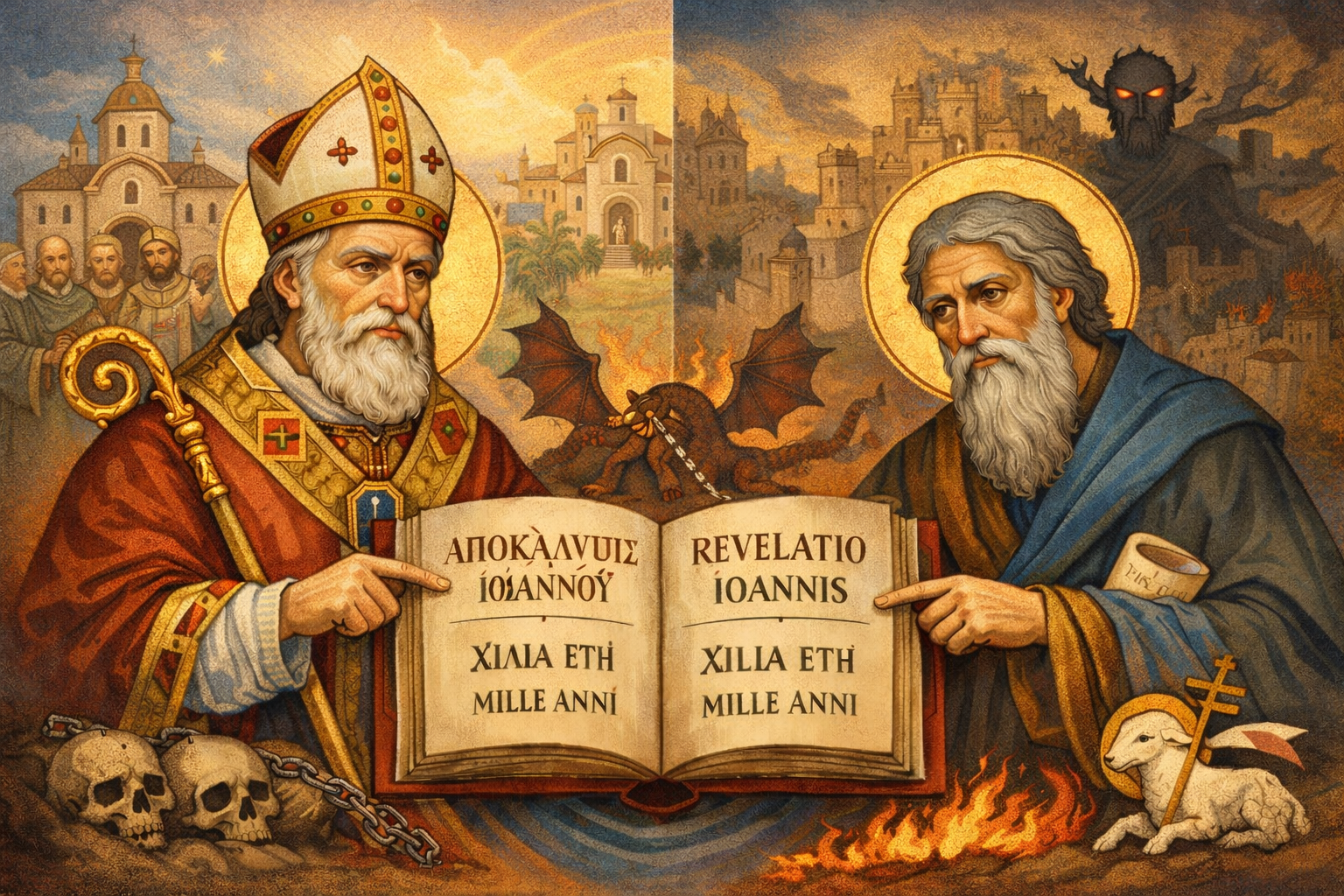
By: Jonathan Photius, NEO-Historicist Research Project
Abstract
Although both Andrew of Caesarea and Augustine of Hippo reject a literal, carnal millennium, their interpretations of Revelation 20 converge more closely than is often assumed. Both understand the “thousand years” symbolically as the present age of the Church, extending from Christ’s first coming to His second, and both interpret the first resurrection in a spiritual sense. Yet a decisive difference emerges in their respective treatments of symbolic interpretation and its relation to history. Augustine’s approach tends toward theological closure, in which the meaning of apocalyptic symbols is fully realized in principle within the present age. Andrew of Caesarea, by contrast, preserves a non-determinative and open-ended symbolic hermeneutic, grounded in χρόνος and πείρα, in which time and historical experience may clarify prophetic meaning retrospectively without establishing a chronological framework.
This article argues that Andrew should not be regarded as a proto-historicist in a chronological sense, but rather as a pre-historicist exegete whose method allows for the illumination of prophecy within history without itself constructing a historical timeline. This distinctly Byzantine hermeneutical posture helps explain the later development of Orthodox historicist tendencies while maintaining fidelity to patristic restraint, and clarifies why Orthodox eschatology cannot be adequately reduced to an Augustinian model.¹²
1. Introduction: Allegory and the Problem of Time
In modern theological taxonomies, Andrew of Caesarea and Augustine of Hippo are often grouped together under the category “amillennial,” on the assumption that both reject a literal thousand-year earthly reign of Christ. While formally true, this classification obscures a decisive difference in how allegory functions within each thinker’s eschatology. The question is not whether the millennium is symbolic, but whether symbolic interpretation abolishes historical development or presupposes it.¹
Andrew’s Commentary on the Apocalypse—the earliest surviving complete Greek commentary on the Book of Revelation—emerged within a Byzantine ecclesial context that understood history itself as the arena of divine pedagogy. Augustine’s De civitate Dei, by contrast, reflects a Latin theological synthesis shaped by anti-chiliastic polemic and an overriding concern for ecclesial stability.²
This study argues that Andrew of Caesarea does not construct a historical or chronological interpretation of prophecy, particularly in his treatment of Revelation 20, which aligns closely with the symbolic and amillennial framework of Augustine of Hippo. However, unlike Augustine, Andrew preserves a non-determinative and open-ended symbolic hermeneutic—grounded in χρόνος and πείρα—that allows for the retrospective illumination of prophecy within history. This hermeneutical posture, while not itself historicist, provided the conditions under which later Byzantine interpreters could develop more explicitly historical readings.
2. Augustine of Hippo: Allegory and Temporal Closure
In City of God XX.7–9, Augustine identifies the “thousand years” of Revelation 20 with the entire period between Christ’s first and second comings.³ The number signifies completeness rather than duration; the binding of Satan is effected through Christ’s passion; the reign of the saints is coextensive with the present Church.
Augustine explicitly resists any expectation of a distinct future historical phase within the present age:
*“The thousand years may be understood in reference not to a definite number of years, but to the fullness of time.”*⁴
The interpretive consequence is decisive. Prophecy is fulfilled in principle at the advent of Christ; history thereafter does not disclose new meaning but merely illustrates theological truths already known.⁵⁶ Apocalyptic symbolism becomes descriptive rather than predictive, ecclesiological rather than historical.
3. Andrew of Caesarea: Allegory without De-Historization
Andrew likewise rejects chiliastic literalism, yet his allegorical method functions differently. Numbers are symbolic, but symbols refer to realities experienced within time, without implying a chronological unfolding of prophecy.⁷
3.1 Time and experience as hermeneutical agents
Andrew’s most explicit methodological statement occurs in his discussion of Revelation 13:18:
*Τὸ δὲ ἀκριβὲς τοῦ ἀριθμοῦ καὶ τῶν λοιπῶν τῶν περὶ αὐτοῦ γεγραμμένων ὁ χρόνος καὶ ἡ πείρα τοῖς σώφροσιν ἐρευνηταῖς ἀποκαλύψει.*⁸
*“Time and experience will reveal to sober investigators the precision of the number and the other things written concerning it.”*⁹¹⁰
This statement establishes a hermeneutic alien to Augustine’s system. Andrew assumes that apocalyptic meaning may become clearer over time, without implying a chronological unfolding of prophecy itself and that later generations may possess superior interpretive vantage.¹¹
3.2 The future Antichrist and phased fulfillment
Andrew affirms a future personal Antichrist, yet this does not negate historicist sensibility. Rather, it presupposes phased fulfillment: apocalyptic symbols may operate across multiple historical manifestations before reaching their final personal expression.¹²
4. Revelation 20 Reconsidered: A Comparative Framework
Andrew’s commentary on Revelation 20 refuses both chiliastic literalism and temporal collapse.¹⁵ In contrast, Augustine identifies the millennium exhaustively with the present Church age.¹⁴¹⁶ Despite frequent classification under the same amillennial framework, Andrew of Caesarea and Augustine of Hippo diverge not in their interpretation of the millennium itself, but in how symbolic meaning relates to historical time.
Revelation 20: Andrew of Caesarea vs. Augustine of Hippo
| Category | Andrew of Caesarea | Augustine of Hippo |
|---|---|---|
| Nature of the “1000 years” | Symbolic number signifying the fullness of the Church age | Symbolic number signifying the fullness of the Church age |
| Temporal scope | From Christ’s first coming to His second | From Christ’s first coming to His second |
| Chronological meaning | Non-literal; not a measurable duration | Non-literal; not a measurable duration |
| Function of the number | Qualitative (perfection, fullness), not quantitative | Qualitative (fullness), not quantitative |
| Binding of Satan | Accomplished through Christ’s victory; ongoing limitation of deception | Accomplished through Christ’s victory; ongoing limitation of deception |
| First resurrection | Spiritual life in Christ; participation in holiness | Spiritual resurrection (regeneration/baptism) |
| Reign of the saints | Present, spiritual, ecclesial participation in Christ | Present, spiritual reign of the Church |
| Structure of history | Present age → final crisis (Antichrist, judgment) | Present age → final judgment |
| Relation to historical time | Symbols may be clarified retrospectively through χρόνος and πείρα | Meaning established in principle; history illustrates rather than clarifies |
| Hermeneutical posture | Open-ended, non-determinative symbolic interpretation | More systematized, tending toward interpretive closure |
| Role of later interpreters | Later generations may perceive meaning more clearly | No privileged later interpretive vantage |
| Prophecy and history | History may illuminate symbols without forming a timeline | Prophecy fulfilled in principle; history adds no new exegetical content |
5. Apocalyptic Time and Byzantine Historical Consciousness
Andrew’s hermeneutic reflects a broader Byzantine understanding of sacred history. In Byzantine theology, history is neither a neutral chronicle nor a disposable prelude to eternity; it is the very medium through which divine providence is revealed.¹⁷¹⁸
The liturgical cycle, the cult of the saints, and the memory of councils all presuppose that time itself is theologically charged.¹⁹ Andrew’s appeal to χρόνος and πείρα aligns Revelation with this Byzantine temporal grammar.
6. From Andrew to the Byzantine Apocalypse Tradition
Andrew’s commentary became the foundation of the Byzantine Apocalypse tradition.²⁰
6.1 Arethas of Caesarea
Andrew’s successor, Arethas of Caesarea, preserves Andrew’s interpretive restraint while reinforcing the legitimacy of historical illumination.²⁰²¹
6.2 The catena tradition
Medieval Byzantine catenae institutionalized Andrew’s method, transmitting a balance of sobriety and historical attentiveness.²²²³
7. Andrew as Pre-Historicist: Method Without Chronology
Andrew of Caesarea should not be understood as a historicist in any chronological or systematic sense. His interpretation of Revelation 20 is explicitly symbolic and non-literal, aligning closely with the amillennial framework of Augustine of Hippo. The “thousand years” denotes the fullness of the present age of the Church from Christ’s first coming to His second, and the first resurrection is understood as spiritual participation in the life of Christ rather than a historical or temporal event. Andrew offers no chronological schema, no attempt to correlate prophetic numbers with historical durations, and no identification of apocalyptic symbols with specific political entities or successive epochs.
Yet to conclude from this that Andrew collapses prophecy into a closed allegory would be equally misleading. His hermeneutical posture remains distinct. While rejecting numerical literalism and chronological construction, Andrew preserves a symbolic method that is non-determinative and open-ended. His appeal to χρόνος and πείρα does not imply that prophecy unfolds through a structured historical sequence, but rather that the meaning of apocalyptic symbols may become clearer over time through lived experience and retrospective recognition.
This distinction is decisive. Andrew does not transform prophecy into history, nor does he construct a progressive timeline of fulfillment. Instead, he allows that history may illuminate prophecy without determining it. Symbols are not fixed to singular historical referents, nor are they exhausted at the moment of their initial interpretation. They remain capable of being recognized more fully as the Church lives through time.
It is in this limited but significant sense that Andrew may be described as a pre-historicist. He does not articulate the chronological logic that defines later historicist systems, but he preserves the conditions under which such systems could emerge. By refusing both chiliastic literalism and interpretive closure, he maintains a hermeneutical space in which time is not itself the content of prophecy, but the medium through which its meaning may be more clearly perceived.
Later Byzantine and post-Byzantine interpreters would move beyond this position by correlating symbolic numbers with historical durations and identifying apocalyptic figures with concrete historical powers. These developments, however, represent an extension of Andrew’s symbolic framework into chronological application, not a direct continuation of his own exegetical practice. Andrew does not historicize prophecy; he renders it historically interpretable.
This selective application of historical interpretation becomes especially clear in later Greek commentators such as John of Myra. While such authors develop recognizably historicist readings of prophetic periods and ecclesiastical history in earlier chapters of the Apocalypse, they often retain Andrew of Caesarea’s symbolic and non-chronological interpretation of Revelation 20. The millennium thus remains anchored in the patristic tradition even as other portions of the text are increasingly read in historical terms. This coexistence of symbolic and historical modes of interpretation demonstrates that Byzantine historicism does not replace Andrew’s hermeneutic, but rather operates alongside it.
Hermeneutical Method: Andrew vs. Augustine
| Category | Andrew of Caesarea | Augustine of Hippo |
|---|---|---|
| Nature of interpretation | Symbolic, non-determinative | Symbolic, more systematized |
| Status of the millennium | Present Church age (non-chronological) | Present Church age (non-chronological) |
| Relation to time | Time may clarify symbols retrospectively (χρόνος καὶ πείρα) | Meaning established in principle at Christ’s advent |
| Function of history | Illustrative and clarifying, not determinative | Illustrative, not interpretively generative |
| Prophetic structure | No chronological unfolding | No chronological unfolding |
| Role of later interpreters | Greater clarity possible, without new stages | No privileged later interpretive development |
| Binding of Satan | Present limitation beginning at Christ’s victory | Same |
| First resurrection | Spiritual participation in Christ | Spiritual regeneration |
| Expectation of historical phases | None (present age → final crisis) | None |
| Relation to Antichrist | Future final manifestation; not historically staged | Future final manifestation |
| Hermeneutical risk avoided | Premature identification of symbols | Millenarian speculation |
| Unintended tendency | Openness to later historical application | Tendency toward interpretive closure |
*** Andrew of Caesarea allegorizes the millennium without collapsing its meaning into a closed system, whereas Augustine allegorizes the millennium in a more systematized and exhaustive manner within the present Church age.
Hermeneutical Method: Why Andrew and Augustine Diverge
| Category | Andrew of Caesarea | Augustine of Hippo |
|---|---|---|
| Primary concern | Interpretive sobriety (σωφροσύνη) with openness to clarification | Ecclesial stability and anti-chiliasm |
| View of allegory | Symbol allows meaning to be clarified over time (retrospectively) | Symbol closes meaning into the present |
| Function of allegory | Retrospective and non-determinative | Static and exhaustive |
| View of prophecy | Symbolic disclosure capable of retrospective clarification | Completed theological description |
| Role of “time” | Time may function as an exegetical aid (χρόνος καὶ πείρα) | Time is largely irrelevant after fulfillment |
| Apocalypse as a book | Symbolic text interpreted within the life of the Church | Symbolic theology of the Church |
| Theological trajectory enabled | Later Byzantine historical interpretation (not constructed by Andrew) | Western amillennialism |
| Reception history | Arethas → Byzantine catenae → post-Byzantine exegetes | Medieval Latin synthesis → Reformation amillennialism |
8. Conclusion: Why Andrew Is Not an Augustinian
Andrew of Caesarea should not be described as a modern historicist. He offers no chronological tables, no speculative identifications of contemporary rulers, and no attempt to calculate prophetic timetables. His interpretation of Revelation 20, in particular, remains firmly symbolic and non-chronological, aligning closely with the amillennial framework of Augustine of Hippo. The “thousand years” signifies the fullness of the present age of the Church from Christ’s first coming to His second, and the first resurrection is understood spiritually rather than historically or temporally.
Yet Andrew’s hermeneutic is not reducible to Augustinian closure. While he rejects numerical literalism and chronological construction, he preserves a non-determinative and open-ended symbolic method grounded in χρόνος and πείρα. In this framework, time and historical experience do not generate new prophetic stages, but may clarify the meaning of symbols retrospectively. Apocalyptic meaning is not progressively unfolded through a structured timeline, but neither is it exhausted at a single moment.²⁴²⁵²⁶
What is less frequently acknowledged, however, is that this hermeneutical posture did not remain confined to Andrew’s own commentary, nor was it merely a latent principle awaiting rediscovery in the modern period. It was actively transmitted, stabilized, and received within the Greek exegetical tradition. The most direct conduit of this transmission is Arethas of Caesarea, whose expanded commentary on the Apocalypse does not revise Andrew’s method but rather institutionalizes it. Arethas preserves Andrew’s methodological sobriety (σωφροσύνη) while explicitly allowing that historical developments may illuminate apocalyptic symbols retrospectively, thereby securing Andrew’s approach as normative within the Byzantine tradition.²⁷
Through Arethas, Andrew’s hermeneutic entered the medieval catena tradition, where it acquired durable authority. Byzantine compilations repeatedly transmit Andrew’s refusal of premature identifications alongside his expectation that later generations may recognize prophetic significance with greater clarity. Revelation is thus read neither as a closed allegory of the present Church nor as a speculative map of historical chronology, but as a sacred text whose symbols accompany the Church through time.
This continuity becomes especially evident in the post-Byzantine period, when Orthodox exegetes writing under radically altered historical circumstances nonetheless retain Andrew’s fundamental interpretive posture. Figures such as Maximus the Peloponnesian do not abandon patristic restraint in favor of speculative historicism; rather, they extend Andrew’s principles into new historical contexts. In Maximus’s Apocalypse commentary, prophetic meaning is discerned not through calculation or anticipation but through lived historical experience (πείρα) and retrospective recognition—a posture already authorized by Andrew’s appeal to χρόνος and πείρα.²⁸
Seen in this light, Byzantine and post-Byzantine historicist tendencies are best understood not as direct continuations of Andrew’s exegesis, but as later developments that extend a symbolic and non-determinative hermeneutic into more explicitly historical forms. Andrew of Caesarea did not bequeath a system; he bequeathed a method. That method—mediated by Arethas and preserved in the Greek exegetical memory—made it possible for later Orthodox interpreters to read Revelation in relation to history without abandoning patristic restraint or succumbing to chiliastic excess.²⁹
Andrew of Caesarea thus stands at the headwaters of Orthodox apocalyptic interpretation not as a historicist avant la lettre (ahead of its time), but as the patristic exegete who refused both chronological reduction and allegorical closure, preserving instead a symbolic framework in which time may illuminate prophecy without determining it. Andrew does not make prophecy historical; he renders it historically interpretable.
© 2026 by Jonathan Photius, NEO-Historicism Research Project
Footnotes
Introduction & Method
- See Asterios A. Agyriou, Les exégèses grecques de l’Apocalypse (Thessaloniki: Patriarchal Institute for Patristic Studies, 1985), 43–61, on the foundational role of Andrew of Caesarea in the Greek reception of Revelation.
- Bernard McGinn, Visions of the End: Apocalyptic Traditions in the Middle Ages (New York: Columbia University Press, 1998), 38–47, for the contrast between Latin and Greek approaches to apocalyptic temporality.
Augustine of Hippo and Revelation 20
- Augustine of Hippo, De civitate Dei XX.7–9, in Corpus Christianorum Series Latina (CCSL) 48, ed. Bernard Dombart and Alphons Kalb (Turnhout: Brepols, 1955), 720–730.
- Augustine, De civitate Dei XX.7 (CCSL 48:722):
“Mille anni duobus modis possunt intelligi… sive propter perfectionem temporis.” - Robert Markus, Saeculum: History and Society in the Theology of St Augustine (Cambridge: Cambridge University Press, 1970), 201–214.
- Gerald Bonner, “Augustine’s Understanding of the Millennium,” Studia Patristica 10 (1970): 290–296.
Andrew of Caesarea: Text and Hermeneutic
- Andrew of Caesarea, Commentarius in Apocalypsin, PG 106:215–452.
- Andrew of Caesarea, Commentarius in Apocalypsin on Rev 13:18, PG 106:332C–D.
- Greek text follows PG 106; cf. Joseph Schmid, Studien zur griechischen Apokalypse, vol. 1 (Munich: Karl Zink, 1955), 82–86, for manuscript discussion and textual variants.
- English translation adapted from Eugene B. Pentiuc, The Old Testament in Eastern Orthodox Tradition (Oxford: Oxford University Press, 2014), 212–213, with adjustments to reflect Andrew’s technical vocabulary.
Allegory, Time, and History
- Agyriou, Les exégèses grecques, 89–112, on Andrew’s principle of interpretive sobriety (σωφροσύνη).
- Paul Magdalino, “The History of the Future and Its Uses,” in The Making of Byzantine History, ed. Roderick Beaton and Charlotte Roueché (Aldershot: Ashgate, 2009), 17–28.
- John Meyendorff, Byzantine Theology: Historical Trends and Doctrinal Themes (New York: Fordham University Press, 1974), 209–222.
Revelation 20 Comparison
- Augustine, De civitate Dei XX.9 (CCSL 48:728–730).
- Andrew of Caesarea, Commentarius on Rev 20:1–6, PG 106:401–412.
- Brian Daley, The Hope of the Early Church (Cambridge: Cambridge University Press, 1991), 188–194.
Byzantine Historical Consciousness (Expansion II)
- Alexander Schmemann, Introduction to Liturgical Theology (Crestwood, NY: St Vladimir’s Seminary Press, 1966), 51–63.
- Georges Florovsky, “The Problem of Christian History,” in Christianity and Culture (Belmont, MA: Nordland, 1974), 37–52.
- Andrew Louth, Greek East and Latin West (Crestwood, NY: St Vladimir’s Seminary Press, 2007), 115–128.
Reception History: Andrew → Arethas (Expansion III)
- Arethas of Caesarea, Commentarius in Apocalypsin, PG 106:493–776.
- Joseph Schmid, Studien zur griechischen Apokalypse, vol. 2 (Munich: Karl Zink, 1956), 133–167.
- Agyriou, Les exégèses grecques, 145–182.
- Sebastian Brock, “The Transmission of the Apocalypse Commentary Tradition,” Byzantinische Zeitschrift 75 (1982): 1–15.
Proto-Historicism and Orthodox Eschatology
- John Behr, The Mystery of Christ (Crestwood, NY: St Vladimir’s Seminary Press, 2006), 274–289.
- Demetrios Constantelos, Byzantine Philanthropy and Social Welfare (New Brunswick, NJ: Rutgers University Press, 1968), 22–25 (for Byzantine teleology of history).
- Christopher Veniamin, Orthodox Eschatology (Etna, CA: Center for Traditionalist Orthodox Studies, 2008), 93–104.
- Arethas of Caesarea, Commentarius in Apocalypsin, in Patrologia Graeca 106:493–776, esp. prologue and scholia on Rev 1–3, where Arethas explicitly affirms Andrew’s restraint (σωφροσύνη) while maintaining that historical developments may clarify apocalyptic symbols retrospectively.
- Maximus the Peloponnesian, Ἑρμηνεία εἰς τὴν Ἀποκάλυψιν, in Δημήτριος Γ. Τσάμης, ed., Μεταβυζαντινὴ Ἐσχατολογικὴ Γραμματεία (Athens: Ἀποστολικὴ Διακονία τῆς Ἐκκλησίας τῆς Ἑλλάδος, 1982), 233–312. See esp. comments on Rev 13 and Rev 20, where Maximus insists that prophetic meanings are discerned through “τὴν ἐκ τῶν πραγμάτων πείραν” rather than speculative calculation.
- Asterios A. Agyriou, Les exégèses grecques de l’Apocalypse (Thessaloniki: Patriarchal Institute for Patristic Studies, 1985), 182–219; and Dimitrios Tselengidis, “Ἡ Ἀποκάλυψις στὴ Μεταβυζαντινὴ Ἑρμηνευτικὴ Παράδοση,” Θεολογία 62 (1991): 401–423. These sources demonstrate that post-Byzantine historicist tendencies are developments within tradition, not innovations.
Bibliography
Primary Sources
Andrew of Caesarea. Commentarius in Apocalypsin. Patrologia Graeca 106:215–452.
Arethas of Caesarea. Commentarius in Apocalypsin. Patrologia Graeca 106:493–776.
Augustine of Hippo. De civitate Dei. Corpus Christianorum Series Latina 48. Edited by Bernard Dombart and Alphons Kalb. Turnhout: Brepols, 1955.
Secondary Sources
Agyriou, Asterios A. Les exégèses grecques de l’Apocalypse. Thessaloniki: Patriarchal Institute for Patristic Studies, 1985.
Behr, John. The Mystery of Christ. Crestwood, NY: St Vladimir’s Seminary Press, 2006.
Bonner, Gerald. “Augustine’s Understanding of the Millennium.” Studia Patristica 10 (1970): 290–296.
Brock, Sebastian. “The Transmission of the Apocalypse Commentary Tradition.” Byzantinische Zeitschrift 75 (1982): 1–15.
Daley, Brian. The Hope of the Early Church. Cambridge: Cambridge University Press, 1991.
Florovsky, Georges. Christianity and Culture. Belmont, MA: Nordland, 1974.
Louth, Andrew. Greek East and Latin West. Crestwood, NY: St Vladimir’s Seminary Press, 2007.
Magdalino, Paul. “The History of the Future and Its Uses.” In The Making of Byzantine History, edited by Roderick Beaton and Charlotte Roueché, 17–28. Aldershot: Ashgate, 2009.
Markus, Robert. Saeculum: History and Society in the Theology of St Augustine. Cambridge: Cambridge University Press, 1970.
McGinn, Bernard. Visions of the End. New York: Columbia University Press, 1998.
Meyendorff, John. Byzantine Theology. New York: Fordham University Press, 1974.
Schmid, Joseph. Studien zur griechischen Apokalypse. 2 vols. Munich: Karl Zink, 1955–1956.
Schmemann, Alexander. Introduction to Liturgical Theology. Crestwood, NY: St Vladimir’s Seminary Press, 1966.
Veniamin, Christopher. Orthodox Eschatology. Etna, CA: Center for Traditionalist Orthodox Studies, 2008.

