
Introduction
One of the most common historical claims advanced by modern Preterists—both Full and Partial—is that the early Church understood the Beast of Revelation 13 to refer to Nero Caesar and viewed much, if not all, of the Apocalypse as a prophecy centered upon the destruction of Jerusalem in AD 70 and the crises of the first-century Roman world. In recent years, this argument has often been reinforced through appeals to patristic material collected by Francis Gumerlock and others in an attempt to demonstrate that “preterism” existed in substance within the early Church long before modernity. Yet upon closer examination, the historical evidence proves far more complex and considerably less supportive of modern Preterist systems than is frequently claimed.
The crucial distinction often overlooked in these discussions is the difference between (1) Nero as a persecuting archetype or precursor to Antichrist and (2) Nero as the definitive historical fulfillment of Revelation 13 and the numerical solution to 666 or 616. The former idea unquestionably existed in antiquity. The latter, however, does not appear as a continuous interpretive tradition within the Greek and Latin Revelation commentaries of the Church. Rather, the explicit “Nero Caesar = 666” system emerges prominently only within early modern and especially nineteenth-century historical-critical scholarship.
This distinction is essential. The Fathers could preserve Nero redivivus traditions while still remaining futurists regarding Antichrist and the consummation of Revelation. Consequently, the mere presence of Nero traditions in patristic literature cannot simply be equated with modern Preterist systems, whether Full or Partial.
Nero Redivivus and the Ancient World
The background to many modern discussions is the ancient Nero redivivus legend. After Nero’s death in AD 68, rumors circulated throughout the Roman world that he had not truly died and would someday return. Suetonius, Tacitus, and Dio Cassius all preserve aspects of this expectation, and the tradition became widespread enough that several impostors later appeared claiming to be Nero returned.¹
This cultural background unquestionably influenced early Christian eschatological reflection. Some Christians viewed Nero as a prototype of the final persecuting tyrant, while others associated the expectation of his return with broader Antichrist traditions. Yet this still falls far short of the claim that Revelation itself had already been fulfilled in Nero and the events surrounding AD 70.
Indeed, the Nero redivivus expectation itself implicitly points away from strict Full Preterism. If Nero had already exhausted the prophecy of the Beast in history, there would be little reason to expect his future return as an eschatological figure. The tradition only makes sense within a framework in which Nero functions typologically as a recurring manifestation or foreshadowing of the final enemy.
Irenaeus and the Future Antichrist
The earliest substantial Christian discussion of the number 666 appears in the writings of Irenaeus in the second century. Significantly, Irenaeus does not identify Nero as the Beast nor offer the famous Hebrew calculation equating Nero Caesar with 666. Instead, in Against Heresies 5.30.3, he explicitly treats the identity of the Beast as a future mystery and proposes alternative names such as Lateinos and Teitan.²
Irenaeus also demonstrates awareness of the 616 textual variant, but he rejects it and insists that 666 is the authentic reading.³ This is highly significant historically. If the modern Full Preterist interpretation had already existed in developed form, one would reasonably expect Irenaeus to mention Nero directly, especially since he was writing barely a century after Nero’s reign and possessed direct connections to earlier apostolic traditions through Polycarp. Yet he does not do so.
Instead, Irenaeus consistently interprets the Beast and Antichrist within a future eschatological framework. The number remains unresolved because the final Antichrist himself has not yet appeared. This alone substantially weakens the claim that the early Church universally understood Nero to be the fulfillment of Revelation 13.
Victorinus, Augustine, and Nero as Typology
Full Preterists frequently appeal to Victorinus of Pettau as evidence that the early Church identified Nero with the Beast. Yet this argument collapses under closer scrutiny. Victorinus unquestionably preserves aspects of the Nero redivivus tradition in his Commentary on the Apocalypse, but he remains fundamentally futurist in his eschatology.⁴ He still expects a future Antichrist, future tribulation, and future consummation of history.
This distinction is critical. Victorinus does not argue that Revelation was fulfilled in Nero. Rather, Nero functions as a prototype or precursor of the final persecuting power. In this sense, Victorinus stands much closer to the futurist framework of Irenaeus than to modern Full Preterism.
The same pattern appears in Augustine. In City of God 20.19, Augustine reports traditions that Nero may return or remain hidden awaiting a future manifestation.⁵ Yet Augustine himself refuses dogmatism on the question and continues to maintain a future eschatological consummation. Once again, Nero appears not as a completed fulfillment of Revelation but as a recurring tyrannical archetype associated with the mystery of Antichrist.
Consequently, appeals to Victorinus and Augustine do not demonstrate ancient Full Preterism. On the contrary, they demonstrate that the Fathers could preserve Nero traditions while simultaneously rejecting the idea that Revelation had already been fulfilled in the first century.
A Late Antique Exception? The Liber genealogus
One important qualification should be noted. In recent scholarship, Francis Gumerlock has drawn attention to a possible late antique association between Nero and the variant reading 616 found within the North African Liber genealogus, a Donatist chronographical text compiled in the early fifth century.¹³ This evidence is significant because it demonstrates that at least some late antique Christians may have associated Nero with the Beast tradition and the 616 textual variant earlier than many modern scholars previously recognized.
Nevertheless, several important limitations remain. First, the Liber genealogus is not a commentary on Revelation but a chronographical world-history text. Second, the passage does not present the later fully developed Hebrew gematria calculation that became standard in modern scholarship. Third, even if the Nero association is accepted, it remains an isolated witness rather than a dominant or continuous exegetical tradition within the Greek and Latin Apocalypse commentaries of the Church.
Thus, while Gumerlock’s findings may push isolated Nero-616 associations deeper into late antiquity, they do not substantially alter the broader historical observation that the mainstream patristic and medieval commentary tradition did not preserve the modern Full Preterist “Nero Caesar = 666” framework as its controlling interpretation of Revelation 13.
The Silence of the Greek Commentary Tradition
The absence of a developed Nero-666 interpretation becomes even more striking when one examines the Greek commentary tradition on Revelation. The major Byzantine commentators—including Oecumenius, Andrew of Caesarea, and Arethas of Caesarea—do not identify Nero as the fulfilled Beast of Revelation 13, nor do they preserve the now-famous Hebrew gematria calculation.⁶
This silence is historically significant. These commentators stood much closer linguistically and culturally to the Greek text of Revelation than modern interpreters. If Nero had been universally understood within the apostolic and patristic tradition as the obvious fulfillment of the Beast, one would reasonably expect the Byzantine exegetical tradition to preserve such an interpretation prominently. Instead, the Greek Fathers consistently retain future-oriented eschatological frameworks.
Andrew of Caesarea, whose commentary became enormously influential throughout the Orthodox East, explicitly interprets Antichrist as future.⁷ Oecumenius similarly treats the Beast within a future eschatological horizon. Arethas, while occasionally historicizing certain portions of Revelation in relation to the Saracens and broader historical developments, nevertheless preserves the essential futurist orientation inherited from Andrew. None of these commentators present Nero as the completed fulfillment of Revelation 13.
Medieval and Reformation Absence
The same absence largely continues throughout the medieval Latin tradition. Commentators such as Primasius, Bede, Joachim of Fiore, and Nicholas of Lyra do not preserve the modern “Nero Caesar = 666” framework.⁸ Medieval interpreters were far more likely to associate the Beast with broader imperial, ecclesiastical, or eschatological realities than with a single first-century fulfillment in Nero.
Indeed, by the time of the Reformation, Protestant historicists were far more inclined to interpret the Beast in relation to the Papacy, ecclesiastical corruption, or long-term historical processes than to Nero. Even those writers who preserved Nero traditions generally treated him as a prototype or precursor of Antichrist rather than the exhaustive fulfillment of Revelation.
This continuity of futurist and historicist interpretation across more than a millennium presents a substantial challenge to modern claims that Full Preterism reflects the historic consensus of the Church.
Alcazar, Grotius, and the Shift Toward Modern Preterism
The major interpretive shift begins after the Reformation. In response to Protestant historicist attacks upon the Papacy, the Jesuit commentator Luis del Alcázar (1554–1613) advanced a radically different reading of Revelation in his Vestigatio Arcani Sensus in Apocalypsi (1614).⁹ Alcázar relocated much of Revelation’s fulfillment into the early centuries of Christianity and interpreted the Beast primarily in relation to pagan Rome and the persecutions of the early Church.
Yet even Alcázar did not formulate the later explicit “Nero Caesar = 666” calculation in its modern scholarly form. Nero appears within a broader corporate conception of pagan imperial power rather than as the definitive mathematical solution to Revelation 13.
The trajectory continued through Hugo Grotius and Henry Hammond, both of whom increasingly historicized Revelation toward the first century and Roman imperial events.¹⁰ Nevertheless, even these writers still lacked the fully developed gematria argument that later became central to modern Preterism.
The Nineteenth-Century Development of Nero Gematria
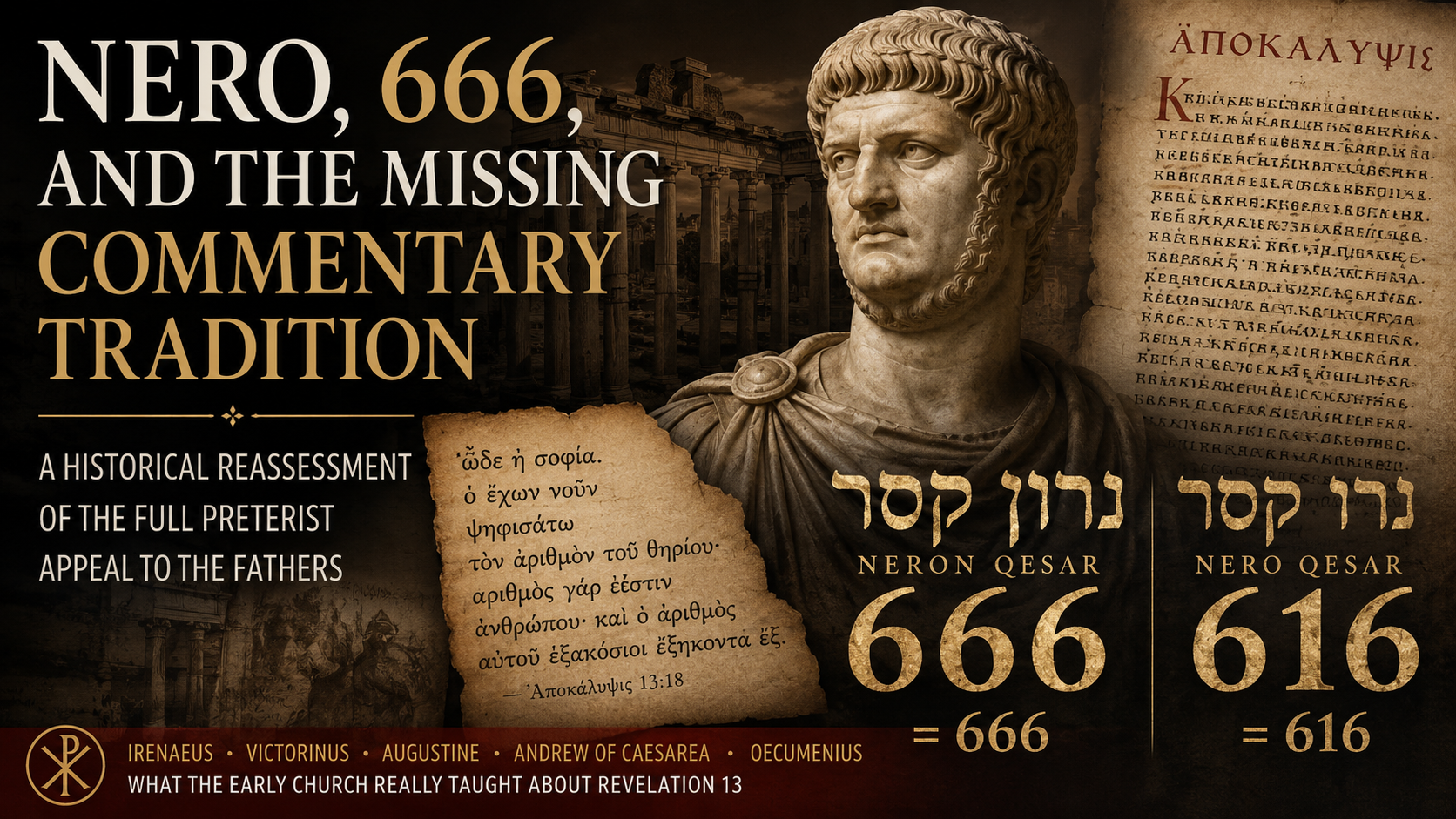
The decisive turning point emerges only within modern historical-critical scholarship. Johann Jakob Wetstein and Johann David Michaelis helped advance textual-critical discussions concerning the 616 variant during the eighteenth century.¹¹ Yet the explicit formulation of the now-famous Hebrew calculation is generally associated with the German orientalist Ferdinand Benary in 1836.¹²
Benary clearly articulated the argument that:
נרון קסר = 666
while the shortened Latinized spelling:
נרו קסר = 616
corresponded to the variant textual reading.
This was a watershed moment in the development of the modern Nero theory. From this point onward, the “Nero Caesar = 666” argument became increasingly mainstream within nineteenth-century German critical scholarship and eventually entered modern academic and popular commentary traditions.
What is historically striking, however, is how late this development appears. The fully articulated Nero-gematria argument emerges not from the continuous commentary tradition of the Greek and Latin Fathers, but from the rise of Enlightenment textual criticism, philology, and historical-critical methodology.
Conclusion
The historical evidence demonstrates that the early Church knew of Nero traditions, Nero redivivus expectations, and the textual variant 616. Yet these elements should not be conflated with the modern Full Preterist system that identifies Nero as the definitive fulfillment of Revelation 13 and the solved meaning of 666.
The Fathers overwhelmingly retained future-oriented eschatological frameworks. Even when Nero appeared in their writings, he functioned primarily as a prototype, precursor, or typological foreshadowing of Antichrist rather than as the completed fulfillment of Revelation itself.
Most importantly, the Greek and Latin commentary traditions failed to preserve the now-standard “Nero Caesar = 666/616” interpretation for well over a millennium. As far as the extant evidence currently demonstrates, the explicit identification of Nero through the 616/666 calculations does not appear as a dominant or continuous feature of the Greek and Latin Revelation commentary tradition prior to the early modern and modern periods. Apart from the isolated and much-debated witness of the fifth-century Liber genealogus, no extant patristic or medieval commentary clearly preserves the later standard “Nero Caesar = 666/616” framework that became prominent in modern historical-critical scholarship. This explicit gematria system emerges prominently only in the modern era, particularly through nineteenth-century German critical scholarship.
Ironically, the historical trajectory of Revelation interpretation after the Reformation moved not toward a closed Neronic fulfillment, but toward broader historical and ecclesiastical applications of the Beast imagery. Protestant historicists frequently understood Nero redivivus traditions typologically, seeing in Nero a precursor or archetype of the later Antichristian power associated with the Papacy and the continuation of imperial Rome in ecclesiastical form. Likewise, within portions of the post-Byzantine Greek exegetical tradition, the Beast imagery increasingly expanded beyond the confines of first-century Rome and became associated with larger historical realities including Islam, ecclesiastical corruption, imperial decline, and the progressive unfolding of sacred history. In this sense, the dominant historical trajectory of both Protestant and post-Byzantine interpretation moved away from strict Nero-preterism rather than toward it.
Consequently, modern Preterism cannot credibly claim that its Nero-centered interpretation of Revelation represents the historic consensus of the early Church. The evidence instead reveals a substantial discontinuity between ancient Christian eschatology and the modern preterist reconstruction.
Footnotes
- Suetonius, The Twelve Caesars; Tacitus, Histories 2.8; Dio Cassius, Roman History 66.19.
- Irenaeus, Against Heresies 5.30.3.
- Irenaeus, Against Heresies 5.30.1.
- Victorinus of Pettau, Commentary on the Apocalypse, on Revelation 13 and 17.
- Augustine, City of God 20.19.
- Oecumenius, Commentary on the Apocalypse; Andrew of Caesarea, Commentary on the Apocalypse; Arethas of Caesarea, Commentary on the Apocalypse.
- Andrew of Caesarea, Commentary on the Apocalypse, Prologue and commentary on Revelation 13.
- Primasius, Commentary on the Apocalypse; Bede, Explanatio Apocalypsis; Joachim of Fiore, Expositio in Apocalypsim; Nicholas of Lyra, Postillae Perpetuae.
- Luis del Alcázar, Vestigatio Arcani Sensus in Apocalypsi (Antwerp, 1614).
- Hugo Grotius, Annotationes in Novum Testamentum; Henry Hammond, Paraphrase and Annotations upon the New Testament.
- Johann Jakob Wetstein, Novum Testamentum Graecum (1751–1752); Johann David Michaelis, Introduction to the New Testament.
- Ferdinand Benary, “Ueber die Zahl 666 in der Apokalypse,” Zeitschrift für speculative Theologie 1 (1836): 205–240.

