
By Jonathan Photius – The NEO-Historicism Research Project
Introduction
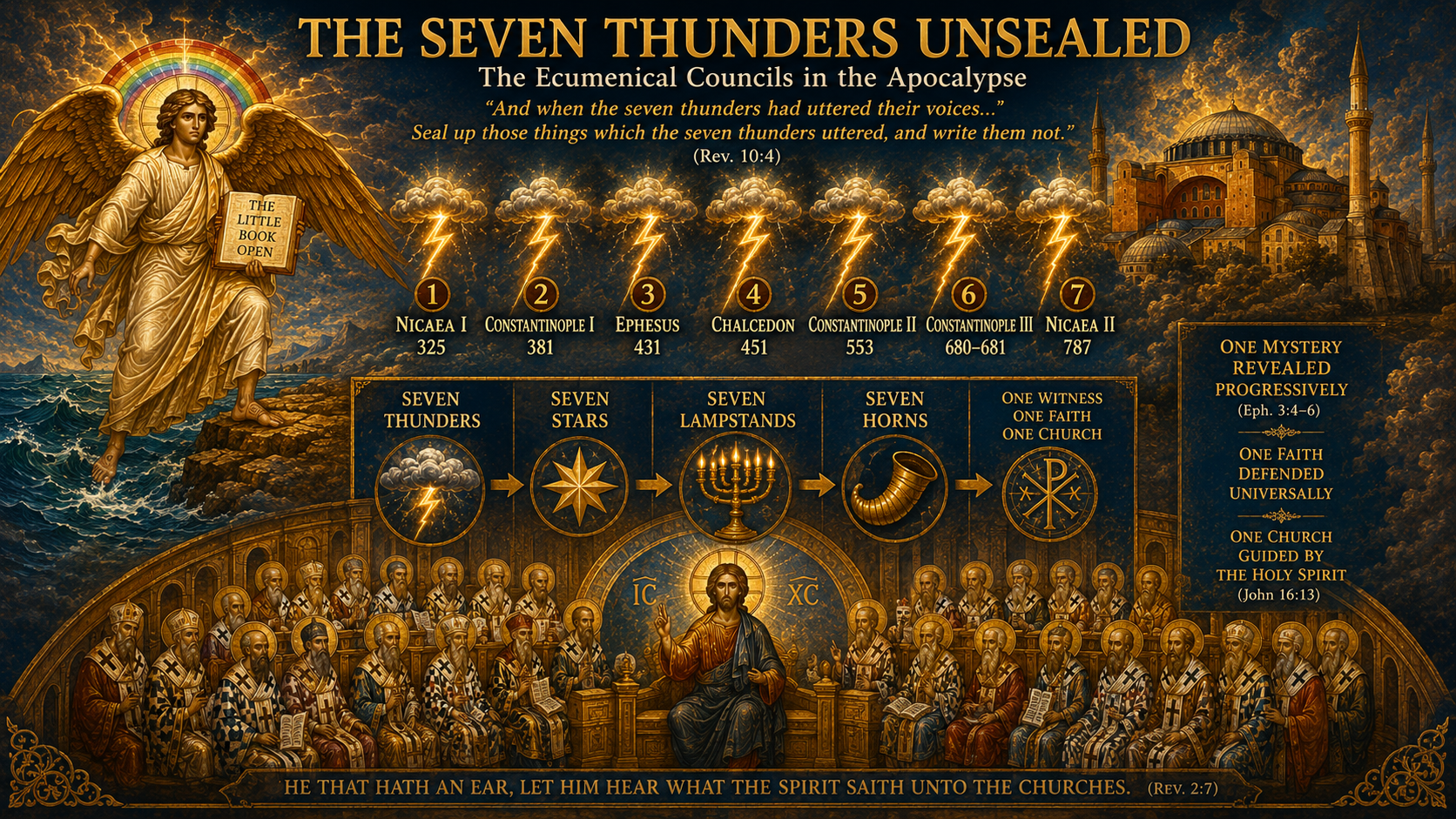
Among the many mysteries of the Apocalypse, few have generated more speculation than the Seven Thunders of Revelation 10. After hearing their voices, St. John writes:
“And when the seven thunders had uttered their voices, I was about to write: and I heard a voice from heaven saying unto me, Seal up those things which the seven thunders uttered, and write them not” (Rev. 10:4).
The text presents an unusual situation. Unlike the seals, trumpets, and bowls, whose contents are subsequently revealed, the words of the Seven Thunders remain hidden. John hears them, understands them, and prepares to write them, yet is explicitly forbidden from doing so. The result is one of the few deliberately withheld revelations in the entire Apocalypse.
While many commentators have treated the Seven Thunders as an unknowable mystery, a fascinating stream of Orthodox interpretation suggests a different approach. Rather than viewing the Thunders as permanently concealed, these commentators understand them as truths destined to unfold progressively within the life of the Church. In this reading, the command to seal does not signify permanent secrecy but delayed manifestation.
This perspective appears with particular clarity in the writings of John Lindios of Myra (1791), Apostolos Makrakis (1881), and Fr. Daniel Sysoev (2000s), while receiving important methodological support from Theodoret of Ioannina. Although these authors differ in emphasis and historical context, they converge upon a common principle: Revelation contains truths that become intelligible through the unfolding experience of the Church in history.
Daniel, Revelation, and the Principle of Progressive Revelation
The background of Revelation 10 is found in Daniel 12. Daniel is commanded:
“But thou, O Daniel, shut up the words, and seal the book, even to the time of the end: many shall run to and fro, and knowledge shall be increased” (Dan. 12:4).
The parallel between Daniel and Revelation was emphasized by Apostolos Makrakis. Commenting on the mighty angel of Revelation 10, Makrakis notes the striking similarity between the angel’s oath and the oath sworn by the man clothed in linen in Daniel 12. Both the man in linen and the Mighty Angel giving the similar oaths are often identified as Christ Himself, one as a pre-incarnate eternal Logos and the other as the post-resurrected Christ. In both passages an oath is sworn by the eternal God, and in both passages the oath concerns a divinely appointed period after which hidden knowledge becomes manifest.
For Makrakis, the relationship between Daniel and Revelation establishes a fundamental principle: knowledge may be sealed for a time, but God reveals it when history reaches its appointed moment. Revelation 10 therefore does not describe the permanent concealment of truth but its gradual disclosure through the providential unfolding of events.¹
This principle closely resembles the famous observation of Andrew of Caesarea concerning prophetic interpretation. Commenting on the number of the Beast, Andrew remarks that time, experience, and diligent inquiry would reveal what was not yet fully understood.² Revelation therefore anticipates future understanding rather than excluding it.
John Lindios and the Conciliar Architecture of Revelation
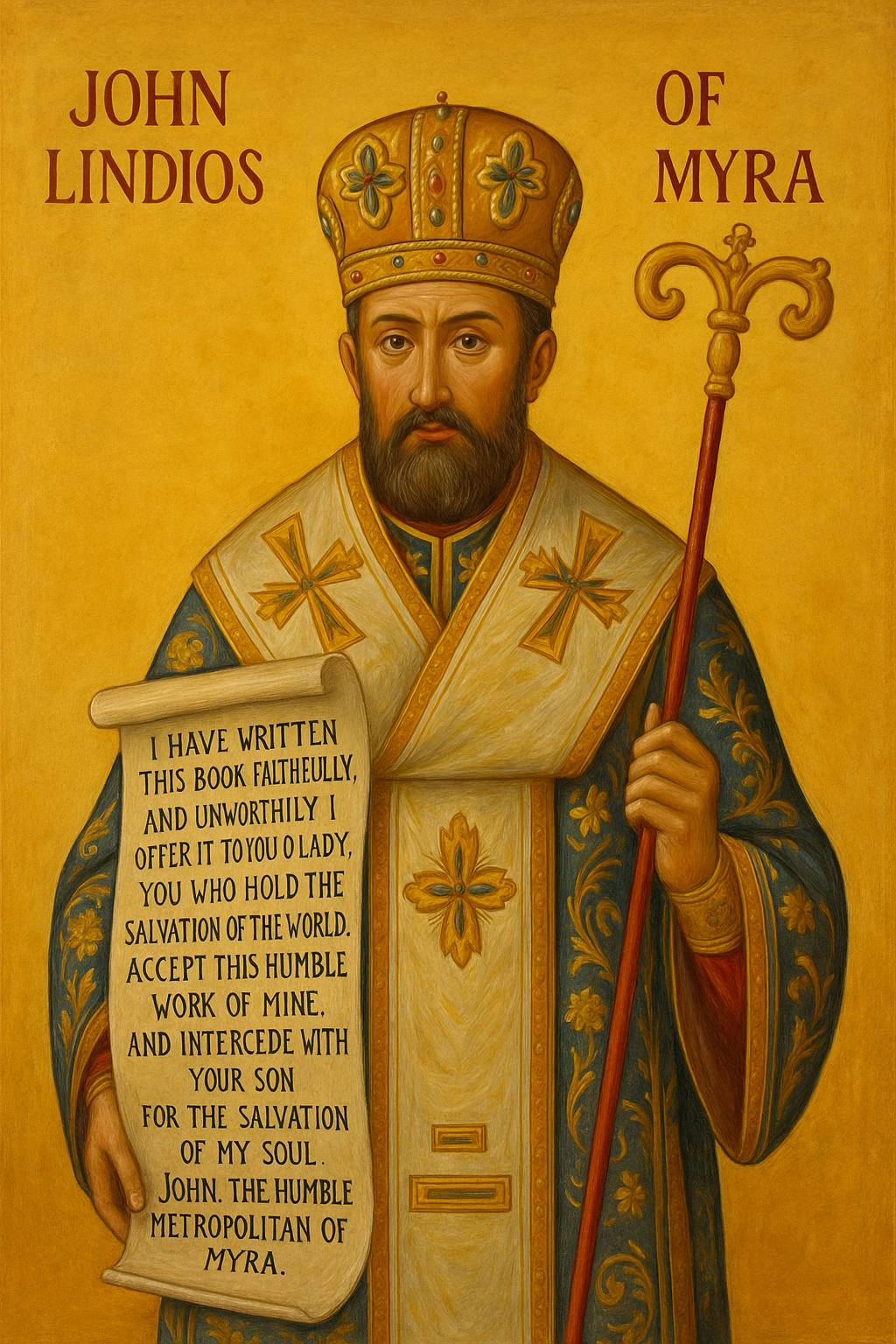
The most remarkable development of this principle appears in the commentary of John Lindios, Bishop of Myra, who wrote is commentary on Revelation at the Iviron Monastery of Mount Athos. Throughout his interpretation of Revelation, Lindios repeatedly associates major apocalyptic symbols with the Seven Ecumenical Councils.
His interpretation extends far beyond Revelation 10. In Revelation 1 he identifies the Seven Stars with the Seven Ecumenical Councils, describing them as luminous guides placed by Christ within His Church. The Seven Golden Lampstands likewise signify the holy Fathers gathered in the Councils, whose virtuous lives and doctrinal precision illuminated the world with the light of Orthodoxy.
The symbolism continues in Revelation 5. Commenting on the Lamb’s Seven Horns, Lindios writes that they signify the teachings brought forth against heretics by the Seven Ecumenical Councils. Through these Councils, he explains, the Church overcame false doctrine and preserved the apostolic faith. The Seven Eyes of the Lamb similarly represent the spiritual vision of the Fathers and teachers through whom the Church beheld and proclaimed divine truth.
Most strikingly, Lindios interprets the “voice” heard by John in Revelation 1 as the future proclamation of the Ecumenical Councils themselves. The voice is described as a harmonious and universal confession destined to resound throughout the inhabited world, supporting the Orthodox while striking terror into heretics like heavenly thunder.³
A coherent pattern emerges:
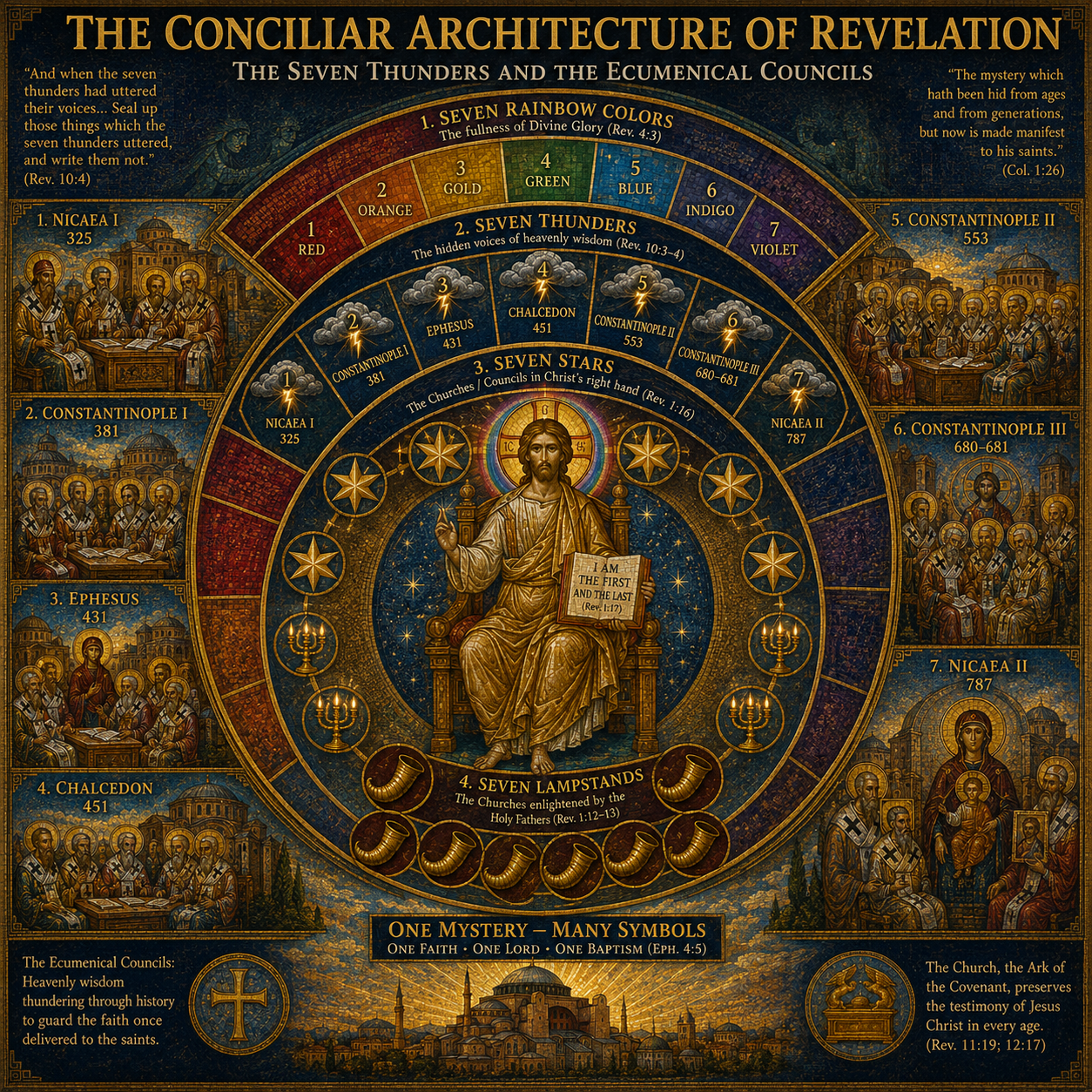
- Seven Stars = Seven Ecumenical Councils
- Seven Lampstands = Seven Ecumenical Councils
- Seven Horns = Seven Ecumenical Councils
- Voice of a Trumpet (Rev 1:10) = Proclamation of the Ecumenical Councils
- Building upon Lindios’ broader conciliar framework, one may further observe the Seven Colors of Rainbow of One Sitting On the Throne (Rev 4) & Sun-Faced Mighty Angel (Rev 10) = Seven Ecumenical Councils
The Seven Thunders therefore do not appear as an isolated symbol but as the culmination of a broader ecclesiastical framework already established throughout the Apocalypse.
The Seven Thunders and the Dogmatic Witness of the Church
When Lindios arrives at Revelation 10, he interprets the Seven Thunders in a manner entirely consistent with the broader conciliar framework he has already established throughout the Apocalypse. Earlier in his commentary he identified the Seven Stars, the Seven Golden Lampstands, and the Seven Horns of the Lamb with the Seven Ecumenical Councils and their dogmatic witness. The Seven Thunders therefore appear not as an isolated symbol but as another manifestation of the same conciliar reality.
Commenting on Revelation 10:4, Lindios writes:
“The Holy Spirit revealed in detail to the blessed John those things which were to come to pass for the Church of Christ after the passing of many years. And what were these things? The impious and godless doctrines of the heretics, as well as the pious refutations and God-delivered teachings of the Seven Ecumenical and other local holy synods of the Holy Gospel.”
This statement is remarkable in its clarity. For Lindios, the content of the Seven Thunders includes both the future rise of heresies and the doctrinal responses through which the Church would overcome them. The Thunders encompass the evangelical teachings, sacred canons, and dogmatic definitions proclaimed by the holy Fathers in defense of the Orthodox faith.
Lindios continues by explaining why John was forbidden to write what he heard:
“Since it was not profitable for the Christians of that time to know all these things—lest they be confounded and fall into despair by the multitude of heresies that were to come and the difficulties of the sacred refutations—for this reason, the blessed John was commanded by the heavenly voice to seal these things and not write them.”
The command to seal therefore reflects divine providence rather than divine silence. The truths contained within the Thunders would not be openly revealed in advance but would unfold gradually through the historical struggles of the Church. As heresies emerged, the corresponding conciliar definitions would arise to answer them.
In this sense, the Ecumenical Councils become historical manifestations of truths already contained within the prophetic vision of St. John. The Apostle heard the Thunders, but their meaning would only become fully apparent as the Church lived through the controversies that called forth the proclamations of Nicaea, Constantinople, Ephesus, Chalcedon, and the subsequent Councils.
Fr. Daniel Sysoev and an Independent Confirmation
An especially noteworthy confirmation of this interpretation appears in the modern Russian Orthodox commentator Fr. Daniel Sysoev.
Unlike Lindios, Sysoev had no known access to the unpublished eighteenth-century Greek commentary preserved in manuscript form. Furthermore, Sysoev generally wrote from within a futurist eschatological framework rather than a historicist one. Yet despite these differences, he arrives at a remarkably similar conclusion.
Commenting on Revelation 10, Sysoev explicitly identifies the Seven Thunders with the Seven Ecumenical Councils. He argues that the Councils progressively revealed the mystery of Christ:
- Nicaea defined His true divinity.
- Constantinople clarified the divinity of the Holy Spirit.
- Ephesus defended the unity of Christ’s person.
- Chalcedon articulated the doctrine of two natures.
- The later Councils further clarified the implications of the Incarnation.
According to Sysoev, John was forbidden to write the words of the Thunders because the Councils themselves had not yet occurred. The revelation was already known in heaven, but its historical manifestation had not yet arrived.⁵
The significance of this agreement should not be overlooked. Two Orthodox commentators separated by more than three centuries, writing in different languages and theological environments, independently associated the Seven Thunders with the Ecumenical Councils.
Theodoret of Ioannina and History as Teacher
Theodoret of Ioannina approaches the passage differently, yet his contribution may be equally important.
Unlike Lindios and Sysoev, Theodoret does not explicitly identify the Seven Thunders with the Ecumenical Councils. Instead, he identifies them with the Seven Trumpets. Yet throughout his commentary he repeatedly emphasizes a principle that provides the methodological foundation for the interpretations of both Lindios and Makrakis.
Theodoret explains that the opened little book signifies realities that have become manifested through history. He repeatedly describes time itself as a teacher and the world as an instructor of future realities. Historical events reveal truths that previously remained concealed.
In one of his most striking observations, he states that the opened book signifies that “as many things as were destined to be manifested have opened and been manifested.”⁶
This principle harmonizes naturally with the interpretations of Lindios and Makrakis. The Seven Thunders represent truths not yet disclosed. Their meaning becomes clear only when history itself unfolds and reveals what had previously been hidden.
The Councils as Historical Thunders
The Ecumenical Councils were not abstract theological discussions. They were responses to concrete historical crises concerning the identity of Christ and the nature of salvation.
Each Council emerged in response to a challenge:
- Arius denied the full divinity of Christ.
- Nestorius divided Christ into separate subjects.
- Monophysitism obscured His true humanity.
- Monothelitism denied the fullness of His human will.
- Iconoclasm challenged the implications of the Incarnation itself.
The Councils therefore functioned as moments of divine clarification within history. Through them the Church articulated truths that had always been present within apostolic revelation but had not yet required formal definition.
This perspective aligns naturally with the symbolism of thunder. Thunder follows the voice. It reverberates across great distances. It announces heavenly realities with unmistakable force. In the same manner, the Ecumenical Councils proclaimed dogmatic truth throughout the Christian world and decisively answered the controversies of their age.
The Sealing of Revelation Commentaries In The Greek East Until After The Seven Councils
“Seal up those things which the seven thunders uttered, and write them not.” (Rev. 10:4)
A striking historical coincidence emerges when the history of the Apocalypse is compared with the history of the Ecumenical Councils. During the very centuries in which the Church was defining the doctrines of the Trinity, the Incarnation, and the two natures of Christ, Revelation occupied a comparatively uncertain position in portions of the Greek East. Questions regarding its authorship persisted, commentaries were scarce, and the book was absent from portions of the liturgical tradition. Yet after the great Christological controversies had largely been resolved, the Apocalypse experienced a revival culminating in the commentary of Andrew of Caesarea, the earliest complete surviving Greek commentary on Revelation.
This sequence may shed light on the command given to St. John not to record the words of the Seven Thunders. Fr. Daniel Sysoev observed that John understood what the Thunders spoke but was forbidden to write their message because its meaning had not yet been manifested in history, as he says in his Revelation commentary: “the ecumenical councils were to unfold over time.” If the Seven Thunders signify the conciliar proclamation of Christological truth, then the centuries-long eclipse of Revelation in the Greek East may itself reflect part of this prophetic pattern. The Apocalypse was preserved, but its deepest Christological significance remained, in a sense, sealed until the Church had passed through the doctrinal struggles necessary to articulate the mystery of Christ.
The Apocalypse contains some of the most profound Christological imagery in Scripture: the Son of Man, the Lamb standing as slain, the One seated upon the throne, and the union of divine and human realities throughout the vision. Perhaps Revelation was not so much neglected as awaiting the theological vocabulary that the Ecumenical Councils would provide. Only after Nicaea, Ephesus, Chalcedon, and the subsequent Councils had defined the faith did the Church possess the conceptual language necessary to approach these mysteries with greater clarity. Because these exact questions were raised by the Seven Ecumenical Councils and these ideas are also presented to us in St John’s Apocalypse:
- Who is Christ?
- Is He truly God?
- Is He truly man?
- How do the two natures relate?
- What is the Trinity?
- What is the Incarnation?
In this sense, the Seven Thunders may be viewed not merely as hidden revelations but as truths that first had to be lived, defended, and articulated within history before they could be fully understood. The Ecumenical Councils themselves became the historical manifestation of what John was forbidden to write directly. Only after the Thunders had sounded through the life of the Church could their meaning begin to be unsealed and the deeper Christological dimensions of the Apocalypse emerge with greater clarity. Perhaps the book itself awaited the theological vocabulary forged through the struggles of Nicaea, Ephesus, Chalcedon, and the subsequent Councils. By the time Andrew of Caesarea composed the first complete surviving Greek commentary on Revelation, the Church possessed the doctrinal language necessary to contemplate many of the mysteries that had previously remained obscure. In this way, the historical unfolding of conciliar theology may itself be understood as part of the gradual unsealing of the Apocalypse.
Conclusion
The Seven Thunders should not be interpreted in isolation from the broader symbolic framework of Revelation. John Lindios identified the Seven Stars, Seven Lampstands, Seven Horns, and even the heavenly Voice with the dogmatic witness of the Ecumenical Councils. When he arrives at Revelation 10, the Seven Thunders naturally become part of the same conciliar architecture. The Seven Thunders were not merely hidden prophecies awaiting future disclosure. According to Lindios, they were the future heresies and the conciliar responses by which the Church would defend the faith. John heard them in vision; the Church heard them in history.
Apostolos Makrakis supplies the connection with Daniel and the principle of knowledge progressively unsealed through history. Theodoret of Ioannina explains how truths hidden in prophecy become manifest through the unfolding experience of the Church. Fr. Daniel Sysoev independently confirms the identification of the Seven Thunders with the Seven Ecumenical Councils themselves.
Taken together, these interpretations suggest that Revelation may be understood not merely as a prophecy of future events but also as a prophetic icon of the Church’s historical defense of the faith. The Seven Thunders are not arbitrary mysteries. They represent the unfolding witness of divine truth through the life of the Church.
Like a Byzantine mosaic, individual tesserae may appear disconnected when viewed closely. Yet when one steps back, the image emerges. The Seven Thunders, the Seven Stars, the Seven Lampstands, the Seven Horns, and the Seven Rainbow Colors of the Sunlike Angel and One Sitting ont the throne all contribute to a larger vision: Christ guiding His Church through history as she preserves, proclaims, and defends the apostolic faith through the Seven Ecumenical Councils.
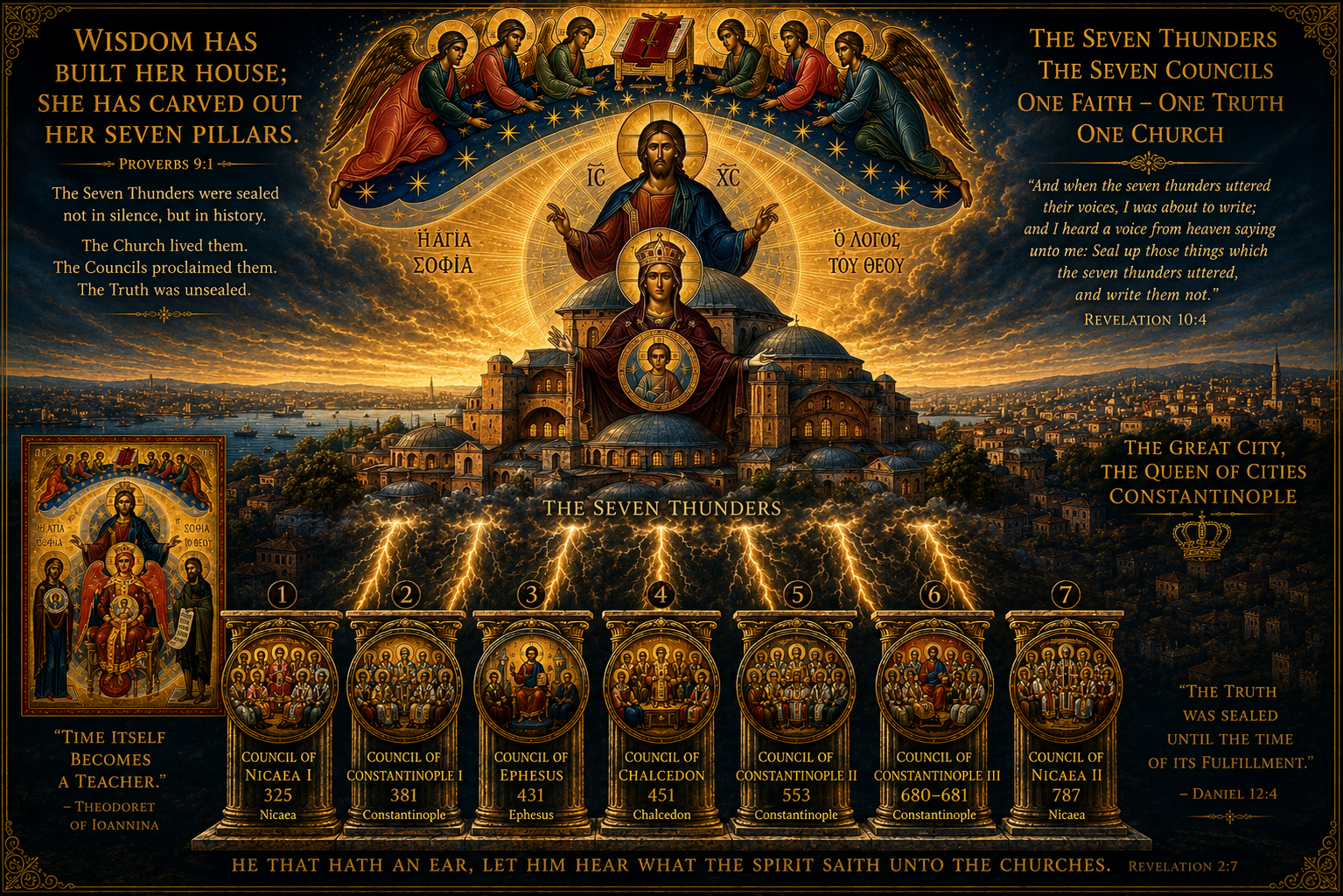
“Wisdom has built her house; she has carved out her seven pillars.” – Proverbs 9:1
© 2026 by Jonathan Photius
Notes
- Apostolos Makrakis, Commentary on the Book of Revelation (Athens, 1881), commentary on Revelation 10:4–7.
- Andrew of Caesarea, Commentary on the Apocalypse, commentary on Revelation 13:18.
- John Lindios of Myra, Interpretation of the Apocalypse, commentary on Revelation 1.
- Ibid., commentary on Revelation 10:4.
- Daniel Sysoev, Explanation of the Apocalypse (Moscow, trans. English edition), 132–133.
- Theodoret of Ioannina, Commentary on the Apocalypse, commentary on Revelation 10.
Appendix – The Greeks Wish To Speak with Jesus in John Chapter 12 – And Then It Thundered
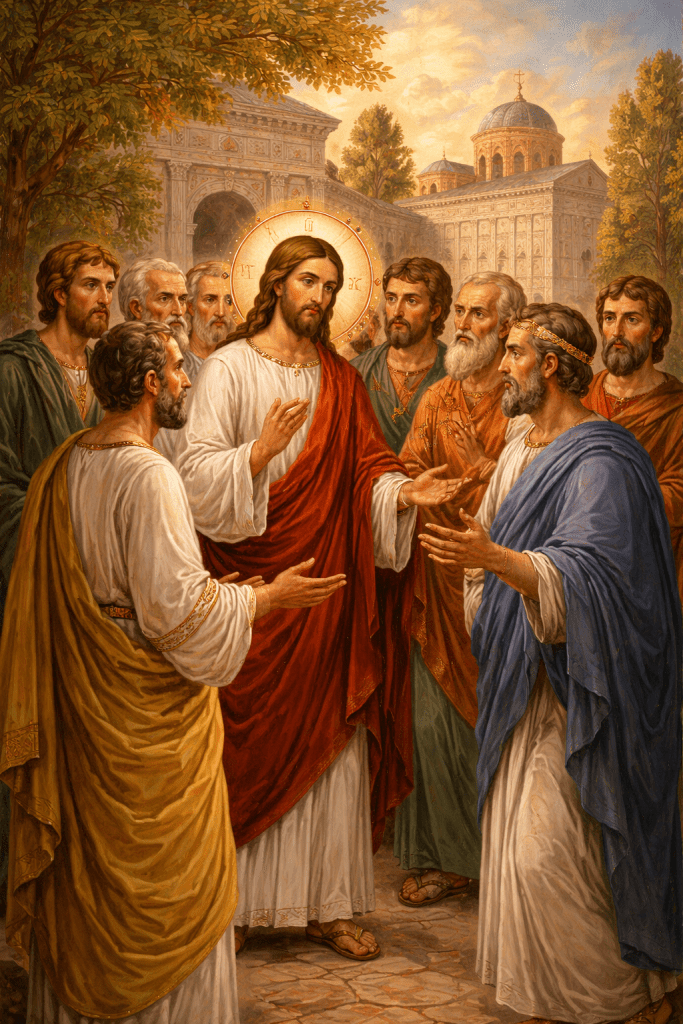
The sounds John hears are the key to interpreting this moment. Across the Johannine writings, thunder functions as a sign of the voice of God made public in history. In John 12:28–29, when Christ prays, “Father, glorify Thy name,” the heavenly voice responds, “I have glorified it, and I will glorify it again,” and the crowd declares, “It thundered.” This moment occurs precisely when the Greeks come seeking Jesus (John 12:21–23), prompting Christ’s declaration: “Now is the time for the Son of Man to be glorified.” The thunder marks a transition from a hidden, localized ministry to a universal, ecclesial glorification. Divine glory is no longer concealed; it begins to resound outward.
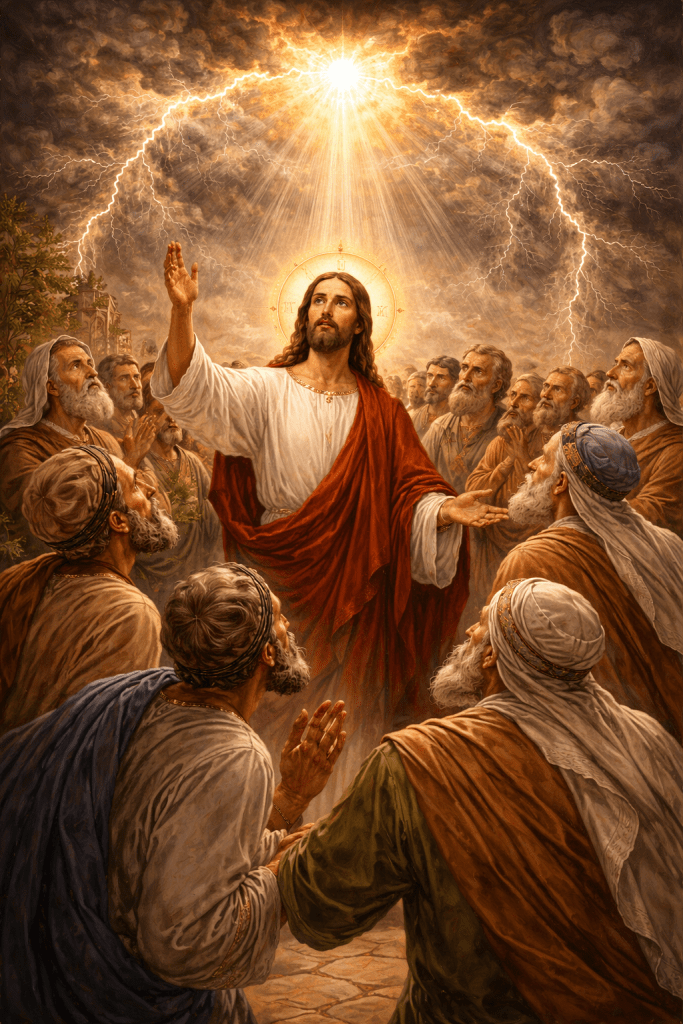
The hebrew transliteration of the word thunder can also mean proclamation or decree.


1 Comment