
Introduction
Among the more surprising interpretations preserved in the Byzantine exegetical tradition is the identification of Babylon the Great with Constantinople itself. Modern discussions of Revelation often assume that Byzantine commentators either understood Babylon as pagan Rome, as a future antichristian city, or as a symbol of the fallen world in general. Yet in his commentary on Revelation 16:19, the tenth-century Archbishop Arethas of Caesarea explicitly rejects both Rome and the world as possible referents before identifying Babylon with Constantinople. This interpretation appears centuries before the Great Schism, the Fourth Crusade, the Ottoman conquest, or the rise of post-Byzantine apocalyptic literature. As such, it provides important evidence that Byzantine interpreters could apply apocalyptic symbols directly to the historical realities of their own Christian civilization. Rather than directing the force of Revelation’s judgments exclusively toward foreign enemies, Arethas internalized apocalyptic judgment within the Christian commonwealth itself. Babylon was not somewhere else. Babylon was home.
Babylon in Early Christian Tradition
The identification of Babylon with an imperial capital was not without precedent in Christian tradition. The Apostle Peter concludes his first epistle by sending greetings from “she who is in Babylon, chosen together with you” (1 Pet. 5:13). From an early period many Christian writers understood this Babylon not as the Mesopotamian city but as Rome itself. The symbolic use of Babylon thus became associated with imperial power, worldly grandeur, and the center of political authority.¹
This symbolic application acquired new significance after the foundation of Constantinople. With the transfer of the imperial capital by Constantine and the gradual development of New Rome as the center of the Christian Empire, Byzantine Christians increasingly understood Constantinople as the legitimate continuation of Roman civilization. The emperor, senate, laws, and institutions of the Roman state survived there long after the disappearance of imperial authority in the West. Consequently, if Rome could once be designated symbolically as Babylon, the possibility existed that the same symbolism might eventually be transferred to New Rome.
Arethas and Revelation 16:19
The crucial passage occurs in Arethas’ commentary on Revelation 16:19:
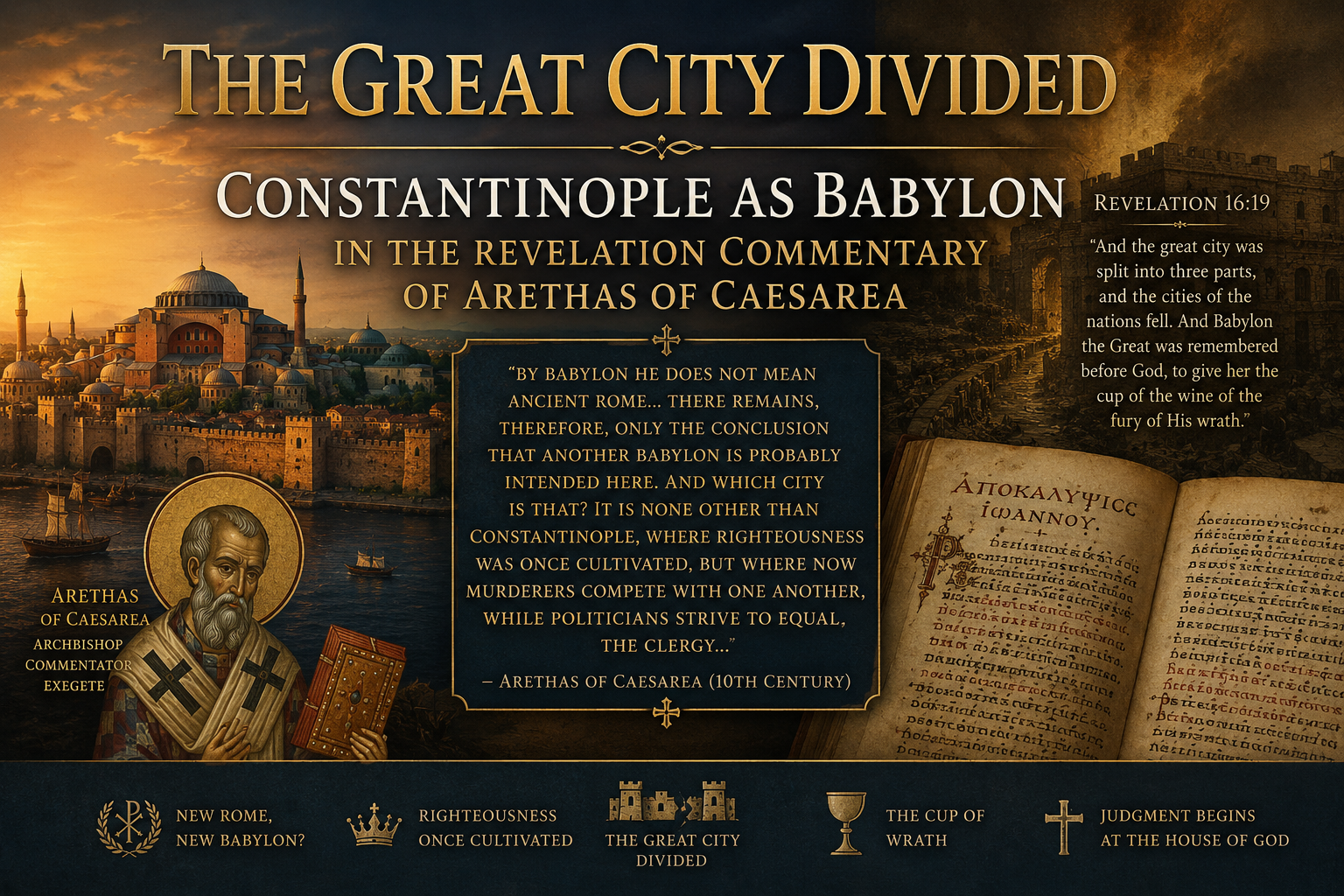
“By Babylon he does not mean ancient Rome, because in it many holy martyrs suffered grievously during the time of the Greeks; nor does he mean the entire universe, although that interpretation finds some approval among certain people… There remains, therefore, only the conclusion that another Babylon is probably intended here. And which city is that? It is none other than Constantinople, where righteousness was once cultivated, but where now murderers compete with one another, while politicians strive to equal the clergy…”²
The force of this statement is difficult to overstate. Arethas is not merely offering one possibility among many. He proceeds through a process of elimination. Rome is excluded. The world as a whole is excluded. Only then does he arrive at Constantinople as the intended referent.
This interpretation appears in the context of Revelation 16:19:
“And the great city was split into three parts, and the cities of the nations fell. And Babylon the Great was remembered before God, to give her the cup of the wine of the fury of His wrath.”
For Arethas, Babylon is not primarily a geographical designation but a moral and spiritual one. The city acquires the name Babylon because it has fallen from its original righteousness into corruption.
What Arethas Rejects
The significance of the passage becomes clearer when one examines the interpretations that Arethas consciously rejects.
First, he rejects the identification of Babylon with ancient Rome. This is noteworthy because Rome had often been associated with Babylon in both Jewish and Christian literature. Arethas does not deny that association existed; rather, he argues that Rome’s sanctification through the blood of the martyrs prevents its straightforward identification with Babylon in this context.³
Second, he rejects the interpretation of Babylon as the entire world. His argument is exegetical. If Babylon were identical with the world, then Revelation’s distinction between Babylon and the islands would lose coherence, since islands themselves are parts of the world.⁴ This demonstrates that Arethas is not merely allegorizing but engaging in a close reading of the text.
Third, he rejects an entirely abstract interpretation. Babylon is not merely an idea. It is a real historical city. The question is which city.
His answer is Constantinople.
Constantinople as the Object of Prophetic Judgment
The most remarkable aspect of Arethas’ interpretation is that his reasoning is not political but moral. He does not identify Constantinople with Babylon because it is the imperial capital. Rather, he identifies it with Babylon because it has fallen from righteousness.
His description is strikingly prophetic:
“where righteousness was once cultivated, but where now murderers compete with one another.”
The language recalls the Old Testament prophets’ treatment of Jerusalem. Isaiah, Jeremiah, and Ezekiel repeatedly directed divine judgment not against foreign nations alone but against the covenant people themselves. The holy city could become spiritually indistinguishable from the nations when it abandoned righteousness. In a similar fashion, Arethas presents Constantinople as a Christian capital whose corruption has rendered it subject to apocalyptic judgment.
This observation is especially significant because Arethas wrote during the Byzantine Empire’s Macedonian Renaissance (867–1056), an era generally regarded as one of imperial revival and cultural flourishing. He was not writing after the Latin conquest of Constantinople in 1204. He was not writing under Ottoman domination. He was not interpreting Revelation in the shadow of imperial collapse. Instead, his identification of Constantinople with Babylon represents an internal prophetic critique of the Christian capital at the very height of Byzantine power.
Judgment Begins at the House of God
The interpretation preserved by Arethas reflects a profoundly biblical principle: judgment begins with the people of God. The Apostle Peter writes, “For the time has come for judgment to begin at the house of God” (1 Pet. 4:17). This principle runs throughout Scripture. Israel is judged more severely than the nations because it possesses greater privileges. Jerusalem receives stronger rebukes than pagan cities because it has received greater revelation.
Arethas applies this same principle to the Christian Empire. Babylon is not an external enemy threatening the Church from without. Babylon is the Christian capital itself when it abandons righteousness.
This internalization of apocalyptic judgment distinguishes Arethas from many later interpreters who increasingly identified Revelation’s symbols with foreign powers. For Arethas, the first object of scrutiny is not Persia, the Arabs, the Latins, or the Turks. It is Constantinople.
Constantinople and the Development of Byzantine Apocalyptic Tradition
The Arethas passage may also illuminate later developments within Greek Orthodox exegesis. Centuries after Arethas, Theodoret of Ioannina likewise identified Babylon with Constantinople in his interpretation of Revelation.⁵ The similarity raises the possibility that Theodoret was not innovating but preserving a much older Byzantine tradition.
Likewise, nineteenth-century Greek commentator Apostolos Makrakis identified the Great City of Revelation 11 with Constantinople.⁶ Although Makrakis and Arethas address different passages, both demonstrate a willingness to interpret major apocalyptic city-symbols through the lens of Byzantine and Orthodox history.
The significance of these parallels should not be overstated. Direct literary dependence cannot presently be demonstrated. Yet the recurrence of Constantinopolitan interpretations across a span of nearly a thousand years suggests a persistent tendency within Greek Orthodox exegesis to relate the Apocalypse to the history of the Christian Empire itself.
Arethas and Historical Interpretation
The passage also contributes to a broader reassessment of Byzantine apocalyptic interpretation. Modern scholarship has often emphasized the spiritual, liturgical, and futurist dimensions of Byzantine exegesis. These elements are unquestionably present in Arethas. Yet Revelation 16:19 demonstrates that Byzantine commentators could also apply apocalyptic symbols to concrete historical realities.
Arethas is not a historicist in the later Protestant sense. He does not construct a continuous chronological scheme extending across church history. Nor does he abandon his fundamentally futurist expectation of the Antichrist. Nevertheless, he clearly identifies a symbol of Revelation with a real city in his own world.
This interpretive move anticipates the more historically oriented applications found in later Byzantine and post-Byzantine commentators. The seed of historical interpretation was already present within the mainstream Byzantine exegetical tradition.
Conclusion
For Arethas of Caesarea, Babylon the Great was neither ancient Rome nor the world in general. It was Constantinople itself—the Christian capital whose corruption invited divine judgment. In making this identification, Arethas preserved a distinctly biblical vision in which apocalyptic judgment begins not with foreign enemies but with the people of God.
The importance of this interpretation lies not merely in its content but in its date. Written in the tenth century, it predates the Great Schism, the Crusades, the fall of Constantinople, the Ottoman era, and the rise of Protestant historicism. It therefore stands as early evidence that Byzantine commentators could apply the symbols of Revelation directly to the historical realities of their own civilization.
Long before later Orthodox writers identified Latins, Ottomans, or other external powers with apocalyptic symbols, Arethas interpreted Babylon as Constantinople itself. The Apocalypse, in his hands, became not only a prophecy of future enemies but also a warning to the Christian commonwealth. Babylon was not merely a city of the past or a city of the future. It was the Christian capital whenever it ceased to cultivate righteousness.
Footnotes
- Eusebius of Caesarea, Ecclesiastical History 2.15.2; Jerome, De Viris Illustribus 8.
- Arethas of Caesarea, Commentary on the Apocalypse 16:19, author’s translation from John Anthony Cramer, ed., Catenae Graecorum Patrum in Novum Testamentum, vol. 8: In Epistolas Canonicas et Apocalypsin (Oxford: E Typographeo Academico, 1844), 398–399.
- Ibid.
- Ibid.
- See Jonathan Photius, “Babylon and the Captive Queen: Constantinople, the Prophets, and Revelation in Theodoret of Ioannina,” Neo-Historicism (January 18, 2026).
- Apostolos Makrakis, commentary on Revelation 11, discussed in Jonathan Photius, “The Πλατεῖα of the Great City: Revelation 11, Conciliar Witness, and the Crucifixion of Wisdom in Constantinople,” Neo-Historicism (January 15, 2026).

