
By Jonathan Photius – The NEO-Historicism Research Project
Introduction
Among the most familiar prophecies of Christ concerning the end of the age is also one whose ecclesiological significance may be considerably deeper than is commonly recognized:
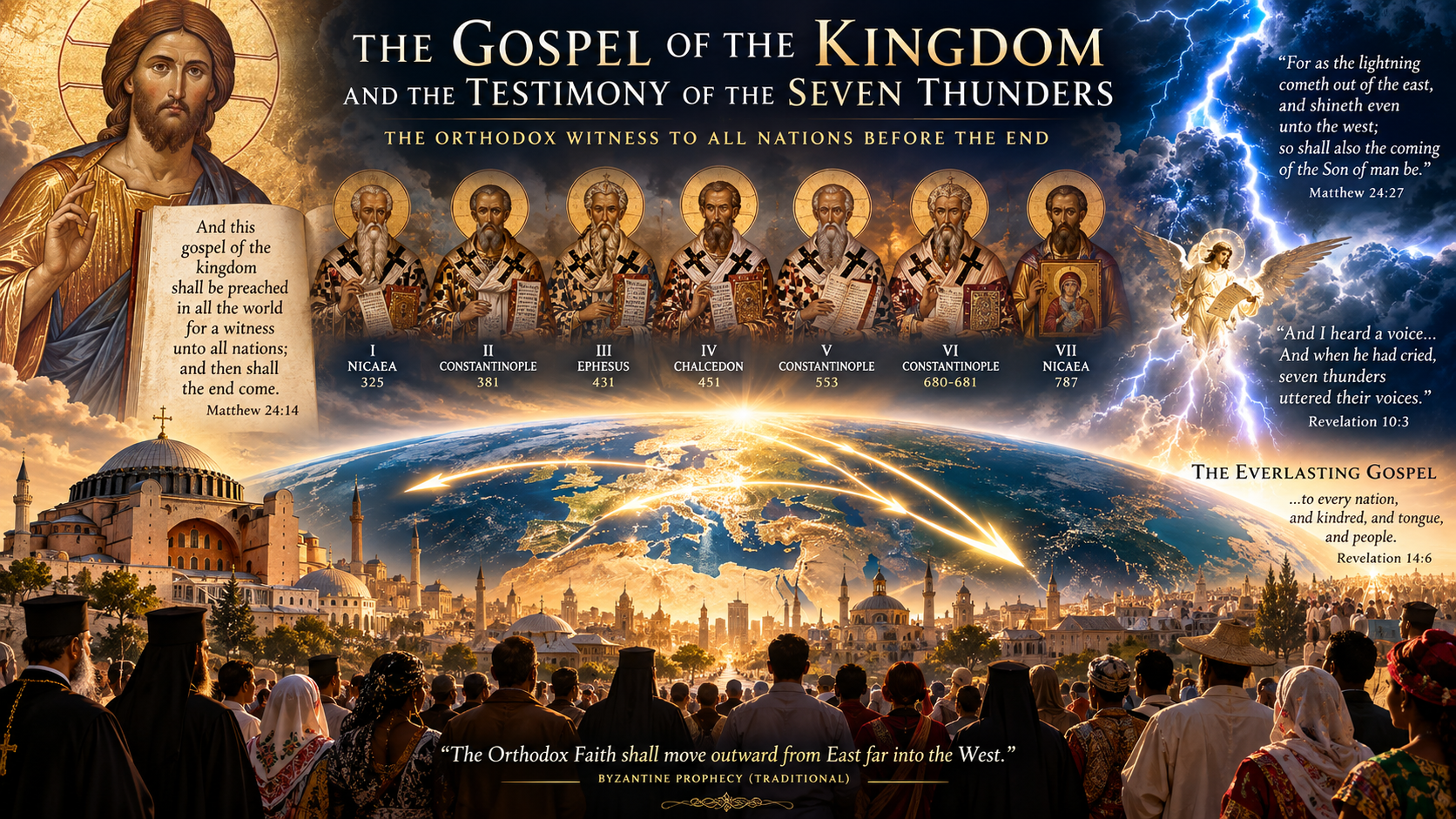
“And this gospel of the kingdom shall be preached in all the world for a witness unto all nations; and then shall the end come.”
— Matthew 24:14
The verse is usually understood as a prophecy of worldwide evangelization. Before the end comes, the Gospel must be carried throughout the world. Yet Christ does not simply say that “the Gospel” will be preached. He calls it specifically “the Gospel of the Kingdom.” Nor does He merely say that it will be heard throughout the world. It will be proclaimed “for a witness unto all nations.” These expressions – Gospel, Kingdom, witness, and nations – open a much larger ecclesiological horizon.
What is this Kingdom whose Gospel must be proclaimed? What is the witness that the nations must receive? And if the Kingdom of Christ has already entered history through His Church, might Matthew 24:14 describe something greater than the geographical dissemination of Christian information? When this prophecy is read alongside the Book of Revelation, particularly its language of the Testimony of Jesus, the Seven Thunders, and the Everlasting Gospel, a distinctly Orthodox understanding begins to emerge. The Gospel of the Kingdom is inseparable from the King Himself, and the testimony concerning that King has been preserved, articulated, and defended within the historical life of the One, Holy, Catholic, and Apostolic Church.
The Kingdom in the Midst of the Church
The Kingdom of God in Orthodox Christianity is not merely an earthly political kingdom, nor is it simply another name for heaven after death. The Kingdom has entered history in the person of Jesus Christ. It is already present sacramentally and mystically within His Church, even while awaiting its complete manifestation at the resurrection and Second Coming. Every Divine Liturgy begins with the proclamation, “Blessed is the Kingdom of the Father and of the Son and of the Holy Spirit.” This is not simply an announcement concerning a distant future reality. The faithful have assembled to participate sacramentally in the Kingdom that Christ has inaugurated.
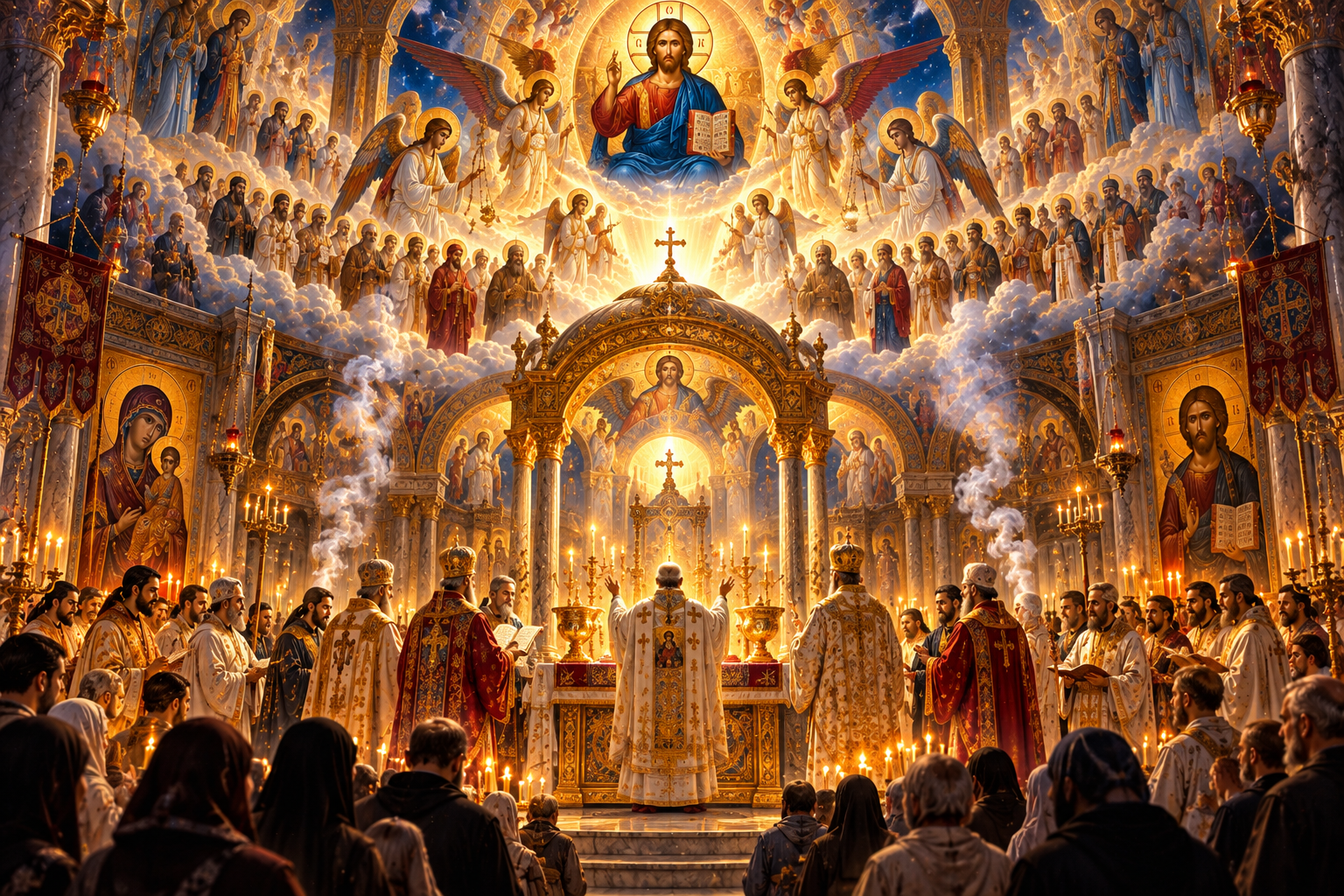
This is one of the great experiential realities of Orthodox Christianity. When the faithful enter the church for the Divine Liturgy, they leave behind, in a mystical and liturgical sense, the fallen order of the world and enter the heavenly assembly. Christ reigns in the midst of His people. The Gospel is enthroned and proclaimed. The angels and saints surround the worshipping Church. The Nicene Faith is confessed, and the faithful approach the Lamb to partake of His Body and Blood. Heaven and earth meet within the Eucharistic assembly. The Church therefore does not merely speak about the Kingdom. She participates in it and manifests its presence within history.
This gives the expression “Gospel of the Kingdom” a distinctly ecclesial character. The Gospel is the proclamation of Jesus Christ as crucified, risen, ascended, and reigning Lord, calling humanity into communion with Him and participation in His Kingdom. Historically, that Kingdom possesses a visible and sacramental witness in the Church. The Gospel of the Kingdom therefore cannot finally be separated from the One, Holy, Catholic, and Apostolic Church entrusted with carrying the apostolic testimony of Christ into the world.
A Witness Unto All Nations
The next phrase in Matthew 24:14 is equally important. Christ says that the Gospel will be preached throughout the inhabited world “for a witness unto all nations.” The Greek expression, εἰς μαρτύριον πᾶσιν τοῖς ἔθνεσιν, contains the word martyrion: testimony or witness. This vocabulary takes us directly into the Apocalypse, where testimony is one of the central themes of the entire book.
St. John introduces Revelation by declaring that he “bare record of the word of God, and of the testimony of Jesus Christ” (Rev. 1:2). He tells us that he was on Patmos “for the word of God, and for the testimony of Jesus Christ” (1:9). Beneath the heavenly altar he sees the souls of those who were slain “for the word of God, and for the testimony which they held” (6:9). The saints overcome the Dragon “by the blood of the Lamb, and by the word of their testimony” (12:11), while the Dragon goes forth to make war against those who “keep the commandments of God, and have the testimony of Jesus Christ” (12:17). Finally, those who suffer “for the witness of Jesus, and for the word of God” appear again in the vision of Revelation 20 (20:4).
The Apocalypse is therefore, from beginning to end, a book about the preservation and proclamation of a testimony. This suggests a profound connection with Matthew 24:14. The Gospel of the Kingdom must become a witness to all nations, while Revelation describes the historical struggle of the Church precisely as the preservation of the Testimony of Jesus. Matthew announces the universal mission; Revelation unveils the historical conflict through which that testimony is preserved and carried forward.
But what exactly is the Testimony of Jesus? It cannot be reduced to the bare assertion that Jesus existed, died, and rose again. The central theological struggles of Christian history concerned the identity of Jesus Christ Himself. Who is the One whom the Church proclaims? Is He truly God? Is He truly man? Is He created or uncreated? Is He of one essence with the Father? Did the eternal Word truly become flesh? Are His divinity and humanity united without confusion and without division? Does He possess a true human will? Can He truly be depicted according to the humanity He assumed?
These were not peripheral theological controversies. They concerned the very content of the Church’s testimony concerning Jesus Christ. It was precisely these questions that the Ecumenical Councils were compelled to answer.
The Seven Councils and the Testimony of Jesus
Nicaea confessed the Son as “God from God, Light from Light, true God from true God, begotten, not made, of one essence with the Father.” Constantinople defended the Nicene confession and the divinity of the Holy Spirit. Ephesus defended the unity of Christ’s person and confessed the Virgin Mary as truly Theotokos because the One born from her is none other than God the Word incarnate. Chalcedon confessed the one Christ in two natures, without confusion, change, division, or separation. The Fifth Council defended the proper Christological understanding of Chalcedon, the Sixth confessed the two natural wills and energies of the one incarnate Christ, and the Seventh defended the holy icons and thereby the reality of the Incarnation itself: the invisible Word had truly become visible in the flesh.
Taken together, the Seven Ecumenical Councils constitute a monumental historical confession of who Jesus Christ is. They are, in this profound sense, the Church’s conciliar articulation and defense of the Testimony of Jesus.
This brings us to one of the most mysterious passages in Revelation. St. John sees a mighty angel descending from heaven with a little book opened in his hand. When the angel cries aloud, something extraordinary occurs:
“And when he had cried, seven thunders uttered their voices.”
— Revelation 10:3
John immediately prepares to record what he has heard:
“And when the seven thunders had uttered their voices, I was about to write: and I heard a voice from heaven saying unto me, Seal up those things which the seven thunders uttered, and write them not.”
— Revelation 10:4
Within the Greek Orthodox historicist tradition, an extraordinary interpretation emerged: the Seven Thunders signify the Seven Ecumenical Councils. This interpretation is particularly striking because the thunders are not merely sounds. They possess voices. They speak from heaven into history. The Seven Councils likewise spoke, and the principal subject of their testimony was the identity of Jesus Christ.
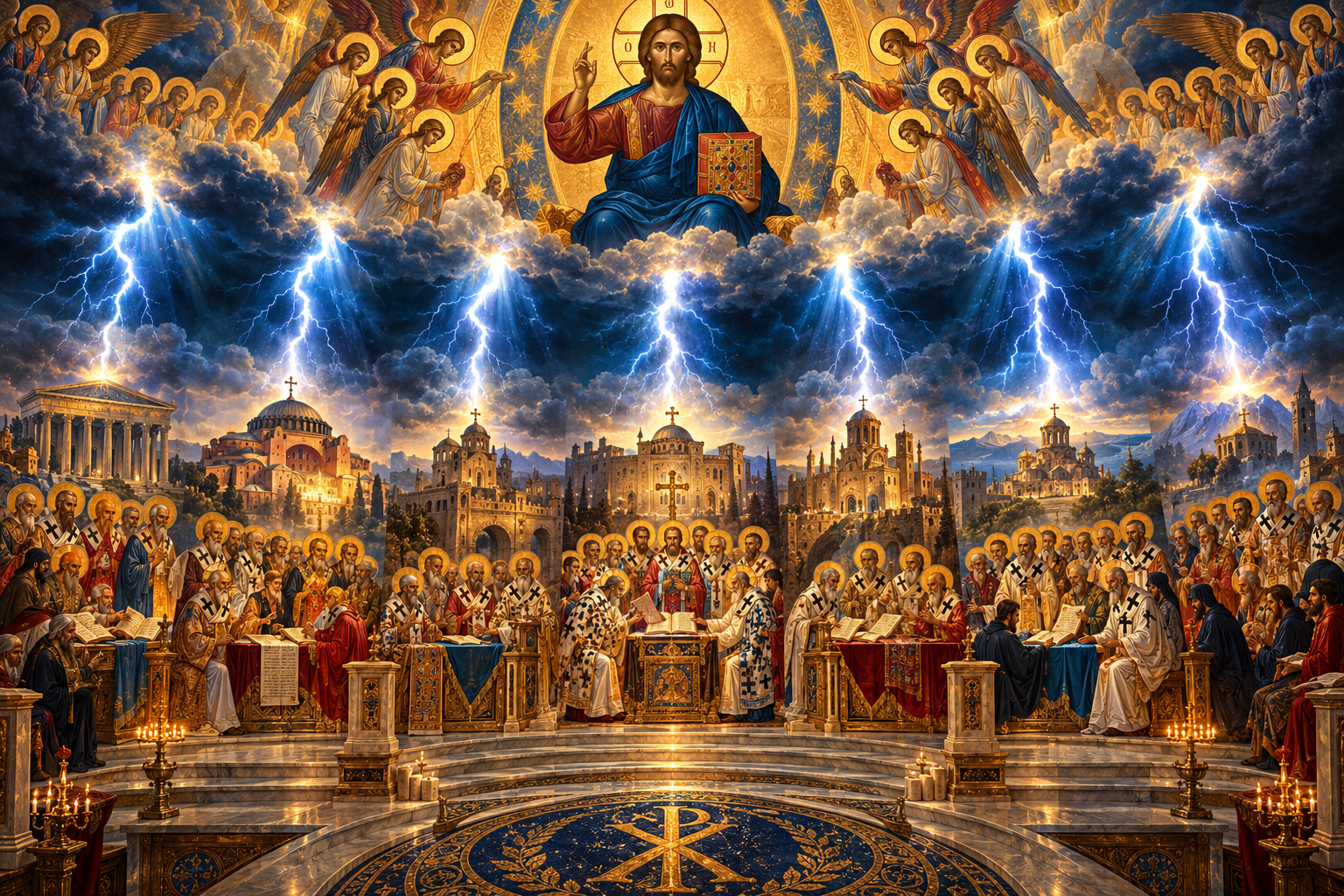
The mystery of their sealing can also be understood historically. St. John lived centuries before Nicaea. The great Christological controversies had not yet arisen. Arius had not yet denied the full divinity of the Son. Nestorius had not yet divided Christ. Eutyches had not confused His natures. Monothelitism had not yet denied His human will, and Iconoclasm had not yet attacked the consequences of the Incarnation. The contents of the Seven Thunders belonged to the future historical life of the Church. John heard their voices prophetically; Church history would eventually reveal the testimony those voices would proclaim.
This is why the Seven Thunders are so important for an Orthodox historicist interpretation of Revelation. Before asking when the prophetic periods occur, we must first know who the Lamb is. Christology precedes chronology. Before the Apocalypse unfolds the history of kingdoms, beasts, persecutions, and judgments, it reveals Jesus Christ. The Lamb who opens history is the God-Man, and the Church that passes through history must preserve His testimony. The Seven Councils therefore do not represent an interruption of the Gospel but its dogmatic clarification and preservation. They guard the Gospel of the Kingdom because they guard the identity of its King.
The Everlasting Gospel to Every Nation
The connection becomes even stronger in Revelation 14. St. John sees another angel carrying a universal proclamation:
“And I saw another angel fly in the midst of heaven, having the everlasting gospel to preach unto them that dwell on the earth, and to every nation, and kindred, and tongue, and people.”
— Revelation 14:6
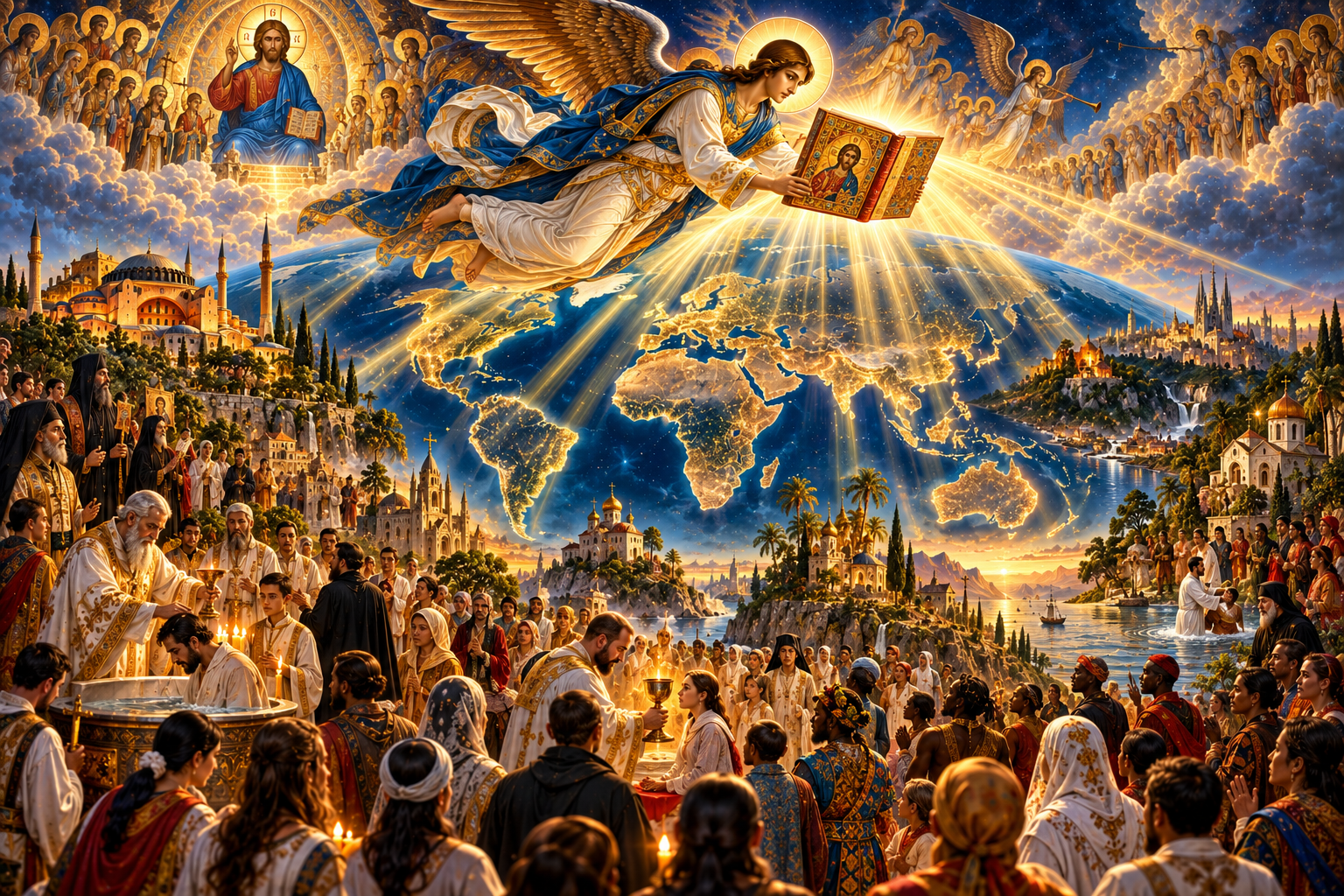
The parallel with Matthew 24:14 is difficult to overlook. Matthew speaks of the Gospel of the Kingdom, proclaimed throughout the inhabited world as a testimony to all nations before the end. Revelation speaks of the Everlasting Gospel, proclaimed over the earth to every nation, kindred, tongue, and people. The two passages illuminate one another. The Gospel proclaimed universally in Revelation 14 is the everlasting Gospel of Jesus Christ and His Kingdom, and Revelation places this proclamation within the great historical struggle between the Lamb and the beasts. The nations must ultimately hear not the voice of the Dragon, but the Testimony of Jesus.
Apostolos Makrakis explicitly connected these two passages in his nineteenth-century commentary on Revelation. In his interpretation of the first angel of Revelation 14, he cites Christ’s prophecy in Matthew 24:14 and understands the Everlasting Gospel as the Gospel that must ultimately be carried to all nations before the end. His language is particularly striking when he speaks of “the preaching of the Gospel and its supremacy over all nations.” Elsewhere in the same discussion, he describes this Gospel as being preached, believed, and applied throughout the nations before the final consummation.
Makrakis is useful here not because this interpretation of Matthew 24:14 depends upon accepting every aspect of his prophetic chronology, but because he preserves an important Orthodox historicist insight: the judgments of Revelation are not ends in themselves. They ultimately serve a positive missionary purpose. The removal of powers that obscure or oppose the Testimony of Jesus clears the historical field for the renewed proclamation of the true Gospel. Sacred history moves not merely toward judgment, but toward evangelization.
The goal is therefore not simply the destruction of the beasts, the collapse of Babylon, or the end of hostile powers. These events are subordinate to something greater: the Gospel of Christ’s Kingdom going forth among the nations. Judgment removes obstacles; the Gospel supplies the purpose.
The Woman, the Wilderness, and the Universal Mission
This also gives new significance to the Woman of Revelation 12. Following the ancient ecclesial interpretation associated especially with St. Methodius of Olympus and received in subsequent Orthodox commentary, the Woman can be understood as the Church. She gives birth, is persecuted, flees into the wilderness, is nourished by God, and survives the Dragon’s attempts to destroy her.
Her wilderness existence, however, cannot be the final condition of the Church. The Woman is preserved because she continues to possess a mission within history. The Church that carries the Testimony of Jesus through centuries of persecution must eventually carry that testimony openly to the nations. The wilderness preserves the Woman, the Seven Thunders preserve her confession, the witnesses preserve her testimony, and the Everlasting Gospel carries that testimony toward the ends of the earth.
Rather than treating these images as unrelated episodes, an ecclesial reading allows us to see them as different dimensions of a single sacred history. The Church passes through persecution without losing the apostolic Faith. The great Christological controversies arise, but the conciliar voice of the Church answers them. The Dragon wars against those who possess the Testimony of Jesus, but that testimony survives. Eventually the Everlasting Gospel appears in the midst of heaven with a message destined for every nation, kindred, tongue, and people.
This provides an important corrective to interpretations of Revelation that make catastrophe itself the center of biblical prophecy. The purpose of history is not merely the rise and fall of persecuting powers. Nor is the Church simply waiting to be rescued from history. She has been preserved within history because she possesses something that must still be given to the world: the Testimony of Jesus Christ.
From East to West
Here the Byzantine and post-Byzantine apocalyptic traditions acquire renewed significance. Again and again, texts within this tradition look beyond periods of catastrophe, warfare, foreign domination, and ecclesiastical suffering toward an unexpected restoration and expansion of the Orthodox Faith.
The Anonymous Prophecy traditionally dated to 1053 but most likely authored by St. Kosmas Aeotolos in 1753 AD, although its actual date and authorship remain disputed, contains the remarkable expectation:
“The Orthodox Faith shall move outward from East far into the West.”
Agathangelos contains a strikingly similar expectation:
“Truth shall triumph, and the sky shall rejoice in true glory. The Orthodox Faith shall be uplifted, and shall spring from East to West in order to be blessed and praised.” – Vison of Agathangelos
Whatever judgment one makes concerning the provenance, chronology, or particular political predictions of these texts, their ecclesial expectation deserves attention. They do not envision the long affliction of Eastern Christianity as its final historical condition. The Church suffers, is diminished, and passes through what might symbolically be described as a wilderness condition, but the Faith eventually moves outward again. The direction repeatedly emphasized is significant: from East to West.
Placed beside Matthew 24:14 and Revelation 14:6, this Byzantine expectation can be understood within a much larger theological horizon. The deepest Christian hope contained within these traditions need not ultimately be the recovery of Constantinople or the restoration of a Christian political empire. Such expectations naturally reflected the historical circumstances of Orthodox peoples living beneath foreign domination. Behind them, however, we can discern a greater ecclesial hope: the restoration of the Church’s universal mission and the proclamation of the apostolic Faith among the nations.
As Lightning from East to West
There is another remarkable expression in the same discourse in which Christ foretells the universal preaching of the Gospel of the Kingdom. Only thirteen verses after Matthew 24:14, Christ declares:
“For as the lightning cometh out of the east, and shineth even unto the west; so shall also the coming of the Son of man be.”
— Matthew 24:27
In its immediate context, this saying concerns the coming of the Son of Man. Christ warns His disciples against claims that His coming has occurred secretly or in some isolated location: “If they shall say unto you, Behold, he is in the desert; go not forth” (Matt. 24:26). His manifestation will instead possess the unmistakable visibility of lightning flashing across the heavens. Matthew 24:27 should therefore not simply be converted into a direct prediction that Orthodoxy will geographically spread from the Christian East into the West.
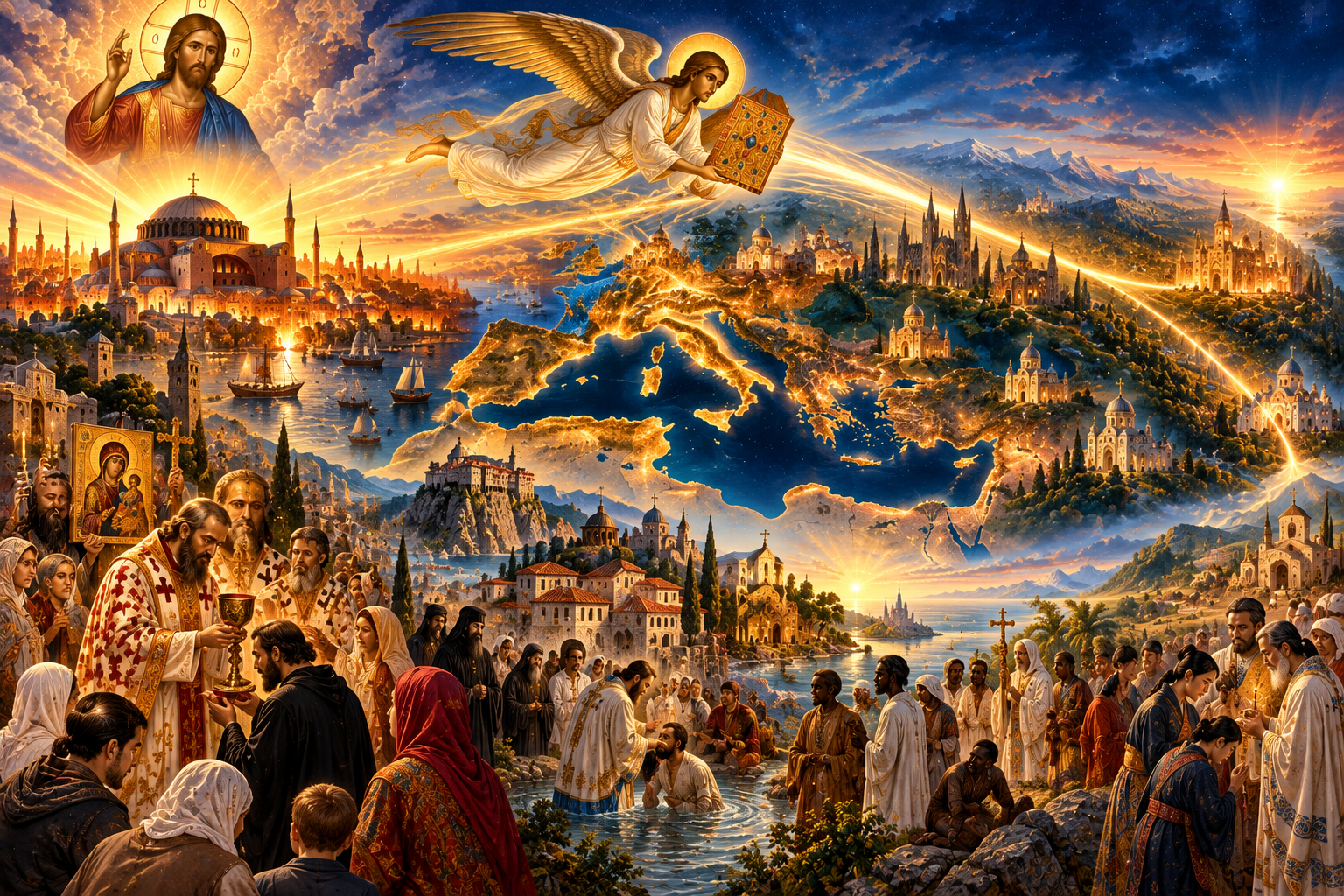
Nevertheless, within the larger symbolic architecture of the discourse, the parallel is striking. Earlier Christ declares that the Gospel of the Kingdom will be proclaimed throughout the inhabited world “for a witness unto all nations.” He then describes His own manifestation under the image of brilliant light proceeding “out of the east” and shining “even unto the west.” The first concerns the universal testimony concerning the King; the second concerns the universal manifestation of the King Himself.
Against this biblical background, the recurring East-to-West language of the Byzantine prophetic tradition becomes particularly suggestive. Agathangelos expects the Orthodox Faith to “spring from East to West,” while the Anonymous Prophecy declares that the Orthodox Faith will “move outward from East far into the West.” These traditions need not be treated as direct commentaries upon Matthew 24:27 for their symbolic affinity to be recognized. They participate in the same powerful Christian geography: light proceeding from the East and becoming manifest toward the West.
There is also a striking symbolic relationship between this imagery and the Seven Thunders. In the natural world, lightning and thunder belong together. The flash is seen and the thunder is heard. Matthew gives us the image of lightning proceeding from East to West; Revelation gives us the mysterious voices of the Seven Thunders. Within the Orthodox historicist interpretation considered here, those Thunders correspond to the Seven Ecumenical Councils and therefore to the Church’s great conciliar confession of Jesus Christ.
The symbolism is suggestive. The light of Christ shines forth, while the voice of the Church testifies concerning the One who is the Light. The lightning is seen; the thunder is heard. The light proceeds outward, while the conciliar testimony declares who that Light truly is. The Orthodox Faith that moves symbolically from East to West is therefore not merely an institution expanding geographically. It is the Church carrying with her the testimony that the Seven Thunders have spoken concerning the God-Man.
After the Seven Thunders: The Ark, the Witnesses, and the Thunder of Revelation 11:19
There may, however, be another element in Revelation itself that deserves consideration before turning to later Orthodox expectations of a future council. The Seven Thunders of Revelation 10 are not the final occurrence of thunder in this portion of the Apocalypse.
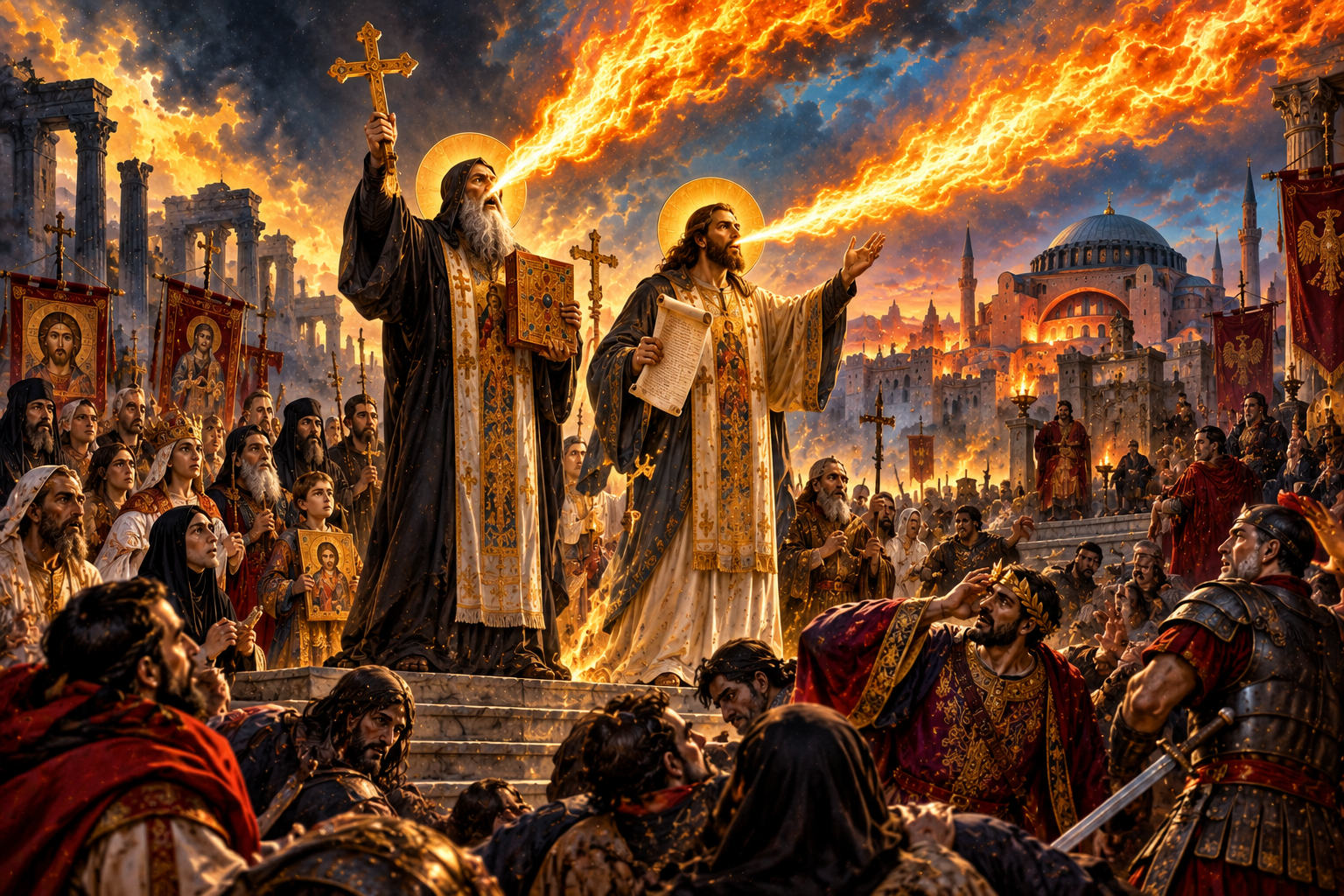
After the Seven Thunders, John introduces the Two Witnesses. They prophesy before the world, and their testimony is represented with extraordinary theological force: “fire proceedeth out of their mouth” (Rev. 11:5). They are eventually overcome and killed, but their apparent defeat is followed by resurrection and vindication. Then, at the conclusion of the vision, the seventh trumpet sounds and the heavenly Temple is opened:
“And the temple of God was opened in heaven, and there was seen in his temple the ark of his testament: and there were lightnings, and voices, and thunderings…” — Revelation 11:19
The sequence is striking. Seven Thunders speak; the Two Witnesses testify; the Witnesses suffer apparent death; the Witnesses rise; the Temple opens; the Ark appears; and thunder is heard again.
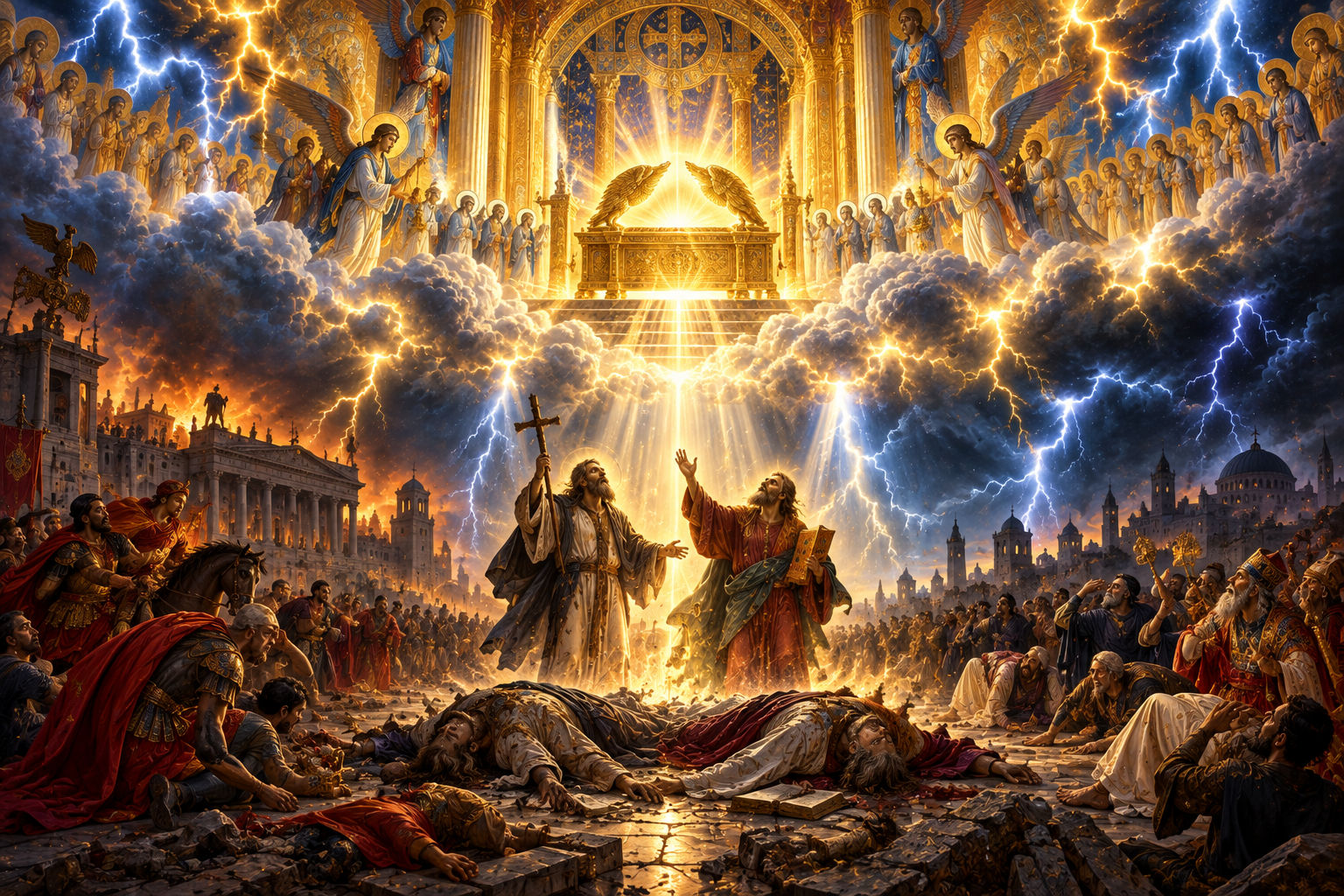
Nor should the appearance of the Ark be separated too quickly from what follows. The modern chapter division can obscure the literary transition. Immediately after John sees the Ark of the Covenant in heaven, he sees “a great sign in heaven,” the Woman clothed with the Sun (Rev. 12:1). Within an ecclesial reading of Revelation, the juxtaposition is highly suggestive. Revelation 11 reaches the revelation of the Ark at the culmination of the witnesses’ story; Revelation 12 then appears to recapitulate sacred history by unveiling the Woman and narrating her conflict with the Dragon from an earlier point.
Put simply: the Ark appears at the end of the story, and the Woman then appears so that John can tell her story from the beginning.
This interpretation also brings the theme of testimony full circle. Revelation 11 concerns the testimony of the Two Witnesses. Revelation 12 concludes with the Dragon making war against the seed of the Woman, those who keep the commandments of God and possess “the testimony of Jesus Christ” (Rev. 12:17). The Ark, the Woman, the witnesses, and the Testimony of Jesus therefore belong to an interconnected ecclesial vision.
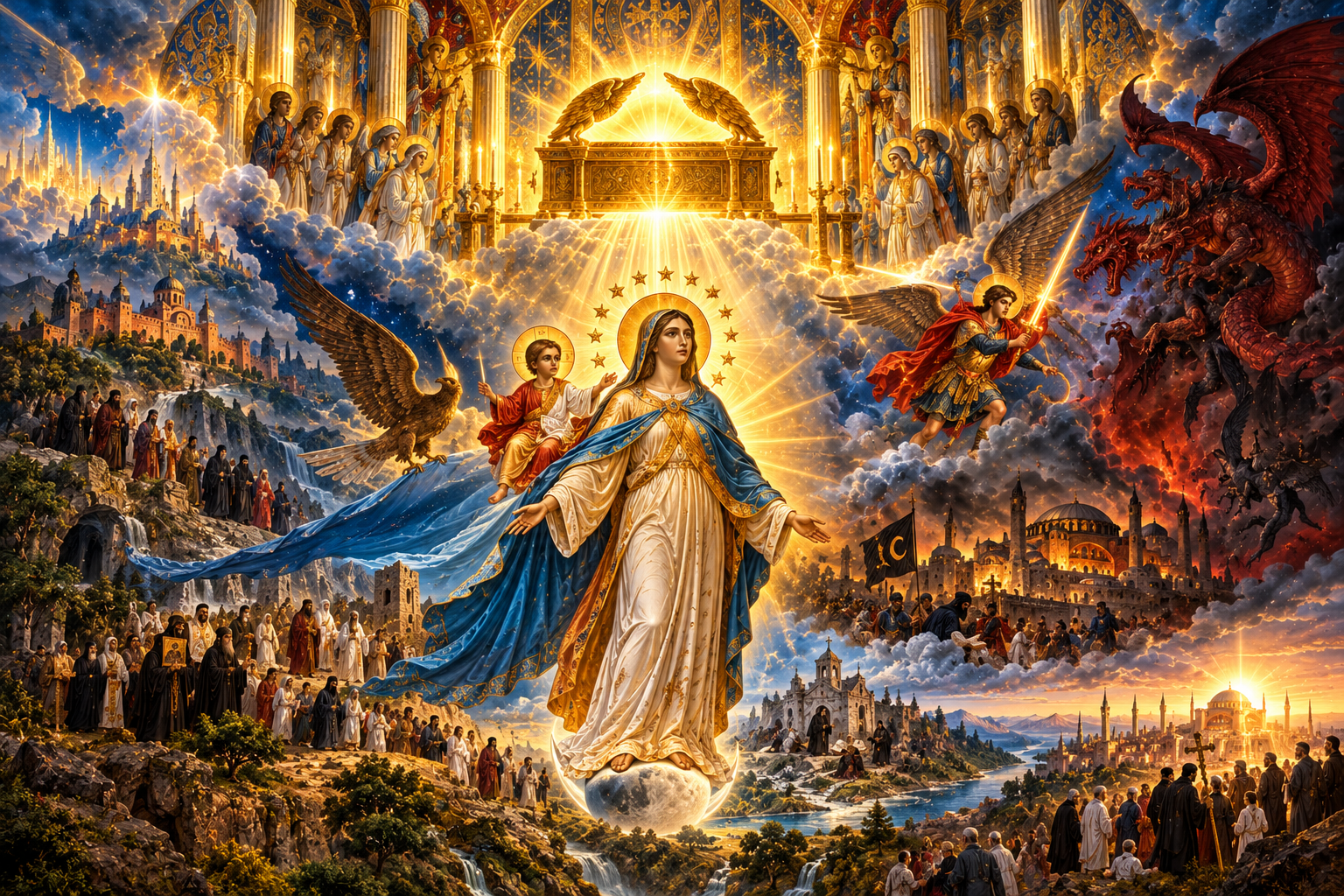
Most intriguing for the present discussion is the renewed thunder of Revelation 11:19. If the Seven Thunders of Revelation 10 may be understood historically as the Seven Ecumenical Councils, Revelation itself subsequently presents thunder again after the resurrection and vindication of the witnesses. The text does not call this an “eighth thunder,” and no interpretation should pretend that it does. Nevertheless, within a historicist reading it raises a legitimate symbolic question: might this renewed thunder represent another great conciliar voice of the Church after the restoration of her witnesses? The question becomes considerably more intriguing when we turn from Revelation itself to a remarkable expectation preserved within later Orthodox prophetic tradition.
The Eighth Council and the Final Orthodox Witness
The relationship between the Seven Thunders and the Seven Ecumenical Councils raises another intriguing question within the wider Greek Orthodox apocalyptic tradition. If the Seven Thunders represent the great conciliar voices through which the Church historically defended the Testimony of Jesus, did Orthodox prophetic tradition expect a final council before the concluding events of sacred history?
A prophecy attributed to St. Neilos (Nilus) the Myrrh-Gusher, who died in 1592, contains precisely such an expectation. Because the textual history and attribution of this particular prophecy require further verification, it should be cited with appropriate caution. Nevertheless, the tradition attributed to him states:
“…During that time the eighth and last Ecumenic Synod will take place, which will pacify the contentions of the Heretics, it will separate the wheat from the chaff, and the right doctrine from the false doctrine, and for the short length of fifty years there will be peace upon the earth.”
The significance of this tradition for the present argument lies not merely in its reference to an Eighth Council, but in the function assigned to that council. It is portrayed as conciliar and confessional. It distinguishes right doctrine from false doctrine and pacifies doctrinal contentions. Its purpose is therefore not to create a new Faith, but to clarify and vindicate the true Faith in the midst of division.
This is particularly suggestive when placed alongside the Seven Thunders. Revelation 10 explicitly speaks of seven thunders, and the integrity of that sevenfold symbolism should remain intact. Yet these are not the final thunderings heard in this portion of the Apocalypse. After the testimony, death, and resurrection of the Two Witnesses, the Temple of God is opened, the Ark of His Covenant is revealed, and there follow “lightnings, and voices, and thunderings” (Rev. 11:19). Revelation does not call this an “eighth thunder,” and we should not claim more than the text itself says. Nevertheless, within the historicist interpretation of the Seven Thunders as the Seven Ecumenical Councils, this renewed thunder following the restoration of the witnesses raises an intriguing possibility: could it signify a renewed conciliar voice of the Church, perhaps even providing a symbolic place for the future council anticipated in later Orthodox prophecy? Such a council would not add a new doctrine to the testimony of the Seven, but would cause their apostolic and Christological testimony to thunder again in history.
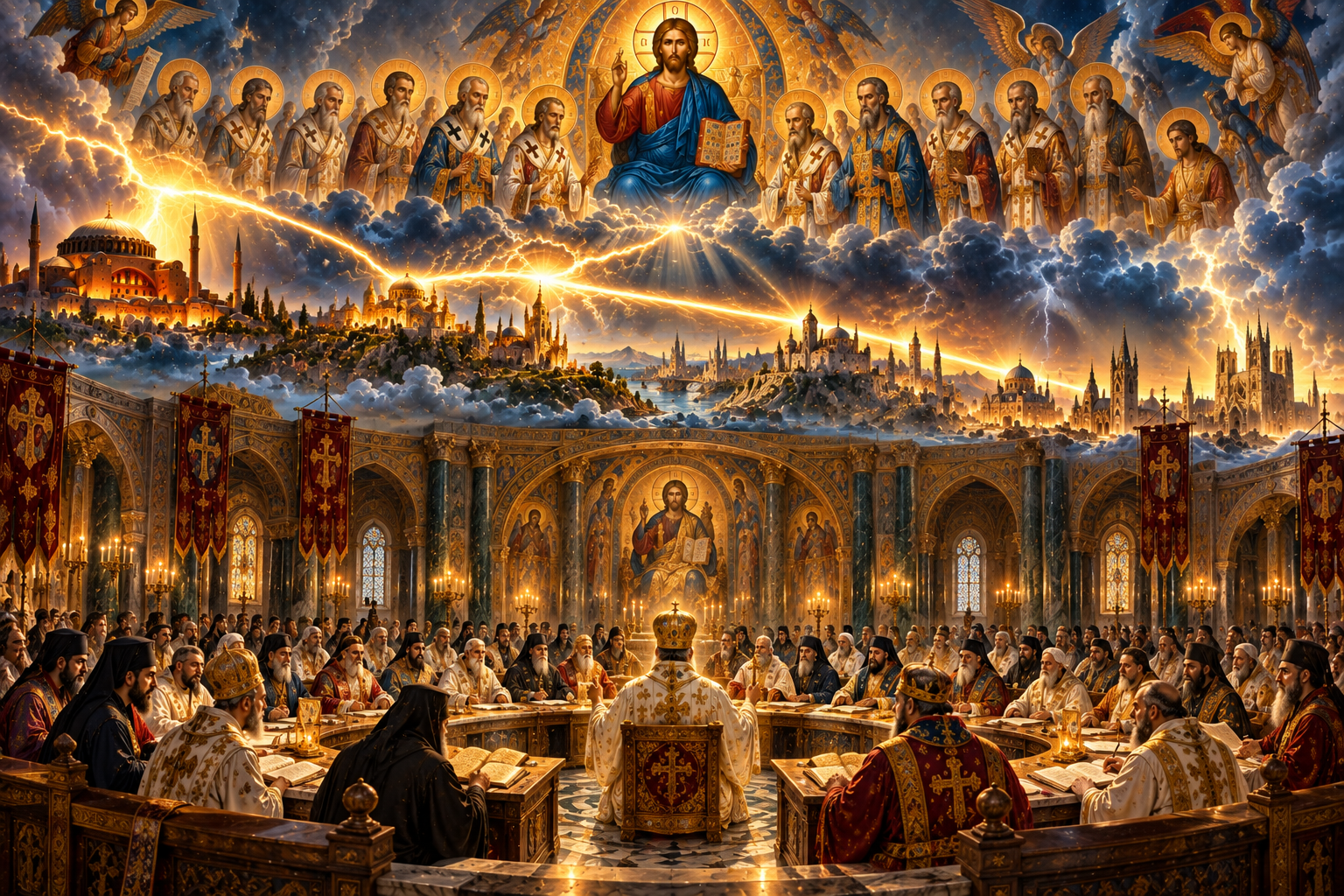
Such a council would not need to reveal a new Christology. Its vocation would be precisely the opposite: to proclaim anew the apostolic and Christological testimony already articulated through the Seven Ecumenical Councils. It could call a divided Christian world back to the Faith confessed at Nicaea, Constantinople, Ephesus, Chalcedon, and the succeeding Councils. The seven voices would remain seven, but their testimony would sound again with renewed force.
The reference attributed to St. Neilos to a period of fifty years of peace following this council is also striking when compared with another stream of Byzantine prophetic tradition. The Vision of Agathangelos likewise speaks of a future period in which “for full fifty years shall peace reign,” followed immediately by the declaration that “Truth shall triumph” and that “the Orthodox Faith shall be uplifted, and shall spring from East to West.” The verbal and conceptual correspondence deserves further historical investigation before any literary dependence is asserted. Yet taken simply as witnesses to Greek Orthodox apocalyptic expectation, the traditions exhibit a remarkably similar sequence: doctrinal restoration, ecclesial peace, and the outward expansion of the Orthodox Faith.
Here the lightning-and-thunder symbolism becomes especially resonant. The light of the Gospel moves outward from East to West while the conciliar testimony of the Church sounds forth with it. The lightning is seen and the thunder is heard. If the Byzantine prophetic expectation of a future council were ever historically realized, its significance within this framework would not be that an eighth voice had replaced the Seven, but that the ancient testimony of the Seven had become audible again to a divided Christian world.
This should not be presented as a direct prediction contained in Matthew 24:27 or Revelation 10. It is instead a theological convergence among biblical imagery, Orthodox conciliar history, and the later Byzantine prophetic tradition. Yet the convergence raises a provocative possibility: the final great missionary expansion envisioned within this tradition might be accompanied not by the invention of a new Orthodoxy, but by a renewed universal confession of the ancient Faith.
Not the Triumph of an Empire, but the Kingdom
This distinction is essential for interpreting the Byzantine prophetic tradition. The Kingdom of God cannot simply be identified with the Byzantine Empire, a restored Roman Empire, a Greek nation-state, Russia, or any other earthly political arrangement. Empires rise and fall; the Kingdom remains. Constantinople can possess immense importance within Orthodox sacred history without becoming the ultimate object of Christian eschatological hope.
The final purpose is not the triumph of one ethnicity over another, nor the replacement of one earthly civilization by another. It is the triumph and universal proclamation of the Gospel of Jesus Christ. The historical vocation of Orthodox Christianity is therefore not ultimately to recreate Byzantium politically, but to carry to the nations what the Orthodox Church believes was preserved through Byzantium and articulated through the Ecumenical Councils: the apostolic and conciliar Testimony of Jesus Christ.
The Seven Councils belong to all nations because Christ belongs to all nations. Nicaea is not Greek ethnic property. Ephesus and Chalcedon do not belong merely to the civilization in which they occurred. The confession of the God-Man is the inheritance of the catholic Church and a testimony intended for the entire world.
The Reawakening of the Catholicity of Orthodoxy
This broader missionary dimension of the Byzantine hope was recognized explicitly by Archimandrite Eusebius Stephanou in his 1967 introduction to Apostolos Makrakis’s Hellenism and the Unfinished Revolution. Stephanou acknowledged Makrakis’s intense concern for Constantinople and the liberation of Orthodox peoples still living under Ottoman domination, but he was careful to explain that Makrakis’s idea of conquest “was not so much military gain, as it was spiritual and cultural expansion.” Makrakis placed greater confidence in faith in Christ than in the power of weapons.
Stephanou then identifies the wider missionary horizon behind this program. According to his summary, Makrakis believed that those who possessed the apostolic Orthodox Faith had a calling extending beyond the liberation of Greek territory and ultimately toward the establishment of Orthodox Christianity throughout the world. He compares this vocation with that of St. Paul, called to carry the name of Christ before the Gentiles, kings, and the sons of Israel.
Most significant for the present argument is Stephanou’s description of the unfinished Orthodox vocation as:
“a call to the re-awakening of the universality and catholicity of Orthodoxy.”
That expression places the older language of Byzantine restoration into a much greater ecclesiological context. The restoration of Orthodoxy is not merely the recovery of something lost in the past. It is a reawakening of catholicity. The Faith preserved within the Orthodox East is not meant to remain the possession of the East. If it is truly catholic, its very nature points outward toward the nations.
Stephanou expresses this missionary principle memorably near the conclusion of his introduction:
“What is worth perpetuating is worth sharing with all men. Otherwise, it is neither worth keeping for ourselves.”
This provides an important way of interpreting the old prophecy that the Faith will move “from East to West.” The historical vocation of Orthodox Christianity is not simply to recreate Byzantium politically, but to carry to the nations what the Orthodox Church believes was preserved through Byzantium and the Ecumenical Councils. The movement from East to West becomes not primarily a movement of armies or borders, but a movement of testimony.
One, Holy, Catholic, and Apostolic
This gives the Nicene Creed itself an eschatological and missionary significance that can easily be overlooked. In every Divine Liturgy Orthodox Christians confess belief in “One, Holy, Catholic, and Apostolic Church.” That confession is inherently universal. The Church is catholic because she possesses the fullness of the Faith, and apostolic because she preserves and continues the testimony entrusted to the apostles. Her mission therefore cannot ultimately be reduced to ethnic preservation.
Greek Orthodoxy cannot exist merely for Greeks, Russian Orthodoxy merely for Russians, or Romanian, Serbian, Georgian, Arab, Bulgarian, African, American, Japanese, Korean, or any other local expression of Orthodoxy merely for its own people. Every local Church participates in the catholic mission of the one Church. The apostolic testimony entrusted to her is intended for all nations.
This may be precisely why the Gospel of the Kingdom and the Seven Thunders belong together. The Seven Councils preserved the apostolic confession concerning the King. The Church carries that confession outward through the Gospel. The nations receive the testimony not through political coercion but through witness, worship, sacrament, holiness, martyrdom, preaching, and mission. The Seven Thunders therefore should not be understood merely as historical monuments belonging to Christianity’s past. Their testimony remains missionary because the Christ whom they confess remains the Gospel offered to the world.
Christ’s final command in Matthew completes this picture:
“Go ye therefore, and teach all nations, baptizing them in the name of the Father, and of the Son, and of the Holy Ghost.”
— Matthew 28:19
Matthew’s Gospel repeatedly proclaims the Kingdom; Matthew 24 foretells the Gospel of that Kingdom becoming a testimony to all nations; and Matthew 28 sends the apostles to disciple those same nations. The Great Commission is therefore not incidental to eschatology. The mission of the Church is itself part of the eschatological movement of history.
Revelation, viewed from this perspective, is not merely a catalogue of disasters preceding the Second Coming. It is the Apocalypse of Jesus Christ: the sacred history of the Lamb, His Church, His witnesses, their testimony, their persecution, their preservation, and the extension of His Gospel among the nations. This is why an ecclesial historicism must be about more than prophetic chronology. The question is not merely when the 1,260 years begin and end. The deeper question is what God is accomplishing through those centuries. He is preserving within history a people who bear the Testimony of His Son.
“And Then Shall the End Come”
Christ’s prophecy contains one final phrase that prevents us from losing sight of the larger horizon: “and then shall the end come.” The end follows the witness to the nations. That ordering matters. At minimum, Christ places the universal witness before the end. Within the stronger Byzantine and post-Byzantine expectation considered here, this universal witness becomes an extraordinary historical reception and expansion of the Orthodox Faith among the nations.
The history of the Church therefore need not be understood simply as an uninterrupted decline culminating in Christ rescuing a tiny remnant from an irredeemably darkened world. There remains a missionary purpose within history. The Testimony must go forth. The Gospel of the Kingdom must be proclaimed. The nations must hear the voice of the Lamb. Revelation 14 presents precisely such an image: the Everlasting Gospel carried to “every nation, and kindred, and tongue, and people.”
Here the Byzantine Apocalyptic Tradition expectation of an Orthodox Faith moving “from East to West” can be understood in its highest and most catholic sense. It need not signify the conquest of West by East or the replacement of one earthly civilization by another. It can signify the outward movement of the apostolic Faith preserved through the Church’s long historical pilgrimage.
The Woman emerges from the wilderness not merely to survive, but to bear witness. The testimony preserved through persecution is proclaimed openly. The voices of the Seven Thunders, once sealed within the prophecy, become audible within Church history through the conciliar confession of the Faith. What was defended at Nicaea, Constantinople, Ephesus, Chalcedon, and the succeeding Ecumenical Councils is not an archaeological remnant of an ancient Christian civilization. It is the universal testimony concerning Jesus Christ: true God and true Man, the incarnate Word, crucified and risen, reigning as King and gathering the nations into His Kingdom.
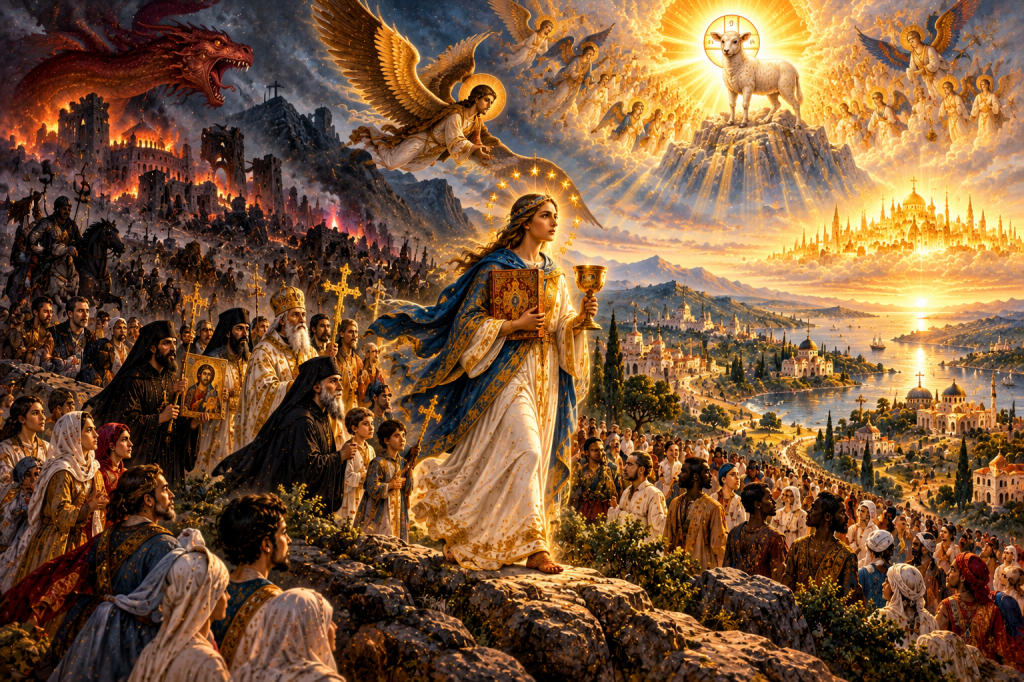
The Seven Thunders did not speak for Byzantium alone. They spoke the catholic confession of the Church. The Christ confessed by the Seven Ecumenical Councils is not the possession of one nation, language, or civilization. He is the King of all nations. The final missionary vocation of Orthodoxy is therefore already contained within her own Creed: One, Holy, Catholic, and Apostolic Church. The Faith preserved through centuries of persecution is preserved in order to be proclaimed, and the testimony defended by the Councils is defended in order to be carried to the world. In Stephanou’s memorable expression, what is required is a “re-awakening of the universality and catholicity of Orthodoxy.”
The imagery now comes together with remarkable force. The Gospel of the Kingdom is the Gospel of the King. The King is the Lamb. The Lamb is the God-Man whose identity the Church confessed through the Seven Ecumenical Councils. The Seven Thunders give voice to that testimony. The Everlasting Gospel carries it to every nation, kindred, tongue, and people. The Woman who was preserved in the wilderness bears that testimony into the world. And the old Byzantine hope sees the Orthodox Faith moving outward from East to West, recalling the lightning that Christ says comes “out of the east, and shineth even unto the west.”
The lightning is seen, and the thunder is heard. The light of Christ goes forth, and the Church gives voice to the testimony concerning Him.
If there remains a future great conciliar witness of the Church, its purpose would not be to add another Gospel to the Seven Councils, but to cause their ancient testimony to sound once more throughout the Christian world. The “right doctrine” would not be newly invented; it would be the apostolic Faith once delivered, preserved through the centuries, and proclaimed anew. In this sense, the hope for a future council, the reawakening of Orthodox catholicity, and the Byzantine expectation of the Faith moving from East to West can all be understood within one missionary horizon.
The Byzantine hope that the Orthodox Faith would one day move from East to West may therefore contain something far greater than the dream of restoring a lost Christian empire. Properly understood, it points toward the catholic vocation of the Church herself: the Testimony of Jesus going forth as the Gospel of the Kingdom to every nation, tribe, tongue, and people.
And only then does Christ conclude:
“And this gospel of the kingdom shall be preached in all the world for a witness unto all nations; and then shall the end come.”
— Matthew 24:14
© 2026 by Jonathan Photius

