
By Stergio N. Sakkos, Emeritus Professor Aristotle University of Thessaloniki
Source: Proceedings of the Theological Conference of the First Metropolis of Thessaloniki “in honor of the Most Holy Theotokos”.
November 15-17, 1989. pp. 351-366.
Translated from Greek to English by Jonathan Photius
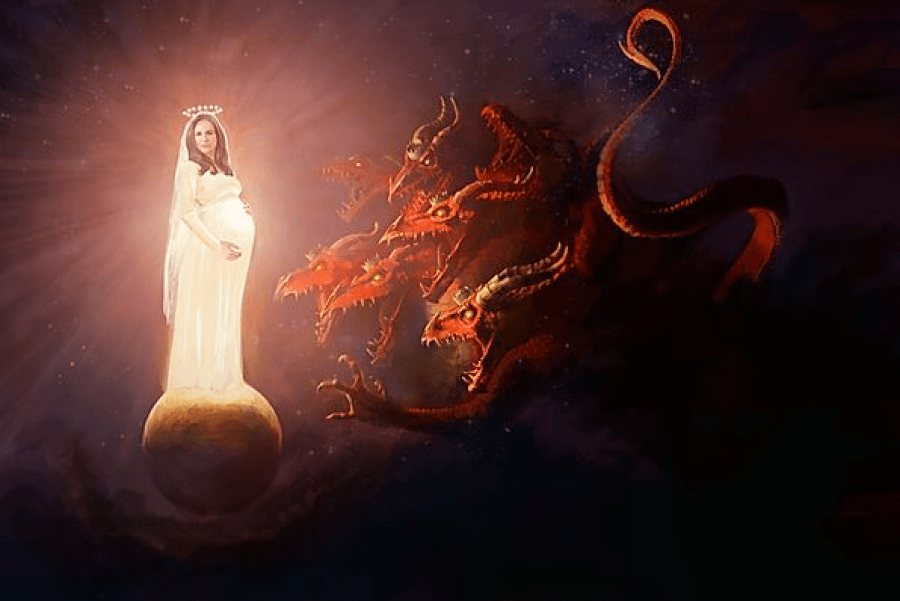
Indeed, in the 12th chapter, roughly in the middle of Revelation and right in the middle of the prophetic account of John1 projects “a great sign in the sky: a woman clothed with the sun and the moon under her feet and on her head a crown of twelve stars.” Then “another spot in the sky” is presented. A pyrrhic and great dragon with seven heads and ten horns, bearing seven diadems on his heads, drags with his tail a third of the stars and casts them down to the earth. This dragon then “stood before the woman of the expectant mother, so that when she gave birth, her child was devoured. And she gave birth to a male son, who in the future will shepherd all the nations with a rod of iron. and her child was caught up to God and to his throne. And the woman fled into the desert, where she has a place prepared by God,
But the story of the Woman and her Child did not end. John interrupts for a while to show us a war that happened in heaven. Michael and his angels fought the dragon and his angels and defeated them. Defeated, the dragon, who is none other than the ancient serpent, the Devil and Satan, fell to earth with his angels. Heaven praised God and his Christ and triumphed, because the accuser of the brothers of men was defeated. But men were still able to defeat the dragon thanks to the blood of the Lamb and thanks to their confession of faith and thanks to their self-sacrifice. Therefore the whole world of heaven rejoices. Woe is to land and sea,
After this scene, which explained to us how the dragon came to be on earth when he was originally in heaven and why he is full of hatred, the Woman’s adventure continues. “And when the dragon saw that he was cast into the earth, he cast out the woman, as she had slain the man. And they gave the woman two wings of the great eagle, so that she may fly into the desert to her place, as she feeds there time and time and half the time from the face of the serpent. And the serpent poured out of his mouth behind the woman water like a river, so that she could be carried away by the river. And the earth helped the woman, and the earth opened her mouth and swallowed the river that the dragon poured out of his mouth. And the dragon was enraged at the woman, and went forth to make war after the rest of her seed,
This is the content of the 12th chapter of Revelation, which creates many problems for interpreters. There is no problem, of course, as to who the dragon is, because the author himself gives us his identity: he is “the great ancient serpent, called the Devil and Satan, the deceiver of the whole world” (v. 9) 2 .
It is about that snake that approached the first woman in Paradise and made God the Creator to her and pushed man into disobedience (Ge. 3,1-6). However, interpreters are troubled as to who exactly is the Woman whom the dragon pursues, as well as how the various events that take place as a unit within the chapter are connected. The second problem, of the unit of chapter 3 , will not occupy us except in the part that will be required by the first problem, the recognition of the Woman. On the other hand, I think that the two problems have a close internal relationship between them, in such a way that if the face of the Woman is illuminated, the unity of the chapter is also understood.
In principle no one disputes that chapter 12 describes the struggle between Satan and Messiah. Certain elements of the narrative, which they cannot harmonize with the facts of the Bible and with the Christian mentality, as they perceive it, cause confusion for foreigners, especially interpreters, and indeed for theologians of negative criticism. Summarizing and systematizing the research on this, I distinguish these elements into six categories:
a) Expressives. The Woman is depicted with material from astrology, as a goddess of the sky, with characteristics that resemble the characteristics of pagan deities. Thus, among the Egyptians the goddess Athor (Isis) is represented with the sun on her head and with a garment full of stars, between which were the moon. To the Babylonians Damkina is called “the woman with the heavenly diadem”, and to the Greeks the demigoddess Leto wears a veil of stars. On the other hand, the Assyrian God Yono wore a crown with twelve precious stones, and it is known that according to the ancient astrologers of Babylon twelve were the signs of the astral zodiac.
b) Thematically. The theme of the dragon chasing the Woman and her uncle Teknos is common in ancient mythologies. In the Egyptians the red dragon Seth (Typhon) pursues Isis and is later killed by her son Horus. In the Babylonians the seven-headed dragon Thiamat pursues Marduk’s mother, Damkina, who is saved by the eagle and the earth. Among the Greeks, the dragon Python pursues Leto, pregnant by Zeus, who, with the help of North and Poseidon, is taken to Delos . there she gives birth to Apollo and after four days he goes to Parnassus and kills Python.
c) Notations. During the narration, there is a transposition in terms of the place of development of the events between heaven and earth. The Woman, that is, appears in heaven, but gives birth on earth and takes refuge in the desert. Her Child is then seized and saved in heaven immediately, it seems, after his birth. At the end, the Woman is shown to have other offspring, with whom the dragon goes to battle. Further contradictions are also indicated : the dragon is defeated in heaven by Michael and his angels, but it is said that men on earth were also defeated by the blood of the Lamb, while it is immediately noted that the earth still suffers from the dragon, because he is among the people.
Faced with these expressive, thematic and semantic difficulties, as I have explained, the interpreters slip into the conclusion that it is not possible that chapter 12 of Revelation came from purely Christian sources. And they are divided, some arguing that the author is directly influenced by pagan mythologies4 and others that the author attributes Semitic and Jewish traditions, which have incorporated and “Judaized” pagan myths5 . In an attempt to unify the two trends, the theory is formulated that there was a primordial common myth, elements of which are preserved in the various mythologies of the ancient peoples and which was elaborated by the Jewish tradition, in order to finally be adapted to the Christian teaching6.
It is clear that with this historical – philological criticism of the sacred text the problems are not only not solved, but also complicated. For how can a proposition which, in order to explain some secondary, say, linguistic difficulty, catalyze the author’s entire authority and pose a major problem of authenticity, be considered a solution? And then things don’t really get complicated when, in order to understand a specific subject, for example, instead of placing it within its own historical and theological space (of the Old and New Testaments in this case), we spread it among the legends and popular traditions and confuse it with the myths and superstitions of foreign nations? Nevertheless, the questions of the 12th chapter of Revelation can find their answer, safe and satisfactory, if they are examined in the light of the orthodox hermeneutical tradition with the Spirit that the fathers of our Church bequeathed to us, enlightened by the same Holy Spirit that dictated to the evangelist John the Apocalypse. To this end, knowledge of the times and history, awareness of the mentality of Scripture and a sense of the life of the Spirit are needed. In particular, it is necessary to put the Apocalypse on its right footing, to know the rules by which it operates and the purpose it serves, in order to be able to interpret the image of the Woman that concerns us.
A necessary condition for understanding the Revelation is to keep in mind that it is all a living and real vision, which God revealed to the evangelist John, who in turn recorded what he saw and sent it as “the word of God” and as a “witness of Jesus Christ” in all the Churches of Asia Minor (Ap. 1,1). I consider the theory of many interpreters, even conservative ones, that the author himself invented, even with the inspiration of the Holy Spirit, but by himself or chose elements to compose the his prophetic visions. This position automatically rejects the divine inspiration of Revelation and is rejected without discussion.
According to the explicit testimony of Revelation, God appeared to John and spoke to him and showed him images and events, just as he did to the Prophets of the Old Testament, Isaiah, Jeremiah and others. That is to say, just as Isaiah, for example, saw the Lord sitting on a high and airy throne and the six-winged Seraphim standing around him, so also John saw the Woman of Revelation in front of him being chased by the dragon and saved by eagle wings. The Prophets did not imagine these nor were they inspired, but they saw them with their senses. Of course, God showed and declared what he wanted to say in a way that could be understood by his Prophets, in the way he used to come into contact with his Jewish people, through his history and through the His testament. Thus the Lord spoke to the apostle John in the language of holy history, of the Old Testament. As unreal and utterly improbable as it is that God ever used pagan representations and fables to communicate with his Prophet, so true it may be that revelation has something to do with them. After this necessary clarification, we can proceed to formulate certain interpretive principles for the understanding of Revelation and especially our chapter, which in fact respond one by one to the difficulties I noted above. As unreal and utterly improbable as it is that God ever used pagan representations and fables to communicate with his Prophet, so true it may be that revelation has something to do with them. After this necessary clarification, we can proceed to formulate certain interpretive principles for the understanding of Revelation and especially our chapter, which in fact respond one by one to the difficulties I noted above. As unreal and utterly improbable as it is that God ever used pagan representations and fables to communicate with his Prophet, so true it may be that revelation has something to do with them. After this necessary clarification, we can proceed to formulate certain interpretive principles for the understanding of Revelation and especially our chapter, which in fact respond one by one to the difficulties I noted above.
a) Revelation is written in symbolic language. The author, in other words, in the same way that he uses symbols and letters to formulate the words, in the same way he lists symbols and images, which express the truths as they are revealed to him. And this, because God wanted to “signify”, as John himself says (Revelation 1:1), that is, to show with visual material, and not just to record in words, his messages. The symbols and the images with which John expresses himself, he does not invent them himself, as I said, and he is certainly not inspired by the myths of the pagans, whom as a genuine Jew he previously detested and as a true Christian now disapproves of, nor is he influenced by any means. from the vague traditions of the people, which he rejected as spurious and disreputable7. On the other hand, a careful study of all these pagan myths and Semitic traditions proves that they have far more differences than similarities with John’s performance. The prophet does not deal with the ramifications of the human mind. He sees “in the Spirit” (Revelation 1:10), but with his eyes, that symbols and images from the rich and divinely inspired world of the Old Testament, which includes the faith of his fathers, from the simple daily life of the people of his time, and from the living and wonderful reality of nature.
b) It is noteworthy and particularly important that John, in addition to various persons, things, but also entire scenes that he sees as symbols, also watches well-known historical events unfold before him as symbols as well. Actions and incidents, that is, that happened in the past appear as types for things that happen in the present or in the future. We have an inverse, I would say, phenomenon of the prophetic infinitive. While there events of the future are presented as events of the past with an infinitive (cf. Baruch :”God on earth suffered and turned to men”, Brch. 3.38), here past events are presented as future events. Just as with the prophetic indefinite the certainty of the future event is declared, with this anachronism of the events the guarantee is offered for the future, that the history that took place will be repeated, albeit with other persons and other settings. It is reasonable, of course, that as historical events are used as symbols, they are transformed according to the requirements of the things prophesied, without distorting history in the least. Freely and arbitrarily the Holy Spirit, arbitrarily, composes pieces of the history of the past and presents them as a picture of the history of the future. So, we don’t have to wonder,
c) On the other hand, we must not overlook that the Apocalypse is not only a prophetic book, but also a historical one. It includes the history of all humanity from creation to completion and deals especially with the history of the Church from creation to glory8 . However, this story, as I already mentioned, is presented in an idiosyncratic way: timeless and timeless. Data from different places and different times are intertwined and unified to serve a specific message. Thus, in Revelation we have history told and history prophesied, and the told history and the prophesied history move freely, outside the seals of space and time. The purpose of the history and prophecy of John is to encourage and strengthen the Church, which was severely tested in the times of the evangelist, by persecutors and heretics, and to strengthen the people of God in the faith for the final triumph of Christ. When we see the Apocalypse with this perspective, we understand its “signs” much better.
Based on the above fundamental principles for the understanding of Revelation, I think we can more easily approach the text of the 12th chapter and distinguish who is “the woman clothed with the sun”. We point out a clear quote from the Old Testament in verse 5, where the word about the Son of the Woman, “he shall always shepherd the nations with a rod of iron”. It is precisely about verse 9 of the 2nd Psalm, which undoubtedly, like the whole Psalm, refers to the Messiah and is a powerful prophecy of the mighty global spiritual kingdom of the Son of God, the God-man Jesus Christ. The testimony is obvious and immediately points in Christian history as a Woman to the mother of the Messiah, the Virgin Mary. This was also the first and most ancient interpretation of the woman’s face9. However, it is observed that the remaining elements of the scene do not fit the characteristics and history of the Virgin Mary. Specifically, the following are opposed:
a) The Woman travails, has labor pains during childbirth, while it is believed that a virgin birth like that of Christ, could not have caused travail .
b) The Son of Woman is caught up to God immediately after his birth, which did not happen at the birth of Christ.
c) The Woman, without her Child, takes refuge in the desert, where she stays for a certain time . But a similar incident is not mentioned in the life of the Virgin.
d) The Woman has other children besides the Child she gave birth to, with whom the dragon continues to fight . This does not agree with the story of the Virgin Mary, who only gave birth to the only begotten Son of God.
Mainly for these reasons, the opinion that it is the Virgin Mary was questioned and rejected very early11 , and other interpretations were proposed, which in recent years were largely determined by the dogmatic beliefs of the interpreters. Thus mainly Protestant writers claim that the Woman of chapter 12 symbolizes the ideal Israel, the Zion of the Old Testament, which is the type of either the ideal kingdom of God of both Testaments12 or the type of a faithful community of the last days 13. On the other hand, the Orthodox and Roman Catholic authors in their great majority maintain that the Woman is a personification of the people of God of the Old and New Testaments from the ancient righteous until the end of the ages, that is, the Church. However, they do not completely abandon the position that the Woman can be understood at the same time as the symbol of the Virgin Mary. And others allow the application, but rule out that it existed in the intention of the author 14 , others do not consider that the author intended to suggest together with the Church and the Virgin 15 . However, among the Roman Catholics, other opinions were expressed, such as that a woman is the Israel of the Old Testament, who gave the world the Messiah 16, or the Church of the New Testament, the apostolic 17 , or finally the Church of later times 18 . In all these interpretations, in which the Woman is not, at least exclusively, an image of the Virgin Mary, the various elements of the scene, where she is presented, are understood metaphorically. Odins are considered the spiritual pains of the Church for the rebirth of people 19 or the persecutions from the world 20 . The rapture of the Son, which is historically explained by the ascension of Christ 21 , refers to the rapture of the faithful to the Lord during the second presence 22 . As the flight of the Woman into the desert for a certain period of time, the flight of the Church to Pella is assumed, before Jerusalem was sacked by Titus 23 , or any other flight and salvation of the Church from the antichrist 24 and generally security and freedom 25 . Finally, the members of the Church, the faithful of the Lord, are perceived as remaining children 26 .
In this maze of various propositions, we need to grasp the myth of the interpretative principles of Revelation, which I developed earlier, in order to be led to a way out. So I remind you of the primary basic rule that John’s supervisory material, the material that God brings to him, comes basically from the history of all the holy Scriptures. Reading the chapter I mainly recognize the following biblical themes, regarding the presentation of the Woman. First, of course, dominates the text and guides the interpretation, as I already mentioned, the messianic passage from the 2nd Psalm about the male child, who will rule all the nations with a rod of iron. Second, the image of the dragon who is hostile to the Woman and her Child, as well as the rest of her children, and asks to destroy them, without succeeding, brings to mind the prophetic word of the Creator to the serpent-Satan, when the first-born fled from heaven in shame, the so-called “first gospel”: “And I will put enmity between you and between the woman and between your seed and between of her seed, he shall keep your head, and you shall keep his tail” (Gen. 3,15). Third, the lurking of the dragon to devour the Child of the Woman, as soon as it is born, refers to Herod’s study and violence to kill the child Jesus immediately after his birth (Mt. 2,3-8. 16). Fourth, the flight into the desert, where the Woman is safe for a certain period of time, while behind her the dragon pours a river of water to drown her, reminds, finally, of the flight of the Virgin Mary to Egypt, where Jesus was safe,
It is clear that all these themes converge and show us a form for the face of the Woman of the chapter: the form of the Virgin Mary. Nor is the issue of the “first gospel” clearly excluded, where Eve plays the leading role, because there too, in Eve’s loins, there is the Virgin, to whom God’s prophecy also applies, since her own, literally, sperm, the Messiah will crush the devil and as long as the great enmity of the devil exists towards the Messiah and his people. Of course, the above biblical themes deviate in certain points from the known events of the Bible, but it is a given that the elements of the story are composed freely by the Holy Spirit in order to form the history of the prophecy.
For the evangelist John, the Virgin Mary was a particularly dear person. He was the only one of Jesus’ disciples who lived so long and so close to the Virgin Mary. John was with the Virgin at the wedding of Cana and he had watched her with how much distinction and humility, but also with how much certainty of the Son’s authority he had treated her (Jn. 2,1-5). He stayed in the same house for a few days, when Jesus went down to Capernaum with his mother and his brothers and with John and the other disciples (Jn. 2,12). Next to the Virgin Mary, John was under the cross of Calvary and he had seen how she endured the dagger of pain that pierced her soul at that horrible time. He saw that she did not beat herself in despair, nor tear her cheeks, nor pull her hair, she did not utter hysterical cries nor did she fall down fainting, but with dignity she stood upright in her pain (Jn. 19,25). Into his own hands the Lord entrusted his mother above the cross and from then on John “received her in the same” (Jn. 19,26-27). In any case, during the years he lived with her, the evangelist would be particularly connected to the Virgin Mary and would learn a lot from her, indeed the theologian would study theology by studying her graceful and blessed personality among all women. Thus, he who was “the disciple whom Jesus loved” also became the disciple who loved Jesus’ mother very much. In any case, during the years he lived with her, the evangelist would be particularly connected to the Virgin Mary and would learn a lot from her, indeed the theologian would study theology by studying her graceful and blessed personality among all women. Thus, he who was “the disciple whom Jesus loved” also became the disciple who loved Jesus’ mother very much. In any case, during the years he lived with her, the evangelist would be particularly connected to the Virgin Mary and would learn a lot from her, indeed the theologian would study theology by studying her graceful and blessed personality among all women. Thus, he who was “the disciple whom Jesus loved” also became the disciple who loved Jesus’ mother very much.
Therefore, by presenting the form of the Virgin Mary to John, God presents him with the most beautiful image that the prophet could see in front of him. Oh, how truly he would have rejoiced, how his heart would have rejoiced and his spirit rejoiced, when he saw her form projected “in heaven”! that is, within the heavenly reality, within the frequency of the Spirit and within the sphere of the divine world and of course not literally in the sky of this earth. It seemed to him a “mega sign”, an amazing, extraordinary, supernatural phenomenon, full of divine messages. And in fact, he did not see her as he knew her, a humble and insignificant daughter, but he saw her majestic and glorified. At the beginning of Revelation John similarly saw Christ, not as he knew him, a simple man, but as he will come again to earth, in his glory, with lamps that shone “as the sun shines in its power” (Revelation 1,13-20). Now, in the middle of his Revelation, he sees the Virgin as “a woman clothed with the sun.” And who is the sun that the Virgin Mary is clothed with, other than the One who shines like the sun and whom the Prophets called the “sun of righteousness” (Ma. 4:2), that is, Christ?
There was no need for John to have in mind either the heavenly deities of the pagans or the astrologies of the magicians. He knew the sun, the moon and the stars like every man on earth and he could use them as a common place, as they all used him, as an example of glory and greatness. Moreover, the apostle was well aware of the use of these symbols by the Prophets and therefore of their prophetic significance. When he saw the form of the Virgin Mary all shining wearing the sun-Christ, he was not surprised, because as the apostle Paul believed that “those who were baptized into Christ, you have brought Christ” (Gal. 3,27). And when he saw the moon lying as a footstool “under her feet,” he would easily recognize old Israel, which had finished its mission and had fulfilled its destiny and stood only as a basis now for the new covenant, which the Virgin Mary brought into the world. Like the moon Israel had shone and temporarily illuminated the world, but now she was fading before the Sun of righteousness. The crown of twelve stars, which the Virgin wore on her head, will immediately declare to John the Apostles of Christ, who rule the Church in his name. And all together sun, moon, stars painted with their brightness not a goddess, but a divine and pure image of the Theotokos. which the Virgin wore on her head, will immediately declare to John the Apostles of Christ, who rule the Church in his name. And all together sun, moon, stars painted with their brightness not a goddess, but a divine and pure image of the Theotokos. which the Virgin wore on her head, will immediately declare to John the Apostles of Christ, who rule the Church in his name. And all together sun, moon, stars painted with their brightness not a goddess, but a divine and pure image of the Theotokos.
But this image certainly does not cease to be a “sign”, as John declared (Revelation 1:1). That is, it does not incarnate a historical figure only, even the excellent form of the Immaculate Virgin Mary, but in addition it must be a type of a divine reality, the highest and unique in the work of the gods. And this is none other than the Church, which is and the central theme of the book of Revelation. Thus, the evangelist John at the center of his visions sees the drama of the Virgin as a symbol of his central theme, the Church. She knows that she who lent her body and blood to Christ had become the same body of Christ, since she was the first and perfect member of the Church. The Lord became in the flesh the God-man, to make man God’ and the Mother of God became, by the grace of the Spirit and with her obedience, the very first man-god. In this way, it is itself a symbol and the beginning of the new creation, of reborn humanity, and is the representative of the deified man, but also the representative of the Church.
We find a similar use and function of “sign” in the 21st chapter of the Revelation with the image of the “city of the holy Jerusalem”, which John sees “new… coming down from heaven from God, prepared as a nymph adorned with her man” (Rev. 21,2). It is also unquestionably about the Church of Christ, which is presented with a symbol of the most holy city and with the most brilliant characteristics, just as in the 12th chapter it is presented with a symbol of the most holy form and with the most brilliant characteristics. With such images, the Church is projected triumphant and glorious, to declare its indomitable power throughout the centuries and to support the faithful in the uproar of the world.
Especially in the years when the Apocalypse was written, during the years 67-70, God’s people were in great need of support. The Church was fighting on two fronts: from the pagans on the one hand, who treated the new and strange religion with suspicion and hatred, their ally was not the Roman power, but also the Jewish establishment, and from the heretics on the on the other, who were perverting the Christian teaching and inciting rebellion against the Apostles and their true successors. The believers, as we learn from the approximately contemporary letters of the Apostles Peter and Jude, suffered suffering and insults from the pagans (1 Pet. 3,14. 17, 4,12-14) and were tempted with false and obscene teachings from the heretics Nicolaitans (2 Pet. 2,3. 14-18. Id. 4). Above all, the Churches of Asia Minor were wintering, to which the apostle John also sends the Apocalypse, before visiting them personally, in order to support them. With the Apocalypse, he reveals to Christians the future of the Church and brings them the message of its victory. He teaches them that terrible dangers lie ahead, but also assures them that triumph awaits at the end. The glorified form of the sun-dappled Woman who remained unscathed in all attacks pacified the hearts of the faithful, who were persecuted by the beasts of power. But also the miraculous virginity of the Virgin Mary, who remained undamaged even after her divine birth, controlled the impurity of the Nicolaitans and preached purity and virginity. before visiting them personally, to support them. With the Apocalypse, he reveals to Christians the future of the Church and brings them the message of its victory. He teaches them that terrible dangers lie ahead, but also assures them that triumph awaits at the end. The glorified form of the sun-dappled Woman who remained unscathed in all attacks pacified the hearts of the faithful, who were persecuted by the beasts of power. But also the miraculous virginity of the Virgin Mary, who remained undamaged even after her divine birth, controlled the impurity of the Nicolaitans and preached purity and virginity. before visiting them personally, to support them. With the Apocalypse, he reveals to Christians the future of the Church and brings them the message of its victory. He teaches them that terrible dangers lie ahead, but also assures them that triumph awaits at the end. The glorified form of the sun-dappled Woman who remained unscathed in all attacks pacified the hearts of the faithful, who were persecuted by the beasts of power. But also the miraculous virginity of the Virgin Mary, who remained undamaged even after her divine birth, controlled the impurity of the Nicolaitans and preached purity and virginity. but also assures them that triumph awaits at the end. The glorified form of the sun-dappled Woman who remained unscathed in all attacks pacified the hearts of the faithful, who were persecuted by the beasts of power. But also the miraculous virginity of the Virgin Mary, who remained undamaged even after her divine birth, controlled the impurity of the Nicolaitans and preached purity and virginity. but also assures them that triumph awaits at the end. The glorified form of the sun-dappled Woman who remained unscathed in all attacks pacified the hearts of the faithful, who were persecuted by the beasts of power. But also the miraculous virginity of the Virgin Mary, who remained undamaged even after her divine birth, controlled the impurity of the Nicolaitans and preached purity and virginity.
With such an eye, John saw the Virgin Mary, as the archetype of the Church, but he also saw her as the type of each faithful soul separately. For the Prophet and Apostle the Woman of the Revelation is very specifically the holy mother of our Lord, who conceived and gave birth to Christ, it is the Church, adorned with the glory of the Apostles and saints, who gives humanity in mystery the Redeemer, but it is and the soul of every believer who conceives with faith and gives birth in his existence in a secret way to Christ in his reborn self. The individual scenes, which are described in the 12th chapter, can and do have their application in all cases. The basic themes of Christ’s birth and his “rapture” “toward God”, i.e. his ascension, they can in principle apply as in the history of the Theotokos and Christ, as well as in the history of the Church, where God undertakes the preservation of his work. There is no need, of course, to insist exhaustively on the interpretation of each separate element of the scenes, because several elements in the descriptions of Revelation function simply as a framework and setting for the symbols (compare the parables of the Lord). It is crude and unintended scholasticism, eg, to ask to explain the odes of the Woman, which are merely mentioned as an integral part of an established picture of childbirth. What we have to do is to capture the main message of the symbol and, secondly, to point out the possible correspondences related to the basic meaning.
Thus, the dragon’s enmity for Christ is none other than his enmity for the Church, which continues Christ’s life on earth. The flight of the woman in the desert does not mean only the flight of the Virgin Mary to Egypt, but also the refuge of the Church in the protection of God, because the desert as well as the period of 1260 days or 3.5 years symbolizes space and time, the conditions and circumstances, where the Church is saved and secured from the wicked one, in the arms of the Lord. The wings of the great eagle show the ways of salvation, which are not of the powers of this world, but of divine power energy and divine love manifested to the members of the Church. They are the wings of the great eagle, the wings of the cross of Christ, which give tender affection and strong protection to the faithful. It is the heresy and it is the persecutions. And the earth that opens its mouth and swallows the river, indicates the extraordinary, the inexplicable and beyond all expectation the intervention of the mercy and longsuffering of God, who saves his people with factors unfathomable to human reason.
Finally, of course, there is no doubt about who the rest of the children of the Woman are: they are the children of the Church, the faithful throughout the ages, who keep the commandments of God and keep the word of Jesus, with whom the devil fights furiously, because he knows that he has little time. It was defeated in heaven by Michael and his angels, it was defeated on earth by Christ and his cross, and now it remains to be defeated by the Church. He will torment her, he will chase her, he will crush her, but he will not destroy her. The Church and the faithful will also defeat the dragon with the blood of the Lamb. The apostle John is certain of this victory, and of this victory God once again assures him by revealing before him the glorious form of the Virgin Mary. The Virgin Mary appears as the ultimate victory of God from the beginning, because with her contribution and cooperation the dragon was defeated and the work of saving people was accomplished. The Virgin Mary anticipates and guarantees the final victory of the Church, because she presents the victory of man in Christ against the dragon conqueror and proud. From this point of view, her vision constitutes the strongest prophecy and the most powerful consolation for the people of God, who see in the image of the Virgin Mary, as John conveys it to us, the Church of the past, present and future, the warring, but always triumphant. The Virgin Mary anticipates and guarantees the final victory of the Church, because she presents the victory of man in Christ against the dragon conqueror and proud. From this point of view, her vision constitutes the strongest prophecy and the most powerful consolation for the people of God, who see in the image of the Virgin Mary, as John conveys it to us, the Church of the past, present and future, the warring, but always triumphant. The Virgin Mary anticipates and guarantees the final victory of the Church, because she presents the victory of man in Christ against the dragon conqueror and proud. From this point of view, her vision is the strongest prophecy and the most powerful consolation for the people of God, who see in the image of the Virgin Mary, as John conveys it to us, the Church of the past, present and future, the warring, but always triumphant.
Notes
1. E. B. Allo, Saint Jean, L’Apocalypse, ed. 2nd, Paris 1921, 155. P. Bratsiotou, The Apocalypse of John, Athens 1950, 191.
2. WR Newell, The Book of Revelation, Chicago 1935. BJ Le Frois, The Woman Clothed with the Sun (No.12), Roma 1954, 148.The. L. Willmington, Willmington’s Guide to the Bible,ed. 6th,USA 1985,562.Andreou, Interpretation of the Revelation of John the Theologian, PG 106, 216-457. Aretha, John the theologian and beloved Apocalypse, PG 106, 500-785. Ekoumeniou, A collection of explanations from various holy men on the Apocalypse of John the Evangelist, Catenae Graecorum Patrum in Novum Testamentum, JA Cramer, vol. 8th, Oxonii 1844. Anthimou patriarchou, Interpretation of Revelation, Jerusalem 1856, ed. 2a, Thessaloniki 1981. I. Giannakopoulou, Interpretation of Revelation, Kalamai 1950. P. Bratiotou, note. e., 195. X. Vassilopoulou, The Apocalypse explained (to ka dynamin), 6th ed., vol. 4th, Athens 1986. M. Rist, The Revelation of St. John the Divine, Introduction and Exegesis, The Interpreter’s Bible, vol . 12 th, New York 1957. GB Caird, A Commentary on the Revelation of St. John the Divine, London 1966. L – Cl. Fillion, La Sainte Bible commentee, vol . 8th , Paris 1921. W. Bousset, Die Offenbarung de s Johannes , ed . 6th , Gottingen 1966. RH Charles, A Critical and Exegetical Commentary on the Revelation of St. John, vol . 1st , International Critical Commentary, Edinburgh 1920. O. Bocher, Die Johannesapocalypse, Wissenschaftliche Buchgesellschaft, Darmstadt 1975, 69. According to Farrar more specifically the dragon is ” an emblem of Satan with the services of secular power , as especially represented by the Roman state , of which the dragon was one of the last emblems ” (FW Farrar, The Early Days of Christianity, London – N. York – Toronto – Melbourne 1909, 461). The sameFC Porter, Book of Revelation, A Dictionary of the Bible, J. Hastings, vol . 3rd , Edinburgh New York 1900, 257. UB Muller, Messias und Menschensohn in judischen Apokalypsen und in der Offenbarung des Johannes, Studien zum Neuen Testament , vol . 6th , Guttersloh 1972, 181. Gollinger differentiates : “neither an earthly historical figure nor Satan himself in person , but a symbol or the supernatural opposing force (H , Gollinger, Das “Grosse Zeichen” von Apokalypse 12, Stuttgarter Biblische Monographien, Wurzburg – Stuttgart 1971, 168).
3. Examining the text philologically, some researchers doubt that the chapter was unified from the beginning. So K. Wellhausen, Skizzen und Vorarbeiten, 6 Heft, 215 ee. Charles, mn . Ε , 305. However, the arguments of the negative criticism are reconstructed and the unity of the chapter is sufficiently supported (Allo, note Ε., 155-156. Miiller, note Ε., 168).
4. Bousset, mn. e., 351. 433. 436. Especially certain interpreters speak of a combination of mythology with astrological elements; see F. Boll, Aus der Offenbarung des Johannes, Leipzig – Berlin 1914, 94 – 118.
5. Charles,mn. e., 303. Muller,mn. e., 189.
6. Charles,mn. e., 307. 308. 309. 310. Le Frois,mn. e., 2.
7. Compare Allo,mn. e., 176 Le Frois,mn. e., 208-209.
8. Compare Allo,mn. eh,,CCXLIX.
9. Thus Ecumenius, Arethas, Anthimos. From the younger Le Frois, mn. e., 216-217. 223225• A . Farrer, The Revelation of St. John the Divine, Oxford 1964.Roman Catholics generally attempt to use Rev. 12 as a scriptural testimony to the Assumption of the Virgin (see Le Frois, note 8). On the other hand, the Roman Catholic interpreters apply relevant reports of ancient interpreters about the Virgin in the said passage of the Revelation, such as Ignatius, Ephes. 19.1. Epiphaneio Panar., PG43,493CD• of Andreas Ephraim Syros, Hymnus de nativitate Domini 17 (12), 1 and 16 (11). Klimentos Al., Ped. 1,6, 41-42 (they also quote a passage from the apocryphal gospel against Hebrews mentioned by Cyril Ier.). However, none of them can be considered a certain allusion to the Apocalypse, apart from the fact that the authenticity of some of them is also questioned (see Le Frois , note 39-49 ).
10. F. Gigot, Apocalypse, London 1931.P: Ketter, Die Apokalypse, Herder Bible, Freiburg i. Bro. 1942.
11. Methodius was the first to refute this interpretation in the Symposium of the ten virgins, P G 18,28 e.
12. C.Brutsch, L’Apocalypse de Jesus Christ, Geneva, 1940.
13. T. Zahn, Die Offenbarung des Johannes,ed. 3rd,Leipzig 1926.
14. P. Ketter. A. Wikenhauser, Offenbarung des Johannes, Regensburg 1947. RP Boismard, L’Apocalypse, Verbum Salutis 16, Paris 1951.
15. EB Allo.
16. FX Steinmetzer, Der apokalyptische Drache, ThGl 28 (1936), 289.
17. L. Poirier, Le chapitre douzieme de l’Apoc. fait-il allusion a l’ Assomption? Stud. Mariana 4 (Montreal 1948), 101.
18. L.-Cl. Fillion, op. e.
19. Methodius,Andreas, Primasius (Comm. in Apoc. 3, PL 68,872), Bede (Expos.in Apoc., PL 93, 165 ff.) C.J. Ellicott (Ellicott’s Bible Commentary,5th ed., Michigan – USA 1977).
20. Anthimos, Gollinger,mn. e., 65.
21. Le Frois,mn. e., 166-167.
22. CC Cox, Apocalyptic Commentary, An Exposition on the Book of Revelation, Cleveland 1959.
23. Eusebius, Eccl. Hist. 3,5,3.
24. Arethas, Bratsiotis.
25. Caird, note e. Giannakopoulou, min. e., 102. Vassilopoulou, note. e., 50.
26. Arethas, Allo, Fillion, H. Ralsanen (Die Mutter Jesu im Neuen Testament, Helsinki 1969, 188), Gollinger (note, 174), Rist, Bratsiotis, Giannakopoulos, Vassilopoulos.

