
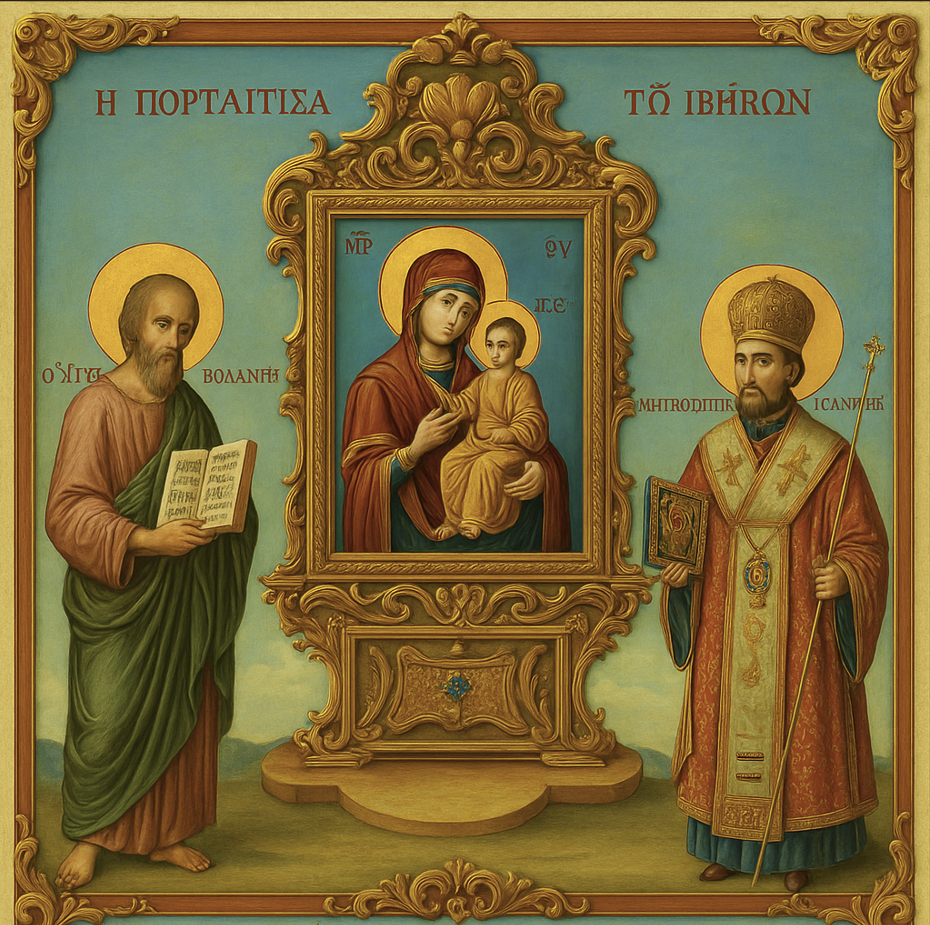
by: Jonathan Photius, N.E.O.-historicism Research Project
Abstract
This article demonstrates that Metropolitan John of Myra (fl. 1791) stands as a crucial figure in the development of Eastern Orthodox apocalyptic interpretation. Far from being a derivative of Protestant historicism, John’s commentary reveals a deeply rooted indigenous Orthodox historicist tradition grounded in Athonite hesychasm, conciliar dogma, mystical symbolism, and ascetical theology. His work forms the theological foundation for later chronological systems developed by Lavriotis, Pantazēs, Makrakis and Sotiropoulos. Metropolitan John thus bridges the gap between Byzantine patristic commentary and modern Greek historicism, offering a hermeneutic that is symbolic, ecclesial, doctrinal, and spiritually ascetical rather than literalist or rationalist. Recovering John’s method is essential for any reconstruction of an authentically Orthodox eschatology.

I. Introduction: A Neglected Theologian of the Apocalypse
Metropolitan John of Myra, whose commentary on the Apocalypse was completed in 1791, is often overshadowed by earlier Byzantine exegetes such as Andrew and Arethas of Caesarea and by later Greek historicists such as Makrakis or 20th-century Greek futurist commentaries like Fr. Mitilinaios. Modern scholarship has tended to treat Orthodox historicism as a late or foreign import, frequently assuming that Orthodox interpreters borrowed from Protestant or Catholic sources.¹
A reassessment of John of Myra’s work, especially as presented in Agyriou’s Les Exégèses Grecques de l’Apocalypse, reveals that this assumption is historically inaccurate.²
John of Myra stands at the heart of a distinctly Eastern Orthodox apocalyptic tradition that integrates symbolic, mystical, ecclesiological, and historical readings into a coherent theological vision.
II. The Hesychastic Background: Metropolitan John and the Collyvades
John of Myra should be understood within the context of the Kollyvades movement, the Athonite spiritual revival that produced the Philokalia.³ His commentary is a direct expression of:
- the hesychastic focus on purity of heart,
- the ascetical disciplines of prayer and fasting,
- a return to patristic sources,
- a distrust of rationalistic speculation,
- and the belief that divine illumination is essential to interpreting Scripture.
This is key to understanding: Greek Orthodox historicism was not the product of the Enlightenment, but of Hesychasm.
The Collyvade influence explains:
- John’s constant use of symbolic, ascetical, and mystical categories,
- his disinterest in political chronology as an end in itself,
- his emphasis on spiritual meaning over literal sequence,
- his integration of angelology, numerology, and conciliar theology into eschatology.
In this sense, John of Myra is the Athonite counterpart to Andrew of Caesarea: a spiritual rather than a chronological exegete.
This background is crucial. It demonstrates that Orthodox historicism is not rationalist, politically driven, nor Protestant-derived, but an organic outgrowth of Athonite spirituality. John’s exegesis reflects a worldview in which apocalyptic symbolism is interpreted within the wider spiritual and sacramental cosmos of Orthodoxy.
III. John’s Hermeneutical Method: A Multi-Layered Vision
John employs a hermeneutic that synthesizes five major interpretive layers:
1. Mystical Theology
Revelation is fundamentally a vision of Christ’s divine glory.
2. Ecclesiology
Symbols such as the Woman, the Bride, the Lampstands, and New Jerusalem represent the Orthodox Church across the ages.
3. Dogmatic History
John interprets certain symbols through the Seven Ecumenical Councils—a hallmark of Orthodox hermeneutics absent from Western models.
4. Ascetical Anthropology
The Apocalypse is read through the lens of virtues, passions, angelic warfare, and the path of deification (theosis).
5. Historical Reality
Islam and the Papacy are identified as the two beasts of Revelation 13, not merely in a political sense but as spiritual distortions of divine truth.
This multi-layered method is the hallmark of Orthodox exegesis and demonstrates that historicism in the East was never merely chronological but profoundly theological.
6. KEY APOCALYPTIC SYMBOLS IN John OF MYRA
John of Myra repeatedly interprets major septenary structures in Revelation as referring—explicitly or implicitly—to the Seven Ecumenical Councils, their dogmatic struggles, and their triumph over heresy. For example, the Seven Thunders (Revelation 10:3–4) represent the authoritative dogmatic proclamations of the Seven Ecumenical Councils.
- Thunder = divine voice (cf. Sinai, Psalm imagery)
- Councils speak with divine authority, not private opinion
- The thunders are sealed, just as conciliar dogma is not endlessly reinterpreted
The Apocalypse does not record the content of the thunders because the Church has already received them through the Councils.
Summary Table — Decoding Revelation’s Symbols & Conciliar Meaning
| Apocalyptic Symbol | Meaning in John of Myra |
|---|---|
| Seven Thunders | Seven Ecumenical Councils |
| Seven Lampstands | Church preserving conciliar light |
| Seven Stars | Conciliar fathers / bishops |
| Seven Churches | Epochs culminating in councils |
| Seven Seals | Doctrinal trials |
| Seven Trumpets | Conciliar warnings |
| Seven Bowls | Judgments after dogmatic rejection |
| Woman Clothed with Sun | Orthodox Church |
| Dragon | Heresy inspired by Satan |
| Two Beasts | Islam & Papacy |
| Babylon | Doctrinal confusion |
| New Jerusalem | Conciliar Orthodoxy perfected |
IV. Islam and the Papacy in John’s Apocalyptic Vision
John follows the established post-Byzantine tradition in identifying:
- Islam with the Beast from the Sea,
- Papacy with the Beast from the Earth / False Prophet,
- Both as precursors to the final Antichrist.
This interpretation is not political polemic but a symbolic-theological reading:
- Islam represents external coercive power.
- The Papacy represents internal doctrinal corruption.
Together they form the two “horns” of Antichristic authority.
John integrates these identifications into a larger metaphysical conflict, interpreting them through spiritual categories rather than through the political determinism common in Western historicism.
V. John’s Relationship to Chronology: A Spiritual Foundation for Later Systems
John of Myra is not a strict chronologist, though he accepts the day-year principle for certain prophecies (e.g., the 1260 years of Islamic domination). His primary contribution is not numerical but structural: he provides the theological architecture that later chronological interpreters—especially Makrakis—would build upon.
John thus stands as the spiritual architect of Orthodox historicism, while Makrakis becomes its systematic architect.
VI. Eastern vs. Western Historicism: A Necessary Distinction
John’s method contrasts sharply with Western Protestant historicism:
| Protestant Historicism | Eastern Orthodox Historicism |
|---|---|
| Primarily political and literalist | Primarily mystical and theological |
| Anti-papal polemic | Symbolic conflict between truth and heresy |
| Rationalist and chronological | Ascetical, symbolic, sacramental |
| Ecclesiology of invisible church | Concrete ecclesiology of Orthodoxy |
| Salvation as justification | Salvation as deification (theosis) |
Theological Foundation
| Protestant Historicism | Eastern Orthodox Historicism |
|---|---|
| Based on literalism, anti-papal polemics, and a forensic, juridical theology. | Based on mysticism, sacramental cosmology, ascetic anthropology, and conciliar dogma. |
| Emphasizes external history and political events. | Emphasizes internal transformation, dogmatic theology, and ecclesial identity. |
| Scripture interpreted primarily through philological and historical methods. | Scripture interpreted through ascetical purity, the Fathers, liturgy, and spiritual illumination. |
Purpose of Interpretation
| Protestant Aim | Orthodox Aim (John of Myra) |
|---|---|
| Determine prophetic chronology, identify papal corruption, prepare for political or societal reform. | Illuminate the divine economy, assist the faithful in spiritual warfare, uphold Orthodox dogma, promote deification. |
John’s method shows that Orthodox historicism is deeply rooted in spiritual anthropology and sacramental ontology—not in Protestant or Enlightenment categories.
Methodological Differences
John’s interpretation incorporates:
- symbolic theology
- angelology
- color and number symbolism
- conciliar history
- typology
- anthropology of the passions and virtues
- ascetical discernment (diakrisis)
- sacramental metaphysics
None of this is present in Western historicism.
In the West, historicism became a tool of:
- anti-Catholic polemic,
- political critique of Rome,
- Protestant ecclesiology,
- emerging national identities.
In John’s commentary, the interpretive engine is entirely different:
- Mystical theology
- Patristic continuity
- Conciliar orthodoxy
- Hesychastic spirituality
Islam and the Papacy are not simply political enemies—they are spiritual and doctrinal distortions, theologically configured opponents of divine truth.
This alone shows the profound difference between the two traditions.
VII. Implications for Modern Orthodox Eschatology
Metropolitan John’s commentary suggests several important theological principles for contemporary Orthodox scholars:
- Orthodox eschatology is inherently symbolic and sacramental.
- The Apocalypse must be interpreted within the life of the Church, not outside it.
- Dogmatic history is integral to prophetic fulfillment.
- Spiritual purification is essential for interpretation (a hesychastic principle).
- Eschatology cannot be divorced from ecclesiology, Christology, or anthropology.
John of Myra provides a template for a fully integrated Orthodox eschatology—precisely what the Neo-Historicism project aims to reconstruct.
VIII. Conclusion: Jean of Myra as a Foundational Witness
John’s contribution to Orthodox eschatology lies not in chronological precision but in establishing the theological, spiritual, and symbolic framework within which Orthodox historicism developed. He demonstrates that:
- Orthodox historicism is indigenous, not Protestant;
- It is mystical, not literalist;
- It is ascetical and ecclesial, not secular;
- It integrates theology and history as dimensions of divine economy.
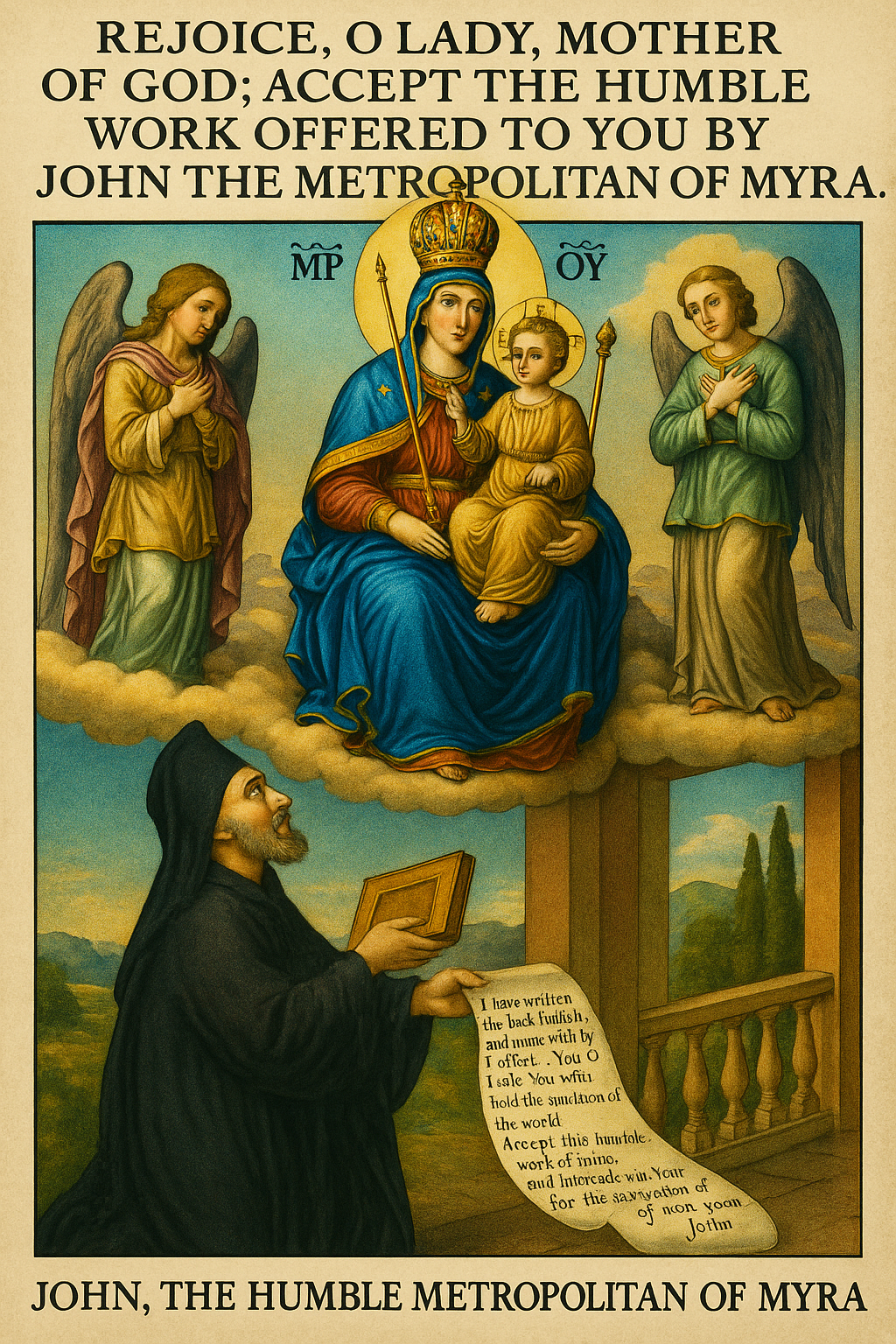
Our conclusion is that John of Myra is the missing link between Byzantine commentators (Andrew, Arethas) and the modern Greek interpreters (Theodoret, Lavriotis, Pantazēs, Makrakis, Sotiropoulos). His work is essential for restoring the Orthodox apocalyptic tradition and grounding Neo-Historicism in its authentic roots.
Footnotes
¹ For example, modern critics in certain Orthodox jurisdictions often claim that the historicist method is inherently Protestant.
² Agyriou, Les Exégèses Grecques, 399–442.
³ Ibid., 428–431.
Bibliography
- Agyriou, A.-A. Les Exégèses Grecques de l’Apocalypse à l’Époque Turque (1453–1821).
- Makrakis, Apostolos. Interpretation of the Revelation of St. John the Divine.
- Gordios, Anastasios. Interpretation of the Apocalypse.
- Koressios, Georgios. Apocalyptic Commentaries.
- Angelos, Christophoros. Prophetic Writings.
- Sotiropoulos, Neilos. On the Apocalypse.
- Andrew of Caesarea. Commentary on the Apocalypse.
- Arethas of Caesarea. Commentary on Revelation.
 NEO-Historicism - End Times Eschatology From An Eastern Orthodox Christian Historicist Perspective