
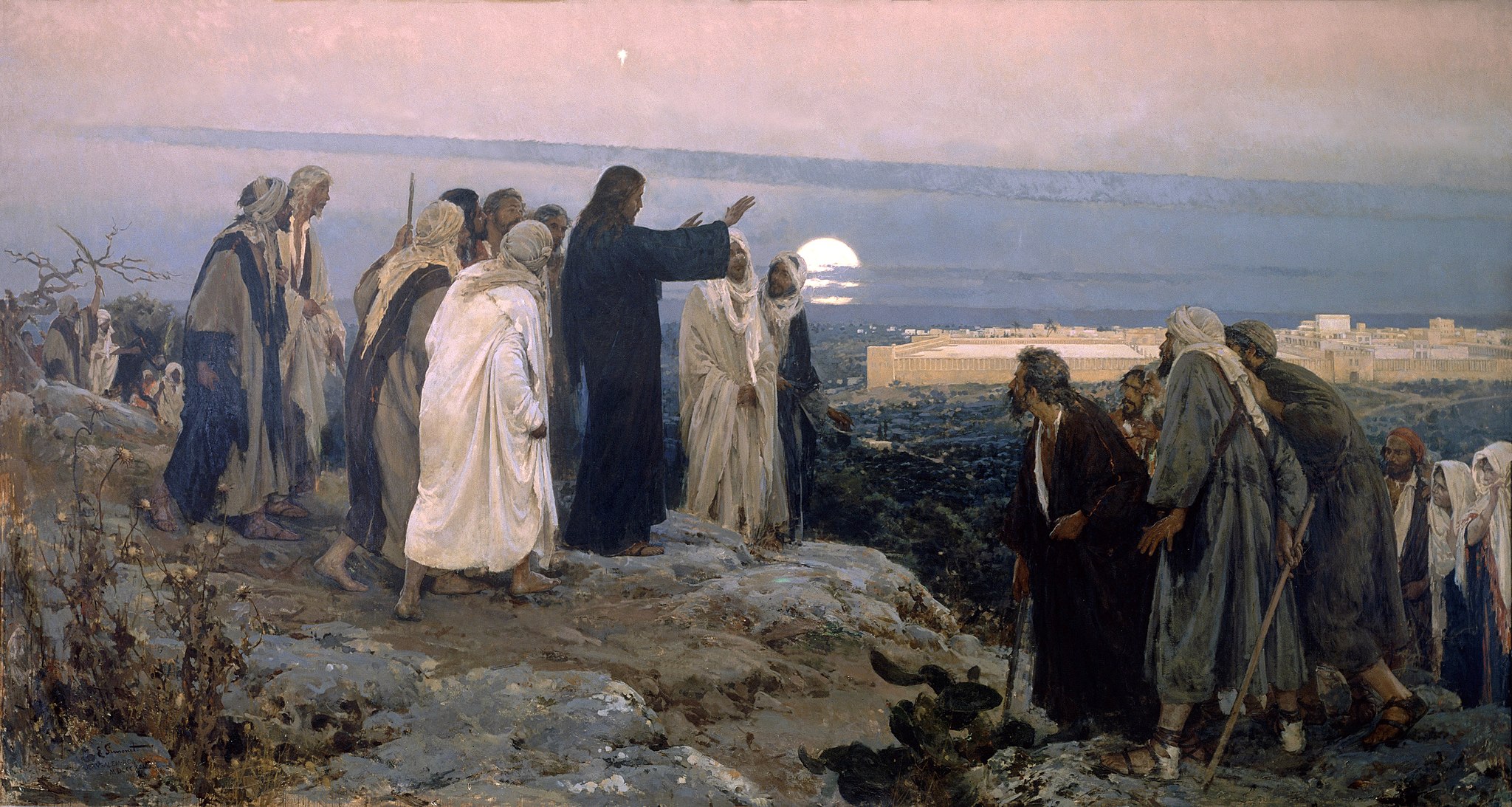
1. The Olivet Discourse as the “Little Apocalypse”
The Olivet Discourse—recorded in Matthew 24, Mark 13, and Luke 21—has long been recognized as a “Little Apocalypse,” presenting in compressed form a prophetic outline of sacred history extending from the desolation of Jerusalem to the completion of the age. It is neither confined to the destruction of the Temple in A.D. 70 nor reducible to a future-only tribulation scenario, but rather functions as a Christological prophecy of the entire Church age.¹
This discourse is among the most misunderstood passages in the New Testament. Futurist and dispensational systems employ it to construct the doctrine of a secret rapture, while preterist systems collapse its fulfillment into the first century in order to argue that “all things” were completed by A.D. 70. Yet Christ repeatedly insists that “the end is not yet” and “will not come immediately,” language that decisively resists both readings.² Moreover, the consistent testimony of early Christian writers places the composition of the Apocalypse toward the end of the first century, undermining attempts to force all apocalyptic prophecy into a pre-70 A.D. framework.³
2. Matthew 23 as the Interpretive Key to Matthew 24
The Olivet Discourse follows immediately upon Christ’s final denunciation of Jerusalem in Matthew 23. There Christ declares: “Your house is left to you desolate… for you shall see Me no more till you say, ‘Blessed is He who comes in the name of the Lord.’”⁴ This statement introduces a conditional future restoration: Christ’s return to Jerusalem in covenantal recognition is contingent upon Israel’s repentance and confession.
The prophets illuminate the shape of this future turning. Zechariah foretells national mourning for the Pierced One, while Daniel 4 presents a typological narrative of chastisement followed by restored “sanity” and praise of the Most High—language that closely parallels Christ’s words in Matthew 23:39.⁵
3. Early Deception, Heresy, and the Apostolic Age
Before addressing the desolation of Jerusalem, Christ warns: “Take heed that no one deceives you.”⁶ Historically, the Church’s earliest centuries were marked by false claimants and Christological distortions—Gnosticism, Marcionism, Manichaeism, and later heresies adjudicated through the Ecumenical Councils. These fulfill the initial phase of false prophets and pseudo-Christs, long before later civilizational upheavals.⁷
4. Wars, Nations, and the Long Unfolding of History
Christ next speaks of “wars and rumors of wars,” insisting that such events do not signal the immediate end.⁸ These are age-long conditions. The prophecy of “nation against nation, kingdom against kingdom” cannot be exhausted in the Jewish revolt of A.D. 70, for Judea was then a Roman province, not a kingdom among kingdoms.
Historically, the emergence of nations and kingdoms in conflict begins most clearly with the Great Migration of Nations from c. 376 A.D., which shattered the Roman world and gave rise to the nations of medieval Europe.⁹ Earthquakes and pestilences include both physical calamities and “moral earthquakes”—revolutions that reorder societies, such as the French and Russian Revolutions.¹⁰
5. “Before All These Things”: The Early Persecutions
Luke provides a crucial chronological marker: “But before all these things…”¹¹ This indicates that prior to later geopolitical upheavals, the Church would first endure intense persecution. From Nero through Diocletian, Christians were imprisoned, tortured, and martyred. These persecutions did not conclude in A.D. 70; they were only beginning.¹²
6. Gospel Proclamation, Councils, and the Completion of Witness
Christ then declares that the Gospel must be preached to all nations before the end comes.¹³ Historically, this corresponds to the period following Constantine: the evangelization of the Roman world, the conversion of barbarian peoples, and the Church’s expansion into Africa and Asia.
This phase aligns with Revelation’s symbolism of completed testimony. The “two witnesses” finish their witness before the beast arises,¹⁴ while the woman gives birth to the “man-child,” a Christological and ecclesial image fulfilled through the Church’s dogmatic witness in the Ecumenical Councils.¹⁵
7. “Let the Reader Understand”: The Abomination of Desolation
At the heart of the discourse stands the interpretive signal: “Let the reader understand.”¹⁶ This deliberate interruption signals that the “abomination of desolation” is easily misunderstood. It is neither exhausted in A.D. 70 nor deferred to a future rebuilt temple.
Drawing on Daniel 9:27, the abomination refers to an idolatrous, anti-Christic worship established in the holy place “in the middle of the week.”¹⁷ Historically, this corresponds to the Islamic conquest of Jerusalem in the seventh century, after which Jerusalem was “trampled by Gentiles until the times of the Gentiles are fulfilled.”¹⁸
8. The Great Tribulation and the 1,260 Years
Christ’s “great tribulation” is described as unparalleled and prolonged.¹⁹ Luke clarifies that it involves captivity among the nations and continues “until the times of the Gentiles are fulfilled.”²⁰ Daniel and Revelation identify this same period as “time, times, and half a time,” forty-two months, or 1,260 days—symbolic years in historicist interpretation.²¹ During this era, captivity, persecution, and martyrdom dominate the Church’s experience.²²
9. The Two Apostasies in the Olivet Discourse
In Matthew 24:24–26, Christ introduces a decisive distinction between false prophets and false Christs, locating their deceptions respectively in the desert and in the inner chambers.²³ This distinction is not rhetorical duplication, but a deliberate prophetic bifurcation identifying two archetypal apostasies unfolding across the Church age.
A false prophet advances a rival revelation external to the Church, while a false Christ substitutes himself for Christ’s headship within the Church’s visible structures. The desert signifies extra-covenantal prophetic religion, while the inner chambers signify concealed ecclesiastical authority.
This Gospel-level distinction anticipates the symbolic duality later revealed in Daniel 7–8 and Revelation 13.²⁴ Within the Eastern Orthodox historicist tradition, these were consistently identified as Islam and the Papacy, each reigning for the prophetic period of 1,260 years.²⁵

Saint Neophytos first identified Mohammed as the False Prophet and second beast of Revelation 13 in the early 1200s. Recent manuscript research by Garrick V. Allen demonstrates that Greek Orthodox monastic manuscripts of the fifteenth and sixteenth centuries explicitly calculated Λατεῖνος and Μαομέτης as 666 by Greek isopsephy, identifying both systems as antichristian powers.²⁶ Christophoros Angelos, Zacharias Gerganos and Anastasios Gordios identified the Papacy and Islam as the 2 beasts. These Orthodox witnesses predate Protestant historicism, establishing Eastern Orthodox priority.
Western witnesses corroborate, this tradition. Nicholas of Lyra associated Mahomet with the Second Beast and the number 666 in his 1329 AD Revelation commentary,²⁷ while Ambrose Phillipps de Lisle confirmed the Greek calculations using Byzantine spellings and stating his sources pointed to others who used Byzantine authors for the calculations.²⁸ Other Protestant historicists such as George Stanley Faber later systematized the same framework for the Papal and Islamic Beasts.²⁹
10. Cosmic Signs and Ecclesial Darkness
After the tribulation, Christ describes the darkening of the sun and moon and the falling of stars.³⁰ These are symbols of ecclesial disorientation: obscured Christology, doctrinal fragmentation, and collapse of visible unity, particularly in the post-Reformation age.³¹
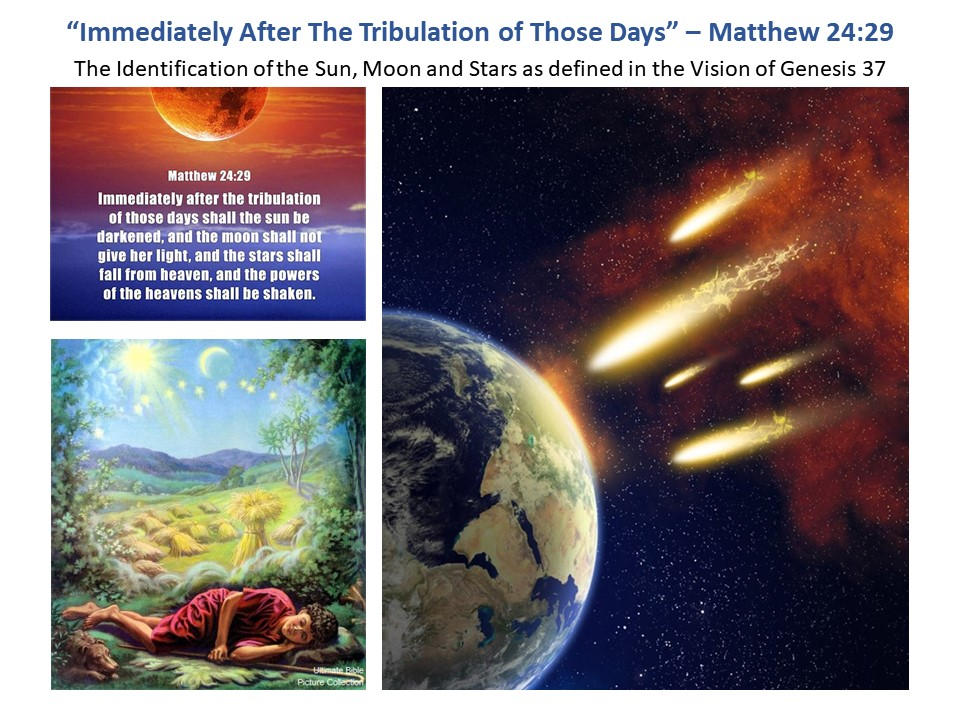
“Immediately After the Tribulation”: Matthew 24:29 and the Eclipse of the Church
After describing the long centuries of persecution, deception, and flight into the wilderness, Christ introduces a decisive chronological marker in the Olivet Discourse:
“Immediately after the tribulation of those days, the sun will be darkened, and the moon will not give her light, and the stars will fall from heaven, and the powers of the heavens will be shaken.” (Matthew 24:29)
The placement of this verse is critical. Christ does not say during the tribulation, but after it. The passage therefore does not describe the persecutions themselves—which have already unfolded through the rise and domination of the two apostate powers—but the next phase in sacred history: a profound apostasy within the Church following a prolonged period of external oppression.
This interpretation is already suggested by earlier historical fulfillments. In the seventh century, Sophronius of Jerusalem identified the Islamic conquest of Jerusalem in A.D. 637 as a secondary fulfillment of the “abomination of desolation.” This event exceeded the Roman destruction of A.D. 70 in its spiritual consequences, inaugurating centuries of Christian subjugation under Islamic rule and prefiguring later catastrophes, including the mass persecutions and genocides of Orthodox Christians in the modern era. These developments reveal the enduring activity of the Little Horn of Daniel, whose power operates not merely through political conquest but through long-term ecclesial and spiritual desolation.
The Symbolic Grammar of Sun, Moon, and Stars
The imagery of Matthew 24:29 is not astronomical but symbolic. Christ draws upon the established biblical grammar found in Joseph’s dream (Genesis 37), where the sun, moon, and stars represent covenantal authority within a family. Read Christologically and ecclesiologically, these symbols signify:
- The Sun: Christ Himself, the “Sun of Righteousness,” the source of divine truth and light
- The Moon: the Church, the Bride of Christ, which reflects—not generates—the light of Christ
- The Stars: the bishops and teachers of the Church, entrusted with apostolic governance and doctrinal guidance
Accordingly, Matthew 24:29 foretells a period in which Christ is no longer clearly known (the Sun darkened), the Church fails to reflect His light faithfully (the Moon gives no light), and ecclesial leadership collapses morally or doctrinally (the Stars fall).
This prophecy finds concrete historical expression in the murder, imprisonment, and silencing of tens of thousands of bishops and clergy under totalitarian regimes, as well as in moral collapse, simony, scandal, and the rejection of apostolic succession within Christianity itself. The Protestant Reformation marks an early and decisive phase of this process, fracturing apostolic authority into innumerable self-governing denominations and obscuring both Sun and Moon through doctrinal disunity. Subsequent Enlightenment and revolutionary movements further “shook the powers of the heavens,” undermining the moral and spiritual authority of the Church itself.
Apostolos Makrakis and the Ethical Interpretation of Matthew 24:29
This ethical–historicist reading is articulated with exceptional clarity by Apostolos Makrakis in his Revelation commentary, who explicitly rejected any literal astronomical interpretation of Matthew 24:29. For Makrakis, the cosmic language refers not to the physical heavens but to the ethical and spiritual order of the Church:
- the darkening of the Sun signifies ignorance of Christ,
- the darkening of the Moon signifies the deadening and laxity of the Church,
- and the falling of the Stars signifies the disintegration of pastors and teachers—from knowledge to ignorance, from holiness to sin, and from righteousness to lawlessness.
Makrakis situates this apostasy within the long 1260-year period described in Daniel and Revelation, during which Satan exercises authority through the two beasts, one dominating the East and the other the West. Only after this period does the next stage of the Olivet Discourse unfold: the appearance of the Sign of the Son of Man, the mourning of the nations, and the gathering of the elect from the four winds, that is, people from throughout the four corners of the world are brought into the church throught a period of unity, spiritural rebirth and unpresented wave of baptisms.
Darkness Before Dawn: the Nearness of the Kingdom
The present age therefore corresponds not to the end itself, but to the deepest point of ethical night—a time in which Christ is obscured, the Church’s witness is dimmed, and truth is relativized. Yet Scripture consistently teaches that night precedes dawn. The eclipse of Sun, Moon, and Stars is temporary.
As lightning flashes from East to West, so the final illumination of the world by the restored apostolic faith will be universal—an expectation echoed in Byzantine prophetic tradition, including the Vision of Agathangelos, which anticipates a future period of illumination, peace, and Orthodox restoration prior to the final consummation.
11. The Sign of the Son of Man and the Seventh Trumpet
The coming of the Son of Man with power and glory remains unfulfilled.³² It corresponds to the sounding of the seventh trumpet, the proclamation of Christ’s kingdom, and the renewed preaching of the Gospel to all nations.³³ Byzantine prophetic tradition likewise speaks of a divine intervention inaugurating a renewed spread of the true apostolic faith.
12. The Fig Tree, the Seven Times, and Israel’s Restoration
Christ therefore immediately directs attention to the parable of the fig tree. Just as winter strips the tree of leaves and fruit, so the Church passes through an ethical winter, appearing barren and lifeless. But when leaves and fruit return, summer is near. Likewise, when the Gospel is again proclaimed in spirit and in truth, when unity and apostolic faith re-emerge, the faithful may know that the Kingdom of God is drawing near.
Thus, the fig tree parable signals the nearness of Kingdom completion.³⁴ This imagery converges with Daniel 4 and Leviticus 26: Israel’s “Seven Times” punishment (2,520 years) followed by restoration.³⁵ Romans 11 provides the theological key: Israel will be grafted back in when unbelief ceases, “until the fullness of the Gentiles comes in.”³⁶

13. “This Generation” as Race, Moral Category, and Prophetic Continuity
“This generation shall not pass away, till all these things be fulfilled” (Matt 24:34) has become one of the central battleground texts between Full-Preterist and Futurist systems. Full Preterists interpret the phrase as a strict chronological limit, insisting that “all these things” were fulfilled within forty years, culminating in A.D. 70. Futurists, by contrast, relocate the phrase to a future end-time cohort, often linking it to a dispensational “gap” in Daniel’s seventy weeks and to modern geopolitical events. Both approaches treat generation as a rigid calendar term and interpret “pass away” merely as the death of individuals.³⁷
A more coherent reading arises when “generation” is recognized as capable of designating (a) a moral or spiritual class, (b) a covenant people or race preserved through history, and when “pass away” is allowed its broader sense of disappear rather than merely “die.”³⁸
13.1 The immediate context: “this generation” in Matthew 23–24
Matthew 24 does not begin in a vacuum: it follows Christ’s condemnation of the scribes and Pharisees, climaxing with the pronouncement, “All these things will come upon this generation” (Matt 23:36), and the declaration that Jerusalem’s house would be left desolate until a future confession of Christ (Matt 23:39). “This generation” is therefore already defined—prior to Matthew 24:34—as the covenantal body resisting Christ’s visitation, what Christ elsewhere calls the “faithless and perverse generation” (Matt 17:17).³⁹
13.2 Chrysostom: “generation” as a spiritual class that endures
Patristic exegesis confirms that γενεά is not restricted to chronology. St. John Chrysostom explicitly interprets “this generation” as the generation of believers—a spiritual class defined by worship and practice rather than by a forty-year time span. For Chrysostom, Christ’s point is that the faithful generation will remain through wars, tumults, false Christs, false prophets, persecutions, and the preaching of the Gospel—none of these trials will extinguish the Church.⁴⁰
13.3 Makrakis: “generation” as the unbelieving Jewish race preserved until restoration
Complementing Chrysostom’s “generation of believers,” Apostolos Makrakis interprets “this generation” as the unbelieving race of the Jews, preserved upon the earth until all prophecies are fulfilled—until, finally, even they confess, “Blessed is He who comes in the name of the Lord.”⁴¹ This preserves the inner logic of Matthew 23:39 and situates Matthew 24:34 within the same covenantal horizon.
13.4 Lexical and contextual support: genea as “race,” with Luke 21:24 as the control
A long stream of earlier commentators—well before modern Preterism and Dispensationalism—argued that γενεά in Matthew 24:34 can mean race or people. Adam Clarke is explicit: “this generation” is “this race,” i.e., the Jews will not cease as a distinct people until the fullness of the Gentiles comes in.⁴²
John P. K. Henshaw (citing Bishop Samuel Horsley) strengthens the point by mapping the semantic range and appealing to Luke 21:24’s “until.”⁴³
13.5 Sirr: “events have made the meaning clear”
Joseph D’Arcy Sirr argues that even if the word were ambiguous, “events have made the meaning clear.” The Jewish nation was destroyed politically, yet the Jewish race remained distinct through centuries of dispersion—confirming Christ’s prophecy.⁴⁴
13.6 Eastern Historicist synthesis
Taken together, the interpretive elements cohere:
- The generation endures
- The race is preserved
- The dispersion continues until completion
- Restoration follows repentance
Luke 21:24, Romans 11, and Daniel 12:7 converge on the same horizon.⁴⁵ The mystery resolves when the unbelieving Israel confesses Christ as a regrafted natural branch.⁴⁶
Footnotes
¹ Matt 24; Mark 13; Luke 21.
² Matt 24:6; Luke 21:9.
³ Irenaeus, Against Heresies V.30; Eusebius, Ecclesiastical History.
⁴ Matt 23:38–39.
⁵ Zech 12:10; Dan 4:34–37.
⁶ Matt 24:4.
⁷ Acts; Ecumenical Councils.
⁸ Matt 24:6.
⁹ Matt 24:7.
¹⁰ Luke 21:11.
¹¹ Luke 21:12.
¹² Early persecutions.
¹³ Matt 24:14.
¹⁴ Rev 11:7.
¹⁵ Rev 12:5.
¹⁶ Matt 24:15.
¹⁷ Dan 9:27.
¹⁸ Luke 21:24.
¹⁹ Matt 24:21–22.
²⁰ Luke 21:24.
²¹ Dan 7:25; Rev 12:6; Rev 13:5.
²² Rev 13:10.
²³ Matt 24:24–26.
²⁴ Dan 7–8; Rev 13.
²⁵ Eastern Orthodox Historicist tradition.
²⁶ Greek Orthodox monastic manuscripts (15th–16th c.).
²⁷ Nicholas of Lyra on Rev 13:18.
²⁸ Ambrose Phillipps de Lisle, Mahometanism in its Relation to Prophecy (1855).
²⁹ George Stanley Faber, A Dissertation on the Prophecies Relative to the Great Period of 1260 Years (1805).
³⁰ Matt 24:29.
³¹ Luke 21:25–26.
³² Matt 24:30–31.
³³ Rev 11:15; Rev 14:6.
³⁴ Matt 24:32–33.
³⁵ Dan 4; Lev 26.
³⁶ Rom 11:17–25.
³⁷ Matt 24:34.
³⁸ Lexical range of γενεά.
³⁹ Matt 23:36; Matt 17:17.
⁴⁰ John Chrysostom, Homilies on Matthew.
⁴¹ Apostolos Makrakis, Interpretation of Matthew.
⁴² Adam Clarke, Commentary on Matt 24:34.
⁴³ J. P. K. Henshaw; Bishop Horsley.
⁴⁴ Joseph D’Arcy Sirr, The First Resurrection Considered.
⁴⁵ Luke 21:24; Rom 11; Dan 12:7.
⁴⁶ Matt 23:39; Matt 24:35.
 NEO-Historicism - End Times Eschatology From An Eastern Orthodox Christian Historicist Perspective