
By: Jonathan Photius – NEO-Historicism Research Project
Introduction: The Apocalypse and the Question of History in Byzantium
The Book of Revelation occupied an uneasy yet indispensable place within Byzantine theology. While universally received as Scripture, it was approached with marked restraint, largely due to fears of chiliastic excess, speculative curiosity, and political misuse. Byzantine exegetes therefore tended to emphasize moral, ecclesial, and sacramental readings, subordinating chronology to theology. Yet this restraint did not imply historical indifference. On the contrary, Revelation was read as a revelation of history rightly understood—a disclosure of how Christ’s lordship unfolds amid persecution, deception, and imperial collapse.¹
It is within this framework that Neophytos the Recluse must be situated. Writing in the traumatic aftermath of the Fourth Crusade (1204), Neophytos produced a commentary on the Apocalypse that simultaneously defends its canonicity, regulates its interpretation, and integrates concrete historical realities—most notably Islam and Latin ecclesial power—into the apocalyptic narrative. His work marks a decisive moment in the maturation of Byzantine apocalyptic historicism.²
Neophytos the Recluse: Life and Work in Cyprus
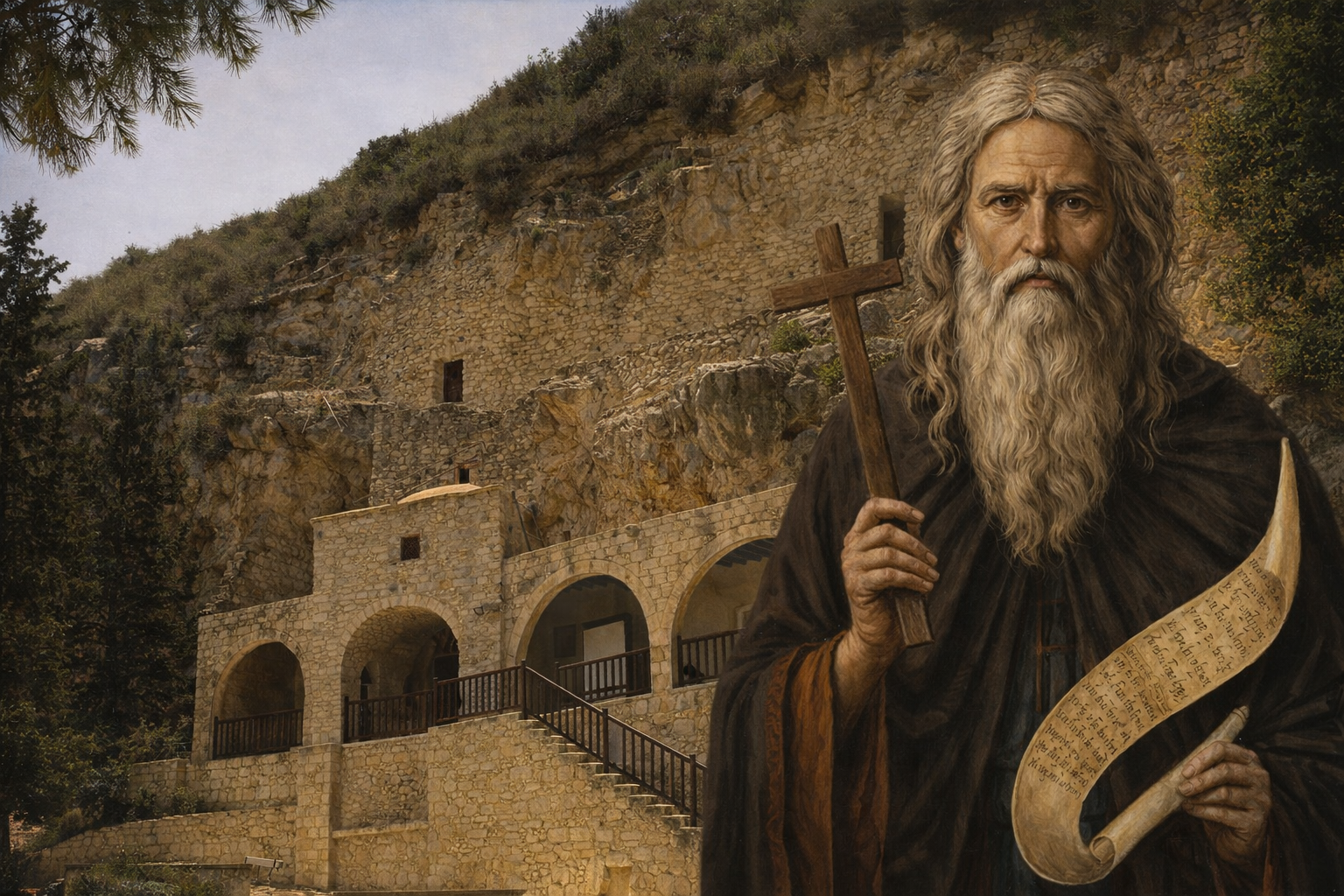
Neophytos the Recluse (c. 1134–after 1214) was a Cypriot monk, ascetic, and theologian whose writings reflect the spiritual and political upheavals of the late Byzantine world. Born in rural Cyprus to a poor farming family, Neophytos entered monastic life at a young age and eventually withdrew into eremitic solitude, carving a hermitage (Enkleistra) into the rock near present-day Paphos. From this secluded cell, he produced a remarkable body of theological, exegetical, and autobiographical works that combine ascetical rigor with acute historical awareness.³
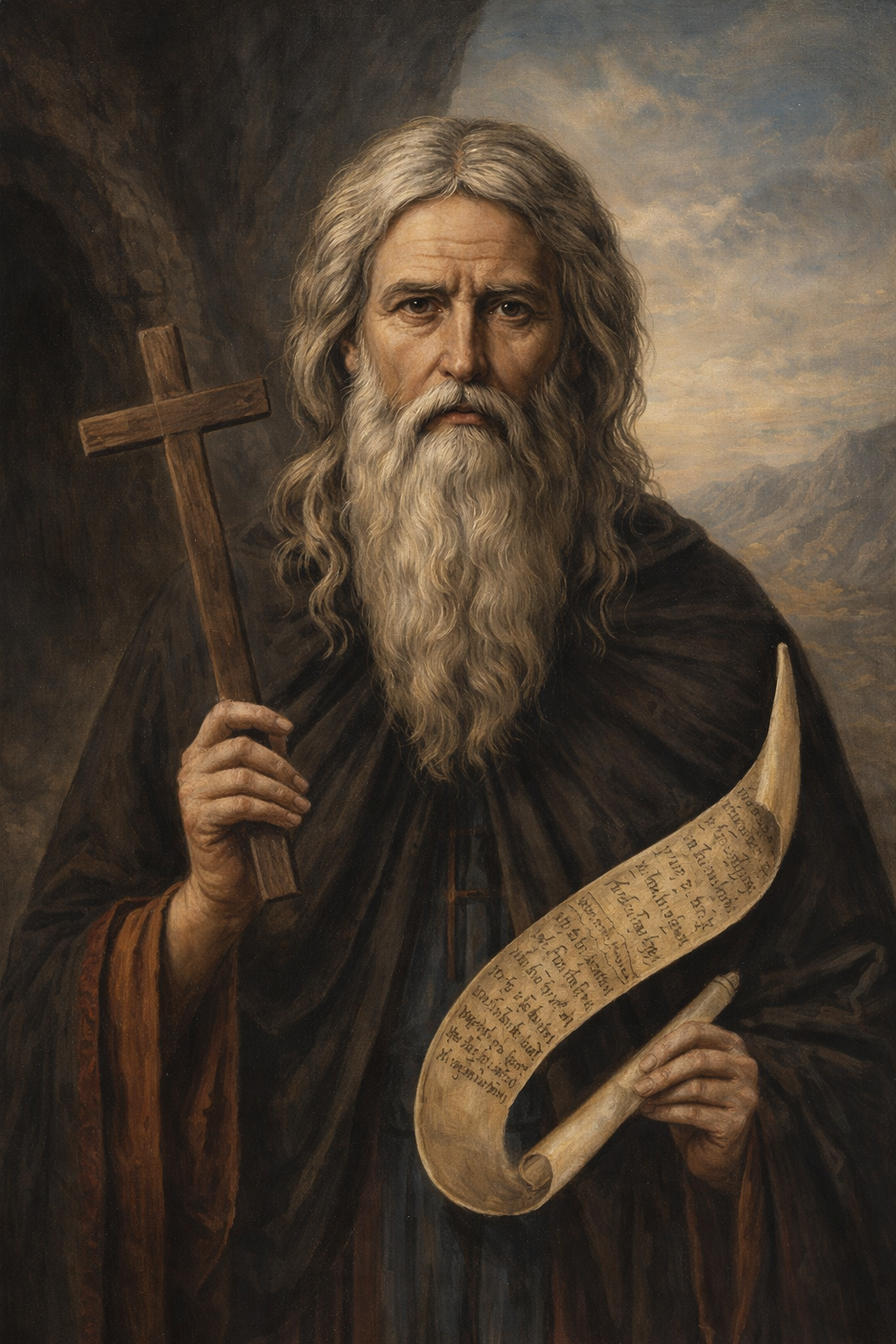
Neophytos lived through the collapse of Byzantine authority on Cyprus, the island’s seizure by Richard the Lionheart in 1191, and its subsequent transfer to Latin (Frankish) rule. These events profoundly shaped his worldview. His writings—especially his lamentations and his Commentary on the Apocalypse—bear witness to a monk deeply attuned to the moral, ecclesial, and historical crises of his time. Far from being an abstract mystic, Neophytos interpreted Scripture as a living commentary on history, reading imperial collapse, Latin domination, and Islamic power through the lens of divine judgment and providence.⁴
Although best known for his Typikon and autobiographical writings, Neophytos’ Commentary on the Apocalypse stands as his most theologically ambitious work. Written after 1204, it represents one of the clearest examples of late Byzantine apocalyptic interpretation shaped by lived catastrophe. Composed in Cyprus—at the crossroads of East and West—this commentary gave voice to an Orthodox eschatological consciousness forged in exile, loss, and fidelity, and it would later resonate with the post-Byzantine Orthodox historicist tradition.⁵
I. Johannine Authority and the Defense of the Apocalypse
Neophytos’ Apology to Those Who Dispute reveals that doubts about the Johannine authorship of Revelation remained active in Byzantine circles well into the twelfth century. These doubts were grounded primarily in stylistic concerns—verbosity and plain diction (πολυλόγον καὶ πεζόλεκτον).⁶ Neophytos rejects such criteria outright. Authorship, he insists, is discerned not through literary elegance but through the height of divine vision (τῆς θεωρίας τὸ ἀνώτατον).⁷
This move is significant. By shifting the question of authorship from philology to theology, Neophytos reinforces an Orthodox principle already visible in earlier patristic reception: Scripture is authenticated within the Church by spiritual discernment and lived fulfillment, not by external aesthetic norms.⁸
II. Pastoral Simplicity and Ecclesial Economy
Neophytos signals that the Apocalypse is chronologically segmented, not merely moral or mystical. In his Prologue he defines fourteen historical divisions of the book. He interprets the seven angels as seven bishops. This is decisive Orthodox ecclesiology, shared by Andrew of Caesarea and later Makrakis. The Apocalypse addresses historical episcopal leadership, not abstract celestial beings. For example, the threat of removing the lampstand is interpreted as expulsion from the Church, not loss of abstract “influence.”
Neophytos further explains Revelation’s rhetorical severity as a function of pastoral necessity. The Apocalypse speaks plainly and repetitively, he argues, because of the spiritual condition of the Churches of Asia, among whom frivolity, ignorance, and impiety prevailed—even among leaders.⁹ This reading aligns closely with Andrew of Caesarea’s insistence that apocalyptic symbolism must be interpreted for moral correction rather than speculative curiosity.¹⁰
Here Neophytos anticipates later Orthodox notions of οἰκονομία in revelation: divine speech adapts itself to human weakness.¹¹ Revelation’s imagery is therefore justified precisely because it addresses a Church in danger of spiritual collapse.
III. Neophytos and Byzantine Historicism: A Clarification
Byzantine historicism differs fundamentally from later Western Protestant models. It does not consist in rigid chronologies or date-setting but in the conviction that Revelation unfolds within concrete ecclesial history.¹² By this definition, Neophytos is unmistakably historicist.
Throughout his commentary he treats Revelation as a sequential narrative, marked by real historical transitions (μετὰ ταῦτα), successive forms of deception, persecution, and judgment.¹³ He thus rejects both preterism and idealism, insisting instead that history itself is the arena of divine judgment—a view deeply rooted in Byzantine apocalyptic consciousness.¹⁴
IV. Mohammed and Islam as Apocalyptic History
1. Mohammed as the False Prophet (Revelation 13)
The most striking historicist feature of Neophytos’ commentary is his explicit identification of Mohammed within the Apocalypse. In Hypothesis Ζ (Revelation 13), he writes:
**Ὁ δὲ ἐκ τῆς γῆς ἀναβὰς θηρίον καὶ λαλῶν ὥσπερ δράκων, ἤτοι ὁ διάβολος, οὗτός ἐστιν ὁ Μαχάμετ, ὁ τοῦ διαβόλου καὶ τοῦ ἀντιχρίστου προφήτης.**¹⁵
This identification places Islam firmly within the historical unfolding of Revelation as a false prophetic system empowered by the dragon, continuing a line of Byzantine anti-Islamic theology while integrating it directly into apocalyptic exegesis.¹⁶
2. Mohammed and Final Judgment (Revelation 19)
Neophytos reiterates this in Hypothesis Ι (Revelation 19):
**Ὁ ἀντίχριστος καὶ ὁ Μοχούμετ, ἀπερίφθησαν εἰς τὴν λίμνην τοῦ πυρός καὶ τοῦ θείου.**¹⁷
Mohammed is thus distinguished from, yet associated with, the Antichrist—confirming Islam as a historical fulfillment rather than the final eschatological event.¹⁸
V. The Number of the Beast and the Symbolism of 666
Neophytos’ handling of Revelation 13:18 preserves the traditional Greek onomastic repertoire:
**Ἐνιανθάς, Τεϊτάν, Λατεῖνος, Βενέδικτος· ἕκαστον τούτων ἀποδίδωσι τὸ ψῆφος τῶν ἑξακοσίων ἑξήκοντα ἕξ.**¹⁹
While drawing on Irenaeus and later Byzantine tradition, Neophytos’ inclusion of Benedict functions typologically, evoking Latin ecclesial authority rather than identifying a particular pope.²⁰ This reflects a restrained Orthodox critique rather than later Protestant polemic.²¹
VI. Post-1204 Trauma and the Maturation of Byzantine Apocalyptic Thought
Writing after the sack of Constantinople, amid Latin occupation and continued Islamic domination, Neophytos interprets Revelation as a theological grammar for lived catastrophe.²² Islam and Latin Christianity are no longer abstract threats but concrete historical realities requiring theological interpretation.
Neophytos thus occupies a transitional position between classical Byzantine restraint and later post-Byzantine historicist chronology, laying theological foundations for figures such as Christophoros Angelos, Anastasios Gordios, and Apostolos Makrakis.²³
Historicism is not a single phenomenon. There are two types of historicisms we can identify throughout history:
- Western, Joachite, system-building historicism
- an Eastern, hesychastic, penitential historicism
1204 AD is the fork in the road of apocalyptic interpretation between Western and Eastern Historicism. Neophytos stands at the origin point of the Eastern branch. Makrakis, Gordios, Lavriotis, and others inherit his side of the fork, not Joachim’s. Neophytos is not a failed Joachim — he is the prototype of a different tradition entirely. Orthodox historicism emerges inside ecclesial time, not outside it.
| Joachim of Fiore | Neophytos of Cyprus |
|---|
| Three ages | One continuous Church |
| Supersession | Continuity |
| Spirit beyond Church | Spirit within Church |
| Speculative system | Penitential reading |
| Revolutionary expectation | Moral judgment |
| Western millenarianism | Orthodox historicism |
Neophytos inaugurates Orthodox historical Apocalypse interpretation without transforming history into a system — a restraint that marks Eastern historicism from its Western counterparts.
Conclusion: Neophytos as a Bridge Figure in Orthodox Historicism
Neophytos the Recluse emerges as a pivotal figure in Orthodox apocalyptic interpretation. He defends the Apocalypse against doubts of authorship, regulates its interpretation through pastoral and ascetical principles, and integrates concrete historical realities—most notably Islam and Latin ecclesial power—into the unfolding narrative of Revelation. Neophytos is not writing a commentary on Revelation; he is producing a historicized re-presentation of Revelation.
His explicit identification of Mohammed as the False Prophet, his preservation of traditional 666 symbolism (including Benedict), and his resistance to speculative chronology together mark the emergence of a distinctly Byzantine historicism method to intepreting the Book of Reveltion after 1204—ecclesial, restrained, and morally charged—revealing history itself as the arena of Christ’s judgment and lordship.
| Period | Apocalypse Interpretation |
|---|---|
| Andrew / Arethas | Symbolic–ecclesial |
| Neophytos (1204) | Symbolic + historical trauma |
| Angelos / Gordios | Chronological historicism |
| Makrakis / Lavriotis | Full historical systems |
The emergence of historical Apocalypse interpretation in the Orthodox East was conditioned not by theological reluctance but by canonical caution and textual scarcity. When the Apocalypse was finally pressed into lived history by the catastrophe of 1204, figures such as Neophytos the Recluse interpreted it historically—not speculatively, but penitentially—thus inaugurating the Orthodox historicist trajectory later developed by Angelos, Gordios, Lindios, Lavriotis and Makrakis.
Footnotes
- Paul J. Alexander, The Byzantine Apocalyptic Tradition (Berkeley: University of California Press, 1985), 1–25.
- Asterios Agryriou, Les Exégèses grecques de l’Apocalypse (Thessaloniki, 1979), 311–345.
- Neophytos the Recluse, Typikon, ed. Englezakis.
- Jonathan Harris, Byzantium and the Crusades (London, 2014), 169–210.
- Agryriou, Les Exégèses, 345–360.
- Neophytos, Commentary on the Apocalypse, Apology.
- Ibid.
- Eusebius, Ecclesiastical History VII.25.
- Neophytos, Commentary, Apology.
- Andrew of Caesarea, Commentary on the Apocalypse, PG 106.
- John Chrysostom, Homilies on Matthew.
- Alexander, Byzantine Apocalyptic Tradition, 89–112.
- Neophytos, Commentary, passim.
- Theophanes the Confessor, Chronographia.
- Neophytos, Commentary, Hypothesis Ζ (Rev. 13).
- John of Damascus, De Haeresibus 101.
- Neophytos, Commentary, Hypothesis Ι (Rev. 19).
- Agryriou, Les Exégèses, 332–337.
- Neophytos, Commentary, Hypothesis Ζ (Rev. 13:18).
- Irenaeus, Adversus Haereses V.30.3.
- Dimitris Pissis, “Byzantine Anti-Latin Apocalyptic Imagery,” Byzantina 28 (2018).
- Harris, Byzantium and the Crusades, 169–210.
- Agryriou, Les Exégèses, 401–425.
Bibliography
Primary Sources
Andrew of Caesarea. Commentary on the Apocalypse. PG 106.
Arethas of Caesarea. Commentary on the Apocalypse. PG 106.
Irenaeus of Lyons. Adversus Haereses.
Neophytos the Recluse. Commentary on the Apocalypse. Ed. Benedict Englezakis.
Theophanes the Confessor. Chronographia.
Secondary Sources
Agryriou, Asterios. Les Exégèses grecques de l’Apocalypse. Thessaloniki, 1979.
Alexander, Paul J. The Byzantine Apocalyptic Tradition. Berkeley, 1985.
Harris, Jonathan. Byzantium and the Crusades. London, 2014.
McGinn, Bernard. Antichrist. New York, 1994.
Pissis, Dimitris. “Byzantine Anti-Latin Apocalyptic Imagery.” Byzantina 28 (2018).
 NEO-Historicism - End Times Eschatology From An Eastern Orthodox Christian Historicist Perspective