
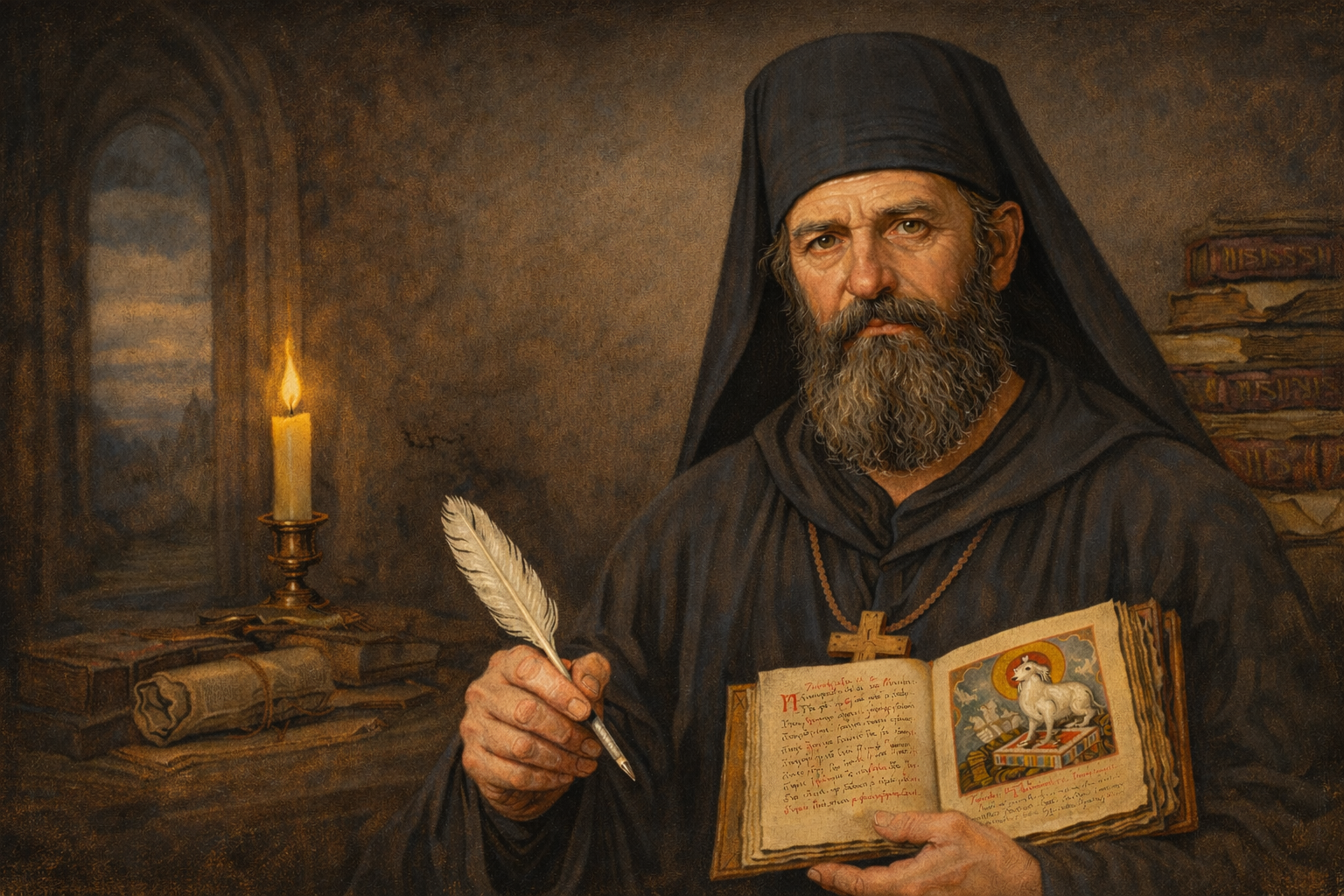
By: Jonathan Photius, The NEO-Historicism Research Project
1. Introduction: A Transitional Figure Reconsidered
Maximos the Peloponnesian occupies a crucial yet understated position in the history of Orthodox interpretation of the Apocalypse. Long treated as a secondary compiler of Andrew of Caesarea and Arethas, he has often been overshadowed both by the authority of the Byzantine tradition he preserved and by the more explicit historicism of later post-Byzantine exegetes. Yet when his life, historical context, and editorial method are considered together—as they can now be through Asterios Argyriou’s Les Exégèses and the biographical documentation preserved in The Elizabeth Day McCormick Apocalypse—Maximos emerges not as a passive transmitter, but as a decisive transitional figure in the evolution of Greek Orthodox Apocalypse exegesis.¹
He did not invent a new interpretive system, nor did he break with Byzantine exegesis. Rather, he reordered, disciplined, and integrated that tradition in a way that subtly but permanently altered how the Apocalypse could be read within Orthodox theology: not only as a mystical and liturgical vision, but as a text capable of bearing historical meaning across time.²
2. Life, Origin, and Clerical Formation
The designation “Maximos the Peloponnesian” situates him immediately within a specific social and ecclesiastical world. Both Argyriou and the McCormick editors note that this geographic epithet indicates origin rather than ecclesiastical office.³ Maximos was born in the Peloponnese, likely in the late sixteenth century, and is never associated with an episcopal see or metropolitan title.⁴ This absence is significant. In post-Byzantine Greek scholarly culture, geographic identifiers were commonly applied to learned clerics whose authority derived from teaching and textual labor, rather than hierarchical rank.⁵
The available evidence consistently points to Maximos as a monk-priest (hieromonk). His mastery of patristic Greek, his liturgical sensitivity, and his confident handling of complex exegetical traditions presuppose formal theological formation within a monastic or clerical environment.⁶ Although the sources do not identify a specific monastery or school, the Peloponnese during this period contained several centers of Orthodox learning closely connected to Constantinople through manuscript circulation and scholarly networks.⁷
He became a monk at a very early age under the name Maximos. He studie in Italy, in Venice and Padua, during the years 1584–1593. From 1598 to 1608, Maximos taught in Alexandria where he fulfilled the duties of archdeacon to Patriarch Pegas (1598–1601), and then, after his ordination to the priesthood (1602), and then under Patriarch Loukaris (1603–1608). From 1611 to 1615, he is found in Ioannina, where he carried out the functions of teacher and preacher and where he experienced Turkish imprisonment (1611). In 1621 he was in Jerusalem. And he traveled back to Greece where he died around the year 1630.
Unlike some contemporaries—such as Georgios Koressios or Zacharias Gerganos—there is no evidence that Maximos studied in Western universities or engaged deeply with Latin scholasticism. His exegetical vocabulary, theological instincts, and method remain thoroughly Byzantine and Orthodox.⁸
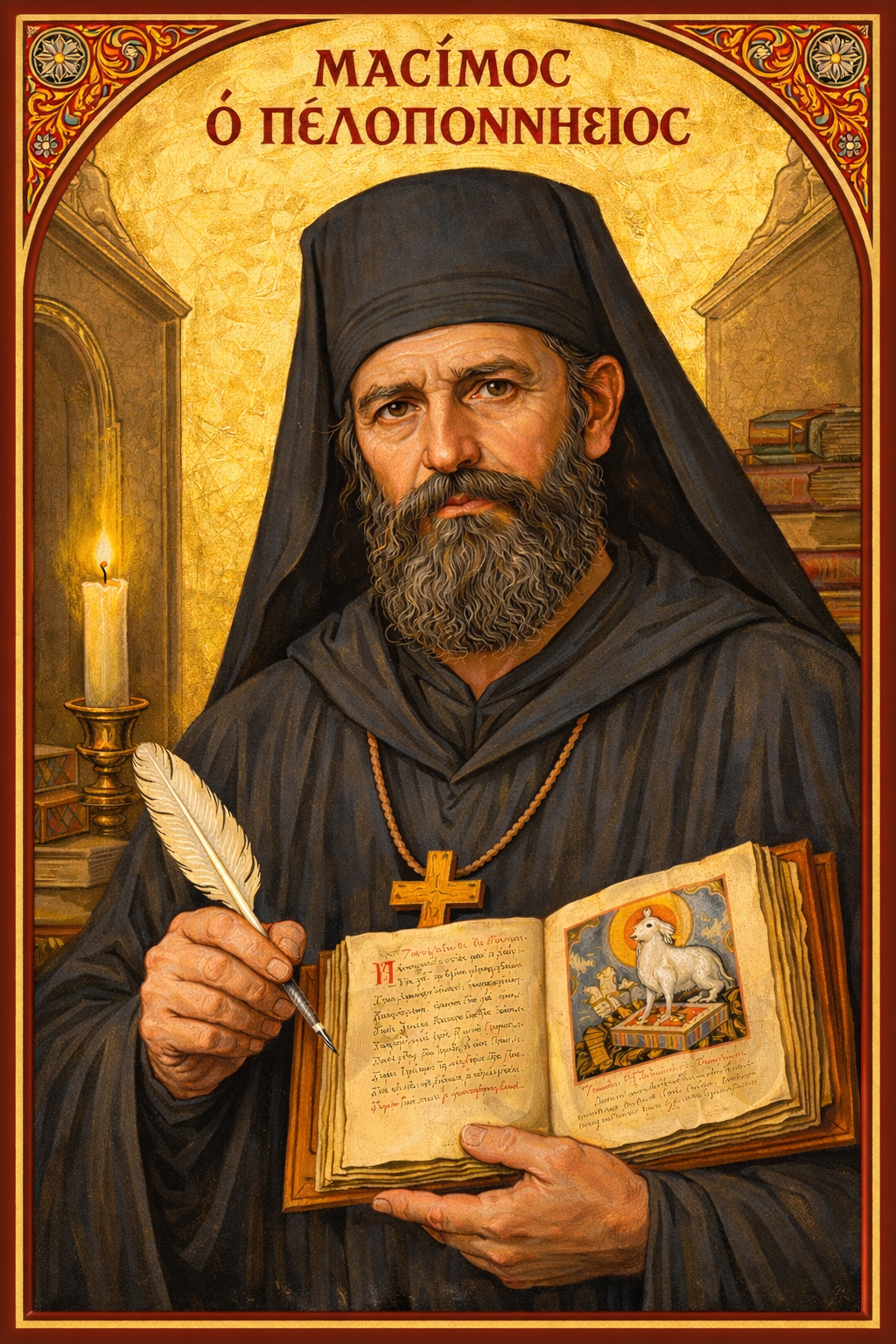
3. Place of Activity and Teaching Role
Neither Les Exégèses nor the McCormick volumes assign Maximos to a single fixed location of activity. Instead, the evidence suggests participation in broader Greek scholarly networks, rather than residence within a single institutional center.⁹ His access to multiple manuscript traditions of Andrew and Arethas implies either travel or sustained correspondence, both of which were characteristic of learned clerics under Ottoman rule.¹⁰
Although no formal teaching appointment is recorded, the Apocalypse commentary itself reveals Maximos’s role as a teacher through texts. The work is carefully structured, pedagogical in tone, and clearly intended for educated clerical readers. As Argyriou observes, such commentaries functioned as instructional tools within monastic and clerical settings, forming readers not only in doctrine but also in interpretive method.¹¹ Maximos thus belongs to a recognizable post-Byzantine type: the exegete-teacher whose classroom was the manuscript.
4. Date of Composition and Historical Setting
The Apocalypse commentary associated with Maximos can be dated with reasonable confidence to the first half of the seventeenth century, most plausibly around c. 1620.¹² This dating, accepted by Argyriou, aligns with paleographical observations and with the broader historical horizon presupposed by the commentary itself.¹³
This period was marked by the consolidation of Ottoman domination over Greek lands, intensified Latin–Orthodox confessional pressure in the post-Tridentine era, and a growing eschatological sensitivity among Orthodox intellectuals seeking to interpret prolonged suffering and historical delay.¹⁴ Within this context, the Apocalypse increasingly functioned not merely as a mystical vision of heavenly realities, but as a text capable of interpreting the Church’s historical endurance.
5. The Commentary as Integrated Synthesis: Andrew, Arethas, and Maximos
Maximos’s most distinctive contribution lies in how he composed his commentary. As Argyriou demonstrates, the work is neither a simple transcription nor an eclectic anthology, but a carefully integrated synthesis of multiple exegetical layers.¹⁵
Andrew of Caesarea provides the structural foundation. Maximos preserves Andrew’s chapter divisions, symbolic interpretations, and theological orientation, ensuring continuity with the authoritative Byzantine tradition and safeguarding doctrinal legitimacy.¹⁶
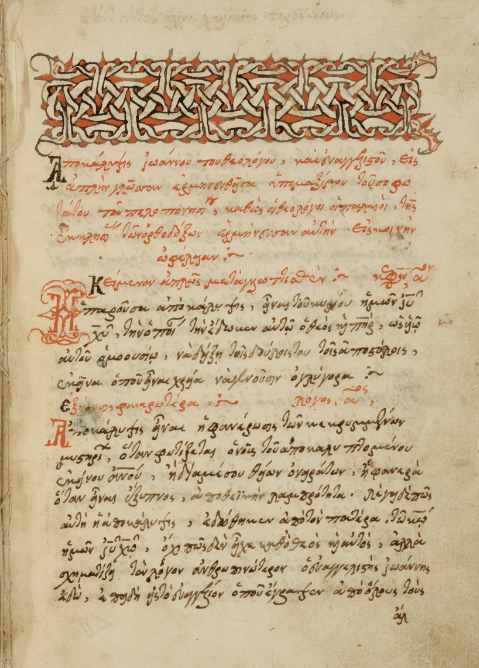
Within this framework, Maximos selectively incorporates material from Arethas of Caesarea. These additions expand moral exhortation, ecclesiological reflection, and polemical awareness. However, Maximos consistently condenses Arethas, omitting rhetorical digressions and retaining those elements that sharpen the historical and ecclesial dimension of the Apocalypse.¹⁷
Maximos’s own contribution appears primarily through editorial judgment rather than overt speculation. His voice is discernible in transitions, emphases, and subtle interpretive cues—especially where attention is drawn to themes of duration, sequence, persecution, false authority, and endurance.¹⁸
6. Methodological Significance: From Symbolic Vision to Historical Process
Earlier Byzantine commentators overwhelmingly approached Revelation through symbolic, moral, and liturgical lenses. Maximos retains these dimensions, but he reorders their priority. Allegory is restrained, while historical process is brought into clearer view.¹⁹
Although Maximos does not construct a fully developed historicist system, he establishes the methodological conditions necessary for such a development. Revelation becomes a book that can be read diachronically—as an account of the Church’s life unfolding through time under divine providence.²⁰
7. Maximos and the Emergence of Greek orthodox Historicism
For this reason, Maximos should be regarded as the initiator of Greek historicism, not in its mature or systematic form, but at the level of method and orientation. Argyriou explicitly notes that later post-Byzantine exegetes did not abandon the framework stabilized by Maximos, but extended it historically.²¹
Figures such as Christophoros Angelos, Anastasios Gordios, John Lindios, and eventually Apostolos Makrakis move from implicit historical awareness to explicit historical identification. Yet their work presupposes the editorial synthesis achieved by Maximos.²² Greek historicism thus emerges not as a rupture with Byzantine tradition, but as its organic continuation.
8. Legacy and Conclusion
The biographical restraint of the sources—no autobiography, no public controversy, no episcopal office—helps explain both Maximos’s later obscurity and his enduring influence. He was not a visionary prophet or polemicist, but a custodian who reordered tradition.²³
Maximos the Peloponnesian stands at the moment when Revelation, without ceasing to be mystical, becomes unmistakably historical. His life as a monk-priest, teacher, and editor shaped a commentary that quietly redirected Orthodox Apocalypse interpretation for centuries to come.
Greek historicism begins here—not with bold speculation, but with careful integration.
Footnotes
- Our knowledge of Maximos the Peloponnesian derives primarily from the editorial and historical work published in The Elizabeth Day McCormick Apocalypse, Vol. II: History and Text, ed. Ernest C. Colwell and Juliette Renaud (Chicago: University of Chicago Press, 1933), which contextualizes MS 931 within seventeenth-century Greek scholarship. This documentation is supplemented and interpreted by Asterios Argyriou’s synthetic analysis in Les Exégèses grecques de l’Apocalypse (XVe–XVIIIe siècles) (Paris: Éditions du CNRS, 1982). References to the manuscript itself (University of Chicago Library, Goodspeed Manuscript Collection, MS 931) are cited separately where direct manuscript evidence is intended.
- Argyriou, Les Exégèses, esp. methodological conclusions on post-Byzantine exegesis.
- Argyriou, Les Exégèses, biographical remarks on Maximos.
- Colwell and Renaud, McCormick Apocalypse, Vol. II.
- Argyriou, Les Exégèses.
- Colwell and Renaud, McCormick Apocalypse, Vol. II.
- Argyriou, Les Exégèses.
- Ibid.
- Ibid.
- Ibid.
- Ibid.
- Argyriou, Les Exégèses.
- Ibid.
- Ibid.
- Ibid.
- Ibid.
- Ibid.
- Ibid.
- Ibid.
- Ibid.
- Ibid.
- Ibid.
- Colwell and Renaud, McCormick Apocalypse, Vol. II.
Bibliography
Argyriou, Asterios. Les Exégèses grecques de l’Apocalypse (XVe–XVIIIe siècles): Esquisse d’une histoire de l’exégèse byzantine et post-byzantine. Paris: Éditions du CNRS, 1982.
Colwell, Ernest C., and Juliette Renaud, eds. The Elizabeth Day McCormick Apocalypse. Vol. II: History and Text. Chicago: University of Chicago Press, 1933.
University of Chicago Library. Goodspeed Manuscript Collection. MS 931. New Testament. Revelation (Elizabeth Day McCormick Apocalypse). Greg.-Aland 2402. Northern Greece or Balkan Peninsula?, 17th century.
Willoughby, Harold R. The Elizabeth Day McCormick Apocalypse. Vol. I: A Greek Corpus of Revelation Iconography. Chicago: University of Chicago Press, 1932.
Maximums the Peloponnesian Commentary on Revelation, Mount Athos, in the Monastery of St. Panteleimon, Codex no. 556
 NEO-Historicism - End Times Eschatology From An Eastern Orthodox Christian Historicist Perspective