

In this article we examine another Greek Orthodox “Historicist” commentator on St. John’s Apocalypse written during the Post-Byzantine Exegetical Movement by the Metropolitan John (Iōannēs) Lindios of Myra. Examining some of the key elements of this interpretation, I find it fascinating that some of the ideas proposed in this interpretation would go on to influence later Greek Orthodox historicist commentaries which looked to historical fulfillments found in many of the chapters. Metropolitan John’s analysis and predictions of some of the time statements (such as the period of “1260 days”) would be published earlier than the Western Protestant Historicist commentaries written a century later, which would further provide evidence that the Historicist approach with its application to the Papacy and Islam predated Western commentaries.
Biography and Early Life
Metropolitan John’s surname “Lindios” by which he is known points to his declaration of origin. He was born in Lindos, a small town on the island of Rhodes. His education allowed him to work as a teacher. He was also better known as an “apostolic preacher of the Great Church” according to one source. We do not have any further information about the place and the duration of his studies which enabled him to acquire a solid religious formation. Before going to Smyrna, Jean Lindios had preached in Chios and perhaps also in Rhodes. A. Agriyiou provides the following account in Les Exegesis: “In Smyrna, where he lived from 1783 to 1785, our author was able to count on the esteem of the Metropolitan Procopius as well as on the hospitality of the notables of the city who helped him materially with the drafting and the publication. of his works. Having become patriarch of Constantinople in 1785, Procope took his protege with him and the following year (1786) restored the ancient metropolis of Myra in his favour, attaching Libysso and Castellorizo to it, purchased by the new metropolitan from Athanasius Comnenus-Hypsilanti, which held them until then as an exarchy. Demanding and undiplomatic, the prelate wanted to put order in the affairs of his diocese, which earned him the disgrace of his most prominent diocesan. Driven out of his metropolis for the first time, he managed to be restored there thanks to the intervention of Procope. But in 1789, the notables of Castellorizo sent to Patriarch Neophyte, the successor of Procopius, a slanderous report against their bishop. Instead of summoning him before the high tribunal of Constantinople and thus allowing him to defend himself, the patriarch decreed in a completely arbitrary fashion the exile of the prelate to the monastery of Iviron (summer 1790). Stripped of all his possessions and in very failing health, John of Myra lived there at least until the spring of 1793, surrounded by the solicitude of the monks of this monastery and enjoying the esteem of the other Athonite monks. A last attempt to return to his metropolis did not bear the expected fruit and John of Myra retired to Wallachia where he ended his days in April 1796 in a convent near Bucharest.”
Metropolitan John of Myra was a strictly religious writer. The collections of his literary work includes not only Sunday homilies, eulogies of saints, biblical and liturgical commentaries, but also translations of homilies or eulogies of ancient authors, letters, small catechism and the confessions of faith. In all his prefaces, dedicatory letters and letters to the reader, Metropolitan John asserts forcefully and on several occasions that his works only aim at the religious, moral and spiritual formation of Orthodox Christians.
It appears based on some evidence that Metropolitan John of Myra may have had close relations with certain leading figures of the Collyvades movement. The religious ideas of this movement perhaps influenced his religious and theological thought. The Exegesis insists much on the purity of the soul, fasting, self-control, spiritual combat, the sacraments of baptism, repentance and the Eucharist which are the favorite themes of collyvade spirituality. Moreover, John of Myra seems to follow the ethno-religious thought of the Collyvades. While the Metropolitan speaks of the imminent liberation of Orthodoxy, he avoids any formulation on the future restoration of the empire of Constantinople, an idea expressed by other Greek authors prior to the Asia Minor catastrophe of 1922, and a theme popularly found in the prophecies of the Byzantine Apocalyptic Tradition.
Ερμηνεία εις την Αποκάλυψιν – Interpretation of the Apocalypse
John Lindios wrote his interpretation in 1791 at the monastery of Iberon. However it was not the first manuscript as he himself confesses that “even eight years ago I preinterpreted the first half of the first chapter.” The reason for attempting another interpretation is due to story he recalls in his opening letter in the Interpretation where says he was reprimanded by the librarian of the monastery of Iberon because he wrote on the pages of a book which he borrowed to read. When he first arrived, he spent the first nine months of his exile there in prayer and reading pious religious works from the library. But one day, he had jotted down some explanatory remarks on a manuscript attributed to Gregory of Nyssa, and the monastery’s librarian was harsh in his response to him marking up the rare work. The Metropolitan was so disturbed over the incident that he locked himself in his monastic cell, and decided to not borrow and read any more books from the library. It was at this moment that he came up with an idea to finish the commentary on the Book of Revelation which he started eight years earlier when he interpreted the first chapter of the book. He worried that such a thought to attempt a full translation was of demonic origin, so then he revealed his yearning desire to analyze and interpret the book of Revelation to his spiritual father, the former Bishop Gregory of Ochride, who gave him his blessing and urged him not to hesitate as he was convinced of the divine origin of his interpretation. Metropolitan John goes on to recall that for “seven whole months I did not give sleep to the eyes” while working on the commentary until he finished his interpretation, worked day and night tirelessly on the Exegesis for seven months.
The work is preserved only in one manuscript – Codex 271 of St. Panteleimon Monastery of Mount Athos, which also contains many of his other works. The manuscript als includes several other writings by the same author. According to Argyriou, John Lindios himself made personal edits and corrections to the surviving manuscript. See: Argyriou, A. Les Exegeses, pp. 397-398. The Interpretation was written in the year 1791, and this data is mentioned at the bottom of the title in Latin Greek and Arabic numerals
Codex 271 of Panteleimon states the following on the manuscript – “The Mother and Holy Interpretation of Revelation of John the Theologian, interpreted by my uncle the words of the humble archbishop of Myron of Lycia, Ioannis Lindios, who was superior under Neophytos in the holy and venerable, Monastery of the Iberians, and dedicated to the superindoxa and Mother of God and queen of all, and above all, the God of all, and to the blessed John the theologian, and received the mystagogy of her supernatural mysteries. Anno MDCCCXCI, in the year of Christ the Savior 1791” (Codex 271 Panteleimonos).
“ὑπερενδόξῳ καὶ ἀειπαρθένῳ Μητρὶ τοῦ Θεοῦ καὶ βασιλίσσῃ τῶν ὅλων Πορταϊτίσσῃ, καὶ τῷ κατ’ ἐξοχὴν πάντων θετῷ υἱῷ αὐτῆς μακ αρίῳ ἐπιστηθίῳ Ἰωάννῃ τῷ θεολόγῳ ἐξ ὧν ἀσμένως καὶ τὴν μυσταγ ωγίαν τῶν ὑπερφυών μυστηρίων τούτης ἐδέξατο. Anno MDCCXCI. Κατά τὸ αωξα ἔτος ἀπὸ Χριστοῦ τὸ σωτήριον. 1791.
On the whole surface of folio 3v of the manuscript, one can admire a very beautiful watercolor, which is an image of the monastery of Iviron; at the top, the icon of the Virgin the Portaitissa and on her left John of Myra dressed in his ceremonial priestly habit and offering his Exegesis to the Virgin.

It is said that this interpretation did not see a wide circulation. It was a product of the “inspiration” of the author. it is not very clear that sources of the ideas were taken from other Orthodox Revelation commentaries, but on certain points and themes, the interpretation and identity of some of the apocalyptic symbols echoed views previously recorded by other Greek authors on Revelation during the earlier days of the Post-Byzantine Exegetical Movement. However they appear to take an emerging new view, but the result of borrowing other ideas presented over time since the fall of Constantinople.
Exegetical Approach and the “Historicist” Method of Interpretation
I will try to highlight a few of the principles of exegesis of Metropolitan John of Myra’s commentary. The Metropolitan’s commentary does not contain an introduction or conclusion, but the text contains various reflections and footnotes repeated many times over on the nature of the text, its biblical derivation, the form and purpose of the composition and methods used in order to understand and decode the text. The Metropolitan says the Apocalypse contains nothing in it that is not already contained within all of the other books of the bible. But the Apocalypse thus contains the incomprehensible mysteries of God, the history of the salvation of humanity and a lofty theology. The depth of the theological teachings in the book is hidden behind material signs and symbols. And all of these symbols can be identified and decoded through other verses in the Old and New Testaments. Each word and each letter can often contain significant theological meanings on God and the Church.
The main purpose of the Apocalypse, according to Metropolitan John, is that it is the revelation to men of the events to occur and happen within the Church from its founding to the Last Judgement. These events are presented to us sometimes as the present, sometimes as already occurring in the the past, and sometimes set to occur in the near future. Saint John the Theologian does not necessarily present these event sin chronological order and can be repeated again from different perspectives or angles. In order to reveal the unfathomable mysteries of God ,the text within the Apocalypse employs various signs, symbols, expressions and visions. Their meaning is intended to remain deep and hidden, where man is incapable of penetrating them by his own means with a literal reading of the text. However, only the Bible is used to guide men on these symbols and signs, and the meanings of these symbols often remain hidden in the biblical texts causing the book to be very difficult to be understood. Metropolitan John offers insight into why this is. All men do not reach the same degree of knowledge and perfection. And the unfathomable mysteries of God should not be known and understood by unclean men. The Metropolitan asserts that human wisdom is of no use for understanding the scriptures in general and the Apocalypse in particular. To understand the Apocalypse, one has to study the Bible with great attention to detail, practical application and purity. He must put himself in a position of humility, prayer and intense spiritual life. Penetration into the mysteries of God requires a pure eye and divine illumination. Nothing can be understood in the Bible without purity of heart and the collaboration of the Holy Spirit.
Metropolitan John of Myra describes the circumstances that let him to write his entire Interpretation to the Book of Revelation. He wanted to preserve the content of his commentary against the attacks of his critics. He states he is ready to renounce anything in his commentary that could turn out to be contrary to the teachings of Christ. But the Metropolitan was surely convinced that his Interpretation is the work of the Holy Spirit who answered his prayers and his fasts as well as his intercessions of St. John the Theologian and the Virgin. Many trustworthy and pious churchmen have testified to his sincerity and to the divine origin of his inspiration. For example, Raphael Kavsocaly quickly recognizes in the metropolitan the wisdom of divine inspiration and the Metropolitan tells us that this was also the opinion of his spiritual father.
The metropolitan tells us that he had stopped borrowing books from the library of the monastery when he began writing his Exegesis. However, we can assume that he must have read certain commentaries prior to that, especially since the idea of commenting on the Book of Revelation had occurred to him in Smyrna eight years earlier in the year 1783. Occasionally we may find similar ideas perhaps influenced from earlier Greek Historicist commentaries of Anastasios Gordios and even more so that of Georges Koressios. As he wrote his commentary, he did not have access to the earlier Greek commentaries by Andrew and Arethas of Caesarea. Metropolitan John does seem to mention the Ecclesiastical History by Meletios of Athens which is cited 5 times in the manuscript. The Ecclesiastical History of Meletios contributed to awakening among the Greeks an interest in historical science persecutions, the heresies that appeared within the early Church, on the history of the seven ecumenical councils, on iconoclasm, on schisms, on Muhammad and the rise of Islam. It appears that the commentary has above all borrowed the main idea fr om Anastasios Gordios interpretation that the Apocalypse is a vision of the Orthodox Church living between the lairs of the two beasts. There are also references and quotes in the commentary to works of St. John Chrysostom, Abba Isaac, the Synaxaire, Denis the Areopagite, St. Basil the Great, St. John of Damascus, and over 150 biblical quotations and 52 verses from the Gospels, and St. Paul’s letters 49 times. And the other biblical texts quoted being Genesis, Exodus, Job, Isaiah, Solomon, Acts and the Epistles of Saint John. But it is most certainly the one source Ecclesiastical History, which is used constantly and directly to provide Metropolitan John of Myra with all the historical elements necessary for his “historicist” interpretation of certain Johannine visions being about the history of the Church. The Exegesis is therefore a personal work not based on the early Latin and Greek commentaries of the Apocalypse, but yet he provides direct quotes by many of the doctors of the Church for theological reflection. But the various theological statements everything is in conformity with the doctrine of the Orthodox Church and it is in vain that his critics would attempt to look for any personal and innovative element whatsoever. But it is obvious that the interpretation of the details, as well as in his global vision of the world where John of Myra follows a completely personal path to decoding symbols instead of restating similar futurist ideas from previous Greek Orthodox commentaries.
The Historicist Content and Allegorical Exegetical Approach
The Book of Revelation contains majestic theology and prophecy concerning events that will occur in the world between the two parousias of Christ. Metropolitan John therefore sets himself to the task, on the one hand, of exposing Christian theology, and on the other hand, of reflecting on the history of the Church. In terms of theology, his contribution resides essentially in a personal and unpublished interpretation of a fairly large number of visions and symbols. With regard to the historical part of the commentary, personal exegesis also occupies an important place. But John Lindios also exposes to us his vision of the history of the world in general and of the Orthodox Church in particular, a vision which, fairly well constructed as a whole, remains confused and hesitant in the description of its various parts.[1]
In terms of exegesis, John of Myra emphatically rejects the literal readying and interpretation of the apocalyptic text. He prefers more the typological and allegorical method. His commentary is above all a historicist interpretation since the Metropolitan identifies in the Apocalypse the description of all of the stages in the history of the church. It is an extensive commentary and at times the author repeats himself tirelessly, offering alternatively new interpretations never seen in earlier Greek commentaries with respect to the decoding of certain symbols. His attitude towards Islam and the Papacy is well understood within the context that the book is the vision of the history of the world and of the church. The commentary is above all a historical exegesis since the author finds in the Book of Revelation the description of all the stages in the history of the Church.
According to the metropolitan, John summarizes at the very start what is to happen to the Church in Rev. 1. “In the first chapter, Saint John gives a summary of the content of the whole Book of Revelation, namely, Trinitarian theology, the creation ex nihilo of the world, the incarnation of Christ, his death on the cross, his burial, his descent into hell, his resurrection. and its ascension, the proclamation of the Gospel by the apostles, the foundation of the Church of the nations and its growth, the persecutions of Christians, the birth of various heresies, the meeting of ecumenical and regional councils, the situation of the Church through the centuries, the appearance and the action of the precursors of the Antichrist, the reign of the latter, the second parousia of Christ, the judgment and the reward of each according to his works, finally, eternal life” (from his commentary – pp. 110-1). From then on, each chapter and each vision of the Book of Revelation will focus on one or another of these great events in the history of the salvation of men in order to develop them. it would appear that Saint John the Theologian had not wanted to proceed with an orderly and progressive description of these events.
This summary of John Lindios presentation of the historical content and aspects of the Apocalypse is given as follows:
Revelation chapters 17 and 18 describe the tyrannical power that the Devil wields over the world as well as the complete destruction of this power at the end of time. Chapter 8 makes known to us the mystery of the economy of salvation from Noah until the second parousia. Chapter 7 refers to the redemptive work of Christ. Chapter 20 relates the most important events which must occur from the resurrection until the end of time. Chapter 8 contains the history of the Church and Chapters 2, 3 and 14 describe the various stages of this history. Chapter 9 reports on the heresies and persecutions that the Church was to know from its foundation until the reign of Constantine the Great and chapter 10 refers to the struggles engaged in by the Church after the reign of this emperor. Chapter 12 relates to the struggles of the Church against the Latins and the Agarenes and Chapter 13 speaks of the Antichrist and of his precursors, the Jews, the Latins and the Agarenes. Chapter 16 describes the battle of the Church against the Antichrist and Chapter 11 the reign of the Antichrist, his destruction and the Last Judgment; chapter 19 recounts the great battle between Christ and the Antichrist. Chapters 4 and 15 refer to the Last Judgment. Finally, chapters 21 and 22 describe the eternal life of the faithful with God.
Now let’s take a look more specifically to some of the highlights of Metropolitan John’s theology and historical content contained within his interpretation:
The Mystery of the Holy Trinity
According to Metropolitan John, Rev. 1:1 – 6 of the Apocalypse reveal the mysteries of the Trinity, the incarnation and the economy of the salvation of the man. Metropolitan John interprets the “the Alpha and the Omega” of Revelation 1:8 as follows. He thinks that these two letters symbolize the unfathomable mystery of the Holy Trinity. The Alpha symbolizes the Father who is without beginning. The Omega symbolizes the Son and the Holy Spirit. Formed by two 0s, the letter 2 tells us about the union of these two persons of the Trinity, equal to each other and originating from Father 2. As for the other 22 letters of the alphabet, included between Alpha and Omega, they symbolize all creatures, visible and invisible, of which the Holy Trinity is the beginning and the end, the principle of creation and conservation. With this last example he then proceeds on the essentially theological content throughout the rest of the commentary.
The Christological Mystery
The Christological analysis is even more extensive in Metropolitan John’s commentary, with the mystery of the incarnation being very closely linked to the redemptive work of Christ. The metropolitan finds in the Apocalypse a very large number of symbols revealing the two natures of Christ. The Revelation of Jesus Christ, is about the revelation of Jesus Christ! Revelation chapter 1 reveal Christ incarnate and always present in the world. Revelation 1:7 reveals the perpetual presence of Christ in the Eucharist, his second parousia, and his eternal presence after the day of Judgment. First risen from the dead, Christ is also the First by his divine nature; being the Last by his human nature, he will also be the last to come after the Antichrist in eschatological times. The Living (Rev 1:18) refers to the eternal and uncreated divinity of Christ, while the expression Living for the centuries refers to his human nature which had a beginning and which, resuscitated, will live eternally. The tree of life (Rev 11:7 and 22:2) is Christ, God made man, the one Christians receive in the Eucharist and whom they will contemplate eternally in a future resurrected life. The hidden manna (Rev 2:17) receives the same interpretation. The expression as a son of man (Rev 1:13) refers to the human nature of Christ and the expression the son of God (Rev 2-18) to his divine nature. In Rev 1:13, the long robe designates the flesh of Christ which envelops his divine nature, while the two breasts symbolize the body and blood of Christ in the Eucharist. In Rev 2:18, the two eyes symbolize the two natures of Christ. The two natures of Christ are also designated in Rev. 1-15 with the brass symbolizing the human nature and the incense the divine nature. We read an analogous interpretation by John of Myra one the crystalline jasper in Rev 21:11, where the jasper symbolizes human nature and the crystal the divine nature of Christ. At this point the Metropolitan proceeds to a brief exposition on the various Christological heresies from Arius to the Filioque via iconoclasm. In Rev. 3-7, the Holy designates Christ made man without sin and the True the incarnate Christ who is God. The key of David symbolizes the Virgin who is of David’s descent, while the phrase she opens and no one will shut refers to the miraculous conception and birth of Christ. The words of this verse seem to be aimed at the Nestorians who refused the Virgin the title of Theotokos. The Virgin Mary is also designated by the sea (Rev 4:6) which is like crystal because of its purity and transparent because of the miraculous conception and birth of Christ. The expression in front of the throne reflects the closeness and intimacy of the Virgin with her Son. The words temple and throne which are often used in the test of the apocalypse almost always receive the same interpretation: symbolize the deified body of Christ, while the words which accompany them symbolize the deified soul of the Christ. The temple and New Jerusalem is the deified body while the City of God the deified soul. In Revelation 3-12 the pillar refers to the partial revelation of the mystery of the incarnation on the day of the first parousia of Christ, while the opening of the Book in Rev 5-3 refers to the complete revelation of this same mystery. the day of the second parousia of Christ. The mystery of the incarnation is further symbolized by the high mountain in Rev 22-1. On it is built the Holy City designating the humanity of Christ in which dwells the plenitude of the divinity and where the treasures of eternal happiness are deposited. The insistence with which John of Myra speaks of the two constituent elements of the human nature of Christ (body soul), deified after his resurrection and his ascension, undoubtedly constitutes the the most interesting element of his Christological doctrine.
The Christology of the Seals and White Horse
Another symbol that lends itself to Christological developments is that of the horse. The whole of Revelation chapter 6 proposed by Met. John refers to the redemptive work of Christ, the full revelation of which will be given to men on the day of the Last Judgment. Thus, the opening of the first seal will reveal the mystery of the incarnation, symbolized by the white horse, the Virgin Mary, and its rider, the incarnate Christ. In the opening of the second seal which will reveal the mystery of the earthly life of Christ and of his preaching, the fiery-red horse (Rev. 6:4) symbolizes the human nature of Christ. In the opening of the third seal which will reveal the mystery of the passion of Christ, the black horse (Rev. 6:5) symbolizes the death on the cross of this same human nature, while the one who rode it was the soul of Christ.
The white horse of Revelation chapter 19:11-16 is the pure and immaculate human nature of Christ, while the Faithful and the True is his divine nature. Horse and rider symbolize in this vision the union without confusion of the two natures of Christ as well as the redemptive power of the incarnation. The two eyes designate the deified soul and body of Christ after the resurrection, the head designating his divinity and the diadems the charisms of the Spirit who dwelt in Christ, God made man. A name is the name of its essence and of its divine nature which have remained incomprehensible to men. As for the mantle, it symbolizes the flesh of Christ who suffered death but who was resurrected and deified, designates the faithful and the expression I will engrave on him signifies the deification of man according to grace. Rev. 4:2 designates the divine nature of Christ seated on the throne, on his human nature. In Rev. 5:2 the throne symbolizes the body and the one who sits is the deified soul of Christ. In Rev 8:3 the throne is the deified body and the golden altar the deified soul of Christ; the expression before the throne denotes the hypostatic union of the soul and body of Christ.
The interpretation by Metropolitan John Lindios of Myra of these two important visions of the Apocalypse (Rev 6:1-8 and Rev. 19:11-16) shows the very close links between the Christological mystery and that of the salvation of men. It is a typological and spiritual exegesis, whereas other authors from the Post-Byzantine Exegetical Tradition gives these two visions a historical interpretation.
The Seven Ecumenical Councils Foretold in the Apocalypse
In his commentary, Metropolitan John is above all interested in the history of the Church in the narrowest sense, that is to say in the history of the Orthodox Church. The bride is the Church that Christ redeemed with his blood shed on the cross. She is represented as a woman to show that she gave birth to a multitude of spiritual children. The Church is also the heavenly Jerusalem built on a high mountain, the mystery of the incarnation. She is enveloped in the glory of God which she transmits to all her members. The town rampart symbolizes the creed of the Church, that is to say all of its dogmas and its moral doctrine, while the town square represents the multitude of the faithful. To measure the city means: to protect and guard the Church so that heretics cannot enter it. We therefore see that in the commentary on this vision Metropolitan John refuses to heretics the right to belong to the Church. In this he is only following the late Orthodox tradition, especially post-Byzantine, according to which there is no Church but the Orthodox Church. Commenting on the phrase John to the Seven Churches of Asia (Revelation 1:4), the author immediately reveals his intentions, his conception of the Church and his attitude towards the Latin Church, the number seven indicates the multitude; the seven Churches of Asia designate the whole of the Eastern Church. St. John excludes the Western Church from his message, because he had foreseen heresy and its innovations. But the Eastern Church is the Orthodox Church of the seven ecumenical councils (Rev 1:4), of the Orthodox patriarchs and emperors (Rev 1:11), the one true church which knew how to formulate, proclaim and defend the dogmas of the Christian faith (Rev 1:12).
The Orthodox Church is always the Church of the seven ecumenical councils, the number seven signifying the fullness of the Orthodox faith. Metropolitan John Lindios of Myra identifies an impressive number of apocalyptic symbols designating the seven ecumenical councils and the many other regional synods: the seven candelabras (Rev 1:12), the seven stars (Rev. 1:16), the seven lamps (Rev 4:5), the seven horns and the seven eyes (Rev. 5:6), the seven trumpets (Rev 8:6), the seven thunders (Rev. 10:3), the seven vials (Rev 16:7). The interpretation of each of these symbols is accompanied by theological explanations in accordance with the context and touching on various aspects of Christian doctrine.
Metropolitan John provides a good summary of the history of the councils and the heresies they had to combat. But he then references the mysterious Seven Thunders of Revelation 10 as the direct prophetic evidence for the coming Seven Ecumenical Councils. For John was to seal up and keep his words secret (Rev 10:4) which means: do NOT reveal the doctrine that the seven councils will be led to formulate in the fight of the Orthodox Church against the various heresies. The voice that spoke (Rev. 1:12) is that of the seven ecumenical councils and the doctors of the Orthodox Church formulating, proclaiming and defending the dogmas of the true faith.
*** Note by Jonathan Photius Wow! This thunderous voice which roared like a lion is an intense link brought to light by the Metropolitan with respect to of Revelation chapter 1’s voice of the seven lampstands to Revelation 10’s voice of the seven thunders and this idea and correlation between these two symbols must be further and explored and analyzed. It is amazing for me to see that Metropolitan John was actually the first-ever (Orthodox) commentator on the Apocalypse to make this connection of the Seven Thunders and Seven Lampstands to represent the Seven Ecumenical Councils proclaiming the “birth” of the two natures of the woman’s “man-child”, that is the divinity and humanity of Christ, i.e. the “revelation OF Jesus Christ”. I am now even more amazed with his work. Some of you might already know that around three years ago I published an article on this topic titled: “The Seven Ecumenical Councils As Foretold in St. John’s Apocalypse” where I quoted from Daniel Sysoev’s recent modern commentary “Explanation of the Apocalypse” where Daniel also identified the mystery of the seven councils with the Seven Thunders of Revelation 10. This same Church of the “seven thunders” is symbolized by the woman (Rev. 12:1), the vine (Rev 14:19), the bride and the heavenly Jerusalem (Rev 21:9-10).
The Seven Churches of Asia and its Stages of History of the Church Foretold
This new historical interpretation of the Letters enabled Metropolitan John to trace the various stages in the history of the Orthodox Church. The application to the history of the Church of the letters to the seven Churches of Asia appears for the first time in a Greek commentary on the Revelation with Metropolitan John’s interpretation. It would be this particular historical interpretation of the letters to the seven Churches of Asia which seems to comprise the most important element over all of the other post-Byzantine commentaries of this latter period under Ottoman rule.
To describe the various stages of the history of the Orthodox Church, of the formulation of its dogmas, of its struggles against tyrants and heretics, of its sufferings leading to the final victory, this seems to be the common thread of the commentary of Metropolitan John. Two passages from the Book of Revelation offer the commentator a complete description of these stages: the text of the letters addressed to the seven Churches of Asia (chaps. 2 and 3) and the vision of the seven angels of the trumpets (chap. 7 to 9).
Addressing the seven Churches of Asia, Saint John wants to reveal to the Eastern Orthodox Church, to the seven ecumenical councils, to the Orthodox patriarchs and emperors what is going to happen in the course of history, step by step. Likewise, when the seven angels prepare to sound the trumpet, they are preparing to reveal the various stages of the history of the Church.
Church of Ephesus
For Metropolitan John, the angel of the Church of Ephesus (Rev 2:1-7 designates the first period of the history of the Church, that of the apostles and their successors until the reign of Constantine the Great. Verse 1.2 refers to the miracles performed by the apostles as well as to the proclamation of the Gospel. As for the wicked, they are the heretics of the apostolic era, while the liars designate the leaders of the Church of Corinth as well as the Judaizers of Jerusalem, Antioch and Galatia. Verse 1.3 refers to the persecutions endured by the apostles and the first Christians. One can even read a brief summary of the Roman persecutions with the names of the ten persecuting emperors designated by the ten days. But after the Constantinian peace, the clergy and the faithful abandoned the life of love and holiness of yesteryear and allowed lust and heresy to enter the interior of the Church. Saint John had addressed to the post-Constantinian Church the warning of verses 2:4-6, a warning that the latter did not want to hear. Addressing the angel of the Church of Ephesus, Saint John had spoken of stars and candelabra, because the Christians of that time, as well as their leaders, were going to behave like veritable luminaries of the Church and the World.
Church of Smyrna
To the angel of the Church of Smyrna. Saint John speaks of the First and the Last, of Christ, God made man, dead and risen. This Church symbolizes the second period of the history of Orthodoxy, that of the Christological quarrels and the age of the ecumenical councils (Rev 2:8). The doctors of this period had to fight painful battles against the heretics and suffer from them exile, insults, dishonor and deprivation of their property. But they were rich, because they possessed the treasures of orthodox doctrine and the love of God. Regarding those who usurp the title of the Jews and who are rather a synagogue of Satan, the commentator makes a brief account of the various heresies from Arius to the Latin heresy, heresies which will exist throughout the period of the history of the Church, throughout the ten days (Rev 2:8-10).
Church of Pergamum
In the letter addressed to the angel of the Church of Pergamum, Saint John speaks of the sharp double-edged sword (II:12) which is the terrible and irrevocable decision of God to destroy and to condemn to eternal hell all tyrants and all the impious. Satan’s throne symbolizes the reign of Julian the Apostate who had wanted to restore paganism and had persecuted the Church. But this emperor was only the prefiguration of Mahomet (Balaam), who appeared during the reign of Heraclius (Balak), just as the doctrine of the Nicolaitans prefigured the Muslim religion. If the throne of Satan designates Julian the Apostate, Satan designates the atheist Mahomet (2:13-15). A little further on (2:24), Satan’s secret designates the Muslim religion and the burden the enslavement of Orthodoxy to the Turks. Verse 2:18 relates to the struggles waged by the defenders of the icons and to their suffering, persecuted as they were by iconoclastic prelates and emperors.
Church of Thyatira
The letter addressed to the angel of the Church of Thyatira therefore relates to the period of iconoclasm. But above all it refers to the separation of the Latin Church designated by Jezebel. The schism began in 714, when the Filioque was added to the Creed; it was consummated under the patriarchate of Photius (867). God gave the Latin Church time to repent. For already more than a thousand years, God has been waiting for her to reconsider her heretical doctrine designated by the prostitutions of Jezebel. She did not do it. That’s why God is going to throw her on a bed; he will destroy all his power. In the meantime, he wanted the Orthodox Church to bear the burden, its enslavement to the Turks, so that it would be protected against the danger which the pernicious doctrines of the Latins represented for it. With regard to the children of Jezebel, Metropolitan John thinks that it is the Lutheran-Calvinist heresy given birth to by the Latin heresy (2:18-29).
Church of Sardis
To show the Latin heretics, designated by the Church of Sardis, that they are deprived of the charisms of the Spirit and of the divine light, Saint John speaks to the angel of this Church of him who possesses the seven spirits of God and the seven stars (Rev. 3:1). For heretics are spiritually dead, their conduct is evil and hypocritical. They must therefore repent and return to the orthodox faith. Otherwise, the rest (Rev. 12:17), the few names (Rev. 3:4), namely the Russian Orthodox, risk being drawn into this same spiritual death (Rev. 3:1-6).
Church of Philadelphia
The Church of Philadelphia is the Eastern Orthodox Church after the schism and the Muslim conquest. She practices holiness, defends the true faith and holds the secret of all Christian dogma. This is why, addressing the angel of this Church, Saint John speaks of the Holy, of the True and of the key of David (Rev. 3:7). Having little power, stripped of its political power and its material wealth, the Orthodox Church knew how to keep the Christian faith and dogmas in their original purity and integrity. God knows the struggles and sufferings of his Church in defense of the Orthodox faith. He therefore entrusted to him the understanding of the Scriptures, the revelation of things to come and the administration of the holy sacraments which constitute the actualization of the mystery of the salvation of men and the gate of heavenly life (Rev. 3:8). At the end of time, God will force those of the Synagogue, all the heretics who call themselves Christians, to come and prostrate themselves before his feet, to recognize his dogmas and to unite with his faith (Rev. 3:9). The end of time is the era of the author. The feet (Rev: 3:9) therefore designate the Orthodox of that time. Since they defended the Christian dogmas, in turn, God will defend them against the test of the Hour (Rev. 3:10), against the sufferings which will befall all the inhabitants of the earth in the time of the Antichrist (Rev. 3:7-13).
Church of Laodicea
The letter addressed to the angel of the Church of Laodicea describes the situation of Christendom at the time of the author. The Orthodox of this time are neither very hot for the love of God, nor very cold for the pleasures of the world; their moral conduct does not conform to the demands of the faith they uphold. Christ therefore blames the inconsistency and hypocrisy of these Orthodox (Rev 3:14-16). He also condemns the attitude of the Latinizers (Rev. 3:17), just as he advises humility to the Latins and to the Lutherans who boast of their science and their power (Rev 3:18). He stands at the door (Rev. 3:20) and calls them to humility, repentance and a return to the true faith. As for the Orthodox, God loves them (Rev. 3:19) because they have preserved the purity of the faith; he chastises them through the intermediary of the Muslims because of their moral conduct and not because of their separation from Rome (3:14-22).
The Precursors of the Antichrist
There are very important visions in the Book of Revelation which, interpreted according to the historicist method and applied to the Orthodox Church (a method and approach which we often call here on this web site “Eastern Historicism” or “Neo-Historicism”) and its history, bring forth very interesting elements which are likely to complete and further clarify the thought of the commentator. This is above all the case for Metropolitan John’s commentary on chapters 12 and 13 of the Book of Revelation applied to the Antichrist and his precursors.
In this case, he identifies the woman clothed with the Sun (Rev. 12:1-2) certainly designates the Virgin Mary who brought Christ into the world. But he also and above all designates the Church which ceaselessly gives birth to saints, martyrs and doctors. The sun is Christ; the moon is the old Law; the twelve stars are the twelve apostles. The Dragon (Rev. 12:3) symbolizes the Devil, the ancient Serpent; he is enormous, because he subjugated all of humanity to his power after the fall of Adam; he is red-hot because of his homicidal cruelty. The seven heads symbolize the multitude of sins by means of which Satan held all mankind under his dominion, while the ten horns signify that after the incarnation of Christ Satan’s power only has hold on the godless, heretics and sinners. The tail (Rev 12:4) denotes the demonic armies of Satan. The third of the stars are the weak among Christians, those whom sin drags into the abyss of hell (earth). The child is the new-born in the faith that the Devil seeks to reach as easy prey, while the male child (XII, 5 p. 409-10) designates the saints, the martyrs and the doctors, all those who, inhabited by the Holy Spirit (the throne), are able to fight the Devil and overcome him.
The Application of the 1260 “Days/Years” to the Roman (Lateinos) Apostacy
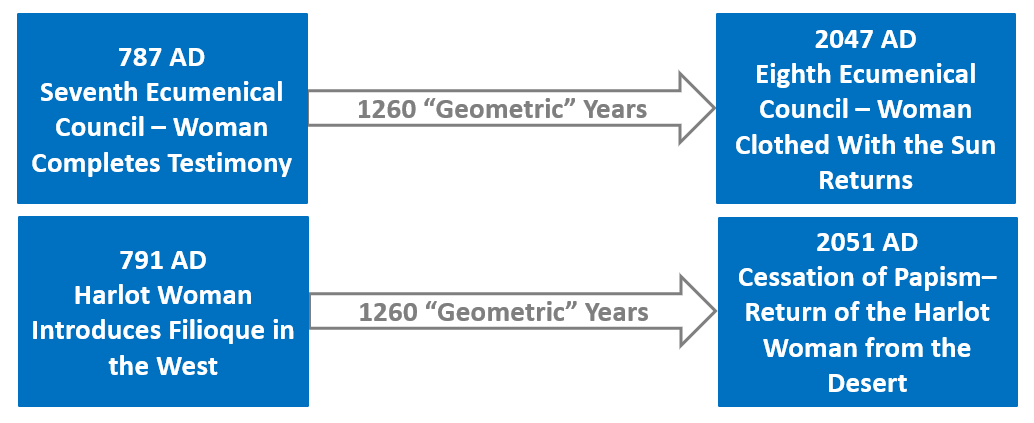
Up to this place (Rev 12:1-5), the vision of the woman seems to relate to the period of the history of the Orthodox Church which extends up to the schism. Later, John of Myra writes that the flight of the Woman in the desert (Rev 12:6) refers to the separation of the Church of Rome from the Church of Constantinople. The commentary of this verse joined to that of verses Rev 2:20-23 (Jezebel) proves to be of great interest. The commentator writes: “In the beginning the seat of the Church was in Rome, the capital of the Roman Empire. But when the capital was transferred to Constantinople, the Church of Rome, like a Prostitute, began to turn away from Christ her husband, and to seek refuge in the desert of her own doctrines, where the life-giving grace of the Spirit no longer blows and where it is no longer nourished by the spiritual and dogmatic doctrine of the Orthodox Church. Her stay in the desert must last 1260 years. A thousand years have already passed since the addition to the Credo of the Filioque (1791-1000 791; addition of the Filioque in 714 AD, schism in 867 AD). The Latin Church will therefore remain separated from the Orthodox Church for another 260 years (1791 + 260 = 2051 AD). Then, she will be obliged to return to the fold and to recognize the purity of the Orthodox faith and the integrity of its dogmas.
*** Note by Jonathan Photius: The Metropolitan’s calculation above showing the possible year for the prophesied “Eighth Ecumenical Council” was very impressive for Metropolitan John Lindios of Myra to conceive. This is similar to the “flight of the Orthodox Woman” set to occur after the Seventh Ecumenical Council. So the similarly we can start the calculation from the Seventh Council in 787 AD. And thus 1260 years from 787 AD = 2047 AD, when the true bride returns from the monastic wilderness for the “wedding feast of the Lamb”. So calculating 1260 years from the introduction of the Filioque is ingenious on the Metropolitan’s part.
After the flight of the Latin Church into the desert of heresy, Gabriel and his armies engaged in battle against the Devil and his armies. In Heaven means that since the schism no heresy or innovation has been introduced into the Orthodox Church, with the exception, however, of the doctrine of a few individuals called Latinizers. Since the seventh ecumenical council, no Christological quarrel has arisen there. In Revelation Chapter 12 the word woman thus receives three different applications according to the Metropolitan. The woman of Rev. 12:1 designates the Church as a whole who dogmatized the man-child God-Man at the First Council. The woman of Rev. 12:6 is the Latin Church the woman of Rev 12:14 represents the Orthodox Church. Thus we see a double interpretation (Prostitute, Church) of the word woman in Revelation Chapter 12. Theodoret of Jannina proceeded to this same double interpretation, since for him the woman designates, in the Apocalypse, sometimes the system of Evil (Church of Rome) and sometimes the system of Good (Orthodox Church).
From now on, the Devil and his angels can only attack men attached to things of the earth. It is therefore a great victory that of the Orthodox Church over the Latin Church, a victory prefiguring that of Christ over the Antichrist (Rev 12:7-11).
Since the seventh ecumenical council, the Orthodox Church has been persecuted by the Agarenes and the Latins, the two precursors of the Antichrist. Revelation 12:14 receives a historical interpretation which joins that of Revelation 2:24, the woman (Revelation 12:14) is the Orthodox Church living under Ottoman yoke. Therefore, the Serpent can only designate the Sultans of Constantinople to whom God gave the power to enslave Orthodoxy for a time and times and half a time, namely for a period of 350 years ( 100+ 200+ 50-350 + 1453 1803). John of Myra means that after the expiry of this period Constantinople will be liberated. We therefore find here the same date as calculated in the Revelation Commentary of Pantazes of Larissa.
In the desert of her enslavement, the Orthodox Church is protected against Latin heresy, for she has received the two wings of the great eagle, the two Testaments, or the dogmas of the incarnation and the divinity of Christ, or even the body and blood of Christ in the Eucharist (p. 418). But the Serpent again committed with his mouth like a river of water his tyranny, his persecutions and his heavy and inhuman taxes with the aim of converting to his own religion the Orthodox living under his domination (Rev. 12:15). His plan, however, was foiled. The earth came to the rescue of the woman means that the Western states, however attached they are to the things of the earth, because they bear the name of Christian states, helped the enslaved Orthodox people and prevented the tyrant Agarenes from convert him by force. At this very moment, all the European States, some openly, others secretly, wish to swallow up the river: they wish the destruction of the Ottoman Empire and the liberation of Orthodoxy (Rev 12:16). This is why, despairing of converting the Orthodox who are subject to him, the sultan went to war against the rest of the children of the woman, namely against the empire of Russia which defends the orthodox faith and practices the Christian virtues. But God protected this Orthodox empire and granted it resounding victories against the Dragon of the Ottoman Empire (Rev. 12:17).
Revelation 13 and the Two Beasts
In chapter 13, Metropolitan John of Myra was able to see the account of the action of the Antichrist and his precursors, Islam and the Papacy. Its commentary presents a certain interest by the new elements which it provides and which come to supplement the preceding historical developments. He then writes that the one who stood on the shore of the sea (Rev 12:18) was the Beast arising from the sea (Rev. 13:1). The power of the Dragon-Antichrist will therefore rest on the Muslim power, the shore, which will be carried away by the waves of Russian power. The first Beast of chapter 13 therefore symbolizes the Antichrist. The sea symbolizes the dark abyss which is the dwelling place of the intelligible Dragon and from which arises the atheistic and repugnant religion of Mahomet as well as all the heresies (Rev 9:1). We will speak later of the Antichrist, of his identity, of his reign and of his harmful action against the Orthodox Church. Now, let us retain what interests its various precursors.
Saint John says elsewhere (I Jn. 2:18) that there are several enemies of Christ and several antichrists. The seven heads of the Beast symbolize the seven deadly sins, the source of a multitude of other sins, just as the seven spirits are the source of all the charisms of the Spirit. The horns symbolize the leaders and rulers of the precursors of the Antichrist and the diadems the royal power of these leaders. They are ten in number, that is to say a large number (Rev 13:1). The panther designates the Greek (Roman) emperors who, from Nero to Maximin, persecuted the Church; the bear designates the Agarenes (Arabs), who also dominate and persecute the Church; the lion designates the Ottomans and their tyrannical empire. “If his precursors have received such great power, how much greater will be the power of the Antichrist who will have gathered in himself all the power of the Devil and will be seated on the throne of Lucifer, remarks Metropolitan John (Rev 13:2). Let us note in our turn that the description of the Beast indicates the various periods of the persecution of the Church
In the vision of the first Beast, Muhammad is described only indirectly. The vision of the second Beast will describe it to us in a very direct way. This Beast has two horns which designate the temporal power of Muhammad (the power of his empire) and his spiritual power (his religion). Muhammad is called the Beast because of his homicidal cruelty and impiety. He presented himself to the world as a lamb, that is to say as a God and with all the spiritual power of Christ. “However, it would not be out of place if we said that this Beast, besides Muhammad, also symbolizes the Jews and the leader of the Latins (the Pope). Indeed, the first precursor of the Antichrist are the Jews, since the true Antichrist will be of Jewish descent 2. The second precursor of the Antichrist is Muhammad. The head of the Western Church is the third (XIII, 11 p. 436-7). Elsewhere (Rev 18:15), the Latins and the Agarenes are called the creatures of the Prostitute who designates the Devil. The second Beast is at the service of the first, the Antichrist, of which it is the precursor as John the Baptist was the precursor of Christ. By his tyrannical power the second Beast leads the weak and the people attached to the things of the earth to adore the Antichrist whose wounded head was partially and momentarily healed under the reign of Julian the Apostate, then completely and definitively. at the time of the Muslim conquests (Rev. 13.12). Mahomet died in 632, but his successors managed to make the image of the Beast speak, to spread the religion taught by Mahomet. In territories occupied by Muslims, anyone who acts against this religion. is put to death (Rev. 13:15). The image of the Beast is therefore Muhammad (Rev 13:14). Whoever adores Mahomet, adores the Antichrist and through him the Devil who succeeds in re-establishing his reign through the intermediary of the three precursors of the Antichrist. These perform great wonders with the help of the Devil and by the use of magical processes of all kinds: the Jews deicidal by the use of the Solomonic cabal; the Muslims of Egypt and other countries by the use of magic and pharmacopoeia. As for the Latins, their leader declares to be the successor of Peter and a kind of earthly God and claims to be able to bring down the fire of the Holy Spirit from heaven and absolve all his followers of their sins (Rev 13:13). If they do not want to lose the priceless treasures of their faith, the Orthodox who live between the lairs of these two Beasts must remain vigilant especially in the time of the Antichrist. The Moslems endeavor to submit to their domination and their religion all the men of the earth. To mark this submission, they put on the right hand of their non-Muslim subjects a sealed sheet, the tax form of their submission. As for the mark on the forehead, it designates the baptism of the Latins which is done by simple sprinkling on the forehead and which signifies the adhesion of the baptized person to the faith and to the heretical dogmas of the Latin Church (Rev. 13:16; see also Rev 14:9-12). In the time of the Antichrist, only those who bear the mark of the Beast on their right hand, that is to say non-Muslims subject to Islam and equipped tax form will be able to buy or sell something. those who bear the name of the Beast, i.e. the Muslims, and those who bear the mark of the Beast on their foreheads, i.e. the Latins (Rev 13:17). The number of the Beast means the name of the latter given in a ciphered way. This name is Teitáv, which is the name of the Antichrist, Moauétis, which is the name of Mahomet and of his religion and Λατεῖνος οι κακὸς ὁδηγός, which is the name of the Pope and of his heresy (Rev. 13:18).
Metropolitan John Myra wishes to see God come to the aid of enslaved Christians, delivering them as soon as possible from the grip of the two Beasts. The commentator recognizes, however, that the Muslim Beast is much more formidable than the Latin Beast. In the commentary on verse 19:20, he devotes the most important page to Muhammad and his religion: “If all heretics and all enemies of the Gospel are the image of the Antichrist and his precursors, his most living image and his most formidable precursor is Muhammad, of Hagar’s descent, the one whom Saint John calls the false prophet. This thrice-cursed man and all his followers led an innumerable crowd of believers away from the faith of Christ and compelled them to receive the mark of the Beast, that is, to convert to Islam well before the Beast-Antichrist comes. Indeed, what the Antichrist will do, Muhammad has already done. Likewise, circumcision constitutes a material prefiguration of the mark that the Antichrist will engrave on the forehead and on the right hand of all men who willingly or unwillingly agree to follow it. This is why Muhammad and his followers will be thrown into the same lake of fire and burning sulfur as the Antichrist, and that even before the judgment of theothers”. This last text certainly contradicts many reflections of the commentator where the enslavement of Orthodoxy to Islam appears to be the most adequate means of preserving the Orthodox faith from the Latin danger. All the effort deployed to trace and describe the various stages of the history of the Church was ultimately intended only to better present the situation of the Orthodox Church of her time. The Roman persecutions and those of Julian the Apostate prefigured and prepared the Muslim persecutions. The heresies that appeared within the Church in the pre-Constantinian period and those of the period of the seven ecumenical councils prefigured and prepared the Latin heresy. This is why the history of the Church always seems to be that of the time of the author. It is the story of the Orthodox Church which, placed between the two Beasts, Islam and the Papacy, tyranny and heresy, deploys all its efforts and employs all its possibilities to defend itself, to on the one hand, against the tyrants who want to destroy his faith, on the other hand, against the heretics who seek to alter his dogmas.
Interpretation of the number 666
In Revelation 13:18, Metropolitan John sees two figures. One concerns a man, the other the Beast. This alternate application of the biblical text leads to a very interesting interpretation – the figure of the Beast designates the Antichrist and his two precursors. As for the number of man, here is its interpretation: the number 6 designates the sixth day of creation, that is to say the day of the creation of man, and symbolizes the earthly life of each individual. Its multiples (60, 600) designate the multitude of men, that is to say the whole of humanity and its history from creation to the end of the world . This double interpretation of the number 666 obeys a double vision of History, an individual history and a collective history.
Interpretation of the numeric “times statements” of the Apocalypse
Ten Days. The ten days primarily designate the ten persecutions of the Roman emperors upon the early Christians until Constantine the Great’s Edict of Milan in 312 ceased those persecutions. This is an interesting application of the day/year principle and I have seen this idea presented in other historicist commentaries. But Metropolitan John takes it a step further and he suggests the Roman persecutions are the prefiguration of all the sufferings that the Orthodox Church must endure throughout history. The ten days can thus designate in a second place the whole period of the history of the Church. And Metropolitan John writes: “I think that by the ten days the Holy Spirit wanted to indicate to Saint John the duration of the present century. Indeed, the period which extends between the first parousia of Christ and the end of the world must last ten or twelve days, each day having to be taken, according to David, as designating a duration of a thousand years. During this period, the Devil will exercise his tyrannical power over his own followers, just as he will be allowed to tempt Orthodox Christians to try their faith” (p. 148)
Half-hour of silence. Regarding the “half-hour of silence” in Revelation 7:1, Metropolitan John writes: “God created the world in six days and rested on the seventh. Christ accomplishes his work on earth in 33 years (3 + 3 = 6). In the seventh week after his death and resurrection, Christ ascended into heaven (ascension) and the angels were astonished to see human flesh entering the heavenly abode. The silence of the half-hour thus reflects the astonishment of the angels in front of this incredible spectacle”
The hour and the day and the month and the year. In Metropolitan John’s interpretation we have an interesting application of the Year/Day principle. In order to exterminate a third of men (Revelation 9:15), here is how the Metropolitan John comments on the expression for the hour and the day and the month and the year: “The four angels, governors of the four parts of the world, were preparing to exterminate the Jews who had killed Christ on the cross, but divine mercy had prevented them (for the time being). After the resurrection of Christ, his ascension and the descent of the Spirit, the angels were again determined to exterminate the Jews, but they were again prevented from doing so (= the day). Thirty years later (= the month), there was a great persecution of the apostles. The four angels had again decided to exterminate the Jews, but God did not allow it. It was therefore only at the end of the persecutions (the year, that is approximately 360 years after the birth of Christ) that divine mercy allowed the four angels to be unleashed”.
*** Note by Jonathan Photius I must confess I find this application of the times statement in Revelation 9:15 fascinating, given this idea was developed by Metropolitan John in the 1700s. Makrakis in 1881 took this idea further to describe the release of the four winds to bring about the Great Barbarian Migration of Nations which resulted in the fall of Rome in 476 AD. The great migrations began around 375 AD, very close to Metropolitan John’s calculation of 360 AD. I took Makrakis’s interpretation of the “hour/day/month/year” times statement a bit further and applied it to the range of dates foretelling the rise and fall of the “restrainer” and Daniel’s Fourth Beast (Rome) starting with the rise of the Roman Empire in 27 BC until the fall of Gaul in 476 AD. Thus this mysterious times statement of Revelation 9 predicts the 391 years after John wrote Revelation to show the birth of the Roman Empire through to it’s completion and fall of Rome’s power. The killing of a “third of men” was the result of war and pestilence (i.e. Justinian Plague) which killed off over a third of Europe’s population, but we can take the allegorical approach to the text one step further and apply the fact that the Barbarian tribes brought with them form of Arianism which would result in the schism and Reformation thanks to the addition of the Filioque causing the spiritual deaths for one-third of Christendom. As Revelation 9 reveals the Western nations never repented of the Arianism which plagued the church for “5 months” (Rev 9 Fifth Trumpet), and it would lead to catastrophic consequences within the church. With the restrainer (Rome) out of the way, conditions were now ripe for the rise of the Papal and Islamic beasts of Revelation 13. Below you will find the excerpt analyzing the times statement of Revelation chapter 9 verse 15 from my book “The Encyclopedia of Christianity in the Book of Revelation.”

On the 1260 Year Reign of Islam and the Liberation of Constantinople
Jean de Myra believed in the coming liberation of Constantinople, an event that he placed before the coming of the Antichrist, in the year 1803 AD (1453 +350) . Theodoret of Iannina admits the possibility of such a strong moment, a theophany which will force heretics, infidels and Jews to embrace the Orthodox faith. We can study prophecies of the Byzantine Apocalyptic Tradition today and see that these exact themes are revealed in the prophecies. (For example, the Anonymous Prophecy of 1053 AD may provide insight into the ordering of these future events). God had wanted to punish the Jews for their crime of deicide and had delivered them to the nations; first to the emperor Titus who destroyed the temple, then to ‘Umar, the second successor of Muhammad who, in 636, transformed the temple into a mosque. The Jews are punished until our days and will be so until the end of time. The forty-two weeks, which make 1260 days, indicate the number of years during which Solomon’s temple will be taken from the Jews. However, the temple has been under Muslim occupation for 1155 years (636 AD + 1155=1791 AD). It will therefore remain in the hands either of the infidels (Muslims) or of the faithful (Christians) until the expiration of the period of 1260 years, that is to say for a period of 105 more years (1791 AD + 105=1896 AD). But what will happen in 1896? John of Myra affirms that the Jews will be punished until the end of time. Should we therefore conclude that the end of time will come in 1896 AD?
According to John of Myra, Constantinople and Jerusalem will be liberated before the coming of the Antichrist. The liberation of Constantinople is set for the year 1803, in accordance with the most widespread eschatological tradition at that time. Merropolitan John avoids specifying the date of the liberation of Jerusalem, which we could situate at the same time, at the end no doubt of the present Russo-Turkish war. But does this mean that these two great centers of Orthodoxy were soon to become the respective capitals of these two other Orthodox kings? Although the commentator was silent on this point, we must admit that such was his thinking. While avoiding chronological and topographical details, John of Myra seems to want to seek to reconcile the most ancient eschatological tradition with the most recent aspirations of the enslaved Orthodox people. Everything, however, is subordinate to the general plan of the history of the salvation of men and the commentator is interested in the coming of the Antichrist much more than in the liberation of the Greeks.
Metropolitan John of Myra knows that it has not been given to man to know the precise date of the second parousia of Christ. But the Lord will return to judge the world, to put an end to the seventh century and to inaugurate the eighth, the century of eternity. Now the reign of the Antichrist will take place at the junction of these two centuries and will last only three and a half years. It is therefore not for man to know the precise date of the coming of the Antichrist. All that John of Myra writes about the duration of the world in general (twelve or ten thousand years) and of the seventh century in particular, these are traditions reported without much conviction. The same is true of the dates proposed for the liberation of Constantinople (1803 AD) and the return of the Latins to the Orthodox faith (2051 AD); the event to occur in Jerusalem in 1896 AD remains much more obscure.
*** Note by Jonathan Photius on the 1896 AD Prediction by Metropolitan John. This calculation is another amazing example of the Greek Orthodox commentators of the Post-Byzantine Exegetical Movement applying use of the Day/Year principle to predict the fall of the Ottoman Empire and return of the Jews to Palestine. We first saw calculations of this from earlier commentators like Anastasios Gordios (1718 AD) and Christoforos Angelos Revelation Commentary of 1624 AD. All of these commentaries applying the 1260 year calculation identifying Mohammed as the “Little Horn” and “Abomination of Desolation” of Daniel predate any Protestant interpretation by at least 175 years. Protestant calculations applying 1260 years to Islam did not begin to appear until the early 1800s. So once again, the Greek Orthodox lead the efforts of exegesis on the historicist method as far as identifying the Islamic Beast. The Western Protestants focused more on the Papal Beasts 1260-year reign. One thing to mention, that Metropolitan John’s calculation identifying the measurement of 1260 years from 636 AD to 638 AD and Omar’s capture of Jerusalem appears to be the first to propose that terminating date of 1896 or 1997 AD. He suspected it would be the liberation of Jerusalem and conversion of the Jews. However we do know that the Zionist congress was established that year. And had Metropolitan John used the SOLAR year calculation of 365.25 days-per-year for a “times” instead of 360-days, he would have arrived at 1917 AD with his prediction, as Henry Gratton Guinness calculated the correct solar-year date in 1882 AD, 35 years before fulfillment. And we know that 1917 was the year when the Ottoman Empire collapsed and the Balfour Declaration was made to enable the Jewish return to Palestine. The “Times Times and a Half of a Time” or “1260-day” prophesies foretelling the trampling of the Holy City of Jerusalem for a period of 1260 years was not necessarily a singular event, but progressed over time to the liberation and annexation in 1967 AD. Regardless, Metropolitan had the foresight to correctly interpret that something of significance would happen after “1260 days” of the fall of Jerusalem would come to pass. God foreordains these events with his mathematical times statements to show validity to the prophecies, and we can confirm theses truths after the fulfillment of the prophecy.


Summary and Conclusions
The main characteristic of Metropolitan John’s work to be considered is the general view by the author that the Apocalypse is book where the entire history of the (Orthodox) Church is recorded, from its foundation until the End and Second Advent. And thus the interpretation offered by of John Lindios revolves around this central consideration and main idea. That the book should contain information on the most critical events in the history of the church, such as the understanding of the nature of Christ through the Seven Ecumenical Councils, and the protection of these dogmas and decrees by the church throughout history up to the present day. This theme was most certainly then adopted by other authors like Apostolos Makrakis, Theodoret of Ioannina and Neilos Sotiropoulos in later Orthodox commentaries of the nineteenth and twentieth centuries. But in trying to understand today’s political climate between the East and West, the so-called “coming apostacy” and “ecumenism is heresy” rants by modern Internet Orthodox figures, most modern Orthodox commentaries on Revelation primarily only seek to reference and quote the oldest of the Greek commentaries (St. Andrew of Caesaria, Arethas of Caesaria, Oecumenius) from the Byzantine-era to prove their points or support their idea and desire for an expected future antichrist. But it is our general observation that most of the early Greek and Latin commentaries did not approach the book in a similar manner to the Post-Byzantine Greeks obviously because they took a “futurist” approach to the book, and at the time they were written the two major apostacies (i.e. the Papacy and Islam) often interpreted by Historicist commentators did not appear yet on the scene in human history. And therefore, monumental events such as the Great Schism and Protestant Reformation had not yet come to pass to be able to highlight those events within the pages of the Apocalypse. So then, if today’s Eastern Orthodox commentaries only maintain such a narrow view and quote only 5th and 6th century Greek Byzantine-era authors prior to any rise of Islam or divisions in the church, the historicist’s argument would be to say that modern ‘futurist’ Orthodox interpreters of the Apocalypse will inevitably fail understand and penetrate the mysteries symbols in the book which it appears were already well understood and deciphered by a number of Orthodox saints, bishops, monks and holy men who, with their newer Greek commentaries provided to us backward-looking historical perspectives over earlier Greek commentaries. It would be such perspectives and interpretations like those of Metropolitan John Lindios and Daniel Sysoev which helped explain the unsealing nature of Christ defined in the Apocalypse throughout history by the church through its defense against heresies challenging the Humanity and Divinity of Christ, at all cost, including the suffering of the church through a long period of persecution as the church sought protection the monastic wilderness… all of these events contained within the pages of the Apocalypse. That is, in light of historical events within the church after 1054 AD and 1453 AD, the Orthodox authors of the Post-Byzantine Exegetical Movement, including this ground-breaking commentary of Metropolitan John, resulted in a shift in the mindset by these authors that the Book of Revelation was primarily intended to be a prophetic vision about the journey of the persecuted Holy Orthodox Faith throughout its history and its defense of the true nature and identity of Christ, the Man-Child, the God-Man and Theanthropos.
Without a doubt this is groundbreaking exegesis by the Metropolitan John Lindios of Myra who wrote over 240 years ago, and it is a shame that only one manuscript of his commentary exists today, most likely others were repressed and destroyed by those favoring the futurist method of interpretation within the church after events of 1917 and 1922, just as was done to similar commentaries of Anastasios Gordios and Theodoret of Ioannina. Many of the Internet Orthodox personalities today prefer to teach that the entire fulfillment of the book of Revelation is not yet, and to be fulfilled well into the (very near) future. But, wait… we are just beginning to discover the rich Christology and amazing insight and analysis found in many of these older Greek Orthodox commentaries of the Ottoman Era.
More analysis of other Post-Byzantine Revelation commentaries to come so stay tuned!
© 2023 by Jonathan Photius
REFERENCES AND FURTHER READING:
- Asterios Argyriou, Les exégèses grecques de l’Apocalypse à l’époque turque (1453-1821). Esquisse d’une histoire des courants idéologiques au seindu peuple grec asservi. Thessaloniki, 1982
- Amoiriaou, E., History of the Interpretation of the “Number of the Beast (666) (Rev. 13:18). From Exegetical Memoirs on Revelation from the 2nd to the early 19th century, in the Eastern Church). Doctoral Thesis submitted to the Department of Theology of the Theological SChool of Thessaloniki. 1998
- Livadiotou , Anastasia. Ιωάννης ο Λίνδιος και η Αποστολική Σαγήνη Περιστατικά Συγγραφής, Περιεχόμενο και Σπουδαιότητα. Thesis submitted to the Pastoral Department and Social Theology of the School of Theology. Thessaloniki, 2019
- A. Argyriou. Anastasios Gordios, Sur Mahomet et contre les Latins. Athens, 1983
- Photius, J., The Encyclopedia of Christianity in the Book of Revelation. Eastern Light Publishing, Sheriden WY, ISBN 978-1-949940-02-2, (2018)
- Allen, G. V. (2020) An anti-Islamic marginal comment in the Apocalypse of “Codex Reuchlin” (GA 2814) and its tradition. In: Karrer, M. (ed.) Der Codex Reuchlins zur Apokalypse: Byzanz – Basler Konzil – Erasmus. Series: Manuscripta Biblica (5). De Gruyter: Berlin; Boston, pp. 193-198. ISBN 9783110674118
- Sotiropoulos, Neilos. The Coming Sharp And Two-Edged Sword, Holy Monastery of Simon’s Petra, Holy Mount Athos, Greece, (1973)
- Makrakis, Apostolos. Interpretation of the Revelation of St. John the Divine. Hellenic Christian Education Society, Chicago, IL, 1948
- Hatzopoulos, Marios. Eighteenth century Greek Prophetic Literature, David Thomas & John Chesworth (eds), Christian-Muslim Relations. A Bibliographical History, Volume 13 Central and Eastern Europe 1700-1800, Leiden: Brill (forthcoming April 2020), 2020
 NEO-Historicism - End Times Eschatology From An Eastern Orthodox Christian Historicist Perspective