
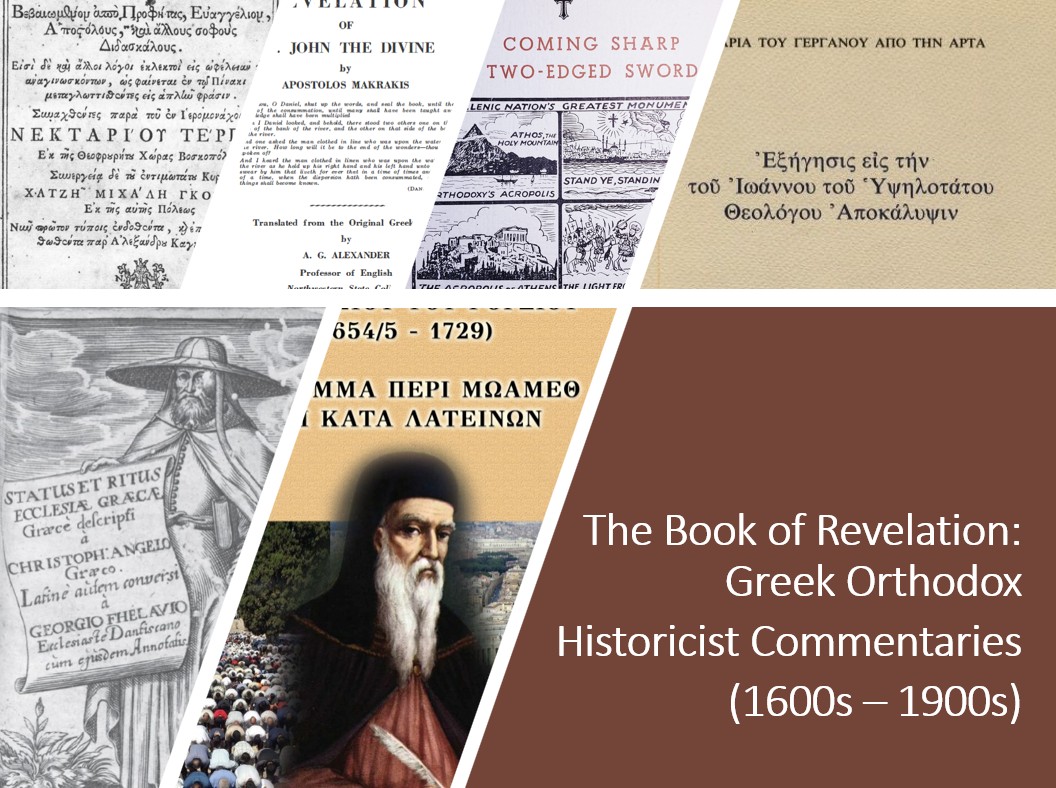
The Historicist method of interpreting the prophecies has long been thought to be a Western Christian phenomenon since the Dawn of the Reformation. In fact most Eastern Orthodox Christians today who look to a future fulfillment of the Book of Revelation would be surprised (and shocked) to learn there is a rich tradition of approaching the mysterious book as “fulfilled” eschatology, such that the book is a framework provided by St. John the Theologian to describe the Church from the time of Christ until the Second Coming. There are over 20+ commentaries written from the time called the Post-Byzantine or Neo-Greek Exegetical Movement, which began after the Fall of Constantinople and continued on all the way through the Greek War of Independence of 1821, and stayed through the period promoting the “Megali Idea” up through 1922. After the catastrophe in Asia Minor and loss of major territories, the Great Idea fell out of favor in Greece and the Balkans, and with that it seems the promotion of Historicist Eschatology in the Orthodox East. This would also be true in Russia as a result of the Russian Revolution in 1917 and the persecution of the Church by the Communists. The Age of Apostacy upon the church had arrived. Forget the fact there were already major genocides and tribulations upon the church already for over 1260 years.
With respect to tracing the roots of historicism in Eastern Christianity, we are now finding evidence with examination of new manuscripts from various monasteries throughout Greece that the identification and calculations of the two beasts of Revelation began as early as the 13th century, and particularly after the Sack of Constantinople in 1204 AD. Thus, the Greeks were well on their way towards looking to the past and present political situation to try to to understand the nature of the forces of evil which were attempting to destroy the Byzantine Empire and Orthodoxy. In fact, we soon would see that the later historicist commentaries seemed to place a particular focus of the Orthodox Church and her defense on the very nature of Christ at the very center of the Apocalypse. And the very threats to its existence these writers would identify with the two beasts, Islam and the Papacy. From there these various post-Byzantine Greek commentaries would attempt to highlight key events in the history of the church found hidden in the pages of Revelation such as the identification of many of the early church heresies, the Seven Ecumenical Councils, the formation of the Creed, the Great Schism and the Protestant Reformation. And thus we find, based on the evidence of these commentaries and the monastic notes contained on old Greek manuscripts of commentaries of Revelation in monasteries like Mt. Athos, it looks that the Historicist approach to interpreting Revelation was utilized for over 700 years in the Orthodox Church. And quite possibly, historicist eschatology was the dominant view from the latter Middle Ages and Ottoman Era in the East, through the Reformation in the West and modern era at the start of the 20th century, lasting much longer than the Futurist views we find today espoused by modern elders and teachers in the Greek and Russian churches believing in a future Antichrist.
So our task is first to try to trace the roots of this Historicist eschatological thought. The view appeared to evolve and progress from the original “big three” Byzantine-era manuscripts. First we find, from the Byzantine East we can identify only three complete pre-Schism (prior to 1053 AD) Greek Orthodox commentaries on Revelation. Many of the early Greek historicist commentaries would rely heavily on them as a starting point. At the time they were written they would be considered to take on the “futurist” view of the prophecies which looked to a future Antichrist fulfillment. All other pre-schism commentaries are from the Latin West. Victorinus, Tyconius, Venerable Bede, Caesarius of Arles and Apringius of Beja were notable ones. The fact there are so few Greek Byzantine-era commentaries can be partially explained with the rejection of the Book of Revelation as canon in the Orthodox East for many centuries. This rejection was primarily due to the influence of St. Dionysius of Alexandria, who denied that the Book of Revelation was written by St. John the Evangelist and denounced the millenarians who, basing their argument on a literal reading of Revelation, believed that after 1,000 years Jesus Christ would return and establish his kingdom on earth.
Eventually, the Greek commentary of Oecumenius (c. late 500s AD) was the first full commentary of Revelation in the Greek language. It was feared that he was a Monophysite, tainting his interpretation, although it seem that this is not entirely proven. And so, Andrew of Caesarea followed in the early seventh century, writing a commentary in response to the fears of the people with the rising tide of Islam, basing his work on a large portion of Oecumenius’s commentary, reusing many parts while making revisions or additions. And the commentary of Arethas of Caesarea a few centuries later (c. 900 AD) was largely dependent on Andrew’s commentary. However, recently we come to find there is also another publication of ancient 6th century commentary on the Book of Revelation called the “Scholia in Apocalypisin” translated by P Tzamakilos that was first thought to be attributed to Origen, but later evidence pointed to the commentary as having been written by Cassian the Sabaite, a monk and abbot from the monastery of Sabas in Palestine. And except for Arethas of Caesarea’s redaction of Andrew’s earlier commentary, there is really no notable Greek Orthodox commentary that can be found from the rise of Islam in the Seven Century until after the conquest of Constantinople in 1453 AD, which was near the time of the Reformation when hundreds (of not thousands) of Commentaries of the Apocalypse began to appear with the advent of the printing press.
As further solid evidence of early historicism in the church, a new research report published by Garrick V. Allen[8] identified copies of a few different manuscripts at the monasteries of Mt. Athos showing marginal commentary/notes added to the original Greek Byzantine-era commentaries. These additions and addendums demonstrate a significant switch from futurist views of apocalyptic thought in the first millennium towards a “fulfilled” eschatological view. And it can be suggested perhaps, these divergent views formed the basis of early historicism we saw in the West at the dawn of the Reformation with the massive exodus of manuscripts after the fall of Constantinople. Allen demonstrates that these ideas were being expressed inside the monasteries of Mt. Athos just a century after the 1204 sack of Constantinople by the Fourth Crusade. That moment in history with the destruction and pillaging of the beloved City, perhaps was viewed as an apocalyptic event by the Byzantines and resulted in numerous prophecies in the Byzantine Apocalyptic Tradition foretelling the City’s eventual fall (and future restoration). Copies of manuscripts identified in the years around the 1300s and 1400s using commentaries of St. Andrew of Caesarea and Oecumenius showed added marginal comments on providing new 666 calculations pointing to identification of both Islam and the Papacy (see: Garrick V. Allen, 2020 – GA 1778 manuscript, Thessaloniki, Vlatadon,35, fifteenth century, and GA 2075 Athos, Iviron, 370, fourteenth century). Similarly, we find marginal comments showed additional calculations of Mohammed and the Papacy in later manuscripts up through the 17th and 18th centuries in the monasteries of Mt. Athos.
The 1453 Fall of Constantinople was the watershed event which also resulted in numerous works from Antiquity carried from the libraries of Constantinople to the West. It was then that we saw the rise of “fulfilled eschatology” within Protestantism. Specifically the Lutherans historicist view aligned very closely with the early commentaries of the Eastern Orthodox and the apocalyptic thought expressed those found at Mt. Athos. One could argue that the rise of such of movement in the West was actually the result of the influence of writings in the East imported to the West, however examining the published works in it becomes clear that the view that ‘Islam and the Papacy’ were the 2 beasts of Revelation was a phenomenon both seen in the Orthodox East and the Protestant West from the dawn of the Reformation. From 1453 up to the 1790s, the Orthodox Church would see the production of about 20 commentaries on the book of Revelation by what Asterios Argyriou has called the ‘Greek exegetical movement’ (1. see Argyriou, Les exégèses).
Here is a brief summary of a few of those commentaries with a change from the early church father commentaries to more of historical fulfillment and contain a “messianic” or “postmillennial” flavor with the various interpretations predicting a coming restoration of the Byzantine Empire.
George Kalyvas (1522)
George Kalyvas witnessed the capture of Rhodes, his native island, by the Turks (1522). Witnessing these events, George desired to answer the question of knowing what are the four Beasts of the vision of Daniel, those same Beasts whose characteristics are also found in Chapter 13 in the Book of Revelation. Kalyvas had corresponded with a monk, known by the name of Mathussala, who, around 1550, had written commentaries on the prophetic Books of the Old Testament and claimed to have received from Saint John, the author of the Apocalypse, the revelation concerning “the true enemies of Orthodoxy as well as the date of their annihilation” and published that interpretation.
Maximus the Peloponnesian (1580s – 1610s)
It is claimed this commentary was written approximately 20 years prior to Zacharias in the late 1500s. One manuscript can be found at Mt Athos Iveron Monastery, copied in 1685. The manuscript at Mt Athos carries a reading offering the name μοαμετις that urges the reader to do the math: μοαμετις μετρισε τα ψιφια (“Muhammad: do the calculation,”. The front cover of the manuscript also shows the word μοαμετις to signal the importance of the identification of the beast. Maximos’s commentary is a paraphrasis of Andrew of Caesarea (563-637) and Arethas of Caesarea (860-939). Maximos added only minor comments to those previous Greek commentaries, making no speculations about futurist fulfillment of the prophecies any time in the near future. Maximos’s equates the Papacy with the scarlet beast in Revelation 17:3.
Zacharias Gerganos (1621)
A Greek commentary on Revelation which identified the Papacy as the Antichrist. He was from Arta. His work entitled Interpretation of the Apocalypse of John (εξεγησις εις την του ιωαννου Αποκαλυψιν) includes both the interpretation of the Papacy and Islam in his study of Revelation 20. Gerganos decodes the name of the beast in 13:18 as λατεινος (“The Latin One”). This calculation goes back as far as Irenaeus. However he identifies this is a direct reference to the Roman Catholic church in Rome. Gerganos identifies Muhammad in his interpretation of Apoc. 20:10, where he determined the dragon is the devil, the beast represents the papacy, and the false prophet as Muhammad.
1624 Χριστόφορος Άγγελος (Christoforos Angelos).
Christoforos Angelos’ commentary appears to show 1260-year calculations for the end of the Papacy and Islam measured from Phocas and Mohammed which would have terminated late 19th century. This application of 1260-years to Islam appears to beat Anastasios Gordios usage of the “1260 years” of tribulation by 100 years (Anastasios wrote his commentary around 1718, see below), and seems to predate any documented Western commentary on Revelation and Daniel demonstrating any calculation by the Protestant Historicists using the 1260 years applied to the reign for Islam and fall of the Ottoman Empire. It is suggested that Anastasios Gordios might have had access to both Angelos and Gerganos commentaries and expanded upon those ideas, given some of the similarities in the interpretations [1].

Mitrofanis Kritopoulos (1627)
Kritopoulos was a Greek monk/theologian who became a the Greek Patriarch of Alexandria. In the final chapter of his book “Confession” he identifies Mohammed as the Antichrist, the son of perdition who subjugated the Eastern Church. In Kritopoulos’s book “Grammar of Vernacular Greek (1627), he promotes the view that the Book of Revelation of John described the destinies of the Orthodox and their Churches. He believes that the apostle John the Theologian composed it to describe the journey of Orthodoxy and its subjugation with the Latins and Turks and it predicts its eventual liberation restoration.
Anastasios Gordios (1654-1729)
Recently canonized as a saint by the Greek church in July of 2021, the Greek hieromonk Anastasios Gordios counts as one of the most prominent ‘tutors of the nation’. He was a physician monk, teacher and preacher. He wrote an interpretation titled “Peri Mōameth kai kata Lateinōn” (‘About Muḥammad and against the Latins’) – This work by Saint Anastasios was written around 1717 to 1718 AD shortly after the Turks reconquered the Peloponnese in 1715. Primarily viewed the two beasts of Revelation 13 as Mohammed and the Papacy. The work shows that the scriptures foretold the rise of Islam and predicts its future demise. He is however skeptical about “the oracles” foretelling the advent of Christian King as he states they are not founded within the scriptures. He believed that Islam will only fall at Christ’s second coming, which would seem to suggest he held the amillennial view.

Some of the key parts of his interpretation include:
1. The identification of the Little Horn of Daniel 7:8 as Mohammed
2. Matthew 24:15 identifying the Abomination of Desolation in the Olivet Discourse to Mohammed (this is in agreement with Patriarch Sophronios of Jerusalem in 637 AD).
3. The identification of the latter part of Revelation 12 as the “flood” of Islam
4. The “woman” represents the 4 remaining Orthodox patriarchates. The flight of the church to the “wilderness” and monasteries of Russia to escape persecution.
5. The two beasts of Revelation 13 as the Papacy and Islam
6. The calculations of the number of the beast as Lateinos and Muhammed
7. Identification of John 5:43 as a reference of Mohammed.
8. Rider of the White Horse in Revelation 6 representing the conquering of Christianity and spread of the gospel to the nations.
9. The 1260 “days” of Revelation views as years, that is 1260 YEARS for the reign of Islam on the “saints” or Orthodox Christians. This last point is significant. He would be the first known Orthodox to teach the application of the year/day principle and a 1260 year tribulation. And this application to Islam as the “beast” or Little Horn would predate the application by Western Protestants by at least 100 years.
Paissios Ligardis (1655)
Identified Ezekiel 38/39’s Gog to be the Turks and Magog as the Saracens. His commentary includes references to about twenty Western commentaries, both Catholic and Protestant. However, he takes a less focused approach in identifying the Pope as the Man of Sin like the Calvinists and balances out these views with Islam inclusion with the apostacy and its predicted destruction.
Eustratios Argentis (early 1700s , died 1750).
A bitter enemy of the Papacy, he defined fifty-four characteristic features of the Antichrist that leave no doubt about his identity. The Antichrist is a human being who would appear in history when Rome separated from Constantinople. And he would be a Christian and will claim to be the vicar of Christ on earth.
Nektarios Terpos. (1740)
An Athonite Monk who then lived in an area near Korçë in present-day Albania. In 1740 he published a commentary titled – Vivliarion kaloumenon Pistis, anankaion eis kathe aploun anthrōpon, vevaiōmenon apo prophētas, euangelion, apostolous, kai allous sophous didaskalous (‘A booklet called Faith, necessary to every simple man, confirmed by prophets, the Gospel, Apostles, and other wise teachers’). He identified the Islamic Ottomans as the Beast and Antichrist with the gemmatria calculations identifying them as such. The book’s purpose was to aid priests in the task of catechism. When it came to Islam he employed eschatology and apocalypticism to promote anti-Islamic arguments. He identified the Antichrist and Man of Perdition with the prophet Muhammed, and conversion to Islam was an unconditional surrender of one’s self to the forces of evil. One chapter of the book is titled “True praise for the people-deceiver Muḥammad and Ali”. Another chapter is called “Council of evil spirits”. In both chapters, Terpos draws on Revelation, showing that the identification of Antichrist with Muḥammad, and with the Ottomans, has a firm foundation in scripture. His 666 calculation shows the numeric value of Greek letters in the word Otmanes (‘Ottomans’) when added together make up the number of the beast. He then uses parts of Revelation 13 to show that the Turk is the very embodiment of the Antichrist (see Revelation 13:3: ‘and all the world wandered after the beast’; 13:7-8: ‘and power was given him over all kindreds, and tongues, and nations. And all that dwell upon the earth shall worship him’). Terpos does not provide comfort with the idea that the tribulation will be short lived but of long duration. Toppling the Antichrist’s rule on earth is the responsibility not of man but of God according to his timetable.
Patriarch Anthimos of Jerusalem (1717 – 1808)
Wrote “Interpretation on the Apocalypse” in 1794-1795 AD. Employing a combined anti-Islamic and anti-Enlightenment perspective, while at the same time drawing on the old exegetical tradition. Viewed the Two Beasts which persecuted the Church in Revelation 13 as Islam and the Papacy. He viewed the subjection of the Orthodox Church and the prospect of its eventual triumph through the lens of the turmoil that Europe was experiencing at the time.
Metropolitan Iōannēs Lindios of Myra (in Lycia, Asia Minor)
– (c. 1710-1790)
Published in 1791 AD, The Hermēneia eis tēn Apokalypsin (‘Interpretation of the Apocalypse’)
Similar to Anthimos’s interpretation. Some new interesting ideas resulting from these commentaries. Viewed the Two Beasts which persecuted the Church in Revelation 13 as Islam and the Papacy. The Islamic and Western beasts would not cease to exist with the Second Coming, but with the advent of Russian or Byzantine power. This was a major shift to “messianism” or Post-Millennial schools of thought within Orthodoxy.
Theodoret of Ioannina (1800)
A Greek monk from Patras. In 1800 AD he published a book titled “Interpretation of the Apocalypse”, described as “a voluminous interpretation in Revelation, where – without forget the Papacy and Islam – inflicted upon now Napoleon and France, in which foresees the Antichrist, while in the face of the Tsar of Russia foresees the Messiah and Resurrection of the Eastern Orthodox Empire.” Viewed the Two Beasts which persecuted the Church in Revelation 13 as Islam and the Papacy. This book caused so much of a stir that the Patriarch of Constantinople had the book repressed and destroyed many copies for fear of persecution by the ruling Ottomans. His perception that the beast represents both Mohammed and the Papacy is underscored by his selection of gemmatria which add up to 666. Mohammad (μοαμετις), Ottomans (οτμανες), the Ottomans (ολοσμανες), Latin (λατεινος), and Benedict (βενεδικτος). The numerical values are also shown to even add up in Arabic script. Providing a more complete Eastern Orthodox historicist approach, Theodoret understands the book of Revelation as delineating the progressive periods of the history of the church: Apoc. 1:1–20:10 covers the eight periods from the incarnation to the end of the twentieth century, while Apoc. 20:11–22:21 provides a meta-historical overview. It is interesting to see Theodoret make a possible reference to Revelation 19’s “Rider on the White Horse” related to the messianic figure (Last Roman Emperor) although he interprets the overall idea to a Russian Czar. It would make sense given the Vision of Agathangelos was being widely distributed in Greece just prior to the Revolution, and that manuscript contains a prophecy referring to the coming Emperor as the “Rider on the White Horse.” Although mysteriously it is not a Russian, but a “Duke of Anjou” figure. From what I can see thus far, Theodoret would be the earliest to make such a figurative and allegorical connection of Revelation 19 to some form of restoration of a Orthodoxy, a reemergence of an Imperial church through an omega-type “Roman” emperor figure. Theodoret interprets the Great Harlot of Revelation 17 symbolized the Church of Rome. Theodoret was a supporter of millennialism, and against the amillennialism found during the Byzantine-era. Although not necessarily full chiliasm, but a partial, post-millennial form of it where the church is resurrected. Perhaps it can be said that Theodoret’s interpretation, which was supported and circulated by Russia, and reviewed by peers just prior to the Revolution, played a significant a role, as much as Oracular prophecy did, to contribute to the inspiration and start of 1821’s Greek War of Independence.
Kyrillos Lauriotēs of Patras 1817 – (born 1741-4 died 1826)
Lavriotis was a monk from Patras, wrote an Exegesis of the Apocalypse between 1792 and 1821, titled: “Κυρίλλου Λαυριώτου ἀνέκδοτος ἑρμηνεία εἰς τὴν ᾿Αποκάλυψιν” He lived in Bucharest for 45 years, where he bore the title of hieromonk (1789) and later (1817) that of archimandrite. He predict a Russian-led Eastern Orthodox restoration over which the millenarian idea of world supremacy. Also provides anti-Islamic and anti-Enlightenment views and vies them as the cause of the subjugation of the Orthodox Church, and Orthodoxy’s eventual triumph. Viewed the Two Beasts which persecuted the Church in Revelation 13 as Islam and the Papacy. His interpretation included the following:
- He viewed chapters 2 to 20 of the Apocalypse to describe the history of the Church from the first to the second parousia of Christ.
- We can only understand the prophetic content of the Johannine visions retrospectively, in the light of events (i.e. after the prophecy is fulfilled)
- The visions of St. John the Theologian are allegorical texts and not to be take literally. It is only through the proper understanding of Revelation’s symbols and various descriptions of the material and spiritual world and taught through the key scripture verses, that St. John had wanted to reveal to the Church what was to happen throughout its whole history.
- Revelation 9 he sees the Papacy delpoying wickedness not only against Muhammed but also against the Orthodox Church and the Byzantine Empire.
- Revelation 9 to 14 is about the Papacy and Ottoman Empire both attacking the Orthodox Empire, through the Crusades and the Ottoman Sultans. Both succeeded to put an end to the reign of Orthodoxy in the Byzantine East. However, Chapter 14 and 15 already appear to show signs of the destruction and demise of these two beasts and the start of the “first resurrection” of the Orthodox.
- The third scene shows the progressive weakening and final fall of the ungodly, sinners and infidels associated with the two beasts, and the progressive increase in the power of the faithful. [perhaps a postmillennial view here]
- A. Argyriou’s summary of Lavriotis’s interpretation of the seven seals: “The opening of the first seal reveals the nation of the true believers and true orthodox Christians; this nation will always be fought against by the ungodly nations but it will never be completely destroyed. The opening of the second seal reveals the nation of polytheists and idolaters and their leaders fighting against the faithful. The opening of the third seal reveals the crowd of prelates, priests and monks announcing the Gospel to the peoples, sanctifying the faithful and fighting against the infidels and the impious. The opening of the fourth seal reveals all the heretics who appeared up to the time of the sixth ecumenical council (680 – 681), the most important of whom were Arius, Macedonius, Nestorius, Origen, the Monophysite Dioscurus and the pope Monothelite Honorius. The opening of the fifth seal reveals iconoclasm, that of the sixth the Papacy and that of the seventh Islam.”
- Lavriotis summarizes Revelation 13 to 15: “In the fifth book, consisting of chapters 13, 14 and 15, the Church is still in struggle against the Ottomans and the Papists. But Christ comes to help him and pours out on his enemies the seven cups designating the military power of Russia. Already in chapter 10, the mighty angel who placed his right foot on the sea and his left foot on the earth, this angel designated the power of the orthodox empire of Russia which fights on the one hand the impiety of the Pope and on the other the tyranny of Mahomet in order to prevent them from completely eliminating the corpses of the two Witnesses (the laity and the clergy) of subjugated Eastern Orthodoxy. On the other hand, chapter 14 constitutes the continuation and development of chapter 9. In the latter (9) are related, on the one hand the expeditions of the Pope against Palestine, Syria and Constantinople (the Crusades), on the other hand the conquests in Asia and Europe of Othman and his successors until at the capture of Constantinople. In chapter 14, we see the angel, on the one hand inviting the Latins to repentance, on the other announcing the collapse of the Ottoman Empire. As the two Beasts had gone on the assault for the extermination of Eastern Orthodoxy, God wanted to put two other Orthodox empires in their path. The first, that of Russia, will fight the two Beasts until the complete destruction of their power and the establishment of the millennium. The second, that of restored Eastern Orthodoxy, will reign over the whole world during the period of the millennium” [1. See: Argyriou, Les Exegesis]
- Lavriotis interestingly interprets the prostitute as Islam and the Ottoman Empire, and Constantinople as Babylon (ie. “New Rome”). The Seventh vial is particular designates the complete destruction of Islam and the Papacy. Revelation 18 describes the destruction and fall of Constantinople.
- Lavriotis interprets Revelation 19 to describe the complete destruction of all of the enemy powers of teh Church, namely Islam, the Papacy, Protestantism and Atheism. This chapter is dedicated to the great eschatological battle when the Orthodox emperor of the East will come to destroy, with the helo fChrist and by his faithful servants and army, all of powers of Islam, Papacy and Protestantism.
- Revelation 20 refers to the first death of all of the enemies of the church through the definitive annihilation of the Papacy and Islam. It also refers to the first resurrection of the faithful, their liberation. Christ leads the emperor to convene an eighth ecumenical council to put an end to all heresies and establish the millennium which will be a prelude to the parousia of Christ.
Apostolos Makrakis (1831-1905)
Apostolos Makrakis was a Greek lay theologian and philosopher. He published a full verse-by-verse commentary of the Apocalypse in a book titled “Interpretation of the Revelation of St. John the Divine” in the year 1882 AD. Completed EXACTLY 1260-years after the appearance of the prophet Mohammed (in 622 AD). Which is ironic given his identification of Mohammed as the Antichrist and Little Horn of Daniel. He identifies Islam and the Papacy as the Two Beasts of Revelation 13. He also identifies Babylon the Harlot as the Roman Catholic Church. However, he shows that the Orthodox Church is the Woman Clothed with the Sun and is also the Lamb Standing on Mt. Zion with the 144,000, as the church would flee to the monasteries starting at the time of the Desert Fathers of Egypt for a period of 1260 years. The central core is significantly different than previous Greek authors in that it is a full interpretation of the history of the Orthodox Church from the time of John until the Second Coming, and includes events such as the rise and fall of Origen (Wormwood), Arius (5th Trumpet), the Fall of Rome in 476 (Sixth Trumpet), the Council of Florence, the fall of Constantinople in 1453, the rise of Luther (Third Vial), the age of Enlightenment (Fourth Vial) and the French Revolution leading us up to the present day. Makrakis predicted the fall of the Ottoman Empire after 1260-years of Islam, although incorrectly predicting by the year 1897 based on Sophronius and the fall of Jerusalem in 637 AD. However had he used the solar calendar, he would have arrived to the year 1917 AD for the end of the “1260 days”, which is when the Ottoman Empire was carved up after WWI. So while his critics attempted to use that against him, and accuse him of being a chiliast, it turns out he was right about the fall of the Ottoman Empire after “42 months” or “1260 days”, but he also expected the return of Constantinople to the Greeks at that time. Then after the fall of Babylon (Rome) and the defeat of the Turks, there would be a future glorious era of Orthodoxy. The major difference from previous Greek Orthodox commentaries is the remarkable demonstration that the Christology of the Church defined in the Seven Ecumenical Councils can be found hidden and foretold in many of the verses and chapters of the Apocalypse, according to Makrakis. He provides excellent decoding of many of the symbols through complete understanding of their origins in the scriptures. And thus the reader is finally left with the conclusion that the Orthodox Church and its history of defending the true nature of Christ, fighting heresy, suffering persecution and eventual triumph all over the world is the very central theme of the Apocalypse.

Nikolaos Damalas (1842-1892)
Nikolaos was a professor of the Theological School of the University of Athens and Rector of the university for the period 1878-1879, also taught similar views as Makrakis in expecting the end of the Ottoman Empire in 1896 or 1897. (both of their predictions would have been correct had they used the solar calendar to arrive at 1917 at the end of the 1260 “years” from the fall of Jerusalem to Omar in 637/638 AD).
Neilos Sotiropoulos (3 editions – 1964, 1973, 1996)
An Athonite Hieromonk from Simonpetra Monastery. Published a partial commentary on Revelation and Daniel in the book titled “The Coming Sharp and Two-Edged Sword“. His was one of the first modern commentaries combining the Byzantine Apocalyptic Tradition with the prophecies of Daniel and the Book of Revelation. He identifies Islam and the Papacy as the two beasts. He provides an interesting interpretation to Daniel’s 70 weeks showing 2 separate timelines. A 490-year timeline calculating Christ, and a 2520-year timeline of the 70 weeks which accurately calculated the return of the Jews to Palestine. He attempts to resolve the dates of Daniel and Revelation, pointing to the fall of the Ottomans by 1912, the formation of Israel in 1948, and uses Agathangelos’s prophecies to attempt to calculate and predict the year of the return of Constantinople by the end of the 20th century. The book was an excellent resource for providing many of the Greek Orthodox prophecies to English for the first time.
SOURCES
- Asterios Argyriou, Les exégèses grecques de l’Apocalypse à l’époque turque (1453-1821). Esquisse d’une histoire des courants idéologiques au seindu peuple grec asservi. Thessaloniki, 1982
- Astérios Argyriou. Anastasios Gordios et la polémique anti-islamique post-byzantine. In: Revue des Sciences Religieuses, tome 43, fascicule 1, 1969. pp. 58-87;
- A. Argyriou, Αναστάσιος ο Γόρδιος και το σύγγραμμά του: Περί του Μωάμεθ και εναντίον των Λατίνων, Athens 1969
- A. Argyriou, Ζαχαρία του Γεργάνου – Ἐξήγησις εἰς τήν τοῦ Ἰωάννου τοῦ Ὑψηλοτάτου θεολόγου Ἀποκάλυψιν, Athens 1991
- A. Argyriou. Anastasios Gordios, Sur Mahomet et contre les Latins. Athens, 1983
- Marios Hatzopoulos, Eighteenth century Greek Prophetic Literature, David Thomas & John Chesworth (eds), Christian-Muslim Relations. A Bibliographical History, Volume 13 Central and Eastern Europe 1700-1800, Leiden: Brill (forthcoming April 2020), 2020
- Marios Hatzopoulos, Oracular Prophecy and the Politics of Toppling Ottoman Rule in South-East Europe, Historical Review VIII:95-116, January 2011
- Allen, G. V. (2020) An anti-Islamic marginal comment in the Apocalypse of “Codex Reuchlin” (GA 2814) and its tradition. In: Karrer, M. (ed.) Der Codex Reuchlins zur Apokalypse: Byzanz – Basler Konzil – Erasmus. Series: Manuscripta Biblica (5). De Gruyter: Berlin; Boston, pp. 193-198. ISBN 9783110674118
- Neilos Sotiropoulos, The Coming Sharp And Two-Edged Sword, Holy Monastery of Simon’s Petra, Holy Mount Athos, Greece, (1973)
- Apostolos Makrakis, Interpretation of the Revelation of St. John the Divine. Hellenic Christian Education Society, Chicago, IL, 1948
- Argyriou, Asterios. The Liberation of the Greeks and the Eschatological Role of Russia and France in the Interpretative Work of Theodoret of Ioannina (c. 1740-1823). “Weather”, honorary volume to the colleague Professor Damiano Ath. Doiko, Thessaloniki 1995, pp. 11-24
- Michael G. Third. Nektarios Terpos The Moscopolite, Teacher of the Generation. Teachers of the Generation and New Martyrs (1453-1821/1829) Historical Memory. Publisher: ΜΙΚΡΗ ΒΙΒΛΙΟΘΗΚΗ ΔΙΔΑΣΚΑΛΩΝ ΤΟΥ ΓΕΝΟΥΣ. ISBN: 9786188438118 December 2020
- Nektarios Terpos, Vivliarion kaloumenon Pistis, anankaion eis kathe aploun anthrōpon, vevaiōmenon apo prophētas, euangelion, apostolous, kai allous sophous didaskalous, Venice, 1732; PPK 122438
- Theodoritos of Ioannina, Hermēneia eis tēn Hieran Apokalypsin Iōannou tou Theologou, Leipzig, 1800; 8557
- Patriarch Anthimos of Jerusalem, Hermēneia eis tēn Hieran Apokalypsin tou Hagiou Endoxou kai Paneuphimou Apostolou kai Euangelistou Iōannou tou Theologou. Syntetheisa hypo tou aoidimou Patriarchou Hierosolymōn Anthimou. Nyn prōton typois ekdidotai Keleusei tou Makariōtatou kai theiotatou Patriarchou tōn Hierosolymōn Kyriou Kyriou Kyrillou, Jerusalem, 1856; 11855/1215
© 2023 by Jonathan Photius
 NEO-Historicism - End Times Eschatology From An Eastern Orthodox Christian Historicist Perspective
yo !
LikeLike