
Modern discussions of prophecy often sound strikingly similar across Christian traditions. Orthodox commentators, evangelical teachers, and internet prophecy channels frequently describe the same future scenario: a rebuilt temple in Jerusalem, a global Antichrist, and a technological “mark of the beast.” But how did this interpretive framework become so widespread—and is it really the historic approach of the Orthodox Church?
In recent years discussions of biblical prophecy have increasingly been shaped by the rapid cycle of global news. Wars in the Middle East, political upheavals, technological developments, and economic crises are often interpreted as signs that the final events described in Scripture may soon unfold.
Within this interpretive framework a recognizable scenario emerges: a rebuilt temple in Jerusalem, the rise of a personal Antichrist who will rule the world for a brief period, the deception of many who accept his authority, and the establishment of a system of economic control often associated with modern technologies.
These ideas are frequently presented as the traditional teaching of the Orthodox Church and the consensus of the Fathers. Yet when the history of interpretation is examined more closely, much of this framework closely resembles a system that developed much later within Western Christianity.
Tracing how this synthesis emerged helps explain why many modern Orthodox discussions of prophecy now sound remarkably similar to the futurist scenarios long popular in Evangelical apocalyptic speculation.
Counter-Reformation Futurism and the Origins of the Modern Prophetic Framework
The development of the modern futurist interpretation of biblical prophecy did not begin in nineteenth-century Protestantism alone. Its roots can be traced further back to the theological debates of the Counter-Reformation in the sixteenth century.
During the Reformation era many Protestant interpreters read the prophecies of the Apocalypse through a historicist lens, identifying the apocalyptic beast and the Antichrist with the Papacy and the system of ecclesiastical authority that had developed in medieval Western Christendom. In response to these interpretations, several Catholic theologians proposed alternative approaches to the book of Revelation.
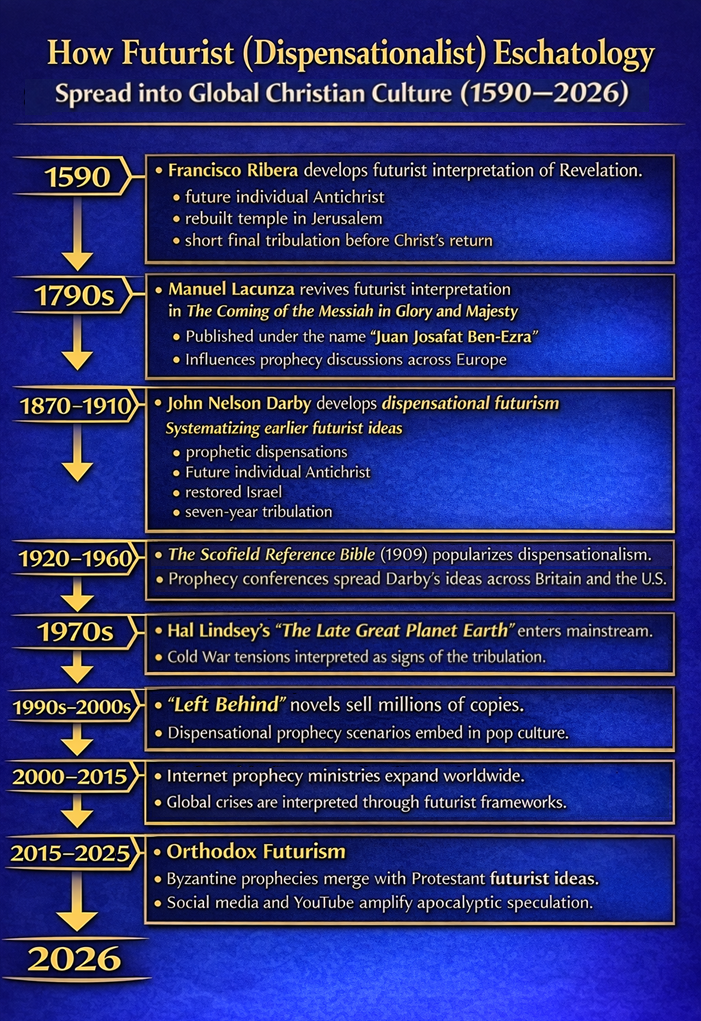
One of the most influential figures in this effort was the Spanish Jesuit theologian Francisco Ribera. In his commentary on the Apocalypse, Ribera argued that most of the prophecies of Revelation referred not to the long course of church history but to events that would occur in a brief period immediately before the end of the world. According to this interpretation, the Antichrist would arise as a future individual ruler, rebuild the temple in Jerusalem, and persecute the Church during a short final tribulation lasting three and a half years.
This futurist interpretation effectively shifted the focus of the Apocalypse away from the historical institutions of the Church and toward a distant future crisis. While Ribera’s work was initially part of a Catholic response to Protestant historicist readings, similar assumptions about a future Antichrist, a rebuilt temple, and a short final tribulation later appeared in various Protestant prophetic systems as well.
Understanding this historical development through the work of Ribera helps explain why many contemporary discussions of the end times—whether in evangelical or Orthodox media—often share similar assumptions about the Antichrist, the rebuilding of the temple in Jerusalem, and a short period of global tribulation immediately preceding the return of Christ.
The Revival of Futurism: Manuel Lacunza
Two centuries after the work of Francisco Ribera, futurist interpretation of the Apocalypse experienced a renewed development through the writings of the Chilean Jesuit theologian Manuel Lacunza (1731–1801). Writing during a period of exile in Italy after the suppression of the Jesuit order in Spanish territories, Lacunza composed an extensive eschatological treatise titled The Coming of the Messiah in Glory and Majesty. Because of the controversial nature of his ideas, the work was published under the pseudonym “Juan Josafat Ben-Ezra,” presented as the reflections of a converted Jewish scholar on biblical prophecy.
Lacunza’s work revived the futurist approach to Revelation first proposed by Ribera and helped reintroduce it into broader Christian discussions of prophecy during the late eighteenth and early nineteenth centuries. Like Ribera, Lacunza argued that the visions of the Apocalypse referred primarily to a future climactic period immediately preceding the Second Coming of Christ, rather than to the entire unfolding of church history.
Several themes emphasized in Lacunza’s writings would later appear in the eschatological framework developed in the nineteenth century by John Nelson Darby. These included the expectation of a future personal (Jewish) Antichrist, the idea of a short and intense 3.5 year period of tribulation before Christ’s return, and renewed attention to the future role of Israel within the divine plan of history. Although Lacunza did not construct the elaborate prophetic system later associated with dispensationalism, his work helped revive a futurist reading of prophecy that circulated widely in Europe during the early nineteenth century.
Through translations and discussions among Protestant interpreters of prophecy, Lacunza’s writings contributed to the intellectual environment in which Darby would later develop the more systematic framework of dispensational futurism.
The Rise of Dispensational Futurism
The system most closely resembling the modern prophecy scenario described above originated in the nineteenth century through the work of the Anglo-Irish Protestant theologian John Nelson Darby. John Nelson Darby incorporated and expanded many of these futurist ideas of Ribera within a broader prophetic framework that became known as dispensationalism. Through prophecy conferences, popular literature, and evangelical media, this system spread widely across the Protestant world and eventually became one of the most recognizable forms of modern prophecy teaching.
Darby developed a structured prophetic model that divided history into a series of “dispensations” and interpreted biblical prophecy in a highly literal and future-oriented way. Central features of this system included:
• the restoration of Israel as a central prophetic actor
• the rebuilding of a Jewish temple in Jerusalem
• the rise of a personal Antichrist who would sit in that temple
• a seven-year tribulation period divided into two halves
• the imposition of the “mark of the beast” through economic control
Through Bible conferences, popular prophecy books, and later through American Evangelical media, this system spread widely during the twentieth century.
By the late twentieth century it had become the dominant eschatological framework in large segments of Protestant Christianity.
Orthodox Tradition and the Antichrist
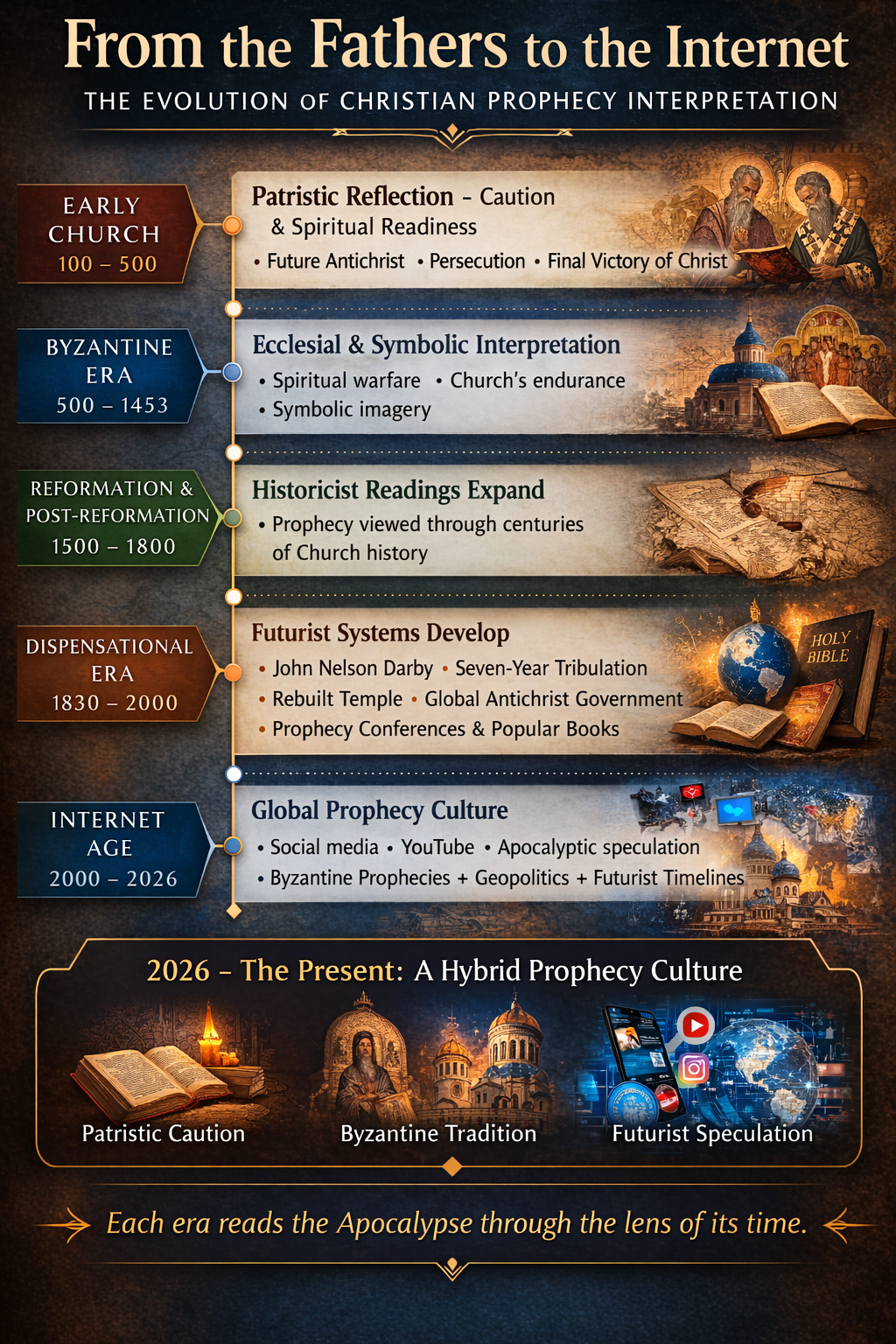
The Orthodox Church has always affirmed the reality of a future Antichrist. Early Christian writers frequently warned that before the final return of Christ a powerful deception would arise in the world, led by a figure who would oppose God and persecute the faithful. Authors such as Hippolytus of Rome and Cyril of Jerusalem discussed the Antichrist in their writings and exhorted Christians to remain spiritually vigilant.
In these early discussions the Antichrist was typically understood as a final manifestation of evil power that would seek to imitate or counterfeit the authority of Christ. He would deceive many, exalt himself above God, and wage persecution against the Church before the ultimate triumph of Christ at the end of history.
At the same time, the patristic tradition did not develop a detailed geopolitical scenario resembling the modern prophetic timelines that are sometimes presented today. The Fathers rarely attempted to construct elaborate chronological systems describing the exact sequence of world events leading to the end.
Instead, their emphasis remained primarily spiritual and pastoral. They warned believers about:
• the deception of the nations
• the persecution of the Church
• the danger of apostasy and moral compromise
• the final manifestation of evil before the return of Christ
These warnings were intended less as a map of future political developments and more as a call to vigilance, repentance, and steadfast faith.
Some early writers did speculate about the possibility that the Antichrist might appear in connection with Jerusalem or a temple, drawing upon passages such as those found in the Second Epistle to the Thessalonians. Yet even in these discussions the Fathers tended to speak cautiously and without constructing the elaborate prophetic systems that later developed in certain strands of Western theology.
For the early Church, the central concern was not the precise political structure of the Antichrist’s reign but the spiritual challenge it would present to believers. The emphasis remained on discernment, perseverance, and fidelity to Christ in the face of deception and persecution.
In this sense, patristic teaching about the Antichrist functioned primarily as a warning about the ultimate confrontation between truth and falsehood at the end of history rather than as a detailed forecast of specific geopolitical events.
The Byzantine Commentary Tradition
When examining the classical Orthodox commentary tradition on the Apocalypse, the interpretive tone becomes even clearer.
The most influential Byzantine commentary on the Book of Revelation was written by Andrew of Caesarea. His work shaped Orthodox interpretation of the text for centuries.
Andrew’s approach was characterized by several key features:
• caution toward speculative predictions
• recognition of symbolic and spiritual meanings
• reluctance to identify specific contemporary political actors with prophetic figures
The Apocalypse was understood as revealing the spiritual conflict between the Church and the powers of evil throughout history rather than providing a detailed forecast of modern geopolitical events.
The Influence of Modern Prophetic Traditions
In the twentieth century, however, another layer of prophetic interpretation began to circulate within Orthodox communities.
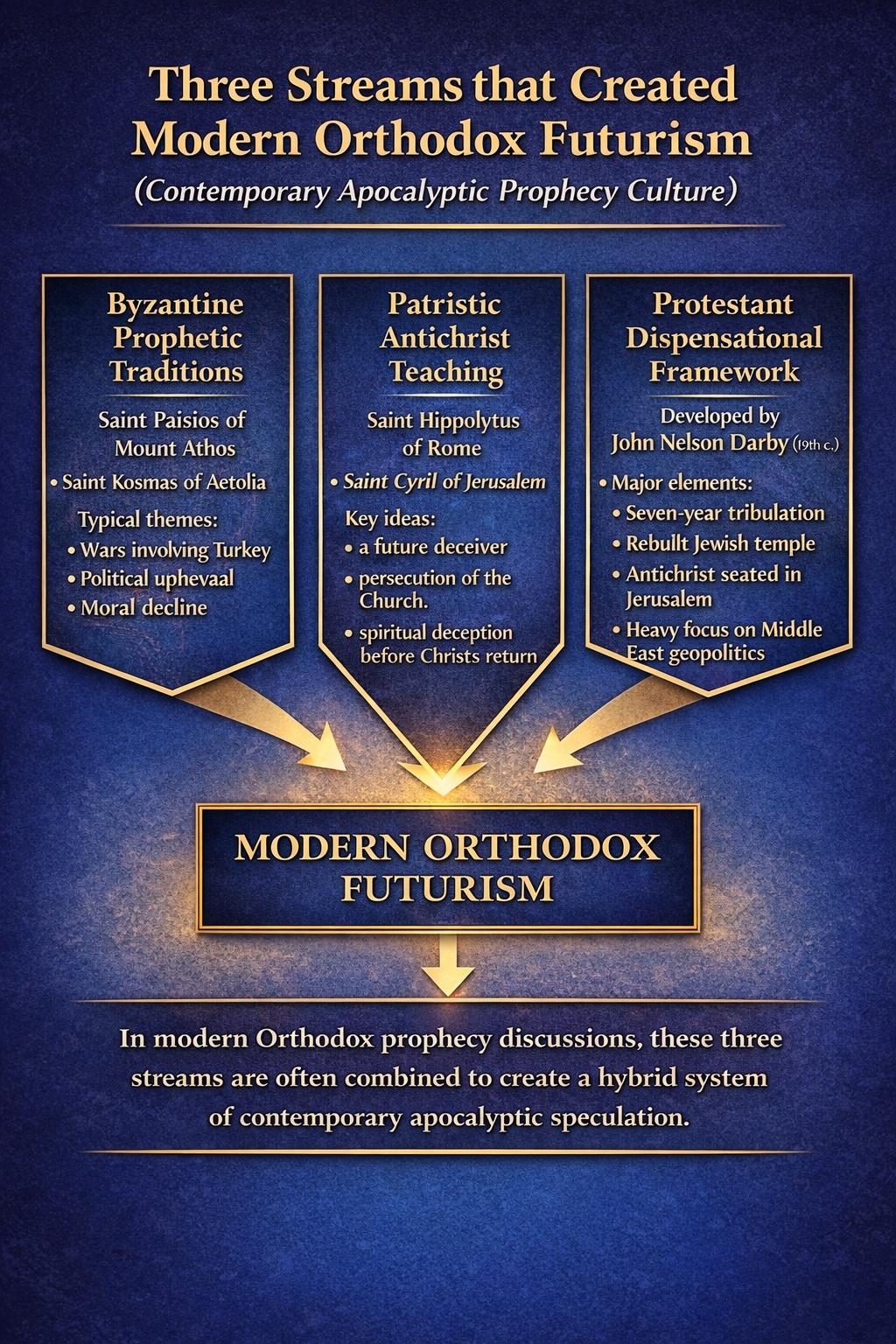
Sayings attributed to figures such as Paisios of Mount Athos and earlier prophetic traditions associated with Kosmas of Aetolia were increasingly discussed in connection with contemporary events.
Many of these traditions focused on themes such as:
• wars involving Turkey
• upheaval in the Middle East
• the possible liberation of Constantinople
These sayings were not originally connected to the elaborate dispensational timeline developed in Protestant theology. Yet in modern discussions they are often merged together into a single narrative.
As a result, a hybrid system emerges: Byzantine prophetic traditions are combined with Protestant futurist structures to produce a dramatic end-times scenario centered on imminent global conflict.
Technology and the “Mark of the Beast”
One of the most striking features of modern Orthodox prophecy discussions is the frequent identification of the “mark of the beast” with contemporary technologies such as digital identification systems, financial surveillance, biometric tracking, or biomedical interventions.
In many modern discussions the imagery of Revelation 13 is interpreted through the lens of technological development. Systems that regulate commerce, digital currencies, electronic identification, and global financial infrastructure are sometimes presented as potential mechanisms through which the “mark of the beast” might eventually be imposed.
The biblical passage describing the mark appears in the Book of Revelation, where it is associated with allegiance to a persecuting power:
“And he causes all, both small and great, rich and poor, free and slave, to receive a mark on their right hand or on their foreheads, so that no one may buy or sell except the one who has the mark.” (Revelation 13:16–17)
Within the symbolic language of the Apocalypse, the mark functions primarily as a sign of loyalty and participation in a system opposed to God. It stands in contrast to the “seal of God” placed upon the faithful earlier in the book (Revelation 7:3), suggesting that the imagery reflects competing forms of spiritual allegiance.
Historically, Christian interpreters applied this imagery in a variety of ways depending on the circumstances of their own time. Some early commentators associated the mark with loyalty to pagan imperial authority, particularly during periods when Christians were pressured to participate in emperor worship or civic religious rituals. Others interpreted it more broadly as participation in corrupt political or religious systems that demanded compromise with anti-Christian power.
Earlier Latin commentators on the Apocalypse also reflected deeply on the symbolism of the number associated with the beast. Some ancient manuscripts record the number as 616 rather than 666, and several early interpreters explored its possible connection with the name of Christ itself. In these readings the number was sometimes examined in relation to the Chi-Rho (☧)—the traditional Christogram used by early Christians. Within this interpretive framework, the numerical symbolism of the passage was understood not merely as a cryptic identifier of a future tyrant but as part of a broader Christological contrast within the Apocalypse, highlighting the opposition between the true authority of Christ and the counterfeit claims of worldly power.
In the Byzantine commentary tradition, interpreters such as Andrew of Caesarea approached the imagery with caution, emphasizing its symbolic and spiritual meaning rather than identifying it with specific institutions or technologies. The mark represented participation in the spirit of the Antichrist—an outward sign of inward allegiance to a system opposed to Christ and His Church.
In later centuries, particularly during the Reformation and post-Byzantine period, many historicist interpreters understood the imagery of Revelation as unfolding through successive historical events. Western Protestant writers often identified the Papacy with the apocalyptic beast, while a number of post-Byzantine Greek commentators interpreted the prophetic imagery in relation to the dominant powers of their own historical context, including both the Papal system in the West and the Islamic empires that had come to dominate much of the former Byzantine world. Within this historicist framework, the rise of Islam and the expansion of Islamic rule were sometimes understood as manifestations of the prophetic opposition to Christ described in the Apocalypse. The “mark of the beast” in such interpretations was therefore not viewed as a literal physical sign but as participation in religious or political systems perceived to stand in opposition to the apostolic faith. These interpretations illustrate how earlier Christian expectations about persecution, deception, and conflict with worldly powers were often applied to real historical developments rather than confined to a single future crisis.
These historical interpretations illustrate how Christian readers across different centuries sought to understand the imagery of Revelation within the context of their own historical experience. Rather than focusing on technological mechanisms, earlier interpreters tended to view the mark and the number of the beast as symbols of spiritual allegiance, religious authority, and the ongoing conflict between the kingdom of God and the powers of the world.
The idea that the mark refers specifically to modern technological systems is therefore a relatively recent interpretive development. As new technologies emerge—credit cards, barcodes, microchips, digital currencies, biometric identification—each generation has sometimes interpreted these innovations through the lens of Revelation’s imagery.
Yet the historical tradition of Christian interpretation suggests a more cautious approach. Rather than identifying the mark with any single technological innovation, many interpreters understood it as representing a deeper spiritual reality: the willingness to give allegiance to powers that oppose the kingdom of God.
Seen in this light, the imagery of the mark speaks not only to future events but to the perennial temptation faced by believers in every age—to compromise faithfulness in exchange for security, economic participation, or political favor.
From Historical Interpretation to Imminent Expectation
One of the most significant differences between classical Orthodox interpretation and modern futurist speculation lies in the treatment of history itself.
Traditional Christian interpreters often understood apocalyptic imagery as unfolding across the long course of history through recurring patterns of persecution, upheaval, and divine judgment. In this view, the symbols of the Apocalypse were not limited to a brief future crisis but reflected the ongoing struggle between the Church and the powers of the world throughout the centuries.
Many commentators approached the Book of Revelation as a theological interpretation of history rather than a detailed prediction of a single future sequence of events. The rise and fall of empires, periods of persecution, moral decline, and moments of renewal were all seen as part of the larger drama described in the prophetic imagery of the text.
This approach allowed the Apocalypse to function as a source of spiritual insight and historical reflection for Christians living in many different eras. Believers could recognize in its symbols the recurring patterns of worldly power, persecution, and divine providence that marked the life of the Church across generations.
Modern prophecy culture, by contrast, frequently assumes that nearly all apocalyptic prophecies remain unfulfilled and will occur within a short period immediately preceding the Second Coming. Within this framework, the imagery of Revelation is often interpreted as a chronological sequence of events that will unfold rapidly in the final years of human history.
As a result, contemporary geopolitical developments are sometimes read as potential fulfillments of specific prophetic symbols. Wars, international alliances, economic crises, and technological developments can quickly become incorporated into elaborate scenarios describing the rise of the Antichrist, the appearance of the mark of the beast, or the outbreak of a final global conflict.
This shift transforms prophecy from a theological reflection on history into a form of contemporary geopolitical forecasting. The focus moves away from understanding the spiritual meaning of apocalyptic imagery within the life of the Church and toward identifying the latest headlines that might signal the beginning of the final tribulation.
In the age of global media and instant communication, this tendency is further amplified. News cycles, social media discussions, and online commentary can rapidly transform complex geopolitical events into perceived signs of imminent prophetic fulfillment.
Yet the long history of Christian interpretation suggests that apocalyptic texts were often intended to cultivate vigilance, spiritual endurance, and trust in divine providence rather than precise predictions of political events. The enduring message of the Apocalypse is not that believers must decipher the exact timeline of the end of the world, but that Christ remains sovereign over history and that the Church will ultimately share in His final victory.
The Rise of YouTube Prophecy in Modern Orthodoxy
In recent years a new arena for prophecy discussion has emerged within Orthodox circles: online video platforms. Podcasts, livestreams, and YouTube channels now serve as major venues where theological commentary, geopolitical analysis, and prophetic interpretation intersect.
Eastern Orthodox Channels such as Orthodox Ethos and Church of the Eternal Logos regularly host discussions examining world events—wars in the Middle East, tensions involving Iran and Israel, global political instability, and emerging technologies—through the lens of Orthodox prophetic traditions. These conversations often draw upon sayings attributed to modern ascetics such as Paisios of Mount Athos as well as earlier figures like Kosmas of Aetolia.
The structure of these discussions typically follows a recognizable pattern. Current geopolitical developments are presented first, followed by references to prophetic sayings or biblical passages that appear to correspond with unfolding events. The discussion then expands into a broader scenario in which global war, political upheaval, and economic control systems are interpreted as precursors to the rise of the Antichrist described in the Book of Revelation and other New Testament passages.
This format reflects a broader shift in how prophecy is discussed in the digital age. Historically, eschatological reflection in the Church was often expressed through theological treatises, commentaries on Scripture, and pastoral teaching within the life of the Church. In contrast, contemporary prophecy discussions frequently unfold in real time as livestreamed conversations responding directly to breaking news events.
The result is a kind of “internet prophecy cycle.” Major geopolitical developments generate immediate commentary, prophetic sayings are introduced into the conversation, and a potential end-times timeline is constructed around the current moment. Social media then amplifies these interpretations, allowing them to circulate rapidly among audiences seeking guidance about how to understand world events.
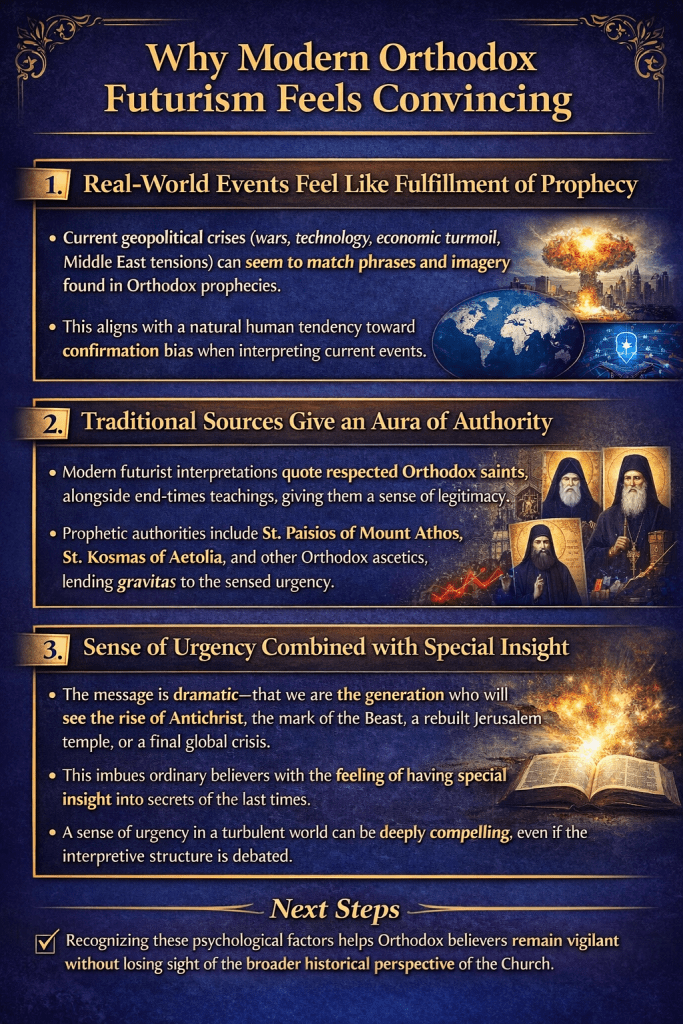
This phenomenon does not necessarily indicate a rejection of traditional Orthodox teaching. Many of these commentators sincerely seek to interpret contemporary history through the spiritual warnings preserved in Orthodox tradition. Nevertheless, the format of modern digital media encourages a style of interpretation that is often more immediate, speculative, and news-driven than the cautious approach typically found in earlier patristic and Byzantine commentary.
Another important observation concerns the sources from which many modern interpretations are drawn. While contemporary discussions frequently associate the “mark of the beast” with technological systems such as digital identification, financial surveillance, or electronic commerce, these connections rarely appear in the classical patristic commentaries on the Apocalypse. Writers such as Andrew of Caesarea interpreted the mark primarily in terms of spiritual allegiance and participation in systems opposed to Christ. The technological interpretation of the mark emerged much later, especially within twentieth-century evangelical prophecy literature that interpreted new technologies through the lens of futurist eschatology. Through books, conferences, television programs, and later the internet, these interpretations spread widely across the Christian world. As a result, many modern discussions of the mark of the beast—whether in evangelical or Orthodox settings—often reflect themes popularized in modern prophecy media rather than the language of the ancient commentaries themselves.
Understanding this shift is essential for interpreting the current landscape of Orthodox prophecy discussions. The rise of online platforms has not only expanded access to theological dialogue but has also reshaped the way prophetic texts are read—placing them in constant conversation with the rapidly changing headlines of the modern world.
Recovering a More Historical Approach
Recognizing the difference between these interpretive traditions does not require dismissing the possibility of future prophetic events. The Church has always affirmed that history will culminate in a final confrontation between Christ and the forces of evil.
However, the historical record shows that Christian interpretation of prophecy has rarely been limited to short-term predictions about contemporary political events.
Instead, prophecy has often been understood as revealing the deeper spiritual patterns at work across centuries of human history.
Recovering this broader historical perspective may help restore a more balanced approach to eschatology—one that encourages vigilance and repentance without reducing the mysteries of prophecy to speculation about the next geopolitical crisis.
In light of these developments, a renewed attention to the historical interpretation of prophecy may offer a more stable path forward. Rather than reducing apocalyptic texts to either purely future speculation or constantly shifting headlines, the historic approach recognizes that the imagery of Scripture has often unfolded across the long course of Christian history. From the persecutions of the early Church to the rise and fall of empires, the prophetic vision has repeatedly revealed deeper patterns in the spiritual drama of civilization. Recovering this broader historical perspective—what might be called a Eastern Orthodox Historicist reading—does not deny the possibility of future fulfillment. Instead, it restores prophecy to its original role: illuminating the providential movement of history while calling the faithful in every generation to vigilance, repentance, and hope.
Prophecy was never given so that Christians might predict the next headline, but so that they might recognize the hand of Providence moving quietly through the centuries of Christian history.
© 2026 by Jonathan Photius
Where Modern Orthodox Futurism Parallels Dispensationalism
| Prophetic Theme | Dispensational Futurism (19th–20th c. Protestant System) | Modern Orthodox Futurism |
|---|---|---|
| Prophetic Timeline | Most prophecy is reserved for a short future period immediately before the Second Coming. | Most prophetic passages are interpreted as referring to events that will occur shortly before the end of the world. |
| Seven-Year Tribulation | A future seven-year tribulation divided into two halves (3½ + 3½ years). | The Antichrist is expected to rule for seven years, often described in two phases. |
| Rebuilt Temple in Jerusalem | A literal Jewish temple must be rebuilt where the Antichrist will sit. | The destruction of the current Islamic structures and rebuilding of the Temple is often expected before Antichrist appears. |
| Jewish Reception of Antichrist | The Antichrist deceives Israel and is accepted as the Messiah. | Jews are often expected to recognize Antichrist as the promised Messiah. |
| Global Political Leader | The Antichrist becomes a world political ruler who dominates nations. | The Antichrist is frequently described as a future global political leader controlling governments. |
| Economic Control System | The “mark of the beast” controls buying and selling through a global economic system. | Modern technologies (digital IDs, financial systems, etc.) are sometimes interpreted as precursors to the mark. |
| Focus on Middle East Geopolitics | Prophecy centers heavily on Israel, Jerusalem, and Middle Eastern conflict. | Modern geopolitical events in Israel, Iran, Turkey, and the region are treated as prophetic signs. |
| Interpretation of Current Events | Contemporary news is interpreted as direct fulfillment of biblical prophecy. | Current geopolitical crises are frequently interpreted as signs of the approaching tribulation. |
| Imminence of the End | Believers are told the end may occur very soon as prophetic signs align. | Discussions often emphasize that the rise of Antichrist may be near in the present generation. |
| Prophecy Teaching Style | Prophetic timelines, charts, and scenario-building are common teaching tools. | Prophecy discussions increasingly resemble scenario-based forecasting of future events. |
When placed side by side, the similarities become difficult to ignore. While Orthodox teachers naturally draw from the language of the Fathers and later prophetic traditions, the overall interpretive structure often mirrors the framework that developed in modern Protestant dispensationalism. Recognizing this parallel does not invalidate Orthodox prophetic traditions, but it does encourage a careful reexamination of how these ideas have been combined in contemporary discussions.
Orthodox Historic Interpretation vs. Modern Orthodox Futurism
| Category | Orthodox Historic Interpretation | Modern Orthodox Futurism |
|---|---|---|
| Primary Approach to Prophecy | Prophecy unfolds gradually across the course of Christian history. Apocalyptic imagery reflects recurring spiritual and historical patterns. | Most prophecies remain unfulfilled and will occur in a short period immediately before the Second Coming. |
| Interpretation of Revelation | Often symbolic, ecclesial, and historical. The book portrays the spiritual struggle between the Church and worldly powers. | Frequently interpreted as a literal sequence of future geopolitical events. |
| View of Historical Events | Major upheavals in history (persecutions, collapses of empires, wars) may reflect apocalyptic imagery. | Historical events are generally not seen as fulfillments of prophecy unless they are direct precursors to the final tribulation. |
| Role of Contemporary News | Current events are approached cautiously and rarely identified directly with prophetic passages. | Current geopolitical developments are often interpreted as immediate signs of approaching end-time events. |
| Antichrist Expectations | The Fathers affirm a future Antichrist but rarely construct a detailed political timeline. | A structured timeline is proposed: rise of Antichrist, rebuilt temple, seven-year tribulation, global control system. |
| Temple in Jerusalem | Some Fathers speculated about a temple, but interpretation varied and was not systematized. | A literal rebuilding of the Jewish temple is often treated as a central prophetic necessity. |
| Mark of the Beast | Historically interpreted as allegiance to persecuting power or participation in anti-Christian authority. | Often linked to modern technologies such as digital identification systems or global economic control mechanisms. |
| Sources Emphasized | Scripture, patristic commentary, and the long experience of the Church through history. | A combination of Scripture, modern prophetic sayings, and contemporary geopolitical analysis. |
| Pastoral Tone | Emphasis on vigilance, repentance, and humility regarding the mystery of future events. | Emphasis on identifying imminent prophetic signs and preparing for an approaching end-time scenario. |
| Historical Method | Prophecy interpreted within the unfolding narrative of Christian civilization. | Prophecy interpreted primarily as prediction of near-future global events. |
 NEO-Historicism - End Times Eschatology From An Eastern Orthodox Christian Historicist Perspective