
An Eastern Orthodox Historicist Reassessment
By Jonathan Photius – The NEO-Historicist Research Project
What if Armageddon is not a single battlefield in the Middle East, but a prophetic symbol for the catastrophic wars of the modern age?
The Book of Revelation describes a gathering of the nations for battle, a great earthquake that shakes the political order of the world, the disappearance of mountains and islands, and the remembrance of “Babylon” before God. Within the Eastern Orthodox historicist tradition, such imagery has often been understood symbolically—as describing profound upheavals among nations rather than merely a future military event. When read in this light, the devastation of the twentieth century—the collapse of ancient empires, the dissolution of colonial systems, and the unprecedented slaughter of nations in the World Wars—raises a striking question: could the prophetic imagery of Armageddon describe the age of world war itself and not the physical location in northern Israel?
Introduction
Few words in Scripture have captured the imagination of modern readers more than Armageddon. Popular interpretations frequently imagine it as a future military battle in the Middle East, a final clash between armies at the end of the world. Yet within the historic interpretive traditions of the Church, the meaning of Armageddon has often been understood quite differently.
The Apocalypse itself provides only a brief description of the event:
“And he gathered them together into a place called in the Hebrew tongue Armageddon.”
(Revelation 16:16)
This enigmatic phrase occurs within the narrative of the seventh vial of God’s wrath, immediately preceding a series of cosmic and political upheavals described in Revelation 16:17–21. The brevity of the reference leaves its meaning open to interpretation, and throughout history commentators have sought to understand the symbolic significance of this mysterious location.
Within the Eastern Orthodox historicist tradition, the imagery of Revelation is often understood not as a literal geographical forecast but as a symbolic portrayal of historical upheavals among nations.
Armageddon and the “Slaughter of Nations”
The term Armageddon derives from the Hebrew Har-Magedon.¹
The expression has often been associated with the ancient battlefield of Megiddo, but the language itself also evokes imagery of catastrophic destruction. In the context of Revelation, the name therefore functions symbolically, pointing not merely to a geographic location but to a climactic moment of immense slaughter among nations.
The Apocalypse immediately associates this place with the gathering of “the kings of the earth and of the whole world” for a decisive conflict (Rev. 16:14).² The emphasis is therefore not on a local skirmish but on a confrontation involving the nations collectively.
In earlier ages warfare was typically limited to regional struggles between neighboring kingdoms. In the modern era, however, warfare assumed an unprecedented scale. The twentieth century witnessed the emergence of total war, in which entire nations were mobilized and millions of soldiers and civilians were drawn into a single global conflict.
For the first time in human history, the armies of the earth were literally gathered together in worldwide war. In this sense the imagery of Armageddon resonates strikingly with the historical phenomenon of world war—the slaughter of nations on a global scale.
The Hebrew Name “Armageddon” And Its Linguistic Clue
The Book of Revelation introduces the term Armageddon with a notable linguistic clue. In Revelation 16:16 the Apostle John writes:
καὶ συνήγαγεν αὐτοὺς εἰς τὸν τόπον τὸν καλούμενον Ἑβραϊστὶ Ἁρμαγεδών —
“And he gathered them together into the place called in the Hebrew tongue Armageddon.”
Significantly, John does not translate the name for his Greek-speaking readers but preserves its Hebrew form. This suggests that the name itself carries interpretive significance. Such usage reflects a common prophetic technique in Scripture, where names function not merely as geographic identifiers but as theological explanations of events. The New Testament preserves several examples of this practice: Golgotha, meaning “place of the skull”; Immanuel, meaning “God with us”; and in Revelation itself Abaddon or Apollyon, meaning “destroyer” (Rev. 9:11). In each case the name reveals something about the meaning of the event it describes.
The expression Har-Magedon therefore invites closer examination. The first component of the word is relatively clear. The Hebrew term har (הר) means mountain, and throughout Scripture mountains frequently symbolize kingdoms, political powers, or centers of authority (cf. Dan. 2:35; Jer. 51:25). The second component of the name is more debated. Traditionally it has been connected with Megiddo, the site of several decisive battles in Israel’s history. Yet some interpreters have observed that the related Hebrew root גדד (gdd) carries the sense of cutting down, attacking, or slaughtering. In this light, the expression Har-Magedon can suggest not merely a geographic reference but a symbolic phrase that evokes the idea of a “mountain of slaughter” or “massacre mountain.”
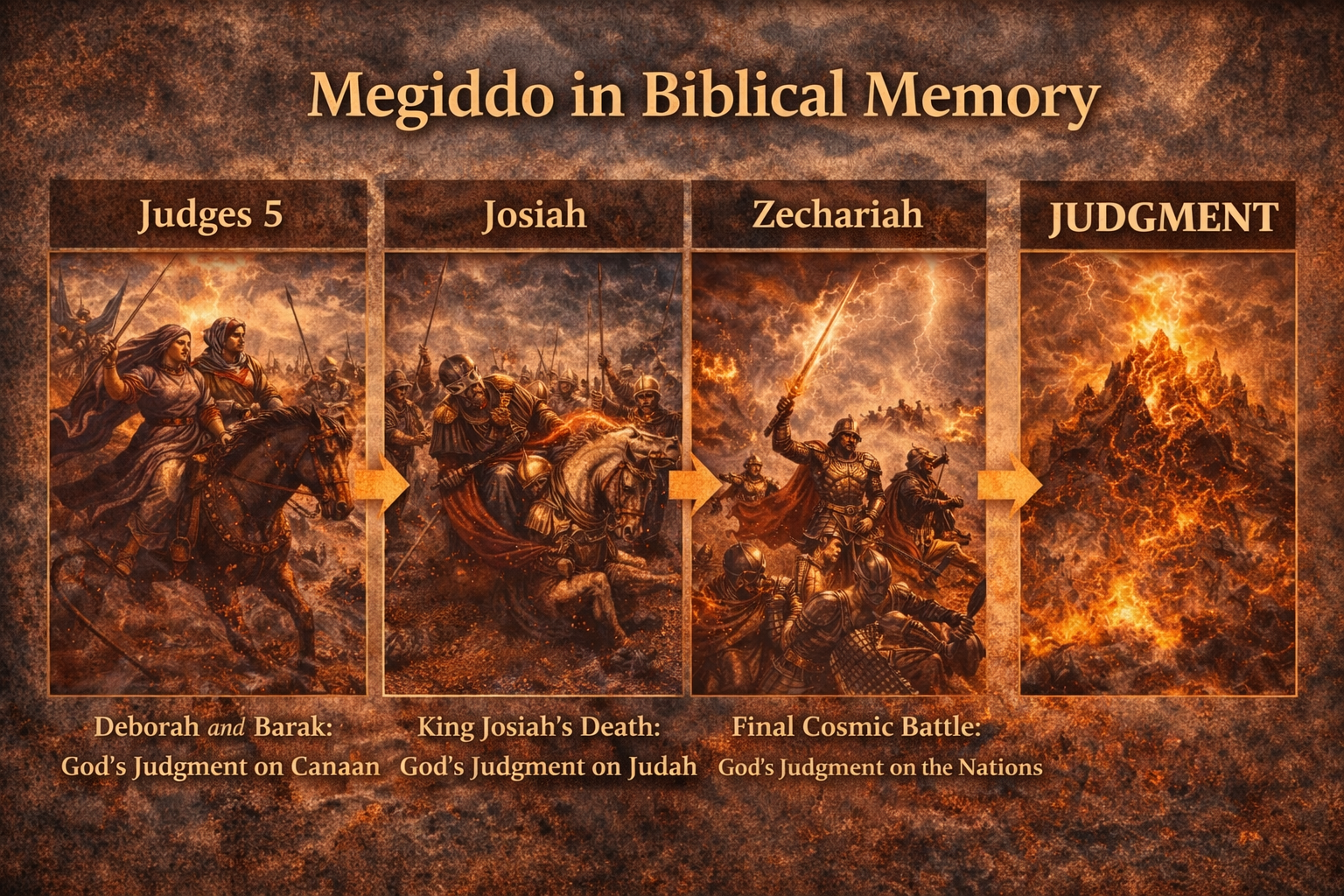
Megiddo itself carried powerful historical associations in Israel’s memory.³ In the Old Testament it was the site of several devastating national tragedies. It was near Megiddo that the forces of Sisera were defeated in the conflict described in Judges 4–5, and it was also at Megiddo that the righteous King Josiah was slain by Pharaoh Necho of Egypt (2 Kings 23:29). The death of Josiah in particular became a moment of profound national mourning for Israel (cf. Zech. 12:11). As a result, the name Megiddo came to symbolize catastrophic national loss and the tragic fall of leaders and armies. When John therefore invokes the name Armageddon in Revelation, he may be deliberately drawing upon this historical memory—evoking the archetypal battlefield where nations suffer devastating defeat. In this sense the symbolism again aligns strikingly with the idea of Armageddon as the slaughter of nations, a conflict marked by massive loss among the powers of the earth.
Such a reading fits remarkably well with the immediate context of Revelation. The passage describes the gathering of the “kings of the earth and of the whole world” for a catastrophic conflict (Rev. 16:14). The emphasis is therefore not on a single battlefield but on the massive destruction that accompanies the clash of nations.
John’s deliberate remark that the name is given “in the Hebrew tongue” further suggests that it functions as symbolic prophetic language, much like other symbolic place names used throughout the Apocalypse. The book repeatedly employs such names to evoke historical archetypes rather than literal geography. The persecuting power opposed to God’s people is called Babylon (Rev. 17–18). The city of persecution is described as Sodom and Egypt (Rev. 11:8). In the final conflict of the book the enemies of God are gathered under the ancient names Gog and Magog (Rev. 20:8).⁴
Armageddon appears to operate in this same symbolic register. Rather than pointing only to a specific location in northern Israel, the name may function as a prophetic image describing a catastrophic moment in history when the nations themselves are cut down in great numbers. Within this framework the expression Har-Magedon can be understood as the “mountain of slaughter,” a symbolic description of the massive destruction accompanying the gathering of the kings of the earth.
This interpretation also harmonizes with the broader argument of this article. If mountains symbolize political powers or kingdoms, and the term itself evokes slaughter on a vast scale, then Armageddon naturally becomes a prophetic image of the slaughter of nations—a catastrophic conflict in which the powers of the world collide and the political landscape of civilization is dramatically reshaped.
The Great Earthquake of the Modern Age
Revelation describes the aftermath of the seventh vial with dramatic imagery:
“There were voices, and thunders, and lightnings; and there was a great earthquake, such as was not since men were upon the earth, so mighty an earthquake, and so great.”
(Revelation 16:18)
Within the symbolic language of prophecy, earthquakes frequently represent political and social upheaval rather than literal geological events.⁵ The prophet Haggai, for example, describes God shaking the nations and overthrowing the thrones of kingdoms (Haggai 2:21–22). The language of shaking the earth therefore serves as a metaphor for the collapse of political orders.
The twentieth century witnessed precisely such upheaval. The two World Wars produced a convulsion in the international system unlike anything seen before. Ancient empires that had dominated the political landscape for centuries collapsed in rapid succession.
Progressive “Moral Earthquakes” in History
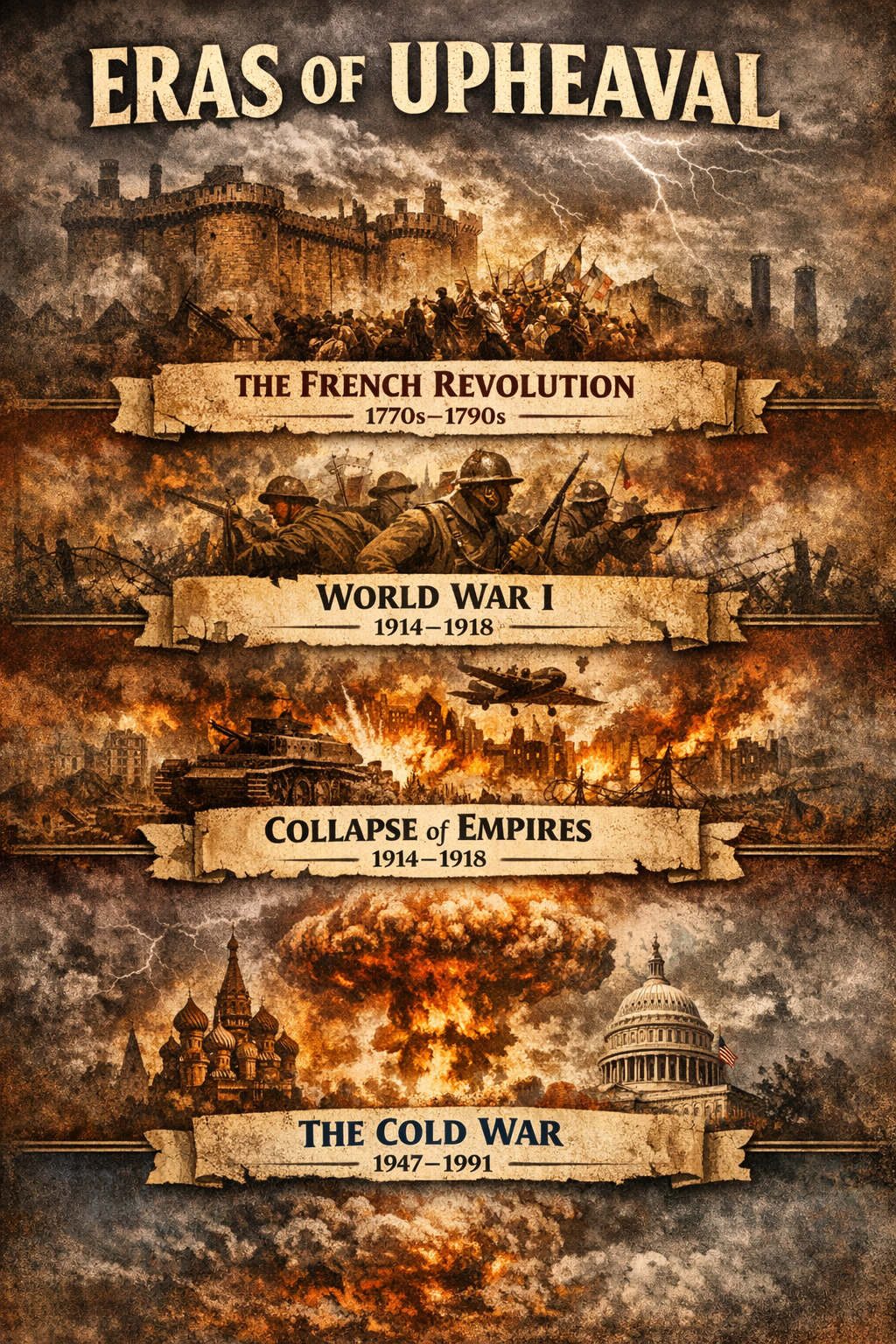
Apostolos Makrakis did not interpret the prophetic earthquakes of Revelation as literal geological events but as profound upheavals in the moral, political, and spiritual order of civilization. One of his primary examples was the French Revolution, which he described as a kind of “moral earthquake” that shook the foundations of the old European order. The Revolution overturned long-standing structures of monarchy, church-state relations, and social hierarchy, sending ideological and political shockwaves across the continent. If this interpretive principle is extended forward, the crises of the modern age appear as successive waves of the same historical convulsion. The French Revolution initiated the destabilization of the traditional imperial order, while the First World War shattered several of the great empires that had dominated Europe and the Near East for centuries—the Ottoman, Austro-Hungarian, German, and Russian empires. The Second World War intensified this upheaval and accelerated the dissolution of colonial systems across the globe. The Cold War then introduced a new stage of global tension in which rival ideological powers possessed weapons capable of destroying entire civilizations. Viewed together, these events resemble a series of escalating historical tremors shaking the structures of empire and political authority. In the language of Revelation, the earth itself appears to convulse as the cities of the nations fall and the mountains of imperial power disappear (Rev. 16:18–20). Within such a framework, Makrakis’ interpretation of the French Revolution as a “moral earthquake” may be understood as the opening phase of a much larger historical transformation unfolding across the modern era.
Structural Parallel with the Seventh Trumpet
This imagery may also reflect a deeper structural pattern within the Apocalypse itself. The events surrounding the seventh vial closely parallel those described when the seventh trumpet sounds earlier in the book. When the seventh trumpet is announced, Revelation declares that “the kingdoms of this world are become the kingdoms of our Lord, and of his Christ” (Rev. 11:15), followed by a sequence of thunder, lightning, earthquake, and hail (Rev. 11:19). The seventh vial unfolds in remarkably similar terms: a heavenly proclamation—“It is done” (Rev. 16:17)—is followed by voices, thunder, lightning, a great earthquake, and devastating hail (Rev. 16:18–21). The repetition of these elements strongly suggests that the seventh trumpet and seventh vial describe the same climactic transformation of the world order from complementary perspectives. Earlier in Revelation we are told that “in the days of the voice of the seventh angel… the mystery of God should be finished” (Rev. 10:7). If so, the declaration “It is done” at the pouring out of the seventh vial may mark the completion of that prophetic process. Within a historicist framework such as that employed by Greek Orthodox Commentators during the Post-Byzantine Exegesis¹⁰ period—who interpreted earlier judgments in relation to the fall of papal power, the collapse of Ottoman dominance, and the upheavals of the modern age—this structural parallel naturally points to the culmination of a long historical drama in which the great imperial systems of the world are shaken and brought to their end.
Mountains Disappear and Islands Flee
Immediately following the description of the earthquake, the Apocalypse declares:
“Every island fled away, and the mountains were not found.”
(Revelation 16:20)
Throughout Scripture mountains frequently represent kingdoms or great political powers (cf. Dan. 2:35; Jer. 51:25). The prophet Daniel famously describes the kingdom of God as a mountain filling the whole earth (Daniel 2:35).⁶ The disappearance of mountains in Revelation therefore suggests the collapse of great political powers. If understood in this sense, the early twentieth century witnessed precisely such a phenomenon. In addition to the collapse of continental empires, the global colonial system that had dominated the previous centuries began to unravel.
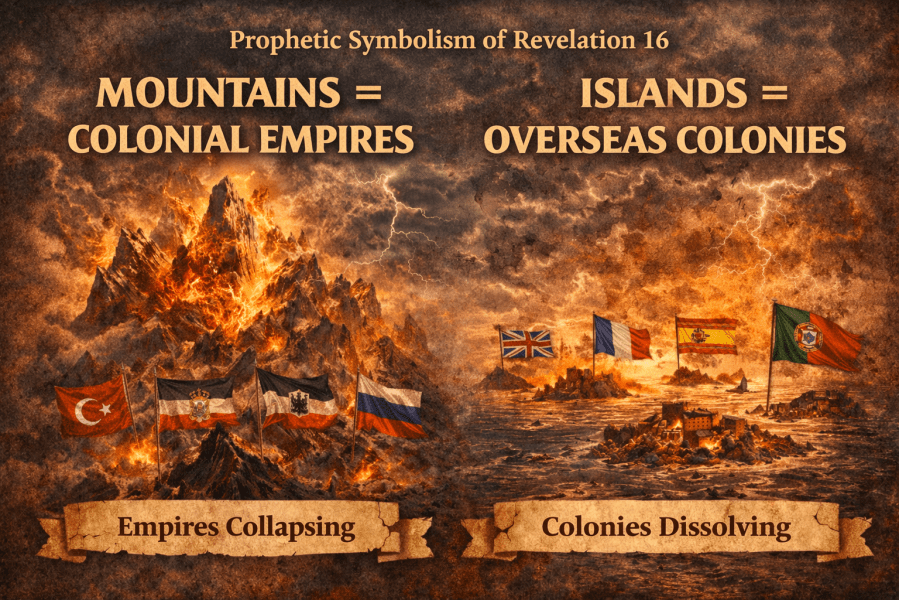
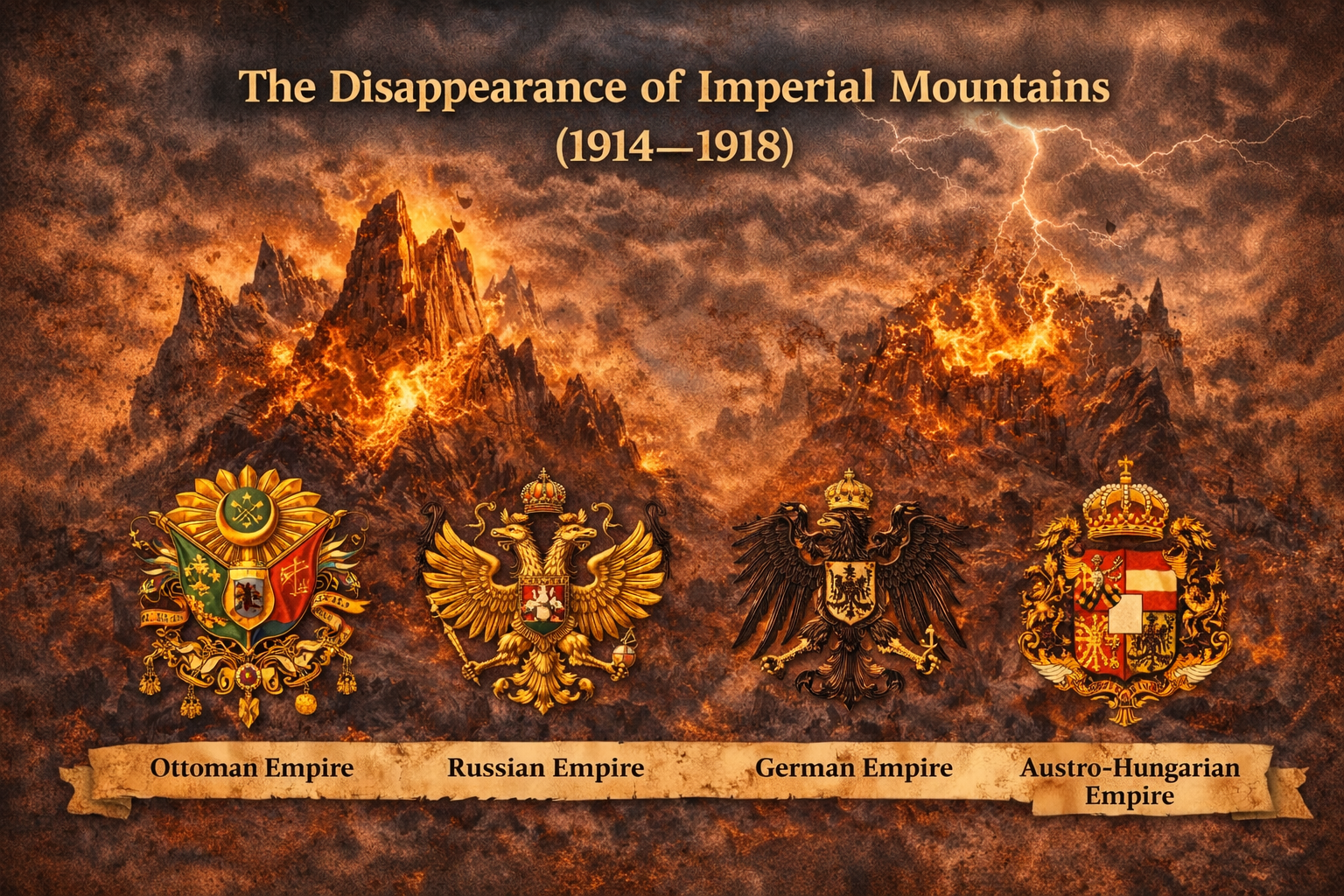
Within the span of only a few years several long-standing imperial “mountains” disappeared from the map:
• The Ottoman Empire, which had ruled large portions of the Middle East and southeastern Europe for nearly five hundred years before its dissolution after the First World War.
• The Austro-Hungarian Empire, a multinational monarchy that had dominated central Europe until its collapse in 1918.
• The German Empire, whose defeat in World War I ended the Hohenzollern monarchy and radically reshaped German political life.
• The Russian Empire, whose centuries-old imperial structure collapsed in the revolutionary upheavals of 1917.
At the same time following the two world wars, the colonial “islands” of European powers gradually vanished as overseas territories moved toward independence during the twentieth century.⁷ The British Empire relinquished control over India and much of its global domain. France lost its colonies in North Africa and Southeast Asia. Spain and Portugal saw the final dissolution of their once-vast imperial possessions.
In prophetic symbolism, these developments resemble the imagery of “islands fleeing away.” Territories that had once formed distant extensions of imperial power disappeared from the control of the great European states. These events dramatically altered the political map of Europe and the Near East. Empires that had stood for centuries vanished within a single generation.
Armageddon and the Era of World War
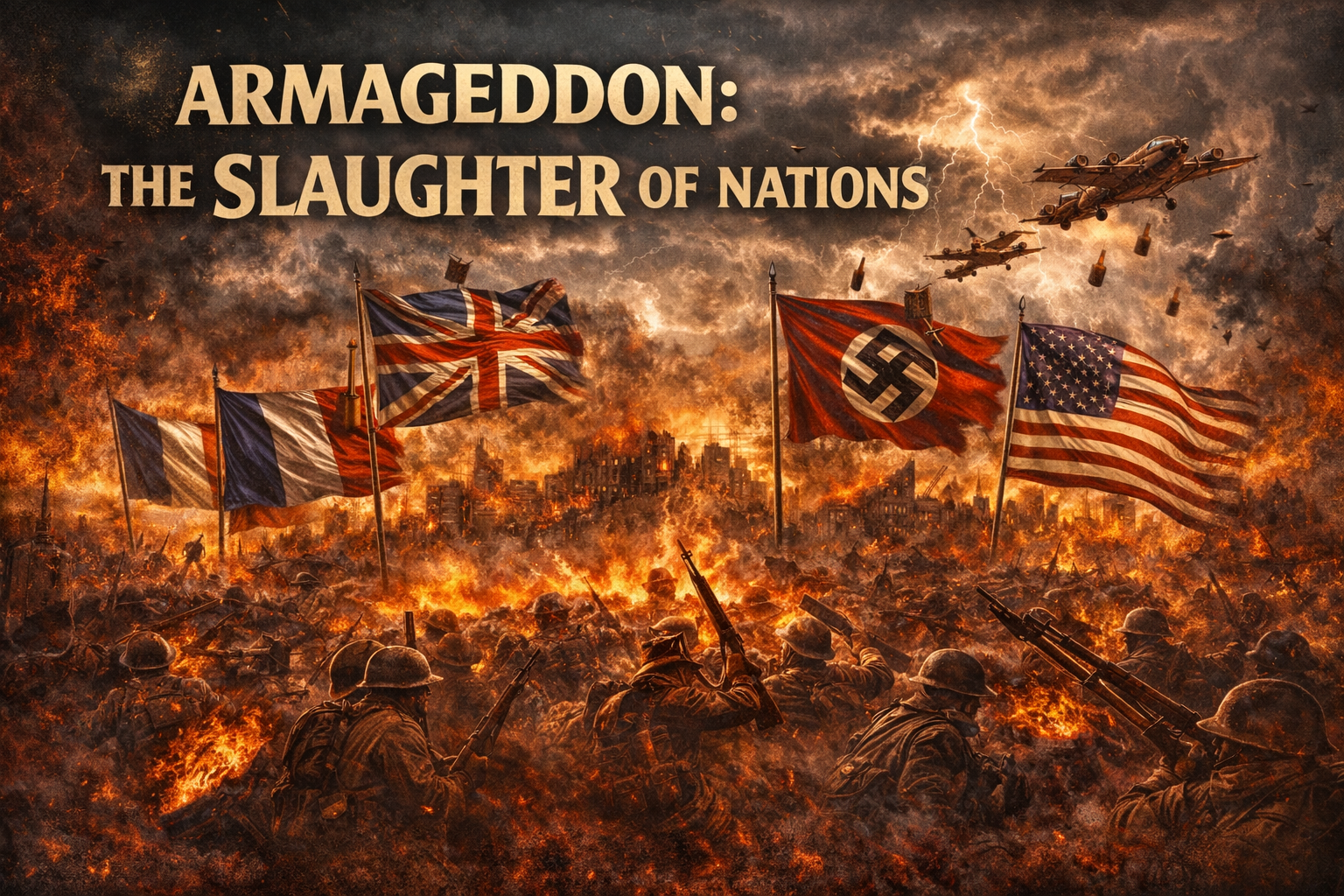
The unprecedented scale of destruction during the two World Wars gives concrete historical expression to the concept of Armageddon as the slaughter of nations.
World War I mobilized more than sixty million soldiers and produced casualties on a scale previously unimaginable. World War II surpassed even this devastation, spreading conflict across Europe, Asia, Africa, and the Pacific and resulting in tens of millions of deaths.⁸
Never before had warfare involved so many nations simultaneously or produced such widespread destruction. The conflicts of the twentieth century therefore represent the first truly global wars, in which the armies of the earth were gathered into a single catastrophic struggle.
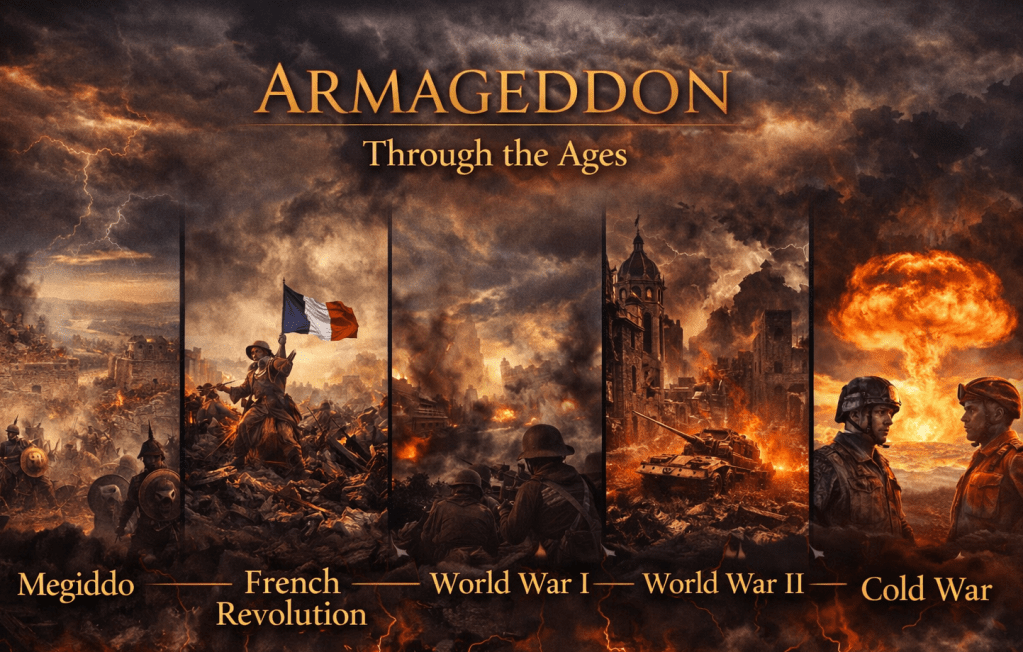
From the perspective of prophetic symbolism, the imagery of Revelation 16—nations gathered for battle, massive destruction, and the collapse of long-standing political powers—bears a striking resemblance to this historical phenomenon.
The Hailstones of Destruction
Revelation continues:
“And there fell upon men a great hail out of heaven, every stone about the weight of a talent.”
(Revelation 16:21)
The talent was an enormous unit of weight in the ancient world, roughly seventy to one hundred pounds. The image of hailstones of such magnitude conveys overwhelming devastation descending from above. Ancient readers would have imagined enormous stones falling from the sky.
In the modern era, however, the imagery evokes an unsettling parallel with the destructive power of aerial bombardment and nuclear weapons, which brought unprecedented devastation from above during the world wars. In the modern era the imagery evokes an unsettling parallel with the destructive power of aerial warfare. The twentieth century introduced weapons capable of raining devastation from the sky, as seen in the bombardments of Dresden and Tokyo and, most dramatically, in the atomic destruction of Hiroshima and Nagasaki—an unimaginable form of destruction in earlier centuries. The atomic bomb code-named Little Boy, dropped on Hiroshima in 1945, contained approximately 64 kilograms (about 141 pounds) of uranium-235—remarkably close to the weight of a biblical talent, often estimated between 75 and 125 pounds.
Significantly, the prophecy concludes with the observation that humanity does not repent, but instead blasphemes God because of the plague of the hail. This is interesting, because if this was the final war that leads to to the return of Christ (according to the Protestant Dispensationalists), why does the text describe humanity continuing to blaspheme God? Perhaps because this detail resonates strikingly with the tense decades of the Cold War, when the world entered an era defined not by repentance but by the terrifying doctrine of mutual nuclear destruction.
While the prophetic imagery should not be forced into a literal technological prediction, the symbolism nevertheless captures the immense destructive power that modern warfare unleashed upon humanity.
A Three-Stage Gathering of the Nations?
It is also noteworthy that the twentieth century witnessed not merely a single global conflict but a sequence of escalating international crises that progressively gathered the nations into opposing camps. The First World War mobilized the major powers of Europe and their imperial domains into a catastrophic continental struggle. The Second World War expanded this conflict into a truly global confrontation involving nations across Europe, Asia, Africa, and the Pacific. In the decades that followed, the Cold War further divided the world into vast geopolitical blocs armed with unprecedented destructive power. While the imagery of Revelation should not be forced into a rigid chronological scheme, the progression from World War I to World War II and finally to the global tension of the Cold War suggests a striking historical pattern: a gradual gathering of the nations into ever larger and more dangerous alignments, echoing the Apocalypse’s description of the kings of the earth being assembled for the climactic conflict associated with Armageddon (Rev. 16:14–16).
Babylon, Constantinople, and the Judgment of History
The climactic judgment of the seventh vial includes a striking declaration:
“And great Babylon came in remembrance before God, to give unto her the cup of the wine of the fierceness of his wrath.”
(Revelation 16:19)
Within the historic interpretive tradition of the Christian East, the identity of “Babylon” was sometimes understood symbolically rather than strictly geographically. While many commentators identified Babylon primarily with Rome or with corrupt political systems of the world, certain later Orthodox interpreters associated the imagery of Babylon with Constantinople under foreign domination.
One notable example appears in the writings of Theodoret of Ioannina, an eighteenth-century Orthodox commentator on the Apocalypse. In his interpretation of Revelation, Theodoret suggested that the “great city” described in the prophetic vision could be understood symbolically in relation to Constantinople and the Ottoman imperial order that had come to dominate the Christian East.⁹ This interpretation reflects a broader theme found in the Byzantine apocalyptic tradition, which often portrayed Constantinople as a city temporarily subjected to foreign powers yet destined for eventual restoration.¹⁰
The nineteenth-century Orthodox thinker Apostolos Makrakis developed similar ideas in his own historicist reading of the Apocalypse, connecting the prophetic imagery of the “great city” with the historical drama surrounding Constantinople and the long struggle between Christian and Islamic political powers.¹¹
The declaration that “Babylon came in remembrance before God” may be understood as a symbolic reference to the ultimate judgment of the political and religious powers that have dominated the nations. Yet Revelation immediately expands this vision beyond the fate of a single city. The prophecy unfolds as a sequence of escalating upheavals affecting both cities and nations:
“The great city was divided into three parts… and the cities of the nations fell.”
(Revelation 16:19)
This description has long puzzled interpreters. When viewed against the backdrop of modern history, however, the language becomes intriguingly suggestive. Following the collapse of the Ottoman Empire during the First World War, Constantinople itself was briefly occupied and effectively divided among the Allied powers, including Britain and France, while earlier diplomatic agreements had envisioned the city ultimately passing into Russian control.¹² After WWI, Allied forces (British, French, and Italian) occupied Constantinople in November 1918, dividing the city into three administrative zones. This occupation, which lasted until 1923, was designed to control the Ottoman capital and straits. The zones largely followed existing, natural divisions of the city, such as the Bosphorus and Golden Horn. For a brief moment, the ancient imperial capital indeed stood under the administration of several competing powers.
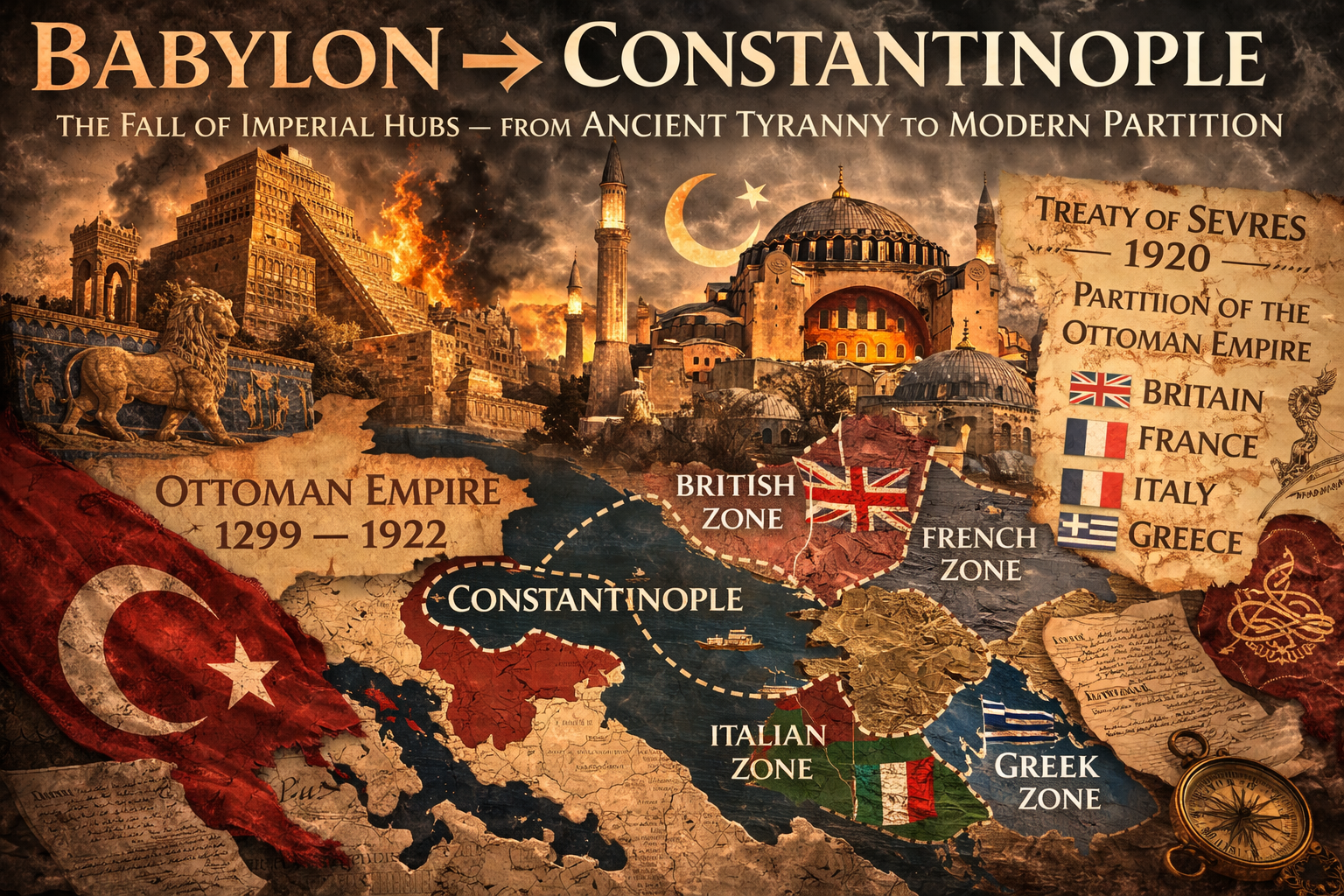
Constantinople was often described as New Rome and, in certain strands of the Byzantine Apocalyptic Tradition, even as a symbolic New Babylon. Several Orthodox prophetic texts center future historical upheavals around the city. Traditions attributed to St. Kosmas the Aitolos, the Anonymous Prophecy of 1053, and St. Andrew the Fool for Christ all speak of dramatic events connected with Constantinople and the surrounding region. In light of these traditions, some interpreters have noted the striking historical moment after the First World War when the city was effectively divided among the Allied powers. Within a historicist framework, such developments raise intriguing questions about whether the prophetic imagery of nations gathered for catastrophic conflict—the “mountain of slaughter” associated with Armageddon—may symbolically intersect with the turbulent history of the imperial city itself.
Old Testament Echoes of the Fall of Babylon
The imagery of the seventh vial also appears to echo earlier Old Testament prophecies describing the fall of ancient Babylon. The prophets frequently portrayed Babylon’s downfall using dramatic cosmic language—earthquakes, the shaking of the earth, and the collapse of cities and kingdoms. Isaiah, for example, declares of Babylon: “I will shake the heavens, and the earth shall remove out of her place, in the wrath of the LORD of hosts” (Isa. 13:13). Jeremiah likewise describes the catastrophe in sweeping terms: “At the noise of the taking of Babylon the earth is moved, and the cry is heard among the nations” (Jer. 50:46). Revelation’s description of the seventh vial strikingly mirrors this prophetic pattern: a great earthquake shakes the earth (Rev. 16:18), the cities of the nations fall (Rev. 16:19), and Babylon comes into remembrance before God (Rev. 16:19). The parallels suggest that John is deliberately invoking the Old Testament archetype of Babylon’s collapse in order to portray the judgment of a global imperial order. In this sense, the symbolic fall of “Babylon” in Revelation continues the biblical pattern in which the rise and fall of great world empires becomes the stage upon which divine judgment unfolds within history.
Conclusion
The symbolism of Armageddon need not be confined to a single battlefield or a purely future military confrontation. Many Protestants today look to Tel Megiddo, a place in northern Israel near the Jezreel Valley. Within the framework of Eastern Orthodox historicist interpretation, the imagery of Revelation may instead describe the profound upheavals that reshape the political and spiritual order of the world.
The modern era witnessed precisely such convulsions. The revolutionary transformations that began in the eighteenth century gave way to the unprecedented devastation of the twentieth. Ancient imperial “mountains” collapsed as the Ottoman, Austro-Hungarian, German, and Russian empires fell in the aftermath of the World Wars and Revolutions of Europe. The global colonial system that had extended the power of European empires such as Britain, France, and Spain across distant “islands” likewise disintegrated from decolonization and therefore “fled away.”
At the center of these upheavals stands the phenomenon of world war itself—a conflict in which entire nations were mobilized and drawn into catastrophic struggle. In this sense the imagery of Armageddon as the “mountain of slaughter” resonates with the tragic reality of the twentieth century: the slaughter of nations on a truly global scale.
Armageddon → “Massacre Mountain” → Slaughter of Nations → World War
The Apocalypse thus speaks not only of the end of the age but also of the recurring crisis of civilization, when the structures of power collapse and the world is shaken like the earth in a great earthquake.
Such moments remind us that history itself stands under divine judgment. Yet the prophetic vision ultimately points beyond these convulsions toward the restoration of divine order, when the kingdoms of this world yield to the sovereignty of God and the long drama of history finds its fulfillment in the kingdom of Christ.
“The kingdom of the world has become the kingdom of our Lord and of his Messiah, and he will reign for ever and ever.” – Rev. 11:15
© 2026 by Jonathan Photius
Footnotes
- G. K. Beale, The Book of Revelation, New International Greek Testament Commentary (Grand Rapids: Eerdmans, 1999), 838–842.
- Revelation 16:14–16.
- See Appendix A below: Megiddo in Biblical Memory.
- On the symbolic use of historical place names in Revelation, see Richard Bauckham, The Climax of Prophecy: Studies on the Book of Revelation (Edinburgh: T&T Clark, 1993), 338–383.
- See Isaiah 13:13; Haggai 2:21–22; Hebrews 12:26–27.
- On the symbolic use of mountains as kingdoms or political powers in biblical prophecy, see Daniel 2:35, 44–45; Jeremiah 51:25; cf. also G. K. Beale, The Book of Revelation: A Commentary on the Greek Text (Grand Rapids: Eerdmans, 1999), 830–831.
- For the collapse of European empires after World War I and World War II, see general histories of the dissolution of the Ottoman, Austro-Hungarian, German, and Russian empires and the twentieth-century process of decolonization.
- Niall Ferguson, The Pity of War (New York: Basic Books, 1999); Antony Beevor, The Second World War (New York: Little, Brown, 2012).
- Theodoret of Ioannina, Interpretation of the Apocalypse, discussed in “Babylon and the Captive Queen: Constantinople, the Prophets, and Revelation in Theodoret of Ioannina,” Neo-Historicism (January 18, 2026).
- Asterios Argyriou, Les Exégèses Grecques de l’Apocalypse à l’époque Turque (1453–1821) (Thessaloniki: Patriarchal Institute for Patristic Studies, 1982).
- Apostolos Makrakis, Interpretation of the Book of Revelation (Athens, 19th century).
- See the Constantinople Agreement (1915) and the Allied occupation of Constantinople (1918–1923).
Further Reading
- Apostolos Makrakis, Commentary on the Apocalypse
- Theodoret of Ioannina, Interpretation of the Apocalypse
- Asterios Argyriou, Les Exégèses Grecques de l’Apocalypse
- Selected studies on Armageddon and Megiddo.
Appendix A – Megiddo in Biblical Memory
The name Megiddo carried powerful historical associations in Israel’s collective memory. In the Old Testament it was the site of several decisive and tragic national events. It was near Megiddo that the forces of the Canaanite commander Sisera were defeated in the conflict described in Judges 4–5, a battle remembered in the Song of Deborah as one in which “the kings came and fought… by the waters of Megiddo” (Judg. 5:19).
Even more significant was the death of the righteous King Josiah. In 609 B.C., Josiah was slain at Megiddo while confronting Pharaoh Necho of Egypt:
“Pharaoh Necho killed him at Megiddo when he saw him.”
(2 Kings 23:29)
Josiah’s death marked a profound turning point in the history of Judah. His reforms had restored the worship of the Lord, and his sudden death signaled the beginning of the kingdom’s final decline. The tragedy was remembered with deep national mourning, and later generations continued to associate Megiddo with this sorrowful event. The prophet Zechariah even used the mourning connected with Megiddo as a metaphor for intense national grief:
“The mourning in Jerusalem shall be as the mourning of Hadad-rimmon in the valley of Megiddo.”
(Zech. 12:11)
By the time of the New Testament, the name Megiddo had come to symbolize catastrophic national loss and decisive turning points in the destiny of nations. When the Apostle John therefore writes that the kings of the earth are gathered to a place called Armageddon, he may be deliberately invoking this historical memory. The name would naturally evoke associations of massive battles, the gathering of kings, and devastating national defeat.
Seen in this light, Armageddon may function not merely as a geographic reference but as a symbolic name drawn from Israel’s own history—an archetypal battlefield representing the catastrophic conflict of nations.
This background further strengthens the interpretation of Armageddon as a prophetic symbol of catastrophic warfare among nations—the “slaughter of nations” envisioned in the apocalyptic imagery of Revelation.
 NEO-Historicism - End Times Eschatology From An Eastern Orthodox Christian Historicist Perspective