
“The Millennium” of Vladimir Moss and Byzantine Historic Postmillennialism in Comparative Perspective
By: Jonathan Photius, The NEO-Historicism Research Project
Abstract
This study offers a comparative theological analysis of Vladimir Moss’s interpretation of Revelation 20 in his research paper titled “The Millennium” and the framework known as Byzantine Historic Postmillennialism. Both systems reject sensual chiliasm and Augustinian present-millennium amillennialism, and both anticipate a future ecclesial vindication of Orthodoxy before the final manifestation of Antichrist. However, they diverge fundamentally in historical hinge, prophetic structure, and canonical integration. Moss’s interpretation pivots on the fall of Orthodox Russia in 1917 and the subsequent Soviet persecution as the “collective Antichrist,” whereas Byzantine Historic Postmillennialism situates Revelation within a Danielic-historicist arc extending from the Roman Empire to the fall of Constantinople (1453), interpreting Babylon as the Roman imperial system in its totality. The comparison reveals two distinct modes of Orthodox eschatological reasoning: one that situates prophetic fulfillment within modern ecclesial catastrophe and anticipated restoration, and another that integrates Revelation within the Danielic dismantling of the Roman imperial system.
I. Introduction
The twentieth chapter of the Apocalypse has long stood at the center of Christian eschatological controversy. The interpretation of the “thousand years” (Rev 20:2–7) has divided exegetes into millenarian, amillennial, and postmillennial schools. Within Orthodox theology, overt chiliasm—especially in its Judaizing and sensual forms—has consistently been rejected.¹ Yet a strictly Augustinian present-millennium reading has not always gone uncontested.²
Among contemporary Orthodox writers, Vladimir Moss offers a sustained interpretation of Revelation 20 that rejects both crude literalism and Western allegorical reductionism.³ His framework anticipates a future ecclesial millennium—spiritual in nature, globally transformative, and preparatory for the final manifestation of Antichrist.
Byzantine Historic Postmillennialism shares this rejection of sensual chiliasm and Augustinian presentism. Yet it diverges profoundly in prophetic architecture. Moss’s interpretation pivots on the collapse of Orthodox Russia in 1917 as the decisive apocalyptic rupture. Byzantine Historic Postmillennialism instead roots Revelation within the long arc of Danielic prophecy and the dismantling of the Roman imperial system itself.
The difference is not doctrinal, but structural.
II. Moss’s Historical Hinge: 1917 and the Collective Antichrist
Moss’s interpretation is shaped by Russian ecclesial history. The Bolshevik Revolution of 1917 and the fall of the “Third Rome” become, in his system, the emergence of a “collective Antichrist.” Soviet atheism functions as the penultimate beastly regime preceding a spiritual restoration.
Following its destruction, Moss anticipates:
- A spiritual resurrection of the Church
- The conversion of the Jews (Rom 11)
- A global flourishing of Orthodoxy
- A possible Eighth Ecumenical Council
- A subsequent loosing of Satan (Gog and Magog)
- The rise of a personal Antichrist
- The Last Judgment
Moss insists that this millennium is spiritual, consisting in righteousness and ecclesial unity, not material luxury.⁴
Yet the prophetic hinge remains modern: the fall of Moscow.
III. Babylon and the Fourth Kingdom
Byzantine Historic Postmillennialism begins with Daniel.
In the Book of Daniel 7, the Fourth Beast is identified by patristic consensus as Rome.⁵ Likewise, Babylon in the Apocalypse corresponds to Rome (cf. First Epistle of Peter 5:13; Revelation 17–18).
If Babylon is Rome, then its fall must correspond to the dismantling of Roman imperial sovereignty.
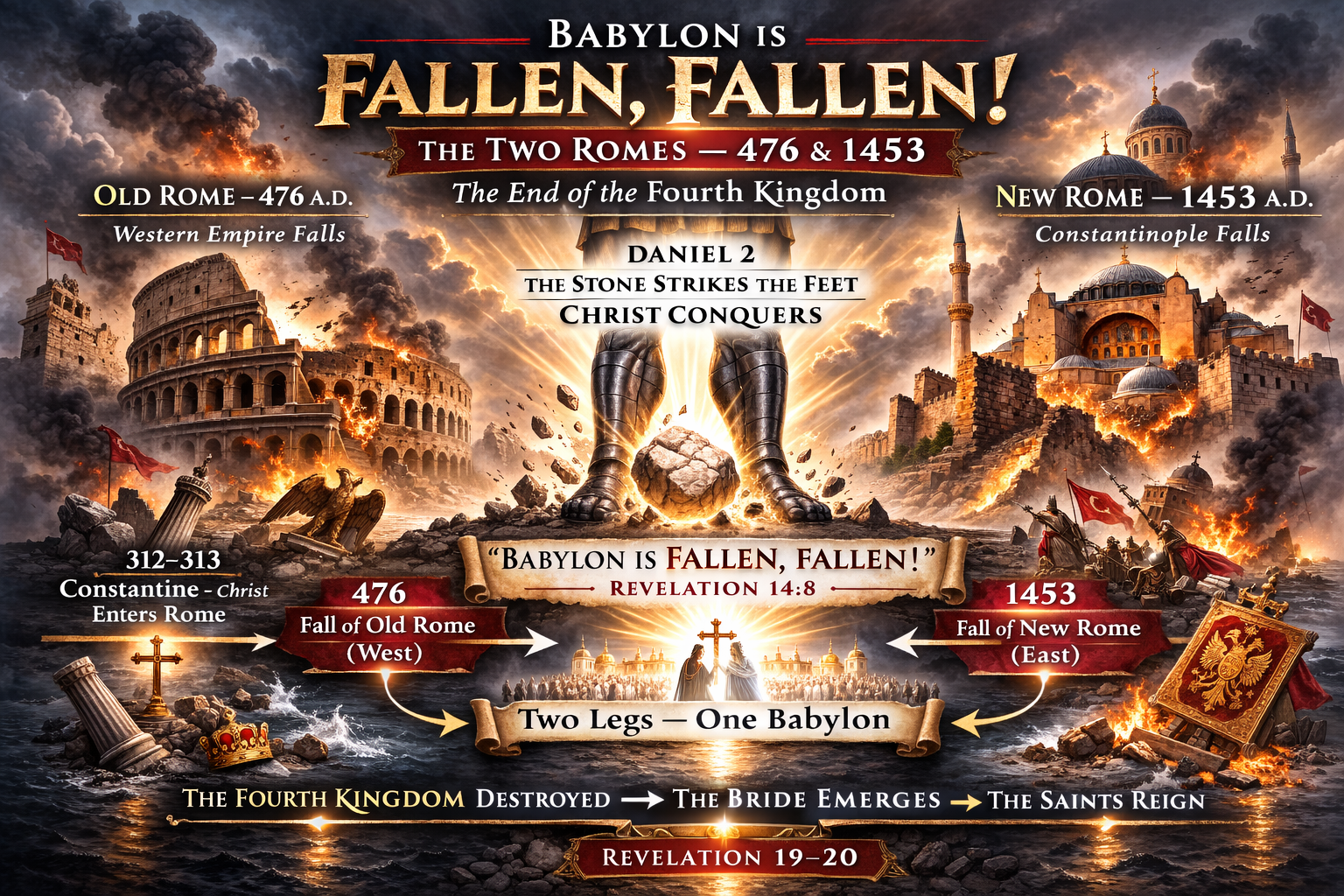
IV. Babylon Fallen Twice: Rome and New Rome
The Roman Empire did not collapse in a single moment. Western Rome fell in 476; Eastern Rome endured until 1453. The imperial office migrated eastward, preserving Roman juridical and symbolic continuity in Constantinople.
This interpretation finds precedent in post-Byzantine Greek historicism. Apostolos Makrakis interprets the sixth trumpet of Revelation 9 in connection with the collapse of Roman structures and the barbarian migrations, viewing these events as divine judgment upon imperial corruption.⁶ Likewise, Theodoret of Ioannina explicitly associates Constantinople with Babylon within a prophetic framework that integrates Daniel and Revelation.⁷
Revelation 14:8 proclaims: “Babylon is fallen, fallen.” Within a Danielic-historicist reading, this double proclamation may reflect the twofold collapse of the Roman imperial organism—Old Rome and New Rome.
“The city is fallen and I am still alive” (Greek: «Ἑάλω ἡ πόλις, καὶ ἔτι ζῶ ἐγώ»)
These are the legendary last words of Constantine XI Palaiologos, the final Byzantine Emperor, upon the fall of Constantinople to the Ottoman Empire on May 29, 1453. The Great City of Revelation 11 historically points us to Constantinople, the Queen of Cities.
Such readings do not condemn Orthodox Byzantium but recognize that the Roman imperial office—whether pagan or Christian—remains within the prophetic category of Daniel’s Fourth Kingdom.
Thus:
Old Rome = Babylon.
New Rome = continuation of Babylon.
Total Roman Empire = Fourth Beast.
Only when both legs fall (476 and 1453) is the Roman imperial organism prophetically dismantled.
V. Daniel 2 and the Stone Striking the Feet
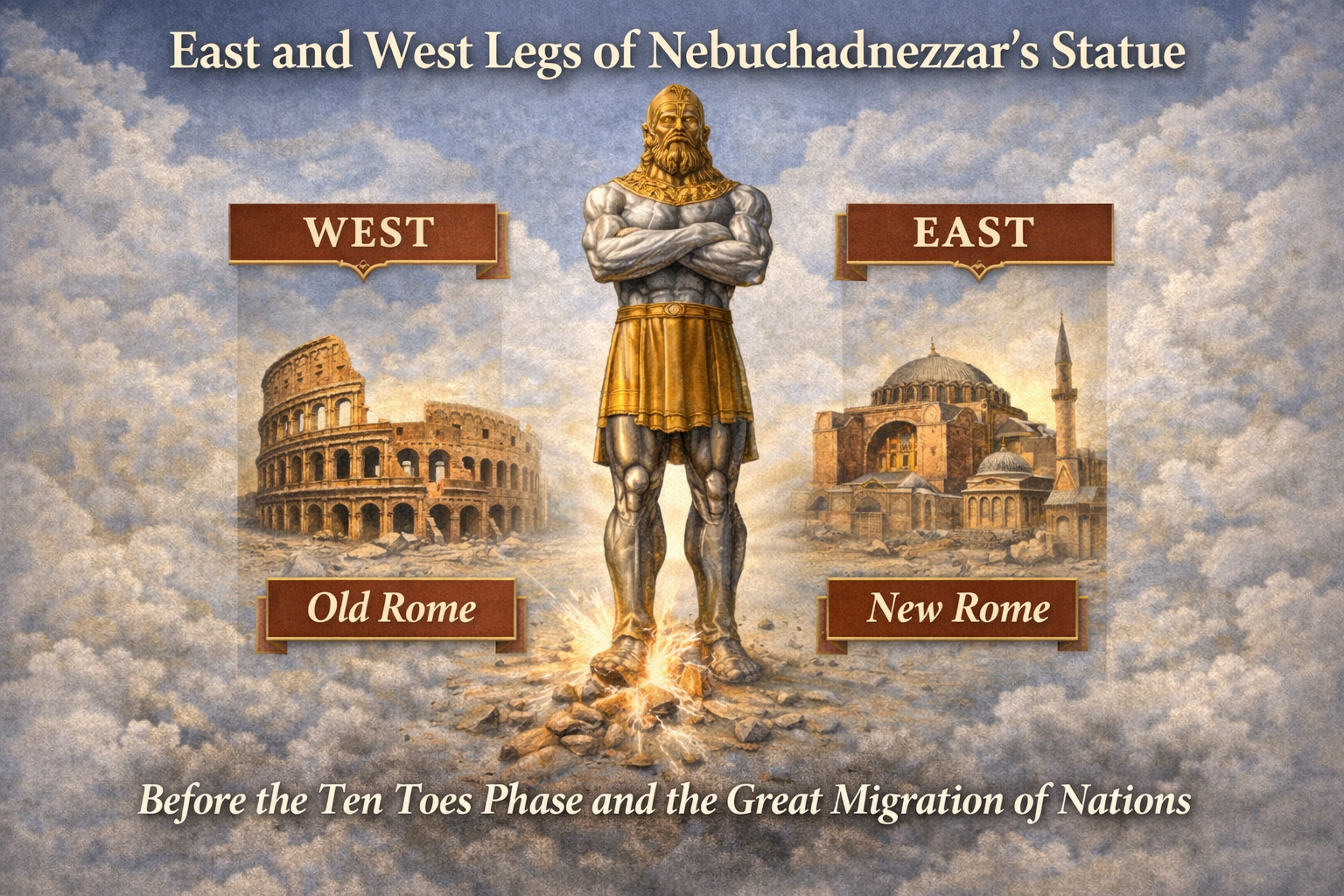
Daniel 2 reinforces this structure. The statue culminates in iron legs and iron-clay feet—traditionally interpreted as Rome. The statue possesses two legs, corresponding historically to the Western and Eastern halves of the Empire.
The Stone “cut without hands” strikes the statue at the feet—not at the head.
The Stone is Christ.
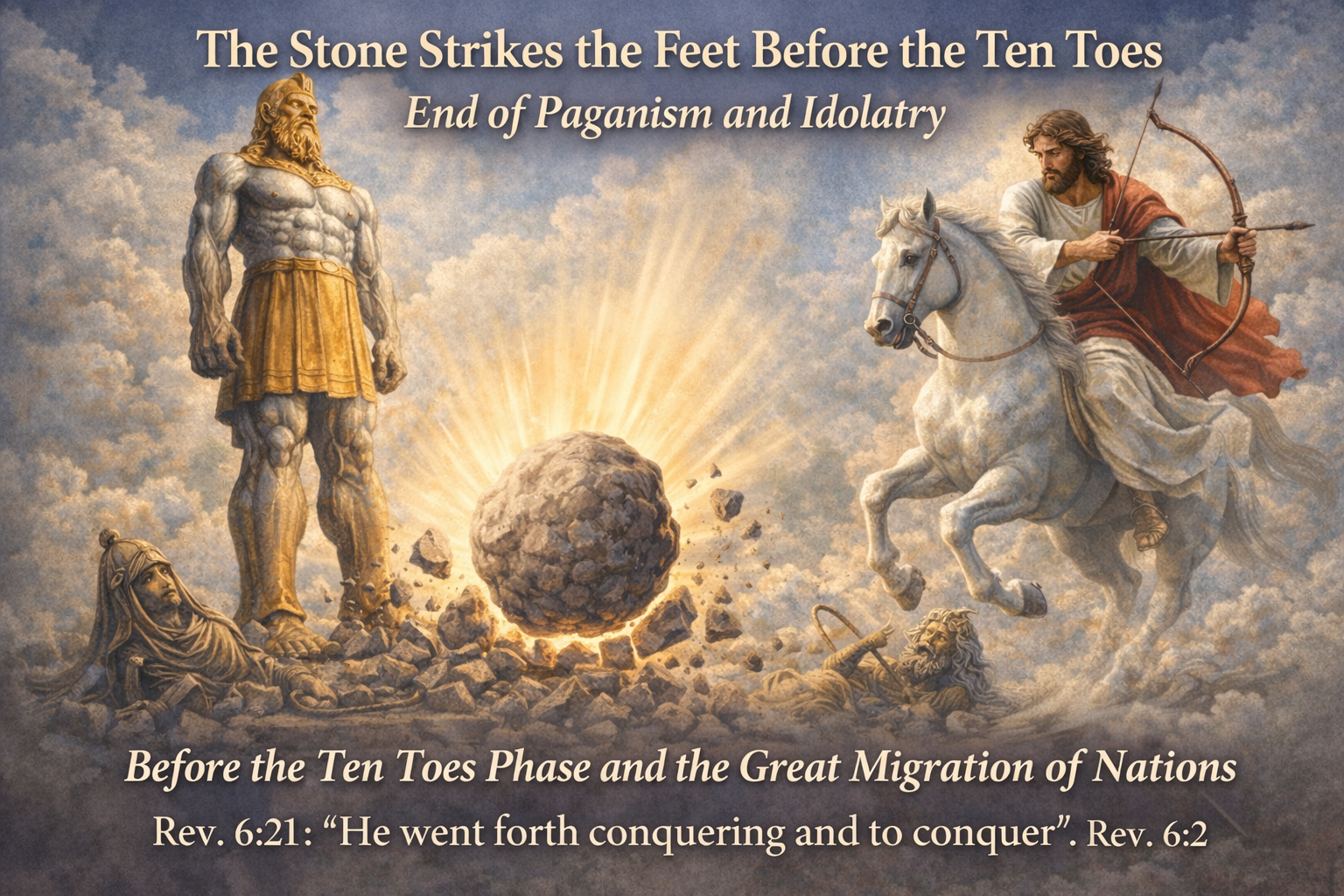
Chronologically, the Stone strikes during the divided Roman phase. Constantine’s conversion (312–313) and the Christianization of the Empire occur before the barbarian fragmentation of the West. Christ enters history under Roman sovereignty and transforms it from within.
The crushing is progressive:
- Christianization, collapse of paganism and idolotry
- Fragmentation by the 10 toes
- Western fall (476)
- Eastern fall (1453)
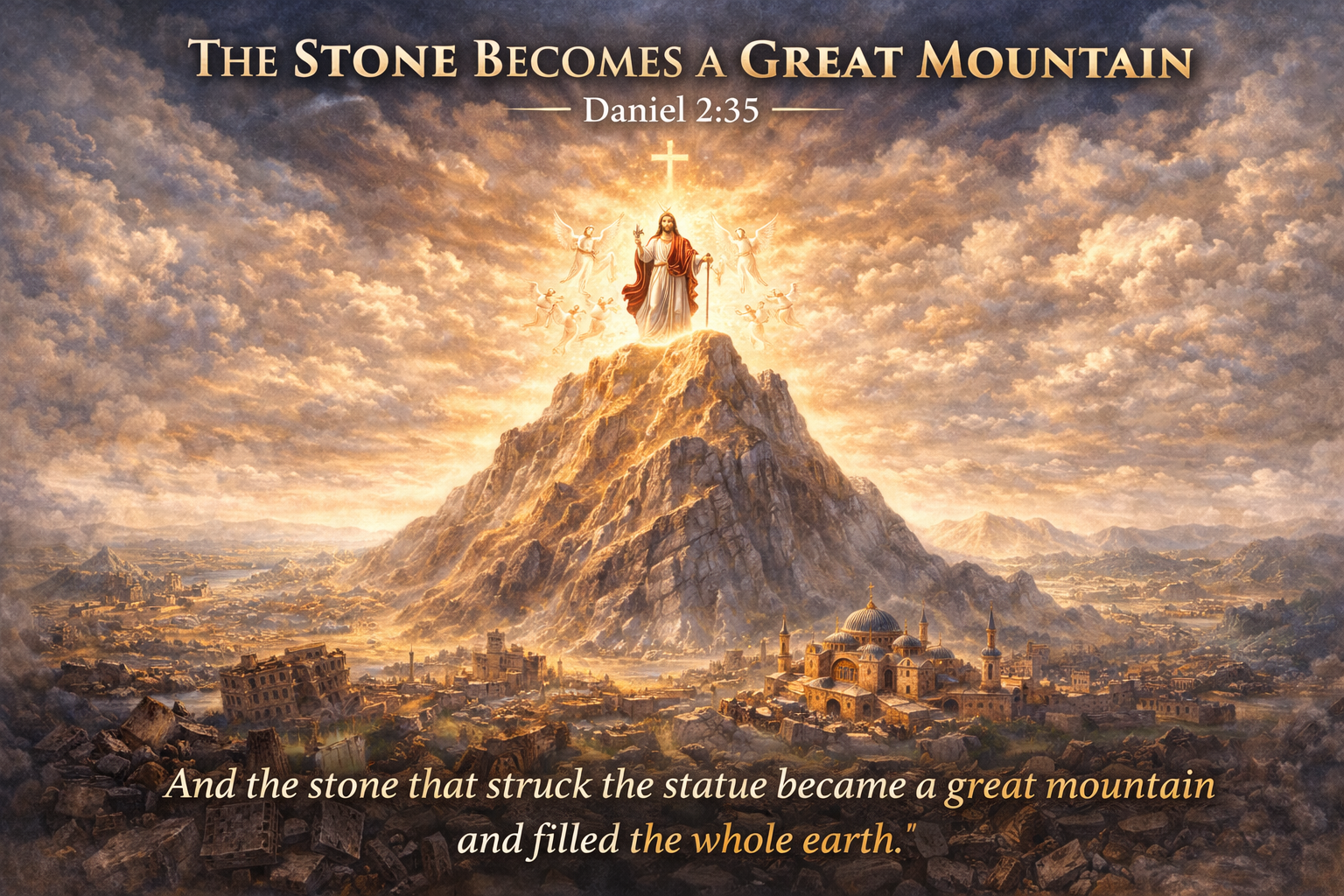
The destruction unfolds across centuries. Daniel’s Stone strikes Rome—not modern Russia. Paganism collapses with Constantine and the rise of the Imperial Church after the Edict of Milan in 312, just prior to the 10 toes or 10 barbarian tribes during the Great Migration period of history. The Stone is destined to become a Great Mountain.
VI. Revelation 12 and the Ecclesial Wilderness
Byzantine Historic Postmillennialism also integrates Revelation 12. The Woman’s 1260-day wilderness corresponds to Daniel’s prophetic time (“time, times, and half a time,” Dan 7:25; 12:7). The Church survives imperial and post-imperial trials across centuries. The Stone is destined to become a Great Mountain.
The millennium of Revelation 20 arises after the exhaustion of this wilderness epoch and after the dismantling of imperial Babylon.
VII. Convergence and Divergence
Both Moss and Byzantine Historic Postmillennialism affirm:
- A future ecclesial vindication and global flourishing of Orthodoxy
- The conversion of the Jews (Rom 11)
- A possible Eighth Ecumenical Council (as foretold in the Byzantine Apoc. Tradition)
- A spiritual millennium
- A subsequent loosing of Satan
- A final Apostacy/Antichrist
- The Last Judgment
Both proposed non-augustinian, non-carnal millennial systems are very similar. The divergence lies in prophetic hinge.
Moss reads Revelation through the fall of the Third Rome (1917).
Byzantine Historic Postmillennialism reads Revelation through the fall of Babylon (476 and 1453).
The former interprets Revelation through the collapse and hoped-for restoration of the Third Rome. The latter interprets Revelation through the fall of Babylon as the total Roman imperial organism, East and West, and hoped-for restoration of New Rome, that once “Great City” of Constantinople where the two witnesses testified to the nature of the woman’s “man child.”
Conclusion
“Babylon is fallen, is fallen, that great city”
If Daniel’s Fourth Kingdom is Rome—as patristic tradition maintains—then the apocalyptic structure must pivot upon the dismantling of Rome East and West.
The Stone struck during the divided Roman phase.
The iron legs fell.
Babylon was fallen—fallen.
Then the Bride re-emerges after protection and sustainment in the wilderness.
Then the saints received the kingdom.
Then comes Gog and Magog.
Then the Great White Throne.
History is not random collapse.
It is courtroom.
Daniel and John speak one architecture.
Footnotes
- St. Jerome, Commentary on Isaiah 60.1.
- St. Augustine of Hippo, City of God 20.7.
- Vladimir Moss, “The Millennium,” October 13/26, 2015.
- Cf. Rom 14:17.
- St. Hippolytus of Rome, On Christ and Antichrist; see also St. Jerome, Commentary on Daniel.
- Apostolos Makrakis, Commentary on the Apocalypse (Athens editions); see also “The Sixth Trumpet and the Great Migration of Nations,” neohistoricism.net, February 4, 2026.
- Theodoret of Ioannina, Commentary on Daniel; see also “Babylon and the Captive Queen: Constantinople, the Prophets, and Revelation in Theodoret of Ioannina,” neohistoricism.net, January 18, 2026.
Bibliography
Augustine of Hippo. The City of God. Translated by Henry Bettenson. London: Penguin Classics, 1972.
Andrew of Caesarea. Commentary on the Apocalypse. Patrologia Graeca 106.
Hippolytus of Rome. On Christ and Antichrist. In Ante-Nicene Fathers, Vol. 5. Buffalo, NY: Christian Literature Publishing Co., 1886.
Jerome. Commentary on Daniel. Patrologia Latina 25.
Jerome. Commentary on Isaiah. Patrologia Latina 24.
Makrakis, Apostolos. Hermeneia eis ten Apokalypsin tou Ioannou [Commentary on the Apocalypse of John]. Athens: various Greek editions.
Moss, Vladimir. “The Millennium.” October 13/26, 2015.
Theodoret of Ioannina. Commentary on Daniel. Greek manuscript tradition.
Photius, Jonathan. “Babylon and the Captive Queen: Constantinople, the Prophets, and Revelation in Theodoret of Ioannina.” Neo-Historicism. January 18, 2026. https://neohistoricism.net/2026/01/18/babylon-and-the-captive-queen-constantinople-the-prophets-and-revelation-in-theodoret-of-ioannina/
Photius, Jonathan. “The Sixth Trumpet and the Great Migration of Nations.” Neo-Historicism. February 4, 2026. https://neohistoricism.net/2026/02/04/the-sixth-trumpet-and-the-great-migration-of-nations/
 NEO-Historicism - End Times Eschatology From An Eastern Orthodox Christian Historicist Perspective