
Revelation 9 as Political, Demographic, and Spiritual Judgment
A Canonical Eastern Orthodox Historicist Interpretation
By: Jonathan Photius – The Neo-Historicist Research Project
Introduction
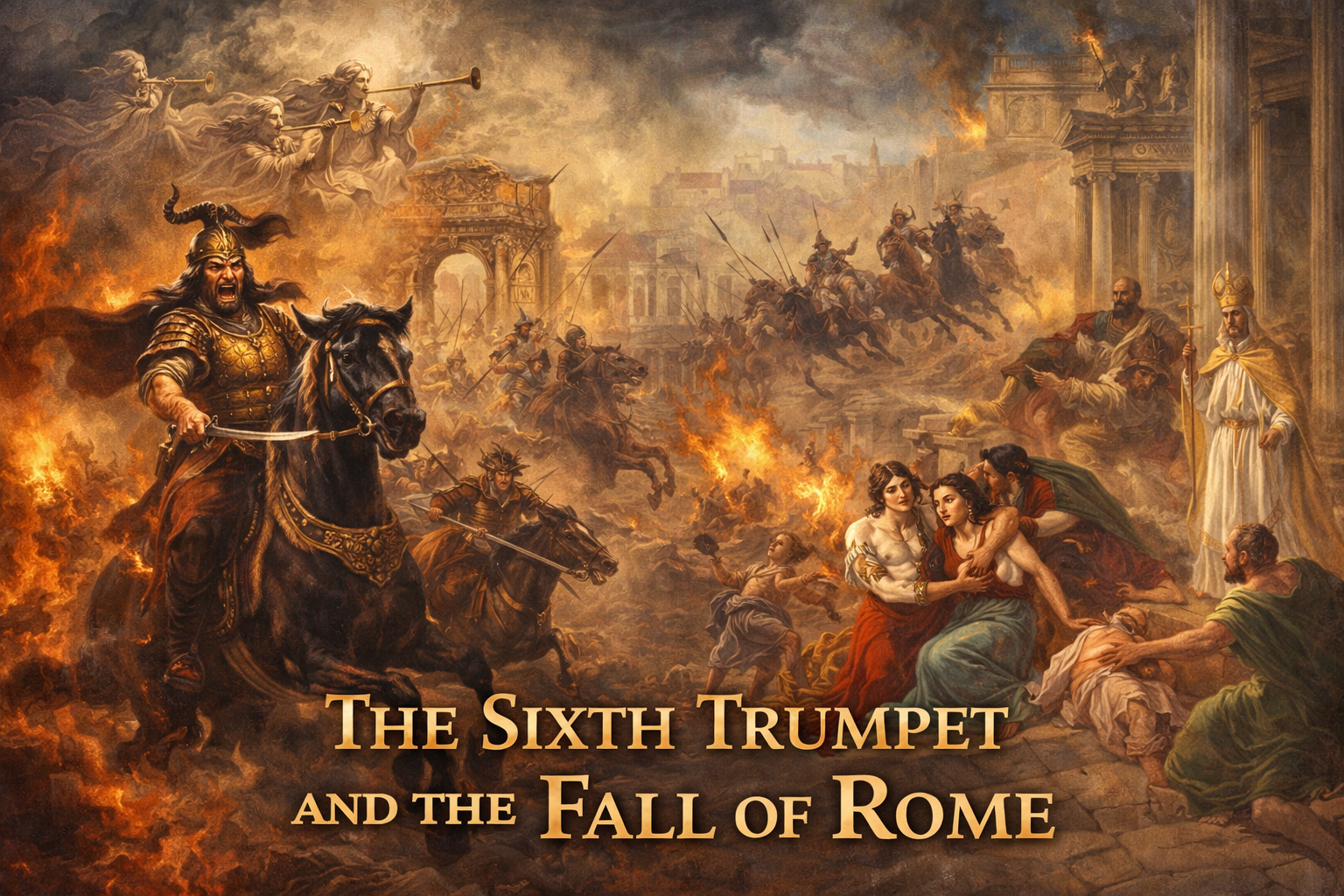
The Sixth Trumpet of the Apocalypse (Revelation 9:13–21) announces one of the most devastating judgments in the prophetic narrative. Unlike earlier trumpets—which wound, darken, or torment—the Sixth Trumpet explicitly kills “a third of men.” In Neo-Historicist interpretation, this judgment is neither a momentary catastrophe nor a purely symbolic abstraction. Rather, it unfolds as a measured, historically verifiable process spanning late antiquity, reshaping the Roman world politically, demographically, and spiritually.
This interpretation stands within the Eastern Orthodox historicist tradition articulated most fully in the modern period by Apostolos Makrakis, while extending that tradition through chronological analysis and ecclesial synthesis. Revelation is thus read not as speculation about the end of time, but as Christ’s judicial interpretation of Church history itself.
I. The Sixth Trumpet as a Judicial Act in History
Revelation 9 presents history as a courtroom, not a chaos. When the sixth angel sounds, a voice issues from the four horns of the golden altar commanding the release of four angels bound at the great river Euphrates (Rev. 9:13–14).¹⁰ The altar signifies completed witness and sacrifice; the voice signifies a decree from the divine court.
Judgment is delayed until the sealing of God’s servants is complete (Rev. 7:1–3).¹³ Only then are the restraining powers removed. Rome does not fall because it is militarily weak, but because its providential role has expired.
II. The Release of the Four Winds and the Great Migration of Nations
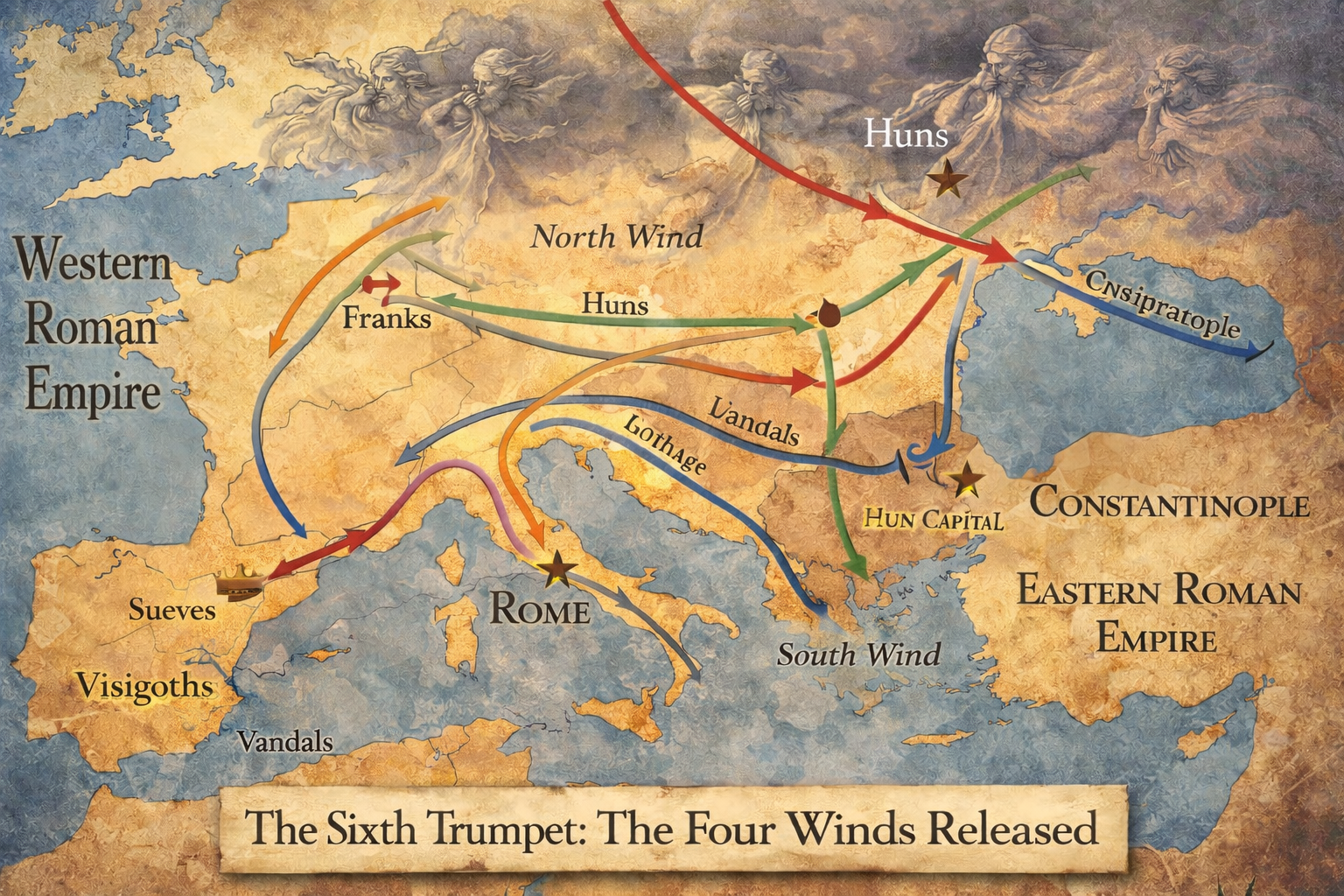
The four angels govern the four winds, long restrained so that no wind might blow upon the earth or the sea (Rev. 7:1–3).¹³ Once released, these winds drive the “sea” (the nations) violently against the “earth” (the Roman oikoumenē).
Historically, this release corresponds to the Great Migration of Nations (fourth–sixth centuries). Modern historians describe this as a complex series of displacements, but Revelation provides the theological cause: the withdrawal of restraint.
The process begins in the East—consistent with the Euphrates imagery—and unfolds in successive waves:
- Central Asian pressure erupts westward
- Germanic peoples are displaced across Roman frontiers
- Imperial defensive systems collapse sequentially
This is not a single invasion but a civilizational chain reaction, exactly as the imagery of the four winds suggests.⁴
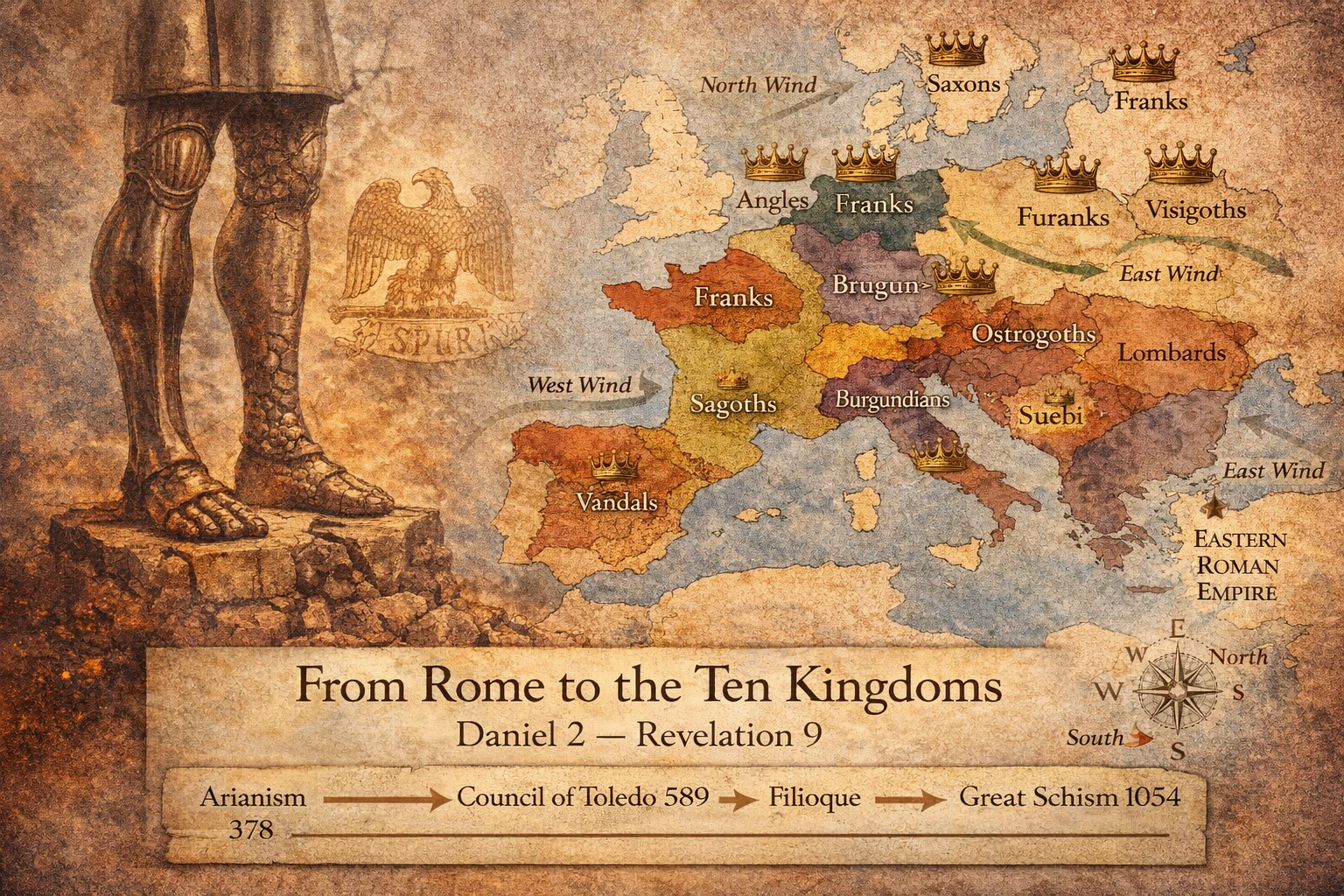
III. Attila the Hun and the Tenfold Barbarian Assault
The first and most violent manifestation of the eastern wind appears in the rise of Attila the Hun. Contemporary historians such as Ammianus Marcellinus describe the Huns as uniquely mobile, terrifying, and destructive cavalry forces.⁵
Attila’s advance shattered Roman equilibrium and triggered the movement of multiple barbarian peoples:
- Visigoths
- Ostrogoths
- Vandals
- Franks
- Saxons
- Angles
- Burgundians
- Lombards
- Alans
- Suebi
The correspondence with Daniel’s ten toes and ten horns (Dan. 2:41–42; 7:24)¹⁴ ¹⁵ is striking. Imperial unity fractures into multiple successor kingdoms—neither fully Roman nor entirely foreign—exactly as Daniel foresaw.
Revelation emphasizes that the devastation spreads through fire, smoke, and brimstone, igniting others beyond the initial invaders (Rev. 9:18).¹¹ The horsemen are not the sole agents of destruction; they are the spark.
IV. “A Third of Men”: Demographic Catastrophe in Late Antiquity
Exact population figures for the Roman world remain debated, but the scale and direction of collapse are beyond dispute.
Modern scholarship affirms:
- The Roman Empire sustained tens of millions at its height.¹
- Western urban centers experienced dramatic contraction.²
- The city of Rome declined from hundreds of thousands (or more) to tens of thousands by the sixth century.²
- Continuous warfare disproportionately eliminated men of military age, the backbone of imperial defense and administration.
When the barbarian invasions are combined with:
- the prolonged wars of reconquest under Justinian, and
- the Justinianic Plague,⁶
the result is one of the most severe demographic and economic contractions in European history.
In Neo-Historicist interpretation, “a third of men” (Rev. 9:18)¹¹ need not denote a mathematical fraction of the entire globe. It signifies a catastrophic proportion of the Roman civilizational world, particularly its military, urban, and institutional population.
V. The Time Statement: Judgment Measured, Not Random
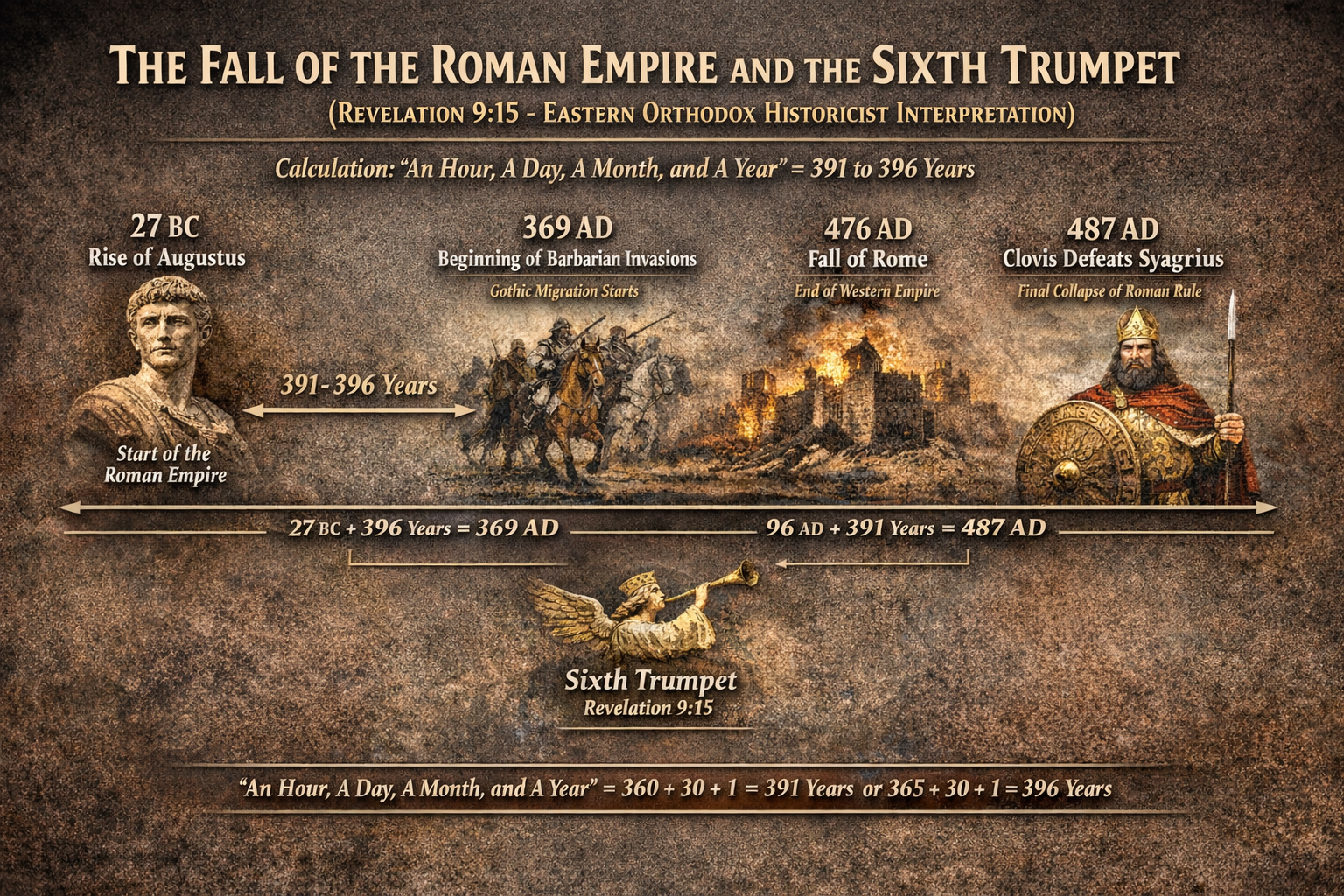
Revelation 9:15 specifies that the four angels were prepared for “an hour, and a day, and a month, and a year.”¹⁰ Such precision in the Apocalypse is never ornamental. In the Eastern Historicist interpretation, this formula indicates a measured and delimited historical judgment, not an undefined period of decline.
Applying the historicist day-year principle, long employed in both Eastern and Western continuous-historical readings of prophecy:
- Year = 360 (or 365) years
- Month = 30 years
- Day = 1 year
- Hour = a fractional portion of a year
The resulting total yields 391–396 years.
When this period is reckoned from the Domitianic era (c. AD 85–96), the terminus aligns with striking precision at AD 476, the deposition of Romulus Augustulus and the conventional end of Western Roman imperial authority.³ This alignment confirms that the Sixth Trumpet describes not a vague process but a chronologically bounded execution of judgment.
However, the time statement also admits a second historically significant anchoring. If one begins the measured period from the post-Temple judgment of AD 70, the same prophetic span reaches AD 461–466. This range corresponds precisely with the death of Majorian (r. 457–461), widely regarded by modern historians as the last Western Roman emperor to mount a serious and credible attempt at imperial recovery.¹⁷
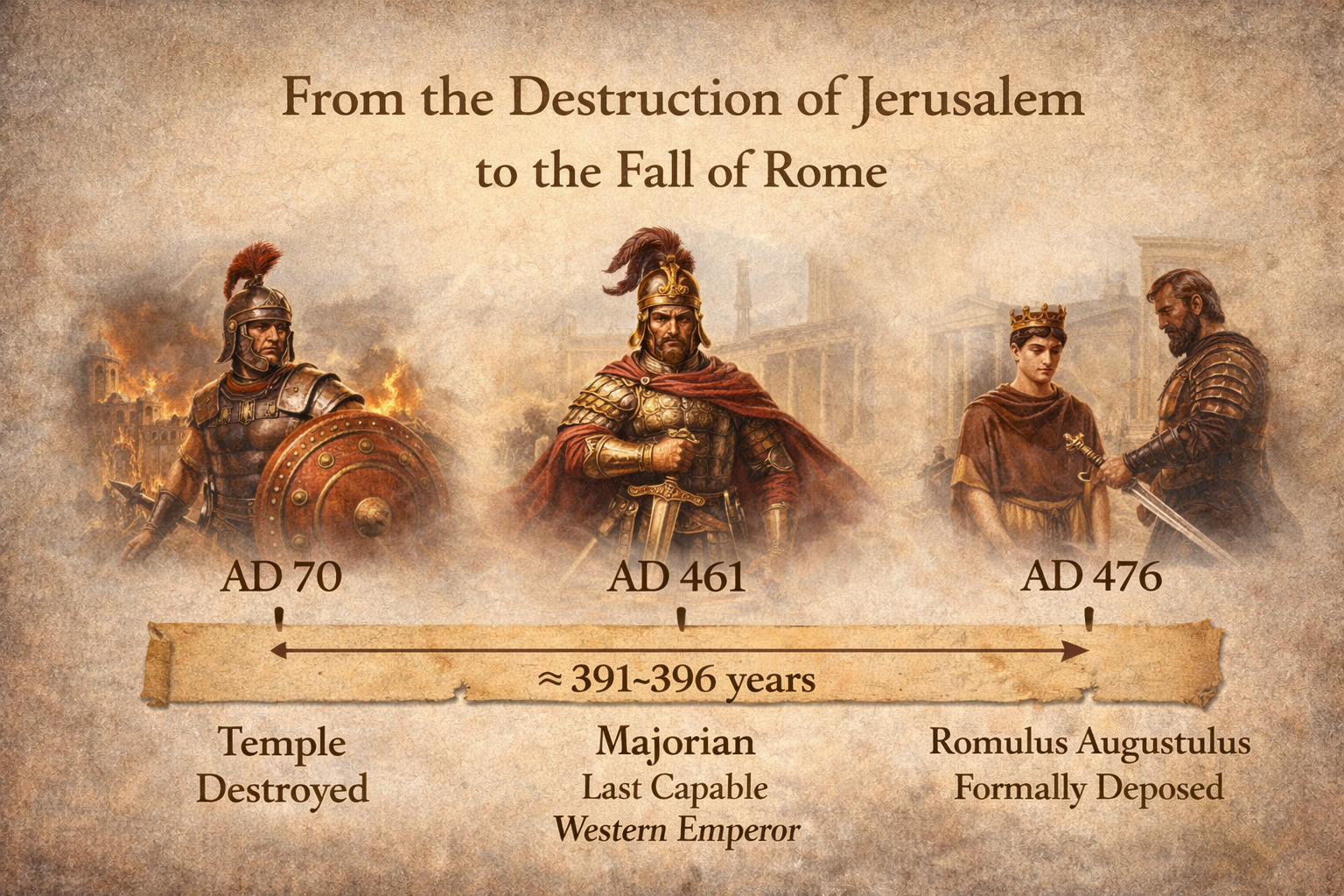
Majorian’s reign represents the final moment when the Western Empire exercised genuine military, fiscal, and administrative agency. After his execution in 461, imperial authority in the West devolved irreversibly into figurehead rule, dominated by barbarian kings and military strongmen. The empire continued to exist in name for another decade, but no longer as a recoverable political organism.¹⁸ ¹⁹ The formal deposition of 476 thus marks not the beginning of collapse, but its juridical conclusion.
In this light, the Sixth Trumpet’s time formula does not merely predict the fall of Rome as a single event. It marks the end of Rome’s capacity for restoration, followed by the inevitable execution of judgment. The prophetic period terminates at the moment when recovery becomes impossible, and history proceeds inexorably toward final dissolution.
This dual anchoring—terminating either at AD 461 (irreversible collapse) or AD 476 (formal abolition)—demonstrates that Revelation’s chronology cannot be compressed into a first-century horizon. A prophetic judgment measured in centuries, unfolding long after the destruction of Jerusalem, stands wholly outside any preterist framework confined to AD 70.
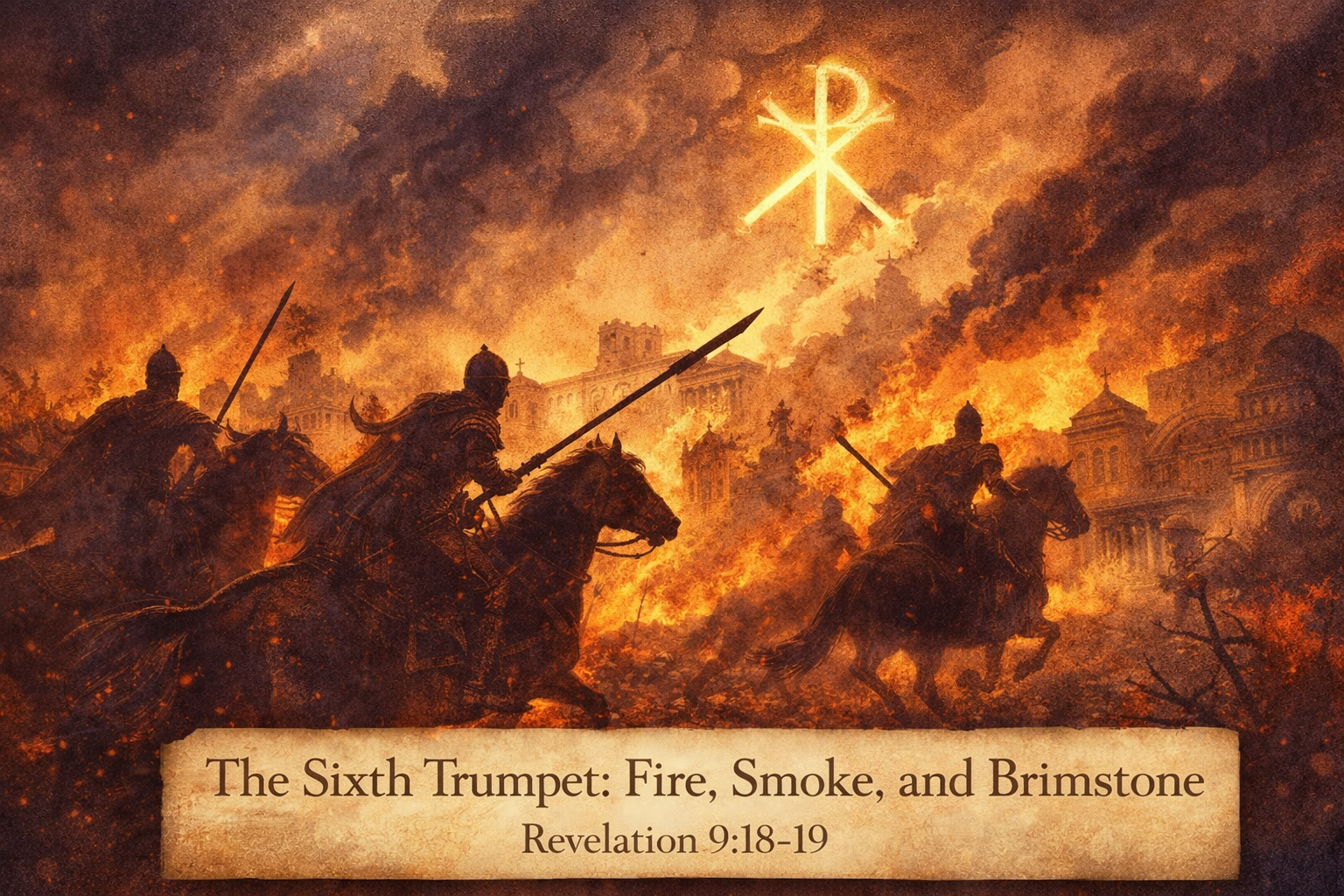
VI. Fire, Smoke, and Brimstone: Spiritual Death through the Mouth
Revelation stresses that the killing proceeds from the mouth:
“For their power is in their mouth… and with them they do hurt” (Rev. 9:19).¹¹
This is theological language.
- Fire signifies destructive zeal.
- Smoke obscures vision, darkening the Sun (Christ) and polluting the air (the Holy Spirit).
- Brimstone marks corrupting judgment.
Makrakis identifies the smoke of Revelation 9 with Arianism, which obscured Christ’s divinity and destabilized Trinitarian faith.⁷ The barbarian invasions re-institutionalized Arianism in the West, as many invading rulers were Arians governing Orthodox populations.
Thus, the Sixth Trumpet brings spiritual death alongside physical death:
- Orthodox peoples ruled by heterodox kings
- Episcopal compromise under coercion
- Doctrinal instability normalized
Men are “killed” not only by the sword, but by corrupted proclamation.
VII. From Arian Smoke to the Filioque
The ecclesial consequences did not end with the fall of Rome.
In regions such as Spain, bishops combating lingering Arianism introduced the Filioque into the Creed.⁸ What began as a local anti-Arian measure hardened into permanent doctrinal alteration, eventually adopted by Rome.
From an Eastern Orthodox Historicist perspective:
- Arianism = smoke
- Filioque = fire formalized
This innovation destabilized Trinitarian balance, subordinated the Spirit, and laid groundwork for later ecclesial absolutism.
VIII. The Sixth Trumpet as Preparation for Revelation 13
The Sixth Trumpet does not conclude the Apocalypse’s historical drama; it prepares it.
- Political unity collapses
- Doctrinal wounds remain unhealed
- Authority migrates from emperors to ecclesiastical institutions
Out of this environment arises the Beast of Revelation 13—a fusion of religious authority and coercive power—eventually provoking the counter-reaction of the Protestant Reformation, itself another catastrophic rupture within Christendom.⁹
IX. “They Did Not Repent”
Revelation 9 concludes with a sobering refrain:
“And the rest of the men… repented not” (Rev. 9:20–21).¹²
Judgment exposes hearts but does not coerce repentance. Idolatry persists, now baptized; moral corruption remains, now institutional. History advances because wounds are not healed and power is not relinquished.
Conclusion
In canonical Eastern Orthodox Historicist interpretation, the Sixth Trumpet announces the end of a world:
- the political world of imperial Rome,
- the demographic stability of the ancient Mediterranean, and
- the doctrinal clarity of post-Nicene Christianity in the West.
Through the release of the four winds, God permits history to unfold its consequences—revealing that unrepented power, even when baptized, cannot endure. The trumpet kills bodies, institutions, and souls alike, setting the stage for the far greater conflicts yet to come in the Apocalypse.
Footnotes
- Walter Scheidel, “Roman Population Size: The Logic of the Debate,” Princeton/Stanford Working Papers in Classics (2007), https://web.stanford.edu/~scheidel/Papers/Popdebate.pdf.
- Bryan Ward-Perkins, The Fall of Rome and the End of Civilization (Oxford: Oxford University Press, 2005), 87–120.
- Peter Heather, The Fall of the Roman Empire (Oxford: Oxford University Press, 2006), 427–440.
- Guy Halsall, Barbarian Migrations and the Roman West, 376–568 (Cambridge: Cambridge University Press, 2007).
- Ammianus Marcellinus, Res Gestae 31.2–3; Hyun Jin Kim, The Huns (London: Routledge, 2016).
- Lester K. Little, ed., Plague and the End of Antiquity (Cambridge: Cambridge University Press, 2007); Lee Mordechai et al., “The Justinianic Plague,” PNAS 116, no. 51 (2019).
- R. P. C. Hanson, The Search for the Christian Doctrine of God (Edinburgh: T&T Clark, 1988).
- A. Edward Siecienski, The Filioque (Oxford: Oxford University Press, 2010).
- Yves Congar, After Nine Hundred Years (New York: Fordham University Press, 1959).
- Revelation 9:13–15, NA28 Greek text.
- Revelation 9:18–19, NA28 Greek text.
- Revelation 9:20–21, NA28 Greek text.
- Revelation 7:1–3, NA28 Greek text.
- Daniel 2:41–42, Septuaginta (Rahlfs).
- Daniel 7:24, Septuaginta (Rahlfs).
- Peter Heather, The Fall of the Roman Empire: A New History of Rome and the Barbarians (Oxford: Oxford University Press, 2006), 427–434. Heather identifies Majorian as the final Western emperor who “made a determined and coherent attempt to restore the fortunes of the western state,” noting that after his death the Western Empire never again possessed an emperor capable of independent action.
- Guy Halsall, Barbarian Migrations and the Roman West, 376–568 (Cambridge: Cambridge University Press, 2007), 279–285. Halsall emphasizes that Majorian’s reign marks the last phase of meaningful imperial agency in the West, after which emperors functioned largely as figureheads.
- Bryan Ward-Perkins, The Fall of Rome and the End of Civilization (Oxford: Oxford University Press, 2005), 58–63, 91–96. Ward-Perkins treats the period following Majorian’s death as the transition from collapse-in-progress to irreversible systemic disintegration.
 NEO-Historicism - End Times Eschatology From An Eastern Orthodox Christian Historicist Perspective