
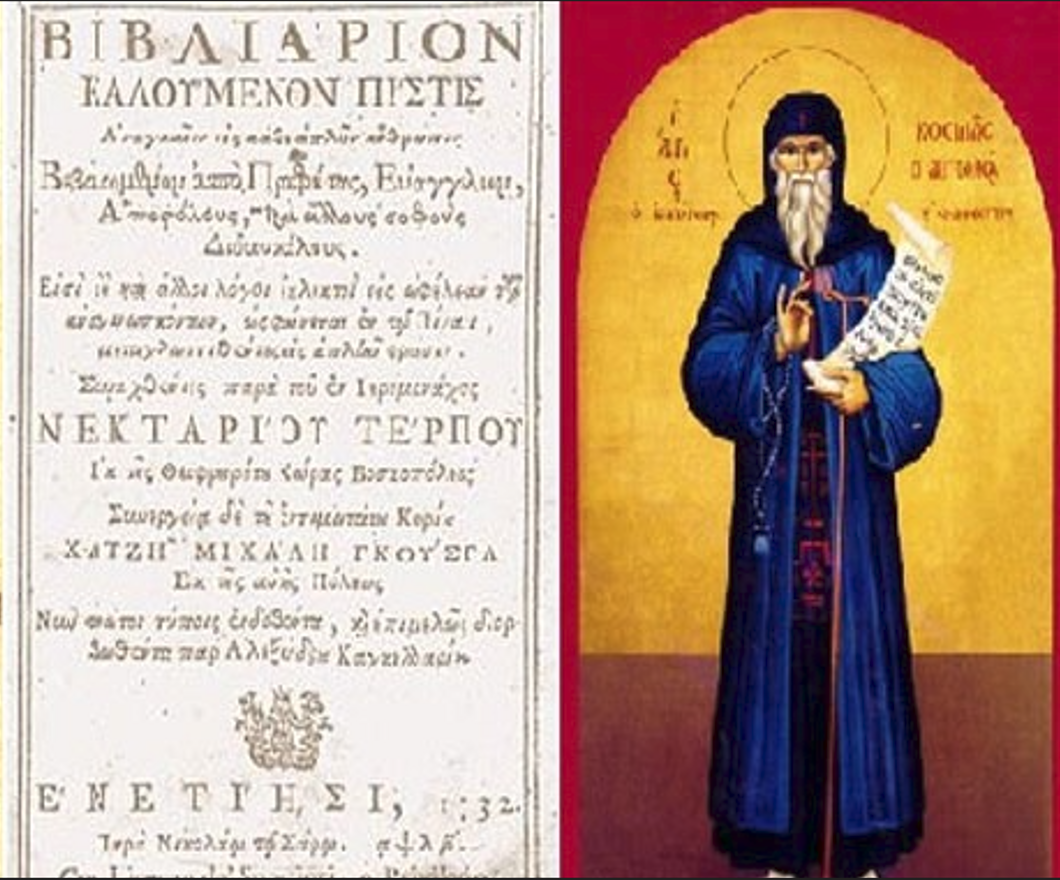
Nektarios Terpos (Νεκτάριος Τέρπος) was an Orthodox Christian scholar, teacher and hieromonk in the 18th century. He was from Moscopole which is located in now modern Albania, and was a Vlach city which had a population of over 80,000 inhabitants which was destroyed and plundered by marauding hordes of Muslim Albanians in 1769 and 1788. As a missionary he traveled to Epirus, Arta and Berat in Northern Greece and Albania. He was of Aromanian background and ethnicity. Terpos, together with St. Kosmas the Aetolos and St. Anastasios Gordios, were considered one of big three notable 18th century Orthodox leaders and fathers of the Neo-Greek religious movements prior to the 1821 Greek Revolution during a period known as the Neo-Hellenic Enlightenment period roughly between 1750 to 1821. Not that everything about this enlightenment period was good with some of the ideas imported from the West after the French Revolution. Freemasonry soon came into Greece around this time. Regardless, these three saintly men were critical in reviving the Holy Orthodox Faith during a dark period of Islamization and repression during the latter days of the Ottoman Empire, before the Greeks were to rise of from yoke of oppression and slavery to liberate their lands and their faith.
Terpos was the author of an important religious book, called A Handbook called Faith (Βιβλιάριο καλούμενον Πίστις in Greek), which was first published in 1732. While he was in Italy, he published his main work The Handbook which achieved remarkable success. It was republished 12 times between 1732 and 1818 AD. While the work is called a “booklet” by Terpos, it was actually a fairly large comprehensive book to aid the priests with the task of catechism of the faithful Orthodox Christians. The main theme of the book is the warnings to the Crypto-Christians who publicly followed Islam and secretly practiced the faith in hiding. Terpos calls them to come back to Christ and Orthodoxy and not to abandon the religion of their ancestors. It is this book where we are primarily interested in a few sections, as it appears to be one of the early 17th century writings with some Historicist ideas similar to Anastasios Gordios with respect to the identification of Islam and Mohammed with the Antichrist of scriptures. Terpos is also remembered for his work at the Ardenica Monastery where in 1731 he wrote a prayer in the form of a fresco.
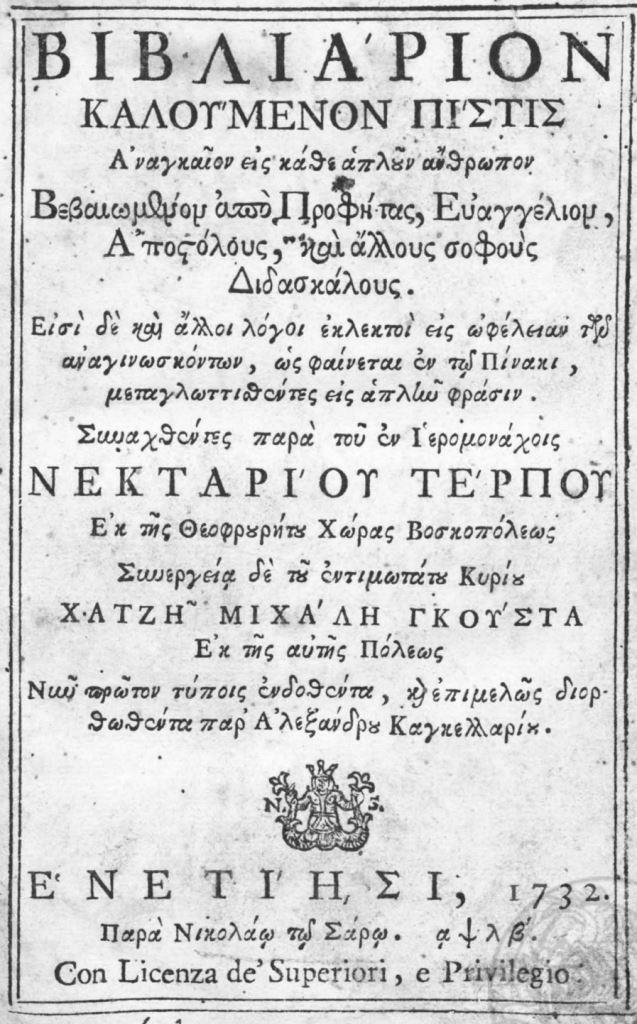
In the Handbook Called Faith, the whole social and religious dimension of Nektarios Terpos’ preaching aims at one thing only: to prevent Christians from converting to Islam. Terpos provides numerous examples in order to show his readers to be the example of the ancient martyrs. “And for this I also order you, that no one should be separated from the holy faith and the Catholic Church of Christ, for the sake of paying a little tribute, so that each one may be governed as a Christian, son and friend of Christ and By God, in whatever way he can. Let him be born a maid and a servant, and let him not be born a Turk, so that after this he may be born a ruler in the next life… “
Nektarios Terpos taught that Mohammed was the “first disciple of the antichrist”. In 1724 he preached in the village of Tragoti, near Elvasan. His audience was only women, because most of the men had converted to Islam. He preaches against the Turks, which resulted in his beating. Based on his account he said: “Afterwards, two Agarene brothers, who were thugs, found out how I declared by confessing Christ the true God, and the Mother of God and Virgin, and Muhammad a liar and schemer, and a first disciple of the antichrist. They came and took me to the priest’s house, and each one of them had a short stick made of clay, and beating me mercilessly, they didn’t look at each other how and where they were hitting, but they hit me wherever each one of them reached… so often I was knocked out, that even the wood was peeled by being turned green. In all places they burdened me, in other places my body was reddened, and in many places it was blackened, and what the suction cup and the horns did, and by the grace of Christ I was healed, but my zerbon arm was injured, and I can never rest in this place.”
The reasons for publishing The Handbook Called Faith are mentioned in Nektarios’ preface. Here is the full text:
“Therefore, this booklet, called Pistis, I did not compose for the wise and literate people, but for the illiterate and peasants, because in these parts of Turkey, many Christians were misled, and are misled by a little need and payment of the tax, and they deny Christ, and deliver themselves into the hands of the devil. For this reason I too, moved by divine zeal, wanted to help them in this mental danger, that they might stand firm in the Faith for the love of Christ, reading and hearing the martyrdoms suffered by the holy martyrs for Christ, and let even the least of them be encouraged, and imitate them, not to deny their Faith, and the Lord of Glory, but to suffer easily after all joy every temptation, and punishment for the name of Christ. Accept therefore, Brothers in Christ, this little booklet, which I have printed for the common good, and pray for me, your wicked servant, and forgive me… and if you were freed and became a Turk, come back, our Master Christ wants you and forgives you.
So I dedicate this Bible to the Holy arms of the Lady Theotokos, the so-called Ardenitza. And for this reason, every person, and indeed the Priests, must interpret the Christians in their Churches, where God wanted to enlighten them.
Then let them read the necessary things from the Book. But I am begging you most of all, for the true Faith of Christ and our God, to speak, for the assurance of the listeners.” – Nectarios Terpos, in “Pistis”
In the first edition of Pistis, Nektarios Terpos focused a dedicated chapter titled “True Praise for the People-Deceiver Mohammed an Ali.” In the second edition he also includes another chapter “Council of Evil Spirits.” In both of these chapters, Terpos discusses parts of Revelation chapter 13 with a Historicist view. He identified the Antichrist as the Prophet Mohammed and the Ottomans, showing that the word Otmanes numerically adds up to 666 in Greek to identify the number of the beast. With his interpretation of Revelation 13 he shows that the Turk is the very embodiment of the Antichrist, as Revelation 13:3 states “and all the world wondered after the beast” and in Revelation 13:7-8 he interprets that the power given over tongues and nations of those who dwell upon the earth would be forced to worship this beast. The Ottoman Empire managed to defeat every nation in its conquest of the Persian, Greek, Asian empires and parts of North Africa and Spain. He calls Muhammed a similar “forerunner” to mimic John the Baptist. In wonder and admiration of the beast of Revelation 13, Terpos shows how many Christians were lured into the privileges and material prosperity offered to those who converted to Islam and abandon their Christian faith. The Ottoman sultans and slave masters deliberately employed tactics to drive Christians slowly into despair through taxation and oppression.
Terpos says on the strategy of the Islamic Beast: The evil spirits advise Mohammed: ‘Let them have their churches, have patriarchs, metropolitans, abbots and primates, let them chant the way they like. But do as I tell you to do. From month to month, and from year to year, tax them as hard as you can and increase their debts. First they will give away their cash, then they will sell their silverware, then their brass, then their land and in the end, with nothing left to give, they will stay poor and desolate. And then, whether they like it or not, they will refuse Christ through their own will, becoming Turks in religion and in this way our own servants’ [See 4. Garitsis “Nektarios Terpos and his work” – page 447)
Concluding Thoughts
Nektarios Terpos was not only a father and forerunner of the Neo-Hellenic Enlightenment period, but a certainly can be considered one of the fathers of Greek Orthodox Historicism and Neo-Greek exegetical movement with his approach to interpreting the book of Revelation through previously fulfilled historical events. Nektarios work was most certainly admired throughout the Turkish occupation of Greece. He passionately promoted the Orthodox faith and the idea of national freedom. It boosted the national spirit of the downtrodden and poor Christians under the Ottomans. He denounced with harsh expressions the multitude of changeable beliefs and never came to terms with the phenomenon of crypto-Christianity, which he considered to be an illegitimate state and the impossibility of a direct and persuasive confession of the truth of Jesus Christ.
It is worth noting that unlike other “historicist” Fathers of the Post-Byzantine Exegetical movement who called for a swift and imminent fall of the Papal and Islamic beasts, Terpos does not provide reassuring comfort that there would be an immediate change in his lifetime. The toppling of the Antichrist Mohammed’s rule on the earth is the responsibility not of man but by God, preordained to his timetable. But yet, we are given mysterious times statements throughout Daniel and Revelation about the length of tribulation. But until that time completes, it was the duty of all Orthodox Christians to repent of their apostacy and abandonment of their faith and endure the pain and suffering brought upon by the Two Beasts. Revelation 13:10 gives to us a similar plea as Nektarios Terpos overall message of endurance and suffering: “He that leadeth into captivity shall go into captivity: he that killeth with the sword must be killed with the sword. Here is the patience and the faith of the saints.”
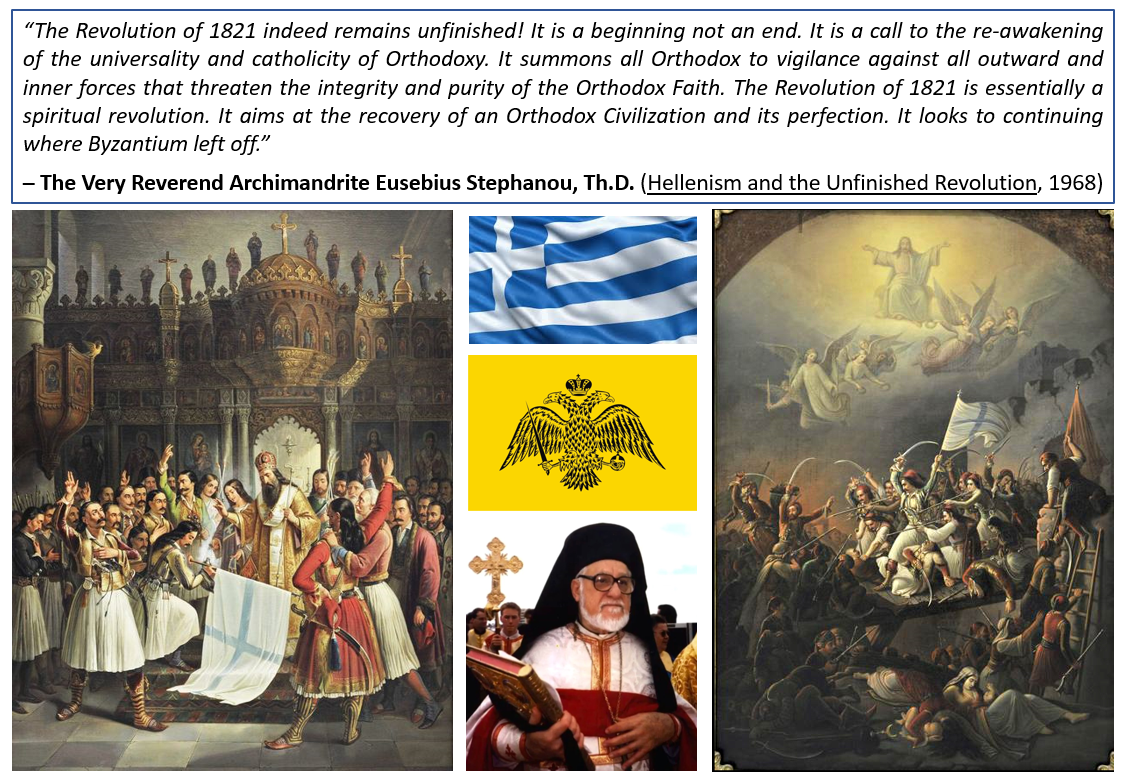
While the work of Terpos would be used to inspire the Greek Revolution of 1821, that work remains unfinished today. That is, perhaps, God-willing, the time has arrived. We now find ourselves at about the end of the one thousand two hundred and sixty “days” (years) of the desolation, when the people will soon be called to shake off the moral slavery of Babylon and make ready to welcome the approaching Kingdom of God. “Repent, for the kingdom of heaven is at hand.”
REFERENCES AND FURTHER READING
- Τέρπος, Νεκτάριος. Βιβλιάριον καλούμενον πίστις, 438 pages, 1732.
- Asterios Argyriou, Les exégèses grecques de l’Apocalypse à l’époque turque (1453-1821). Esquisse d’une histoire des courants idéologiques au seindu peuple grec asservi. Thessaloniki, 1982.
- Asterios Argyriou. Introduction to the Greek military and apologetic literature against Islam during the Turkish rule (part B), new Logios Ermis v. 5-6, August 18, 2020. https://ardin-rixi.gr/archives/224278#_ftn60
- Konstantinos Garitsis, Ο Νεκτάριος Τέρπος και το έργο του. Εισαγωγή-Σχόλια-Κριτική έκδοση του έργου του Πίστις, Θεσβίτης, Θήρα 2002.
- Nomikos Michael Vaporis, Some Unlikely Forerunners of the Greek Revolution, The Journal of Modern Hellenism. Vol. 9 (1992), journals.sfu.ca.
- Nektarios Terpos the Muscopolitan. An unknown teacher of the Neo-Hellenic Enlightenment, February 26, 2021.
- Constantinou Garitsis, “Nektarios Terpos and his work” ISBN: 960-87217-0-9
- Marios Hatzopoulos, Eighteenth century Greek Prophetic Literature, David Thomas & John Chesworth (eds), Christian-Muslim Relations. A Bibliographical History, Volume 13 Central and Eastern Europe 1700-1800, Leiden: Brill (forthcoming April 2020), 2020.
 NEO-Historicism - End Times Eschatology From An Eastern Orthodox Christian Historicist Perspective