
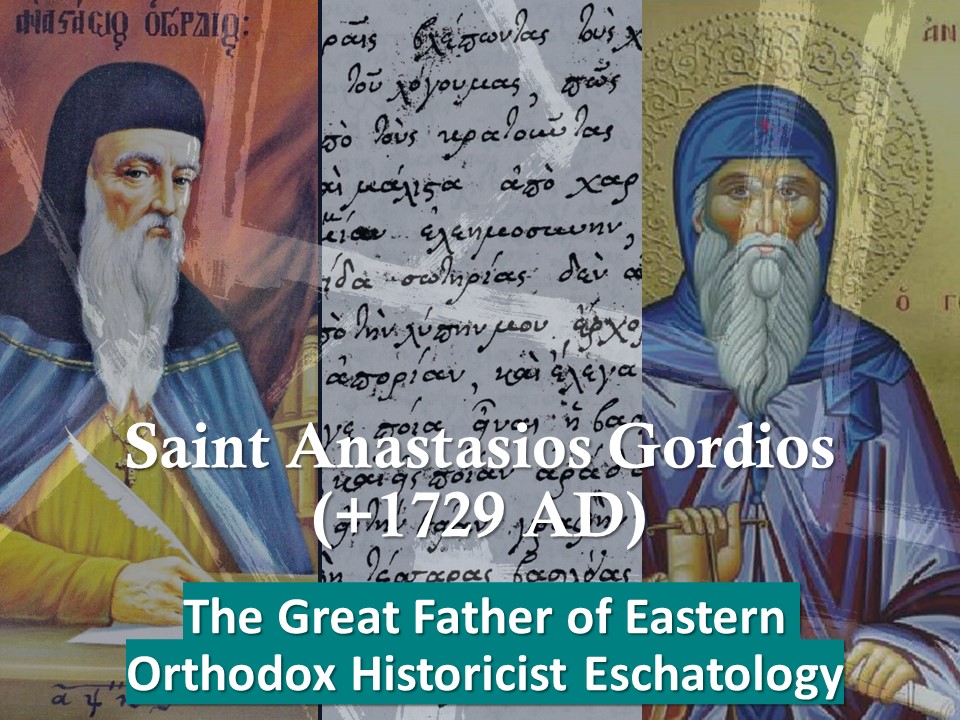
Every year on June 7th in the Orthodox Church, we commemorate the newly-canonized Saint Anastasios Gordios (born in 1654, died on June 7, 1729). Saint Anastasios was canonized by the Holy Synod of the Church of Greece on July 14th-15th 2021 during its session in Athens. Saint Anastasios is considered to be numbered among the Teachers of Modern Greece and is considered a precursor to the Modern Greek Enlightenment leading to the Greek War of Independence of 1821.
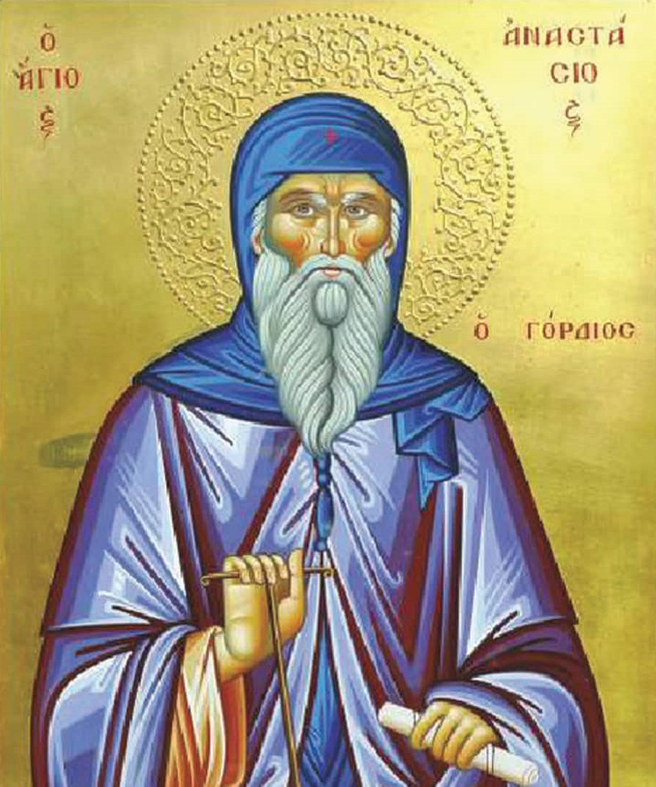
We will examine the life of this saint and examine some of his eschatology. When I started my initial analysis of the Neo-Greek commentaries on Revelation – commentaries which exploded during a period called the “Post-Byzantine Exegetical Movement” between 1453 AD and 1922 AD – it became clear that Anastasios Gordios was a major influence on many later Eastern Orthodox historicist commentaries in the 19th century and should be considered one of the key fathers of the movement towards fulfilled eschatology related to the life and history of the church. But, before we examine some of the major points of his eschatology, we will first look into the life of Saint Anastasios.
Biography
The Greek hieromonk Anastasios Gordios was a physician monk, teacher and preacher. He counts as one of the most prominent ‘tutors of the nation’ (didaskaloi tou genous), who sought to preserve Greek culture in Greece under Ottoman rule (16th-19th centuries).
Anastasios was born in 1654/5 in Vraniana, Eurytania, central Greece. His parents were poor peasants and gave him the birth name Alexis. He was able to go to school at the age of eight and studied for 12 years. He received his elementary education in Vraniana (Eurytania), and then until 1676 in Karpenisi and Vraniana. In order to access higher education in philosophy and theology, he enrolled under the hieromonk Eugenios Yannoulis, whose philosophy was based on the neo-Aristotelian commentaries of Theophilos Korydalleus. He was ordained a deacon when he was in his final year of school around the year 1676 and took the monastic name of Anastasios (October 1676). He then continued his studies in philosophy with hieromonk Nikodemos Mazarrakis in Athens, and Arta and Ioaninna in Epirus (around 1676/8). Between the years 1679 and 1682 Gordios taught at the school of Trikala. It is during these same years that we must situate his accession to the priesthood. He lived in Padua, Florence and Rome. In Padua, he attended the college of Kouttounios and the university, where, as a free auditor, he took courses in Greek and Latin literature, medicine and pharmacy. In Rome, he attended the courses of the physicist Senger. He succeeded Yannoulis as a teacher in the school of Vraniana/Agrapha, and in the years following Yannoulis’ death in 1682 he continued to teach in Vraniana. Between 1687 and 1689 he appears to have been an auditor at the school of the Artisti in Padua, and, after his return to Greece and a short sojourn in Zakynthos (Zante) between 1690 and 1710, he taught at the school of Aetolicon, close to Messolonghi in Aetolia. In summer 1710, he returned to his birthplace, Vraniana, where he worked mainly as a private teacher until his death on 7 June 1729. From 1711 to 1729, the year of his death, he taught at the school of Ste-Paraskevi, in Gouva, a school of which he was also the director.
The Personality and Character of Anastasios
As a teacher, Gordios occupies an eminent place in the history of Greek education of his time. His knowledge was great and embraced several areas of knowledge. He was proficient in the Latin language and excelled in Greek grammar and philology; he had a solid knowledge of physics but his preferences were in the natural sciences; he knew pharmaceutical science and practiced medicine without possessing a diploma; his theological training was very solid and he excelled in hagiography and polemics. Also Gordios had he been able to acquire a reputation of master and scholar extending far beyond the borders of his mountainous region. People wrote to him from everywhere asking for advice of all kinds, in the most varied fields: medicine, theology, painting, pastoral care, administration. He was asked for copies of his writings, he was suggested to write on such subject, to translate such old work, to publish such of his writings, to express his opinion on such work.
Teaching was not his only occupation, however. Relieving the physical and material suffering of a people degraded by the misery of inhuman slavery was also one of his dearest occupations. Whenever his health permitted, Gordios traveled to the towns and villages of mainland Greece and even the Peloponnese to preach the word of God, receive confession from the faithful and give advice to leaders, priests, monks and masters. of school. Some Greek scholars today consider him to be the precursor of St. Kosmas the Aeolian. But his activity with respect to missionary travel was geographically limited compared to St. Kosmas, because it was more linked to the schools where he had taught, to the students they had trained, to the people he had known.
Gordios was one of the greatest Greek writers of the Turkish period. This probably due to being a teacher with long experience and a very deep awareness of the needs of his students. His writings on grammar, vocabulary, logic, rhetoric, natural sciences as well as his translations bear witness to this. His theological writings mainly relate to hagiography. He translated a dogmatic treaties of the Divinity of Christ attributed to Hermonymus of Sparta into vulgar Greek. However his greatest theological writing is his Treaties “On Muhammed and Against the Latins.” Such a popular book, it has been released with up to 26 known published editions.
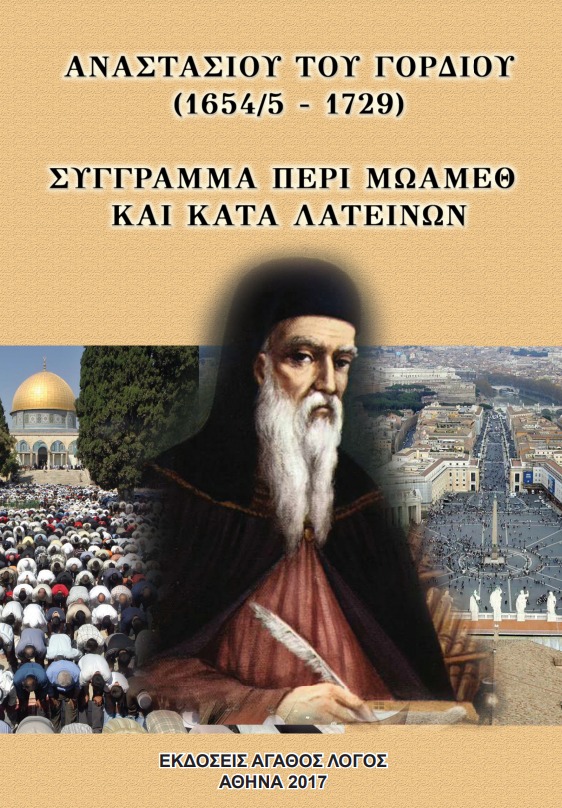
On Mohammed and Against the Latins – Περί Μωάμεθ και Κατά Λατείνων Σύγγραμμα
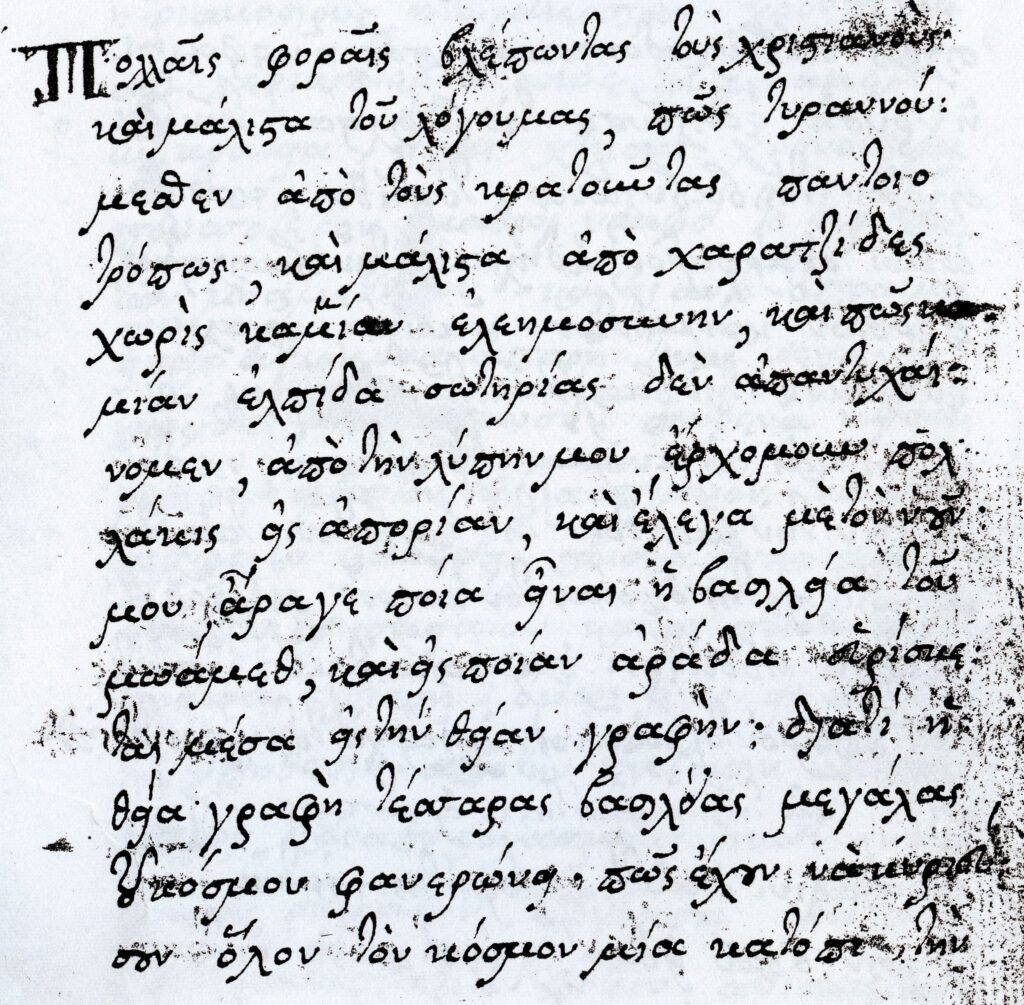
This book by Saint Anastasios was written around 1717 to 1718 AD shortly after the Turks reconquered the Peloponnese in 1715. Primarily viewed the two beasts of Revelation 13 as Mohammed and the Papacy. The work shows that the scriptures foretold the rise of Islam and predicts its future demise.
“This treatise is Gordios’s most remarkable theological work, demonstrating his theological and ideological attitude towards the religious and historical developments of his time. It is extant in a large number of manuscripts; in the critical edition it is around 90 pages long.” – Asterios Argyriou
Commentary/Analysis:
As I continue to research his life and especially his writing “On Muhammed and the Latins”, I am becoming more fascinated with his end-times views and how closely they aligned with other authors like Theodoret of Ioannina (1800 AD), Apostolos Makrakis (1882 AD) and Neilos Sotiropoulos (1974 AD). While there are Orthodox commentaries prior to 1920 AD that followed this historical method of interpretation (i.e. viewing many of the prophecies of Revelation as being fulfilled from the time of Christ until the present era), it appears many of these later interpretation echo many of his core ideas with respect to the identification of the two beasts of Revelation 13.
Some highlights so far in his eschatology:
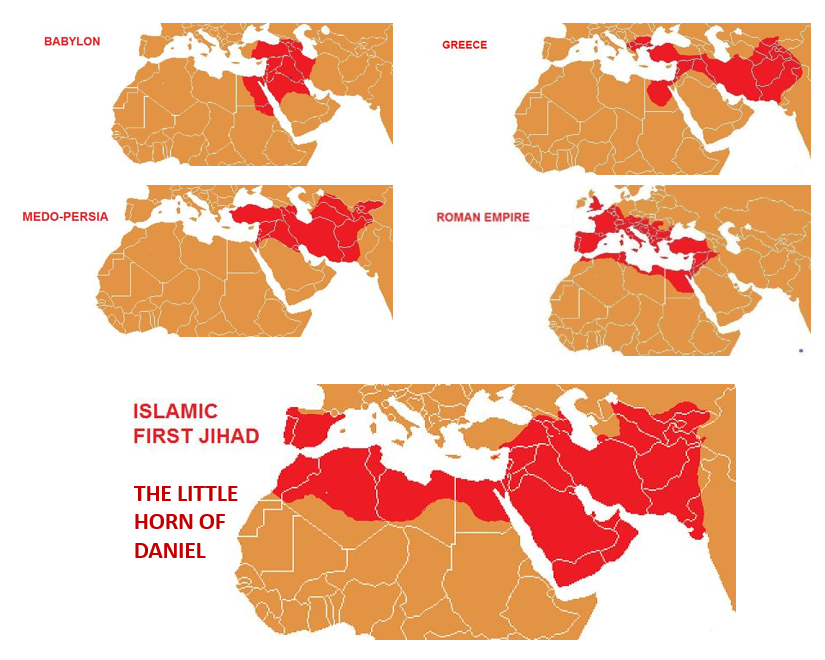
1. The identification of the Little Horn of Daniel chapter 7 as Mohammed. Here Gordios says: “And again, this prophet (Daniel), in the first vision he saw, says how the four winds of heaven blew into the sea and this I saw, he says, how four great beasts rose from the sea. The first was a female lion and represented the kingdom of the Babylonians; the second was like a bear and represented the Persians; the third was like a leopard and represented the king Alexander and the kingdom of the Greeks; the fourth beast, the most terrible, declared the kingdom of the Romans. (Dn. VII, 1-7) But did the feet of the icon have ten toes? and the fourth beast had ten horns. And this is the prophecy and it says four great kingdoms. And to the fourth kingdom, which belongs to the Romans, he says how the end will come. As for the reign of Muhammad, which prophet or apostle or other of the great saints is there to mention him, much or little? Even the four kingdoms came to an end and we do not miss anything else, only the kingdom of the Antichrist. But whence did Muhammad appear in the midst, such a terrible beast, and subdue the whole world and bring it under his power and his religion? Are you unable to say how it is a partial kingdom and that is why they do not have it in measure and did not write it down? See well how not only it is not partial but also significantly bigger than the other four, the first ones. Because the religion and the kingdom of Muhammad conquered more places and lasted longer and will last. Because of the four parts of the earth, he took three and only one remained, that of the West, where the Latins hold it. And the ancient kings, that is, the Persians, the Babylonians and the Macedonians, lasted for three or four hundred years and no more. But the territory of Mohammed is a thousand years and more, as the history of the Mohammedans confirms this.“
2. Matthew 24:15 identifying the Abomination of Desolation in the Olivet Discourse to Mohammed (this is in agreement with Patriarch Sophronios of Jerusalem in 637 AD).
3. The identification of the latter part of Revelation 12 as the “flood” of Islam
4. The “woman” represents the church. He later says they are the 4 remaining Orthodox patriarchates. The flight of the church to the “wilderness” and monasteries of Russia to escape persecution. Gordios says: “The woman clothed with the sun is, as we have said, the Church, whom Christ redeemed with his holy blood, when he was crucified, and married her with an unholy and unsanctified spiritual marriage, and gave birth to the new Israel from her, the people from the nations, were the infinite multitude of martyrs and the faithful of whom we wrote above. And she is tormented to flee, because with much labor and sweat the saints sanctified where they also shed their blood. And he who says, that how the dragon stood in front of the woman, is how the Devil made a terrible war with the martyrs and with the saints in order to defeat them and swallow them. However, the saints, with their great patience and with the divine help, defeated him state by state and raptured to God and to his throne, the infinite multitude, as we said, of the martyrs and the faithful”
5. The two beasts of Revelation 13 as the Papacy and Islam. Gordios leads into this thesis in Revelation 12 where he says: “As mentioned before, the woman clothed with the sun is a vision of the Church, and the male child she gave birth to are the Gentile peoples who believed and sanctified, some by martyrdom and others by practice, as we said, with whom the Dragon fought and it was anointed and cast down as if from heaven, from the honor with which the world worshiped him for God with idolatry. And as he fell, he set out again to persecute the Church through the antichrist Muhammad and his devils (angels) from the part of the South and the East, and from the part of the West through the second person of the Antichrist, is the Papacy. Because the kingdom of the Antichrist consists of two generations, the Ottomans and the Latins, and of two persons, Muhammad and the Pope, and from these two the second persecution of the Church was and is being done now for a thousand years, and will continue to be persecuted until the time of the end”
6. The calculations of the number of the beast 666 as Lateinos and Muhammed
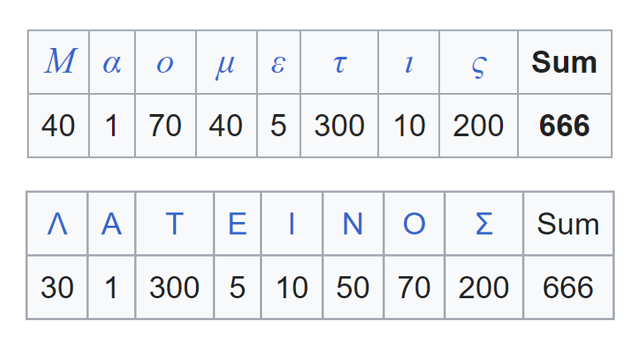
Some new research in recent years has provided some amazing historical evidence of older commentary or notes on Revelation within Orthodoxy identifying the prophet Mohammed as the Antichrist (for example, showing that ‘μοαμετις‘ calculates to the number 666) shown in 14th and 15th century manuscripts of notable commentaries of Revelation (specifically, marginal comments found in manuscripts of Andrew of Caesarea and Oecumenius) identified at Orthodox monasteries of Panteleimonos at Mt. Athos and Vlatadon monasteries in Thessaloniki. An excellent paper describing this evidence: Allen, G. V. (2020) An anti-Islamic marginal comment in the Apocalypse of “Codex Reuchlin” (GA 2814) and its tradition. And there is another Greek commentary written by Zacharias Gerganos from Arta in the year 1621, which identified the Papacy as the Antichrist. So these calculations of 666 pointing to both the Papacy and/or Mohammed were certainly not new by the time of St. Anastasios’s commentary written in the early 1700s, and they sowed the seeds to his interpretation as he looked around himself and pondered the spiritual slumber and persecution of his fellow Greeks in a Post-Byzantine world three centuries after The City’s fall in 1453 AD.
7. Identification of John 5:43 as a reference of Mohammed.
8. He provides an explanation of the first three seals which is interesting. The first seal the Rider of the White Horse in Revelation 6 representing the conquering of Christianity and spread of the gospel to the nations, the second seal of the Red Horse the blood of the martyrs, and the third seal the Black Horse the rise of monasticism in the church. Gordios says: “This opening of the first seal, as the exegetes say, means the preaching of the Holy Apostles of the evangelical crew and the glorious grace which in a short time converted the whole world to the knowledge of God. Regarding the opening of the second seal And here the commentators say that this is the second sermon of the Apostles, which was completed by the witnesses and the teachers. And when peace arose from the earth, the countless massacres of the martyrs took place and the preaching of the Apostles was confirmed, with the confession of the martyrs, the persecution and the shedding of the blood of the martyrs, during the latter reign of the Roman Emperors, immediately started the order of monks. And in this we said a little, how the three seals indicated the three orders of the saints: first the order of the holy Apostles, secondly the martyrs and hierarchs and thirdly the order of the monks. From which three orders the wicked Devil was completely destroyed and was completely removed from the power he had over the human race”
9. The Papacy is identified as the second Beast of Revelation 13 and and the second face of the Antichrist. Gordios states: “But this second Beast, the theologian says, came up from the earth and had the horns of a lamb. And who, then, should we consider what this Beast is like? It is nothing else, as can be seen from the facts and from his arguments, than the pope of Old Rome. This is the second Beast. And listen to what he says: how he had two horns like a lamb. The two horns indicate the two powers he has in his speech: to be king and high priest, and the two crowns he wears on his head. And this does not need much explanation, because it is self-evident. No king from the past seems to have worn a dikronon, let alone the pope. And because of this, the Evangelist saw the horns of a lamb, belonging to the Christian kingdom and priesthood, a sheep on the outside and a wolf on the inside. And he roars like a dragon. And Mohammed is a persecutor of Christians, while the Pope is a persecutor of the Orthodox Church. Because in the territory of Mohammed there are Orthodox churches everywhere, whether many or few, but in the territory of the pope there is no orthodox church at all, except in Zakynthos, Koryho and Kefallinia, and in this because of their need.”
10. The 1260 “days” of Revelation interpreted as years, that is 1260 YEARS for the reign of Islam on the “saints” or Orthodox Christians. Gordios says: “In this way I preached about the flight of the Church and about the wilderness, where it was given to be fed for a time and times and half a time, which are one thousand two hundred and sixty days, which show one thousand two hundred and sixty years from the time when Muhammed was born. until her time continuously. Because Muhammad, who was the Antichrist, has to endure one thousand two hundred and sixty years, and the flight of the Church into the wilderness one thousand two hundred and sixty years has to endure, and the preaching of Enoch and Elias and John the theologian one thousand two hundred It is sixty years old to reserve. Because everything began at one time, at one time they have to end, at the end. Right where Muhammad was born, right away the Church of Christ began to be troubled and to receive the messages of her annihilation and of her ultimate flight and desertion.”
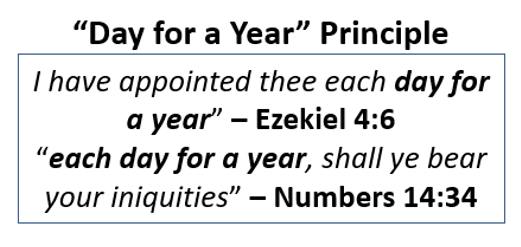
This last point here is significant. As he provides a 1260 year calculation on Mohammed as the Beast and Little Horn. This appears to be the first EVER application of the 1260 years on Islam and not calculated to the Papacy, which we can see began with numerous Protestant commentaries in West starting in the 1500s to 1600s. And thus the first known Orthodox Saint who was applying the “year-for-a-day” method of interpretation based on what is taught in Ezekiel 4:6 and Numbers 14:34. Based on these scriptures, the times statements “42 months”, “1260 days” and “time times and a half of a time” must be interpreted to be years, and not days, that is, tribulation upon the church was to last for 1260 years.
Based on this application of the scriptures to the calculation, Anastasios expected the fall of Islam to occur in 1860 AD based on the arrival of Mohammed in 600 AD (i.e. 600 AD + 1260 years = 1860 AD). While looking backwards at history we can say his calculation was obviously incorrect, the practical application was most certainly notable that he was applying the termination of the Tribulation from the distinct starting point of the arrival of the “Little Horn.” But what is fascinating is that this calculation pointing to Mohammed was at least 100 years before any and all of the Protestant commentaries in the West during the 19th century began to perform a similar “Sophronius” calculation identifying Islam as the Little Horn of Daniel 8 starting from the fall of Jerusalem in 636/637 AD. Now, as we look back into these periods of history with the benefit of revolutions, world wars, and declarations for the partition and division of the Ottoman Empire, the Balfour declaration, and the Six-Day war in 1967, we can definitely say that Anastasios was on to something here. See the pattern as we apply solar, lunar and geometric calculations to the 3.5 “times” to the prophecies of Daniel and Revelation. It reveals an emerging pattern that the “holy city” (that is, both Jerusalem or the Church), was to be trampled for a period of 1260 years. A pattern that is not yet complete until the final judgment of the Little Horn.

For example, if we apply 1260 solar years (1279 years) from the fall of Jerusalem to Islam in 637/638 AD, we come to the year 1917, which was the very same year for the dissolution of the Ottoman Empire by the Great Powers and the Balfour Declaration at the end of WWI. That is, 638 AD + 1279 years = 1917 AD).
Astérios Argyriou points out that St. Anastasios’s commentary influenced all other Greek Orthodox commentaries on Revelation up to 1920. And he has a good point here, as after the early 20th century we saw a distinct reversal in all of the 20th century Orthodox commentaries on Revelation up to the present with a particular shift to Futurist views of the Antichrist, and a shift away from anything to do with “messianism“, “millenarianism” or “millennialism” views of the Church or about a coming period of Orthodoxy or “Last Roman Emperor” while Constantinople was to be liberated by the “Blond” nation from the north. Some reasons to explain this shift in the mindset to Futurist eschatology within Orthodoxy can be explained due to the 1922 Greek Catastrophe, loss of Asia Minor which led to the rejection and death of the “Megali Idea“, as well as the Russian Revolution and rise of communism as a newly created modern Turkish nation was propped up and supported by the Western nations and NATO. And then after WWII, the rise and dominance of Protestant Dispensationalist theology could also explain the shift within Orthodoxy from Fulfilled Eschatology to Futurist Eschatology. The apostacy was now upon us, the “age of the antichrist” was soon to be here, and the postmillennial dreams of a coming golden age was erased from our memory.
However, We find other later Greek commentators like Athonite monk Theodoret of Ioannina, Apostolos Makrakis, and Athonite Monk Neilos Sotiropoulos were all major advocate and proponent of the year/day method of interpretation. Back when I republished Makrakis’s Revelation commentary in 2018, I called him the “Father of Eastern Historicism” as I made the mistake to assume that he was the first Orthodox to write from a historical perspective. But now we have evidence of over 20 existing Greek Orthodox historicist commentaries written in the 17th through the 19th centuries. There were a few Orthodox commentaries in the 1600s which began to sew the seeds of historical applications to the Apocalypse, but they were just starting to crack open the door, and Gordios took their ideas and kicked the door wide open. I now retract my initial statement and belief on the roots of historicist approach in Orthodoxy, to say that it is otherwise Saint Anastasios who is clearly one of the first major author’s of these historicist ideas coming from the Eastern Church. And as such, Anastasios Gordios is indeed considered to be one of the major “Fathers of Eastern Orthodox Historicist Eschatological Thought.”

To summarize the major point of emphasis here: we now have a Saint of our Orthodox Church advocating the year day principle and the concept of a 1260-year period of tribulation upon the church, and the identification of the two major historic threats that sought to dominate and destroy Orthodoxy and the Byzantine Empire, with the identification of the two beasts as Islam and the Papacy. A saint in full agreement with the ominous and prophetic words of Saint Sophronius, the Patriarch of Jerusalem, who also similarly identified the very same Little Horn and Abomination of Desolation of Daniel back in the Seventh Century (at the very start of the “1260 years”). However today these events are fulfilled. And prophecies are only understood after the fact, with real evidence found in our history textbooks. All this, in stark contrast to what a few of the more recent modern Orthodox “futurist” interpretations published in the last 20-30 years. Which approach is the correct one? Time will only reveal to us the answer to that question!
© 2023 by Jonathan Photius
REFERENCES AND FURTHER READING
- Asterios Argyriou, Les exégèses grecques de l’Apocalypse à l’époque turque (1453-1821). Esquisse d’une histoire des courants idéologiques au seindu peuple grec asservi. Thessaloniki, 1982
- Astérios Argyriou. Anastasios Gordios et la polémique anti-islamique post-byzantine. In: Revue des Sciences Religieuses, tome 43, fascicule 1, 1969. pp. 58-87;
- A. Argyriou, Αναστάσιος ο Γόρδιος και το σύγγραμμά του: Περί του Μωάμεθ και εναντίον των Λατίνων, Athens 1969
- A. Argyriou. Anastasios Gordios, Sur Mahomet et contre les Latins. Athens, 1983
- Allen, G. V. (2020) An anti-Islamic marginal comment in the Apocalypse of “Codex Reuchlin” (GA 2814) and its tradition. In: Karrer, M. (ed.) Der Codex Reuchlins zur Apokalypse: Byzanz – Basler Konzil – Erasmus. Series: Manuscripta Biblica (5). De Gruyter: Berlin; Boston, pp. 193-198. ISBN 9783110674118
- Neilos Sotiropoulos, The Coming Sharp And Two-Edged Sword, Holy Monastery of Simon’s Petra, Holy Mount Athos, Greece, (1973)
- Apostolos Makrakis, Interpretation of the Revelation of St. John the Divine. Hellenic Christian Education Society, Chicago, IL, 1948
- Marios Hatzopoulos, Eighteenth century Greek Prophetic Literature, David Thomas & John Chesworth (eds), Christian-Muslim Relations. A Bibliographical History, Volume 13 Central and Eastern Europe 1700-1800, Leiden: Brill (forthcoming April 2020), 2020
 NEO-Historicism - End Times Eschatology From An Eastern Orthodox Christian Historicist Perspective