
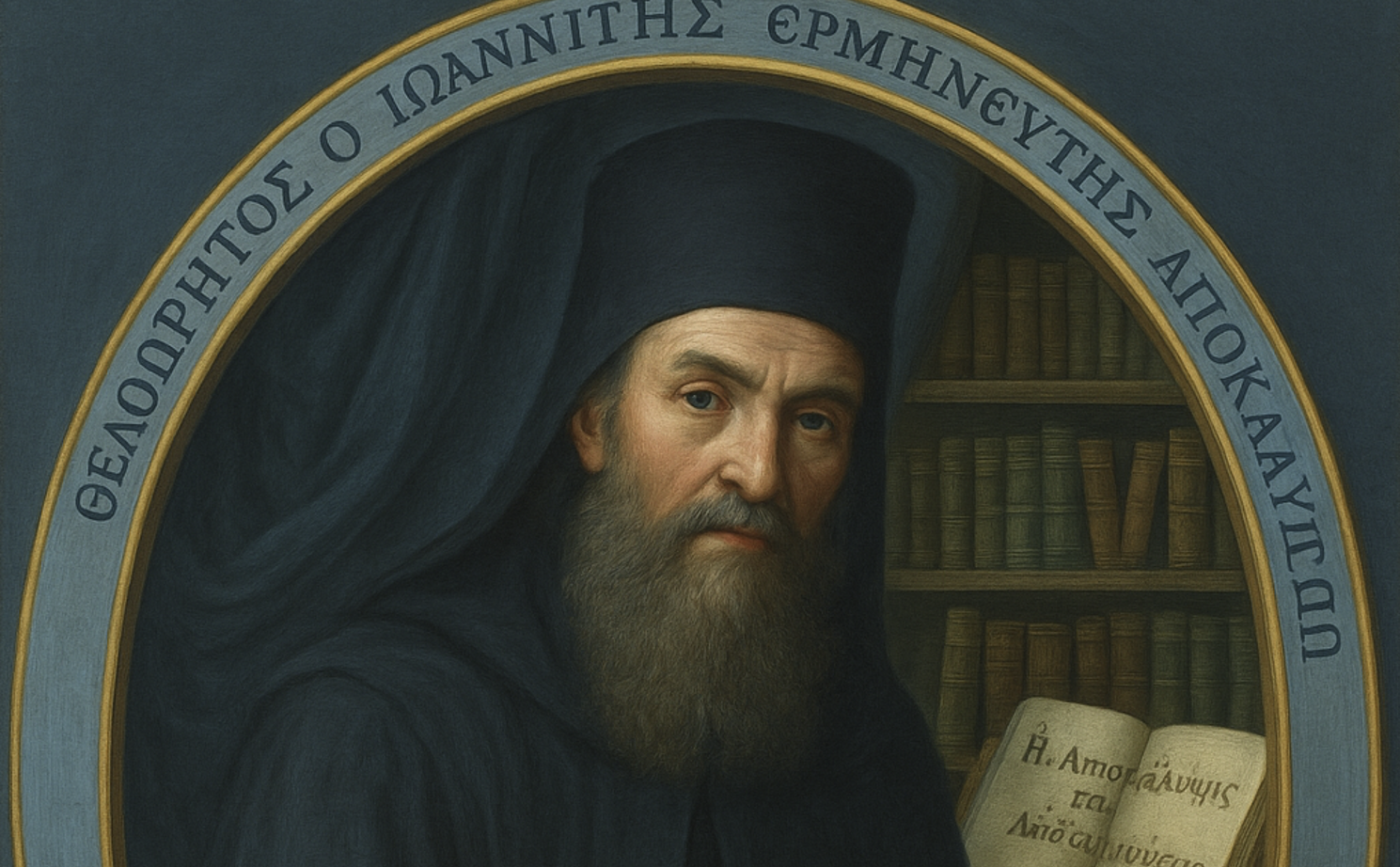
I. Introduction
Among the many Greek Orthodox interpreters of the Book of Revelation who wrote during the Ottoman period, Theodoret of Ioannina stands apart. He was neither a preacher nor a popular exhorter, but a system-builder—a thinker who attempted nothing less than a total interpretive architecture of sacred history. His Apocalypse commentary, written at the close of the eighteenth century, represents one of the most ambitious historicist syntheses ever produced in the Orthodox world.
Yet Theodoret is today largely forgotten—and in some circles actively distrusted. He is overshadowed not only by more accessible figures such as Anastasios Gordios or later prophetic voices like Apostolos Makrakis, but also by the long shadow of ecclesiastical controversy. As the historian Asterios Agryriou observed, Théodoret’s work is cold, difficult, and demanding—designed not to console the enslaved Orthodox masses, but to explain the logic of history itself.
This difficulty, however, does not fully explain his marginalization. Théodoret’s legacy was shaped by his conflict with influential Athonite reformers, his rupture with Nicodemus the Hagiorite, and the subsequent removal of his marginalia from canonical collections. These events placed his writings outside the dominant Athonite editorial and devotional networks at precisely the moment when Orthodox theological memory was being consolidated. As a result, his Apocalypse commentary—already unsuited to popular devotion—circulated little and was rarely cited. There are also indications that ecclesiastical authorities in Constantinople discouraged the circulation of Theodoret’s commentary, likely out of concern that openly apocalyptic interpretations against Islam might provoke Ottoman reprisals—an atmosphere that further limited the work’s dissemination within the empire and beyond.
In modern Orthodox discourse, these inherited polemics are often repeated uncritically. Theodoret’s additions and interpretations are sometimes dismissed online as “heretical,” not on the basis of doctrinal analysis, but through the repetition of nineteenth-century judgments formed in the heat of liturgical and methodological disputes. His work is thus not merely obscure, but encumbered by a contested reception history that continues to shape how it is read—or avoided—today.
What follows is a critical re-examination of Theodoret’s Apocalypse commentary: its aims, methods, strengths, limitations, and lasting significance for the development of Orthodox historicist eschatology.
II. Life, Formation, and the Athonite World
Theodoret of Ioannina (c. 1740–1823) was born in Ioannina, Epirus, during the later Ottoman period to a family of modest means. His formal schooling appears to have been modest, limited largely to the elementary grammatical education typical of Greek communities under Ottoman rule. Yet this lack of institutional education would be compensated by a lifetime of relentless self-study, manuscript research, and intellectual exchange. Théodoret developed into a formidable autodidact through sustained private study of Scripture, patristic literature, canon law, and history.³
He entered monastic life on Mount Athos and is attested by the 1770s as a monk of Saint Anne’s Skete. His participation in the Athonite delegation to the Synod of Constantinople (1776) demonstrates that he was already trusted as a representative of the Holy Mountain in ecclesiastical affairs.⁴
During the later eighteenth century, Théodoret rose to positions of significant institutional authority. He served as Superior (προηγούμενος) of the Great Lavra, acting as presiding superior during its idiorrhythmic period, and on 16 August 1802 was appointed Superior of the Monastery of Esphigmenou, one of Athos’ major houses. These appointments place Théodoret at the institutional center of Athonite monastic life.⁵
III. Exile in Moldavia and the Birth of a System
A decisive episode in Théodoret’s life was his ten-year absence from Mount Athos (1790–1800). During this period he resided in Moldavia, attached to a metochion of Esphigmenou near Botoșani, within the Danubian Principalities.⁶
This period proved intellectually formative. Moldavia at the end of the eighteenth century was a crossroads of Orthodox scholarship, Enlightenment influence, and geopolitical anxiety. It was here that Théodoret composed the bulk of his Exegesis of the Apocalypse, revising the work no fewer than four times before its publication in Leipzig in 1800.⁷
Significantly, Théodoret was not working in isolation. Other Orthodox historicist works—especially those of Pantazēs of Larissa and Cyril Lavriotis of Patras—were being composed in the same region and period, indicating a broader milieu of apocalyptic reflection.⁸
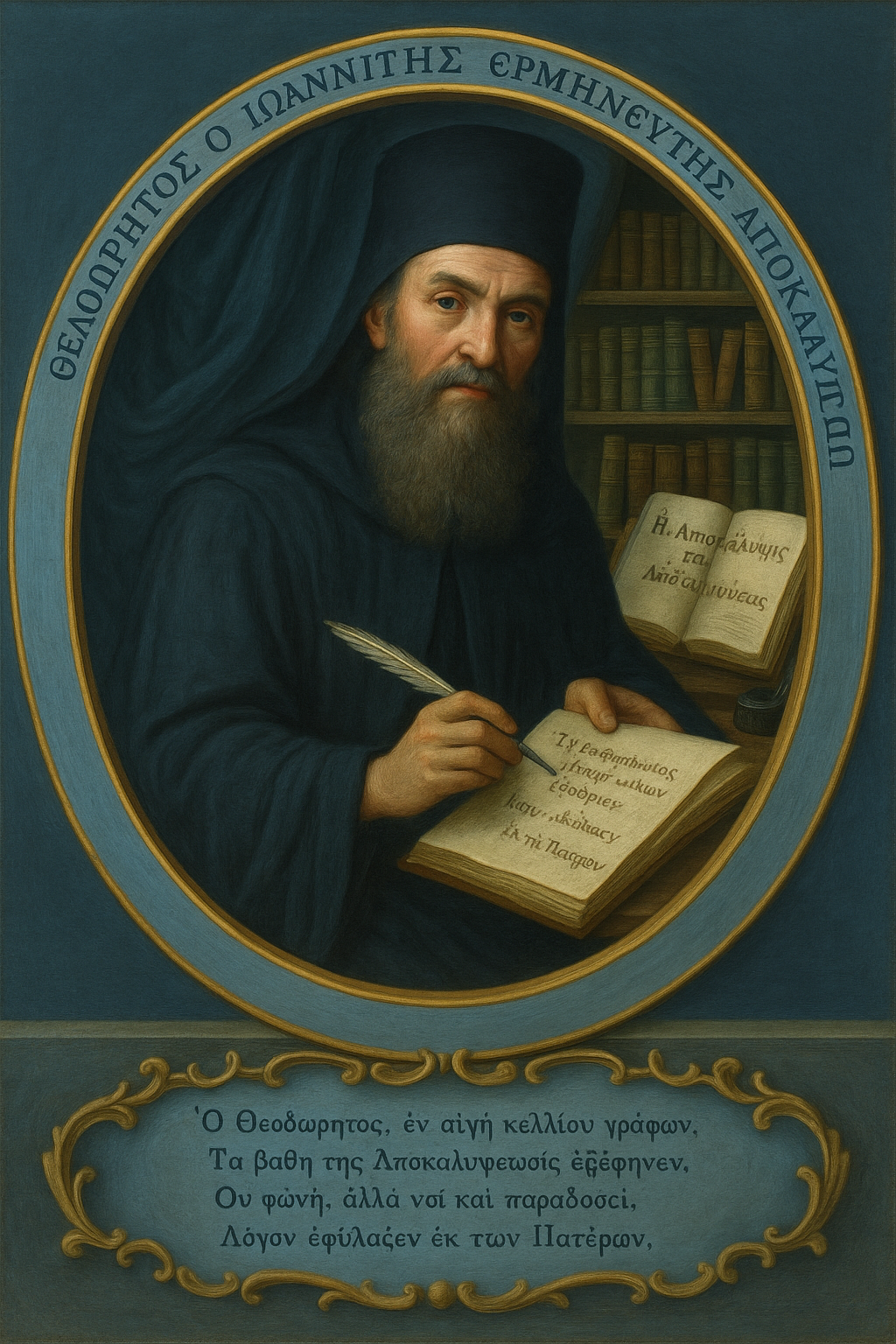
“Theodoret, writing in the silence of his cell,
made manifest the depths of the Apocalypse;
not by loud voice, but by mind and tradition,
he preserved the Word handed down by the Fathers.“
IV. Theodoret and the Kollyvades Movement: Conflict and Marginalization
Theodoret’s relative obscurity cannot be explained solely by the difficulty of his Apocalypse commentary or its lack of pastoral tone. It must also be situated within the ecclesiastical conflicts of his time—particularly the rise of the Kollyvades reform movement on Mount Athos.
Although Théodoret shared the Kollyvades’ commitment to Orthodox tradition, he did not belong to their movement and openly opposed certain positions associated with it, especially the absolutization of liturgical practices surrounding memorial services and the rigid enforcement of reform through editorial authority. His disagreements were not merely practical, but methodological: Théodoret believed that tradition could be critically examined in non-dogmatic matters and that historical development must inform theological interpretation.
V. Theodoret and St. Nicodemus the Hagiorite
Theodoret’s relationship with St. Nicodemus the Hagiorite, the most influential figure of the Kollyvades movement, was initially one of collaboration and trust. Theodoret submitted early versions of his Apocalypse commentary for review and was entrusted with contributing scholarly notes to the Pedalion (The Rudder), the authoritative Orthodox collection of canon law.⁹
Theodoret’s relationship with St. Nicodemus is one of the most misunderstood episodes in modern Orthodox historiography. Their differences came to a head in his rupture with St. Nicodemus. The controversy surrounding Théodoret’s marginal notes in the Pedalion—and their subsequent removal from later editions—effectively placed him outside the dominant Athonite reform network. In a monastic culture where publication, manuscript transmission, and reception were closely tied to spiritual authority, this exclusion had lasting consequences.
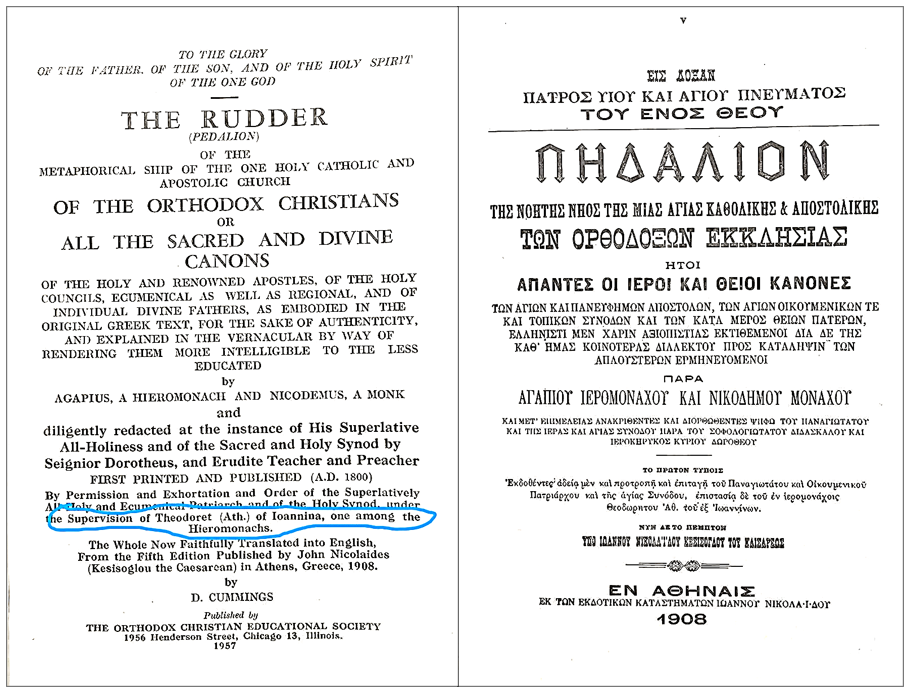
On the one hand:
- Theodoret submitted the first three versions of his Apocalypse commentary to Nicodemus and his collaborators.
- He praised Nicodemus lavishly in correspondence.
- Nicodemus trusted Theodoret enough to allow him to insert scholarly notes into the Pedalion (The Rudder), the definitive canonical collection of the Orthodox Church.
The rupture between the two occurred when Theodoret inserted independent marginal notes—some touching on liturgical practice and apocalyptic interpretation—without clear attribution. Theodoret used this editorial trust with his insertions which contradicted Nicodemus’ own positions. These notes addressed:
- memorial services (mnemosyna),
- kollyva,
- genuflections,
- and—most explosively—apocalyptic interpretation.
Nicodemus regarded this as a breach of trust and denounced Theodoret publicly, leading to the removal of Theodoret’s notes from later editions of the Pedalion.¹⁰ But this accusation requires careful evaluation. The so-called “heretical” notes:
- did not deny Orthodox dogma
- did not contradict conciliar teaching
- were often in line with official Church positions, especially on mnemosyna
Mnemosyna are Orthodox memorial services or liturgical prayersfor the souls of the departed. Theodoret did not oppose them. He opposed the Kollyvades insistence that they be celebrated only in one rigid manner (i.e. only on Saturdays). This disagreement—pastoral rather than dogmatic—contributed to his marginalization. This attitude placed Theodoret at odds with Nicodemus’ strict traditionalism and his supporters. As a result, Théodoret’s Exegesis of the Apocalypse, already demanding and unsuited to devotion, lacked the institutional support necessary for wide dissemination. Its neglect was not the result of formal condemnation, but of marginalization within the very circles that shaped Orthodox theological memory in the early nineteenth century.
VI. The Charge of “Heresy” Reconsidered
Later accusations against Théodoret are often summarized as charges of heresy, yet this characterization is misleading. The disputed notes did not deny Orthodox dogma or conciliar teaching. The conflict was methodological and ecclesiological, not doctrinal.¹¹
Theodoret believed that:
- tradition must be critically examined,
- patristic authorities can err in non-dogmatic matters,
- and history itself is a legitimate theological source for interpreting the Apocalypse.
Most importantly, Théodoret’s apocalyptic marginalia in The Rudder presupposed a framework in which:
- the Papacy represents an internal ecclesial distortion, and
- Islam represents an external rival religious-political system.
Read within this dual-system framework, Theodoret’s contested interpretations are coherent and consistent with Orthodox historicist tradition.¹² Indeed, later nineteenth-century interpretations, together with the twentieth-century collapse of the Ottoman Empire—occurring roughly 1,260 solar years after the trampling of Jerusalem in 637, described by the seventh-century Patriarch Sophronius of Jerusalem as the “Abomination of Desolation”—lend additional support to the view that Theodoret’s commentary merits renewed examination in relation to a 1,260-year epoch of persecution involving both the Papacy and Islam. History confirms parts of Theodoret’s central ideas. For example, one significant chronological data point suggests that the Ottoman Empire collapsed approximately 1,260 solar years after the initial Islamic conquest of Jerusalem in 637, reaching the year 1917. Likewise, if one calculates 1,260 years from the construction of the Dome of the Rock in 688, erected on the site of the former Second Temple, the resulting termini fall in 1948 or 1967, depending on whether biblical (prophetic) or solar years are employed. These dates correspond to pivotal moments in the erosion and eventual loss of Islamic control over the Holy Land and the Holy City. Viewed retrospectively—nearly two centuries after Théodoret’s commentary—history itself functions as an interpreter, lending plausibility to the apocalyptic claim that the power symbolized as the Beast in Revelation 13 would trample the holy city for “forty-two months,” that is, 1,260 days understood as years.
VII. Why Théodoret Turned to the Apocalypse
Theodoret explicitly presents his engagement with Revelation as an apologetic response to three pressures: the trauma of 1453, Enlightenment skepticism, and the conviction that Revelation alone speaks directly of events still unfolding. To abandon the Apocalypse would be to abandon history itself to unbelief.¹³
VIII. Revelation as a Total Historical System
Theodoret approaches the Apocalypse with a radical conviction: the book is not a collection of isolated visions, but a single, internally coherent map of world history. Every symbol, number, and image must therefore be interpreted in relation to the whole. This method—described by Agryriou as “conjugated exegesis”—reads Revelation simultaneously through Daniel, Church history, and symbolic correspondences.¹⁴
Theodore’ts Congugated Exegesis involved:
- other biblical books (especially Daniel),
- the entire course of Church history,
- and a dense web of symbolic correspondences (numbers, directions, cycles, empires).
The Apocalypse, in this view, is not merely about the end of time. It is a summary of sacred history from the Incarnation to the final judgment, written in symbolic code.
Chronological Structure of the Apocalypse according to Théodoret of Ioannina
| Period | Approx. Dates | Revelation Chapters | Historical-Theological Meaning |
|---|---|---|---|
| 1. First Period | Incarnation – 306 | Rev 1–3 | Apostolic Church; early martyrdom; pre-Constantinian Christianity |
| 2. Second Period | 306 – c. 640 (Heraclius) | Rev 4–6 | Christian Empire before Islam; imperial Orthodoxy |
| 3. Third Period | c. 640 – 1261 | Rev 7–9 | Islamic expansion; endurance of Orthodoxy |
| 4. Fourth Period | 1261 – 1453 | Rev 10–13 | Crusades, Papacy, Ottoman rise; dual Antichrist system |
| 5. Fifth Period | 1453 (compressed) | Rev 14:1–13 | Fall of Constantinople; historical rupture |
| 6. Sixth Period | 1453 – early 20th c. | Rev 14:14–15:6 | Russia as guardian and avenger of Orthodoxy |
| 7. Seventh Period | Overlapping (867–early 20th c.) | Rev 15–18 | Babylon, Beast, Papacy, Islam |
| 8. Seventh–Eighth Period | Late 19th – early 20th c. | Rev 19–20 | Cavalier (Faithful & True); eschatological conflict |
| 9. Meta-Historical Period | Beyond history | Rev 20:11–22:21 | Final Judgment; New Jerusalem; eternity |
TABLE I — The Spatial Dimension of History
| Category | East | North | South | West |
|---|---|---|---|---|
| Seasons | Spring | Summer | Autumn | Winter |
| Cycle of Seven | Churches | Seals | Trumpets | Plagues |
| Beasts (Dan 7) | Lion | Bear | Leopard | Ten-horned Beast |
| Pre-Christian Empires | Babylonian | Persian | Macedonian | Roman |
| Post-Christian Evil Empires | Persia | Papacy | Islam | |
| Living Creatures (Rev 4) | Lion | Calf | Man | Eagle |
| Horses (Rev 6) | White | Fiery Red | Black | Pale |
| Great Signs (Rev 12–13) | Woman | Dragon | First Beast | Second Beast |
| Systems | Faithful | Jewish-Roman | Papacy | Islam |
TABLE II — The Temporal Dimension of History
| Day | Church | Patriarchate | Period | Planet | Ministry |
|---|---|---|---|---|---|
| 1 | Ephesus | Rome I | 1st | Saturn | Apostles |
| 2 | Smyrna | Jerusalem | 2nd | Jupiter | Prophets |
| 3 | Pergamum | Antioch | 3rd | Mars | Doctors |
| 4 | Thyatira | Alexandria | 4th | Sun | Miracles |
| 5 | Sardis | Constantinople | 5th | Venus | Healing |
| 6 | Philadelphia | Moscow | 6th | Mercury | Discernment |
| 7 | Laodicea | Rome II | 7th | Moon | Tongues |
IX. The Two Systems of Evil: Papacy and Islam
At the heart of Theodoret’s interpretation lies a decisive historical thesis: evil in history does not appear randomly, but in organized systems. He identifies two such systems:
- The Papacy, understood as a corruption arising within Christianity—an internal distortion of ecclesial authority and doctrine.
- Islam, understood as an external, rival religious-political power opposing Christian civilization from without.
These two Papal/Islamic systems function as coordinated adversarial powers throughout history sometimes independently, sometimes cooperatively. For Théodoret, they are the true historical referents behind many of Revelation’s composite symbols: the Beast, Babylon, the Prostitute, and the Antichrist.¹⁵
This dual-system model allows Théodoret to explain why Revelation’s enemies appear multiple times under different images while still referring to the same historical realities.
Within Théodoret’s broader framework:
- The Papacy embodies a counterfeit ecclesial fullness
- Islam embodies a counterfeit monotheistic universality
Both:
- claim universal authority,
- replace Christ-centered mediation,
- impose law and obedience without sacramental grace.
IX.A – Theodoret’s 666 Application to the Papacy and Islam
“The second Beast rises from the solid earth (Rev. 13:11). This earth is the same one upon which the first angel fell (Rev. 9:5), where the fifth angel fell (Rev. 9:1), and where the Dragon and his angels were cast down (Rev. 12:9). The Beast arises in the place where the Lamb with seven horns reigned (Rev. 5:6; 14:1), where the mighty angel had placed his two legs like pillars of fire (Rev. 10:1)—that is to say, upon the two metropolises of Christendom, Rome and Constantinople, and upon the two parts of the Orthodox Empire, the eastern part and the western part. The Beast with two horns designates, to be sure, the Pope, who exercises his double authority over one of the two metropolises; it also designates the Sultan of Constantinople installed in the other metropolis. The Beast with two horns therefore designates both Islam and the Papacy; it designates the entire system of the Antichrist after the fall of Constantinople. It is the Antichrist himself bearing two horns: on the one hand, a double spiritual power (Latin heresy, Muslim religion); on the other hand, a double temporal power (the Ottoman Empire and the Western states). Thus doubled (2 + 2 = 4), the two horns designate the reign of the Antichrist extended over the entire inhabited earth where Orthodoxy had previously reigned. The number of the Beast (Rev. 13:18) designates these two powers, for its calculation yields the names Mohammed, Osman, the sons of Osman, Lateinos and Benedictos.¹ The Beast with two horns unites the two systems of Evil into a single one, because since the fall of Constantinople the two persons of the Antichrist have acted in concert, and because their deepest desire is the total extermination of the Orthodox faith. In chapters XVII, XVIII, and XIX, these two persons constitute a single system and are called the Beast, the Scarlet Beast, Babylon, and the Harlot. It is against this system that the rider called Faithful and True must fight—that is to say, Russian Orthodoxy during the sixth period of the history of the Church” — Théodoret of Ioannina. Exegesis of the Apocalypse. Leipzig, 1800. (pp. 311–319).
X. Periodization and the Hinge of 1453
Theodoret is a historicist in the strongest sense: he believes history unfolds in divinely ordered periods, and that Revelation mirrors this unfolding, culminating in the unique compression of 1453 as a theological rupture.
Key features of his periodization include:
- A sevenfold structure of sacred history, aligned with biblical patterns.
- Overlapping and recapitulating phases rather than a single linear timeline.
- A unique emphasis on 1453, the fall of Constantinople, as a theological rupture so severe that it becomes a compressed “period” in itself.
For Theodoret, 1453 is not merely a political catastrophe. It is the moment when Orthodox imperial authority is stripped away, inaugurating a prolonged historical humiliation symbolized by the “death” of the Two Witnesses in Revelation 11.¹⁶
XI. Russia and the Transference of Empire
One of the most striking—and controversial—elements of Théodoret’s commentary is his interpretation of Russia’s eschatological role. Following a logic of providential succession, Théodoret argues that:
- When Constantinople fell, Orthodox imperial responsibility did not disappear.
- Instead, it was transferred northward, to Moscow.
- The sixth Church of Revelation (Philadelphia) thus corresponds to Russia, the final historical refuge of Orthodoxy before the end.
This move is not a nationalist innovation but a continuation of Byzantine translatio imperii logic: empires fall, but sacred authority migrates. ¹⁷ Later Orthodox historicists—especially Lavriotis—would inherit and harden this idea into more explicit prophetic chronologies.
XII. Numbers, Time, and the Limits of Calculation
Theodoret makes extensive use of apocalyptic numbers: 1,260 days, 42 months, three and a half times. He clearly understands these as long historical durations, implicitly employing the year–day principle.¹⁸
Yet unlike later historicists, Theodoret refuses to absolutize arithmetic. He:
- allows multiple possible starting points,
- accepts overlapping chronologies,
- and ultimately admits that the future cannot be read “securely” from numbers alone.
This hesitation becomes especially visible in the late 1790s, when European geopolitics—Napoleon, Russo-Ottoman alliances, revolutionary atheism—disrupt his expected prophetic alignments. Rather than forcing the math, Theodoret retreats into theological reserve and introduces the idea of a pre-Parousia divine intervention (a theophany) to resolve history’s contradictions.
XIII. Why Théodoret Was Not Widely Read
Agryriou’s final assessment is sobering. Theodoret’s commentary failed to gain a wide audience not because it lacked originality, but because it lacked pastoral warmth.
- He does not speak to suffering hearts.
- He does not console the enslaved Orthodox.
- He builds systems instead of sermons.
Anastasios Gordios succeeded where Théodoret did not precisely because Gordios wrote for the people. Theodoret wrote for the architecture of ideas. Theodoret addressed the logic of history, not the immediate consolation of the enslaved Orthodox people under 400 years of Ottoman oppression.¹⁹ In addition, Theodoret’s commentary appears to have been actively suppressed due to the conflicts with the Kollyvades and by the Patriarchate of Constantinople, which feared that its apocalyptic interpretations might provoke Ottoman reprisals—a concern that certainly impeded its circulation within the Ottoman world and beyond.
XIV. Why Théodoret Still Matters
Despite his limited reception, Theodoret of Ioannina occupies a crucial place in Orthodox intellectual history. He represents:
- the most systematic Orthodox historicist before Makrakis,
- a bridge between post-Byzantine symbolic exegesis and modern chronological historicism,
- and a rare example of intellectual honesty, willing to admit uncertainty when history resists interpretation.
His tables and schemas—far from being curiosities—reveal a comprehensive attempt to integrate Scripture, history, empire, and eschatology in a single explanatory vision.²⁰
XV. Conclusion
Theodoret of Ioannina did not merely comment on the Apocalypse; he attempted to decode the logic of history itself. That his system strained under the weight of modern geopolitics does not diminish its importance. On the contrary, it marks the moment when Orthodox historicism confronted modernity and was forced to adapt, retreat, and reconfigure.²¹
Theodoret of Ioannina stands at a pivotal moment in Orthodox intellectual history:
- between Byzantine symbolic exegesis and modern historicism,
- between Athonite traditionalism and Enlightenment confrontation,
- between pastoral caution and prophetic urgency.
His condemnation was not the result of heresy, but of intellectual audacity. Read within his own framework—where Papacy and Islam form the two Antichristic systems—his Apocalypse commentary emerges as profoundly Orthodox, courageous, and tragically misunderstood.
Moreover, subsequent nineteenth-century commentaries and the twentieth-century historical culmination represented by the collapse of the Ottoman Empire—nearly 1,260 solar years after the trampling of Jerusalem in 637 and construction of the Dome of the Rock in 688—suggest that Theodoret’s apocalyptic framework warrants renewed attention, particularly with respect to a sustained 1,260-year period of persecution attributed to the Papacy and Islam.
To read Theodoret today is to witness Orthodox eschatology in transition: from symbolic world-model to chronological prophecy, from imperial theology to modern crisis. That makes his forgotten commentary not obsolete, but newly relevant.
For contemporary scholars and modern readers of Orthodox apocalyptic thought seeking to recover the roots of Eastern Orthodox Historicism, Théodoret is not a peripheral curiosity or an endpoint. He is a missing cornerstone.
Table III. Théodoret of Ioannina in Comparison with Other Orthodox Historicists
| Feature | Théodoret of Ioannina | Anastasios Gordios | Cyril Lavriotis of Patras | Apostolos Makrakis |
|---|---|---|---|---|
| Literary style | Systematic, schematic, theoretical | Pastoral, exhortatory | Polemical, chronological | Expansive, prophetic |
| Intended audience | Educated clergy, scholars | Enslaved Orthodox laity | Anti-Latin polemicists | Modern Orthodox public |
| Use of symbolism | Dense, multi-layered | Limited | Strong but selective | Highly developed |
| Use of chronology | Cautious, flexible | Minimal | Explicit calculations | Extensive calculations |
| Year–day principle | Implicit, restrained | Rare | Explicit | Fully explicit |
| Papacy identified as | Antichristic system | Corrupt Western Church | First Beast | First Beast / False Prophet |
| Islam identified as | External Antichristic system | Political scourge | Second Beast | Second Beast |
| View of Russia | Providential successor | Little emphasis | Strong emphasis | Central eschatological role |
| Reception | Marginalized | Widely read | Influential | Highly influential |
Table IV. Interpretive Methodologies among Orthodox Historicists
| Methodological Feature | Théodoret | Gordios | Lavriotis | Makrakis |
|---|---|---|---|---|
| Revelation read as total historical system | ✔ | ✖ | ✔ | ✔ |
| Daniel–Revelation synthesis | ✔ | Limited | ✔ | ✔ |
| Recapitulation model | Strong | Weak | Moderate | Strong |
| Symbol = single referent | ✖ | ✔ | Mixed | ✖ |
| Symbol = recurring system | ✔ | ✖ | ✔ | ✔ |
| Willingness to revise interpretations | ✔ | ✖ | Limited | ✖ |
Interpretive note:
Théodoret stands out for his epistemic humility: he allows history to correct interpretation, a trait largely absent in later Orthodox historicists.
Table V. Théodoret’s Interpretation of Key Apocalyptic Symbols
| Apocalyptic Symbol | Théodoret’s Interpretation |
|---|---|
| Beast (Rev 13) | Composite symbol representing organized, historical systems of opposition to Orthodoxy |
| First Beast | Papacy as an internal ecclesial distortion |
| Second Beast | Islam as an external politico-religious power |
| Babylon | Corrupt religious-political civilization opposed to true Orthodoxy |
| Prostitute | Institutionalized spiritual corruption allied with power |
| Antichrist | Not a single future individual, but a recurring historical reality manifested in systems |
| Two Witnesses (Rev 11) | Orthodox imperial and ecclesial authority |
| Death of the Witnesses | Fall of Constantinople (1453) |
| Resurrection of the Witnesses | Future restoration of Orthodox authority |
| Woman (Rev 12) | The Orthodox Church preserved under persecution |
| Wilderness | Period of enslavement under Islamic rule |
| Beast from the Abyss | Renewed historical phase of Antichristic power |
Table 4. Chronology and Time-Periods in Théodoret’s System
| Time Period | Théodoret’s Understanding |
|---|---|
| 1,260 days / 42 months | Long historical period (year–day principle implied) |
| Starting point | Multiple possible candidates (not fixed dogmatically) |
| Ending point | Indeterminate; subject to historical verification |
| 1453 | Theological rupture, compressed apocalyptic moment |
| 637 (Jerusalem) | Foundational moment of Islamic domination |
| Use of arithmetic | Subordinate to theology and history |
| Attitude toward prediction | Cautious; rejects certainty |
| Eschatological climax | Requires divine intervention beyond calculation |
Notes
- Asterios Agryriou, Les Exégèses grecques de l’Apocalypse à l’époque turque (1453–1821) (Thessaloniki: Patriarchal Institute for Patristic Studies, 1989), 443–447.
- Ibid., 520–523.
- Ibid., 447–449.
- Ibid., 449–450.
- Ibid., 450–452.
- Ibid., 452–454.
- Ibid., 455–458.
- Ibid., 458–460.
- Ibid., 460–463.
- Ibid., 463–466.
- Ibid., 466–468.
- Ibid., 468–470.
- Ibid., 471–473.
- Ibid., 474–477.
- Ibid., 477–480.
- Ibid., 480–483.
- Ibid., 483–487.
- Ibid., 487–493.
- Ibid., 520–522.
- Ibid., 523–525.
- Ibid., 525.
Bibliography
Primary Sources
Asterios Agryriou.
Les Exégèses grecques de l’Apocalypse à l’époque turque (1453–1821). Thessaloniki: Patriarchal Institute for Patristic Studies, 1989.
Théodoret of Ioannina.
Exegesis of the Apocalypse. Leipzig, 1800.
Greek original; multiple revised recensions composed c. 1790–1800.
———. [Apocalyptic and Canonical Marginal Notes].
Fragments preserved in early editions of the Pedalion and Athonite manuscript tradition.
Nicodemus the Hagiorite.
Πηδάλιον (The Rudder). Venice, 1800; subsequent Athonite and Constantinopolitan editions.
Canonical collection with later editorial revisions removing Théodoret’s marginalia.
Pantazēs of Larissa.
Apocalyptic Exegeses. Manuscript tradition; excerpts cited in Les Exégèses.
Cyril Lavriotis of Patras.
Commentary on the Apocalypse. Manuscript and early printed tradition; excerpts analyzed in Les Exégèses.
Apostolos Makrakis.
Commentary on the Apocalypse. Athens, 1904.
Andrew of Caesarea.
Commentary on the Apocalypse. In Patrologia Graeca 106.
Arethas of Caesarea.
Commentary on the Apocalypse. In Patrologia Graeca 106.
The Holy Bible.
Septuagint (Daniel) and Greek New Testament (Revelation).
Secondary Sources
Asterios Agryriou.
———. “L’exégèse de l’Apocalypse après la chute de Constantinople.” In Byzantina, various volumes.
Constantinos Th. Dimaras.
Neo-Hellenic Enlightenment. Athens: Hermes, 1977.
Tonia Kiousopoulou.
Byzantine Historiography and Eschatology. Athens: MIET, 2005.
Alexis Politis.
Romanticism and National Time in Modern Greece. Athens: MIET, 1999.
Michalis Pissis.
“Orthodox Apocalyptic Thought in the Ottoman Period.” Byzantina Symmeikta 22 (2012): 203–245.
Francis X. Gumerlock.
Chiliasm and the Early Church. Eugene, OR: Wipf & Stock, 2012.
Garrick V. Allen.
Manuscripts of the Book of Revelation. Oxford: Oxford University Press, 2019.
 NEO-Historicism - End Times Eschatology From An Eastern Orthodox Christian Historicist Perspective